Quantum Desynchronization of Limit Cycles
Pith reviewed 2026-06-29 06:47 UTC · model grok-4.3
The pith
Synchronization of quantum limit cycles breaks down via proliferating quantum phase slips despite strong correlations.
A machine-rendered reading of the paper's core claim, the machinery that carries it, and where it could break.
Core claim
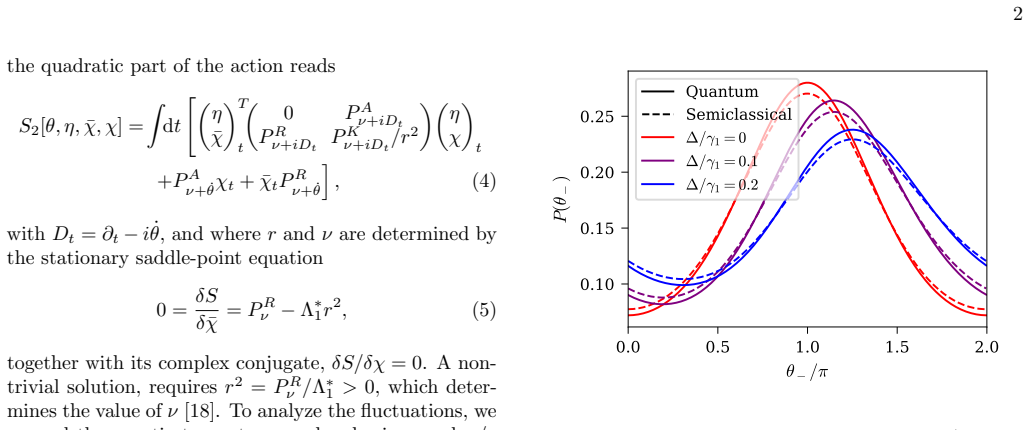
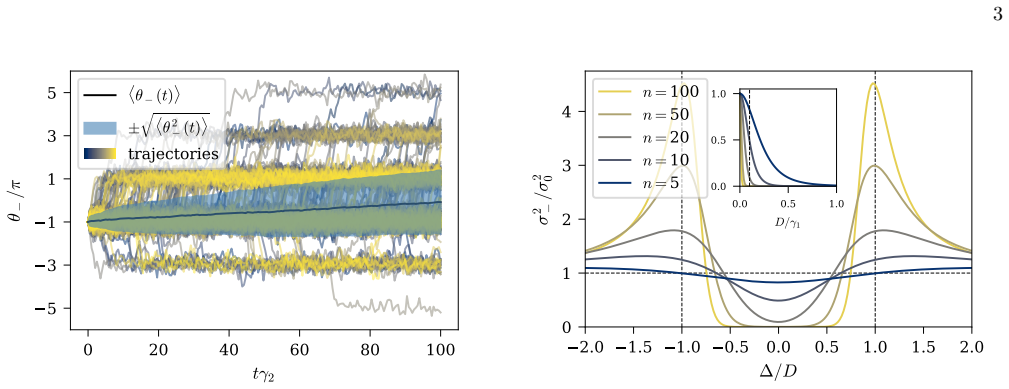
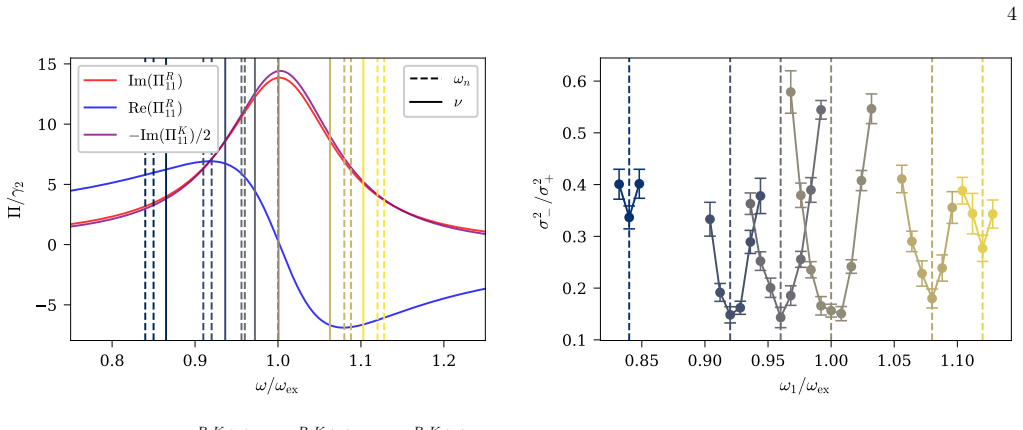
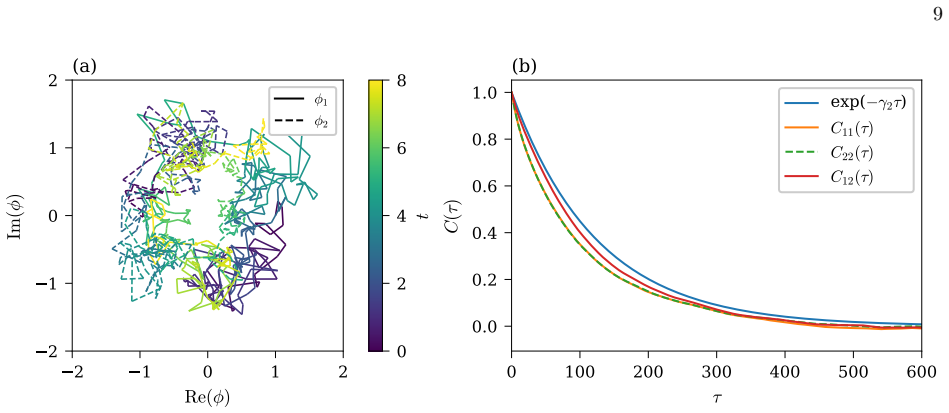
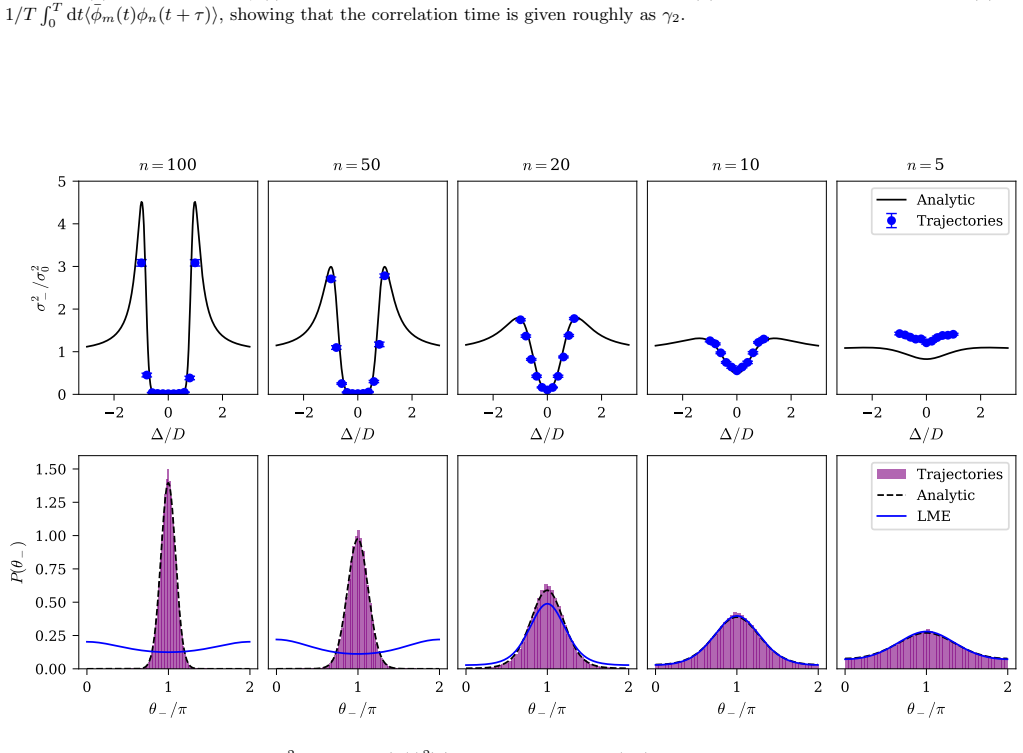
We show here how the synchronization of continuous variable quantum systems breaks down by proliferation of quantum phase slips. Within a Keldysh path integral formulation of limit cycles, we analyze the phase dynamics and show how, in spite of strong phase correlations, quantum phase slips degrade the actual phase locking. This approach also allows us to address non-Markovian effects on the synchronization of limit cycles, which we illustrate explicitly for superconducting resonators coupled via a voltage biased double quantum dot.
What carries the argument
Keldysh path integral formulation of limit cycles, which tracks phase dynamics to show degradation by quantum phase slips.
If this is right
- Quantum continuous-variable oscillators exhibit desynchronization even when phase correlations are strong.
- Non-Markovian environments modify the synchronization properties of quantum limit cycles.
- The same phase-slip mechanism applies to concrete systems such as voltage-biased double quantum dot coupled resonators.
Where Pith is reading between the lines
- The result suggests that additional suppression mechanisms may be needed for stable quantum synchronization in networks of oscillators.
- The path-integral treatment could be extended to study how quantum phase slips interact with other forms of quantum noise.
- Similar desynchronization may appear in other continuous-variable platforms once the same formulation is applied.
Load-bearing premise
The Keldysh path integral formulation of limit cycles accurately captures the phase dynamics and the mechanism by which quantum phase slips proliferate to degrade synchronization.
What would settle it
An experiment on coupled quantum oscillators such as superconducting resonators that measures phase locking and finds no degradation from quantum phase slips would falsify the claim.
Figures
read the original abstract
It is well known from classical physics that weakly coupled self-sustained oscillators may spontaneously lock their phases. Just like classical synchronization is known to break down due to noise induced phase slips, we show here how the synchronization of continuous variable quantum systems breaks down by proliferation of quantum phase slips. Within a Keldysh path integral formulation of limit cycles, we analyze the phase dynamics and show how, in spite of strong phase correlations, quantum phase slips degrade the actual phase locking. This approach also allows us to address non-Markovian effects on the synchronization of limit cycles, which we illustrate explicitly for superconducting resonators coupled via a voltage biased double quantum dot.
Editorial analysis
A structured set of objections, weighed in public.
Referee Report
Summary. The paper claims that synchronization of continuous-variable quantum limit-cycle oscillators breaks down through proliferation of quantum phase slips, analyzed via a Keldysh path-integral formulation of the phase dynamics; strong phase correlations persist but actual locking is degraded. The framework is used to treat non-Markovian effects, illustrated by voltage-biased double-quantum-dot coupling of superconducting resonators.
Significance. If the central derivation holds, the work supplies a concrete quantum mechanism for desynchronization that parallels classical noise-induced slips while remaining within the Keldysh formalism; the explicit non-Markovian example is a practical strength for modeling realistic open quantum systems.
minor comments (2)
- [Abstract] Abstract: the phrase 'in spite of strong phase correlations' would benefit from a one-sentence clarification of how the correlation function is defined and computed within the path integral.
- The non-Markovian illustration is presented as an application; a short statement on the regime of validity of the double-quantum-dot coupler model would improve clarity.
Simulated Author's Rebuttal
We thank the referee for their positive summary, significance assessment, and recommendation of minor revision. No specific major comments were raised in the report.
Circularity Check
No significant circularity detected
full rationale
The paper applies the established Keldysh path-integral formalism to model quantum limit cycles and analyze phase dynamics via quantum phase slips. This is presented as a direct application of a standard technique rather than a self-derived result. No steps reduce by construction to fitted inputs, self-definitions, or load-bearing self-citations; the non-Markovian double-quantum-dot example is explicitly an illustration. The derivation chain remains self-contained against external benchmarks of the Keldysh method.
Axiom & Free-Parameter Ledger
axioms (2)
- standard math Weakly coupled self-sustained oscillators may spontaneously lock their phases (classical synchronization).
- domain assumption Keldysh path integral formulation is appropriate for analyzing phase dynamics of quantum limit cycles.
Forward citations
Cited by 1 Pith paper
-
Synchronization in the quantum regime
The paper reviews advances in quantum synchronization, covering characterization of synchronous oscillations, nonclassical forms of synchrony, and many-body synchronization on quantum networks.
Reference graph
Works this paper leans on
-
[1]
Pikovsky, M
A. Pikovsky, M. Rosenblum, and J. Kurths,Synchroniza- tion: A Universal Concept in Nonlinear Sciences(Cam- bridge University Press, Cambridge, England, UK, 2001)
2001
-
[2]
Lefranc, Entraining oscillations in the nf-κb signaling system: With a little help from noise, Cell Systems3, 507 (2016)
M. Lefranc, Entraining oscillations in the nf-κb signaling system: With a little help from noise, Cell Systems3, 507 (2016)
2016
-
[3]
A. T. Winfree, Biological rhythms and the behavior of populations of coupled oscillators, Journal of Theoretical Biology16, 15 (1967)
1967
-
[4]
Tabareau, J.-J
N. Tabareau, J.-J. Slotine, and Q.-C. Pham, How Syn- chronization Protects from Noise, PLoS Comput. Biol.6, e1000637 (2010)
2010
-
[5]
Stratonovich, Oscillator synchronization in the pres- ence of noise, inNon-Linear Transformations of Stochas- tic Processes, edited by P
R. Stratonovich, Oscillator synchronization in the pres- ence of noise, inNon-Linear Transformations of Stochas- tic Processes, edited by P. Kuznetsov, R. Stratonovich, and V. Tikhonov (Pergamon, 1965) pp. 269–282
1965
-
[6]
J. A. Freund, L. Schimansky-Geier, and P. H¨ anggi, Fre- quency and phase synchronization in stochastic systems, Chaos: An Interdisciplinary Journal of Nonlinear Science 13, 225 (2003)
2003
-
[7]
A. Mari, A. Farace, N. Didier, V. Giovannetti, and R. Fazio, Measures of quantum synchronization in con- tinuous variable systems, Phys. Rev. Lett.111, 103605 (2013)
2013
-
[8]
Walter, A
S. Walter, A. Nunnenkamp, and C. Bruder, Quantum Synchronization of a Driven Self-Sustained Oscillator, Physical Review Letters112, 094102 (2014)
2014
-
[9]
Walter, A
S. Walter, A. Nunnenkamp, and C. Bruder, Quantum synchronization of two Van der Pol oscillators, Annalen der Physik527, 131 (2015)
2015
- [10]
-
[11]
Nadolny and C
T. Nadolny and C. Bruder, Quantum limit cycles and synchronization from a measurement perspective, Phys. Rev. Res.8, 023050 (2026)
2026
-
[12]
Hassler, D
F. Hassler, D. Scheer, S. Saquaque, and S. Kim, Quantum synchronization of fock states (2025)
2025
-
[13]
29 and reserve that term to the more general equation which has noU(1)-symmetry and exhibits two characteristic time scales characteristic of a relaxation oscillator
This equation is often referred to as the quantum van der Pol equation, but we choose here to follow Ref. 29 and reserve that term to the more general equation which has noU(1)-symmetry and exhibits two characteristic time scales characteristic of a relaxation oscillator
-
[14]
T. E. Lee and H. R. Sadeghpour, Quantum Synchroniza- tion of Quantum van der Pol Oscillators with Trapped Ions, Physical Review Letters111, 234101 (2013)
2013
-
[15]
Kamenev,Field Theory of Non-Equilibrium Systems (Cambridge University Press, Cambridge, UK, 2023)
A. Kamenev,Field Theory of Non-Equilibrium Systems (Cambridge University Press, Cambridge, UK, 2023)
2023
-
[16]
Cottet, Z
A. Cottet, Z. Leghtas, and T. Kontos, Theory of inter- actions between cavity photons induced by a mesoscopic circuit, Physical Review B102, 155105 (2020)
2020
-
[17]
Hermansen and J
C. Hermansen and J. Paaske, Synchronizing microwave circuit quantum electrodynamics limit cycle oscillators, Physical Review B113, 075434 (2026)
2026
-
[18]
L. M. Sieberer, M. Buchhold, and S. Diehl, Keldysh field theory for driven open quantum systems, Reports on Progress in Physics79, 096001 (2016)
2016
-
[19]
Dutta, S
S. Dutta, S. Zhang, and M. Haque, Quantum Origin of Limit Cycles, Fixed Points, and Critical Slowing Down, Physical Review Letters134, 050407 (2025)
2025
-
[20]
Polkovnikov, Phase space representation of quantum dynamics, Annals of Physics325, 1790 (2010)
A. Polkovnikov, Phase space representation of quantum dynamics, Annals of Physics325, 1790 (2010)
2010
-
[21]
Y. Kato, N. Yamamoto, and H. Nakao, Semiclassical phase reduction theory for quantum synchronization, Physical Review Research1, 033012 (2019)
2019
-
[22]
Reimann, C
P. Reimann, C. Van Den Broeck, H. Linke, P. H¨ anggi, J. M. Rubi, and A. P´ erez-Madrid, Diffusion in tilted peri- odic potentials: Enhancement, universality, and scaling, Physical Review E65, 031104 (2002)
2002
-
[23]
Sonar, M
S. Sonar, M. Hajduˇ sek, M. Mukherjee, R. Fazio, V. Ve- dral, S. Vinjanampathy, and L.-C. Kwek, Squeezing En- hances Quantum Synchronization, Physical Review Let- ters120, 163601 (2018)
2018
-
[24]
Mok, L.-C
W.-K. Mok, L.-C. Kwek, and H. Heimonen, Synchro- nization boost with single-photon dissipation in the deep quantum regime, Phys. Rev. Res.2, 033422 (2020)
2020
-
[25]
M. A. Zaks, E.-H. Park, M. G. Rosenblum, and J. Kurths, Alternating Locking Ratios in Imperfect Phase Synchro- nization, Phys. Rev. Lett.82, 4228 (1999)
1999
-
[26]
Boccaletti, J
S. Boccaletti, J. Kurths, G. Osipov, D. L. Valladares, and C. S. Zhou, The synchronization of chaotic systems, Phys. Rep.366, 1 (2002)
2002
-
[27]
Y.-Y. Liu, J. Stehlik, C. Eichler, M. J. Gullans, J. M. Taylor, and J. R. Petta, Semiconductor double quantum dot micromaser, Science347, 285 (2015)
2015
-
[28]
17, we choose the DQD parameters ast=ε=ω ex/ √ 8 and Γ = 0.05ω ex, while the electron- photon coupling is set to (g/ω ex)2 = 0.02 and the bias voltage ateV= 10ℏω ex
In the notation of Ref. 17, we choose the DQD parameters ast=ε=ω ex/ √ 8 and Γ = 0.05ω ex, while the electron- photon coupling is set to (g/ω ex)2 = 0.02 and the bias voltage ateV= 10ℏω ex
-
[29]
A. Chia, L. C. Kwek, and C. Noh, Relaxation oscilla- tions and frequency entrainment in quantum mechanics, Physical Review E102, 042213 (2020)
2020
-
[30]
Thompson and A
F. Thompson and A. Kamenev, Field theory of many- body Lindbladian dynamics, Annals of Physics455, 169385 (2023). 6 SUPPLEMENT AR Y INFORMA TION Details on the derivation of the Noisy Adler Equation In this section, we give the details on the derivation of Eq. (11) in the main text. First we describe the map from the Lindblad Master equation (LME) to a co...
2023
discussion (0)
Sign in with ORCID, Apple, or X to comment. Anyone can read and Pith papers without signing in.