Curvature conditions for generalized singularity theorems
Pith reviewed 2026-06-28 04:47 UTC · model grok-4.3
The pith
Curvature conditions for focal points fail to hold in general for higher-codimension trapped submanifolds.
A machine-rendered reading of the paper's core claim, the machinery that carries it, and where it could break.
Core claim
The curvature conditions introduced in Class. Quant. Grav. 27, 152002 to predict focal points for trapped spacelike submanifolds do not apply in general but may apply for specific compact trapped submanifolds of higher codimension. Consequently, while higher codimension CTMs may still serve as singularity predictors, the possibility that they intersect the domain of outer communications cannot be ruled out using standard arguments.
What carries the argument
The curvature conditions from Class. Quant. Grav. 27, 152002 that are intended to guarantee focal points along orthogonal geodesics for trapped submanifolds of any codimension.
If this is right
- Higher-codimension CTMs cannot be ruled out as singularity predictors solely on the basis of the general failure of the conditions.
- Particular choices of CTMs may still satisfy the curvature requirements and thus serve as predictors.
- Standard methods leave open the possibility that higher-codimension CTMs intersect the domain of outer communications.
- Generalizing Penrose's theorem to higher codimensions requires case-by-case verification or new conditions.
Where Pith is reading between the lines
- Alternative curvature conditions adapted specifically to higher codimensions could be developed to restore the predictive power.
- Concrete examples of spacetimes with higher-codimension trapped submanifolds should be checked to see when the conditions hold.
- The domain-of-outer-communications issue may require separate geometric arguments beyond the curvature conditions.
Load-bearing premise
The curvature conditions introduced in Class. Quant. Grav. 27, 152002 are the relevant ones whose applicability must be checked to determine whether focal points can be predicted for higher-codimension trapped submanifolds.
What would settle it
A spacetime containing a higher-codimension compact trapped submanifold that violates the curvature conditions but develops a singularity (or satisfies them without producing one) would settle whether the conditions are necessary for the prediction.
Figures
read the original abstract
We study the curvature conditions introduced in [Class. Quant. Grav. 27, 152002] to predict focal points for trapped spacelike submanifolds in spacetimes of arbitrary dimensions, with the purpose of generalizing Penrose's singularity theorem to compact trapped submanifolds (CTMs) of codimension higher than two. We find that these conditions do not apply in general but may apply for specific CTMs. As a result, higher codimension CTMs may still work as singularity predictors, although the possibility that they intersect the domain of outer communications cannot be ruled out using standard arguments.
Editorial analysis
A structured set of objections, weighed in public.
Referee Report
Summary. The manuscript examines the curvature conditions introduced in Class. Quant. Grav. 27, 152002 for predicting focal points along higher-codimension compact trapped submanifolds (CTMs) in spacetimes of arbitrary dimension. The central claim is that these conditions fail to hold for generic higher-codimension CTMs, although they remain viable for certain special cases; consequently, such CTMs may still function as singularity predictors, but standard arguments cannot exclude the possibility that they intersect the domain of outer communications.
Significance. If the applicability analysis holds, the result usefully delimits the scope of existing curvature hypotheses when extending Penrose-type theorems beyond codimension two. It supplies a negative result for the generic case while preserving the logical possibility of special CTMs, thereby clarifying where new curvature conditions or alternative focal-point arguments will be required in higher-dimensional singularity theory.
minor comments (1)
- The abstract states the main negative finding clearly, but the manuscript would benefit from a brief explicit example (even schematic) of a specific CTM for which the 2010 curvature conditions are satisfied.
Simulated Author's Rebuttal
We thank the referee for their positive assessment of the manuscript and for recommending acceptance. The report accurately captures the central claim that the curvature conditions from Class. Quant. Grav. 27, 152002 do not hold generically for higher-codimension compact trapped submanifolds, while remaining applicable in special cases. No major comments were provided, so no revisions are required.
Circularity Check
No significant circularity identified
full rationale
The manuscript recalls curvature conditions from the external 2010 reference Class. Quant. Grav. 27, 152002, applies them to higher-codimension compact trapped submanifolds, and reports that the conditions fail to hold generically while remaining viable only for special cases. This produces a straightforward applicability check whose logical steps (recall external hypotheses, test on new geometric setting, conclude limited scope) contain no self-definitional reductions, no fitted inputs renamed as predictions, and no load-bearing self-citations. The central claim is therefore independent of the paper's own inputs and rests on an externally supplied benchmark.
Axiom & Free-Parameter Ledger
Forward citations
Cited by 1 Pith paper
-
Convex foliations and trapped submanifolds
Tests in symmetrically collapsing spacetimes and the full sub-extreme Kerr-Newman family support the conjecture that compact trapped submanifolds of codimension >1 stay inside black holes and do not reach the domain o...
Reference graph
Works this paper leans on
-
[1]
Schwarzschild-Tangherlini BH 14
-
[2]
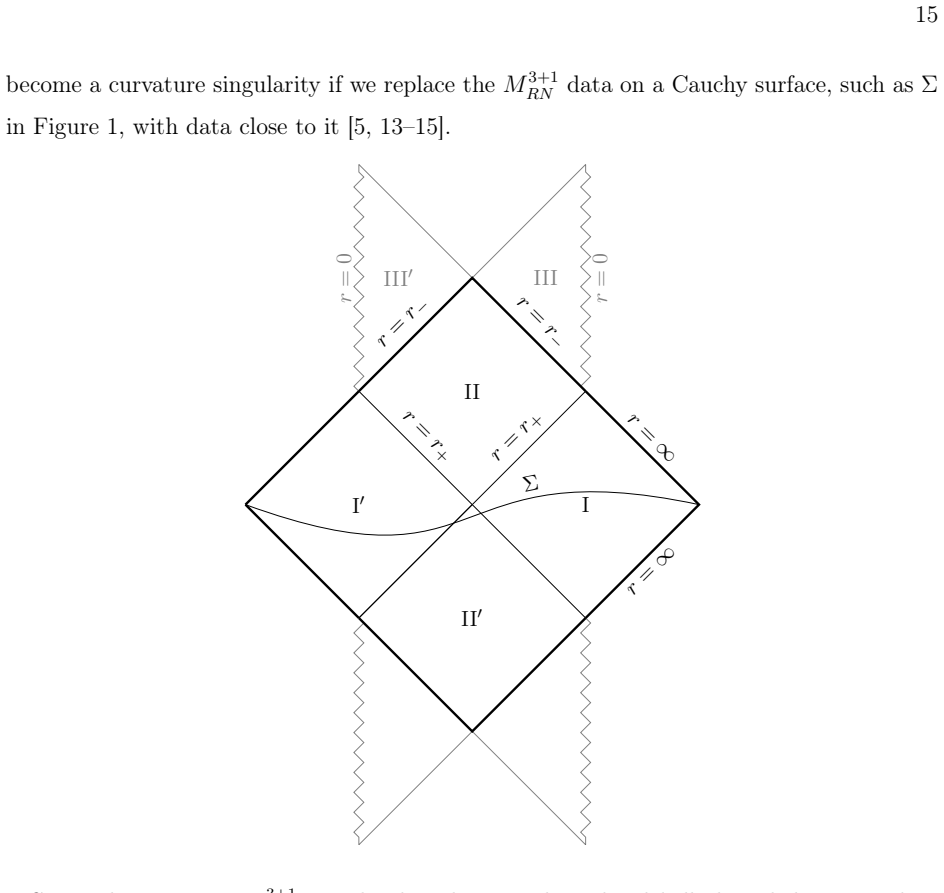
Reissner-Nördstrom BH 14 IV. Conclusions 16 References 17 ∗ gustavo.dotti@unc.edu.ar arXiv:2606.05453v1 [gr-qc] 3 Jun 2026 2 I. INTRODUCTION Energy conditions in3 + 1General Relativity are largely motivated as hypothesis of singularity theorems and obstruction theorems for compact trapped surfaces (CTSs) inter- secting the domain of outer communications (...
Pith/arXiv arXiv 2026
-
[3]
In this case it is trivial to see that (36) is fulfilledat every point of the spacetime, in particular, along the future null normal geodesics of our trappedk−spheres
Schwarzschild-Tangherlini BH Insertingβ(v, r) = 0andµ(v, r) =µ >0in (31) gives the generalization of the Schwarzschild BH to arbitrary dimensions [8]. In this case it is trivial to see that (36) is fulfilledat every point of the spacetime, in particular, along the future null normal geodesics of our trappedk−spheres. As mentioned above, by Proposition 7, ...
-
[4]
As there is no dependence inr, the only negative contribution in (36) vanishes, so the curvature condition is satisfied
Vaidya Spacetime The Vaidya spacetime of incoming radiation is trivially extended to arbitrary dimensions by replacingβ(v, r) = 0andµ(v, r) =µ(v)>0(withdµ/dv≥0) in (31). As there is no dependence inr, the only negative contribution in (36) vanishes, so the curvature condition is satisfied. The conclusion is same as in the previous example
-
[5]
For the sake of simplicity we will fixd= 4, then the metric is (31) with β(v, r) = 0andf(v, r) = 1− 2m r + q2 r2
Reissner-Nördstrom BH A more intriguing case is the spherically symmetric charged sub-extreme black hole, whose metric depends on two parameters: the massm >0and the electric chargeq̸= 0, subject tom≥ |q|. For the sake of simplicity we will fixd= 4, then the metric is (31) with β(v, r) = 0andf(v, r) = 1− 2m r + q2 r2. The zeroes offare the Cauchy (r−) and...
-
[6]
Twilight for the energy conditions?
C. Barcelo and M. Visser,Twilight for the energy conditions?, Int. J. Mod. Phys. D11, 1553- 1560 (2002) doi:10.1142/S0218271802002888 [arXiv:gr-qc/0205066 [gr-qc]]
work page internal anchor Pith review Pith/arXiv arXiv doi:10.1142/s0218271802002888 2002
-
[7]
The region with trapped surfaces in spherical symmetry, its core, and their boundaries
I. Bengtsson y J. M. M. Senovilla,The Region with trapped surfaces in spherical symmetry, its core, and their boundaries, Phys. Rev. D83(2011), doi: 10.1103/PhysRevD.83.044012. [arXiv: 1009.0225 [gr-qc]]
work page internal anchor Pith review Pith/arXiv arXiv doi:10.1103/physrevd.83.044012 2011
-
[8]
Singularity theorems for warped products and the stability of spatial extra dimensions
N. Cipriani and J. M. M. Senovilla,Singularity theorems for warped products and the stability of spatial extra dimensions, JHEP04, 175 (2019) doi:10.1007/JHEP04(2019)175 [arXiv:1901.07271 [gr-qc]]
work page internal anchor Pith review Pith/arXiv arXiv doi:10.1007/jhep04(2019)175 2019
-
[9]
Curiel,A Primer on Energy Conditions, Einstein Stud.13(2017) doi: 10.1007/978-1-4939- 3210-8-3
E. Curiel,A Primer on Energy Conditions, Einstein Stud.13(2017) doi: 10.1007/978-1-4939- 3210-8-3. [arXiv: 1405.0403 [physics.hist-ph]]
-
[10]
M. Dafermos,Stability and instability of the Reissner-Nordstrom Cauchy horizon and the problem of uniqueness in general relativity, Contemp. Math.350, 99-113 (2004) [arXiv:gr- qc/0209052 [gr-qc]]
arXiv 2004
-
[12]
Dotti,Obstructions for trapped submanifolds, Class
G. Dotti,Obstructions for trapped submanifolds, Class. Quant. Grav.42, no.16, 165002 (2025) doi:10.1088/1361-6382/adf2f1 [arXiv:2504.01207 [gr-qc]]
-
[13]
Black Holes in Higher Dimensions
R. Emparan and H. S. Reall,Black Holes in Higher Dimension, Living Rev. Rel.11(2008), doi:10.12942/lrr-2008-6 [arXiv:0801.3471 [hep-th]]
work page internal anchor Pith review Pith/arXiv arXiv doi:10.12942/lrr-2008-6 2008
-
[14]
G. J. Galloway and J. M. M. Senovilla,Singularity theorems based on trapped submani- folds of arbitrary co-dimension, Class. Quant. Grav.27, 152002 (2010) doi:10.1088/0264- 18 9381/27/15/152002 [arXiv:1005.1249 [gr-qc]]
work page internal anchor Pith review Pith/arXiv arXiv doi:10.1088/0264- 2010
-
[15]
S. W. Hawking and G. F. R. Ellis,The Large Scale Structure Of Space-time, Cambridge Univ. Press, 1973, isbn: 0-521-09906-4
1973
-
[16]
Minguzzi,A gravitational collapse singularity theorem consistent with black hole evaporation, Lett
E. Minguzzi,A gravitational collapse singularity theorem consistent with black hole evaporation, Lett. Math. Phys.110, (2020) 2383–2396. doi: 10.1007/s11005-020-01295-9
-
[17]
O’Niell,Semi-Riemannian Geometry, Academic Press, 1983, isbn: 0-12-526740-1
B. O’Niell,Semi-Riemannian Geometry, Academic Press, 1983, isbn: 0-12-526740-1
1983
-
[18]
E. Poisson and W. Israel,Inner-horizon instability and mass inflation in black holes,Phys. Rev. Lett.63, 1663-1666 (1989) doi:10.1103/PhysRevLett.63.1663
-
[19]
M. Simpson and R. Penrose,Internal instability in a Reissner-Nordström black hole, Int. J. Theor. Phys.7(1973), 183–197, doi:10.1007/BF00792069
-
[20]
R. M. Wald,General Relativity, Chicago Univ. Pr., 1984, isbn: 0-226-87033-2
1984
discussion (0)
Sign in with ORCID, Apple, or X to comment. Anyone can read and Pith papers without signing in.