Finite N Black Holes through the Brick Wall
Pith reviewed 2026-06-27 23:51 UTC · model grok-4.3
The pith
Finite N in AdS/CFT prevents black holes from acting as ideal continuum absorbers, producing residual reflections or echoes not suppressed by entropy.
A machine-rendered reading of the paper's core claim, the machinery that carries it, and where it could break.
Core claim
Finite N prevents the near-horizon sector from being an ideal continuum absorber. The brick-wall model is a simple effective representation of this limitation, where the failure of perfect absorption appears as residual reflection or echoes. Such return effects will not be suppressed as e^{-S_BH}, although their detailed amplitude is model-dependent. A Dirichlet wall is reflecting, but once the regulated near-wall modes are replaced by interacting stretched-horizon degrees of freedom, the exterior simple sector can look absorptive and black-hole-like. If these degrees of freedom are thermally populated while the exterior incoming modes are in their vacuum, they radiate as an ordinary hot obj
What carries the argument
The brick-wall model, in which a Dirichlet wall is modified by replacing regulated near-wall modes with interacting stretched-horizon degrees of freedom that can be thermally populated independently of the exterior vacuum.
If this is right
- Hawking radiation arises when the stretched-horizon degrees of freedom are thermally populated while exterior modes remain in vacuum.
- Imperfect absorption at finite N produces residual reflection or echoes whose amplitude is not suppressed exponentially by black hole entropy.
- The same effective description applies when the inner boundary arises dynamically from a regular matter core instead of an imposed wall.
- The near-horizon region cannot function as a perfect continuum absorber once N is finite.
Where Pith is reading between the lines
- Echo signals in gravitational-wave data from black hole mergers could appear at amplitudes set by the details of the stretched-horizon dynamics rather than by e^{-S_BH}.
- The construction suggests that information carried by infalling matter may reappear in the exterior through the same non-ideal absorption channel that produces the echoes.
- Similar brick-wall cutoffs could be applied to other finite-N systems where semiclassical EFT assumes a perfect continuum, such as de Sitter horizons.
Load-bearing premise
Replacing the regulated near-wall modes by interacting stretched-horizon degrees of freedom is sufficient to make the exterior sector look absorptive and black-hole-like while allowing those degrees of freedom to be thermally populated independently of the exterior vacuum.
What would settle it
A explicit calculation of the reflection coefficient for a finite-N system that shows perfect absorption (vanishing reflection) to exponential accuracy in the entropy would falsify the claim that return effects are not suppressed as e^{-S_BH}.
Figures
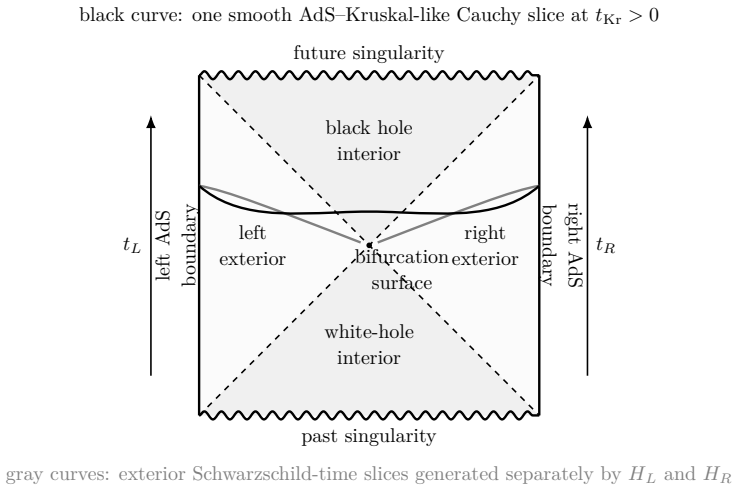
read the original abstract
In AdS/CFT at finite N, black holes are described by ordinary quantum systems with finite entropy and discrete spectra, while semiclassical bulk effective field theory treats the near-horizon region as an ideal continuum. We reconsider the brick-wall model as a simple effective description of the finite N departure from the semiclassical near-horizon continuum in AdS/CFT. A Dirichlet wall is reflecting; however, once the regulated near-wall modes are replaced by interacting stretched-horizon degrees of freedom, the exterior simple sector can look absorptive and black-hole-like. If these degrees of freedom are thermally populated while the exterior incoming modes are in their vacuum, they radiate as an ordinary hot object, and this gives Hawking radiation. Furthermore, we show that finite N prevents the near-horizon sector from being an ideal continuum absorber; the brick-wall model is a simple effective representation of this limitation, where the failure of perfect absorption appears as residual reflection or echoes. Such return effects will not be suppressed as $e^{-S_{\rm BH}}$, although their detailed amplitude is model-dependent. We also discuss brick-wall-like models in which the effective inner boundary arises dynamically from a regular matter core rather than from an imposed boundary condition.
Editorial analysis
A structured set of objections, weighed in public.
Referee Report
Summary. The manuscript reconsiders the brick-wall model as a simple effective description of finite-N departures from the semiclassical near-horizon continuum in AdS/CFT. It argues that a Dirichlet wall is reflecting, but replacing the regulated near-wall modes by interacting stretched-horizon degrees of freedom allows the exterior sector to appear absorptive and black-hole-like; thermal population of these degrees of freedom (while exterior modes remain in vacuum) then produces Hawking radiation. The paper further claims that finite N prevents ideal continuum absorption, so that residual reflections or echoes appear and are not suppressed by e^{-S_BH} (though their amplitude is model-dependent). It also discusses models in which the inner boundary arises dynamically from a regular matter core.
Significance. If the central interpretive replacement can be made rigorous, the work supplies a concrete effective model connecting finite-N discreteness to non-exponentially-suppressed echoes and to dynamical inner boundaries. This could bridge quantum-system descriptions of black holes with semiclassical bulk physics. No machine-checked proofs, reproducible code, or quantitative benchmarks are supplied; the argument remains qualitative.
major comments (2)
- [Abstract] Abstract (paragraph beginning 'A Dirichlet wall is reflecting'): The statement that the exterior sector 'can look absorptive and black-hole-like' after the replacement by interacting stretched-horizon degrees of freedom is asserted without an explicit interaction Hamiltonian, scattering calculation, or mode-matching that simultaneously demonstrates absorption for exterior modes and independent thermal population of the new degrees of freedom.
- [Abstract] Abstract (sentence beginning 'Furthermore, we show that finite N prevents'): The claim that return effects 'will not be suppressed as e^{-S_BH}' is presented as following from the construction, yet no controlled estimate or bound on the reflection coefficient is given; the quantitative non-suppression therefore rests on the same unverified replacement.
minor comments (1)
- [Abstract] The phrase 'stretched-horizon degrees of freedom' is introduced in the abstract without a precise definition or pointer to the section where the replacement is formalized.
Simulated Author's Rebuttal
We thank the referee for their careful reading and constructive comments. The manuscript offers a conceptual reinterpretation of the brick-wall model as an effective description of finite-N effects in AdS/CFT, remaining at a qualitative level throughout. We respond point by point to the major comments.
read point-by-point responses
-
Referee: [Abstract] Abstract (paragraph beginning 'A Dirichlet wall is reflecting'): The statement that the exterior sector 'can look absorptive and black-hole-like' after the replacement by interacting stretched-horizon degrees of freedom is asserted without an explicit interaction Hamiltonian, scattering calculation, or mode-matching that simultaneously demonstrates absorption for exterior modes and independent thermal population of the new degrees of freedom.
Authors: We agree that no explicit interaction Hamiltonian, scattering calculation, or mode-matching is provided. The replacement is introduced as a conceptual effective description to capture how interactions among a finite number of stretched-horizon degrees of freedom can produce absorptive behavior for exterior modes while permitting thermal radiation, in contrast to the purely reflecting Dirichlet wall. This is presented by analogy with effective models (e.g., the membrane paradigm) rather than as a microscopic derivation. The manuscript does not claim to demonstrate the replacement rigorously. We will revise the abstract and main text to state more explicitly that the argument is interpretive and qualitative. revision: partial
-
Referee: [Abstract] Abstract (sentence beginning 'Furthermore, we show that finite N prevents'): The claim that return effects 'will not be suppressed as e^{-S_BH}' is presented as following from the construction, yet no controlled estimate or bound on the reflection coefficient is given; the quantitative non-suppression therefore rests on the same unverified replacement.
Authors: The non-suppression statement follows from the observation that finite N implies a finite (though large) number of near-horizon states, so that the effective inner sector cannot act as a perfect continuum absorber; residual reflections therefore appear at an amplitude set by the specific inner model but not parametrically suppressed by e^{-S_BH}. The brick-wall cutoff is used to represent this finite-state limitation. We acknowledge that no explicit bound or controlled estimate of the reflection coefficient is derived, consistent with the qualitative nature of the work. We will add a clarifying sentence noting that the amplitude remains model-dependent and that the paper does not supply a quantitative calculation. revision: partial
Circularity Check
No significant circularity; effective model proposal remains self-contained.
full rationale
The paper presents the brick-wall construction as an effective description chosen to capture finite-N departures from continuum behavior in AdS/CFT. No derivation chain reduces a claimed prediction or first-principles result back to its own inputs by construction, nor does any load-bearing step rely on a self-citation whose content is itself unverified. The identification of the model with finite-N effects is an explicit modeling assumption rather than a tautological redefinition, and the text supplies no equations or fitted quantities whose output is forced to match the input. The argument is therefore independent of the patterns that would raise the circularity score.
Axiom & Free-Parameter Ledger
axioms (2)
- domain assumption AdS/CFT correspondence holds at finite N with black holes described by ordinary quantum systems having discrete spectra
- ad hoc to paper Interacting stretched-horizon degrees of freedom can be thermally populated while exterior incoming modes remain in vacuum
invented entities (1)
-
stretched-horizon degrees of freedom
no independent evidence
Forward citations
Cited by 1 Pith paper
-
Near-horizon modifications in finite $N$ holography
Explicit reconstructions in modified near-horizon AdS2 and BTZ geometries recover prior non-locality estimates controlled by a throat parameter and exhibit dip-ramp-plateau spectral form factors in 3D.
Reference graph
Works this paper leans on
-
[1]
The Large N limit of superconformal field theories and supergravity,
J. M. Maldacena, “The Large N limit of superconformal field theories and supergravity,”Adv. Theor. Math. Phys.2(1998) 231–252,arXiv:hep-th/9711200. 35
Pith/arXiv arXiv 1998
-
[2]
Gauge theory correlators from noncritical string theory,
S. S. Gubser, I. R. Klebanov, and A. M. Polyakov, “Gauge theory correlators from noncritical string theory,”Phys. Lett. B428(1998) 105–114, arXiv:hep-th/9802109
Pith/arXiv arXiv 1998
-
[3]
Anti-de Sitter space and holography,
E. Witten, “Anti-de Sitter space and holography,”Adv. Theor. Math. Phys.2(1998) 253–291,arXiv:hep-th/9802150
Pith/arXiv arXiv 1998
-
[4]
Eternal black holes in anti-de Sitter,
J. M. Maldacena, “Eternal black holes in anti-de Sitter,”JHEP04(2003) 021, arXiv:hep-th/0106112
Pith/arXiv arXiv 2003
-
[5]
Very long time scales and black hole thermal equilibrium,
J. L. F. Barbon and E. Rabinovici, “Very long time scales and black hole thermal equilibrium,”JHEP11(2003) 047,arXiv:hep-th/0308063
Pith/arXiv arXiv 2003
-
[6]
Poincare recurrences and topological diversity,
M. Kleban, M. Porrati, and R. Rabadan, “Poincare recurrences and topological diversity,”JHEP10(2004) 030,arXiv:hep-th/0407192
Pith/arXiv arXiv 2004
-
[7]
The Arrow of time, black holes, and quantum mixing of large N Yang-Mills theories,
G. Festuccia and H. Liu, “The Arrow of time, black holes, and quantum mixing of large N Yang-Mills theories,”JHEP12(2007) 027,arXiv:hep-th/0611098
Pith/arXiv arXiv 2007
-
[8]
Finite N and the failure of bulk locality: Black holes in AdS/CFT,
D. Kabat and G. Lifschytz, “Finite N and the failure of bulk locality: Black holes in AdS/CFT,”JHEP09(2014) 077,arXiv:1405.6394 [hep-th]
Pith/arXiv arXiv 2014
-
[9]
On the Quantum Structure of a Black Hole,
G. ’t Hooft, “On the Quantum Structure of a Black Hole,”Nucl. Phys. B256(1985) 727–745
1985
-
[10]
Black holes and entropy,
J. D. Bekenstein, “Black holes and entropy,”Phys. Rev. D7(1973) 2333–2346
1973
-
[11]
Particle Creation by Black Holes,
S. W. Hawking, “Particle Creation by Black Holes,”Commun. Math. Phys.43(1975) 199–220. [Erratum: Commun.Math.Phys. 46, 206 (1976)]
1975
-
[12]
The Stretched horizon and black hole complementarity,
L. Susskind, L. Thorlacius, and J. Uglum, “The Stretched horizon and black hole complementarity,”Phys. Rev. D48(1993) 3743–3761,arXiv:hep-th/9306069
Pith/arXiv arXiv 1993
-
[13]
Black hole entropy in canonical quantum gravity and superstring theory,
L. Susskind and J. Uglum, “Black hole entropy in canonical quantum gravity and superstring theory,”Phys. Rev. D50(1994) 2700–2711,arXiv:hep-th/9401070
Pith/arXiv arXiv 1994
-
[14]
Black hole entropy without brick walls,
J.-G. Demers, R. Lafrance, and R. C. Myers, “Black hole entropy without brick walls,”Phys. Rev. D52(1995) 2245–2253,arXiv:gr-qc/9503003
Pith/arXiv arXiv 1995
-
[15]
Brick wall and quantum statistical entropy of black hole,
S. N. Solodukhin, “Brick wall and quantum statistical entropy of black hole,” hep-th/9607166
-
[16]
Black holes, brick walls, and the Boulware state,
S. Mukohyama and W. Israel, “Black holes, brick walls, and the Boulware state,” Phys. Rev. D58(1998) 104005,arXiv:gr-qc/9806012 [gr-qc]. 36
Pith/arXiv arXiv 1998
-
[17]
Normal modes of the stretched horizon: a bulk mechanism for black hole microstate level spacing,
C. Krishnan and P. S. Pathak, “Normal modes of the stretched horizon: a bulk mechanism for black hole microstate level spacing,”JHEP03(2024) 162, arXiv:2312.14109 [hep-th]
arXiv 2024
-
[18]
A smooth horizon without a smooth horizon,
V. Burman, S. Das, and C. Krishnan, “A smooth horizon without a smooth horizon,” JHEP2024(2024) 014,arXiv:2312.14108 [hep-th]
arXiv 2024
-
[19]
Brickwall one-loop determinant: spectral statistics & Krylov complexity,
H.-S. Jeong, A. Kundu, and J. F. Pedraza, “Brickwall one-loop determinant: spectral statistics & Krylov complexity,”JHEP05(2025) 154,arXiv:2412.12301 [hep-th]
arXiv 2025
-
[20]
Brickwall model for hyperbolic black holes and chaos,
H.-S. Jeong, K.-Y. Kim, G. Yun, and H. Yu, “Brickwall model for hyperbolic black holes and chaos,”arXiv:2510.00886 [hep-th]
-
[21]
Cosmological brick walls & quantum chaotic dynamics of de Sitter horizons,
J. M. Begines, S. Das, H.-S. Jeong, and J. F. Pedraza, “Cosmological brick walls & quantum chaotic dynamics of de Sitter horizons,”arXiv:2603.29443 [hep-th]
-
[22]
Brick Walls for Black Holes in AdS/CFT,
N. Iizuka and S. Terashima, “Brick Walls for Black Holes in AdS/CFT,”Nucl. Phys. B895(2015) 1–32,arXiv:1307.5933 [hep-th]
Pith/arXiv arXiv 2015
-
[23]
Simple bulk reconstruction in anti-de Sitter/conformal field theory correspondence,
S. Terashima, “Simple bulk reconstruction in anti-de Sitter/conformal field theory correspondence,”PTEP2023no. 5, (2023) 053B02,arXiv:2104.11743 [hep-th]
arXiv 2023
-
[24]
Subregion Complementarity in AdS/CFT,
S. Sugishita and S. Terashima, “Subregion Complementarity in AdS/CFT,” arXiv:2309.04231 [hep-th]
-
[25]
Stretched horizon dissipation and the fate of echoes,
S. Terashima, “Stretched horizon dissipation and the fate of echoes,”JHEP10(2025) 147,arXiv:2506.20462 [hep-th]
arXiv 2025
-
[26]
Notes on black hole evaporation,
W. G. Unruh, “Notes on black hole evaporation,”Phys. Rev. D14(1976) 870
1976
-
[27]
Holography at Finite N: Breakdown of Bulk Reconstruction for Subregions,
S. Terashima, “Holography at Finite N: Breakdown of Bulk Reconstruction for Subregions,”arXiv:2508.11592 [hep-th]
-
[28]
Rindler bulk reconstruction and subregion duality in AdS/CFT,
S. Sugishita and S. Terashima, “Rindler bulk reconstruction and subregion duality in AdS/CFT,”JHEP11(2022) 041,arXiv:2207.06455 [hep-th]
arXiv 2022
-
[29]
Bulk reconstruction and gauge invariance,
S. Sugishita and S. Terashima, “Bulk reconstruction and gauge invariance,”Phys. Rev. D112no. 4, (2025) 046003,arXiv:2409.02534 [hep-th]
arXiv 2025
-
[30]
Bulk locality in the AdS/CFT correspondence,
S. Terashima, “Bulk locality in the AdS/CFT correspondence,”Phys. Rev. D104 no. 8, (2021) 086014,arXiv:2005.05962 [hep-th]
arXiv 2021
-
[31]
AdS/CFT Correspondence in Operator Formalism,
S. Terashima, “AdS/CFT Correspondence in Operator Formalism,”JHEP02(2018) 019,arXiv:1710.07298 [hep-th]
Pith/arXiv arXiv 2018
-
[32]
Rindler Physics with a UV Cutoff on the Lattice,
S. Chikazawa and S. Terashima, “Rindler Physics with a UV Cutoff on the Lattice,” arXiv:2604.07915 [hep-th]. 37
-
[33]
Gravitating monopole solutions,
P. Breitenlohner, P. Forgacs, and D. Maison, “Gravitating monopole solutions,”Nucl. Phys. B383(1992) 357–376
1992
-
[34]
Black Holes in Magnetic Monopoles,
K.-M. Lee, V. P. Nair, and E. J. Weinberg, “Black Holes in Magnetic Monopoles,” Phys. Rev. D45(1992) 2751–2761,arXiv:hep-th/9112008
Pith/arXiv arXiv 1992
-
[35]
Magnetic monopoles near the black hole threshold,
A. Lue and E. J. Weinberg, “Magnetic monopoles near the black hole threshold,” Phys. Rev. D60(1999) 084025,arXiv:hep-th/9905223
Pith/arXiv arXiv 1999
-
[36]
The Fuzzball proposal for black holes: An Elementary review,
S. D. Mathur, “The Fuzzball proposal for black holes: An Elementary review,” Fortsch.Phys.53(2005) 793–827,arXiv:hep-th/0502050
Pith/arXiv arXiv 2005
-
[37]
The Information paradox: A Pedagogical introduction,
S. D. Mathur, “The Information paradox: A Pedagogical introduction,”Class. Quant. Grav.26(2009) 224001,arXiv:0909.1038 [hep-th]
Pith/arXiv arXiv 2009
-
[38]
Y. Sekino and L. Susskind, “Fast Scramblers,”JHEP10(2008) 065, arXiv:0808.2096 [hep-th]
Pith/arXiv arXiv 2008
-
[39]
Emergent times in holographic duality,
S. Leutheusser and H. Liu, “Emergent times in holographic duality,” arXiv:2112.12156 [hep-th]
-
[40]
Is the gravitational-wave ringdown a probe of the event horizon?,
V. Cardoso, E. Franzin, and P. Pani, “Is the gravitational-wave ringdown a probe of the event horizon?,”Phys. Rev. Lett.116no. 17, (2016) 171101,arXiv:1602.07309 [gr-qc]. [Erratum: Phys.Rev.Lett. 117, 089902 (2016)]
Pith/arXiv arXiv 2016
-
[41]
Echoes from the Abyss: Tentative evidence for Planck-scale structure at black hole horizons,
J. Abedi, H. Dykaar, and N. Afshordi, “Echoes from the Abyss: Tentative evidence for Planck-scale structure at black hole horizons,”Phys. Rev. D96(2017) 082004, arXiv:1612.00266 [gr-qc]
Pith/arXiv arXiv 2017
-
[42]
Quantum Black Holes in the Sky,
J. Abedi, N. Afshordi, N. Oshita, and Q. Wang, “Quantum Black Holes in the Sky,” Universe6no. 3, (2020) 43,arXiv:2001.09553 [gr-qc]. 38
arXiv 2020
discussion (0)
Sign in with ORCID, Apple, or X to comment. Anyone can read and Pith papers without signing in.