The Proxy Benders Decomposition
Pith reviewed 2026-06-27 21:09 UTC · model grok-4.3
The pith
A projection-and-completion layer lets optimization proxies generate valid Benders cuts without exact subproblem solves.
A machine-rendered reading of the paper's core claim, the machinery that carries it, and where it could break.
Core claim
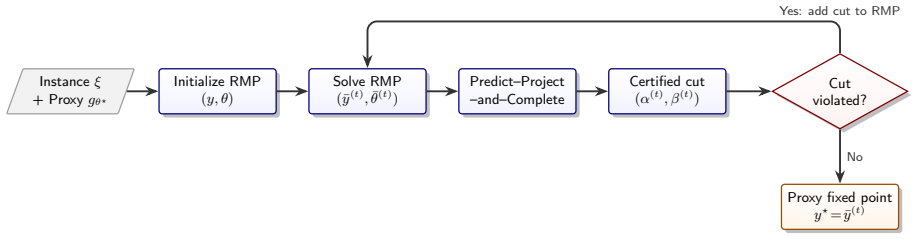
The Proxy Benders decomposition framework replaces subproblem optimization with certified optimization proxies that follow a predict-project-and-complete mechanism to produce dual-feasible solutions for generating provably valid Benders cuts, preserving the theoretical validity of the decomposition independently of prediction quality.
What carries the argument
The projection-and-completion certification layer that converts proxy predictions into dual-feasible solutions for provably valid Benders cuts.
Load-bearing premise
The projection-and-completion certification layer can always convert an arbitrary proxy prediction into a dual-feasible solution that produces a valid Benders cut, regardless of how poor the initial proxy output is.
What would settle it
An instance in which the projection-and-completion layer fails to produce any dual-feasible solution from the proxy output, so that no valid cut can be generated and the algorithm cannot proceed correctly.
Figures
read the original abstract
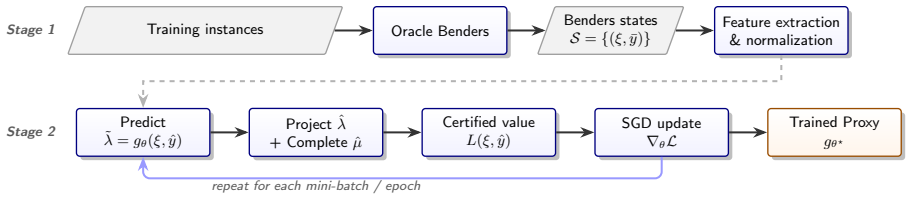
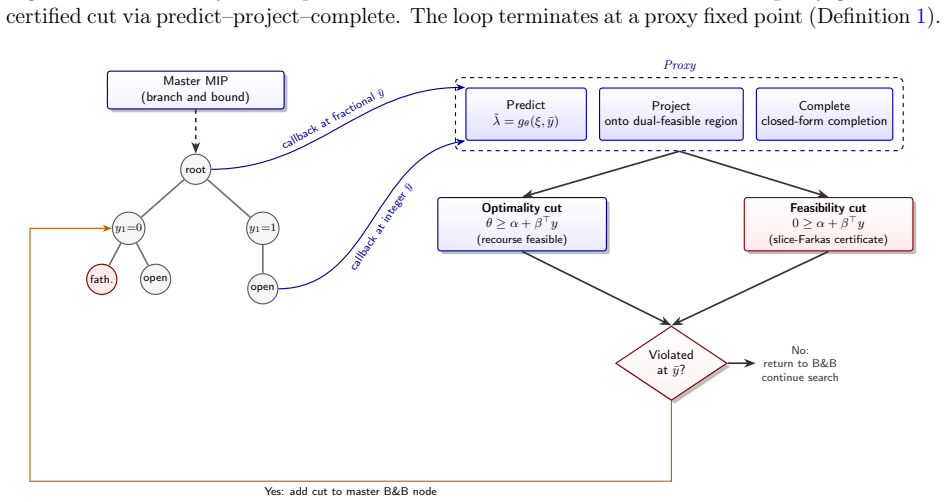
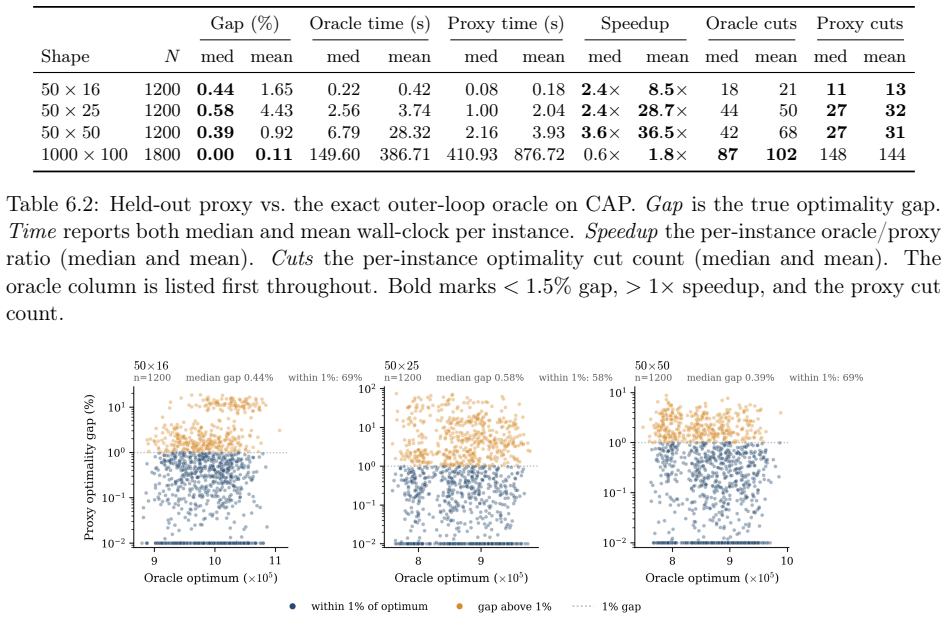
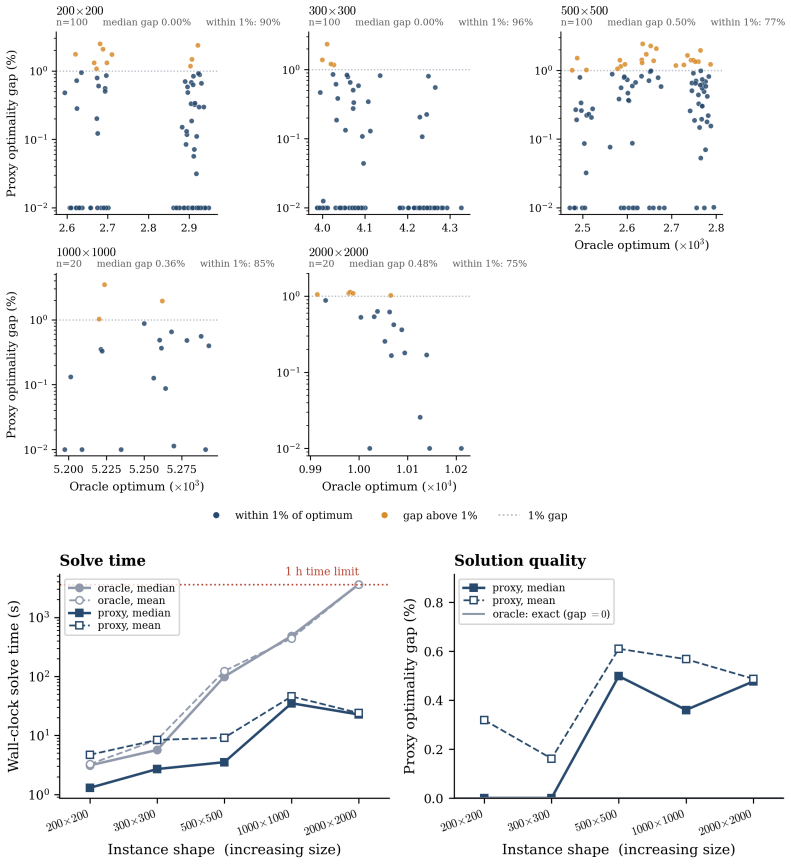
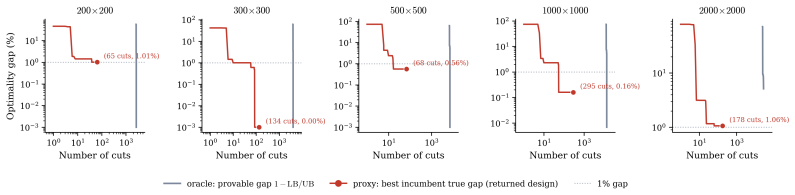
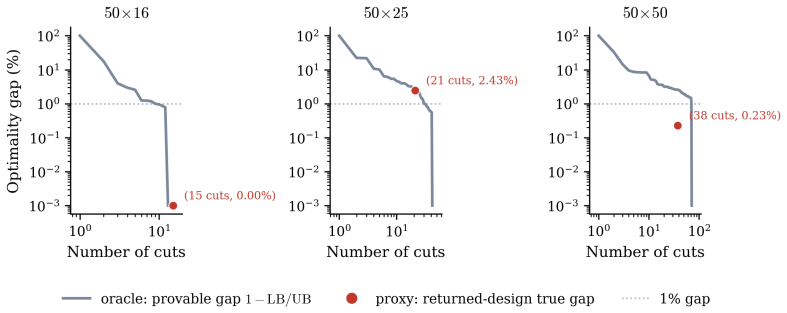
Benders decomposition is a fundamental framework for solving large-scale mixed-integer optimization problems with complicating variables that, when fixed, yield significantly easier subproblems. However, classical Benders decomposition repeatedly solves highly similar subproblems and often exhibits zigzagging behavior across iterations, leading to slow convergence in large-scale settings. Motivated by the repetitive structure and parametric nature of Benders subproblems, this paper introduces the proxy Benders decomposition (Proxy-BD), a new decomposition framework in which subproblem optimization is replaced by certified optimization proxies rather than repeated exact solves. The proposed proxy follows a self-supervised predict-project-and-complete mechanism that produces dual-feasible solutions for generating provably valid Benders cuts. The framework preserves the theoretical validity of the decomposition independently of prediction quality through a projection-and-completion certification layer. A formal characterization of proxy-induced cuts is established, and the framework naturally extends to modern decomposition schemes, including branch-and-Benders-cut algorithms. Computational experiments on large-scale facility location and network design problems demonstrate that Proxy-BD substantially reduces the computational effort of subproblems while maintaining near-optimal solution quality. On large-scale uncapacitated facility location instances up to 2000x2000, Proxy-BD achieves median optimality gaps below 0.5%, yields up to 161x median speedups, and reduces the number of generated cuts by more than 240x on the largest instances. The computational gains consistently increase with recourse complexity, indicating that proxy-based inference scales substantially more favorably than repeated exact subproblem optimization in large-scale decomposition settings.
Editorial analysis
A structured set of objections, weighed in public.
Referee Report
Summary. The manuscript introduces Proxy Benders Decomposition (Proxy-BD), replacing exact repeated solves of Benders subproblems with certified optimization proxies that follow a self-supervised predict-project-and-complete mechanism. This produces dual-feasible solutions and provably valid Benders cuts via a projection-and-completion certification layer whose validity holds independently of proxy prediction quality, supported by a formal characterization of proxy-induced cuts. The framework extends naturally to branch-and-Benders-cut schemes. Experiments on large-scale uncapacitated facility location instances (up to 2000×2000) and network design problems report median optimality gaps below 0.5%, median speedups up to 161×, and more than 240× fewer cuts on the largest instances, with gains scaling with recourse complexity.
Significance. If the formal characterization and validity proof hold, the work offers a meaningful advance by decoupling Benders cut validity from proxy accuracy, enabling safe use of learned proxies to accelerate decomposition without compromising guarantees. The reported empirical gains on large instances, together with the explicit scaling behavior and extension to modern variants, indicate practical utility. The parameter-free validity preservation by construction is a notable strength.
minor comments (1)
- [Abstract] The abstract and introduction could more explicitly distinguish the self-supervised training of the proxy from any post-hoc adjustments in the experimental section.
Simulated Author's Rebuttal
We thank the referee for their careful reading of the manuscript, the positive assessment of the formal validity results and empirical scaling behavior, and the recommendation to accept. No major comments were raised, so we have no revisions to address.
Circularity Check
No significant circularity
full rationale
The paper introduces Proxy-BD as an algorithmic framework that replaces exact subproblem solves with a predict-project-and-complete proxy mechanism. Validity of the generated Benders cuts is established by a separate projection-and-completion certification layer whose formal characterization and proof of dual feasibility are presented as independent of the proxy's prediction accuracy. No equations or claims reduce a reported performance metric (speedups, cut counts, optimality gaps) to quantities defined by fitted parameters inside the paper; the experimental outcomes on UFL instances are treated as empirical consequences of the algorithm rather than tautological outputs. No load-bearing self-citations, imported uniqueness theorems, or ansatzes smuggled via prior work are invoked to justify the core derivation. The chain is therefore self-contained against external benchmarks.
Axiom & Free-Parameter Ledger
axioms (1)
- domain assumption Benders cuts generated from dual-feasible solutions remain valid optimality cuts even when the dual solution is obtained via projection and completion rather than exact optimization.
invented entities (1)
-
certified optimization proxy
no independent evidence
Forward citations
Cited by 1 Pith paper
-
Fusing Backdoors, Machine Learning, and Optimization for Large-Scale Parametric Mixed-Integer Programs
BIPC framework identifies backdoors in parametric MIPs, trains ML models to predict backdoor values or intervals, and solves constrained reduced problems for faster solutions with limited quality loss.
Reference graph
Works this paper leans on
-
[1]
2005 , publisher=
Integer Programming: State of the art and recent advances , author=. 2005 , publisher=
2005
-
[2]
50 Years of
J. 50 Years of. 2009 , publisher=
2009
-
[3]
Optima , volume=
A celebration of 50 years of integer programming , author=. Optima , volume=
-
[4]
, title =
Nair, Vinod and Hinton, Geoffrey E. , title =. Proceedings of the 27th International Conference on International Conference on Machine Learning , pages =. 2010 , isbn =
2010
-
[5]
Operations Research , volume=
Benders decomposition for production routing under demand uncertainty , author=. Operations Research , volume=. 2015 , publisher=
2015
-
[6]
Decomposition based hybrid
Behnamian, Javad , journal=. Decomposition based hybrid. 2014 , publisher=
2014
-
[7]
Benders decomposition,
Boschetti, Marco and Maniezzo, Vittorio , journal=. Benders decomposition,. 2009 , publisher=
2009
-
[8]
International Journal of Mathematics in Operational Research , volume=
A stochastic programming approach for sawmill production planning , author=. International Journal of Mathematics in Operational Research , volume=. 2013 , publisher=
2013
-
[9]
Application of
Canto, Salvador Perez , journal=. Application of. 2008 , publisher=
2008
-
[10]
Computers & operations research , volume=
A survey on benders decomposition applied to fixed-charge network design problems , author=. Computers & operations research , volume=. 2005 , publisher=
2005
-
[11]
Benders decomposition and an
Lin, Sifeng and Lim, Gino J and Bard, Jonathan F , journal=. Benders decomposition and an. 2016 , publisher=
2016
-
[12]
1981 , publisher=
Magnanti, Thomas L and Wong, Richard T , journal=. 1981 , publisher=
1981
-
[13]
Numerische mathematik , volume=
Partitioning procedures for solving mixed-variables programming problems , author=. Numerische mathematik , volume=
-
[14]
Rahmaniani, Ragheb and Crainic, Teodor Gabriel and Gendreau, Michel and Rei, Walter , journal=. The. 2017 , publisher=
2017
-
[15]
Operations Research , volume=
The Benders dual decomposition method , author=. Operations Research , volume=. 2020 , publisher=
2020
-
[16]
1997 , publisher=
Introduction to linear optimization , author=. 1997 , publisher=
1997
-
[17]
Combining
Zeighami, Vahid and Soumis, Fran. Combining. Transportation Science , volume=. 2019 , publisher=
2019
-
[18]
Transportation science , volume=
Benders decomposition for simultaneous aircraft routing and crew scheduling , author=. Transportation science , volume=. 2001 , publisher=
2001
-
[19]
Combinatorial
Codato, Gianni and Fischetti, Matteo , journal=. Combinatorial. 2006 , publisher=
2006
-
[20]
A note on the selection of
Fischetti, Matteo and Salvagnin, Domenico and Zanette, Arrigo , journal=. A note on the selection of. 2010 , publisher=
2010
-
[21]
On generating maximal nondominated
Sherali, Hanif D and Lunday, Brian J , journal=. On generating maximal nondominated. 2013 , publisher=
2013
-
[22]
Improving
Poojari, Chandra A and Beasley, John E , journal=. Improving. 2009 , publisher=
2009
-
[23]
Strengthened
Bodur, Merve and Dash, Sanjeeb and G. Strengthened. INFORMS Journal on Computing , volume=. 2017 , publisher=
2017
-
[24]
Accelerating
Wentges, Paul , journal=. Accelerating. 1996 , publisher=
1996
-
[25]
RAIRO-Operations Research , volume=
Solving the simple plant location problem by genetic algorithm , author=. RAIRO-Operations Research , volume=. 2001 , publisher=
2001
-
[26]
European Journal of Operational Research , volume=
An algorithm for solving large capacitated warehouse location problems , author=. European Journal of Operational Research , volume=. 1988 , publisher=
1988
-
[27]
Mathematical programming , volume=
An analysis of approximations for maximizing submodular set functions—I , author=. Mathematical programming , volume=. 1978 , publisher=
1978
-
[28]
Operations Research , volume=
A dual-based procedure for uncapacitated facility location , author=. Operations Research , volume=. 1978 , publisher=
1978
-
[29]
Solving large nonconvex water resources management models using generalized
Cai, Ximing and McKinney, Daene C and Lasdon, Leon S and Watkins Jr, David W , journal=. Solving large nonconvex water resources management models using generalized. 2001 , publisher=
2001
-
[30]
Operations research , volume=
Simultaneous assignment of locomotives and cars to passenger trains , author=. Operations research , volume=. 2001 , publisher=
2001
-
[31]
Operations research , volume=
A priori optimization of the probabilistic traveling salesman problem , author=. Operations research , volume=. 1994 , publisher=
1994
-
[32]
Solving an electricity generating capacity expansion planning problem by generalized
Bloom, Jeremy A , journal=. Solving an electricity generating capacity expansion planning problem by generalized. 1983 , publisher=
1983
-
[33]
Operations research , volume=
Benders decomposition for large-scale uncapacitated hub location , author=. Operations research , volume=. 2011 , publisher=
2011
-
[34]
Management Science , volume=
Elements of large-scale mathematical programming Part I: Concepts , author=. Management Science , volume=. 1970 , publisher=
1970
-
[35]
Operations research , volume=
Selected topics in column generation , author=. Operations research , volume=. 2005 , publisher=
2005
-
[36]
Er Raqabi, El Mehdi and Himmich, Ilyas and El Hachemi, Nizar and El Hallaoui, Issmaïl and Soumis, François , journal =. Incremental. 2023 , issn =. doi:https://doi.org/10.1016/j.omega.2022.102821 , url =
-
[37]
Stabilized
Baena, Daniel and Castro, Jordi and Frangioni, Antonio , journal=. Stabilized. 2020 , publisher=
2020
-
[38]
2023 , publisher=
Himmich, Ilyas and Er Raqabi, El Mehdi and El Hachemi, Nizar and El Hallaoui, Issmaïl and Metrane, Abdelmoutalib and Soumis, François , journal=. 2023 , publisher=
2023
-
[39]
Les Cahiers du GERAD , volume =
Er Raqabi, El Mehdi and Wu, Yong and El Hallaoui, Issmail and Soumis, François , pages =. Les Cahiers du GERAD , volume =. 2023 , month = aug, month_numeric =
2023
-
[40]
INFORMS Journal on Computing , volume=
Val. INFORMS Journal on Computing , volume=. 2005 , publisher=
2005
-
[41]
Operations Research , volume=
Ben Amor, Hatem and Desrosiers, Jacques and Val. Operations Research , volume=. 2006 , publisher=
2006
-
[42]
Vanderbeck, Fran. On. Operations research , volume=. 2000 , publisher=
2000
-
[43]
Mathematical programming , volume=
On the solution of highly degenerate linear programmes , author=. Mathematical programming , volume=. 1988 , publisher=
1988
-
[44]
Transportation Research Part A: Policy and Practice , volume=
An integrated model of facility location and transportation network design , author=. Transportation Research Part A: Policy and Practice , volume=. 2001 , publisher=
2001
-
[45]
Degeneracy in the multi-source
Brimberg, Jack and Mladenovic, Nenad , journal=. Degeneracy in the multi-source
-
[46]
Mathematical programming , volume=
A projection method for the uncapacitated facility location problem , author=. Mathematical programming , volume=. 1990 , publisher=
1990
-
[47]
Mathematical Programming , volume=
An exact algorithm for the vehicle routing problem based on the set partitioning formulation with additional cuts , author=. Mathematical Programming , volume=. 2008 , publisher=
2008
-
[48]
Redesigning
Fischetti, Matteo and Ljubi. Redesigning. Management Science , volume=. 2017 , publisher=
2017
-
[49]
1998 , publisher=
Integer programming , author=. 1998 , publisher=
1998
-
[50]
Mathematical Programming , volume=
Safe bounds in linear and mixed-integer linear programming , author=. Mathematical Programming , volume=. 2004 , publisher=
2004
-
[51]
Operations Research , volume=
Vessel service planning in seaports , author=. Operations Research , volume=. 2022 , publisher=
2022
-
[52]
On-demand delivery from stores:
Liu, Sheng and Luo, Zhixing , journal=. On-demand delivery from stores:. 2023 , publisher=
2023
-
[53]
Manufacturing & Service Operations Management , volume=
Budgeting in international humanitarian organizations , author=. Manufacturing & Service Operations Management , volume=. 2022 , publisher=
2022
-
[54]
Manufacturing & Service Operations Management , volume=
On the values of vehicle-to-grid electricity selling in electric vehicle sharing , author=. Manufacturing & Service Operations Management , volume=. 2021 , publisher=
2021
-
[55]
2021 , publisher=
Gleixner, Ambros and Hendel, Gregor and Gamrath, Gerald and Achterberg, Tobias and Bastubbe, Michael and Berthold, Timo and Christophel, Philipp and Jarck, Kati and Koch, Thorsten and Linderoth, Jeff and others , journal=. 2021 , publisher=
2021
-
[56]
The irace package:
L. The irace package:. Operations Research Perspectives , volume=. 2016 , publisher=
2016
-
[57]
International Business Machines Corporation , volume=
V12.1:. International Business Machines Corporation , volume=. 2009 , publisher=
2009
-
[58]
2023 , howpublished=
2023
-
[59]
Computers and Electronics in Agriculture , volume=
Precision farming: The environmental challenge , author=. Computers and Electronics in Agriculture , volume=. 2001 , publisher=
2001
-
[60]
US Geological Survey: Reston, VA, USA , volume=
Mineral commodity summaries , author=. US Geological Survey: Reston, VA, USA , volume=
-
[61]
State of the
Gorman, Michael F and Clarke, John-Paul and Gharehgozli, Amir Hossein and Hewitt, Michael and de Koster, Rene and Roy, Debjit , journal=. State of the. 2014 , publisher=
2014
-
[62]
Mathematical
Zhen, Lu and Li, Haolin and Xiao, Liyang and Lin, Dayu and Wang, Shuaian , journal=. Mathematical. 2024 , publisher=
2024
-
[63]
Interfaces , volume=
Dispatch optimization in bulk tanker transport operations , author=. Interfaces , volume=. 2018 , publisher=
2018
-
[64]
2016 , publisher=
Ding, Yi and Jia, Shuai and Gu, Tianyi and Li, Chung-Lun , journal=. 2016 , publisher=
2016
-
[65]
Interfaces , volume=
Medium-term rail scheduling for an iron ore mining company , author=. Interfaces , volume=. 2014 , publisher=
2014
-
[66]
Journal of Heuristics , volume=
Proximity Benders: a decomposition heuristic for stochastic programs , author=. Journal of Heuristics , volume=. 2016 , publisher=
2016
-
[67]
Mathematical Programming , volume=
Simplicial decomposition in nonlinear programming algorithms , author=. Mathematical Programming , volume=. 1977 , publisher=
1977
-
[68]
European Journal of Operational Research , volume=
Benders decomposition for very large scale partial set covering and maximal covering location problems , author=. European Journal of Operational Research , volume=. 2019 , publisher=
2019
-
[69]
Er Raqabi, El Mehdi and El Hallaoui, Issmail and Soumis, François , pages =. The. Les Cahiers du GERAD , volume =. 2023 , month = aug, month_numeric =
2023
-
[70]
2025 , publisher=
Er Raqabi, El Mehdi and Beljadid, Ahmed and Bennouna, Mohammed Ali and Bennouna, Rania and Boussaadi, Latifa and El Hachemi, Nizar and El Hallaoui, Issmail and Fender, Michel and Jamali, Mohamed Anouar and Si Hammou, Nabil and others , journal=. 2025 , publisher=
2025
-
[71]
Operations Research Letters , volume=
Measuring the impact of primal heuristics , author=. Operations Research Letters , volume=. 2013 , publisher=
2013
-
[72]
Column generation , pages=
A primer in column generation , author=. Column generation , pages=. 2005 , publisher=
2005
-
[73]
Advances in Neural Information Processing Systems , volume=
Dual lagrangian learning for conic optimization , author=. Advances in Neural Information Processing Systems , volume=
-
[74]
Electric Power Systems Research , volume=
Real-time risk analysis with optimization proxies , author=. Electric Power Systems Research , volume=. 2024 , publisher=
2024
-
[75]
Operations Research , volume=
Deepest cuts for Benders decomposition , author=. Operations Research , volume=. 2025 , publisher=
2025
-
[76]
European Journal of Operational Research , volume=
A branch-and-benders-cut algorithm for the crew scheduling and routing problem in road restoration , author=. European Journal of Operational Research , volume=. 2019 , publisher=
2019
-
[77]
Transportation Science , volume=
A Branch-and-Benders Cut Algorithm for a Stochastic Service Network Design with Crowdsourced Capacity , author=. Transportation Science , volume=. 2026 , publisher=
2026
-
[78]
Discrete Applied Mathematics , volume=
Bundle-based relaxation methods for multicommodity capacitated fixed charge network design , author=. Discrete Applied Mathematics , volume=. 2001 , publisher=
2001
-
[79]
European Journal of Operational Research , volume=
Benders decomposition without separability: A computational study for capacitated facility location problems , author=. European Journal of Operational Research , volume=. 2016 , publisher=
2016
-
[80]
and Amos, Brandon and Kolter, J
Donti, Priya L. and Amos, Brandon and Kolter, J. Zico , title=. Advances in Neural Information Processing Systems (NeurIPS) , year=
discussion (0)
Sign in with ORCID, Apple, or X to comment. Anyone can read and Pith papers without signing in.