REVIEW 2 minor 2 cited by
Trajectory-Refined Distillation corrects prefix failures in on-policy distillation by revising student rollouts at the trajectory level under teacher guidance.
Reviewed by Pith at T0; open to challenge. T0 means a machine referee read the full paper against a public rubric. the ladder, T0–T4 →
T0 review · grok-4.3
2026-06-27 19:02 UTC pith:SHPR3HLI
load-bearing objection TRD gives a clean mechanistic story for fixing prefix issues in on-policy distillation via trajectory corrections, but the abstract supplies no numbers so the actual gains stay unproven.
Trajectory-Refined Distillation
The pith
A machine-rendered reading of the paper's core claim, the machinery that carries it, and where it could break.
Core claim
Prefix failure in on-policy distillation induces a bimodal teacher mixture and fragmented gradients that token-level loss truncation or reweighting cannot resolve. Trajectory-Refined Distillation performs trajectory-level output corrections on the student's rollout under teacher guidance while staying within on-policy support, thereby mitigating prefix failure at its source and exposing the student to alternative valid derivations even when the original rollout is correct. The same correction applies to on-policy self-distillation that uses the student conditioned on privileged information as the teacher.
What carries the argument
Trajectory-Refined Distillation, the trajectory-level correction procedure that revises the student's rollout prefixes under teacher guidance before distillation loss is applied.
Load-bearing premise
Prefix failure is the common structural cause of problems in on-policy distillation and trajectory-level output corrections can mitigate it at its source while remaining within on-policy support.
What would settle it
A controlled comparison in which token-level loss interventions produce equivalent gains in accuracy and reasoning coverage as Trajectory-Refined Distillation on the same set of benchmarks and models would falsify the necessity of trajectory-level correction.
If this is right
- Correcting prefixes before distillation removes the bimodal teacher mixture that token-level interventions leave untouched.
- Exposing the student to alternative valid derivations under teacher guidance increases exploration even on originally correct rollouts.
- The trajectory correction extends directly to on-policy self-distillation without requiring a separate teacher model.
- The resulting gains appear as improved single-attempt accuracy together with wider coverage of reasoning paths.
Where Pith is reading between the lines
- Trajectory-level interventions may outperform token-level ones in other on-policy training regimes for language models where errors accumulate over sequences.
- The same correction mechanism could be tested on non-reasoning tasks where prefix errors compound, such as long-form generation or tool use.
- If prefix failure is structural, similar trajectory refinement might reduce reliance on auxiliary loss reweighting schemes in distillation pipelines.
Editorial analysis
A structured set of objections, weighed in public.
Referee Report
Summary. The paper identifies 'prefix failure' as a structural cause of issues in on-policy distillation (OPD) for LLMs, in which dense per-token teacher supervision produces bimodal mixtures and fragmented gradients that token-level loss modifications cannot resolve. It introduces Trajectory-Refined Distillation (TRD), which performs trajectory-level output corrections on the student's rollout under teacher guidance while remaining inside on-policy support; this is claimed to mitigate prefix failure at its source and to increase exploration by surfacing alternative valid derivations. The approach is also extended to on-policy self-distillation (OPSD). Experiments across multiple benchmarks, base models, and scales are reported to show consistent gains in single-attempt accuracy and reasoning coverage relative to prior baselines.
Significance. If the empirical results hold, the work supplies a mechanistic account of a recurring difficulty in OPD together with a practical trajectory-level intervention that improves both accuracy and coverage. The public code release is a clear strength that supports reproducibility and follow-on work. The contribution is proportionate to the centrality of distillation in current LLM post-training pipelines.
minor comments (2)
- The abstract states that TRD 'consistently outperforms prior baselines' yet supplies no numerical deltas, error bars, or dataset identifiers; adding at least one concrete result would strengthen the summary.
- The precise mechanism by which trajectory corrections are guaranteed to stay inside on-policy support (mentioned in the abstract) should be stated explicitly in the method section with a short formal condition or pseudocode.
Simulated Author's Rebuttal
We thank the referee for the positive summary of our work on Trajectory-Refined Distillation and for recommending minor revision. No major comments appear in the report, so there are no specific points requiring point-by-point response.
Circularity Check
No significant circularity
full rationale
The paper identifies an observed phenomenon (prefix failure) in on-policy distillation and proposes a new method (TRD) to address it via trajectory-level corrections. The central claims are empirical performance gains across benchmarks, models, and scales, with code release providing external verifiability. No equations, fitted parameters renamed as predictions, or self-citation chains appear in the provided text; the derivation is a mechanistic motivation followed by independent experimental validation rather than any reduction of outputs to inputs by construction.
Axiom & Free-Parameter Ledger
axioms (1)
- domain assumption On-policy distillation provides dense per-token teacher supervision along the student's own rollouts.
invented entities (1)
-
prefix failure
no independent evidence
read the original abstract
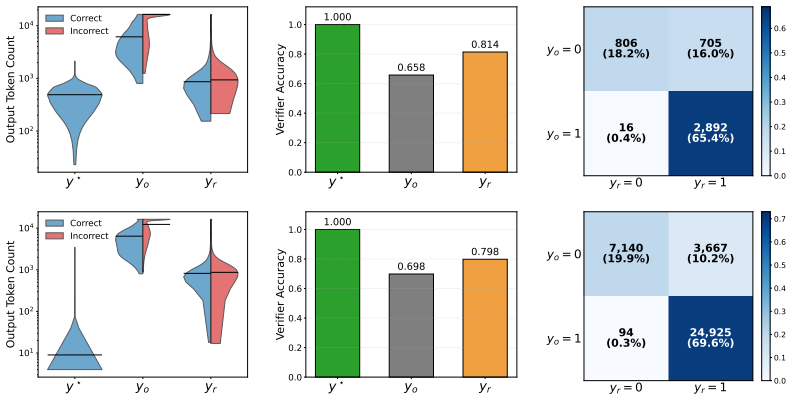
On-policy distillation (OPD) has become a central post-training tool for large language models (LLMs), providing dense per-token teacher supervision along the student's own rollouts. In this work, we identify a common structural cause underlying OPD, which we call prefix failure. Under prefix failure, dense per-token supervision induces a bimodal teacher mixture and fragmented gradients that token-level loss truncation or reweighting fail to address. This observation motivates us to move beyond token-level loss interventions toward trajectory-level output corrections. We thus propose Trajectory-Refined Distillation (TRD), a trajectory-level correction method that revises the student's rollout under the teacher guidance while within on-policy support. By correcting problematic prefixes before distillation, TRD mitigates prefix failure at its source. Moreover, TRD improves the exploration by exposing the student to alternative valid derivations under teacher guidance, even when the original rolls are already correct. TRD can also be applied to on-policy self-distillation (OPSD), a parameter-sharing variant that uses the student model conditioned on privileged informations as the teacher. Across a wide range of benchmarks and base models at multiple scales, TRD consistently outperforms prior baselines, improving single-attempt accuracy and broadening reasoning coverage. Code is available at https://github.com/louieworth/trd
Figures



Forward citations
Cited by 2 Pith papers
-
Pass the Baton: Trajectory-Relayed On-Policy Distillation
Relay-OPD detects when a student LLM is about to continue in a wrong reasoning direction and has the teacher redirect with a short intervention, improving math accuracy and cutting training length.
-
Recursive Self-Improvement in AI: From Bounded Self-Refinement to Autonomous Research Loops
A survey of 1,250 papers organizes AI self-improvement along two axes—what is improved and loop closure—finding that demonstrated self-improvement strength tracks a verification hierarchy from formal verifiers down to...
Reference graph
Works this paper leans on
-
[1]
Preserve the overall structure and reasoning path of your original solution
-
[2]
Identify and fix errors in computation or logic
-
[3]
Keep correct intermediate steps and meaningful work
-
[4]
OPSD Math Refinement
Output ONLY the rewritten solution Please reason step by step, and put your final answer within\boxed{}. OPSD Math Refinement. Your task is to rewrite your mathematical solution using the reference solution as guidance. Problem: {PROBLEM} Reference Solution: {EXPERTSOLUTION} Your Initial Solution: {INITIALRESPONSE} Instructions:
-
[5]
Review the reference solution to understand the target reasoning and method
-
[6]
Rewrite your solution so it is consistent with the reference solution
-
[7]
Keep useful parts of your original structure and style when appropriate
-
[8]
21 OPD Code Refinement
Output ONLY the rewritten solution Please reason step by step, and put your final answer within\boxed{}. 21 OPD Code Refinement. Your task is to rewrite your Python solution. Problem: {PROBLEM} Your Initial Solution: {INITIALRESPONSE} Instructions:
-
[11]
OPSD Code Refinement
Output ONLY the rewritten Python solution Return only the corrected Python code inside a single```pythoncode block. OPSD Code Refinement. Your task is to rewrite your Python solution using the reference solution as guidance. Problem: {PROBLEM} Reference Solution: ```python {EXPERTSOLUTION} ``` Your Initial Solution: {INITIALRESPONSE} Instructions:
-
[12]
Fix correctness issues and edge cases
-
[13]
Preserve useful parts of the original approach when appropriate
-
[14]
C.5 Training Metrics for Fig
Output ONLY the rewritten Python solution Return only the corrected Python code inside a single```pythoncode block. C.5 Training Metrics for Fig. 3 The diagnostic curves in Fig. 3 are collected in the OPSD setting, because that setting controls for teacher–student model mismatch. The same trainer can log these metrics for OPD, but the reported OPD direct-...
2025
discussion (0)
Sign in with ORCID, Apple, or X to comment. Anyone can read and Pith papers without signing in.