REVIEW 3 major objections 6 minor 1 cited by
A Bayesian 2MRS reconstruction recovers the local Universe’s large-scale gravitational flow and matches independent Cosmicflows-4 velocities.
Reviewed by Pith at T0; open to challenge. T0 means a machine referee read the full paper against a public rubric. the ladder, T0–T4 →
T0 review · grok-4.5
2026-07-14 18:12 UTC pith:SRGX3OAM
load-bearing objection Solid, carefully framed 2MRS MAP/HMC reconstruction with external CF4 conditional-mean tests and usable Gadget ICs; the main soft spot is the ZA+bias forward model on the mildly nonlinear scales the paper itself emphasizes. the 3 major comments →
Bayesian Reconstruction of the Local Universe from 2MRS: Testing the Gravitational Flow with Cosmicflows-4
The pith
A machine-rendered reading of the paper's core claim, the machinery that carries it, and where it could break.
Core claim
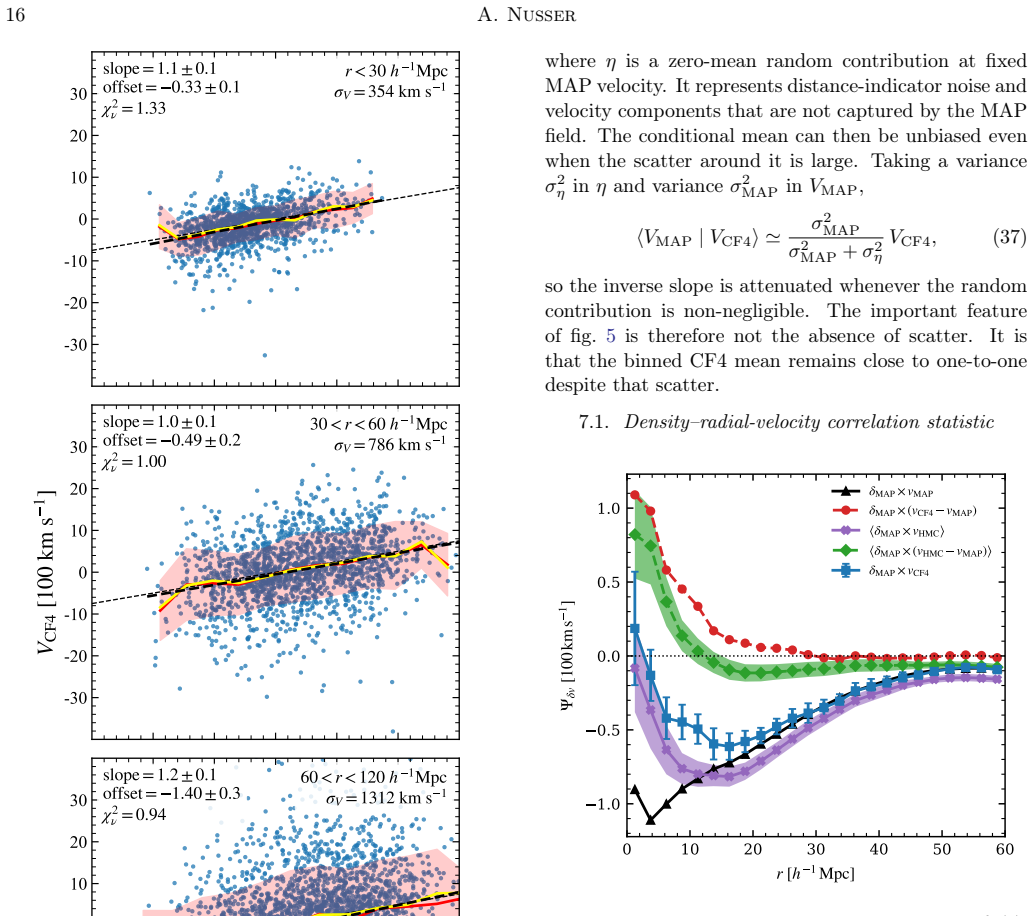
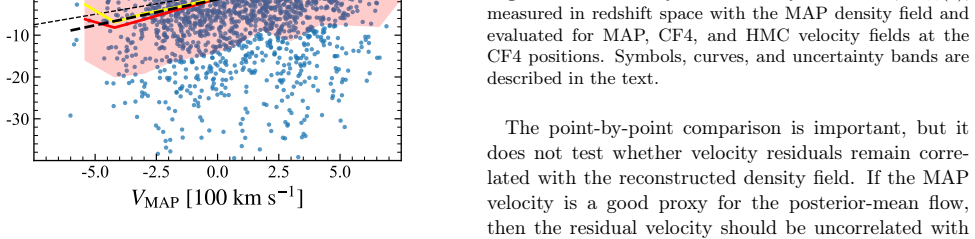
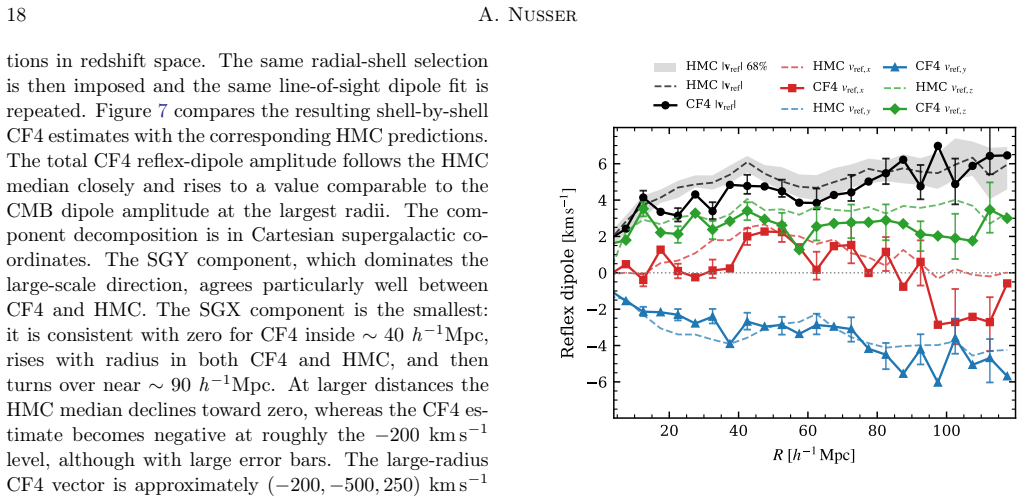
The 2MRS field-level MAP/HMC reconstruction captures the large-scale gravitational flow of the nearby Universe: at Cosmicflows-4 redshift-space positions the conditional mean satisfies ⟨V_CF4 | V_MAP⟩ ≃ V_MAP, with supporting density–velocity correlation and shell-by-shell reflex-dipole agreement, and posterior draws provide initial conditions suitable for constrained Gadget-4 simulations.
What carries the argument
Zel’dovich-approximation forward model inside an explicit Bayesian posterior: a whitened Gaussian initial field is evolved to redshift space, biased with a coarse-grid power-law radius-dependent prescription, and compared to 2MRS through an unbinned Poisson point-process likelihood; the MAP solution and HMC samples of that posterior supply both the tested velocity field and the constrained initial conditions.
Load-bearing premise
That first-order Zel’dovich evolution plus a coarse-grid power-law galaxy bias is accurate enough on the mildly nonlinear scales that enter the Cosmicflows-4 tests and the constrained simulations.
What would settle it
If, at fixed MAP velocity bins evaluated at Cosmicflows-4 redshift-space positions, the binned mean CF4 radial velocity systematically departs from the one-to-one line (or residual density–velocity correlations remain large on scales ≳10 h⁻¹ Mpc after the same model), the claim that the reconstruction recovers the gravitational flow would fail.
Editorial analysis
A structured set of objections, weighed in public.
Referee Report
Summary. The paper presents a field-level Bayesian reconstruction of the local density and velocity fields from 2MRS, using a Gaussian prior on whitened initial conditions, a Zel'dovich forward model with redshift-space distortions, selection, ZoA mask, and a coarse-grid radius-dependent power-law bias, constrained by an unbinned Poisson point-process likelihood. The MAP solution is obtained by optimization and HMC (NUTS) is used for posterior samples and constrained realizations. The reconstructed velocities are tested against independent CF4 group peculiar velocities (held out of the posterior) via conditional mean comparisons at CF4 redshift-space positions, a density–radial-velocity correlation statistic, and shell-by-shell reflex dipoles. Posterior draws are refined to 256³ and evolved with Gadget-4, recovering large-scale structure and nonlinear Fingers of God. The central claim is that the 2MRS reconstruction captures the large-scale gravitational flow of the nearby Universe and yields usable constrained initial conditions.
Significance. If the conditional CF4 agreement and constrained-simulation results hold under the stated model, this is a solid and useful contribution to Local-Universe reconstruction. Strengths include an explicit posterior (not only a learned mapping), an unbinned Poisson likelihood, clear separation of CF4 as external validation, and a correctly framed conditional-mean test (Eqs. 1–2) rather than object-by-object recovery of noisy velocities. The three complementary CF4 diagnostics and the Gadget-4 evolution of HMC draws go beyond many previous 2MRS reconstructions. The work sits usefully between classical constrained-realization programs and full BORG-style field-level inference, and provides practical ICs for nearby-structure simulations. The main scientific limitation is the approximate ZA+effective-bias forward model on mildly nonlinear scales, which the paper largely acknowledges.
major comments (3)
- [§4.4.3, Eqs. 26–30] §4.4.3 (Eqs. 26–30): The radius-dependent bias exponent b(r) and the coarse bias-grid scale (~10 h⁻¹ Mpc) are load-bearing free ingredients of the density-to-velocity map, yet the manuscript never states the functional form or numerical values of b(r) used for the 2MRS MAP/HMC run, nor whether they were fixed from the literature, tuned by hand, or optimized. Without this, the CF4 conditional agreement and the claim of a well-specified forward model cannot be reproduced or stress-tested. Please specify b(r), the coarse-grid choice, and any sensitivity checks (e.g., constant-b vs b(r), or alternate coarse scales).
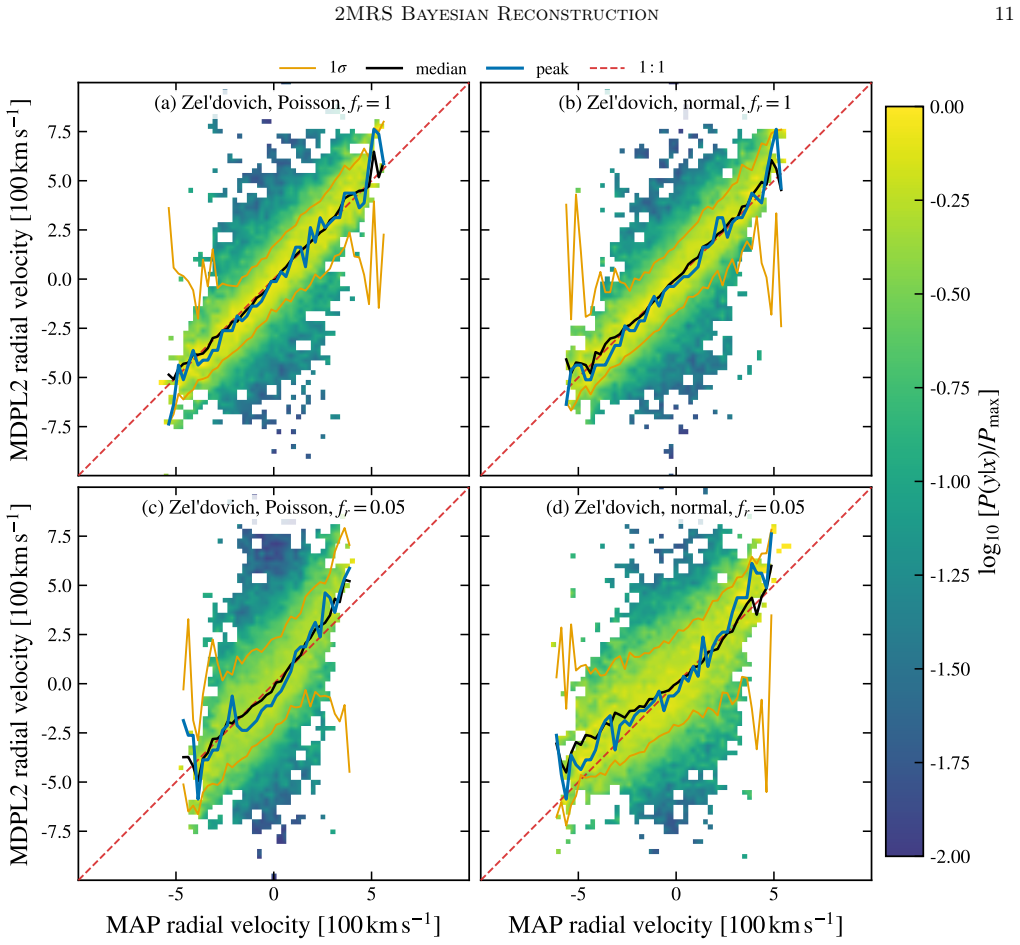
- [§5] §5: The MDPL2 validation is important for conditional unbiasedness of MAP velocities (Fig. 1), but it omits the 2MRS selection function, ZoA mask, and flux-limited sampling that enter the actual reconstruction. The paper notes this, yet the central claim is about a 2MRS-constrained gravitational flow. A limited 2MRS-like mock (even one diluted realization with ϕ(r) and a ZoA cut) would substantially strengthen the bridge from Fig. 1 to Figs. 5–7; without it, residual small-scale δ–v correlations (Fig. 6, ≲10 h⁻¹ Mpc) and Local Group overdensity issues (§8) remain harder to interpret as model vs data effects.
- [§5] §5 text inconsistency: the MDPL2 subvolume is first stated as L=200 h⁻¹ Mpc and later as L=300 h⁻¹ Mpc, with the same halo mass cut. This affects the reported mean densities, dilutions, and the interpretation of the conditional scatter. Please correct and make the validation volume unambiguous throughout §5 and Fig. 1.
minor comments (6)
- [§4.4.2] §4.4.2: The optional 2LPT test is mentioned only qualitatively (“small changes”). A short quantitative comparison (e.g., rms velocity difference or CF4 slope change) would help justify defaulting to first-order ZA for the scales emphasized in the introduction.
- [§7, Fig. 5] Fig. 5: The reduced χ² uses an extra scatter floor σ0=200 km s⁻¹. Please state more clearly whether this is only a goodness-of-fit device or whether any conclusion (slopes, offsets) depends on it; the text already notes raising it to 250 km s⁻¹ for the nearest bin.
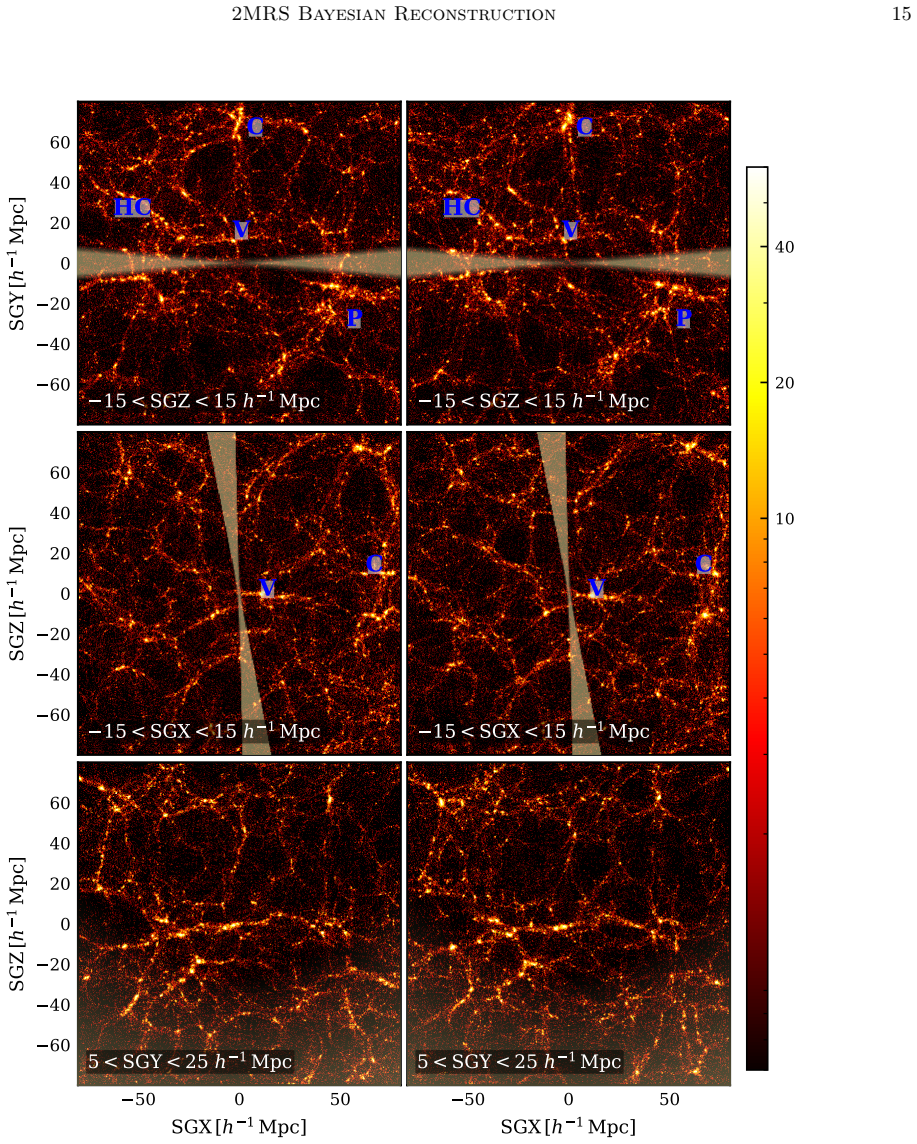
- [Figs. 2, 4] Fig. 2 / Fig. 4: Color bars and structure labels are helpful, but the ZoA yellow shading description in Fig. 4 (fraction of slab obscured) could be stated once in the caption more explicitly for readers unfamiliar with the geometric effect.
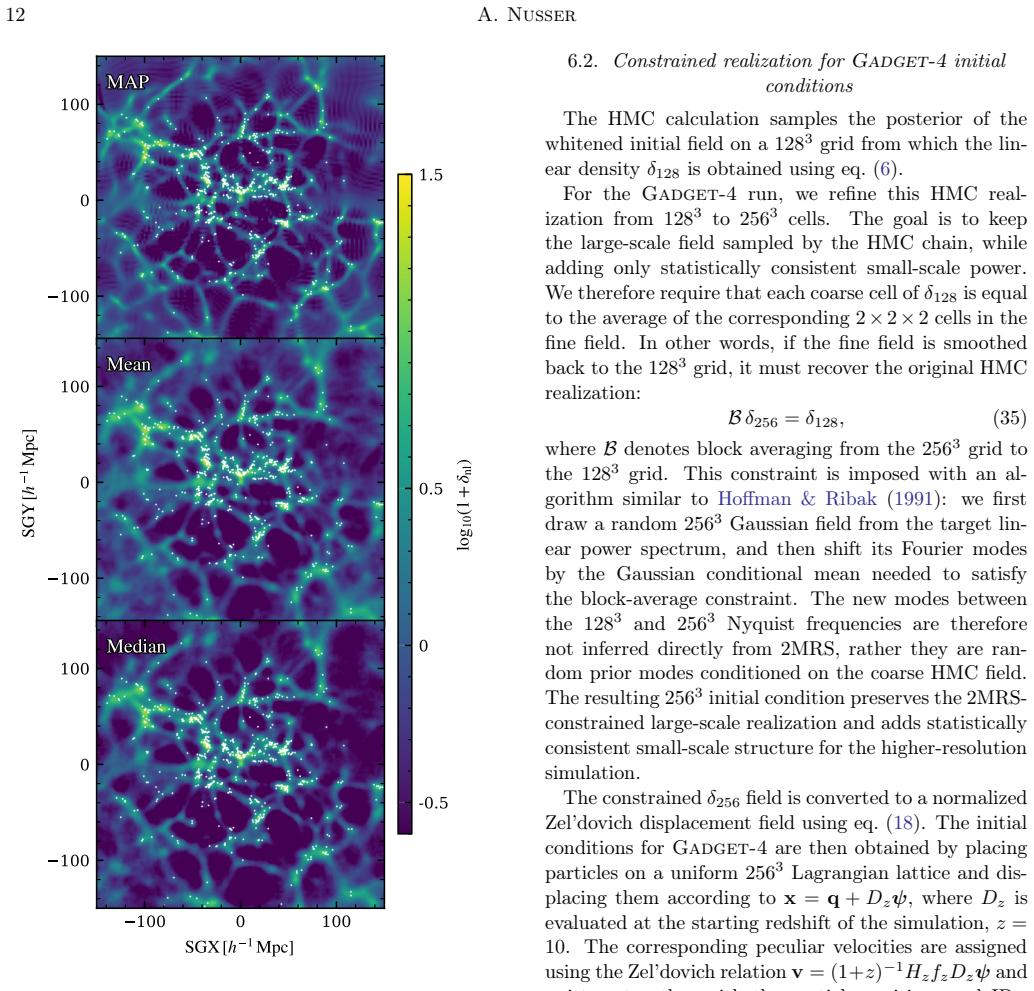
- [§6] §6: HMC setup (5 chains × 70 retained, last 30 used) is given, but no convergence diagnostics (e.g., split-ˆR or effective sample size on a few summary modes) are reported. Even a brief statement would increase confidence that the 150 late-chain samples used for mean/median are adequate.
- [§5] Minor typography: several compound words are missing spaces in the compiled text (e.g., “andhaloeswith”, “useshaloswithM”), likely from line-break artifacts; a proof pass would help.
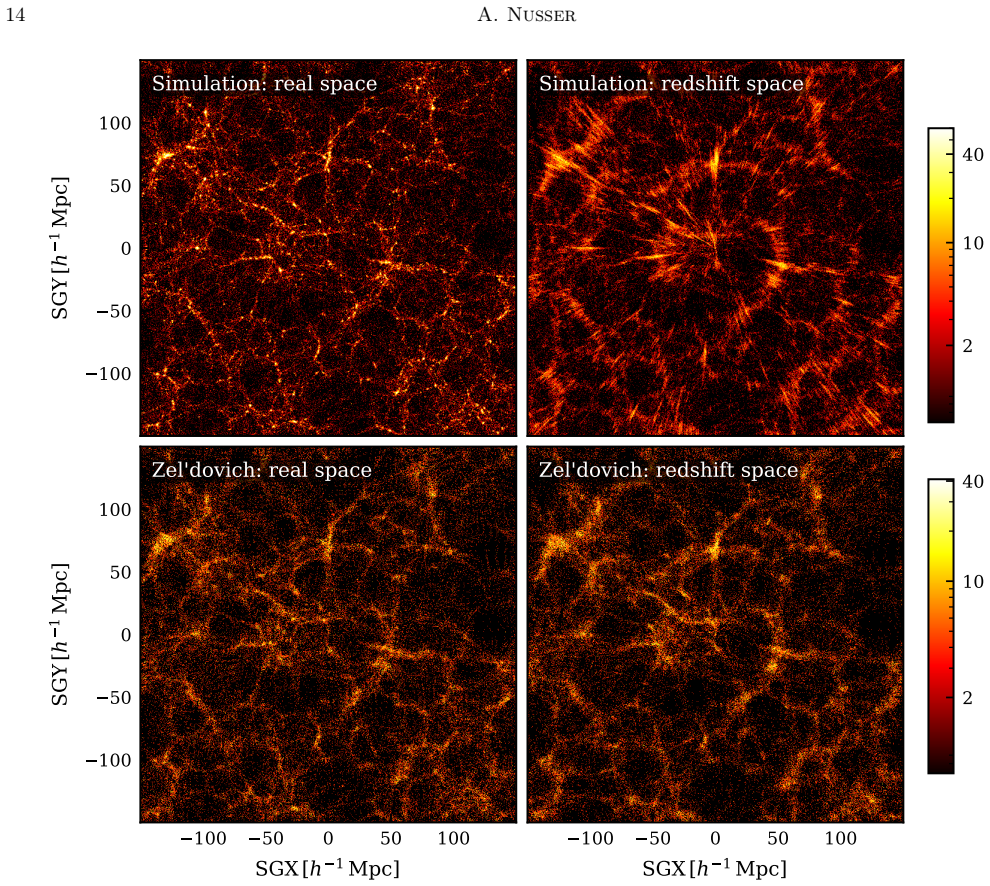
- [§8] §8: The discussion of not collapsing FoG and of Local Group overdensity is appropriately cautious; consider flagging earlier (methods or results) that FoG are left uncollapsed so readers interpret fragmented cluster regions in redshift-space maps correctly.
Circularity Check
No significant circularity: 2MRS reconstruction is independent of CF4, which is held out as external validation; self-citations supply methods context only.
full rationale
The derivation chain is self-contained and non-circular. The MAP/HMC posterior (eqs. 4, 15–16) is constrained solely by the 2MRS redshift-space point catalogue via an unbinned Poisson likelihood and a Zel’dovich + radius-dependent bias forward model under a Gaussian initial-conditions prior; CF4 enters nowhere in the likelihood or optimization (explicitly stated in §§3.2, 4.5, 7, 8). The central claim ⟨V_CF4 | V_MAP⟩ ≃ V_MAP (and the supporting density–velocity and reflex-dipole tests) is therefore an external, falsifiable comparison performed at the observed CF4 redshift-space positions without smoothing CF4 to the MAP resolution. MDPL2 halo mocks provide an independent simulation-level check of conditional unbiasedness. Self-citations (Lilow & Nusser 2021, Veena et al. 2023, etc.) appear only as related-work or methodological background and do not supply the CF4 test statistic or force the reported agreement. The ZA/bias forward model is an approximation whose adequacy is tested rather than assumed by construction; no fitted parameter is renamed a prediction, no uniqueness theorem is imported from the authors, and no ansatz is smuggled via self-citation. Score 0 is therefore required.
Axiom & Free-Parameter Ledger
free parameters (5)
- distance-dependent bias exponent b(r) and coarse bias-grid scale (~10 h⁻¹ Mpc)
- computational box L=300 h⁻¹ Mpc and 128³ MAP/HMC grid
- CF4 extra scatter floor σ0=200 km s⁻¹ in reduced χ²
- Poisson intensity normalization n0 via ∫ M ϕ d³r = N0 (not conditioned on model δg)
- redshift-space mapping regularizers r_soft and W_inner(r) near the observer
axioms (6)
- domain assumption Initial density fluctuations are a Gaussian random field with covariance fixed by the linear matter power spectrum P(k).
- domain assumption First-order Zel'dovich approximation adequately maps initial conditions to late-time density and velocity for the scales used in the likelihood and CF4 tests.
- domain assumption Observed 2MRS galaxies are an inhomogeneous Poisson point process with intensity set by selection, mask, and biased ZA density in redshift space.
- ad hoc to paper Galaxy bias is a local power-law 1+δg = A(1+δm)^{b(r)} imposed on a coarse grid and transferred as particle weights.
- domain assumption Background cosmology is fixed Planck ΛCDM (Ωm≈0.31, f≈Ωm^0.55); no joint sampling of cosmological parameters.
- domain assumption Dynamics and redshifts are analyzed in the Local Sheet frame so nearby redshift-space positions approximate true distances.
read the original abstract
We present a Bayesian reconstruction of the local density and velocity fields traced by the 2MASS Redshift Survey (2MRS) and test the inferred gravitational flow against independent Cosmicflows-4 (CF4) galaxy-group peculiar velocities. The fiducial reconstruction is the maximum-a-posteriori (MAP) solution of a Zel'dovich-approximation forward model, constrained by the 2MRS redshift-space distribution through an unbinned Poisson point-process likelihood. The model assumes Gaussian initial conditions and includes the 2MRS selection function, the Zone of Avoidance, redshift-space distortions, and a distance-dependent galaxy-bias prescription. The MAP field is obtained by optimization of the posterior, while Hamiltonian Monte Carlo is used to draw posterior samples and constrained realizations within the same framework. The reconstructed velocity field agrees well with CF4 in object-by-object, density--velocity-correlation, and shell-by-shell reflex-dipole tests. These comparisons are made at the CF4 redshift-space positions and do not require smoothing the observed CF4 velocities to the MAP resolution. We also evolve constrained initial conditions with Gadget-4. The real-space density retains the large-scale Zel'dovich structure while developing additional nonlinear small-scale structure, and the redshift-space distribution develops nonlinear Fingers of God. The results show that the 2MRS field-level reconstruction captures the large-scale gravitational flow of the nearby Universe and provides initial conditions suitable for constrained simulations.
Figures
Forward citations
Cited by 1 Pith paper
-
Emulating Cosmic Structure Formation with a Lagrangian Neural Cellular Automaton
A ~4,000-parameter recurrent local network correcting the Zeldovich approximation reaches percent-level matter power-spectrum accuracy at k≲0.5 h/Mpc at z=0, matching larger U-Net emulators on Quijote N-body tests.
Reference graph
Works this paper leans on
-
[1]
Tully, R. B. 1982, The Astrophysical Journal, 258, 64, doi: 10.1086/160053
doi:10.1086/160053 1982
-
[2]
Bilicki, M., Chodorowski, M., Jarrett, T., & Mamon, G. A. 2011, ApJ, 741, 31, doi: 10.1088/0004-637X/741/1/31 20A. Nusser
-
[3]
Ajhar, E. A. 1999, \apjl, 527, L73, doi: 10.1086/312404
doi:10.1086/312404 1999
-
[4]
S., Fiedorowicz, P., & Rozo, E
Boruah, S. S., Fiedorowicz, P., & Rozo, E. 2024, Physical Review D, 110, 023524, doi: 10.1103/PhysRevD.110.023524
-
[5]
2012, MNRAS, 424, 472, doi: 10.1111/J.1365-2966.2012.21210.X
Branchini, E., Davis, M., & Nusser, A. 2012, MNRAS, 424, 472, doi: 10.1111/J.1365-2966.2012.21210.X
-
[6]
2002, MNRAS, 335, 53, doi: 10.1046/j.1365-8711.2002.05611.x
Branchini, E., Eldar, A., & Nusser, A. 2002, MNRAS, 335, 53, doi: 10.1046/j.1365-8711.2002.05611.x
-
[7]
1993, MNRAS, 264, 375
Buchert, T., & Ehlers, J. 1993, MNRAS, 264, 375
1993
-
[8]
G., Hoffman, Y., Gottlöber, S., et al
Carlesi, E., Sorce, J. G., Hoffman, Y., Gottlöber, S., et al. 2016, MNRAS, 458, 900, doi: 10.1093/mnras/stw357
-
[9]
Carrick, J., Turnbull, S. J., Lavaux, G., & Hudson, M. J. 2015, MNRAS, 450, 317, doi: 10.1093/mnras/stv547
-
[10]
Courtois, H. M., Pomarède, D., Tully, R. B., Hoffman, Y., & Courtois, D. 2013, Astronomical Journal, 146, 69, doi: 10.1088/0004-6256/146/3/69 de Grijs, R., & Bono, G. 2020, Astrophysical Journal Supplement Series, 251, 15, doi: 10.3847/1538-4365/abbb96
-
[11]
1987, ApJ, 313, 59, doi: 10.1086/164948
Djorgovski, S., & Davis, M. 1987, ApJ, 313, 59, doi: 10.1086/164948
doi:10.1086/164948 1987
-
[12]
1995, MNRAS, 272, 885
Zaroubi, S. 1995, MNRAS, 272, 885
1995
-
[13]
2002, \nat, 417, 260 Gottlöber, S., Hoffman, Y., & Yepes, G
Frisch, U., Matarrese, S., Mohayaee, R., & Sobolevski, A. 2002, \nat, 417, 260 Gottlöber, S., Hoffman, Y., & Yepes, G. 2010, in High Performance Computing in Science and Engineering, Garching/Munich 2009, ed. S. Wagner, M. Steinmetz, A. Bode, & M. M. Müller (Berlin, Heidelberg: Springer Berlin Heidelberg), 309–322 Haugbølle, T., Hannestad, S., Thomsen, B....
doi:10.1086/513600 2002
-
[14]
1991, ApJL, 380, L5, doi: 10.1086/186160
Hoffman, Y., & Ribak, E. 1991, ApJL, 380, L5, doi: 10.1086/186160
doi:10.1086/186160 1991
-
[15]
Huchra, J. P., Macri, L. M., Masters, K. L., et al. 2012, ApJS, 199, 26, doi: 10.1088/0067-0049/199/2/26
-
[16]
Jasche, J., & Wandelt, B. D. 2013, MNRAS, 432, 894, doi: 10.1093/mnras/stt449
-
[17]
1987, MNRAS, 227, 1
Kaiser, N. 1987, MNRAS, 227, 1
1987
-
[18]
Karachentsev, I. D., Kaisina, E. I., Makarov, D. I., et al. 2013, Astronomical Journal, 145, 101, doi: 10.1088/0004-6256/145/4/101
-
[19]
2017, MNRAS, 467, 1915, doi: 10.1093/mnras/stx152
Keselman, A., & Nusser, A. 2017, MNRAS, 467, 1915, doi: 10.1093/mnras/stx152
-
[20]
Kitaura, F.-S., Erdogdu, P., Nuza, S. E., et al. 2012, MNRAS, 427, L35, doi: 10.1111/j.1745-3933.2012.01330.x
-
[21]
2016, MNRAS, 457, 4340, doi: 10.1093/mnras/stw248
Klypin, A., Yepes, G., Gottlöber, S., Prada, F., & Heß, S. 2016, MNRAS, 457, 4340, doi: 10.1093/mnras/stw248
-
[22]
Kourkchi, E., Tully, R. B., Eftekharzadeh, S., et al. 2020, ApJ, 902, 145, doi: 10.3847/1538-4357/ABB66B
-
[23]
2016, MNRAS, 455, 3169, doi: 10.1093/mnras/stv2499
Lavaux, G., & Jasche, J. 2016, MNRAS, 455, 3169, doi: 10.1093/mnras/stv2499
-
[24]
B., Mohayaee, R., & Colombi, S
Lavaux, G., Tully, R. B., Mohayaee, R., & Colombi, S. 2010, ApJ, 709, 483, doi: 10.1088/0004-637X/709/1/483
-
[25]
Libeskind, N. I., Carlesi, E., Grand, R. J., et al. 2020, MNRAS, 498, 2968, doi: 10.1093/mnras/staa2541
-
[26]
2024, A&A, 689, A226, doi: 10.1051/0004-6361/202450219
Lilow, R., Ganeshaiah Veena, P., & Nusser, A. 2024, A&A, 689, A226, doi: 10.1051/0004-6361/202450219
-
[27]
2021, MNRAS, 507, 1557, doi: 10.1093/MNRAS/STAB2009
Lilow, R., & Nusser, A. 2021, MNRAS, 507, 1557, doi: 10.1093/MNRAS/STAB2009
-
[28]
Linder, E. V. 2005, PRD, 72, 043529, doi: 10.1103/PhysRevD.72.043529
-
[29]
Macri, L. M., Kraan-Korteweg, R. C., Lambert, T., et al. 2019, The Astrophysical Journal Supplement Series, 245, 6, doi: 10.3847/1538-4365/ab465a
-
[30]
Mei, S., Blakeslee, J. P., Côté, P., et al. 2007, Astrophysical Journal, 655, 144, doi: 10.1086/509598
doi:10.1086/509598 2007
-
[31]
2025, The Astrophysical Journal, 994, 38, doi: 10.3847/1538-4357/ae17c0
Mundow, R., & Nusser, A. 2025, The Astrophysical Journal, 994, 38, doi: 10.3847/1538-4357/ae17c0
-
[32]
2021, Journal of Cosmology and Astroparticle Physics, 2021, 058, doi: 10.1088/1475-7516/2021/03/058
Nguyen, N.-M., Schmidt, F., Lavaux, G., & Jasche, J. 2021, Journal of Cosmology and Astroparticle Physics, 2021, 058, doi: 10.1088/1475-7516/2021/03/058
-
[33]
2023, Physical Review D, 108, 083534, doi: 10.1103/PhysRevD.108.083534
Mohayaee, R. 2023, Physical Review D, 108, 083534, doi: 10.1103/PhysRevD.108.083534
-
[34]
Nikakhtar, F., Sheth, R. K., Lévy, B., & Mohayaee, R. 2022, Physical Review Letters, 129, 251101, doi: 10.1103/PhysRevLett.129.251101
-
[35]
2024, Physical Review D, 109, 123512, doi: 10.1103/PhysRevD.109.123512
Mohayaee, R. 2024, Physical Review D, 109, 123512, doi: 10.1103/PhysRevD.109.123512
-
[36]
Norberg, P., Baugh, C. M., Hawkins, E., et al. 2001, MNRAS, 328, 64, doi: 10.1046/j.1365-8711.2001.04839.x
-
[37]
Nusser, A. 2017, Mon. Not. R. Astron. Soc. , 470, 445, doi: 10.1093/mnras/stx1225
-
[38]
2000, MNRAS, 313, 587, doi: 10.1046/j.1365-8711.2000.03261.x
Nusser, A., & Branchini, E. 2000, MNRAS, 313, 587, doi: 10.1046/j.1365-8711.2000.03261.x
-
[39]
2011, ApJ, 735, 77, doi: 10.1088/0004-637X/735/2/77
Nusser, A., Branchini, E., & Davis, M. 2011, ApJ, 735, 77, doi: 10.1088/0004-637X/735/2/77
-
[40]
1994, ApJL, 421, L1, doi: 10.1086/187172
Nusser, A., & Davis, M. 1994, ApJL, 421, L1, doi: 10.1086/187172
doi:10.1086/187172 1994
-
[41]
2014, ApJ, 788, 157, doi: 10.1088/0004-637X/788/2/157
Nusser, A., Davis, M., & Branchini, E. 2014, ApJ, 788, 157, doi: 10.1088/0004-637X/788/2/157
-
[42]
1992, The Astrophysical Journal, 391, 443, doi: 10.1086/171360
Nusser, A., & Dekel, A. 1992, The Astrophysical Journal, 391, 443, doi: 10.1086/171360
doi:10.1086/171360 1992
-
[43]
2020, ApJ, 905, 47, doi: 10.3847/1538-4357/abc42f 2MRS Bayesian Reconstruction21
Nusser, A., Yepes, G., & Branchini, E. 2020, ApJ, 905, 47, doi: 10.3847/1538-4357/abc42f 2MRS Bayesian Reconstruction21
-
[44]
Peebles, P. J. E. 1980, The large-scale structure of the universe (Princeton University Press, NJ). http://adsabs.harvard.edu/abs/1980lssu.book.....P —. 1989, ApJ, 344, L53, doi: 10.1086/185529
doi:10.1086/185529 1980
-
[45]
Peebles, P. J. E., & Tully, R. B. 2013, Astrophysical Journal, 778, 137, doi: 10.1088/0004-637X/778/2/137
-
[46]
Riess, A. G., Filippenko, A. V., Challis, P., et al. 1998, AJ, 116, 1009, doi: 10.1086/300499 Rodríguez-Puebla, A., Behroozi, P., Primack, J., et al. 2016, MNRAS, 462, 893, doi: 10.1093/mnras/stw1705
doi:10.1086/300499 1998
-
[47]
Saulder, C., Mieske, S., Zeilinger, W. W., & Chilingarian, I. 2013, AA, 557, A21, doi: 10.1051/0004-6361/201321466
-
[48]
2021, Journal of Cosmology and Astroparticle Physics, 2021, 033, doi: 10.1088/1475-7516/2021/04/033
Schmidt, F. 2021, Journal of Cosmology and Astroparticle Physics, 2021, 033, doi: 10.1088/1475-7516/2021/04/033
-
[49]
2024, arXiv e-prints, arXiv:2409.14546
Scolnic, D., et al. 2024, arXiv e-prints, arXiv:2409.14546. https://arxiv.org/abs/2409.14546
Pith/arXiv arXiv 2024
-
[50]
2021, MNRAS, 506, 2871, doi: 10.1093/mnras/stab1855
Springel, V., Pakmor, R., Zier, O., & Reinecke, M. 2021, MNRAS, 506, 2871, doi: 10.1093/mnras/stab1855
-
[51]
Tully, R. B., Rizzi, L., Shaya, E. J., et al. 2009, Astronomical Journal, 138, 323, doi: 10.1088/0004-6256/138/2/323
-
[52]
Tully, R. B., Shaya, E. J., Karachentsev, I. D., et al. 2008, ApJ, 676, 184, doi: 10.1086/527428
doi:10.1086/527428 2008
-
[53]
Tully, R. B., Kourkchi, E., Courtois, H. M., et al. 2023, ApJ, 944, 94, doi: 10.3847/1538-4357/ac94d8
-
[54]
Valade, A., Libeskind, N. I., Pomarède, D., et al. 2024, Nature Astronomy, 8, 1610, doi: 10.1038/s41550-024-02370-0
-
[55]
Veena, P. G., Lilow, R., & Nusser, A. 2023, MNRAS, 522, 5291, doi: 10.1093/mnras/stad1222
-
[56]
Wempe, E., Lavaux, G., White, S. D. M., et al. 2024, Astronomy & Astrophysics, 691, A348, doi: 10.1051/0004-6361/202450975
-
[57]
Zaroubi, S., Hoffman, Y., Fisher, K. B., & Lahav, O. 1995, ApJ, 449, 446, doi: 10.1086/176070
doi:10.1086/176070 1995
-
[58]
Zehavi, I., Zheng, Z., Weinberg, D. H., et al. 2011, The Astrophysical Journal, 736, 59, doi: 10.1088/0004-637X/736/1/59 Zel’dovich, Y. B. 1970, A&A, 5, 84
discussion (0)
Sign in with ORCID, Apple, or X to comment. Anyone can read and Pith papers without signing in.