REVIEW 3 major objections 6 minor 50 references
A strictly local, recurrent rule of a few thousand learned coefficients can emulate non-linear cosmic structure formation at percent-level accuracy while returning full particle trajectories.
Reviewed by Pith at T0; open to challenge. T0 means a machine referee read the full paper against a public rubric. the ladder, T0–T4 →
T0 review · deepseek-v4-flash
2026-08-01 09:32 UTC pith:SVJJI2AH
load-bearing objection A genuinely new NCA-based emulator with a real equivariance overclaim; worth refereeing but expecting heavy revision. the 3 major comments →
Emulating Cosmic Structure Formation with a Lagrangian Neural Cellular Automaton
The pith
A machine-rendered reading of the paper's core claim, the machinery that carries it, and where it could break.
Core claim
The paper's central claim is that non-linear gravitational structure formation can be emulated by a strictly local, recurrent update rule that corrects the Zeldovich approximation, and that this rule, with only a few thousand learned coefficients, reproduces N-body matter fields at percent-level accuracy in power and cross spectra to k≈0.5 h/Mpc at z=0, while returning complete particle trajectories and native lightcones. The learned dynamics are built from E(3)-invariant scalar features and equivariant vector menus, integrated with a symplectic scheme, and are claimed to be exactly rotationally and translationally equivariant, temporally continuous, and interpretable as an explicit polynomi
What carries the argument
The central object is the Lagrangian Neural Cellular Automaton: a lattice of nodes whose connectivity is fixed in Lagrangian coordinates q while nodes move in physical space; each node carries displacement, velocity, and latent scalar and vector fields. The learned update is a pointwise Kolmogorov-Arnold Network (a polynomial neural network whose activations are learned Taylor expansions) that maps an E(3)-invariant scalar pool, built from Laplacians, Hessians, and products of gradients, into coefficients that linearly combine an equivariant vector menu, yielding residual acceleration updates that are integrated over time. This construction enforces locality and equivariance by design and ma
Load-bearing premise
The central assumption is that the local derivative features computed on a fixed cubic Lagrangian lattice are sufficient to capture the full non-linear dynamics, so that a strictly local update with a 32-substep horizon can form collapsed halos at percent-level accuracy; if shell crossing requires information from beyond that stencil, the halo and percent-level claims fail.
What would settle it
Rotate a held-out initial-condition box by 30 degrees about a lattice axis, evolve it with the trained model, and compare the power spectrum and cross-correlation to the unrotated evolution: if the equivariance is only octahedral, mode phases will disagree at some k and the declared percent-level budget will be exceeded. Alternatively, double the integration substeps or neighborhood size and see whether the low-mass halo mass function rises toward the N-body reference.
If this is right
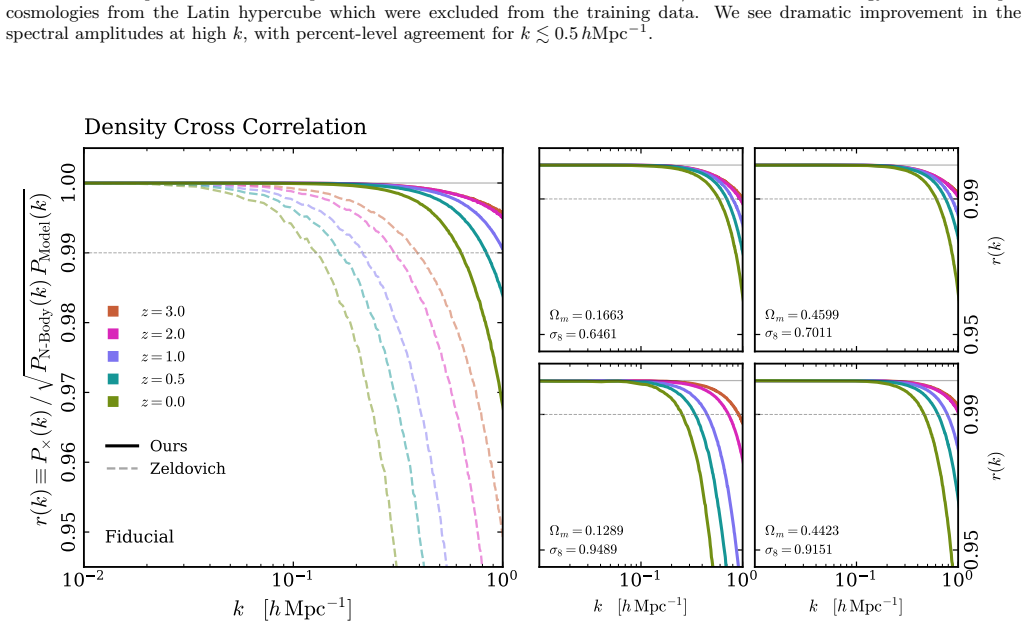
- At z=0 the emulator achieves <1% power-spectrum residuals for k≲0.5 h/Mpc and <1% phase decoherence for k≲0.7 h/Mpc, with better performance at higher redshifts.
- Recovered halo populations match the N-body reference at the high-mass end, while the abundance of low-mass halos is underpredicted.
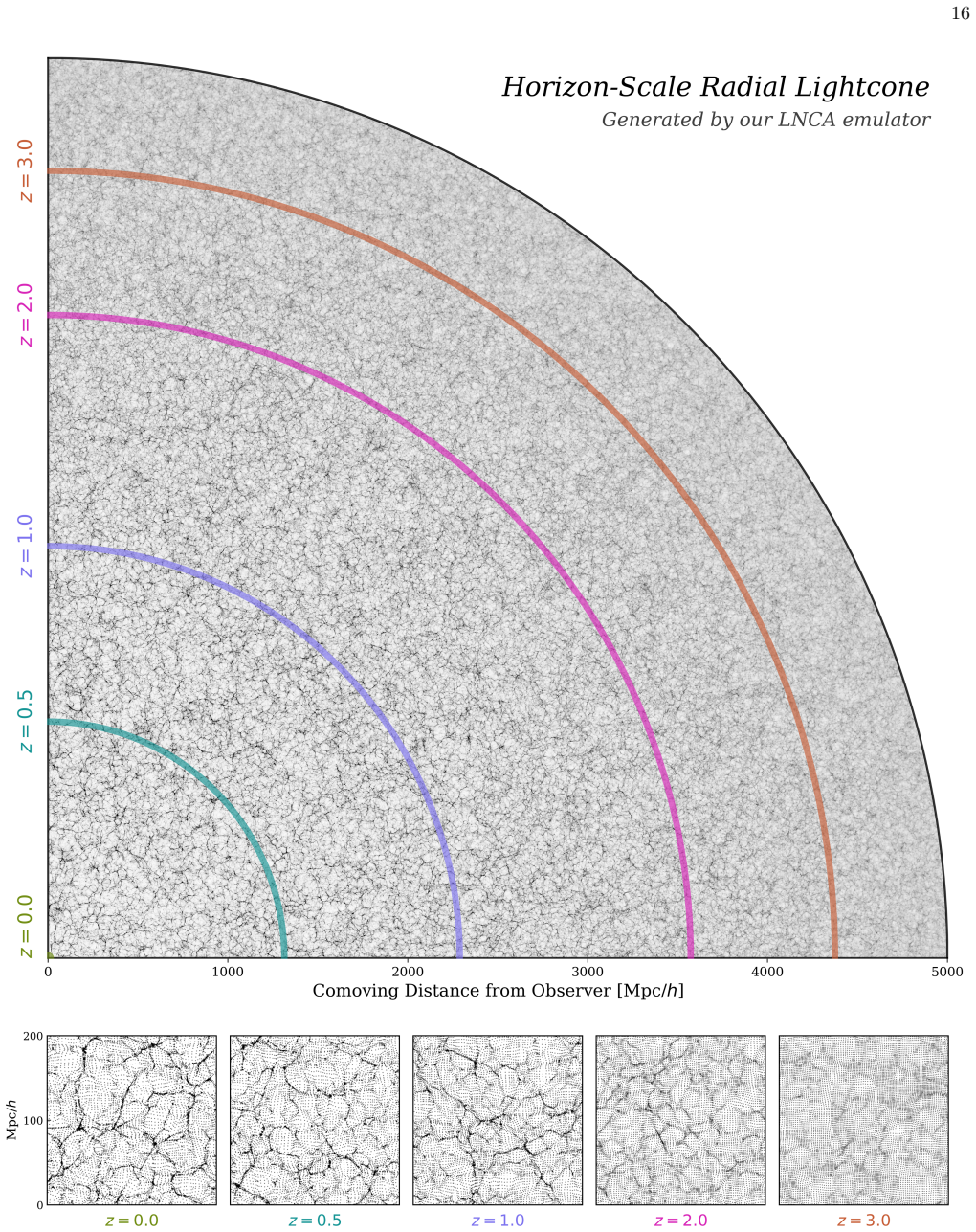
- Because positions and velocities exist at every integration step, lightcone mocks require no additional passes, and velocities are evolved jointly with density, supporting kSZ-type observables.
- The compact polynomial update rule can be inspected: attribution tables show the corrections are driven mainly by local shear amplitude and the coupling of a latent field gradient to the tidal field.
- The model generalizes across a broad range of cosmologies, including held-out extremes of the training distribution, without retraining.
Where Pith is reading between the lines
- If the finite-difference stencils are only exactly equivariant under the discrete octahedral group, the claimed continuous E(3) equivariance is approximate; one could test this by rotating a held-out initial condition by a non-octahedral angle and checking whether r(k) degrades.
- The bounded information propagation means the Jacobian of the emulator is local, so gradient-based sampling could exploit local likelihood curvature to reduce cost; the paper does not discuss this, but it follows directly from the finite-speed lightcone.
- The acknowledged ceiling on internal halo morphology suggests a specific testable route: adding multi-scale neighborhoods or hierarchical message passing should preferentially raise the low-mass halo abundance if the deficit is caused by the receptive-field horizon.
Editorial analysis
A structured set of objections, weighed in public.
Referee Report
Summary. The paper introduces the Lagrangian Neural Cellular Automaton (LNCA), a recurrent, strictly local Lagrangian-frame emulator trained on Quijote Latin Hypercube simulations to predict the residual displacement correction beyond the Zeldovich approximation. The model iterates 32 substeps from z=127 to z=0, with a KAN acting on invariant scalar features and modulating an equivariant vector menu. Validation covers per-particle displacement residuals, power spectra, cross-correlation coefficients, halo mass functions, and a lightcone demonstration, with claims of percent-level fidelity for k ≲ 0.5 h/Mpc at z=0 using only ~4,000 learned parameters.
Significance. If the central claims withstand scrutiny, this is a significant contribution: a ~4,000-parameter recurrent local rule that produces continuous, differentiable trajectories and approaches the accuracy of a 2×10^7-parameter U-Net emulator would be a valuable building block for field-level inference and lightcone construction. The Zeldovich residual decomposition, the fixed Lagrangian connectivity, and the interpretable KAN update are genuine design strengths, and the paper is careful to compare against an established baseline and to test on held-out cosmologies. However, two load-bearing issues must be addressed before the claims as stated can be accepted: the exact E(3) rotational equivariance is not established by the finite-difference construction, and the halo validation is partly circular because the halo loss directly fits the moments used for validation.
major comments (3)
- [§II 'Equivariant Formulation', Eqs. (4)–(5); abstract] The central symmetry claim is overclaimed. The scalar pool and vector menu are built from finite-difference Laplacians, Hessians, and vector products on a fixed cubic q-lattice. Such stencils are equivariant only under the discrete octahedral group of the lattice, not under continuous O(3). For a rotation R outside O_h, the finite-difference derivatives of the rotated input are not the rotated versions of the unrotated derivatives, so the statement that the synthesized updates are 'mathematically guaranteed to be E(3) rotationally equivariant' does not follow. The quoted percent-level validation is performed in the training lattice orientation and cannot detect this symmetry breaking. Please either weaken the claim to discrete octahedral equivariance and add a concrete rotation test (e.g., rotating initial conditions by an angle not a multiple of 90° and checking that all reported metric
- [§II Eq. (11) and §III 'Halo Population'] The halo validation is partly circular. L_Halo is defined by fitting the center-of-mass position, bulk momentum, and position/velocity dispersions of target-identified halos; the validation in Fig. 12 therefore rewards precisely the moments used in training. Additionally, because L_Halo averages only over target halos, it contains no penalty for spurious collapsed objects, so the halo mass function comparison is not an independent test of the model's halo-collapse behavior. Please report halo statistics for an ablation trained without L_Halo, or explicitly state which halo properties are inherited from the loss and which are genuinely emergent.
- [Abstract and §II Eq. (2)] The phrase 'guaranteeing accuracy at large scales' is stronger than the architecture supports. The decomposition Ψ = D(t)Ψ_IC + Ψ_res is an excellent physics prior, but the learned residual is unconstrained and could in principle alter large-scale modes; large-scale fidelity is enforced by the training data, not by construction. Please replace 'guarantee' with a more precise formulation, e.g., 'enforce via the Zeldovich prior', or add an architectural constraint that suppresses long-wavelength residual power. This also affects how the low-k percent-level transfer function results should be interpreted.
minor comments (6)
- [Appendix B, Table II area] The manuscript contains the stray text 'super secret hidden text' after Table II, and repeated 'this text left intentionally' in Appendix C. These placeholders must be removed before submission.
- [Fig. 12 and §III 'Halo Population'] The halo mass function plot has no error bars, although the text claims agreement 'within the Poisson scatter of the reference'. Please add Poisson uncertainties or otherwise quantify the comparison.
- [Eq. (12) and Figs. 10–11] The transfer-function and cross-correlation plots do not show error bars or sample variance. If these are single realizations, state this explicitly and, where possible, show the scatter across test realizations.
- [§IV 'Comparison to Existing Emulators'] The abstract says '~10^4 times fewer learned parameters', but the numbers quoted in §IV give 2×10^7/4×10^3 = 5×10^3. This is acceptable as an order-of-magnitude statement, but 'four orders of magnitude' is the more precise phrasing and avoids an apparent factor-of-two discrepancy.
- [General] A code/data availability statement is absent. Given the reproducibility-focused claims of the paper, please provide a link to the trained model, training code, or at least pseudocode for the update rule.
- [§II and §V] The text has small typographical issues, including 'consrtained' in §II and 'using using' in §II. A careful proofread is needed.
Circularity Check
No significant circularity: the derivation is a supervised training pipeline benchmarked on held-out Quijote cosmologies; the Zeldovich decomposition and halo loss are physics-based targets, not self-referential predictions.
full rationale
The core derivation is a supervised machine-learning pipeline, not a chain of definitions that secretly assumes its own conclusions. The Zeldovich decomposition in Eq. (2), Psi(t) = D(t) Psi_IC + Psi_res(t), is a physics prior: the linear growth term is fixed and externally known, and the network is trained to fit the residual against N-body ground truth. This does not make the validation circular, because the headline power-spectrum and cross-correlation results are reported on data withheld from training: the paper explicitly states for Fig. 10 that the four sample cosmologies are 'excluded from the training data', and Fig. 13 likewise uses cosmologies 'not included in our training set'. The L_Halo loss (Eq. 11) fits halo center-of-mass, bulk momentum, and dispersion moments, but the halo validation uses an independently run friends-of-friends finder on predicted and reference fields and compares mass functions, which is not the same statistic; moreover the high-mass agreement is demonstrated on held-out cosmologies, testing generalization rather than memorization. No load-bearing claim is supported by a self-citation chain: the citations to the authors' own prior work (e.g., [12, 18, 39]) are contextual and do not supply the equivariance construction or the residual-decomposition idea. The paper's main scientifically questionable assertion is the claimed exact continuous E(3) equivariance of finite-difference stencils on a cubic lattice (Section II); that is a correctness or verification concern, not a circularity, since the accuracy numbers do not rely on that guarantee and a rotation test would settle it. Overall, no step in the derivation reduces by construction to its own input; the residual score only reflects a small number of non-load-bearing self-citations.
Axiom & Free-Parameter Ledger
free parameters (8)
- Learned KAN weights (polynomial coefficients) =
≈4×10^3 terms
- KAN polynomial degree pmax =
not specified in main text
- Loss weights and sparsity threshold =
LΨ, Lp, Lδ, LHalo combined; τ_prune=0.01; Group-Lasso ≈1%
- Integration substep count =
32
- Neighborhood size =
26 Moore neighbors
- Crop volume and padding =
96^3 voxels, 200 Mpc/h crops, N_steps padding
- Network widths =
bottleneck 16, hidden 32
- Evolutionary hyperparameters =
16 candidates, 32 generations, 1000 epochs/generation, NSGA-II
axioms (6)
- standard math The Zeldovich displacement plus residual decomposition is a valid backbone; D(t)Ψ_IC from linear theory can be hard-coded.
- domain assumption Information propagation in gravitational structure formation is bounded to a few Mpc/h, so a 32-cell Lagrangian receptive field is sufficient for the claimed accuracy.
- ad hoc to paper Finite-difference derivative operators on a fixed cubic lattice yield exact E(3)-equivariant feature pools.
- domain assumption Cropped 200 Mpc/h training volumes with 96^3 resolution generalize to full 512^3, 1 Gpc/h Quijote boxes.
- domain assumption Quijote N-body simulations are accurate enough ground truth at the target scales.
- domain assumption The scalar pool built from Laplacians, Hessians, and vector products 'spans the complete LPT operator basis' so any polynomial LPT correction is representable.
invented entities (2)
-
Latent scalar fields S_i (L_s channels)
no independent evidence
-
Latent vector fields V_i (L_v × 3 channels)
no independent evidence
read the original abstract
Field-level inference of cosmological initial conditions from galaxy surveys requires a forward model that is simultaneously accurate in the non-linear regime, computationally efficient, and fully differentiable. Traditional N-body simulations are accurate but computationally prohibitive for iterative inference, while approximate solvers like Lagrangian Perturbation Theory (LPT) fail to capture the knotty halo-forming dynamics of the cosmic web at late times. We introduce the \textit{Lagrangian Neural Cellular Automaton} (LNCA), a hybrid deep learning framework that can be applied to emulate structure formation as a local, iterative dynamical process on a comoving lattice. Unlike standard Eulerian Convolutional Neural Networks (CNNs) which map fixed density fields, the LNCA operates in the Lagrangian frame, advecting the computational graph itself to follow the flow of mass. By training the network to learn only the \textit{residual} displacement corrections to the Zeldovich approximation, we achieve high-fidelity emulation of the non-linear physics while guaranteeing accuracy at large scales. We further constrain our model to produce complete trajectories, not just final states, by adopting an equivariant cellular automaton architecture, which recurrently iterates on its internal states to yield a dynamic history. The resulting model is strictly local, translationally and rotationally equivariant, and naturally supports continuous time integration, making it a reliable differentiable forward model for reconstructing the initial conditions of the universe from lightcone data. Our trained model supports percent-level precision in the power and cross spectra well into the non-linear regime ($k \lesssim 0.5 \, h \text{Mpc}^{-1}$), while requiring $\sim10^4$ times fewer learned parameters than comparable models which take the form of an interpretable internal dynamic rule set.
Figures





Reference graph
Works this paper leans on
-
[1]
DESI Collaboration, The DESI experiment part I: Science, targeting, and survey design (2016), arXiv:1611.00036 [astro-ph.IM]
Pith/arXiv arXiv 2016
-
[2]
Laureijset al., Euclid definition study report (2011), arXiv:1110.3193 [astro-ph.CO]
R. Laureijset al., Euclid definition study report (2011), arXiv:1110.3193 [astro-ph.CO]
Pith/arXiv arXiv 2011
-
[3]
O. Dor´ e, J. Bock, M. Ashby, P. Capak, Y.-T. Cheng, R. de Putter, T. Eifler,et al., Cosmology with the spherex all-sky spectral survey (2014), arXiv:1412.4872 [astro-ph.CO]
Pith/arXiv arXiv 2014
-
[4]
D. Spergel, N. Gehrels, C. Baltay, D. Bennett, J. Breck- inridge, M. Donahue, A. Dressler,et al., Wide-field in- frared survey telescope-astrophysics focused telescope assets wfirst-afta 2015 report (2015), arXiv:1503.03757 [astro-ph.IM]
Pith/arXiv arXiv 2015
-
[5]
R. Akeson, L. Armus, E. Bachelet, V. Baker, E. Bartlett, R. Bean,et al., The wide field infrared survey telescope: 100 hubbles for the 2020s (2019), arXiv:1902.05569 [astro-ph.IM]
Pith/arXiv arXiv 2019
-
[6]
LSST Science Collaboration, Lsst science book, version 2.0 (2009), arXiv:0912.0201 [astro-ph.IM]
Pith/arXiv arXiv 2009
-
[7]
Jasche and B
J. Jasche and B. D. Wandelt, Bayesian physical recon- struction of initial conditions from large scale structure surveys, Monthly Notices of the Royal Astronomical So- ciety432, 894 (2013)
2013
-
[8]
H. Wang, H. Mo, X. Yang, Y. Jing, and W. Lin, Elucid- exploring the local universe with the reconstructed initial density field. i. hamiltonian markov chain monte carlo method with particle mesh dynamics, The Astrophysical Journal794, 94 (2014)
2014
-
[9]
Seljak, G
U. Seljak, G. Aslanyan, Y. Feng, and C. Modi, Generative 22 model for cosmological large-scale structure, Journal of Cosmology and Astroparticle Physics2017(12), 009
-
[10]
S. McAlpine, J. Jasche, M. Ata,et al., The manticore project i: a digital twin of our cosmic neighbourhood from bayesian field-level analysis, Mon. Not. Roy. Astron. Soc.540, 716 (2025), arXiv:2505.10682 [astro-ph.CO]
Pith/arXiv arXiv 2025
-
[11]
C. Hahn, M. Eickenberg, S. Ho, J. Hou, P. Lemos, E. Massara, C. Modi, A. Moradinezhad Dizgah, B. R´ egaldo-Saint Blancard, and M. M. Abidi, Simbig: mock challenge for a forward modeling approach to galaxy clustering, Journal of Cosmology and Astropar- ticle Physics2023(04), 010
-
[12]
N.-M. Nguyen, F. Schmidt, B. Tucci, M. Reinecke, and A. Kosti´ c, How much information can be extracted from galaxy clustering at the field level?, Phys. Rev. Lett.133, 221006 (2024), arXiv:2403.03220 [astro-ph.CO]
Pith/arXiv arXiv 2024
-
[13]
C. Modi, Y. Feng, and U. Seljak, Cosmological inference with differentiable forward modeling, Journal of Cosmol- ogy and Astroparticle Physics2021(10), 035
-
[14]
T. Buchert, Lagrangian theory of gravitational instability of friedman-lemaitre cosmologies and the’zel’dovich ap- proximation’, Monthly Notices of the Royal Astronomical Society254, 729 (1992)
1992
-
[15]
Bouchet, S
F. Bouchet, S. Colombi, E. Hivon, and R. Juszkiewicz, Perturbative lagrangian approach to gravitational insta- bility, Astronomy and Astrophysics296, 575 (1995)
1995
-
[16]
Doeser, D
L. Doeser, D. Jamieson, S. Stopyra, G. Lavaux, F. Leclercq, and J. Jasche, Bayesian inference of initial conditions from non-linear cosmic struc- tures using field-level emulators, Monthly Notices of the Royal Astronomical Society535, 1258 (2024), https://academic.oup.com/mnras/article- pdf/535/2/1258/60481350/stae2429.pdf
2024
-
[17]
A. Nusser, Bayesian reconstruction of the local uni- verse from 2mrs: Testing the gravitational flow with cosmicflows-4 (2026), arXiv:2606.08593 [astro-ph.CO]
Pith/arXiv arXiv 2026
-
[18]
Babi´ c, F
I. Babi´ c, F. Schmidt, and B. Tucci, Straightening the ruler: field-level inference of the bao scale with leftfield, Journal of Cosmology and Astroparticle Physics2025 (11), 066
-
[19]
Tassev, M
S. Tassev, M. Zaldarriaga, and D. Eisenstein, Cola: fast cosmological simulations using the lagrangian perturba- tion theory with a particle-mesh algorithm, Journal of Cosmology and Astroparticle Physics2013(06), 036
-
[20]
C. Howlett, M. Manera, and W. J. Percival, L-picola: A parallel code for fast dark matter simulation, As- tron. Comput.12, 109 (2015), arXiv:1506.03737 [astro- ph.CO]
Pith/arXiv arXiv 2015
-
[21]
Y. Feng, M.-Y. Chu, U. Seljak, and P. McDonald, FastPM: a new scheme for fast simulations of dark matter and haloes, MNRAS463, 2273 (2016), arXiv:1603.00476 [astro-ph.CO]
Pith/arXiv arXiv 2016
-
[22]
M. Ntampaka, C. Avestruz, S. Boada, J. Caldeira, J. Cisewski-Kehe, R. D. Stefano, C. Dvorkin, A. E. Evrard, A. Farahi, D. Finkbeiner, S. Genel, A. Good- man, A. Goulding, S. Ho, A. Kosowsky, P. L. Plante, F. Lanusse, M. Lochner, R. Mandelbaum, D. Nagai, J. A. Newman, B. Nord, J. E. G. Peek, A. Peel, B. Poc- zos, M. M. Rau, A. Siemiginowska, D. J. Sutherla...
Pith/arXiv arXiv 2021
-
[23]
J. Kwan, K. Heitmann, S. Habib, N. Padmanabhan, E. Lawrence, H. Finkel, N. Frontiere, and A. Pope, Cos- mic emulation: Fast predictions for the galaxy power spectrum, The Astrophysical Journal810, 35 (2015)
2015
-
[24]
S. He, Y. Li, Y. Feng, S. Ho, S. Ravanbakhsh, W. Chen, and B. P´ oczos, Learning to predict the cosmologi- cal structure formation, Proceedings of the National Academy of Sciences116, 13825 (2019)
2019
-
[25]
Kodi Ramanah, T
D. Kodi Ramanah, T. Charnock, and G. Lavaux, Paint- ing halos from cosmic density fields of dark matter with physically motivated neural networks, Phys. Rev. D100, 043515 (2019)
2019
-
[26]
P. Berger and G. Stein, A volumetric deep convolu- tional neural network for simulation of mock dark matter halo catalogues, Mon. Not. Roy. Astron. Soc.482, 2861 (2019), arXiv:1805.04537 [astro-ph.CO]
Pith/arXiv arXiv 2019
-
[27]
Jamieson, Y
D. Jamieson, Y. Li, R. A. de Oliveira, F. Villaescusa- Navarro, S. Ho, and D. N. Spergel, Field-level neural network emulator for cosmological n-body simulations, The Astrophysical Journal952, 145 (2023)
2023
-
[28]
Ramanah, T
D. Ramanah, T. Charnock, F. Villaescusa-Navarro, and B. D. Wandelt, Super-resolution emulator of cosmological simulations using deep physical models, Monthly Notices of the Royal Astronomical Society495, 4227 (2020), https://academic.oup.com/mnras/article- pdf/495/4/4227/33372045/staa1428.pdf
2020
-
[29]
B. Dai and U. Seljak, Translation and rotation equiv- ariant normalizing flow (TRENF) for optimal cosmologi- cal analysis, MNRAS516, 2363 (2022), arXiv:2202.05282 [astro-ph.CO]
Pith/arXiv arXiv 2022
-
[30]
X. Zhang, P. Lachance, Y. Ni, Y. Li, R. A. C. Croft, T. Di Matteo, S. Bird, and Y. Feng, Ai-assisted superres- olution cosmological simulations iii: time evolution, MN- RAS528, 281 (2024), arXiv:2305.12222 [astro-ph.CO]
Pith/arXiv arXiv 2024
-
[31]
Jamieson, Y
D. Jamieson, Y. Li, F. Villaescusa-Navarro, S. Ho, and D. N. Spergel, Field-level emulation of cosmic structure formation with cosmology and redshift dependence, Jour- nal of Cosmology and Astroparticle Physics2025(03), 072
-
[32]
Tosone, M
F. Tosone, M. C. Neyrinck, B. R. Granett, L. Guzzo, and N. Vittorio, muscle-ups: improved approximations of the matter field with the extended press–schechter formalism and lagrangian perturbation theory, Monthly Notices of the Royal Astronomical Society505, 2999 (2021), https://academic.oup.com/mnras/article- pdf/505/2/2999/38626803/stab1517.pdf
2021
-
[33]
Chartier, B
N. Chartier, B. Wandelt, Y. Akrami, and F. Villaescusa- Navarro, Carpool: fast, accurate computation of large-scale structure statistics by pairing costly and cheap cosmological simulations, Monthly No- tices of the Royal Astronomical Society503, 1897 (2021), https://academic.oup.com/mnras/article- pdf/503/2/1897/36678136/stab430.pdf
2021
-
[34]
Kaushal, F
N. Kaushal, F. Villaescusa-Navarro, E. Giusarma, Y. Li, C. Hawry, and M. Reyes, Necola: Toward a univer- sal field-level cosmological emulator, The Astrophysical Journal930, 115 (2022)
2022
-
[35]
B. Dai and U. Seljak, Multiscale flow for robust and op- timal cosmological analysis, Proc. Nat. Acad. Sci.121, e2309624121 (2024), arXiv:2306.04689 [astro-ph.CO]
Pith/arXiv arXiv 2024
-
[36]
D. J. Bartlett, M. Chiarenza, L. Doeser, and F. Leclercq, COmoving Computer Acceleration (COCA): N-body simulations in an emulated frame of reference, Astron. Astrophys.694, A287 (2025), arXiv:2409.02154 [astro- ph.IM]
Pith/arXiv arXiv 2025
-
[37]
N. Porqueres, A. Heavens, D. Mortlock, and G. Lavaux, 23 Bayesian forward modelling of cosmic shear data, MN- RAS502, 3035 (2021), arXiv:2011.07722 [astro-ph.CO]
Pith/arXiv arXiv 2021
-
[38]
N.-M. Nguyen, J. Jasche, G. Lavaux, and F. Schmidt, Taking measurements of the kinematic Sunyaev- Zel’dovich effect forward: including uncertainties from velocity reconstruction with forward modeling, JCAP 2020(12), 011, arXiv:2007.13721 [astro-ph.CO]
Pith/arXiv arXiv 2020
-
[39]
Villaescusa-Navarro, D
F. Villaescusa-Navarro, D. Angl´ es-Alc´ azar, S. Genel, D. N. Spergel, R. S. Somerville, R. Dave, A. Pillepich, L. Hernquist, D. Nelson, P. Torrey, D. Narayanan, Y. Li, O. Philcox, V. La Torre, A. Maria Delgado, S. Ho, S. Has- san, B. Burkhart, D. Wadekar, N. Battaglia, G. Con- tardo, and G. L. Bryan, The camels project: Cosmology and astrophysics with m...
2021
-
[40]
Wolfram, Statistical mechanics of cellular automata, Rev
S. Wolfram, Statistical mechanics of cellular automata, Rev. Mod. Phys.55, 601 (1983)
1983
-
[41]
Gilpin, Cellular automata as convolutional neural networks, Phys
W. Gilpin, Cellular automata as convolutional neural networks, Phys. Rev. E100, 032402 (2019)
2019
-
[42]
B. Hartl, M. Levin, and L. Pio-Lopez, Neural cellular automata: applications to biology and beyond classical ai, Phys. Life Rev.56, 94 (2026), arXiv:2509.11131
Pith/arXiv arXiv 2026
-
[43]
A. Mordvintsev, E. Randazzo, E. Niklasson, and M. Levin, Growing neural cellular au- tomata, Distill 10.23915/distill.00023 (2020), https://distill.pub/2020/growing-ca
-
[44]
Grattarola, L
D. Grattarola, L. Livi, and C. Alippi, Learning graph cel- lular automata, 35th Conference on Neural Information Processing Systems34, 20983 (2021)
2021
-
[45]
Sanchez-Gonzalez, J
A. Sanchez-Gonzalez, J. Godwin, T. Pfaff, R. Ying, J. Leskovec, and P. Battaglia, Learning to simulate com- plex physics with graph networks, International confer- ence on machine learning , 8459 (2020)
2020
-
[46]
Z. Liu, Y. Wang, S. Vaidya, F. Ruehle, J. Halver- son, M. Soljaˇ ci´ c, T. Y. Hou, and M. Tegmark, Kan: Kolmogorov-arnold networks (2025), arXiv:2404.19756 [cs.LG]
Pith/arXiv arXiv 2025
-
[47]
Z. Liu, M. Tegmark, P. Ma, W. Matusik, and Y. Wang, Kolmogorov-arnold networks meet science, Phys. Rev. X 15, 041051 (2025)
2025
-
[48]
Villaescusa-Navarro, C
F. Villaescusa-Navarro, C. Hahn, E. Massara, A. Baner- jee, A. M. Delgado, D. K. Ramanah, T. Charnock, E. Giusarma, Y. Li, E. Allys, A. Brochard, C. Uhlemann, C.-T. Chiang, S. He, A. Pisani, A. Obuljen, Y. Feng, E. Castorina, G. Contardo, C. D. Kreisch, A. Nicola, J. Alsing, R. Scoccimarro, L. Verde, M. Viel, S. Ho, S. Mallat, B. Wandelt, and D. N. Sperge...
2020
-
[49]
Y. Li, L. Lu, C. Modi, D. Jamieson, Y. Zhang, Y. Feng, W. Zhou, N. P. Kwan, F. Lanusse, and L. Greengard, pmwd: A differentiable cosmological particle-meshN- body library, arXiv e-prints (2022), arXiv:2211.09958 [astro-ph.CO]
Pith/arXiv arXiv 2022
-
[50]
L. Thiele, M. Cranmer, W. Coulton, S. Ho, and D. N. Spergel, Predicting the thermal sunyaev-zel’dovich field using modular and equivariant set-based neural networks (2022), arXiv:2203.00026 [astro-ph.CO]
Pith/arXiv arXiv 2022
discussion (0)
Sign in with ORCID, Apple, or X to comment. Anyone can read and Pith papers without signing in.