REVIEW 3 major objections 5 minor 1 cited by
Keeping the full history of diagnoses, revisions, and evidence lets agents keep improving skills across sessions without rediscovering past rationale.
Reviewed by Pith at T0; open to challenge. T0 means a machine referee read the full paper against a public rubric. the ladder, T0–T4 →
T0 review · grok-4.5
2026-07-12 14:40 UTC pith:FBZJNKBV
load-bearing objection Useful systems paper on skill maintenance via decision history; within-setting gains and ablations are solid, commercial-agent headline is confounded. the 3 major comments →
SkillHone: A Harness for Continual Agent Skill Evolution Through Persistent Decision History
The pith
A machine-rendered reading of the paper's core claim, the machinery that carries it, and where it could break.
Core claim
The central claim is that continual skill maintenance requires persistent decision history, not only an optimized artifact: by pairing skill revisions with evaluation-side practice feedback and recording diagnoses, revisions, redacted evidence, and outcomes under role-separated subagents, later agents can continue improvement across sessions without re-deriving prior rationale, and the resulting skills outperform both commercial deep-research agents (in the raw open-web setting) and prior skill-evolution baselines.
What carries the argument
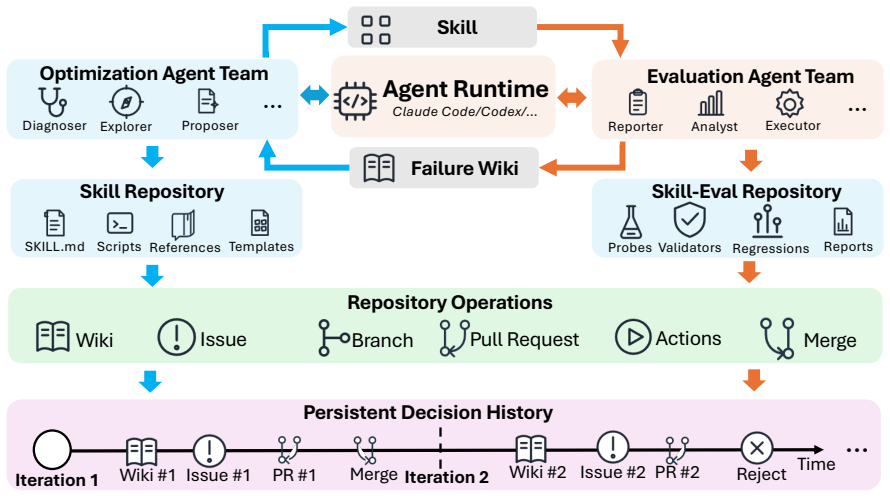
Persistent decision history: each step is a record ht = (diagnosis qt, candidate revision rt, redacted evidence et, outcome ot), accumulated across sessions while optimization and evaluation subagents operate under separated permissions so practice probes do not become memorization targets.
Load-bearing premise
The headline win over a commercial deep-research agent assumes that gap is mainly due to the decision-history harness rather than unequal retrieval stacks, development controllers, or evaluation protocols.
What would settle it
Re-run the GAIA and WebWalkerQA comparison with SkillHone and the commercial agent on identical retrieval tools, the same development and evaluation models, and matched compute; if the 15.8-point GAIA gap disappears while the within-setting ablations of decision history still hold, the cross-setting claim fails.
Editorial analysis
A structured set of objections, weighed in public.
Referee Report
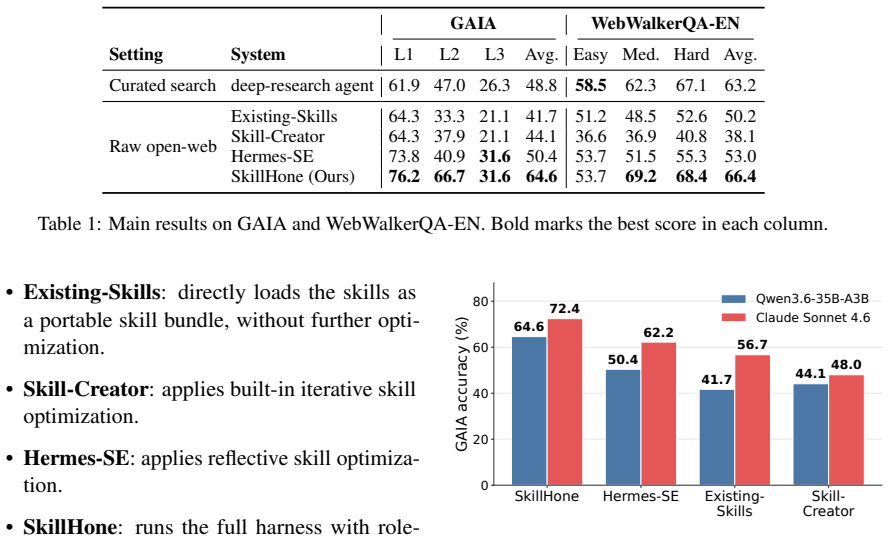
Summary. The paper proposes SkillHone, a harness for continual evolution of agent skills that retains structured decision history rather than only the final skill artifact. Each development step records a decision tuple (diagnosis, candidate revision, redacted evaluation evidence, outcome) linking a skill repository to a skill-evaluation repository. Role-separated optimization and evaluation subagents, with redacted reporting, generate these records so later sessions can continue refinement without re-deriving prior rationale. Empirically, under a raw open-web setting with a shared community skill pool and fixed Qwen3.6-35B-A3B execution backbone, SkillHone reaches 64.6% on GAIA and 66.4% on WebWalkerQA-EN, exceeding Existing-Skills, Skill-Creator, and Hermes-SE; it also reports 15.8/3.2 point gains over a curated-search commercial deep-research agent and +18.8 points average on seven internal tool-mediated analysis scenarios, with ablations attributing larger drops to removing decision history than role separation, and transfer of the skill bundle to Claude Sonnet 4.6 without re-optimization.
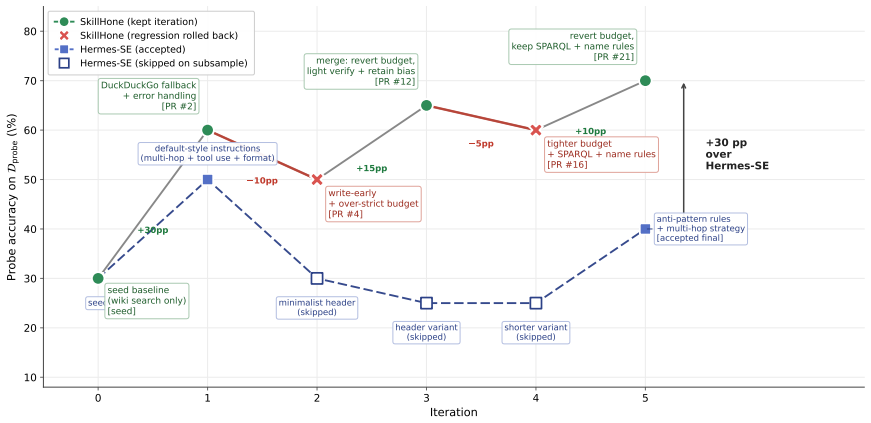
Significance. If the within-setting results hold, the work identifies a practical gap in artifact-only skill optimization and supplies a portable, permission-bounded harness that makes skill maintenance auditable across sessions. The ablations (Table 2), shared seed pool, fixed evaluation backbone, probe trajectory with scoped reverts (Figure 4 / Appendix C), and cross-backbone transfer without re-optimization are concrete strengths that go beyond a single optimized prompt. The internal deployment study further suggests the harness is not limited to public web benchmarks. The contribution is systems-level rather than theoretical, but it is timely for agent skill frameworks (Claude Code, Codex, Hermes) where long-lived skills must survive API and environment change.
major comments (3)
- Abstract, Table 1, and §3.3 headline that SkillHone “outperforms the commercially backed deep-research agent by 15.8 points on GAIA and 3.2 on WebWalkerQA-EN” while running without a pre-integrated search stack. §3.1 explicitly contrasts curated commercial retrieval with raw open-web public pages and community skills, and §3.2 uses Claude Opus 4.6 as development controller versus Qwen3.6-35B-A3B for evaluation. That comparison is confounded by tool stack and protocol; it should be reframed as a secondary, non-matched reference rather than the primary claim. The load-bearing evidence is the within-setting gaps vs Existing-Skills / Skill-Creator / Hermes-SE and the Table 2 ablations.
- §3.2–3.4 and free parameters of the setup: optimization budget T, acceptance policy, and practice-probe composition are not fully specified for the main runs (only illustrated for one trajectory in Appendix B–C). Because decision history and redacted probes are the claimed mechanisms, the paper should state probe provenance (overlap with GAIA/WebWalkerQA), number of iterations, and acceptance rules used for Table 1, and ideally report sensitivity of final scores to these choices. Without that, reproducibility of the headline within-setting gains is incomplete even though the ablation design is otherwise careful.
- §3.5 / Table 3 deployment study: gains of +18.8 average across seven internal scenarios are reported with exact-match accuracy, but Appendix F only sketches de-identified requests and LLM+human reference answers. For a load-bearing secondary claim, the paper needs clearer scenario definitions, evaluation-set sizes, seed-skill baselines, and whether probes used during SkillHone optimization overlap the reported test sets. List filtering at +0.0 also warrants a short failure analysis so the average is not over-read.
minor comments (5)
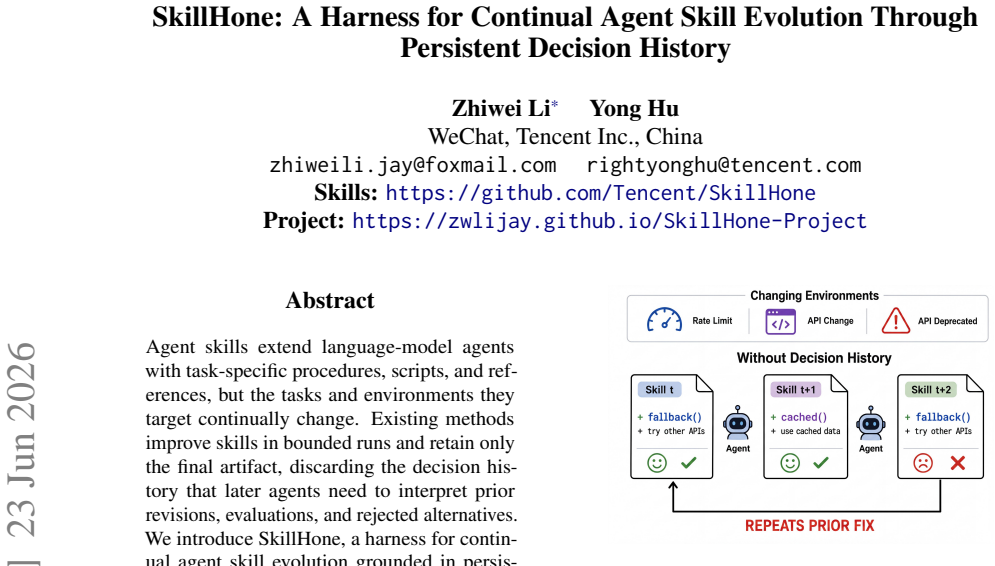
- Figure 1 is conceptual but sparse; a short caption walkthrough tying it to a concrete obsolete-fix example (rate limits / API deprecation) would help readers who skip §1.
- Algorithm 1 uses APPLY and redacted ˜E_t without a precise interface contract; a one-line definition of what Redact may and may not expose (Appendix D) should be cross-referenced in the main text.
- Table 4 line-count aggregates are useful, but the issue/PR numbering jumps (#1–#2 then #11, #15, #19); a note that intermediate issues were diagnostic-only would avoid confusion.
- Related Work cites GEPA and Hermes-SE appropriately; a brief explicit contrast with Reflexion-style verbal memory would clarify why decision records are not just longer traces.
- Limitations correctly notes single-skill isolation; mentioning whether decision history scales with multi-skill shared resources would strengthen the forward-looking paragraph.
Circularity Check
Empirical systems paper with external benchmarks and redacted practice probes; no derivation reduces a claimed prediction to its own inputs by construction.
full rationale
SkillHone is a harness for skill evolution (role-separated subagents, redacted evaluation feedback, persistent decision history H_t = {(q_t, r_t, e_t, o_t)}). Its load-bearing claims are empirical scores on GAIA and WebWalkerQA-EN and internal exact-match scenarios, not first-principles predictions. The method does not define success metrics in terms of the reported outcomes: practice feedback uses a skill-evaluation repository with redacted reports, and Appendix D states that final benchmark evaluation remains outside the optimization loop. Ablations (Table 2) and within-setting baselines (Existing-Skills, Skill-Creator, Hermes-SE) are independent of the method definition. There is no self-definitional equation, no fitted parameter renamed as a prediction, no uniqueness theorem imported from the authors, and no load-bearing self-citation chain. Confounds in the commercial deep-research comparison (curated search vs raw open-web) are experimental-design fairness issues, not circularity. Per the analyzer rules, this is an honest non-finding: score 0, no circular steps.
Axiom & Free-Parameter Ledger
free parameters (4)
- Optimization iteration budget T and acceptance policy
- Practice probe suite composition
- Development vs execution model pair (Claude Opus 4.6 controller; Qwen3.6-35B-A3B eval backbone)
- Seed community skill pool selection
axioms (4)
- domain assumption An agent runtime can launch scoped, permission-bounded subagent dispatches that separate skill-repository writes from unredacted evaluation assets.
- domain assumption Redacted evaluation reports retain enough diagnostic signal for useful skill revision without exposing oracle targets/validators/traces as memorization targets.
- domain assumption Exact-match accuracy on fixed public/internal evaluation sets is a valid proxy for skill quality under continual maintenance.
- standard math Standard multi-agent role specialization and repository workflows (issues/PRs/merges) can implement auditable decision history.
invented entities (3)
-
SkillHone harness M = (T_opt, T_eval, D)
no independent evidence
-
Decision record h_t = (q_t, r_t, e_t, o_t) and history H_t
no independent evidence
-
Linked skill repository and skill-evaluation repository with redacted reporting
no independent evidence
Cite this review
Pith. "Pith review of SkillHone: A Harness for Continual Agent Skill Evolution Through Persistent Decision History." pith.science (2026). https://pith.science/paper/FBZJNKBV
@misc{pith2026260608671,
  author       = {Pith},
  title        = {Pith review of: SkillHone: A Harness for Continual Agent Skill Evolution Through Persistent Decision History},
  year         = {2026},
  howpublished = {\url{https://pith.science/paper/FBZJNKBV}},
  note         = {Machine review of arXiv:2606.08671}
}
read the original abstract
Agent skills extend language-model agents with task-specific procedures, scripts, and references, but the tasks and environments they target continually change. Existing methods improve skills in bounded runs and retain only the final artifact, discarding the decision history that later agents need to interpret prior revisions, evaluations, and rejected alternatives. We introduce SkillHone, a harness for continual agent skill evolution grounded in persistent decision history. SkillHone pairs skill revisions with evaluation-side evidence that supplies practice feedback, recording structured histories of diagnoses, revisions, evidence, and outcomes. Role-separated subagents run candidate skills on practice probes with redacted reporting and propose revisions informed by prior decisions, enabling cross-session refinement without rediscovering past rationale. On deep-research benchmarks, SkillHone runs without a pre-integrated search stack and outperforms the commercially backed deep-research agent by 15.8 points on GAIA and 3.2 points on WebWalkerQA-EN, while also exceeding prior skill-evolution methods. We further deploy SkillHone on internal tool-mediated analysis scenarios, where it improves accuracy by an average of 18.8 points across seven settings.
Figures
Forward citations
Cited by 1 Pith paper
-
Rethinking Self-Evolving Agent Skills: Feedback Dynamics over Multiple Rounds
Persistent agent skill evolution is sparse, validation-filtered search whose gains depend strongly on model, benchmark, and which feedback (failures versus successes) is shown.
Reference graph
Works this paper leans on
-
[1]
Xingyan Liu, Xiyue Luo, Linyu Li, Ganghong Huang, Jianfeng Liu, and Honglin Qiao
Agent skills: A data-driven analysis of claude skills for extending large language model functional- ity.arXiv preprint arXiv:2602.08004. Xingyan Liu, Xiyue Luo, Linyu Li, Ganghong Huang, Jianfeng Liu, and Honglin Qiao. 2026. Skill- forge: Forging domain-specific, self-evolving agent skills in cloud technical support.arXiv preprint arXiv:2604.08618. Grégo...
arXiv 2026
-
[2]
Skill-r1: Agent skill evolution via reinforce- ment learning.arXiv preprint arXiv:2605.09359. Lei Wang, Chen Ma, Xueyang Feng, Zeyu Zhang, Hao Yang, Jingsen Zhang, Zhiyuan Chen, Jiakai Tang, Xu Chen, Yankai Lin, and 1 others. 2024. A survey on large language model based autonomous agents. Frontiers of Computer Science, 18(6):186345. Jialong Wu, Wenbiao Yi...
Pith/arXiv arXiv 2024
discussion (0)
Sign in with ORCID, Apple, or X to comment. Anyone can read and Pith papers without signing in.