REVIEW 3 major objections 5 minor 1 cited by
Rethinking zero-shot navigation as a VLM tool-calling harness lifts success rate to 55% on the R2R-CE benchmark.
Reviewed by Pith at T0; open to challenge. T0 means a machine referee read the full paper against a public rubric. the ladder, T0–T4 →
T0 review · deepseek-v4-flash
2026-08-02 11:52 UTC pith:F5URKEP6
load-bearing objection Clean tool-calling redesign of zero-shot VLN-CE, but the 11-point SOTA gain is a single-run result on 100 episodes and needs more evidence before I'd trust it. the 3 major comments →
AgenticNav: Zero-Shot Vision-and-Language Navigation as a Tool-Calling Harness
The pith
A machine-rendered reading of the paper's core claim, the machinery that carries it, and where it could break.
Core claim
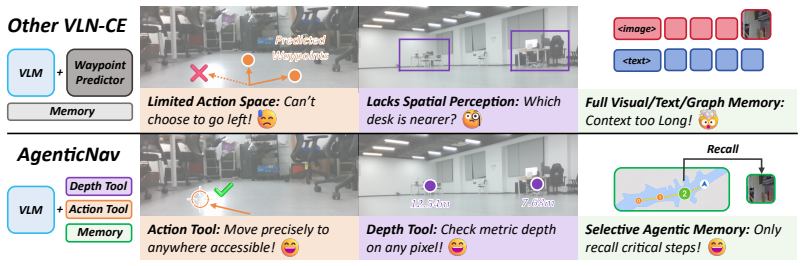
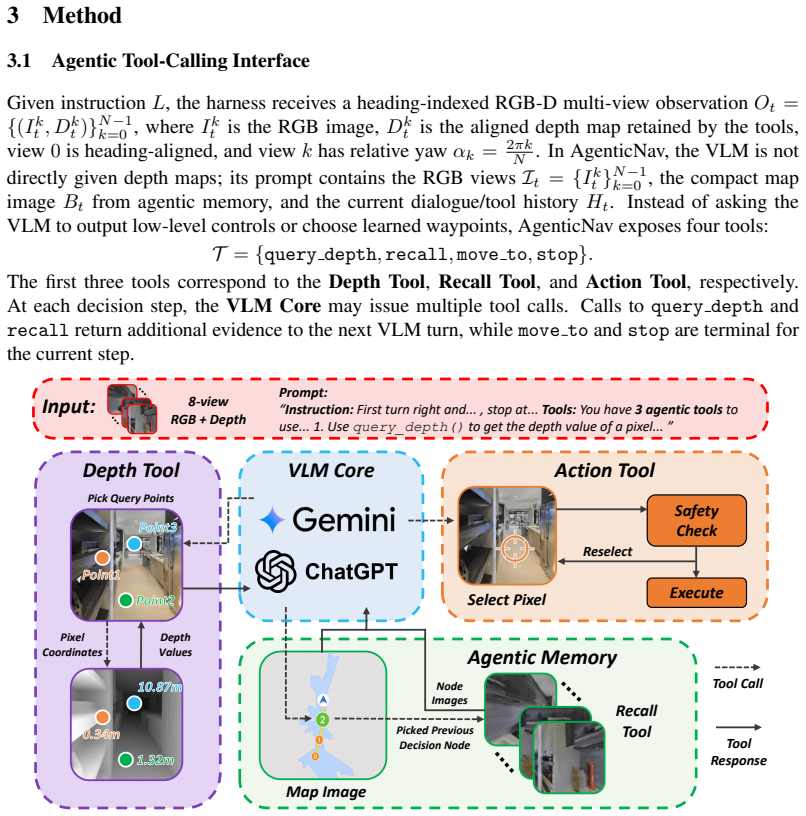
Zero-shot VLN-CE can be solved more effectively by an agentic harness that exposes action, depth, and memory as tools than by the dominant waypoint-predictor-plus-VLM design. The action tool back-projects the VLM's chosen pixel through camera intrinsics and depth to produce a continuous motion (turn angle and forward distance), with a geometric safety check that rejects motions whose swept corridor contains body-height points. The depth tool returns metric depth and local statistics for queried pixels, giving the VLM precise spatial evidence without dumping dense depth maps into its prompt. The memory module keeps a compact map image in the prompt plus a recall tool that retrieves previously
What carries the argument
The Action Tool—move to(k, u, v)—is the central object. The VLM selects a pixel in one of the panoramic RGB views; the harness unprojects that pixel into 3D using depth and camera calibration, converts it to a ground-plane bearing and executable forward distance, and runs a swept-corridor safety check over body-height back-projected points. This converts the VLM's visual selection into a concrete robot motion without a trained waypoint predictor, and is what lets the model choose any visible location rather than only proposed candidates.
Load-bearing premise
The load-bearing premise is that the VLM can reliably pick the instruction-relevant pixel in the RGB view and that the depth at that pixel is navigable floor—the geometric safety check only rejects collisions in a swept corridor, so a semantically wrong but geometrically safe pixel will move the robot in the wrong direction.
What would settle it
Construct episodes where the target is visible but a geometrically safe, semantically wrong floor pixel lies along the instruction path (e.g., a glass partition or a floor region on the wrong side of a boundary). If a VLM-equipped harness repeatedly selects that safe-but-wrong pixel and fails, while waypoint-predictor baselines succeed, the claim that pixel-level action grounding is sufficient collapses. Alternatively, an offline analysis of failed episodes: if the agent's selected pixels are typically semantically wrong but geometrically safe, that confirms the bottleneck.
If this is right
- Removing the trained waypoint predictor and letting the VLM pick a target pixel directly improves success, from 44% to 55% SR with the same VLM backbone.
- Exposing depth as an on-demand pixel query is more effective for the VLM than feeding dense depth images: the ablation drops to 42% SR with no depth, and adding depth images only partially recovers the loss.
- A compact trajectory map plus selective visual recall beats accumulating long histories and beats map-only memory, raising SR from 41% (no memory) to 51% (map only) and 55% (full memory).
- The tool harness is not tied to one VLM: a 27B open model still reaches 35% SR, and a mid-tier commercial VLM outperforms prior zero-shot waypoint-predictor methods under the stricter episodic zero-shot setting.
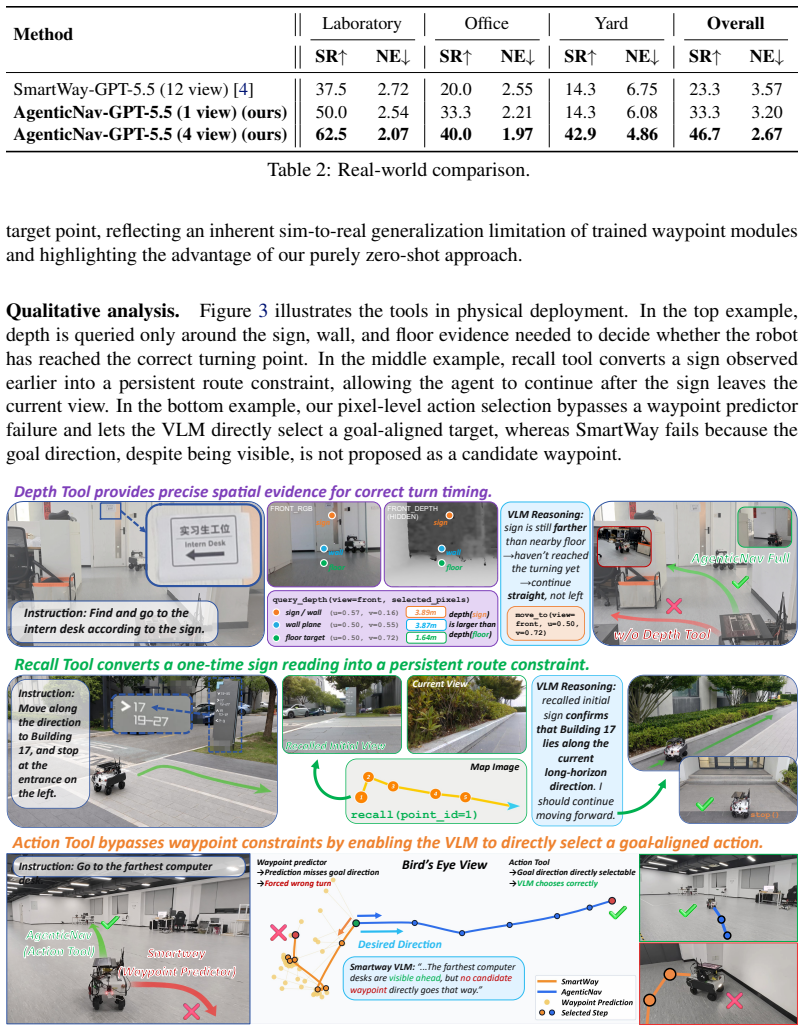
- Real-robot trials with fewer panorama views (1 or 4 versus 12) double the success rate over the waypoint-predictor baseline in 30 novel episodes spanning lab, office, and outdoor scenes.
Where Pith is reading between the lines
- If harness design is as decisive as model scale, the next gains in zero-shot embodied agents may come from richer tool semantics—e.g., a tool that verifies the selected pixel is floor or landmark before acting, which could attack the paper's own 88.9%-of-failures VLM-decision bottleneck.
- The pixel-to-motion pattern (select a visual target, back-project with depth, safety-check geometrically) is general and could transfer to other continuous visuomotor tasks, such as pick-and-place goal selection or semantic grasping, where VLMs can point but not control.
- The on-demand numeric depth tool suggests a design principle for VLMs in metric-sensitive tasks: give the model a query interface to small quantitative facts rather than a dense sensor image; this is testable on other depth-reasoning benchmarks.
- A testable extension: add a semantic confirmation step that asks the VLM to double-check the chosen pixel's category before executing, then measure whether the VLM-decision failure share drops.
Editorial analysis
A structured set of objections, weighed in public.
Referee Report
Summary. AgenticNav proposes a zero-shot VLN-CE harness that replaces the learned waypoint predictor with a tool-calling interface. The VLM selects target pixels in panoramic RGB views, queries metric depth on demand, and selectively recalls past visual observations from a compact memory; the harness converts the pixel choice into a continuous motion command via deterministic depth unprojection and a geometric safety check. The paper reports 55% SR / 48.41% SPL on the R2R-CEval unseen 100-episode protocol with GPT-5.5, claiming state-of-the-art zero-shot performance under the same VLM backbone, and reports real-world results on 30 episodes. Ablations attribute gains to the action tool, the depth tool, and the selective recall mechanism.
Significance. If the results are reproducible, the contribution is valuable: the design is genuinely waypoint-free, keeps geometric execution deterministic, and does not fit free parameters to the benchmark. The same-backbone SmartWay comparison and the ablation design are sensible and internally consistent. The paper also ships a real-world validation, which is uncommon. However, the central SOTA claim rests on a single run of 100 simulated episodes and 30 real episodes, and several key comparisons are within plausible sampling noise; the load-bearing premise that VLM pixel selection gives semantically correct navigable targets is not independently verified. The idea is promising, and the deterministic grounding is a strength, but the current evidence is not yet sufficient for a definitive accept.
major comments (3)
- [§4.1, Tables 1 and 3] The central claim of new SOTA performance is supported by a single run on 100 episodes. With SR near 50%, the standard error of the difference between the 55% AgenticNav and 44% SmartWay reproduction is roughly 7 percentage points, so the headline 11-point gain is within 1.6 standard errors. Several ablation deltas in Table 3 (55 vs 50, 55 vs 51) are within 1 standard error, and even the larger deltas are borderline. The paper does not report whether VLM decoding is deterministic (e.g., temperature 0), nor any confidence intervals, variance, or paired per-episode statistics. Please report the number of runs, paired McNemar/Wilcoxon tests, and the decoding temperature. Without this, the claimed superiority of the harness over the SmartWay reproduction is not yet established.
- [§3.4 Action Tool, §6 Limitations] The method relies on the VLM selecting an instruction-relevant pixel whose back-projected depth corresponds to a navigable floor location. The safety check only rejects motions whose swept corridor contains body-height depth points; it does not verify that the selected pixel is semantically correct or lies on the floor. A geometrically safe but semantically wrong pixel can move the robot in the wrong direction. The failure analysis in §6 attributes 88.9% of simulation failures to VLM decisions, but this does not quantify how often the action tool receives a wrong-pixel selection, how often Reselect corrects it, or how often depth queries mislead the VLM. Please provide a breakdown of action-tool failure modes and the rate of Reselect feedback.
- [§4.1, Table 1] The main comparison is against 'SmartWay-GPT-5.5*', which is the authors' own reproduction. The paper does not release the exact prompt, waypoint-predictor checkpoint and thresholds, stop criteria, or episode bookkeeping used in this reproduction. Because the headline gain is computed relative to this author-run baseline, the comparison cannot be independently verified. Please provide the reproduction configuration, code, or at minimum a detailed protocol describing how the baseline's waypoint predictor and stop decision were instantiated on the same 100 episodes.
minor comments (5)
- [Tables 1 and 3] The nDTW and NE columns are concatenated as '63.415.19' in several rows; missing column separation makes the table hard to read.
- [§3.2] The notation 's5×5_i' is introduced without a clear definition of the tuple structure. It later says 'minimum, mean, and median depth' but the notation is not explicitly tied to those quantities.
- [§4.1] The protocol is described as 'the exact same 100 R2R-CEval unseen episodes' from [3,4,5]. Please clarify whether these are a standard official split or a custom subset, and whether the episode IDs are available for reproducibility.
- [§4.2] Real-world results are based on 30 episodes with no confidence intervals or per-scene significance tests. While presented as a demonstration, the 23.3% to 46.7% overall SR difference should be interpreted with caution; please state the sample size limitation explicitly.
- [§3.4] The safety corridor condition in Eq. (1) is defined for the proposed forward motion, but it is not stated how the robot's final orientation or the turning trajectory is checked. Please clarify whether the swept volume accounts for the rotation phase before translation.
Circularity Check
No circular derivation; AgenticNav is a deterministic tool harness with no parameters fitted to the benchmark.
full rationale
The paper's central claim is an empirical comparison of a tool-calling harness on R2R-CE. The action tool, depth tool, safety check, and map/recall memory are all deterministic, parameter-free geometric or bookkeeping operations (Sections 3.2–3.4); no free parameter is fitted to the evaluation episodes. The VLM's pixel choice is an open decision, not a quantity derived from the metric being predicted. The ablations compare tool variants under the same backbone, and the 'SmartWay-GPT-5.5*' baseline is an author-run reproduction, which is a reproducibility concern but not circularity—the baseline is an external method, not an input to AgenticNav's design. There is no instance where a prediction is equivalent to its input by construction, no fitted value renamed as a prediction, and no load-bearing self-citation chain; the cited related works are external baselines and prior art, and the authors do not invoke their own prior uniqueness or ansatz results to justify the harness. The paper is self-contained against the external R2R-CE benchmark and reports standard metrics, so the honest finding is no significant circularity.
Axiom & Free-Parameter Ledger
free parameters (3)
- Geometric execution constants (stopping margin m, max-step rho_max, step discretization Delta) =
not reported
- Safety-check bounds (agent radius r_a, body-height interval [y_min, y_max]) =
not reported
- Number of panoramic views N =
8 in simulation; 1 or 4 in real-world
axioms (5)
- standard math Perspective camera model and depth unprojection p_t = T_k (d K^{-1} [x,y,1]^T)
- domain assumption Depth maps are metric and aligned with RGB in simulation and on the real sensor
- domain assumption The VLM can map language-referenced locations to pixel coordinates in multi-view RGB images
- domain assumption The environment is locally traversable along the back-projected straight corridor, and the safety sweep detects all obstacles
- domain assumption The 100 R2R-CEval episodes are representative and the exact same protocol is used across compared methods
read the original abstract
Zero-shot vision-and-language navigation in continuous environments (VLN-CE) has recently become feasible with large vision-language models (VLMs). However, existing methods typically rely on learned waypoint predictors to propose navigable actions. This severely limits the model's action space and fails to leverage depth inputs effectively. Moreover, memory is commonly handled by accumulating long textual or visual histories with substantial irrelevant context, or by retrieving cross-episode experiences, which weakens the zero-shot setting. In this paper, we rethink zero-shot VLN-CE as an agentic interface between the VLM and the environment, and present AgenticNav, a lightweight navigation harness that exposes action, depth, and memory as callable tools. Instead of choosing from predicted waypoints, the action tool allows the VLM to directly select a target pixel in RGB observations, converting it into executable motion. Depth is exposed through an on-demand pixel-depth tool, enabling the VLM to request precise metric distances only where they matter. For memory, AgenticNav provides a compact map image summarizing the historical trajectory, paired with a recall tool that allows the VLM to selectively revisit past visual observations without overwhelming the prompt context. On the R2R-CE benchmark, AgenticNav establishes new state-of-the-art (SOTA) performance among zero-shot methods given the same VLM backbone. Real-world validation further highlights its zero-shot generalization compared to prior methods. Ablations show that our action tool design outperforms traditional waypoint predictors, and that depth tool and agentic memory further contribute to navigation performance.
Figures
Forward citations
Cited by 1 Pith paper
-
Embodied Agents Take Control: Minimal-Interface Zero-Shot Agents Rival Industrial-Scale Policies in Vision-and-Language Navigation
Unmodified software-agent harnesses, given only a monocular RGB camera and four discrete actions, achieve 68–78% success on zero-shot R2R-CE navigation, rivaling trained and workflow-based systems.
Reference graph
Works this paper leans on
-
[1]
Anderson, Q
P. Anderson, Q. Wu, D. Teney, J. Bruce, M. Johnson, N. S ¨underhauf, I. Reid, S. Gould, and A. van den Hengel. Vision-and-language navigation: Interpreting visually-grounded naviga- tion instructions in real environments. InProceedings of the IEEE Conference on Computer Vision and Pattern Recognition (CVPR), 2018
2018
-
[2]
Krantz, E
J. Krantz, E. Wijmans, A. Majumdar, D. Batra, and S. Lee. Beyond the nav-graph: Vision-and- language navigation in continuous environments. InProceedings of the European Conference on Computer Vision (ECCV), 2020
2020
-
[3]
Y . Qiao, W. Lyu, H. Wang, Z. Wang, Z. Li, Y . Zhang, M. Tan, and Q. Wu. Open-nav: Exploring zero-shot vision-and-language navigation in continuous environment with open-source llms. In Proceedings of the IEEE International Conference on Robotics and Automation (ICRA), 2025
2025
-
[4]
X. Shi, Z. Li, W. Lyu, J. Xia, F. Dayoub, Y . Qiao, and Q. Wu. Smartway: Enhanced waypoint prediction and backtracking for zero-shot vision-and-language navigation. InProceedings of the IEEE/RSJ International Conference on Intelligent Robots and Systems (IROS), 2025
2025
-
[5]
G. Dai, S. Wang, Z. Wang, G.-S. Xie, Y . Yang, J. Pan, Q. Sun, and X. Shu. History to fu- ture: Evolving agent with experience and thought for zero-shot vision-and-language naviga- tion. InProceedings of the IEEE/CVF Conference on Computer Vision and Pattern Recognition (CVPR), June 2026
2026
-
[6]
Fried, R
D. Fried, R. Hu, V . Cirik, A. Rohrbach, J. Andreas, L.-P. Morency, T. Berg-Kirkpatrick, K. Saenko, D. Klein, and T. Darrell. Speaker-follower models for vision-and-language navi- gation. InAdvances in Neural Information Processing Systems (NeurIPS), 2018
2018
-
[7]
C.-Y . Ma, Z. Wu, G. AlRegib, C. Xiong, and Z. Kira. The regretful agent: Heuristic-aided navigation through progress estimation. InProceedings of the IEEE Conference on Computer Vision and Pattern Recognition (CVPR), 2019
2019
-
[8]
F. Zhu, Y . Zhu, X. Chang, and X. Liang. Vision-language navigation with self-supervised auxiliary reasoning tasks. InProceedings of the IEEE Conference on Computer Vision and Pattern Recognition (CVPR), 2020
2020
-
[9]
W. Hao, C. Li, X. Li, L. Carin, and J. Gao. Towards learning a generic agent for vision-and- language navigation via pre-training. InProceedings of the IEEE Conference on Computer Vision and Pattern Recognition (CVPR), 2020
2020
-
[10]
Guhur, M
P.-L. Guhur, M. Tapaswi, S. Chen, I. Laptev, and C. Schmid. Airbert: In-domain pretraining for vision-and-language navigation. InProceedings of the IEEE/CVF International Conference on Computer Vision (ICCV), 2021
2021
-
[11]
Z. Wang, J. Li, Y . Hong, Y . Wang, Q. Wu, M. Bansal, S. Gould, H. Tan, and Y . Qiao. Scaling data generation in vision-and-language navigation. InProceedings of the IEEE/CVF Interna- tional Conference on Computer Vision (ICCV), 2023
2023
-
[12]
Krantz, A
J. Krantz, A. Gokaslan, D. Batra, S. Lee, and O. Maksymets. Waypoint models for instruction- guided navigation in continuous environments. InProceedings of the IEEE/CVF International Conference on Computer Vision (ICCV), 2021
2021
-
[13]
Y . Hong, Z. Wang, Q. Wu, and S. Gould. Bridging the gap between learning in discrete and continuous environments for vision-and-language navigation. InProceedings of the IEEE/CVF Conference on Computer Vision and Pattern Recognition (CVPR), 2022
2022
-
[14]
Chen, P.-L
S. Chen, P.-L. Guhur, M. Tapaswi, C. Schmid, and I. Laptev. Think global, act local: Dual- scale graph transformer for vision-and-language navigation. InProceedings of the IEEE/CVF Conference on Computer Vision and Pattern Recognition (CVPR), 2022. 9
2022
-
[15]
D. An, Y . Qi, Y . Li, Y . Huang, L. Wang, T. Tan, and J. Shao. Bevbert: Multimodal map pre-training for language-guided navigation. InProceedings of the IEEE/CVF International Conference on Computer Vision (ICCV), 2023
2023
-
[16]
D. An, H. Wang, W. Wang, Z. Wang, Y . Huang, K. He, and L. Wang. Etpnav: Evolving topological planning for vision-language navigation in continuous environments.IEEE Trans- actions on Pattern Analysis and Machine Intelligence (TPAMI), 47(7), 2025
2025
-
[17]
Z. Wang, X. Li, J. Yang, Y . Liu, and S. Jiang. Gridmm: Grid memory map for vision-and- language navigation. InProceedings of the IEEE/CVF International Conference on Computer Vision (ICCV), 2023
2023
-
[18]
Zheng, S
D. Zheng, S. Huang, L. Zhao, Y . Zhong, and L. Wang. Towards learning a generalist model for embodied navigation. InProceedings of the IEEE/CVF Conference on Computer Vision and Pattern Recognition (CVPR), 2024
2024
-
[19]
Zhang, K
J. Zhang, K. Wang, R. Xu, G. Zhou, Y . Hong, X. Fang, Q. Wu, Z. Zhang, and H. Wang. Navid: Video-based vlm plans the next step for vision-and-language navigation. InProceedings of Robotics: Science and Systems (RSS), 2024
2024
-
[20]
Cheng, Y
A.-C. Cheng, Y . Ji, Z. Yang, Z. Gongye, X. Zou, J. Kautz, E. Biyik, H. Yin, S. Liu, and X. Wang. Navila: Legged robot vision-language-action model for navigation. InProceedings of Robotics: Science and Systems (RSS), 2025
2025
-
[21]
Ichter, A
B. Ichter, A. Brohan, Y . Chebotar, C. Finn, K. Hausman, A. Herzog, D. Ho, J. Ibarz, A. Ir- pan, E. Jang, R. Julian, D. Kalashnikov, S. Levine, Y . Lu, C. Parada, K. Rao, P. Sermanet, A. T. Toshev, V . Vanhoucke, F. Xia, T. Xiao, P. Xu, M. Yan, N. Brown, M. Ahn, O. Cortes, N. Sievers, C. Tan, S. Xu, D. Reyes, J. Rettinghouse, J. Quiambao, P. Pastor, L. Lu...
2023
-
[22]
C. H. Song, J. Wu, C. Washington, B. M. Sadler, W.-L. Chao, and Y . Su. LLM-Planner: Few- shot grounded planning for embodied agents with large language models. InProceedings of the IEEE/CVF International Conference on Computer Vision (ICCV), October 2023
2023
-
[23]
P. Chen, X. Sun, H. Zhi, R. Zeng, T. H. Li, G. Liu, M. Tan, and C. Gan.A 2Nav: Action-aware zero-shot robot navigation by exploiting vision-and-language ability of foundation models,
-
[24]
G. Zhou, Y . Hong, and Q. Wu. Navgpt: Explicit reasoning in vision-and-language navigation with large language models. InProceedings of the AAAI Conference on Artificial Intelligence (AAAI), volume 38, 2024
2024
-
[25]
Y . Long, X. Li, W. Cai, and H. Dong. Discuss before moving: Visual language navigation via multi-expert discussions. InProceedings of the IEEE International Conference on Robotics and Automation (ICRA), 2024
2024
-
[26]
J. Chen, B. Lin, R. Xu, Z. Chai, X. Liang, and K.-Y . Wong. MapGPT: Map-guided prompting with adaptive path planning for vision-and-language navigation. InProceedings of the 62nd Annual Meeting of the Association for Computational Linguistics (ACL), Volume 1: Long Pa- pers. Association for Computational Linguistics, 2024
2024
-
[27]
Y . Long, W. Cai, H. Wang, G. Zhan, and H. Dong. Instructnav: Zero-shot system for generic instruction navigation in unexplored environment. InProceedings of The 8th Conference on Robot Learning (CoRL), volume 270 ofProceedings of Machine Learning Research. PMLR, 2025. 10
2025
-
[28]
Z. Zhan, L. Yu, S. Yu, and G. Tan. MC-GPT: Empowering vision-and-language navigation with memory map and reasoning chains, 2024. arXiv preprint arXiv:2405.10620
Pith/arXiv arXiv 2024
-
[29]
Huang, F
W. Huang, F. Xia, T. Xiao, H. Chan, J. Liang, P. Florence, A. Zeng, J. Tompson, I. Mordatch, Y . Chebotar, P. Sermanet, T. Jackson, N. Brown, L. Luu, S. Levine, K. Hausman, and B. Ichter. Inner monologue: Embodied reasoning through planning with language models. InProceed- ings of The 6th Conference on Robot Learning (CoRL), volume 205 ofProceedings of Ma...
2023
-
[30]
Liang, W
J. Liang, W. Huang, F. Xia, P. Xu, K. Hausman, B. Ichter, P. Florence, and A. Zeng. Code as policies: Language model programs for embodied control. InProceedings of the IEEE International Conference on Robotics and Automation (ICRA), 2023
2023
-
[31]
D. Shah, B. Osinski, B. Ichter, and S. Levine. Lm-nav: Robotic navigation with large pre- trained models of language, vision, and action. InProceedings of The 6th Conference on Robot Learning (CoRL), volume 205 ofProceedings of Machine Learning Research. PMLR, 2023
2023
-
[32]
Rajvanshi, K
A. Rajvanshi, K. Sikka, X. Lin, B. Lee, H.-P. Chiu, and A. Velasquez. Saynav: Grounding large language models for dynamic planning to navigation in new environments. InProceedings of the International Conference on Automated Planning and Scheduling (ICAPS), volume 34, 2024
2024
-
[33]
Driess, F
D. Driess, F. Xia, M. S. M. Sajjadi, C. Lynch, A. Chowdhery, B. Ichter, A. Wahid, J. Tompson, Q. Vuong, T. Yu, W. Huang, Y . Chebotar, P. Sermanet, D. Duckworth, S. Levine, V . Vanhoucke, K. Hausman, M. Toussaint, K. Greff, A. Zeng, I. Mordatch, and P. Florence. PaLM-e: An embodied multimodal language model. InProceedings of the 40th International Confere...
2023
-
[34]
Chandaka, G
B. Chandaka, G. X. Wang, H. Chen, H. Che, A. J. Zhai, and S. Wang. Human-like navigation in a world built for humans. InProceedings of the 9th Conference on Robot Learning (CoRL), 2025. 11
2025
-
[2023]
arXiv preprint arXiv:2308.07997
discussion (0)
Sign in with ORCID, Apple, or X to comment. Anyone can read and Pith papers without signing in.