Experimental Tabletop Petz recovery of a photonic qubit
Pith reviewed 2026-06-27 09:46 UTC · model grok-4.3
The pith
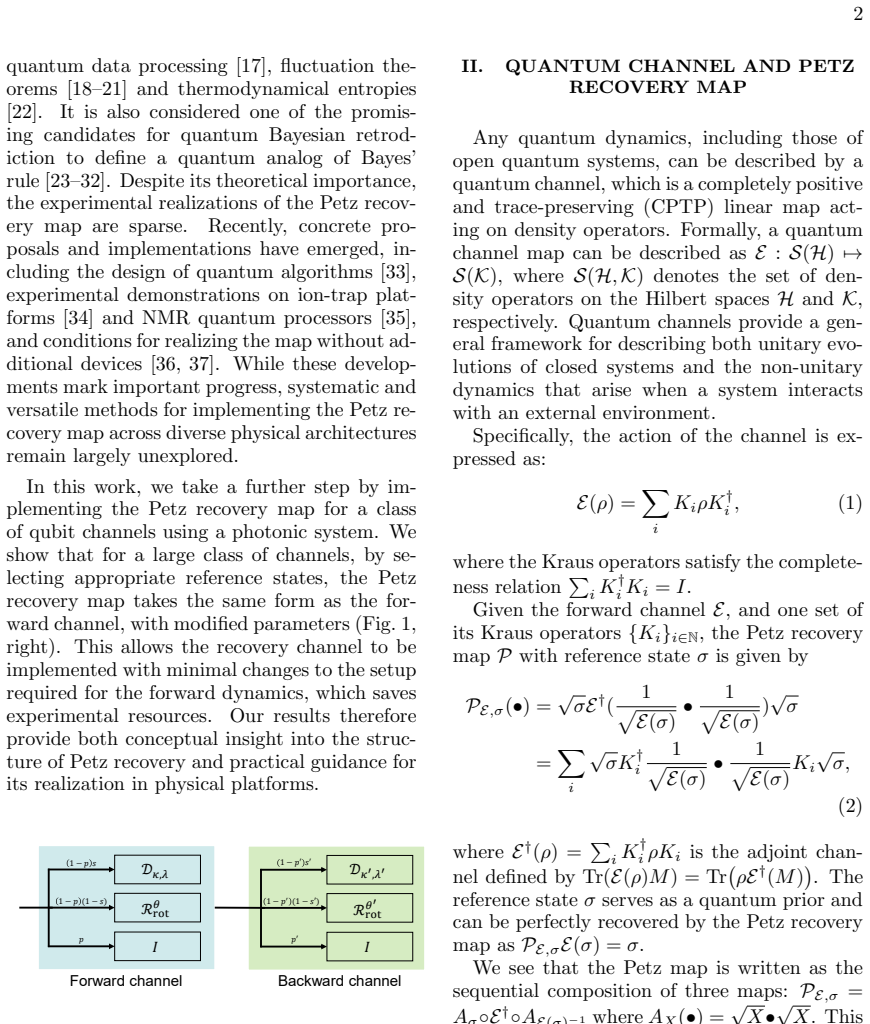
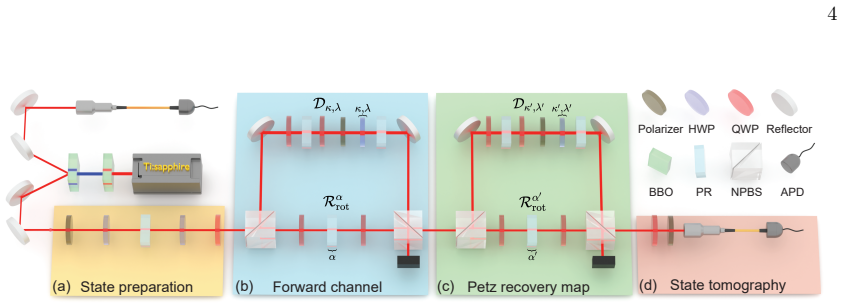
The Petz recovery map for tunable qubit channels can be implemented with the same optical devices used for the forward dissipative evolution.
A machine-rendered reading of the paper's core claim, the machinery that carries it, and where it could break.
Core claim
The Petz recovery map guarantees near-optimal recovery when the reference state is close to the actual state; the experiment realizes this map for a versatile family of qubit channels and demonstrates that the recovery can be performed with the identical optical setup employed for the dissipative evolution.
What carries the argument
The Petz recovery map, a quantum channel constructed from a given noise channel and a reference state that partially reverses the noise effect.
If this is right
- Partial recovery of quantum information becomes possible with minimal added hardware for this class of channels.
- The same devices can implement both the noise and its partial reversal over a continuous range of decoherence strengths.
- Resource-efficient mitigation of information loss is feasible without ancillary systems.
Where Pith is reading between the lines
- The approach may extend to other physical platforms where the forward map and its Petz inverse share the same hardware primitives.
- Practical performance will depend on how closely one can estimate the actual state to select the reference.
- This form of reversibility could simplify error-mitigation protocols that alternate noise and recovery steps.
Load-bearing premise
The experimental optical setup implements the theoretical Petz map accurately and the chosen reference state stays sufficiently close to the actual state encountered in the experiment.
What would settle it
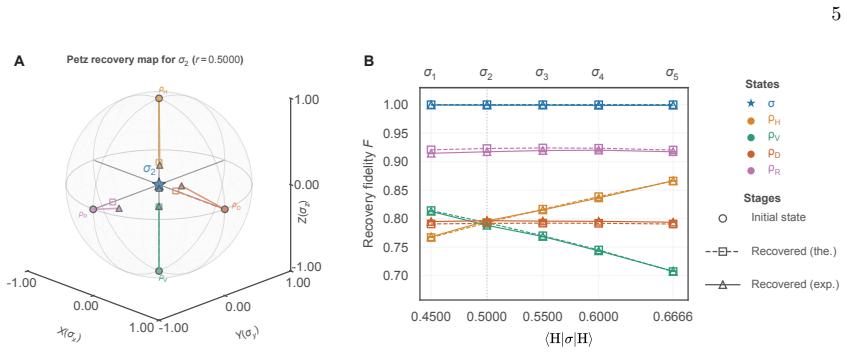
A direct comparison of measured recovery fidelity against the theoretical Petz prediction across a range of reference states, with clear mismatch when the reference deviates from the actual state.
Figures
read the original abstract
The quantum information lost in open evolutions cannot be fully recovered, but partial recovery is possible. The Petz recovery map guarantees almost optimal recovery, notably if the chosen reference state is close to the real one. This map has been widely used in theoretical studies, but has been the object of only a handful of experimental realisations, typically under a single fixed noise model. In this work, we describe and implement the Petz recovery map for a versatile class of qubit channels with tunable decoherence and dissipation. The setup we realize is also the first experimental example of ``tabletop reversibility'': for a good range of choices of the reference state, the Petz recovery map can be implemented with the same devices as the forward dissipative evolution, whose effect it is partially undoing. Our results demonstrate that the Petz recovery map can be resource-efficiently realized without requiring complex ancillary resources, providing a feasible pathway for mitigating information loss in quantum systems.
Editorial analysis
A structured set of objections, weighed in public.
Referee Report
Summary. The manuscript experimentally realizes the Petz recovery map for a family of tunable qubit channels (with adjustable decoherence and dissipation) in a photonic platform. It constructs the recovery operations explicitly from the channel parameters and a chosen reference state, implements them using the same optical elements as the forward channel (termed 'tabletop reversibility'), and reports process tomography or fidelity data showing performance close to the theoretical optimum without ancillas. This is presented as the first such experimental demonstration for versatile rather than fixed noise models.
Significance. If the quantitative agreement holds, the result demonstrates a resource-efficient experimental route to near-optimal recovery for a broad class of channels, which could aid quantum error mitigation. The explicit parameter-based construction and reuse of forward-map hardware are concrete strengths that distinguish this from prior fixed-model experiments. The tunable-channel design also supplies a falsifiable testbed for how recovery fidelity varies with reference-state choice.
minor comments (3)
- [§4] §4 (Experimental Implementation): the device settings for the recovery unitaries are listed, but the text does not explicitly tabulate the measured process-matrix elements or the numerical fidelity values with error bars that are referenced in the abstract; adding a compact table would strengthen verifiability.
- [Figure 2] Figure 2 caption: the plotted recovery fidelity curves lack an explicit statement of how many experimental runs contribute to each data point and whether the error bars are standard deviation or standard error; this affects assessment of statistical significance.
- [§3.2] §3.2 (Reference-state selection): the procedure for selecting the reference state in the lab is described qualitatively, but a quantitative criterion (e.g., trace-distance threshold) for 'sufficiently close' would clarify the practical range over which tabletop reversibility is claimed.
Simulated Author's Rebuttal
We thank the referee for the positive assessment of our work on the experimental realization of the Petz recovery map and for recommending minor revision. No specific major comments were listed in the report.
Circularity Check
No significant circularity
full rationale
The paper is an experimental demonstration of the Petz recovery map on photonic qubits for tunable channels. The Petz map itself is invoked as a standard theoretical construct from prior literature, with the work focusing on optical implementation using the same devices for forward and recovery maps, plus process tomography to verify performance. No derivation chain exists that reduces by construction to fitted parameters, self-citations, or ansatzes; channel parameters and reference states are inputs, and recovery operations are constructed explicitly from them. The central claim rests on experimental agreement with theory, which is externally falsifiable via fidelity measurements and independent of any internal self-referential steps.
Axiom & Free-Parameter Ledger
axioms (1)
- standard math Standard quantum mechanics and completely positive trace-preserving maps
Forward citations
Cited by 1 Pith paper
-
Connecting Quantum Tomography and Quantum Retrodiction
The Petz recovery map equals the gradient of the log-likelihood in maximum-likelihood tomography, unifying retrodiction and state reconstruction via a shared iterative procedure.
Reference graph
Works this paper leans on
-
[1]
Bayesian approach to irreversibility
The fi- delities between the experimentally prepared in- put state and the theoretical states areF ρH = 0.9999±0.00006,F ρV = 0.9986±0.0003,F ρD = 0.9991±0.0003,F ρR = 0.9986±0.0002 respec- tively. The experimentally recovered states for the different input states and the five different Petz recovery maps are shown in Fig. 3. We can see that the recovery ...
1974
-
[2]
Messiah,Quantum mechanics(Courier Cor- poration, 2014)
A. Messiah,Quantum mechanics(Courier Cor- poration, 2014)
2014
-
[3]
Davies,Quantum Theory of Open Systems (Academic Press, 1976)
E. Davies,Quantum Theory of Open Systems (Academic Press, 1976)
1976
-
[4]
I. L. Chuang, R. Laflamme, P. W. Shor, and W. H. Zurek, Quantum computers, factoring, and decoherence, Science270, 1633 (1995)
1995
-
[5]
P. W. Shor, Scheme for reducing decoherence in quantum computer memory, Physical Review A52, R2493 (1995)
1995
-
[6]
S. J. van Enk, J. I. Cirac, and P. Zoller, Ideal quantum communication over noisy channels: a quantum optical implementation, Physical Review Letters78, 4293 (1997)
1997
-
[7]
Matsuzaki, S
Y. Matsuzaki, S. C. Benjamin, and J. Fitzsi- mons, Magnetic field sensing beyond the stan- dard quantum limit under the effect of decoher- ence, Physical Review A—Atomic, Molecular, and Optical Physics84, 012103 (2011)
2011
-
[8]
Tsang, Quantum metrology with open dy- namical systems, New Journal of Physics15, 073005 (2013)
M. Tsang, Quantum metrology with open dy- namical systems, New Journal of Physics15, 073005 (2013)
2013
-
[9]
Peres, Reversible logic and quantum com- puters, Phys
A. Peres, Reversible logic and quantum com- puters, Phys. Rev. A32, 3266 (1985)
1985
-
[10]
Viola and S
L. Viola and S. Lloyd, Dynamical suppression of decoherence in two-state quantum systems, Physical Review A58, 2733 (1998)
1998
-
[11]
Viola, E
L. Viola, E. Knill, and S. Lloyd, Dynamical decoupling of open quantum systems, Physical Review Letters82, 2417 (1999)
1999
-
[12]
Petz, Sufficient subalgebras and the relative entropy of states of a von Neumann algebra, Communications in mathematical physics105, 123 (1986)
D. Petz, Sufficient subalgebras and the relative entropy of states of a von Neumann algebra, Communications in mathematical physics105, 123 (1986)
1986
-
[13]
Petz, Monotonicity of quantum relative entropy revisited, Reviews in Mathematical Physics15, 79 (2003)
D. Petz, Monotonicity of quantum relative entropy revisited, Reviews in Mathematical Physics15, 79 (2003)
2003
-
[14]
Barnum and E
H. Barnum and E. Knill, Reversing quantum dynamics with near-optimal quantum and clas- sical fidelity, Journal of Mathematical Physics 43, 2097 (2002)
2097
-
[15]
H. K. Ng and P. Mandayam, Simple approach to approximate quantum error correction based on the transpose channel, Physical Review A—Atomic, Molecular, and Optical Physics 81, 062342 (2010)
2010
-
[16]
Zheng, W
G. Zheng, W. He, G. Lee, and L. Jiang, Near- optimal performance of quantum error cor- 8 rection codes, Physical Review Letters132, 250602 (2024)
2024
-
[17]
B. Li, Z. Wang, G. Zheng, Y. Wong, and L. Jiang, Optimality condition for the Petz map, Physical Review Letters134, 200602 (2025)
2025
-
[18]
S. Beigi, N. Datta, and F. Leditzky, Decod- ing quantum information via the Petz re- covery map, arXiv preprint arXiv:1504.04449 https://doi.org/10.1063/1.4961515 (2015)
-
[19]
˚Aberg, Fully quantum fluctuation theorems, Physical Review X8, 011019 (2018)
J. ˚Aberg, Fully quantum fluctuation theorems, Physical Review X8, 011019 (2018)
2018
-
[20]
Kwon and M
H. Kwon and M. Kim, Fluctuation theorems for a quantum channel, Physical Review X9, 031029 (2019)
2019
-
[21]
C. C. Aw, F. Buscemi, and V. Scarani, Fluctu- ation theorems with retrodiction rather than reverse processes, AVS Quantum Science3, https://doi.org/10.1116/5.0060893 (2021)
-
[22]
Buscemi and V
F. Buscemi and V. Scarani, Fluctuation theo- rems from Bayesian retrodiction, Physical Re- view E103, 052111 (2021)
2021
-
[23]
Buscemi, J
F. Buscemi, J. Schindler, and D. ˇSafr´ anek, Ob- servational entropy, coarse-grained states, and the Petz recovery map: information-theoretic properties and bounds, New Journal of Physics 25, 053002 (2023)
2023
-
[24]
M. S. Leifer and R. W. Spekkens, Towards a formulation of quantum theory as a causally neutral theory of Bayesian inference, Physi- cal Review A—Atomic, Molecular, and Optical Physics88, 052130 (2013)
2013
-
[25]
Tsang, Generalized conditional expecta- tions for quantum retrodiction and smoothing, Physical Review A105, 042213 (2022)
M. Tsang, Generalized conditional expecta- tions for quantum retrodiction and smoothing, Physical Review A105, 042213 (2022)
2022
-
[26]
A. J. Parzygnat and F. Buscemi, Axioms for retrodiction: achieving time-reversal symmetry with a prior, Quantum7, 1013 (2023)
2023
-
[27]
A. J. Parzygnat and J. Fullwood, From time- reversal symmetry to quantum Bayes’ rules, PRX Quantum4, 020334 (2023)
2023
-
[28]
A. C. Cenxin, K. Onggadinata, D. Kasz- likowski, and V. Scarani, Quantum Bayesian inference in quasiprobability representations, PRX Quantum4, 020352 (2023)
2023
-
[29]
Surace and M
J. Surace and M. Scandi, State retrieval beyond Bayes’ retrodiction, Quantum7, 990 (2023)
2023
-
[30]
G. Bai, F. Buscemi, and V. Scarani, Quan- tum Bayes’ rule and Petz transpose map from the minimum change principle, Physical Re- view Letters135, 090203 (2025)
2025
-
[31]
M. Liu, V. Scarani, A. Auff` eves, and K. T. Lav- erick, Retrodictive approach to quantum state smoothing, Physical Review A112, L030203 (2025)
2025
-
[32]
M. Liu, G. Bai, and V. Scarani, The state of a quantum system is not a complete description for retrodic- tion, arXiv preprint arXiv:2502.10030 https://doi.org/10.48550/arXiv.2502.10030 (2025)
work page internal anchor Pith review Pith/arXiv arXiv doi:10.48550/arxiv.2502.10030 2025
-
[33]
M. Liu, G. Bai, and V. Scarani, Unifying quantum smoothing theories with extended retrodiction, arXiv preprint arXiv:2510.08447 https://doi.org/10.48550/arXiv.2510.08447 (2025)
work page internal anchor Pith review Pith/arXiv arXiv doi:10.48550/arxiv.2510.08447 2025
-
[34]
Gily´ en, S
A. Gily´ en, S. Lloyd, I. Marvian, Y. Quek, and M. M. Wilde, Quantum algorithm for Petz recovery channels and pretty good measure- ments, Physical Review Letters128, 220502 (2022)
2022
-
[35]
Png and V
W.-H. Png and V. Scarani, Petz recovery maps of single-qubit decoherence channels in an ion trap quantum processor, Physical Review A 112, 022613 (2025)
2025
-
[36]
Realizing the Petz Recovery Map on an NMR Quantum Processor
G. Singh, R. S. Sahani, V. Jagadish, L. Lautenbacher, N. K. Bernardes, and K. Dorai, Realizing the Petz recov- ery map on an NMR quantum pro- cessor, arXiv preprint arXiv:2508.08998 https://doi.org/10.48550/arXiv.2508.08998 (2025)
work page internal anchor Pith review Pith/arXiv arXiv doi:10.48550/arxiv.2508.08998 2025
-
[37]
C. C. Aw, L. H. Zaw, M. Balanz´ o-Juand´ o, and V. Scarani, Role of dilations in reversing phys- ical processes: Tabletop reversibility and gen- eralized thermal operations, PRX Quantum5, 010332 (2024)
2024
-
[38]
M. Song, H. Kwon, and V. Scarani, Ex- act and approximate conditions of tabletop reversibility: when is Petz recovery cost- free?, arXiv preprint arXiv:2510.26895 https://doi.org/10.48550/arXiv.2510.26895 (2025)
-
[39]
H. Li, J. Xie, H. Kwon, Y. Zhao, M. Kim, and L. Zhang, Experimental demonstration of gen- eralized quantum fluctuation theorems in the presence of coherence, Science Advances11, eadq6014 (2025)
2025
-
[40]
Lautenbacher, F
L. Lautenbacher, F. de Melo, and N. K. Bernardes, Approximating invertible maps by recovery channels: Optimality and an applica- tion to non-Markovian dynamics, Physical Re- view A105, 042421 (2022)
2022
-
[41]
H. Kwon, R. Mukherjee, and M. Kim, Re- versing Lindblad dynamics via continuous Petz recovery map, Physical Review Letters128, 9 020403 (2022)
2022
-
[42]
transition probability
A. Uhlmann, The “transition probability” in the state space of a*-algebra, Reports on Math- ematical Physics9, 273 (1976)
1976
-
[43]
Jozsa, Fidelity for mixed quantum states, Journal of modern optics41, 2315 (1994)
R. Jozsa, Fidelity for mixed quantum states, Journal of modern optics41, 2315 (1994)
1994
-
[44]
M. A. Nielsen and I. L. Chuang,Quantum computation and quantum information(Cam- bridge university press, 2010). Appendix A: Implementation of Petz recovery map Here we prove the claim that, in some cases, the Petz map takes the same form as the forward channel, possibly with different parameters. Consider the forward channelE(ρ) defined as E(ρ) =pρ+ (1−p)...
2010
-
[45]
Substitutingj ′ 03 =T 03 into (A18): T03 + (1−p ′)s′κ′ =T 00 =⇒κ ′ = T00 −T 03 (1−p ′)s′ .(A25) Similarly, the first term ofj ′ 22 in (A19) is exactly−j ′ 12 =−T 12. Substituting this yields: −T12 + (1−p ′)s′λ′ =T 22 =⇒λ ′ = T22 +T 12 (1−p ′)s′ .(A26) Finally, substituting the denominator (1−p ′)s′ = 1−T 03 +T 12 into the expressions forκ ′ and λ′, we get...
-
[46]
Rotation operation on the Bloch sphere The forward channel is given by: E(ρ) =pρ+ (1−p)[R π/2 rot (ρ) +sD κ,λ(ρ)].(D1) Here, we defineR θ rot = 1 2 Ry(θ)ρR† y(θ)+ 1 2 Ry(−θ)ρR† y(−θ) as the equal mixture of two rotations, Ry(±θ), about they-axis of the Bloch sphere. A rotation by an angleθabout an arbitrary axis ˆn on the Bloch sphere can be expressed as:...
-
[47]
Mixture of two arbitrary rotation operations Now, we explicitly calculate each component ofR θ rot(ρ). First, evaluating the positive rotation yields: Ry(θ)ρR† y(θ) = cos θ 2 −sin θ 2 sin θ 2 cos θ 2 a b c d cos θ 2 sin θ 2 −sin θ 2 cos θ 2 = acos θ 2 −csin θ 2 bcos θ 2 −dsin θ 2 asin θ 2 +ccos θ 2 bsin θ 2 +dcos θ 2 cos θ 2 sin θ 2 −sin θ 2 cos θ 2 = aco...
-
[48]
Experimental implementation for the rotation channel The Jones matrix for a quarter-wave plate (QWP) oriented at an angleθis given by: JQWP(θ) = cos2 θ+isin 2 θ(1−i) sinθcosθ (1−i) sinθcosθsin 2 θ+icos 2 θ .(D11) Specifically, for orientation angles ofθ=±45 ◦, the matrices simplify to: JQWP(45◦) = 1+i 2 1−i 21−i 2 1+i 2 = 1 +i 2 1−i −i1 ,(D12) JQWP(−45◦) ...
-
[49]
Let the initial density matrix beρ= a b c d
Since density matrices are invariant under global phases, a±π/2 rotation on the Bloch sphere about thex-axis can be physically implemented using a quarter-wave plate oriented at±45 ◦. Let the initial density matrix beρ= a b c d . Applying theπ/2 rotation about thex-axis (via the 45◦ QWP), the state transforms as: Rx π 2 ρR† x π 2 = 1 2 1−i −i1 a b c d 1i ...
-
[50]
Experimental simplification for the forward channel Recall that the original form of the forward channel is expressed as: E(ρ) =pρ+ (1−p)[(1−s)R π/2 rot (ρ) +sD κ,λ(ρ)].(D20) From our previous derivation, the equal mixture of±π/2 rotations evaluates to: R π 2 rot(ρ) = 1 2 a+d b−c c−b a+d .(D21) The unitary portion of the channel,pρ+ (1−p)(1−s)R π/2 rot (ρ...
-
[51]
but differ in relative phase: |ψ1⟩= a b eiϕ ,|ψ 2⟩= a b eiψ .(E1) Their corresponding density matrices are |ψk⟩⟨ψk|= a2 ab e−iθk ab eiθk b2 ,(E2) whereθ 1 =ϕandθ 2 =ψ. An incoherent mixture with weightsηand 1−η(where 0≤η≤1) yields the density matrix ρ= (1−η)|ψ 1⟩⟨ψ1|+η|ψ 2⟩⟨ψ2|= a2 ab α∗ ab α b 2 ,(E3) where we define α≡(1−η)e iϕ +η e iψ.(E4) 24 Separatin...
discussion (0)
Sign in with ORCID, Apple, or X to comment. Anyone can read and Pith papers without signing in.