Connecting Quantum Tomography and Quantum Retrodiction
Pith reviewed 2026-06-26 08:04 UTC · model grok-4.3
The pith
The Petz recovery map for a measurement channel is the gradient update of the log-likelihood in maximum-likelihood tomography.
A machine-rendered reading of the paper's core claim, the machinery that carries it, and where it could break.
Core claim
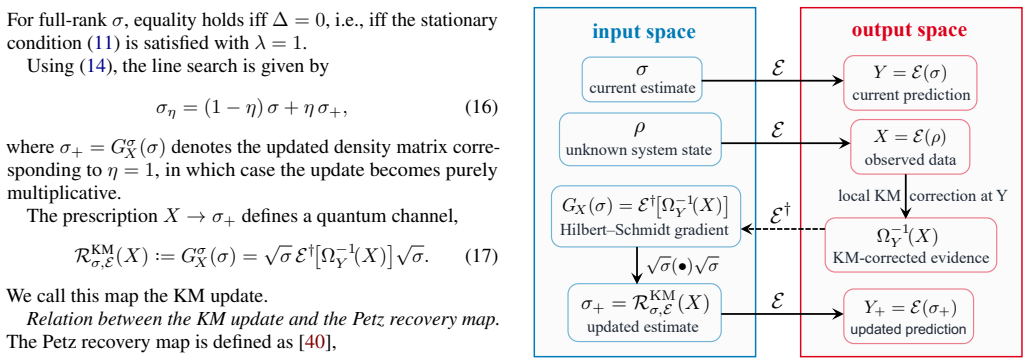
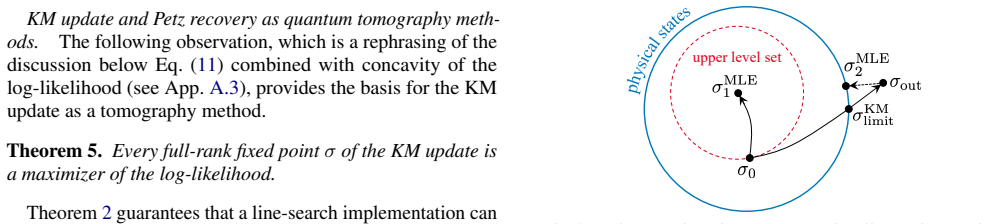
We prove that the Petz recovery map associated with a measurement channel is precisely the gradient update of the log-likelihood used in maximum-likelihood tomography. Consequently, repeated applications of the Petz map monotonically increase the likelihood. Extending beyond measurement channels, we derive a noncommutative generalization of the Petz map from the gradient of a generalized likelihood for arbitrary quantum channels. The resulting iterative procedure maximizes the likelihood and provides a general framework for quantum tomography.
What carries the argument
The Petz recovery map, identified as the exact gradient of the log-likelihood with respect to the quantum state for the given measurement channel.
Load-bearing premise
The log-likelihood is written in a form whose gradient with respect to the state reproduces the Petz map action exactly for the chosen channel.
What would settle it
An explicit derivative calculation for a two-outcome projective measurement on a single qubit showing that the gradient of the log-likelihood differs from the Petz map output.
Figures
read the original abstract
Quantum tomography and quantum retrodiction are traditionally viewed as separate inference tasks: tomography reconstructs quantum states from measurement data, whereas retrodiction infers past quantum states from observed outcomes. We show that the two are manifestations of the same underlying principle. We prove that the Petz recovery map associated with a measurement channel is precisely the gradient update of the log-likelihood used in maximum-likelihood tomography. Consequently, repeated applications of the Petz map monotonically increase the likelihood. Extending beyond measurement channels, we derive a noncommutative generalization of the Petz map from the gradient of a generalized likelihood for arbitrary quantum channels. The resulting iterative procedure maximizes the likelihood and provides a general framework for quantum tomography, establishing a direct bridge between retrodiction, recovery maps, and statistical inference.
Editorial analysis
A structured set of objections, weighed in public.
Referee Report
Summary. The manuscript proves that the Petz recovery map for a measurement channel equals the gradient update step on the log-likelihood in maximum-likelihood quantum tomography. Repeated application of the map therefore monotonically increases the likelihood. The authors extend the construction to arbitrary quantum channels by introducing a generalized noncommutative likelihood whose gradient yields a corresponding recovery map, thereby supplying a unified iterative procedure for tomography that links retrodiction, recovery maps, and statistical inference.
Significance. If the central identification holds, the work supplies a direct mathematical bridge between quantum retrodiction and maximum-likelihood tomography, with the monotonicity property furnishing a concrete algorithmic consequence. The derivation of the generalized map from the gradient of a noncommutative likelihood is a notable technical contribution that may inform the design of iterative reconstruction methods.
minor comments (2)
- [Abstract / §2] The abstract states the result for 'a measurement channel' without specifying whether the equality is restricted to projective measurements or holds for general POVMs; a clarifying sentence in §2 would help readers locate the precise channel definition used in the proof.
- [§4] Notation for the generalized likelihood in the extension to arbitrary channels is introduced without an explicit comparison table to the classical log-likelihood; adding such a table would improve readability of the noncommutative construction.
Simulated Author's Rebuttal
We thank the referee for their positive evaluation and recommendation to accept the manuscript. The provided summary correctly identifies the central result equating the Petz recovery map with the gradient step in maximum-likelihood tomography, as well as the extension to a generalized noncommutative likelihood for arbitrary channels.
Circularity Check
No significant circularity
full rationale
The paper establishes a mathematical equivalence between the Petz recovery map for a measurement channel and the gradient of a log-likelihood function used in maximum-likelihood tomography. This is presented as a proof of identity for the specific forms chosen, with the monotonicity consequence following directly, and a generalization derived for arbitrary channels via a noncommutative likelihood. No steps reduce by construction to fitted inputs, self-citations, or renamings; the derivation is self-contained as an explicit identification between standard objects in quantum information, with independent content in the proof and extension.
Axiom & Free-Parameter Ledger
axioms (1)
- standard math Standard properties of completely positive trace-preserving maps and the Petz recovery map as defined in quantum information theory.
Reference graph
Works this paper leans on
-
[1]
V ogel and H
K. V ogel and H. Risken, Determination of quasiprobability distributions in terms of probability distributions for the rotated quadrature phase, Phys. Rev. A40, 2847(R) (1989). 5
1989
-
[2]
Leonhardt, Measuring the Quantum State of Light (Cam- bridge University Press, Cambridge, 1997)
U. Leonhardt, Measuring the Quantum State of Light (Cam- bridge University Press, Cambridge, 1997)
1997
-
[3]
D. F. V . James, P. G. Kwiat, W. J. Munro, and A. G. White, Measurement of qubits, Phys. Rev. A64, 052312 (2001). arXiv:quant-ph/0103121 [quant-ph] (2001)
Pith/arXiv arXiv 2001
-
[4]
G. M. D’Ariano, M. G. A. Paris, and M. F. Sacchi, Quantum Tomography, Adv. Imaging Electron Phys.128, 205 (2003). arXiv:quant-ph/0302028 [quant-ph] (2003)
arXiv 2003
-
[5]
Hradil, Quantum-state estimation, Phys
Z. Hradil, Quantum-state estimation, Phys. Rev. A55, R1561(R) (1997). arXiv:quant-ph/9609012 [quant-ph] (1996)
Pith/arXiv arXiv 1997
-
[6]
K. Banaszek, G. M. D’Ariano, M. G. A. Paris, and M. F. Sacchi, Maximum-likelihood estimation of the density matrix, Phys. Rev. A61, 010304(R) (1999). arXiv:quant-ph/9909052 [quant- ph] (1999)
Pith/arXiv arXiv 1999
-
[7]
M. Je ˇzek, J. Fiur ´aˇsek, and Z. Hradil, Quantum inference of states and processes, Phys. Rev. A68, 012305 (2003). arXiv:quant-ph/0210146 [quant-ph] (2002)
Pith/arXiv arXiv 2003
-
[8]
Paris and J
M. Paris and J. ˇReh´aˇcek (Eds.), Quantum State Estimation (Springer Berlin, Heidelberg, 2004)
2004
-
[9]
J. ˇReh´aˇcek, Z. Hradil, E. Knill, A. I. Lvovsky, Diluted maximum-likelihood algorithm for quantum tomography, Phys. Rev. A75, 042108 (2007). arXiv:quant-ph/0611244 [quant-ph] (2006)
Pith/arXiv arXiv 2007
-
[10]
Blume-Kohout, Hedged Maximum Likelihood Quantum State Estimation, Phys
R. Blume-Kohout, Hedged Maximum Likelihood Quantum State Estimation, Phys. Rev. Lett.105, 200504 (2010). arXiv:1001.2029 [quant-ph] (2010)
Pith/arXiv arXiv 2010
-
[11]
E. Bolduc, G. C. Knee, E. M. Gauger, and J. Leach, Projected gradient descent algorithms for quantum state tomography, npj Quantum Inf.3, 44 (2017). arXiv:1612.09531 [quant-ph] (2016)
Pith/arXiv arXiv 2017
-
[12]
K. Aditi and S. Becker, Rigorous maximum-likelihood esti- mation for quantum states, Phys. Rev. A112, 052436 (2025). arXiv:2506.16646 [quant-ph] (2025)
arXiv 2025
-
[13]
A. Gaikwad, M. S. Torres, S. Ahmed, and A. F. Kockum, Gradient-descent methods for fast quantum state tomography, Quantum Sci. Technol.10, 045055 (2025). arXiv:2503.04526 [quant-ph] (2025)
arXiv 2025
-
[14]
Blume-Kohout, Optimal, reliable estimation of quan- tum states, New J
R. Blume-Kohout, Optimal, reliable estimation of quan- tum states, New J. Phys.12, 043034 (2010). arXiv:quant- ph/0611080 [quant-ph] (2006)
arXiv 2010
-
[15]
F. Husz´ar and N. M. T. Houlsby, Adaptive Bayesian quantum tomography, Phys. Rev. A85, 052120 (2012). arXiv:1107.0895 [quant-ph] (2011)
Pith/arXiv arXiv 2012
-
[16]
R. Kueng and C. Ferrie, Near-optimal quantum tomography: estimators and bounds, New J. Phys.17, 123013 (2015). arXiv:1503.00677 [quant-ph] (2015)
Pith/arXiv arXiv 2015
-
[17]
C. Granade, J. Combes, and D. G. Cory, Practical Bayesian to- mography, New J. Phys.18, 033024 (2016). arXiv:1509.03770 [quant-ph] (2015)
Pith/arXiv arXiv 2016
-
[18]
S. S. Straupe, Adaptive quantum tomography, JETP Lett.104, 510 (2016). arXiv:1610.02840 [quant-ph] (2016)
Pith/arXiv arXiv 2016
-
[19]
J. M. Lukens, K. J. H. Law, A. Jasra, and P. Lougovski, A practical and efficient approach for Bayesian quantum state estimation, New J. Phys.22, 063038 (2020). arXiv:2002.10354 [quant-ph] (2020)
arXiv 2020
-
[20]
J. C. Chapmanet al., Bayesian homodyne and heterodyne tomography, Opt. Express30, 15184 (2022). arXiv:2202.03499 [quant-ph] (2022)
arXiv 2022
-
[21]
Aaronson, Shadow Tomography of Quantum States, arXiv:1711.01053 [quant-ph] (2017)
S. Aaronson, Shadow Tomography of Quantum States, arXiv:1711.01053 [quant-ph] (2017)
Pith/arXiv arXiv 2017
- [22]
-
[23]
Strickeret al., Experimental Single-Setting Quantum State Tomography, PRX Quantum3, 040310 (2022)
R. Strickeret al., Experimental Single-Setting Quantum State Tomography, PRX Quantum3, 040310 (2022). arXiv:2206.00019 [quant-ph] (2022)
arXiv 2022
-
[24]
Z. Qin, J. M. Lukens, B. T. Kirby, and Z. Zhu, Enhancing quantum state reconstruction with structured classical shadows, npj Quantum Inf.11, 147 (2025). arXiv:2501.03144 [quant-ph] (2025)
arXiv 2025
-
[25]
M. Gut ¸˘a, J. Kahn, R. Kueng, and J. A. Tropp, Fast state tomog- raphy with optimal error bounds, J. Phys. A: Math. Theor.53, 204001 (2020). arXiv:1809.11162 [quant-ph] (2018)
arXiv 2020
-
[26]
C. H. Bennett, P. W. Shor, J. A. Smolin, and A. V . Thap- liyal, Universal quantum data compression via nondestructive tomography, Phys. Rev. A73, 032336 (2006). arXiv:quant- ph/0403078 [quant-ph] (2004)
arXiv 2006
-
[27]
Wu, State tomography via weak measurements, Sci
S. Wu, State tomography via weak measurements, Sci. Rep.3, 1193 (2013). arXiv:1212.3655 [quant-ph] (2012)
Pith/arXiv arXiv 2013
-
[28]
Grosset al., Quantum State Tomography via Compressed Sensing, Phys
D. Grosset al., Quantum State Tomography via Compressed Sensing, Phys. Rev. Lett.105, 150401 (2010). arXiv:0909.3304 [quant-ph] (2009)
Pith/arXiv arXiv 2010
-
[29]
S. T. Flammia, D. Gross, Y .-K. Liu, and J. Eisert, Quantum tomography via compressed sensing: error bounds, sample complexity and efficient estimators, New J. Phys.14, 095022 (2012). arXiv:1205.2300 [quant-ph] (2012)
Pith/arXiv arXiv 2012
-
[30]
Crameret al., Efficient quantum state tomography, Nat
M. Crameret al., Efficient quantum state tomography, Nat. Commun.1, 149 (2010). arXiv:1101.4366 [quant-ph] (2011)
Pith/arXiv arXiv 2010
-
[31]
B. P. Lanyonet al., Efficient tomography of a quantum many- body system, Nat. Phys.13, 1158 (2017). arXiv:1612.08000 [quant-ph] (2016)
Pith/arXiv arXiv 2017
-
[32]
Ferrie, Self-Guided Quantum Tomography, Phys
C. Ferrie, Self-Guided Quantum Tomography, Phys. Rev. Lett. 113, 190404 (2014). arXiv:1406.4101 [quant-ph] (2014)
Pith/arXiv arXiv 2014
-
[33]
R. J. Chapman, C. Ferrie, and A. Peruzzo, Experimental Demonstration of Self-Guided Quantum Tomography, Phys. Rev. Lett.117, 040402 (2016). arXiv:1602.04194 [quant-ph] (2016)
Pith/arXiv arXiv 2016
-
[34]
Lohaniet al., Machine learning assisted quantum state estimation, Mach
S. Lohaniet al., Machine learning assisted quantum state estimation, Mach. Learn.: Sci. Technol.1, 035007 (2020). arXiv:2003.03441 [quant-ph] (2020)
arXiv 2020
-
[35]
Torlaiet al., Neural-network quantum state tomography, Nat
G. Torlaiet al., Neural-network quantum state tomography, Nat. Phys.14, 447 (2018). arXiv:1703.05334 [cond-mat.dis- nn] (2017)
Pith/arXiv arXiv 2018
-
[36]
T. Xinet al., Local-measurement-based quantum state tomog- raphy via neural networks, npj Quantum Inf.5, 109 (2019). arXiv:1807.07445 [quant-ph] (2018)
arXiv 2019
-
[37]
J. Carrasquilla, G. Torlai, R. G. Melko, and L. Aolita, Recon- structing quantum states with generative models, Nat. Mach. Intell.1, 155 (2019). arXiv:1810.10584 [quant-ph] (2018)
arXiv 2019
-
[38]
A. M. Palmieriet al., Experimental neural network en- hanced quantum tomography, npj Quantum Inf.6, 20 (2020). arXiv:1904.05902 [quant-ph] (2019)
arXiv 2020
-
[39]
Petz, Sufficient subalgebras and the relative entropy of states of a von Neumann algebra, Commun
D. Petz, Sufficient subalgebras and the relative entropy of states of a von Neumann algebra, Commun. Math. Phys.105, 123 (1986)
1986
-
[40]
Petz, Sufficiency of channels over von Neumann algebras, Quart
D. Petz, Sufficiency of channels over von Neumann algebras, Quart. J. Math. Oxford Ser.39, 97 (1988)
1988
-
[41]
Petz, Monotonicity of quantum relative entropy revisited, Rev
D. Petz, Monotonicity of quantum relative entropy revisited, Rev. Math. Phys.15, 79 (2003). arXiv:quant-ph/0209053 [quant-ph] (2002)
Pith/arXiv arXiv 2003
- [42]
-
[43]
O. Fawzi and R. Renner, Quantum Conditional Mutual Informa- tion and Approximate Markov Chains, Commun. Math. Phys. 340, 575 (2015). arXiv:1410.0664 [quant-ph] (2014). 6
Pith/arXiv arXiv 2015
-
[44]
M. M. Wilde, Recoverability in quantum information theory, Proc. R. Soc. A471, 20150338 (2015). arXiv:1505.04661 [quant-ph] (2015)
Pith/arXiv arXiv 2015
-
[45]
D. Sutter, O. Fawzi, and R. Renner, Universal recovery map for approximate Markov chains, Proc. R. Soc. A472, 20150623 (2016). arXiv:1504.07251 [quant-ph] (2015)
Pith/arXiv arXiv 2016
-
[46]
D. Sutter, M. Tomamichel, and A. W. Harrow, Strength- ened Monotonicity of Relative Entropy via Pinched Petz Recovery Map, IEEE Trans. Inf. Theory62, 2907 (2016). arXiv:1507.00303 [quant-ph] (2015)
Pith/arXiv arXiv 2016
-
[47]
D. Sutter, M. Berta, and M. Tomamichel, Multivariate Trace Inequalities, Commun. Math. Phys.352, 37 (2017). arXiv:1604.03023 [math-ph] (2016)
Pith/arXiv arXiv 2017
-
[48]
Jungeet al., Universal Recovery Maps and Approximate Sufficiency of Quantum Relative Entropy, Ann
M. Jungeet al., Universal Recovery Maps and Approximate Sufficiency of Quantum Relative Entropy, Ann. Henri Poincar´e 19, 2955 (2018). arXiv:1509.07127 [quant-ph] (2015)
Pith/arXiv arXiv 2018
-
[49]
M. S. Leifer and R. W. Spekkens, Towards a formulation of quantum theory as a causally neutral theory of Bayesian in- ference, Phys. Rev. A88, 052130 (2013). arXiv:1107.5849 [quant-ph] (2011)
Pith/arXiv arXiv 2013
-
[50]
Tsang, Generalized conditional expectations for quantum retrodiction and smoothing, Phys
M. Tsang, Generalized conditional expectations for quantum retrodiction and smoothing, Phys. Rev. A105, 042213 (2022). arXiv:1912.02711 [quant-ph] (2019)
arXiv 2022
-
[51]
J. Surace and M. Scandi, State retrieval beyond Bayes’ retrod- iction, Quantum7, 990 (2023). arXiv:2201.09899 [quant-ph] (2022)
arXiv 2023
-
[52]
A. J. Parzygnat and F. Buscemi, Axioms for retrodiction: achieving time-reversal symmetry with a prior, Quantum7, 1013 (2023). arXiv:2210.13531 [quant-ph] (2022)
arXiv 2023
-
[53]
A. J. Parzygnat and J. Fullwood, From Time-Reversal Symme- try to Quantum Bayes’ Rules, PRX Quantum4, 020334 (2023). arXiv:2212.08088 [quant-ph] (2022)
arXiv 2023
-
[54]
F. Buscemi, J. Schindler, and D. ˇSafr´anek, Observational entropy, coarse-grained states, and the Petz recovery map: information-theoretic properties and bounds, New J. Phys.25, 053002 (2023). arXiv:2209.03803 [quant-ph] (2022)
arXiv 2023
-
[55]
C. C. Aw, K. Onggadinata, D. Kaszlikowski, and V . Scarani, Quantum Bayesian Inference in Quasiprobability Represen- tations, PRX Quantum4, 020352 (2023). arXiv:2301.01952 [quant-ph] (2023)
arXiv 2023
- [56]
-
[57]
G. Bai, F. Buscemi, and V . Scarani, Quantum Bayes’ Rule and Petz Transpose Map from the Minimum Change Principle, Phys. Rev. Lett.135, 090203 (2025). arXiv:2410.00319 [quant- ph] (2024)
arXiv 2025
-
[58]
M. Liu, V . Scarani, A. Auff`eves, and K. T. Laverick, Retrodic- tive approach to quantum state smoothing, Phys. Rev. A112, L030203 (2025). arXiv:2501.15986 [quant-ph] (2025)
arXiv 2025
-
[59]
M. Liu, G. Bai, and V . Scarani, Unifying Quantum Smooth- ing Theories with Extended Retrodiction, arXiv:2510.08447 [quant-ph] (2025)
Pith/arXiv arXiv 2025
-
[60]
M. Liu, V . Scarani, and G. Bai, Proper and Improper Mixed States Serve as Different Prior Beliefs for Quantum State Retro- diction, Phys. Rev. Lett.136, 060203 (2026). arXiv:2502.10030 [quant-ph] (2025)
Pith/arXiv arXiv 2026
-
[61]
I. L. Chuang and M. A. Nielsen, Prescription for experimen- tal determination of the dynamics of a quantum black box, J. Mod. Opt.44, 2455 (1997). arXiv:quant-ph/9610001 [quant- ph] (1996)
Pith/arXiv arXiv 1997
-
[62]
J. F. Poyatos, J. I. Cirac, and P. Zoller, Complete Characteriza- tion of a Quantum Process: The Two-Bit Quantum Gate, Phys. Rev. Lett.78, 390 (1997). arXiv:quant-ph/9611013 [quant-ph] (1996)
Pith/arXiv arXiv 1997
-
[63]
A. I. Lvovsky and M. G. Raymer, Continuous-variable optical quantum-state tomography, Rev. Mod. Phys.81, 299 (2009). arXiv:quant-ph/0511044 [quant-ph] (2005)
Pith/arXiv arXiv 2009
-
[64]
C. L. Degen, F. Reinhard, and P. Cappellaro, Quantum sensing, Rev. Mod. Phys.89, 035002 (2017). arXiv:1611.02427 [quant- ph] (2016)
Pith/arXiv arXiv 2017
-
[65]
Scaraniet al., The security of practical quantum key dis- tribution, Rev
V . Scaraniet al., The security of practical quantum key dis- tribution, Rev. Mod. Phys.81, 1301 (2009). arXiv:0802.4155 [quant-ph] (2008)
Pith/arXiv arXiv 2009
-
[66]
H. Barnum and E. Knill, Reversing quantum dynamics with near-optimal quantum and classical fidelity, J. Math. Phys.43, 2097 (2002). arXiv:quant-ph/0004088 [quant-ph] (2000)
arXiv 2097
-
[67]
H. K. Ng and P. Mandayam, Simple approach to approximate quantum error correction based on the transpose channel, Phys. Rev. A81, 062342 (2010). arXiv:0909.0931 [quant-ph] (2009)
Pith/arXiv arXiv 2010
-
[68]
Gily´enet al., Quantum Algorithm for Petz Recovery Chan- nels and Pretty Good Measurements, Phys
A. Gily´enet al., Quantum Algorithm for Petz Recovery Chan- nels and Pretty Good Measurements, Phys. Rev. Lett.128, 220502 (2022). arXiv:2006.16924 [quant-ph] (2020)
arXiv 2022
- [69]
-
[70]
J. Chen, M. Song, J. J. X. Chan, and V . Scarani, The Petz recovery map for optical losses, arXiv:2511.05941 [quant-ph] (2025)
Pith/arXiv arXiv 2025
-
[71]
H. Liet al., Experimental Tabletop Petz recovery of a photonic qubit, arXiv:2606.12020 [quant-ph] (2026)
Pith/arXiv arXiv 2026
- [72]
-
[73]
M. Song, H. Kwon, and V . Scarani, Exact and approximate conditions of tabletop reversibility: when is Petz recovery cost- free?, arXiv:2510.26895 [quant-ph] (2025)
arXiv 2025
-
[74]
Singhet al., Realizing the Petz recovery map on an NMR quantum processor, Phys
G. Singhet al., Realizing the Petz recovery map on an NMR quantum processor, Phys. Rev. A113, 052415 (2026). arXiv:2508.08998 [quant-ph] (2025)
Pith/arXiv arXiv 2026
- [75]
-
[76]
˚Aberg, Fully Quantum Fluctuation Theorems, Phys
J. ˚Aberg, Fully Quantum Fluctuation Theorems, Phys. Rev. X 8, 011019 (2018). arXiv:1601.01302 [quant-ph] (2016)
Pith/arXiv arXiv 2018
-
[77]
H. Kwon and M. S. Kim, Fluctuation Theorems for a Quantum Channel, Phys. Rev. X9, 031029 (2019). arXiv:1810.03150 [quant-ph] (2018)
arXiv 2019
-
[78]
C. C. Aw, F. Buscemi, and V . Scarani, Fluctuation theorems with retrodiction rather than reverse processes, A VS Quantum Sci.3, 045601 (2021). arXiv:2106.08589 [cond-mat.stat-mech] (2021)
arXiv 2021
-
[79]
F. Buscemi and V . Scarani, Fluctuation theorems from Bayesian retrodiction, Phys. Rev. E103, 052111 (2021). arXiv:2009.02849 [quant-ph] (2020)
arXiv 2021
-
[80]
C. C. Aw, L. H. Zaw, M. Balanz ´o-Juand´o, and V . Scarani, Role of Dilations in Reversing Physical Processes: Tabletop Reversibility and Generalized Thermal Operations, PRX Quan- tum5, 010332 (2024). arXiv:2308.13909 [quant-ph] (2023)
arXiv 2024
discussion (0)
Sign in with ORCID, Apple, or X to comment. Anyone can read and Pith papers without signing in.