REVIEW 1 major objections 1 cited by
OCOO-T : A Simple and Scalable Virtual Cell Model for Transcriptional Perturbation Response Prediction
T0 review · 1 major / 0 minor · reviewed 2026-06-27 · grok-4.3
Pith's one-line read A vanilla Transformer with flow-matching and adaptive normalization predicts single-cell transcriptional responses to perturbations at state-of-the-art accuracy.
desk verdict OCOO-T is a minimalist vanilla Transformer with flow-matching for perturbation prediction that claims SOTA on three benchmarks, but the abstract supplies zero numbers or protocol details to check the claim. read the letter →
The pith
A machine-rendered reading of the paper's core claim, the machinery that carries it, and where it could break.
The reading
What carries the argument
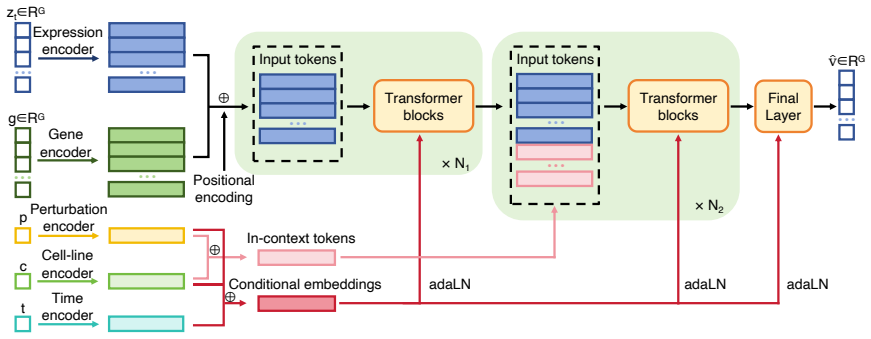
Vanilla Transformer stack performing flow-matching denoising on continuous gene-expression profiles, conditioned by adaptive layer normalization and in-context tokens.
What would settle it
A new benchmark dataset containing strong, previously unseen gene-regulatory interactions where any method that explicitly encodes those interactions significantly outperforms OCOO-T on held-out perturbations.
Extended reading notes
Core claim
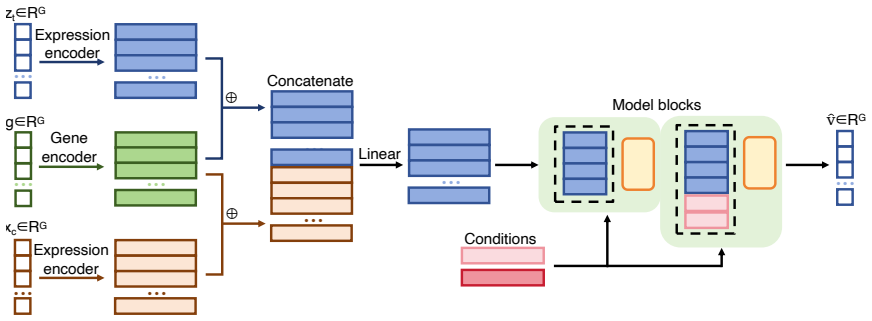
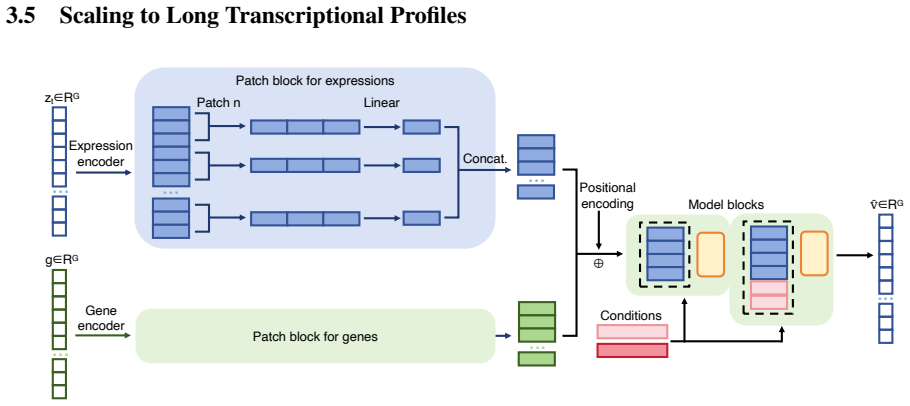
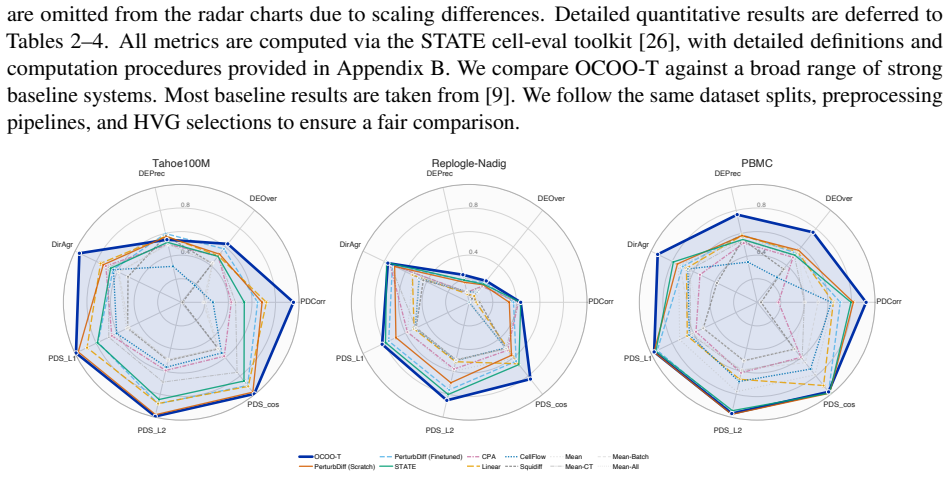
OCOO-T formulates transcriptional perturbation response prediction as a continuous-time flow-matching denoising task performed by a vanilla Transformer that operates directly on continuous gene-expression vectors; perturbation embeddings, dosage, and cell specificity are supplied solely through adaptive layer normalization and in-context tokens, enabling state-of-the-art accuracy across diverse perturbations and cell types on Tahoe100M, Replogle, and PBMC benchmarks together with linear scaling to long profiles through patching and depatching.
Load-bearing premise
That perturbation type, dosage, and cell identity supplied only through adaptive layer normalization and in-context tokens are sufficient to capture relevant biological response dynamics without gene-interaction priors or hierarchical encoders.
Editorial extensions
If this is right
- The model scales linearly to full-length transcriptional profiles by patching and depatching cellular contexts.
- Performance remains competitive across genetic, chemical, and cytokine perturbations as well as multiple cell types.
- Architectural complexity can be reduced while preserving or improving accuracy on existing single-cell perturbation benchmarks.
- In-silico cellular simulation becomes feasible at larger scale because the design avoids dedicated encoder-decoder modules.
Reading between the lines
- If the minimalist conditioning proves sufficient, explicit gene-interaction graphs may be unnecessary for many perturbation-prediction tasks.
- The same patching strategy could be tested on other high-dimensional single-cell modalities such as chromatin accessibility or protein abundance.
- Training cost and iteration speed for virtual-cell models would drop if the vanilla-Transformer baseline continues to match specialized architectures.
Signed reviews
Editorial analysis
A structured set of objections, weighed in public.
Referee Report
Summary. The paper introduces OCOO-T, a minimalist flow-matching-based virtual cell model that uses a vanilla Transformer operating directly on continuous gene expression profiles to predict single-cell transcriptional responses to genetic, chemical, and cytokine perturbations. Perturbation embeddings, dosage, and cell specificity are incorporated via adaptive layer normalization and in-context tokens, with patching/depatching for scalability to long profiles. The central claim is that this simple architecture achieves state-of-the-art performance on the Tahoe100M, Replogle, and PBMC benchmarks across diverse perturbations and cell types.
Significance. If the performance claims hold with proper validation, this would be significant for AIVC modeling by showing that standard flow-matching and Transformer components can suffice without auxiliary encoders, hierarchical VAEs, or gene-interaction priors, potentially improving scalability and reproducibility. The emphasis on a parameter-light design using established techniques is a strength for the field.
major comments (1)
- [Abstract] Abstract: the assertion of state-of-the-art performance on Tahoe100M, Replogle, and PBMC benchmarks provides no quantitative metrics, baseline details, error analysis, or statistical comparisons, which is load-bearing for the central empirical claim and prevents verification of the reported improvements.
Simulated Author's Rebuttal
We thank the referee for their review and constructive comment. We address the concern about the abstract below and will incorporate the suggested changes in the revised manuscript.
read point-by-point responses
-
Referee: [Abstract] Abstract: the assertion of state-of-the-art performance on Tahoe100M, Replogle, and PBMC benchmarks provides no quantitative metrics, baseline details, error analysis, or statistical comparisons, which is load-bearing for the central empirical claim and prevents verification of the reported improvements.
Authors: We agree that the abstract would be strengthened by including key quantitative metrics to support the SOTA claim. In the revised version, we will add concise performance highlights (e.g., primary metrics and baseline comparisons on each benchmark) drawn directly from the results tables, while preserving the abstract's length and readability. This addresses the verification concern without altering the manuscript's core claims. revision: yes
Circularity Check
No significant circularity detected
full rationale
The paper introduces OCOO-T as a minimalist flow-matching Transformer model for perturbation response prediction, relying on standard components (vanilla Transformer, adaptive layer norm, in-context tokens, patching) and reports empirical SOTA results on external benchmarks (Tahoe100M, Replogle, PBMC). No equations, derivations, or predictions are presented that reduce by construction to fitted parameters or self-defined quantities. No load-bearing self-citations, uniqueness theorems, or ansatzes imported from prior author work are invoked; the central claims rest on benchmark performance rather than internal definitional closure. This is a standard empirical modeling paper with no circular steps.
Assumptions & free parameters
Cite this review
Pith. "Pith review of OCOO-T : A Simple and Scalable Virtual Cell Model for Transcriptional Perturbation Response Prediction." pith.science (2026). https://pith.science/paper/MVTAGSH3
@misc{pith2026260612838,
  author       = {Pith},
  title        = {Pith review of: OCOO-T : A Simple and Scalable Virtual Cell Model for Transcriptional Perturbation Response Prediction},
  year         = {2026},
  howpublished = {\url{https://pith.science/paper/MVTAGSH3}},
  note         = {Machine review of arXiv:2606.12838}
}
read the original abstract
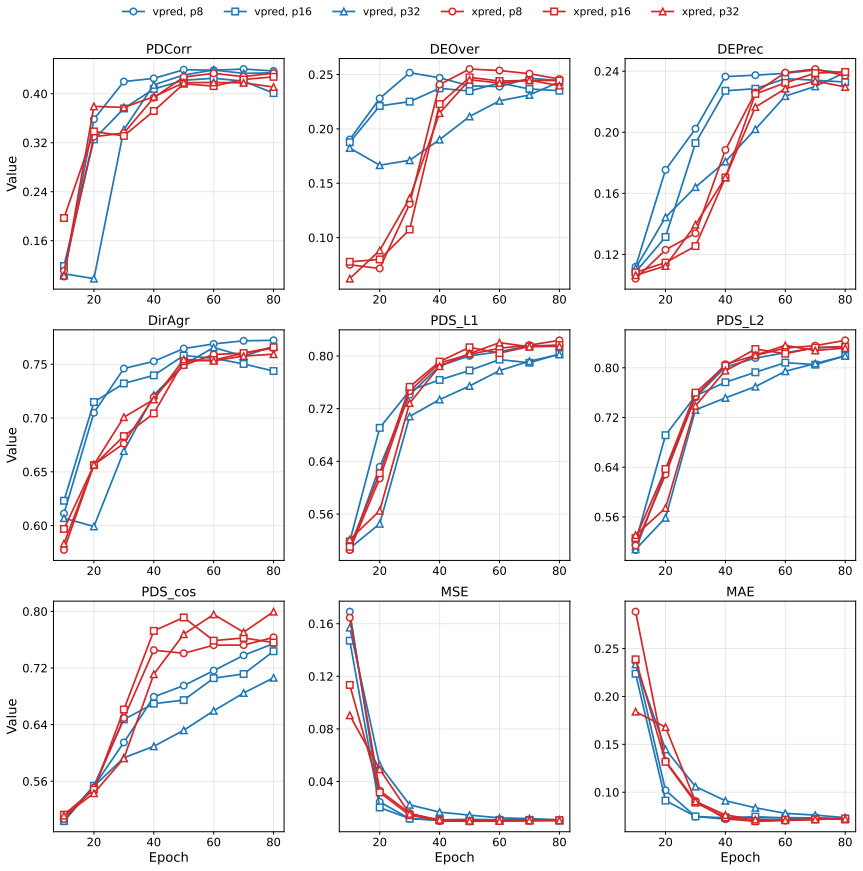
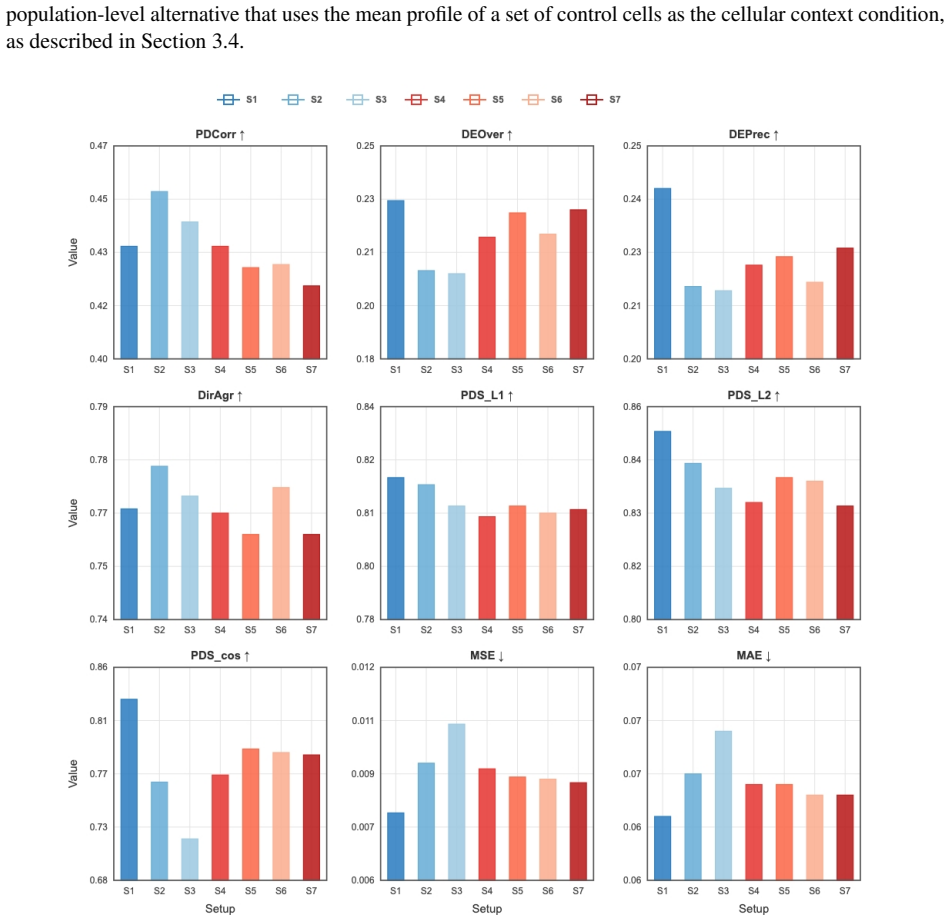
Predicting single-cell transcriptional responses to genetic, chemical and cytokine perturbations is a fundamental challenge in computational biology and AI Virtual Cell (AIVC) modeling, with direct implications for drug discovery and the elucidation of gene regulatory networks. Existing approaches often rely on auxiliary cell-state encoders, hierarchical variational autoencoders, dedicated Transformer encoder-decoder modules, or gene-interaction priors to compress high-dimensional expression profiles into latent representations. While effective, these designs increase architectural complexity and may limit scalability and generalizability. This paper introduces OCOO-T, a minimalist flow-matching-based AIVC model for transcriptional perturbation response prediction. OCOO-T utilizes a vanilla Transformer stack that operates directly on continuous gene expression profiles and formulates perturbation response prediction as a continuous-time denoising process. Perturbation embeddings, dosage information, and cell-line/cell-type specificity are integrated through adaptive layer normalization and in-context tokens. Comprehensive evaluations on Tahoe100M, Replogle, and PBMC benchmarks demonstrate that OCOO-T achieves state-of-the-art performance across diverse perturbations and cell types while effectively scaling to long transcriptional profiles through patching and depatching of cellular contexts. By leveraging the simplicity of Transformer-based denoising for single-cell omics, OCOO-T provides an effective and scalable framework for in-silico cellular simulation.
Figures
Figures from the paper (3 more)
Forward citations
Cited by 1 Pith paper
-
PerturbMap: Cross-Context Transfer of Single-Cell Perturbation Responses
Reliability-weighted ridge transport of measured source perturbation responses improves recipient-context mean-effect MSE by 4.1% over a recipient-local low-rank base on Frangieh Perturb-CITE-seq.
Reviewed June 27, 2026 · model on record in the stance chip above.
Discussion (0). Continue with ORCID to comment.