REVIEW 3 major objections 5 minor 1 cited by
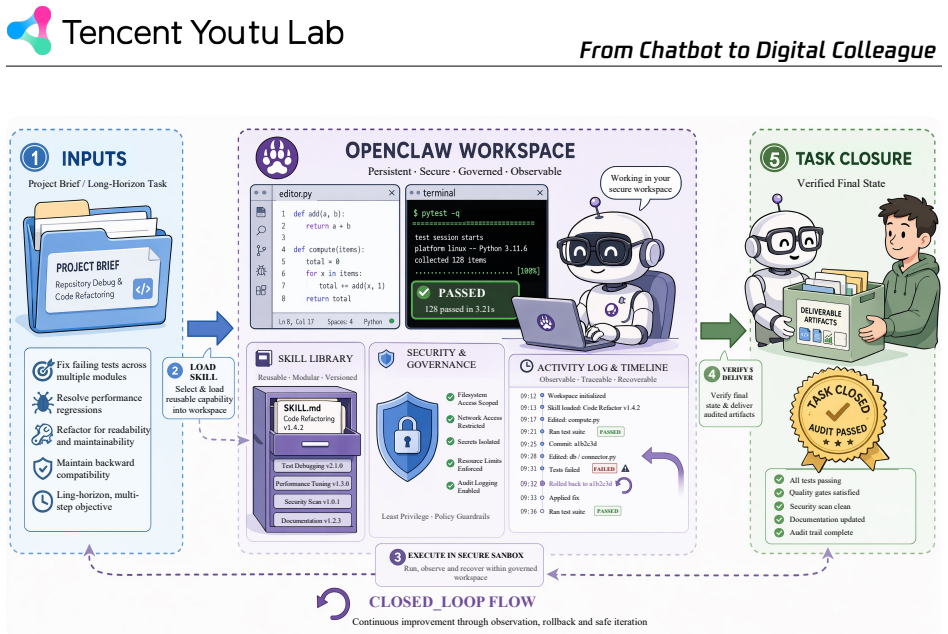
Persistent workspaces and reusable skills are the mechanism that turns chatbots into durable digital colleagues.
Reviewed by Pith at T0; open to challenge. T0 means a machine referee read the full paper against a public rubric. the ladder, T0–T4 →
T0 review · deepseek-v4-flash
2026-08-02 11:25 UTC pith:WCZZYTPL
load-bearing objection A useful synthesis of the agent-to-workspace trend, but the central causal claim — Workspace+Skill is the key leap — is asserted, not demonstrated. the 3 major comments →
From Chatbot to Digital Colleague: The Paradigm Shift Toward Persistent Autonomous AI
The pith
A machine-rendered reading of the paper's core claim, the machinery that carries it, and where it could break.
Core claim
The paper's central claim is that Workspace + Skill is the decisive architectural step. A Workspace is a persistent digital environment where files, terminals, browsers, repositories, logs, and permissions survive across a task; a Skill is a reusable, parameterizable procedure with instructions, scripts, checks, dependencies, and safety constraints. Together they convert episodic, best-effort tool use into persistent, inspectable work: the agent can load a procedure, operate on durable state, detect and repair failures, and leave a verified final workspace state. The authors assert that current agent failures—fragmented perception, ephemeral tool calls, brittleness under environmental noise,
What carries the argument
The central mechanism is the pair Workspace + Skill. The Workspace supplies persistent state and evidence—files, terminals, browsers, logs, permissions, snapshots—so that actions have inspectable and recoverable consequences. The Skill supplies procedural memory—packaged instructions, scripts, validation checks, dependencies, and safety constraints—so that repeated work does not have to be rediscovered each time. The paper argues that only when both are present does an agent achieve task closure: reaching and verifying the intended final state under reproducible and safe conditions. Workstation-style agent systems are presented as the representative engineering form of this mechanism.
Load-bearing premise
The load-bearing premise is that today's agent failures—fragmented perception, ephemeral tool calls, brittleness, missing task closure—are a fundamental architectural limitation of the environment-action-feedback loop, rather than simply a shortfall in model capability, training, or reasoning; if long-horizon unreliability is mostly a model-cognition problem, then persistent workspaces and skills are helpful scaffolding but not the decisive leap.
What would settle it
Run a controlled comparison of the same base model and agent loop on a long-horizon stateful benchmark (for example, desktop or web tasks with execution-based checks) under three conditions: stateless tool calls, a persistent workspace without skills, and persistent workspace plus a skill library. If task-closure rates do not improve materially when workspace state and skills are added—while the model is held fixed—the survey's central claim is falsified. A weaker disconfirmation would be showing that model scaling alone reproduces the same reliability gains without any workspace changes.
If this is right
- If Workspace + Skill is the key leap, then the binding constraint on reliable autonomous AI is the execution substrate—state persistence, verification loops, permissions, rollback—alongside the model's reasoning ability.
- Agent training data should be built from complete state-action-observation trajectories, including tool outputs, intermediate failures, and final-state evidence, rather than static instruction-response pairs.
- Evaluation should move to task closure: final-state verification, repeated-run reliability, efficiency, reproducibility, and trajectory-level safety, instead of answer-level accuracy.
- The main bottleneck in deploying agents shifts from prompt design to system operations: skill lifecycle management, workspace hygiene, sandboxing, audit trails, and governance.
- Human-AI interaction shifts from instruction-following to delegation—users set objectives, constraints, permissions, and acceptance criteria, then audit the work episode.
Where Pith is reading between the lines
- Editorial inference: If the architectural thesis is right, harness quality may matter more than model scale for practical long-horizon work; a well-instrumented workspace could let smaller, cheaper models compete with much larger ones on real tasks.
- Testable extension: A controlled ablation—same base model and instruction set, run with and without persistent workspace state and a reusable skill library on a stateful benchmark—would isolate whether the gains attributed to Workspace + Skill are architectural or just extra context and tool access.
- Neighbouring consequence: The skill-as-package view predicts that skill provenance, versioning, and dependency checking become as important as model safety, and that supply-chain attacks on skill libraries will be a primary failure mode.
- The delegation framing implies that research on AI interfaces should focus on authority, escalation, and audit surfaces rather than chat alone; progress may be measured by how little human micro-management is needed at a given level of risk.
Editorial analysis
A structured set of objections, weighed in public.
Referee Report
Summary. This paper is a broad survey and position paper that organizes recent LLM evolution along two dimensions: the cognitive core (Chatbot → Thinking LLM) and tool-augmented task execution (Agent → OpenClaw-style workstation systems). Its central claim, stated in the Introduction and developed in Part III, is that the combination of a persistent Workspace and reusable Skills is "the key leap" that transforms chatbot-style interaction into durable, task-closing "digital colleague" work. The paper reviews models, benchmarks, data regimes, and evaluation methods across four eras, and it discusses open challenges in reliability, governance, memory, and self-evolving ecosystems. It is explicitly a synthesis rather than a new experimental study: no experiments are run, and the framework is assembled from existing systems and benchmarks.
Significance. If the central thesis is accepted, the paper makes a useful conceptual contribution by shifting attention from model-scale and reasoning ability alone to the execution substrate, skill libraries, verification loops, and governance mechanisms that enable long-horizon task closure. The survey's strengths include its broad and current coverage of systems and benchmarks, the clear two-dimensional framing, the concrete taxonomy of data and evaluation stages (Tables 6–11), and a candid list of limitations of the Workspace + Skill paradigm in §4.2.2. It also usefully connects technical reliability with security, forensics, and organizational governance. The paper does not ship machine-checked proofs or code, but it does provide a falsifiable framing: the claim that persistent workspaces and reusable skills are causally important could, in principle, be tested by controlled comparisons. The main weakness is that the load-bearing causal attribution is asserted rather than evidenced.
major comments (3)
- [§3.1.2 and Part III] The paper's central claim that "Workspace + Skill is the key leap" is a causal attribution that is not tested. §3.1.2 calls the four Agent-era bottlenecks "a fundamental architectural limitation" rather than a reflection of insufficient model capability, and Part III builds on this. However, no controlled comparison separates the effect of the workspace/skill substrate from model cognition: the cited benchmarks (WebArena, SWE-bench, OSWorld) compare different models or settings, and Table 4's Agent/OpenClaw boundary is a definitional dichotomy, not empirical evidence. The failure modes listed are equally consistent with limited planning, reasoning, and self-correction in the base model. To make the central claim defensible, the paper should either reframe it as a proposal/hypothesis with explicit testable predictions, or present the available evidence in a way that separates substrate ef
- [Figure 2] The figure claims that "the time horizon of frontier AI agents has grown exponentially" and presents this as a key takeaway. Yet no fitted curve, confidence interval, or regression is shown, and the provenance of the underlying "50%-time horizon" data is only a footnote to an external website. Axis units are mixed (seconds in one label, minutes in another), and the methodology for computing the median task length is not described. If this exponential claim is load-bearing for the paper's narrative, the data points and fitting procedure should be reported; otherwise the claim should be softened to "approximately exponential in the observed period" or removed.
- [§4.2.2 and Conclusion] The paper's own limitation list — skill brittleness, environmental drift, negative transfer, workspace contamination, security/supply-chain risk, and governance overhead — substantially weakens the "key leap" framing. These are not merely operational details; they show that the benefits of Workspace + Skill are conditional on an expensive governance and maintenance layer. The manuscript should state under which conditions the paradigm is decisive (e.g., bounded, versioned environments with strong verification) and where it acts only as scaffolding atop model capability. Without this, Part III's conclusion overreaches relative to the evidence the paper itself presents.
minor comments (5)
- [Section 1] Typo: "the central question is thereforeno longer limited tohow can a model generate a better answer?Instead, it is howhow can an AI system reliably transform user intent into completed work?" — "howhow" should read "how".
- [Figure 1] Several node labels contain typos or inconsistent formatting: "Qwen3-Instuct" should be "Qwen3-Instruct", "Dep2025" is likely "Dec2025", and the legend text about open/closed box styles is missing a glyph. Please also ensure the timeline dates are consistent between text and figure.
- [Figure 2] The caption refers to a footnote for the data source, but the definition of "50%-time horizon" should be in the caption itself, along with the unit of measurement (seconds/minutes). The y-axis labels mix seconds and minutes, which makes the plot hard to read.
- [Table 10 notes] The note "UI-TARS-2 scores marked with 'use the paper's extended GUI-SDK setting" has an unmatched quotation mark. Also, "Terminal 2.0" is used as a column heading but the text refers to "Terminal-Bench v2.0"; this shorthand should be defined in the table notes.
- [§5.2.4 / Table 11] The selection rationale "retained columns were selected using Semantic Scholar citation-overlap" is not a transparent criterion. Either describe the exact selection procedure or report the full set of benchmark columns; otherwise the table may appear cherry-picked.
Circularity Check
No significant circularity: the Workspace+Skill thesis is a conceptual organizing claim, not a derived result, and the only self-citations are informational table entries.
full rationale
Walked the claimed derivation chain: the paper's central claim is that 'Workspace + Skill provides the mechanism that turns chatbot-style interaction into durable digital-colleague work' (Section 1). This is a survey thesis and organizing framework, not a formal derivation with fitted parameters or equations that reduce to its own inputs. The four Agent-era bottlenecks (§3.1.2) are attributed to external benchmarks and failure analyses (AgentBench, WebArena, SWE-bench, GAIA, LLM Agent Failure); the sentence calling them 'a fundamental architectural limitation' is a causal assertion, not a result derived within the paper, so it is a correctness-risk concern rather than a circularity. The paper's own §4.2.2 limitations paragraph explicitly concedes skill brittleness, environmental drift, negative transfer, workspace contamination, and supply-chain risk, which weakens the strength of the central claim but does not make it circular. The only author-affiliated items are Youtu-LLM and Youtu-VL in Table 1, which are purely informational timeline entries and are not cited anywhere in the load-bearing argument. The framework is assembled from external systems and benchmarks (OpenHands, SWE-agent, SWE-bench, WebArena, OSWorld, ClawsBench, etc.), and OpenClaw is used as a representative case study rather than as an input to a derivation. No circular step was found.
Axiom & Free-Parameter Ledger
axioms (3)
- domain assumption LLM evolution is separable into two dimensions (cognitive core; tool-augmented execution) and four eras (Chatbot, Thinking LLM, Agent, OpenClaw).
- ad hoc to paper Persistent state (Workspace) and reusable procedures (Skill) are the decisive mechanism—the 'key leap'—for reliable long-horizon task closure.
- domain assumption The benchmark scores and system facts in Tables 9–11 and Figure 2 are accurate and current as of submission.
invented entities (2)
-
Digital Colleague (the 'next paradigm' state)
no independent evidence
-
Workspace + Skill paradigm
no independent evidence
read the original abstract
Large Language Models (LLMs) are undergoing a fundamental transformation from conversational generators into integrated AI systems capable of reasoning, action, memory, and self-improvement. We conceptualize this transition as a shift from Chatbot to Digital Colleague: from conversational answers to persistent work. We organize this transition along two tightly coupled dimensions. First, at the cognitive core level, LLMs are advancing from Chatbot-era "fast thinking" systems driven by next-token prediction toward Thinking LLMs that leverage inference-time computation, Chain-of-Thought reasoning, reflection, process supervision, and reinforcement learning to support more deliberate and reliable cognition. Second, at the tool-augmented task execution level, LLMs are progressing from tool-calling Agents that invoke external resources in an ad hoc manner toward OpenClaw-style workstation systems (OpenClaw) equipped with persistent Workspaces, skills, verification loops, and governance. The "Workspace + Skill" paradigm makes episodic tool use colleague-like via state persistence, reusable procedures, task closure, and experience reuse. We examine data construction shifts from instruction-response pairs to State-Action-Observation trajectories and evaluation from static benchmarks to sandboxed, auditable, self-evolving AI ecosystems.
Figures




Forward citations
Cited by 1 Pith paper
-
Thinking in Video: Can Video Generators Really Reason About the Real World?
Video generators show a perception-prediction gap: they can generate plausible continuations while failing explicit visual reasoning tests.
Reference graph
Works this paper leans on
-
[1]
On the opportunities and risks of foundation models.arXiv preprint arXiv:2108.07258, 2021
Rishi Bommasani, Drew A Hudson, Ehsan Adeli, Russ Altman, Simran Arora, Sydney von Arx, Michael S Bernstein, Jeannette Bohg, Antoine Bosselut, Emma Brunskill, et al. On the opportunities and risks of foundation models.arXiv preprint arXiv:2108.07258, 2021
Pith/arXiv arXiv 2021
-
[2]
Recent advances in natural language processing via large pre-trained language models: A survey.ACM Computing Surveys, 56(2): 1–40, 2023
Bonan Min, Hayley Ross, Elior Sulem, Amir Pouran Ben Veyseh, Thien Huu Nguyen, Oscar Sainz, Eneko Agirre, Ilana Heintz, and Dan Roth. Recent advances in natural language processing via large pre-trained language models: A survey.ACM Computing Surveys, 56(2): 1–40, 2023
2023
-
[3]
A comprehensive overview of large language models.ACM Transactions on Intelligent Systems and Technology, 16(5):1–72, 2025
Humza Naveed, Asad Ullah Khan, Shi Qiu, Muhammad Saqib, Saeed Anwar, Muhammad Usman, Naveed Akhtar, Nick Barnes, and Ajmal Mian. A comprehensive overview of large language models.ACM Transactions on Intelligent Systems and Technology, 16(5):1–72, 2025
2025
-
[4]
A survey on large language model based autonomous agents.Frontiers of Computer Science, 18(6), 2024
Lei Wang, Chen Ma, Xueyang Feng, Zeyu Zhang, Hao Yang, Jingsen Zhang, Zhiyuan Chen, Jiakai Tang, Xu Chen, Yankai Lin, et al. A survey on large language model based autonomous agents.Frontiers of Computer Science, 18(6), 2024
2024
-
[5]
Zhiheng Xi, Wenxiang Chen, Xin Guo, Wei He, Yiwen Ding, Boyang Hong, Ming Zhang, Junzhe Wang, Senjie Jin, Enyu Zhou, et al. The rise and potential of large language model based agents: A survey.arXiv preprint arXiv:2309.07864, 2023
Pith/arXiv arXiv 2023
-
[6]
Libo Qin, Qiguang Chen, Xiachong Feng, Yang Wu, Yongheng Zhang, Yinghui Li, Min Li, Wanxiang Che, and Philip S. Yu. Large language models meet nlp: A survey, 2025. URL https://arxiv.org/abs/2405.12819
Pith/arXiv arXiv 2025
-
[7]
ReAct: Synergizing reasoning and acting in language models.arXiv preprint arXiv:2210.03629, 2022
Shunyu Yao, Jeffrey Zhao, Dian Yu, Nan Du, Izhak Shafran, Karthik Narasimhan, and Yuan Cao. ReAct: Synergizing reasoning and acting in language models.arXiv preprint arXiv:2210.03629, 2022
Pith/arXiv arXiv 2022
-
[8]
Generative agents: Interactive simulacra of human behavior
Joon Sung Park, Joseph O’Brien, Carrie Jun Cai, Meredith Ringel Morris, Percy Liang, and Michael S Bernstein. Generative agents: Interactive simulacra of human behavior. In Proceedings of the 36th Annual ACM Symposium on User Interface Software and Technology, pages 1–22, 2023
2023
-
[9]
A survey on the memory mechanism of large language model-based agents.ACM Transactions on Information Systems, 43(6):1–47, 2025
Zeyu Zhang, Quanyu Dai, Xiaohe Bo, Chen Ma, Rui Li, Xu Chen, Jieming Zhu, Zhenhua Dong, and Ji-Rong Wen. A survey on the memory mechanism of large language model-based agents.ACM Transactions on Information Systems, 43(6):1–47, 2025
2025
-
[10]
Attentionisallyouneed
Ashish Vaswani, Noam Shazeer, Niki Parmar, Jakob Uszkoreit, Llion Jones, Aidan N Gomez, ŁukaszKaiser,andIlliaPolosukhin. Attentionisallyouneed. InAdvancesinNeuralInformation Processing Systems, pages 5998–6008, 2017
2017
-
[11]
Language models are few-shot learners.Advances in Neural Information Processing Systems, 33:1877–1901, 2020
TomBBrown,BenjaminMann,NickRyder,MelanieSubbiah,JaredKaplan,PrafullaDhariwal, Arvind Neelakantan, Pranav Shyam, Girish Sastry, Amanda Askell, et al. Language models are few-shot learners.Advances in Neural Information Processing Systems, 33:1877–1901, 2020
1901
-
[12]
Scaling laws for neural language models.arXiv preprint arXiv:2001.08361, 2020
Jared Kaplan, Sam McCandlish, Tom Henighan, Tom B Brown, Benjamin Chess, Rewon Child, Scott Gray, Alec Radford, Jeffrey Wu, and Dario Amodei. Scaling laws for neural language models.arXiv preprint arXiv:2001.08361, 2020. 58 From Chatbot to Digital Colleague
Pith/arXiv arXiv 2001
-
[13]
Training compute-optimal large language models
Jordan Hoffmann, Sebastian Borgeaud, Arthur Mensch, Elena Buchatskaya, Trevor Cai, Eliza Rutherford, Diego de Las Casas, Lisa Anne Hendricks, Johannes Welbl, Aidan Clark, et al. Training compute-optimal large language models. InAdvances in Neural Information Processing Systems (NeurIPS), 2022. URLhttps://arxiv.org/abs/2203.15556
Pith/arXiv arXiv 2022
-
[14]
Gpt-4 technical report.arXiv preprint arXiv:2303.08774, 2023
Josh Achiam, Steven Adler, Sandhini Agarwal, Lama Ahmad, Ilge Akkaya, Florencia Leoni Aleman, Diogo Almeida, Janko Altenschmidt, Sam Altman, Shyamal Anadkat, et al. Gpt-4 technical report.arXiv preprint arXiv:2303.08774, 2023
Pith/arXiv arXiv 2023
-
[15]
Chain-of-thought prompting elicits reasoning in large language models
Jason Wei, Xuezhi Wang, Dale Schuurmans, Maarten Bosma, Fei Xia, Ed Chi, Quoc V Le, Denny Zhou, et al. Chain-of-thought prompting elicits reasoning in large language models. Advances in neural information processing systems, 35:24824–24837, 2022
2022
-
[16]
Daya Guo, Dejian Yang, Haowei Zhang, Junxiao Song, Peiyi Wang, Qihao Zhu, Runxin Xu, Ruoyu Zhang, Shirong Ma, Xiao Bi, Xiaokang Zhang, Xingkai Yu, Yu Wu, Z. F. Wu, Zhibin Gou, Zhihong Shao, Zhuoshu Li, Ziyi Gao, Aixin Liu, Bing Xue, Bingxuan Wang, Bochao Wu, Bei Feng, Chengda Lu, Chenggang Zhao, Chengqi Deng, Chong Ruan, Damai Dai, Deli Chen, Dongjie Ji, ...
2025
-
[17]
Toolformer: Language models can teach themselves to use tools.Advances in Neural Information Processing Systems, 36, 2023
Timo Schick, Jane Dwivedi-Yu, Roberto Dessì, Roberta Raileanu, Maria Lomeli, Eric Hambro, Luke Zettlemoyer, Nicola Cancedda, and Thomas Scialom. Toolformer: Language models can teach themselves to use tools.Advances in Neural Information Processing Systems, 36, 2023. 59 From Chatbot to Digital Colleague
2023
-
[18]
Yujia Qin, Shihao Liang, Yining Ye, Kunlun Zhu, Lan Yan, Yaxi Lu, Yankai Lin, Xin Cong, Xiangru Tang, Bill Qian, et al. ToolLLM: Facilitating large language models to master 16000+ real-world APIs.arXiv preprint arXiv:2307.16789, 2023
Pith/arXiv arXiv 2023
-
[19]
Qingyun Wu, Gagan Bansal, Jieyu Zhang, Yiran Wu, Beibin Li, Erkang Zhu, Li Jiang, Xiaoyun Zhang, Shaokun Zhang, Jiale Liu, et al. AutoGen: Enabling next-gen LLM applications via multi-agent conversation.arXiv preprint arXiv:2308.08155, 2023
Pith/arXiv arXiv 2023
-
[20]
Sirui Hong, Xiawu Zheng, Jonathan Chen, Yuheng Cheng, Jinlin Wang, Ceyao Zhang, Zili Wang, Steven Ka Shing Yau, Zijuan Lin, Liyang Zhou, et al. MetaGPT: Meta programming for multi-agent collaborative framework.arXiv preprint arXiv:2308.00352, 2023
Pith/arXiv arXiv 2023
-
[21]
Introducing ChatGPT.https://openai.com/blog/chatgpt, 2022
OpenAI. Introducing ChatGPT.https://openai.com/blog/chatgpt, 2022
2022
-
[23]
Gemma 2: Improving open language models at a practical size, 2024
Gemma Team, Morgane Riviere, Shreya Pathak, Pier Giuseppe Sessa, Cassidy Hardin, Surya Bhupatiraju, Léonard Hussenot, Thomas Mesnard, Bobak Shahriari, Alexandre Ramé, et al. Gemma 2: Improving open language models at a practical size, 2024
2024
-
[24]
Albert Q. Jiang, Alexandre Sablayrolles, Arthur Mensch, Chris Bamford, Devendra Singh Chaplot, Diego de Las Casas, Florian Bressand, Gianna Lengyel, Guillaume Lample, Lucile Saulnier, et al. Mistral 7b.arXiv preprint arXiv:2310.06825, 2023. URLhttps://arxiv. org/abs/2310.06825
Pith/arXiv arXiv 2023
-
[25]
Pali-x: On scaling up a multilingual vision and language model.arXiv preprint arXiv:2305.18565, 2023
Xi Chen, Josip Djolonga, Piotr Padlewski, Basil Mustafa, Soravit Changpinyo, Jialin Wu, Carlos Riquelme Ruiz, Sebastian Goodman, Xiao Wang, Yi Tay, et al. Pali-x: On scaling up a multilingual vision and language model.arXiv preprint arXiv:2305.18565, 2023
Pith/arXiv arXiv 2023
-
[26]
Fabio Petroni, Tim Rocktäschel, Sebastian Riedel, Patrick Lewis, Anton Bakhtin, Yuxiang Wu, and Alexander Miller. Language models as knowledge bases? InProceedings of the 2019 conference on empirical methods in natural language processing and the 9th international joint conference on natural language processing (EMNLP-IJCNLP), pages 2463–2473, 2019
2019
-
[27]
Towards reasoning in large language models: A survey
Jie Huang and Kevin Chen-Chuan Chang. Towards reasoning in large language models: A survey. InFindingsoftheassociationforcomputationallinguistics: ACL2023, pages1049–1065, 2023
2023
-
[28]
Faith and fate: Limits of transformers on compositionality.Advances in neural information processing systems, 36: 70293–70332, 2023
Nouha Dziri, Ximing Lu, Melanie Sclar, Xiang Lorraine Li, Liwei Jiang, Bill Yuchen Lin, Sean Welleck, Peter West, Chandra Bhagavatula, Ronan Le Bras, et al. Faith and fate: Limits of transformers on compositionality.Advances in neural information processing systems, 36: 70293–70332, 2023
2023
-
[29]
Large language models still can’t plan (a benchmark for llms on planning and reasoning about change)
Karthik Valmeekam, Alberto Olmo, Sarath Sreedharan, and Subbarao Kambhampati. Large language models still can’t plan (a benchmark for llms on planning and reasoning about change). InNeurIPS 2022 Foundation Models for Decision Making Workshop, 2022
2022
-
[30]
Scaling LLM test-time compute optimally can be more effective than scaling model parameters, 2024
Charlie Snell, Jaehoon Lee, Kelvin Xu, and Aviral Kumar. Scaling LLM test-time compute optimally can be more effective than scaling model parameters, 2024. URLhttps:// arxiv.org/abs/2408.03314. 60 From Chatbot to Digital Colleague
Pith/arXiv arXiv 2024
-
[31]
Large language models are zero-shot reasoners.Ad- vances in Neural Information Processing Systems, 35:22199–22213, 2022
Takeshi Kojima, Shixiang Shane Gu, Machel Reid, Yutaka Matsuo, and Yusuke Iwasawa. Large language models are zero-shot reasoners.Ad- vances in Neural Information Processing Systems, 35:22199–22213, 2022. URL https://proceedings.neurips.cc/paper_files/paper/2022/hash/ 8bb0d291acd4acf06ef112099c16f326-Abstract-Conference.html
2022
-
[32]
Self-refine: Iterative refinement with self- feedback.Advances in Neural Information Processing Systems, 36:46534–46594,
Aman Madaan, Niket Tandon, Prakhar Gupta, Skyler Hallinan, Luyu Gao, Sarah Wiegreffe, Uri Alon, Nouha Dziri, Shrimai Prabhumoye, Yiming Yang, Shashank Gupta, Bodhisattwa Prasad Majumder, Katherine Hermann, Sean Welleck, Amir Yazdanbakhsh, and Peter Clark. Self-refine: Iterative refinement with self- feedback.Advances in Neural Information Processing Syste...
-
[33]
Re- flexion: Language agents with verbal reinforcement learning.Advances in neural information processing systems, 36:8634–8652, 2023
Noah Shinn, Federico Cassano, Ashwin Gopinath, Karthik Narasimhan, and Shunyu Yao. Re- flexion: Language agents with verbal reinforcement learning.Advances in neural information processing systems, 36:8634–8652, 2023
2023
-
[34]
Let’s verify step by step
Hunter Lightman, Vineet Kosaraju, Yuri Burda, Harrison Edwards, Bowen Baker, Teddy Lee, Jan Leike, John Schulman, Ilya Sutskever, and Karl Cobbe. Let’s verify step by step. In International Conference on Learning Representations, volume 2024, pages 39578–39601, 2024
2024
-
[35]
Xu, Jun-Mei Song, Mingchuan Zhang, Y
Zhihong Shao, Peiyi Wang, Qihao Zhu, R. Xu, Jun-Mei Song, Mingchuan Zhang, Y. K. Li, Yu Wu, and Daya Guo. Deepseekmath: Pushing the limits of mathematical reasoning in open language models.ArXiv, abs/2402.03300, 2024
Pith/arXiv arXiv 2024
-
[36]
Generative to agentic ai: Survey, conceptualization, and challenges
Johannes Schneider. Generative to agentic ai: Survey, conceptualization, and challenges. arXiv preprint arXiv:2504.18875, 2025
Pith/arXiv arXiv 2025
-
[37]
Agentic reasoning for large language models.arXiv preprint arXiv:2601.12538, 2026
Tianxin Wei, Ting-Wei Li, Zhining Liu, Xuying Ning, Ze Yang, Jiaru Zou, Zhichen Zeng, Ruizhong Qiu, Xiao Lin, Dongqi Fu, et al. Agentic reasoning for large language models.arXiv preprint arXiv:2601.12538, 2026
Pith/arXiv arXiv 2026
-
[38]
Advancing reasoning in large language models: Promising methods and approaches
Avinash Patil and Aryan Jadon. Advancing reasoning in large language models: Promising methods and approaches. InInternational Conference on Computational Intelligence and Soft Computing, pages 284–298. Springer, 2025
2025
-
[39]
Edge general intelligence through world models, large language models, and agentic ai: Fundamentals, solutions, and challenges
Changyuan Zhao, Guangyuan Liu, Ruichen Zhang, Yinqiu Liu, Jiacheng Wang, Jiawen Kang, Dusit Niyato, Zan Li, Xuemin Shen, Zhu Han, et al. Edge general intelligence through world models, large language models, and agentic ai: Fundamentals, solutions, and challenges. IEEE Transactions on Cognitive Communications and Networking, 2026
2026
-
[40]
A survey on large language model-based game agents.arXiv preprint arXiv:2404.02039, 2024
Sihao Hu, Tiansheng Huang, Gaowen Liu, Ramana Rao Kompella, Fatih Ilhan, Selim Furkan Tekin, Yichang Xu, Zachary Yahn, and Ling Liu. A survey on large language model-based game agents.arXiv preprint arXiv:2404.02039, 2024
Pith/arXiv arXiv 2024
-
[41]
Toward large reasoning models: A survey of reinforced reasoning with large language models.Patterns, 6(10), 2025
Fengli Xu, Qianyue Hao, Chenyang Shao, Zefang Zong, Yu Li, Jingwei Wang, Yunke Zhang, Jingyi Wang, Xiaochong Lan, Jiahui Gong, et al. Toward large reasoning models: A survey of reinforced reasoning with large language models.Patterns, 6(10), 2025. 61 From Chatbot to Digital Colleague
2025
-
[42]
Taicheng Guo, Xiuying Chen, Yaqi Wang, Ruidi Chang, Shichao Pei, Nitesh V Chawla, Olaf Wiest, and Xiangliang Zhang. Large language model based multi-agents: A survey of progress and challenges.arXiv preprint arXiv:2402.01680, 2024
Pith/arXiv arXiv 2024
-
[43]
Large language model agents: A comprehensive survey on architectures, capabilities, and applications
Yiming Lei, Jiawei Xu, Chia Xin Liang, Ziqian Bi, Xiaoming Li, Danyang Zhang, Junhao Song, and Zhenyu Yu. Large language model agents: A comprehensive survey on architectures, capabilities, and applications. 2025
2025
-
[44]
A survey of reasoning with foundation models: Concepts, methodologies, and outlook.ACM Computing Surveys, 57(11):1–43, 2025
Jiankai Sun, Chuanyang Zheng, Enze Xie, Zhengying Liu, Ruihang Chu, Jianing Qiu, Jiaqi Xu, Mingyu Ding, Hongyang Li, Mengzhe Geng, et al. A survey of reasoning with foundation models: Concepts, methodologies, and outlook.ACM Computing Surveys, 57(11):1–43, 2025
2025
-
[45]
Agentic large language models, a survey.Journal of Artificial Intelligence Research, 84, 2025
Aske Plaat, Max van Duijn, Niki Van Stein, Mike Preuss, Peter van der Putten, and Kees Joost Batenburg. Agentic large language models, a survey.Journal of Artificial Intelligence Research, 84, 2025
2025
-
[46]
Openhands: An open platform for ai software developers as generalist agents
Xingyao Wang, Boxuan Li, Yufan Song, Frank F Xu, Xiangru Tang, Mingchen Zhuge, Jiayi Pan, Yueqi Song, Bowen Li, Jaskirat Singh, et al. Openhands: An open platform for ai software developers as generalist agents. InInternational Conference on Learning Representations, volume 2025, pages 65882–65919, 2025
2025
-
[47]
SWE-agent: Agent-computer interfaces enable automated software engineering
John Yang, Carlos E Jimenez, Alexander Wettig, Kilian Lieret, Shunyu Yao, Karthik R Narasimhan, and Ofir Press. SWE-agent: Agent-computer interfaces enable automated software engineering. InThe Thirty-eighth Annual Conference on Neural Information Process- ing Systems, 2024. URLhttps://openreview.net/forum?id=mXpq6ut8J3
2024
-
[48]
Alexandre Drouin, Maxime Gasse, Massimo Caccia, Issam H Laradji, Manuel Del Verme, Tom Marty, Léo Boisvert, Megh Thakkar, Quentin Cappart, David Vazquez, et al. Workarena: How capable are web agents at solving common knowledge work tasks?arXiv preprint arXiv:2403.07718, 2024
Pith/arXiv arXiv 2024
-
[49]
OSWorld: Benchmarking multimodal agents for open-ended tasks in real computer environments
Tianbao Xie, Danyang Zhang, Jixuan Chen, Xiaochuan Li, Siheng Zhao, Ruisheng Cao, Toh Jing Hua, Zhoujun Cheng, Dongchan Shin, Fangyu Lei, Yitao Liu, Yiheng Xu, Shuyan Zhou, Silvio Savarese, Caiming Xiong, Victor Zhong, and Tao Yu. OSWorld: Benchmarking multimodal agents for open-ended tasks in real computer environments. InThe Thirty-eight Conference on N...
2024
-
[50]
Xu, Hao Zhu, Xuhui Zhou, Robert Lo, Abishek Sridhar, Xianyi Cheng, Tianyue Ou, Yonatan Bisk, Daniel Fried, Uri Alon, and Graham Neubig
Shuyan Zhou, Frank F. Xu, Hao Zhu, Xuhui Zhou, Robert Lo, Abishek Sridhar, Xianyi Cheng, Tianyue Ou, Yonatan Bisk, Daniel Fried, Uri Alon, and Graham Neubig. Webarena: A realistic web environment for building autonomous agents. InThe Twelfth International Conference on Learning Representations, 2024. URLhttps://openreview.net/forum? id=oKn9c6ytLx
2024
-
[51]
Voyager: An open-ended embodied agent with large language models.Transactions on Machine Learning Research, 2024
Guanzhi Wang, Yuqi Xie, Yunfan Jiang, Ajay Mandlekar, Chaowei Xiao, Yuke Zhu, Linxi Fan, and Anima Anandkumar. Voyager: An open-ended embodied agent with large language models.Transactions on Machine Learning Research, 2024. ISSN 2835-8856. URLhttps: //openreview.net/forum?id=ehfRiF0R3a. 62 From Chatbot to Digital Colleague
2024
-
[52]
Junyu Luo, Weizhi Zhang, Ye Yuan, Yusheng Zhao, Junwei Yang, Yiyang Gu, Bohan Wu, Binqi Chen, Ziyue Qiao, Qingqing Long, et al. Large language model agent: A survey on methodology, applications and challenges.arXiv preprint arXiv:2503.21460, 2025
Pith/arXiv arXiv 2025
-
[53]
María Miró Maestre, Iván Martínez-Murillo, Tania J Martin, Borja Navarro-Colorado, Antonio Ferrández, Armando Suárez Cueto, and Elena Lloret. Beyondgenerativeartificial intelligence: Roadmap for natural language generation.arXiv preprint arXiv:2407.10554, 2024
Pith/arXiv arXiv 2024
-
[54]
A survey on the optimization of large language model-based agents.ACM Computing Surveys, 58(9):1–37, 2026
Shangheng Du, Jiabao Zhao, Jinxin Shi, Zhentao Xie, Xin Jiang, Yanhong Bai, and Liang He. A survey on the optimization of large language model-based agents.ACM Computing Surveys, 58(9):1–37, 2026
2026
-
[55]
Saikat Barua. Exploring autonomous agents through the lens of large language models: A review.arXiv preprint arXiv:2404.04442, 2024
Pith/arXiv arXiv 2024
-
[56]
A survey on agentic multimodal large language models.arXiv preprint arXiv:2510.10991, 2025
Huanjin Yao, Ruifei Zhang, Jiaxing Huang, Jingyi Zhang, Yibo Wang, Bo Fang, Ruolin Zhu, Yongcheng Jing, Shunyu Liu, Guanbin Li, et al. A survey on agentic multimodal large language models.arXiv preprint arXiv:2510.10991, 2025
arXiv 2025
-
[57]
AgentBench: Evaluating LLMs as agents.arXiv preprint arXiv:2308.03688, 2023
Xiao Liu, Hao Yu, Hanchen Zhang, Yifan Xu, Xuanyu Lei, Hanyu Lai, Yu Gu, Hangliang Ding, Kaiwen Men, Kejuan Yang, et al. AgentBench: Evaluating LLMs as agents.arXiv preprint arXiv:2308.03688, 2023
Pith/arXiv arXiv 2023
-
[58]
Carlos E. Jimenez et al. Swe-bench: Can language models resolve real-world github issues? arXiv preprint arXiv:2310.06770, 2023. doi: 10.48550/arXiv.2310.06770. URLhttps: //arxiv.org/abs/2310.06770
-
[59]
Lei Huang, Weijiang Yu, Weitao Ma, Weihong Zhong, Zhangyin Feng, Haotian Wang, Qian- glong Chen, Weihua Peng, Xiaocheng Feng, Bing Qin, et al. A survey on hallucination in large language models: Principles, taxonomy, challenges, and open questions.arXiv preprint arXiv:2311.05232, 2023
Pith/arXiv arXiv 2023
-
[60]
Survey of hallucination in natural language generation
Ziwei Ji, Nayeon Lee, Rita Frieske, Tiezheng Yu, Dan Su, Yan Xu, Etsuko Ishii, Ye Jin Bang, Andrea Madotto, and Pascale Fung. Survey of hallucination in natural language generation. ACM Computing Surveys, 55(12):1–38, 2023
2023
-
[61]
Memgpt: towards llms as operating systems
Charles Packer, Vivian Fang, Shishir_G Patil, Kevin Lin, Sarah Wooders, and Joseph_E Gonzalez. Memgpt: towards llms as operating systems. 2023
2023
-
[62]
Identifying the risks of lm agents with an lm-emulated sandbox
Yangjun Ruan, Honghua Dong, Andrew Wang, Silviu Pitis, Yongchao Zhou, Jimmy Ba, Yann Dubois, Chris Maddison, and Tatsunori Hashimoto. Identifying the risks of lm agents with an lm-emulated sandbox. InInternational Conference on Learning Representations, volume 2024, pages 27031–27098, 2024
2024
-
[63]
Agentdojo: A dynamic environment to evaluate prompt injection attacks and defenses for llm agents.Advances in Neural Information Processing Systems, 37:82895–82920, 2024
Edoardo Debenedetti, Jie Zhang, Mislav Balunovic, Luca Beurer-Kellner, Marc Fischer, and Florian Tramèr. Agentdojo: A dynamic environment to evaluate prompt injection attacks and defenses for llm agents.Advances in Neural Information Processing Systems, 37:82895–82920, 2024
2024
-
[64]
Injecagent: Benchmarking indirect prompt injections in tool-integrated large language model agents
Qiusi Zhan, Zhixiang Liang, Zifan Ying, and Daniel Kang. Injecagent: Benchmarking indirect prompt injections in tool-integrated large language model agents. InFindings of the Association for Computational Linguistics: ACL 2024, pages 10471–10506, 2024. 63 From Chatbot to Digital Colleague
2024
-
[65]
Frank Li. Openclaw prism: A zero-fork, defense-in-depth runtime security layer for tool- augmented llm agents.arXiv preprint arXiv:2603.11853, 2026. URL https://arxiv. org/abs/2603.11853
arXiv 2026
-
[67]
Chameleon: Plug-and-play compositional reasoning with large language models.Advances in Neural Information Processing Systems, 36:43447–43478, 2023
Pan Lu, Baolin Peng, Hao Cheng, Michel Galley, Kai-Wei Chang, Ying Nian Wu, Song-Chun Zhu, and Jianfeng Gao. Chameleon: Plug-and-play compositional reasoning with large language models.Advances in Neural Information Processing Systems, 36:43447–43478, 2023
2023
-
[68]
Qwen3.6-27B non-thinking, April 2026
Qwen Team. Qwen3.6-27B non-thinking, April 2026. URLhttps://qwen.ai/blog?id= qwen3.6-27b
2026
-
[69]
Ahmed Salem, Andrew Paverd, and Sahar Abdelnabi. Stateless yet not forgetful: Implicit memory as a hidden channel in llms.arXiv preprint arXiv:2602.08563, 2026
arXiv 2026
-
[70]
Reasoning and planning with large language models in code development
Hao Ding, Ziwei Fan, Ingo Guehring, Gaurav Gupta, Wooseok Ha, Jun Huan, Linbo Liu, Behrooz Omidvar-Tehrani, Shiqi Wang, and Hao Zhou. Reasoning and planning with large language models in code development. InProceedings of the 30th ACM SIGKDD Conference on Knowledge Discovery and Data Mining, pages 6480–6490, 2024
2024
-
[71]
Structured chain-of-thought prompting for code generation.ACM Transactions on Software Engineering and Methodology, 34(2):1–23, 2025
Jia Li, Ge Li, Yongmin Li, and Zhi Jin. Structured chain-of-thought prompting for code generation.ACM Transactions on Software Engineering and Methodology, 34(2):1–23, 2025
2025
-
[72]
A survey on large reasoning models with self-play deep reinforcement learning and chain-of-thought
Chunfang Ou, Lijuan Fan, Guobin Fu, Renzheng Liu, and Zhongzhi Li. A survey on large reasoning models with self-play deep reinforcement learning and chain-of-thought. In Proceedings of the 2025 2nd Symposium on Big Data, Neural Networks, and Deep Learning, pages 186–190, 2025
2025
-
[73]
Mul- timodal chain-of-thought reasoning in language models.arXiv preprint arXiv:2302.00923, 2023
Zhuosheng Zhang, Aston Zhang, Mu Li, Hai Zhao, George Karypis, and Alex Smola. Mul- timodal chain-of-thought reasoning in language models.arXiv preprint arXiv:2302.00923, 2023
Pith/arXiv arXiv 2023
-
[74]
Progco: Program helps self-correction of large language models
Xiaoshuai Song, Yanan Wu, Weixun Wang, Jiaheng Liu, Wenbo Su, and Bo Zheng. Progco: Program helps self-correction of large language models. InProceedings of the 63rd Annual Meeting of the Association for Computational Linguistics (Volume 2: Short Papers), pages 944–959, 2025
2025
-
[75]
Thinking, fast and slow.Farrar, Straus and Giroux, 2011
Daniel Kahneman. Thinking, fast and slow.Farrar, Straus and Giroux, 2011
2011
-
[76]
A survey of large language models.arXiv preprint arXiv:2303.18223, 2023
Wayne Xin Zhao, Kun Zhou, Junyi Li, Tianyi Tang, Xia Wang, Yupeng Hou, Yingqian Min, Beichen Zhang, Junjie Zhang, Zican Dong, et al. A survey of large language models.arXiv preprint arXiv:2303.18223, 2023
Pith/arXiv arXiv 2023
-
[77]
Safechain: Safety of language models with long chain-of-thought reasoning capabilities
Fengqing Jiang, Zhangchen Xu, Yuetai Li, Luyao Niu, Zhen Xiang, Bo Li, Bill Yuchen Lin, and Radha Poovendran. Safechain: Safety of language models with long chain-of-thought reasoning capabilities. InFindings of the Association for Computational Linguistics: ACL 2025, pages 23303–23320, 2025. 64 From Chatbot to Digital Colleague
2025
-
[78]
Yancheng He, Shilong Li, Jiaheng Liu, Weixun Wang, Xingyuan Bu, Ge Zhang, Zy Peng, Zhaoxiang Zhang, Zhicheng Zheng, Wenbo Su, et al. Can large language models detect errors in long chain-of-thought reasoning? InProceedings of the 63rd Annual Meeting of the Association for Computational Linguistics (Volume 1: Long Papers), pages 18468–18489, 2025
2025
-
[79]
Interactive reasoning: Visualizing and controlling chain- of-thought reasoning in large language models
Rock Yuren Pang, KJ Kevin Feng, Shangbin Feng, Chu Li, Weijia Shi, Yulia Tsvetkov, Jeffrey Heer, and Katharina Reinecke. Interactive reasoning: Visualizing and controlling chain- of-thought reasoning in large language models. InProceedings of the 31st International Conference on Intelligent User Interfaces, pages 852–867, 2026
2026
-
[80]
Dawei Zhu, Xiyu Wei, Guangxiang Zhao, Wenhao Wu, Haosheng Zou, Junfeng Ran, Xun Wang, Lin Sun, Xiangzheng Zhang, and Sujian Li. Chain-of-thought matters: improving long- context language models with reasoning path supervision.arXiv preprint arXiv:2502.20790, 2025
Pith/arXiv arXiv 2025
-
[81]
Aligning large and small language models via chain- of-thought reasoning
Leonardo Ranaldi and Andre Freitas. Aligning large and small language models via chain- of-thought reasoning. InProceedings of the 18th Conference of the European Chapter of the Association for Computational Linguistics (Volume 1: Long Papers), pages 1812–1827, 2024
2024
-
[82]
Recot: Reflective self- correction training for mitigating confirmation bias in large vision-language models
Mengxue Qu, Yibo Hu, Kunyang Han, Yunchao Wei, and Yao Zhao. Recot: Reflective self- correction training for mitigating confirmation bias in large vision-language models. In Proceedings of the IEEE/CVF International Conference on Computer Vision, pages 9147–9157, 2025
2025
discussion (0)
Sign in with ORCID, Apple, or X to comment. Anyone can read and Pith papers without signing in.