REVIEW 3 major objections 7 minor 1 cited by
Edge ML deadline governors fail when they ignore the memory clock and only model CPU and GPU.
Reviewed by Pith at T0; open to challenge. T0 means a machine referee read the full paper against a public rubric. the ladder, T0–T4 →
T0 review · grok-4.5
2026-07-12 13:53 UTC pith:E3RFW7UZ
load-bearing objection Measured on-hardware result: EMC-blind governors miss 25–28% at tight deadlines while a two-cell EMC-aware refit stays under 2% QoS, with energy and two-SKU evidence; the static-EMC repair assumption is the softest part, not the gap itself. the 3 major comments →
Edge-Inference Governors Need Memory-Clock State
The pith
A machine-rendered reading of the paper's core claim, the machinery that carries it, and where it could break.
Core claim
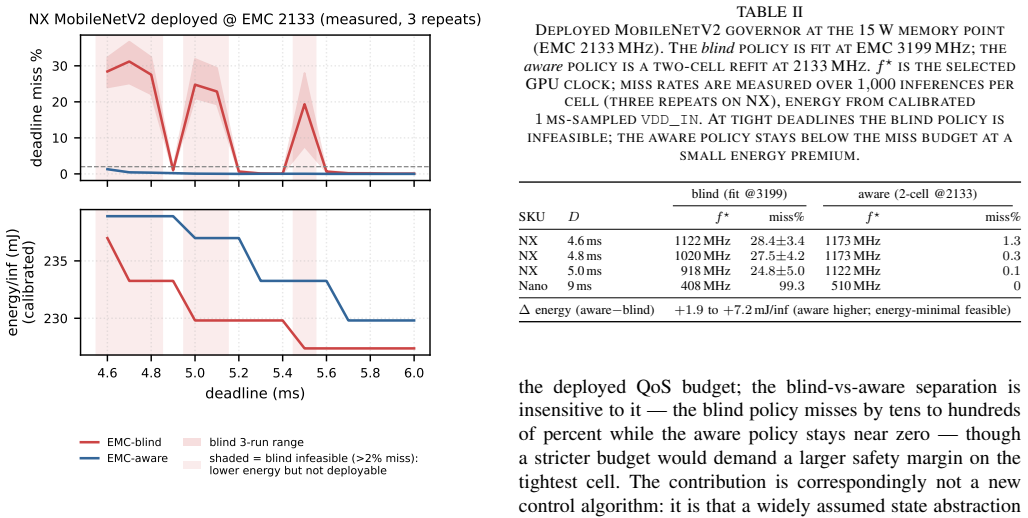
Frequency-aware latency estimators that model only the CPU×GPU plane leave the memory controller clock (EMC) as an unobserved deployment state. On Jetson Orin that omission drives a deadline governor to infeasible clocks: an EMC-blind fit profiled at one memory point and deployed at another misses 25–28 percent of cycles at tight deadlines, whereas an EMC-aware two-cell refit at the deployment EMC holds misses to ≤1.3 percent under a 2 percent QoS budget by selecting the lowest budget-feasible (and, for periodic vision, energy-minimal) GPU clock.
What carries the argument
The per-lockable-point EMC table (equivalently a two-cell refit of T = k/f_gpu + b at the deployment EMC). It supplies the missing state so the governor can locate a budget-feasible operating point; parametric 1/f memory terms and online constant-offset drift calibration cannot repair the memory-clock-dependent slope error.
Load-bearing premise
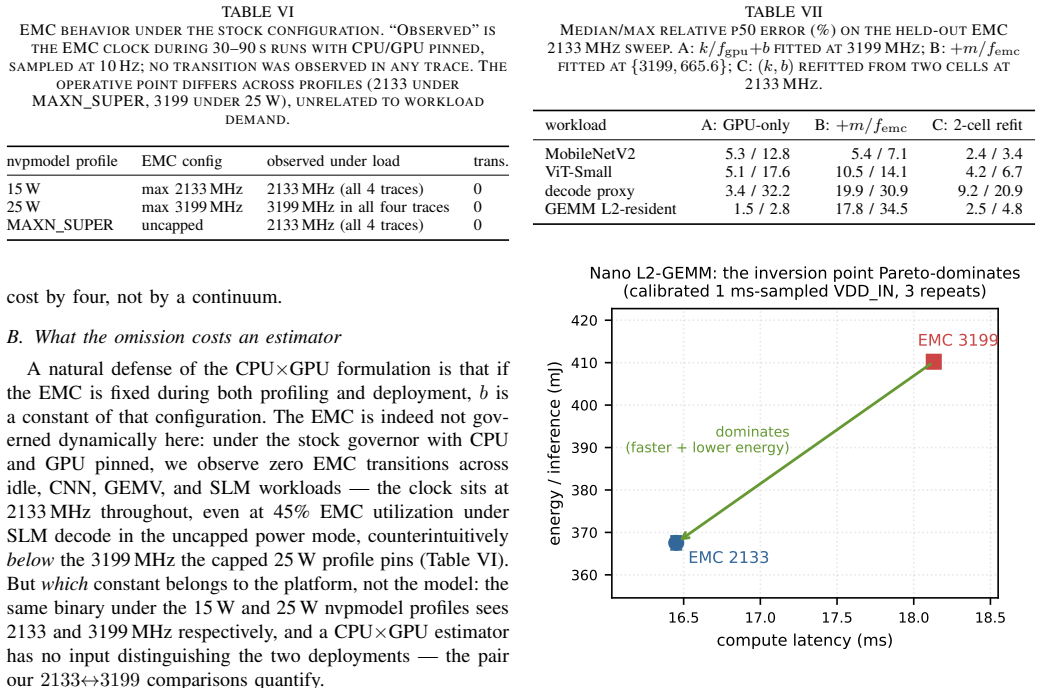
The memory clock is treated as a fixed pin set by the power profile that can differ between profiling and deployment, so a static table over the four lockable points is a sufficient repair.
What would settle it
Run the identical blind and aware governors on a platform where the stock power profile keeps the memory clock the same in profiling and deployment, or where the memory clock is scaled dynamically under load; if the measured miss-rate gap collapses, the claim that a static missing EMC state is decisive does not hold for that platform.
If this is right
- Deadline-aware DVFS governors on integrated SoCs must condition latency models on each lockable memory-clock point rather than only the CPU×GPU grid.
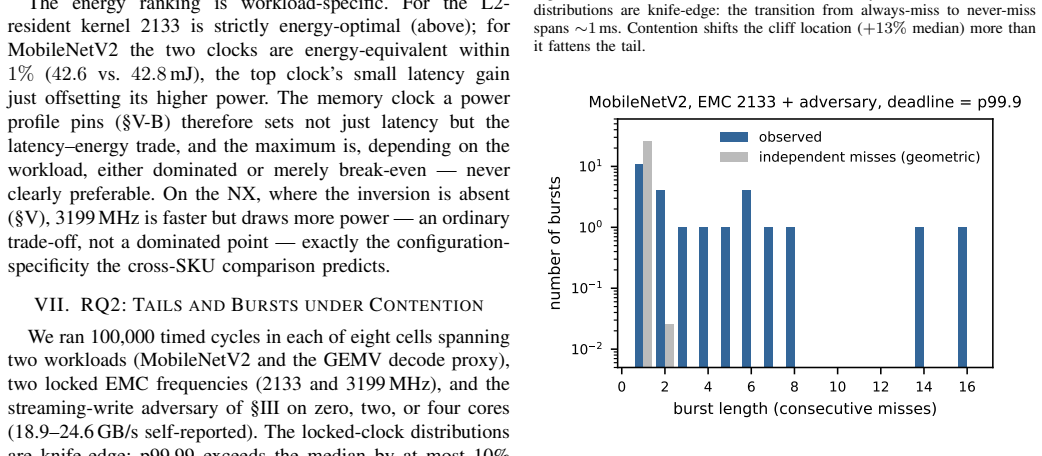
- Aggregate QoS percentages hide weakly-hard risk because deadline misses arrive in long consecutive bursts; continuation probability or ⟨m,k⟩ statistics must be reported alongside miss rate.
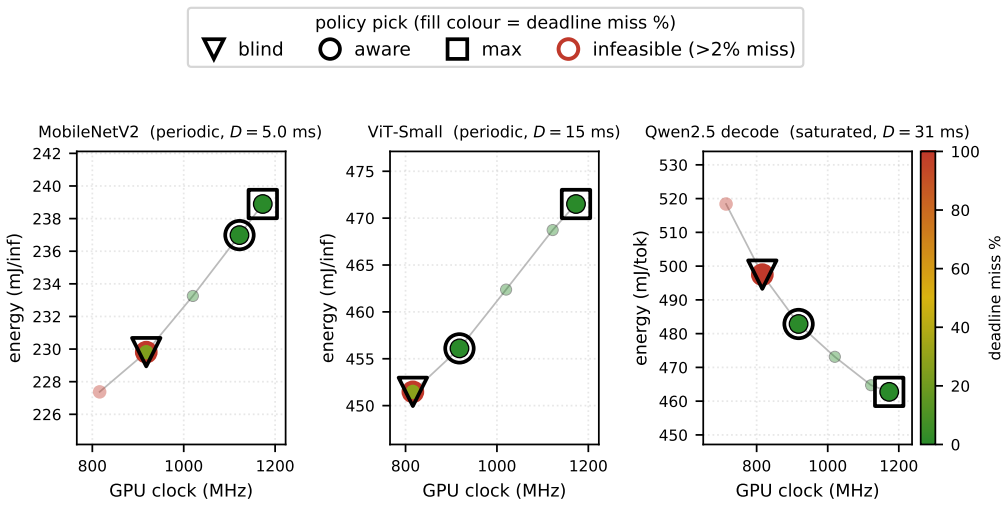
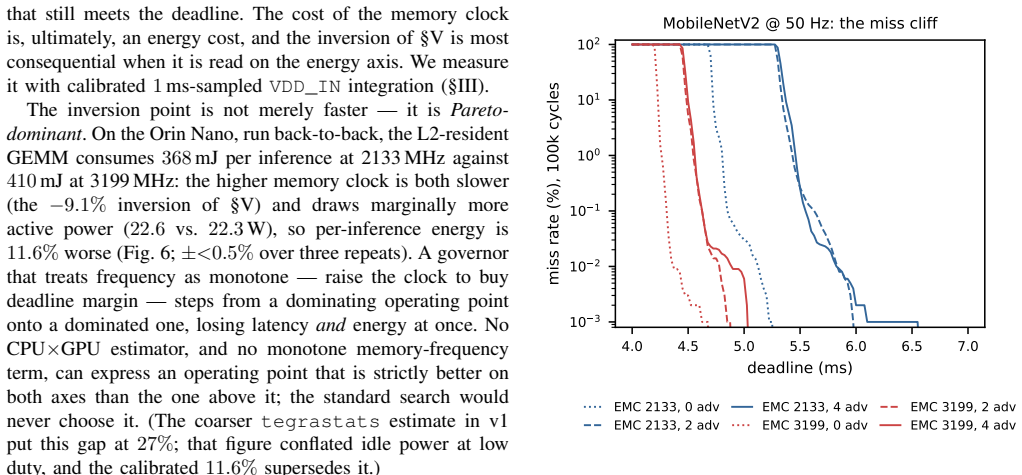
- Energy-optimal feasible points are duty-dependent: lowest feasible clock for periodic vision, highest feasible clock for saturated token decode.
- Frequency-search procedures that assume latency is non-increasing in clock are unsafe once non-monotonic inversions are possible.
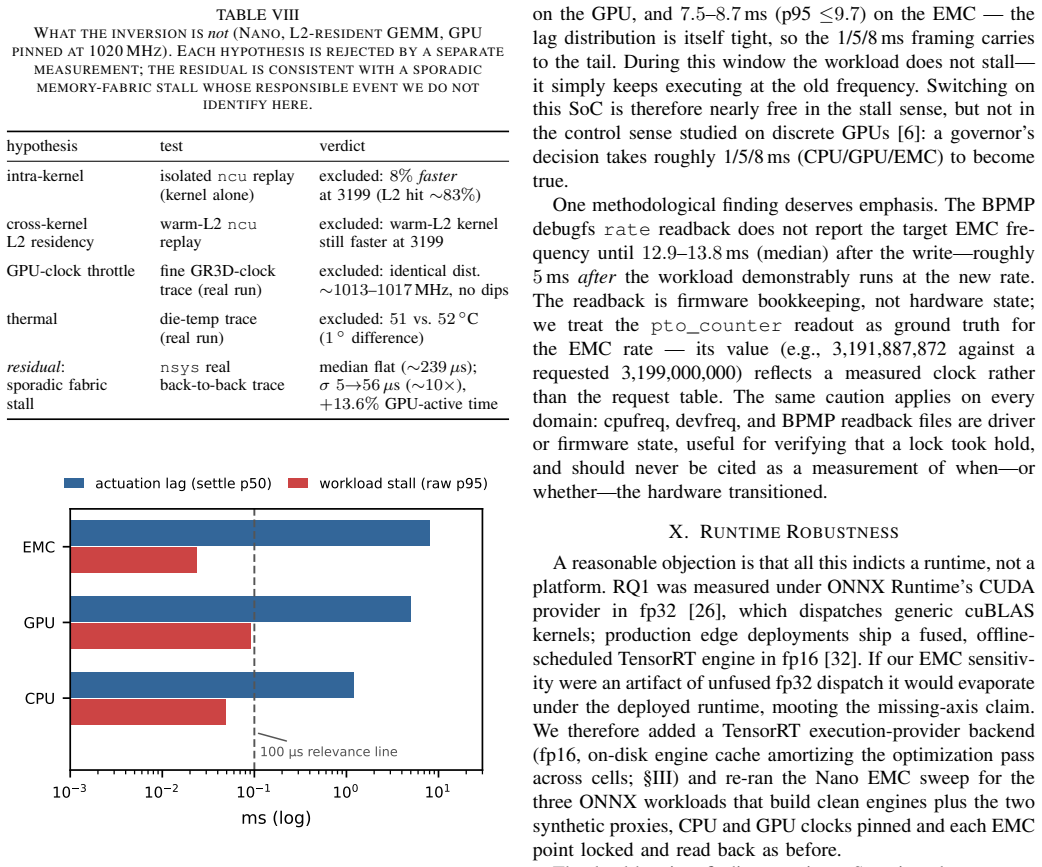
- Actuation lag (roughly 1/5/8 ms on CPU/GPU/EMC) bounds how quickly any online governor can react; the deployed fix works by choosing the operating point ahead of the run.
Where Pith is reading between the lines
- Any integrated SoC whose memory fabric sits on an independent DVFS domain will exhibit an analogous missing-state failure for CPU×GPU-only governors, even outside the NVIDIA Orin family.
- Reactive online calibrators that only correct a constant bias will keep failing on memory-bound workloads whose latency slope itself moves with the memory clock.
- Admission policies that also probe decode horizon (KV-cache growth) and GPU co-tenancy are a natural next layer once the EMC state is already required for feasibility.
- Knife-edge distributions near the miss cliff mean that probe variance and headroom become first-class parts of any measured guarantee, not afterthoughts.
Editorial analysis
A structured set of objections, weighed in public.
Referee Report
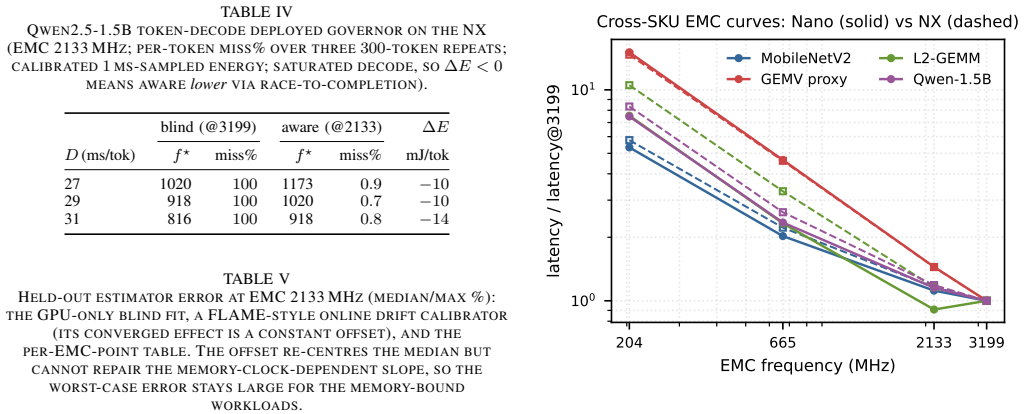
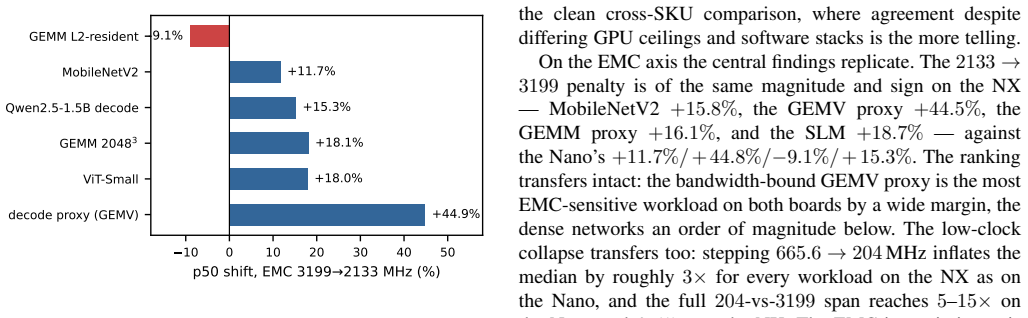
Summary. The paper argues that on integrated edge SoCs whose memory fabric has an independent DVFS domain (EMC on Jetson Orin), frequency-aware latency estimators used by deadline-aware DVFS governors are incomplete if they condition only on CPU imes GPU clocks. The central evidence is a deployed governor on Orin NX: an EMC-blind GPU-only fit profiled at EMC 3199 MHz and deployed at 2133 MHz misses 25–28% of cycles at tight deadlines (e.g., 28.4±3.4% at D=4.6 ms over three 1,000-cycle repeats), while a two-cell EMC-aware refit holds misses to ≤1.3% under a 2% QoS budget by selecting the lowest budget-feasible GPU clock—the energy-minimal feasible point for periodic vision (calibrated 1 ms-sampled VDD_IN). The failure is shown across MobileNetV2, ViT-Small, and Qwen2.5 decode; EMC median penalties of ~+12–45% and a low-clock collapse replicate on Nano and NX; a scoped non-monotonic inversion, miss clustering under contention, and 1/5/8 ms actuation lags are characterized; TensorRT roughly halves but does not remove the EMC effect. The authors release the harness and scope claims to BPMP-class Orin parts.
Significance. If the result holds, it is a concrete state-abstraction correction for edge-inference governors: CPU×GPU estimators (e.g., FLAME-style T=k/f+b) fold a deployment-deciding variable into a constant b, and that omission produces infeasible operating points under realistic power-profile pins. The work is valuable for systems and real-time edge ML because it closes the loop with on-hardware deployment, three-repeat miss rates, calibrated module-rail energy, six roofline-spanning workloads, two SKUs sharing lockable EMC points, TensorRT robustness, and an explicit pitfall catalog (P1–P6). Releasing the harness and raw cycle data is a clear strength. The paper does not claim the prior art is wrong within its CPU×GPU scope; it shows that deployed deadline control on integrated SoCs needs the memory-clock state. That framing is proportionate and useful.
major comments (3)
- §IV–§V-B and Table VI: The measured blind-vs-aware miss gap is solid, but the claim that a static per-lockable-point (or two-cell) table is a sufficient repair rests on EMC being a fixed deployment constant set by nvpmodel (zero transitions observed with CPU/GPU pinned). If production stacks co-scale EMC with demand, or if arbitration differs, a memory-clock-dependent slope error can reappear and online constant-offset drift calibration cannot fix it (Table V). Please either (a) measure under unpinned/dynamic EMC or a second power-management path, or (b) explicitly bound the sufficiency claim to static profile pins and state what re-validation is required when EMC moves online. This does not overturn the central feasibility result but is load-bearing for the “table is enough” prescription.
- §IV, Tables II–IV vs. abstract framing: Feasibility is defined as measured miss rate below τ=2% (soft QoS), not hard zero-miss. That is stated, but the paper repeatedly invokes weakly-hard / (m,k) language in §VII and the introduction. Please make the contract with the real-time reader sharper in §IV: report empirical consecutive-miss / continuation statistics for the same deployed blind and aware cells (not only aggregate miss %), so the weakly-hard risk of the blind policy is quantified on the same runs that establish the 25–28% gap.
- §XII and §VII: Burst and stall claims are measured against a single IsolBench-style streaming-write adversary. The paper acknowledges this, but the shared-stall signature and continuation probabilities (up to ~0.74) are then used to motivate reporting practice for governors. Either add one alternate contention shape (e.g., GPU co-runner or second inference stream) for the worst MobileNetV2 cell, or move the burst-process prescriptions more clearly into “under this adversary class” so they are not read as platform-universal.
minor comments (7)
- Fig. 1 caption and §IV: Clarify that “aware pick need not be the lowest-energy feasible dot” because selection is T+M≤D, not energy minimization; a short sentence in the caption would prevent misreading the bold dots as energy optima.
- Table V: State explicitly how many iterations the FLAME-style drift calibrator was allowed to converge and whether the held-out EMC 2133 MHz evaluation includes the convergence window (the text mentions ~100–300 iterations spent on missed deadlines).
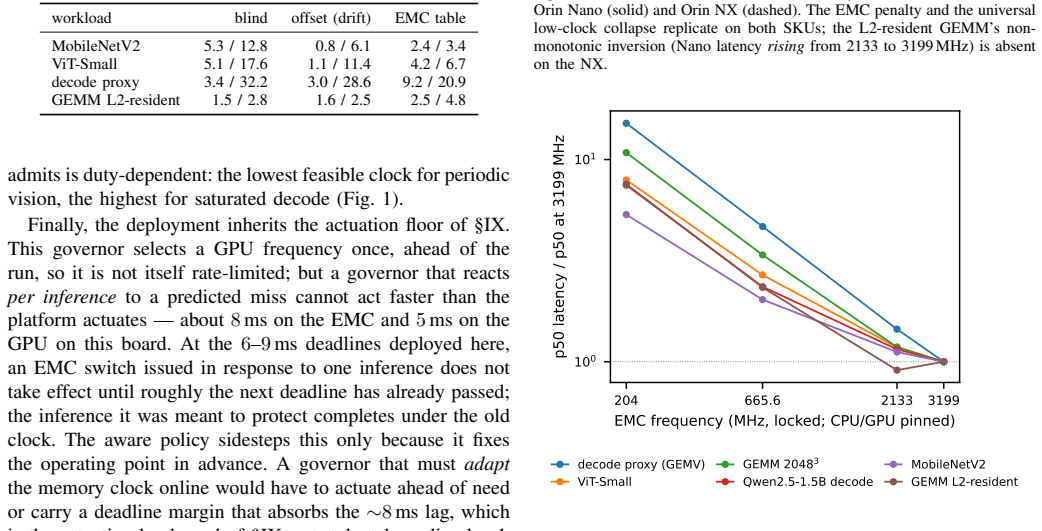
- §V-A / Fig. 3: The non-replication of the L2-GEMM inversion on NX is important; consider a one-row summary table (SKU × runtime × GPU pin → sign of 2133↔3199) so the scoping is scannable.
- §IX: The pre-specified 100 µs stall demotion criterion is good practice; note in the text that raw p95 is reported alongside the probe noise floor so readers do not subtract non-quantile quantities.
- Terminology consistency: abstract/body alternate “≤1.3%” (MobileNet) with other workloads’ ≤0.9%/≤0.2%; keep a single primary MobileNet number in the abstract and point to Tables III–IV for the others.
- References [1] and [4] are cited as 2025/2026 arXiv preprints; if camera-ready, update status and ensure the FLAME comparison remains accurate against the cited version’s stated CPU×GPU scope.
- Reproducibility: Zenodo DOI and GitHub are given; add the exact L4T/jetpack and nvpmodel profile names used for the 15 W / 25 W pins in a one-line “reproduce Table II” recipe.
Circularity Check
No significant circularity: central blind-vs-aware miss gaps and energy orderings are measured on-device against external clocks and rails, not forced by the estimator form or self-citation.
full rationale
This is an empirical systems paper whose load-bearing results are hardware measurements, not a derivation that reduces to its inputs. The T(f)=k/f+b form is imported from FLAME as a standard baseline estimator; the paper fits coefficients at one EMC point (or refits two cells at the deployment EMC), uses the resulting (T+M) rule only to select a GPU clock, then deploys that clock on the live device and counts deadline misses and integrates calibrated VDD_IN energy over independent 1 000-cycle (or 300-token) runs (Tables II–IV, Fig. 1–2). The measured miss rates (25–28 % blind vs ≤1.3 % aware) and energy deltas are therefore external observations, not identities of the fitted k,b. Held-out estimator-error tables (V, VII) likewise evaluate predictions against separate latency sweeps; the two-cell refit is presented as a practical repair whose sufficiency is then validated by the same on-wire deployment, not claimed as a first-principles prediction. Online drift calibration is shown not to close the slope gap (Table V), which is an independent negative result rather than a circular rescue. There are no uniqueness theorems, self-citation chains that carry the central claim, ansatzes smuggled via the authors’ prior work, or renamings of known patterns. The paper is self-contained against external hardware benchmarks (lockable EMC points, INA3221 rails, tegrastats traces, Nsight timelines). Score 0 is therefore the correct, proportionate finding.
Axiom & Free-Parameter Ledger
free parameters (5)
- QoS miss budget τ
- Latency model coefficients (k, b) per EMC point / workload
- Margin model M = T(r^{-1})
- GPD exceedance threshold (p99) and profiling window split
- Deadline grid near workload floor
axioms (6)
- domain assumption Baseline frequency-aware latency form T(f)=k/f+b with b absorbing 'frequency-independent' overheads including memory transfers (FLAME-style).
- domain assumption On these boards the stock power profile pins EMC at a fixed lockable rate with no dynamic transitions under the measured workloads (Table VI).
- domain assumption Only four EMC rates lock in practice on both Orin SKUs: {204, 665.6, 2133, 3199} MHz.
- ad hoc to paper Feasibility means measured miss rate below deployment budget τ (soft QoS), not hard real-time zero-miss.
- domain assumption Module-input VDD_IN rail integration at 1 ms is an adequate energy metric for policy comparison (with compute-rail cross-check).
- standard math Standard math/statistics for medians, GPD tail fits as quantile heuristics, and geometric independence baselines for burst analysis.
invented entities (2)
-
EMC as 'missing deployment state' (state-abstraction framing)
independent evidence
-
Per-lockable-point EMC latency table T=k(f_emc)/f_gpu + b(f_emc, w)
independent evidence
read the original abstract
On integrated edge SoCs whose memory fabric is governed independently of the compute clocks, frequency-aware latency estimators let deadline-aware DVFS governors schedule ML inference by modeling latency over CPU and GPU clocks -- but they do not condition on the memory clock (EMC), a deployment state that decides whether a governor meets its deadlines and at what energy. We show this with a deployed, measured governor on Jetson Orin: an EMC-blind GPU-only fit misses 25-28% of cycles at tight deadlines, whereas an EMC-aware two-cell refit holds misses to <=0.9% under a 2% QoS budget -- selecting a budget-feasible operating point proactively, where latency-only reactive calibration cannot repair memory-clock-dependent slope error. Across six models on two Orin SKUs, the core MobileNetV2 and ViT-Small results replicate on both boards; detection and LLM deployments reproduce the failure on the NX. Sustained deployment requires two further state layers: decode horizon, where KV-cache growth erodes tight-deadline feasibility over long responses, and GPU co-tenancy, whose occupancy opens queueing tails. A contract-admission policy composes the three layers from bounded probes and deploys live, including a joint cell decoding 2,000 tokens against an active GPU co-tenant where tenancy-blind admission misses 32% of tokens. Under the reference-probe maximum-guard accounting, every accepted contract is decisively measured-feasible. Fresh-probe stress tests then expose a probe-variance failure mode at knife-edge admissions; a dispersion-banded guard, validated on held-out trials, eliminates the observed probe-induced low-clock selections (held-out aggregate 1.19%); and one bin of headroom yielded observed per-launch compliance across eight fresh launches. A governor's guarantee is thus a measured conservatism ladder -- state repair, probe-variance banding, and headroom for launch realization.
Figures
Forward citations
Cited by 1 Pith paper
-
StreamingQEC: Streaming Quantum Error Correction in Tightly Integrated Quantum-Classical Systems via Certified Recurrence
A new simulator shows that quantum error correction's classical pipeline can be compressed exactly with a certified recurrence and approximated with a staged-fluid model, and that transfer and decoder bottlenecks shif...
Reference graph
Works this paper leans on
-
[1]
Taming asynchronous CPU-GPU coupling for frequency-aware latency estimation on mobile edge,
J. Chen, J. You, Z. Liu, and Z. Li, “Taming asynchronous CPU-GPU coupling for frequency-aware latency estimation on mobile edge,” 2026, accessed 2026-06-11. [Online]. Available: https://arxiv.org/abs/2604.15357
Pith/arXiv arXiv 2026
-
[2]
DVFS-aware DNN inference on GPUs: Latency modeling and performance analysis,
Y . Han, Z. Nan, S. Zhou, and Z. Niu, “DVFS-aware DNN inference on GPUs: Latency modeling and performance analysis,” 2025, accessed 2026-06-11. [Online]. Available: https://arxiv.org/abs/2502.06295
Pith/arXiv arXiv 2025
-
[3]
NVIDIA Jetson Linux Developer Guide (Release 36.5): Platform Power and Performance — Jetson Orin Nano Series, Jetson Orin NX Series and Jetson AGX Orin Series,
NVIDIA Corporation, “NVIDIA Jetson Linux Developer Guide (Release 36.5): Platform Power and Performance — Jetson Orin Nano Series, Jetson Orin NX Series and Jetson AGX Orin Series,” https://docs.nvidia.com/jetson/ archives/r36.5/DeveloperGuide/SD/PlatformPowerAndPerformance/ JetsonOrinNanoSeriesJetsonOrinNxSeriesAndJetsonAgxOrinSeries. 5.4 5.5 5.6 5.7 5.8...
2026
-
[4]
Joint memory frequency and computing frequency scaling for energy-efficient DNN inference,
Y . Han, Z. Nan, S. Zhou, and Z. Niu, “Joint memory frequency and computing frequency scaling for energy-efficient DNN inference,” 2025, accessed 2026-06-11. [Online]. Available: https://arxiv.org/abs/ 2509.17970
arXiv 2025
-
[5]
zTT: Learning- based DVFS with zero thermal throttling for mobile devices,
S. Kim, K. Bin, S. Ha, K. Lee, and S. Chong, “zTT: Learning- based DVFS with zero thermal throttling for mobile devices,” inProceedings of the 19th Annual International Conference on Mobile Systems, Applications, and Services (MobiSys ’21). Virtual Event, Wisconsin: ACM, 2021, pp. 41–53. [Online]. Available: https://doi.org/10.1145/3458864.3468161
-
[6]
Methodology for GPU frequency switching latency measurement,
D. Velicka, O. Vysocky, and L. Riha, “Methodology for GPU frequency switching latency measurement,” 2025. [Online]. Available: https://arxiv.org/abs/2502.20075
Pith/arXiv arXiv 2025
-
[7]
Evaluation of CPU frequency transition latency,
A. Mazouz, A. Laurent, B. Pradelle, and W. Jalby, “Evaluation of CPU frequency transition latency,”Computer Science – Research and Development, vol. 29, no. 3–4, pp. 187–195, 2014. [Online]. Available: https://doi.org/10.1007/s00450-013-0240-x
-
[8]
Evaluating the energy impact of device parameters for DNN inference on edge,
A. Dutt, S. P. Rachuri, A. Lobo, N. Shaik, A. Gandhi, and Z. Liu, “Evaluating the energy impact of device parameters for DNN inference on edge,” inProceedings of the 14th International Green and Sustainable Computing Conference (IGSC ’23). ACM, 2023, pp. 52–55, accessed 2026-06-11. [Online]. Available: https: //doi.org/10.1145/3634769.3634809
-
[9]
DeepRT: A soft real time scheduler for computer vision applications on the edge,
Z. Yang, K. Nahrstedt, H. Guo, and Q. Zhou, “DeepRT: A soft real time scheduler for computer vision applications on the edge,” inProceedings of the 6th ACM/IEEE Symposium on Edge Computing (SEC), 2021, pp. 271–284. [Online]. Available: https://arxiv.org/abs/2105.01803
Pith/arXiv arXiv 2021
-
[10]
DARIS: An oversubscribed spatio- temporal scheduler for real-time DNN inference on GPUs,
A. F. Babaei and T. Chantem, “DARIS: An oversubscribed spatio- temporal scheduler for real-time DNN inference on GPUs,” in Proceedings of the 62nd ACM/IEEE Design Automation Conference (DAC). IEEE, 2025, pp. 1–7, accessed 2026-06-11. [Online]. Available: https://arxiv.org/abs/2504.08795
Pith/arXiv arXiv 2025
-
[11]
RTGPU: Real-time GPU scheduling of hard deadline parallel tasks with fine-grain utilization,
A. Zou, J. Li, C. D. Gill, and X. Zhang, “RTGPU: Real-time GPU scheduling of hard deadline parallel tasks with fine-grain utilization,”IEEE Transactions on Parallel and Distributed Systems, vol. 34, no. 5, pp. 1450–1465, May 2023. [Online]. Available: https://ieeexplore.ieee.org/document/10012550
arXiv 2023
-
[12]
Taming non-blocking caches to improve isolation in multicore real-time systems,
P. K. Valsan, H. Yun, and F. Farshchi, “Taming non-blocking caches to improve isolation in multicore real-time systems,” in2016 IEEE Real- Time and Embedded Technology and Applications Symposium (RTAS), 2016, pp. 161–172, accessed 2026-06-11. Origin of the IsolBench benchmark suite, including the Bandwidth memory-bandwidth adversary benchmark; code at htt...
arXiv 2016
-
[13]
Protecting real-time GPU kernels on integrated CPU-GPU SoC platforms,
W. Ali and H. Yun, “Protecting real-time GPU kernels on integrated CPU-GPU SoC platforms,” in30th Euromicro Conference on Real-Time Systems (ECRTS 2018), ser. Leibniz International Proceedings in Informatics (LIPIcs), vol. 106. Schloss Dagstuhl– Leibniz-Zentrum f ¨ur Informatik, 2018, pp. 19:1–19:22, accessed 2026- 06-11. [Online]. Available: https://drop...
-
[14]
Profiling concurrent vision inference workloads on NVIDIA Jetson – extended,
A. Chakraborty, W. Tavernier, A. Kourtis, M. Pickavet, A. Oikonomakis, and D. Colle, “Profiling concurrent vision inference workloads on NVIDIA Jetson – extended,” 2025, accessed 2026-06-11. [Online]. Available: https://arxiv.org/abs/2508.08430
Pith/arXiv arXiv 2025
-
[15]
MemGuard: Memory bandwidth reservation system for efficient performance isola- tion in multi-core platforms,
H. Yun, G. Yao, R. Pellizzoni, M. Caccamo, and L. Sha, “MemGuard: Memory bandwidth reservation system for efficient performance isola- tion in multi-core platforms,” inProceedings of the 19th IEEE Real-Time and Embedded Technology and Applications Symposium (RTAS 2013). IEEE, 2013, pp. 55–64
2013
-
[16]
A dynamic priority assignment technique for streams with (m,k)-firm deadlines,
M. Hamdaoui and P. Ramanathan, “A dynamic priority assignment technique for streams with (m,k)-firm deadlines,”IEEE Transactions on Computers, vol. 44, no. 12, pp. 1443–1451, 1995
1995
-
[17]
Weakly hard real-time systems,
G. Bernat, A. Burns, and A. Llamos ´ı, “Weakly hard real-time systems,” IEEE Transactions on Computers, vol. 50, no. 4, pp. 308–321, 2001
2001
-
[18]
Control- system stability under consecutive deadline misses constraints,
M. Maggio, A. Hamann, E. Mayer-John, and D. Ziegenbein, “Control- system stability under consecutive deadline misses constraints,” in Proceedings of the 32nd Euromicro Conference on Real-Time Systems (ECRTS 2020), ser. LIPIcs, vol. 165. Schloss Dagstuhl – Leibniz- Zentrum f ¨ur Informatik, 2020, pp. 21:1–21:24
2020
-
[19]
Statistical analysis of WCET for scheduling,
S. Edgar and A. Burns, “Statistical analysis of WCET for scheduling,” inProceedings of the 22nd IEEE Real-Time Systems Symposium (RTSS 2001). IEEE Computer Society, 2001, pp. 215–224
2001
-
[20]
Measurement-based probabilistic timing analysis for multi-path pro- grams,
L. Cucu-Grosjean, L. Santinelli, M. Houston, C. Lo, T. Vardanega, L. Kosmidis, J. Abella, E. Mezzetti, E. Qui ˜nones, and F. J. Cazorla, “Measurement-based probabilistic timing analysis for multi-path pro- grams,” inProceedings of the 24th Euromicro Conference on Real-Time Systems (ECRTS 2012). IEEE Computer Society, 2012, pp. 91–101
2012
-
[21]
A survey of probabilistic timing analysis techniques for real-time systems,
R. I. Davis and L. Cucu-Grosjean, “A survey of probabilistic timing analysis techniques for real-time systems,”Leibniz Transactions on Embedded Systems (LITES), vol. 6, no. 1, pp. 03:1–03:60, 2019
2019
-
[22]
J. Dean and L. A. Barroso, “The tail at scale,”Communications of the ACM, vol. 56, no. 2, pp. 74–80, Feb. 2013. [Online]. Available: https://doi.org/10.1145/2408776.2408794
-
[23]
V . J. Reddi, C. Cheng, D. Kanter, P. Mattson, G. Schmuelling, C.-J. Wu, B. Anderson, M. Breughe, M. Charlebois, W. Chou, R. Chukka, C. Coleman, S. Davis, P. Deng, G. Diamos, J. Duke, D. Fick, J. S. Gardner, I. Hubara, S. Idgunji, T. B. Jablin, J. Jiao, T. St. John, P. Kanwar, D. Lee, J. Liao, A. Lokhmotov, F. Massa, P. Meng, P. Micikevicius, C. Osborne, ...
Pith/arXiv arXiv 2020
-
[24]
Efficiently scaling transformer inference,
R. Pope, S. Douglas, A. Chowdhery, J. Devlin, J. Bradbury, J. Heek, K. Xiao, S. Agrawal, and J. Dean, “Efficiently scaling transformer inference,” inProceedings of Machine Learning and Systems, D. Song, M. Carbin, and T. Chen, Eds., vol. 5. Curan, 2023, pp. 606–624. [On- line]. Available: https://proceedings.mlsys.org/paper files/paper/2023/ hash/c4be71ab...
2023
-
[25]
Full stack optimization of transformer inference: a survey,
S. Kim, C. Hooper, T. Wattanawong, M. Kang, R. Yan, H. Genc, G. Dinh, Q. Huang, K. Keutzer, M. W. Mahoney, Y . S. Shao, and A. Gholami, “Full stack optimization of transformer inference: a survey,” 2023, accessed 2026-06-11. [Online]. Available: https: //arxiv.org/abs/2302.14017
Pith/arXiv arXiv 2023
-
[26]
ONNX runtime,
Microsoft, “ONNX runtime,” https://github.com/microsoft/onnxruntime, release v1.23.0, CUDA execution provider. Accessed 2026-06-12
2026
-
[27]
MobileNetV2: Inverted residuals and linear bottlenecks,
M. Sandler, A. G. Howard, M. Zhu, A. Zhmoginov, and L. Chen, “MobileNetV2: Inverted residuals and linear bottlenecks,” in2018 IEEE/CVF Conference on Computer Vision and Pattern Recognition (CVPR). IEEE, 2018, pp. 4510–4520
2018
-
[28]
An image is worth 16x16 words: Transformers for image recognition at scale,
A. Dosovitskiy, L. Beyer, A. Kolesnikov, D. Weissenborn, X. Zhai, T. Unterthiner, M. Dehghani, M. Minderer, G. Heigold, S. Gelly, J. Uszkoreit, and N. Houlsby, “An image is worth 16x16 words: Transformers for image recognition at scale,” in9th International Conference on Learning Representations (ICLR 2021), 2021. [Online]. Available: https://openreview.n...
2021
-
[29]
Qwen Team, “Qwen2.5 technical report,” 2024. [Online]. Available: https://arxiv.org/abs/2412.15115
Pith/arXiv arXiv 2024
-
[30]
llama.cpp: LLM inference in C/C++,
G. Gerganov and contributors, “llama.cpp: LLM inference in C/C++,” https://github.com/ggml-org/llama.cpp, commit ac4cdde, CUDA back- end, Q4 K M GGUF. Accessed 2026-06-12
2026
-
[31]
Roofline: An insightful visual performance model for multicore architectures,
S. Williams, A. Waterman, and D. A. Patterson, “Roofline: An insightful visual performance model for multicore architectures,”Communications of the ACM, vol. 52, no. 4, pp. 65–76, 2009
2009
-
[32]
TensorRT developer guide,
NVIDIA, “TensorRT developer guide,” https://docs.nvidia.com/ deeplearning/tensorrt/, accessed 2026-06-12
2026
-
[33]
Real-time group scheduling,
The Linux Kernel documentation, “Real-time group scheduling,” documentation/scheduler/sched-rt-group.rst. Accessed 2026-06-12. [On- line]. Available: https://docs.kernel.org/scheduler/sched-rt-group.html
2026
discussion (0)
Sign in with ORCID, Apple, or X to comment. Anyone can read and Pith papers without signing in.