Effective description of lensed gravitational waves diffracted by stellar fields
Pith reviewed 2026-06-26 23:37 UTC · model grok-4.3
The pith
Singular value decomposition of simulations produces an effective model for stellar microlensing of gravitational waves.
A machine-rendered reading of the paper's core claim, the machinery that carries it, and where it could break.
Core claim
Numerical simulations of wave-optics lensing by stellar fields can be compressed, via singular value decomposition, into a compact orthonormal basis together with a probability density function for the coefficients; the resulting Reduced-Order Stochastic Diffraction models then provide an effective description of microlensing distortions that can be injected into or recovered from gravitational-wave data.
What carries the argument
Reduced-Order Stochastic Diffraction (ROSD) models obtained by singular value decomposition of simulated wave-optics lensing outputs, yielding an orthonormal basis for microlensing distortions and a coefficient probability density.
If this is right
- The models supply priors that can be used directly in Bayesian parameter estimation of lensed gravitational-wave signals.
- They enable quantitative checks for consistency between observed signals and expectations from stellar-field microlensing.
- Truncation order can be adjusted to balance accuracy against computational cost for a given detector and source.
- The same construction procedure can be repeated for other microlens mass functions or external lens potentials.
Where Pith is reading between the lines
- The approach could be used to test whether observed lensing statistics deviate from those expected for ordinary stellar populations.
- If the coefficient distributions prove robust, the same framework might be adapted to search for wave-optics signatures from other compact objects such as primordial black holes.
- Detector-specific versions of the model could improve the reach of searches for high-redshift binary mergers by removing a previously intractable systematic.
Load-bearing premise
The basis vectors and coefficient distributions extracted from the authors' chosen stellar-field simulations remain representative for actual astrophysical microlens populations and external potentials.
What would settle it
A catalog of confirmed lensed gravitational-wave events whose observed frequency-dependent amplitude and phase modulations lie systematically outside the probability distributions predicted by the SVD coefficient model.
Figures
read the original abstract
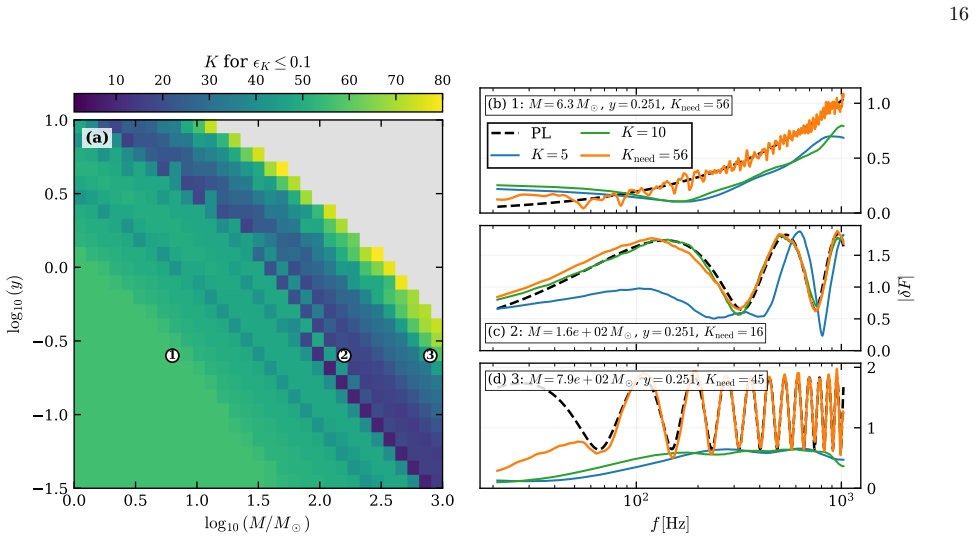
As natural telescopes, Gravitational lenses enable the observation of sources that would otherwise be too distant and faint. Stellar-mass objects, or microlenses, act as impurities in the lens, producing subtle distortions of the source. These effects are necessary to correctly interpret observations, and may in some cases be themselves evidence of gravitational magnification. Gravitational waves (GWs) observed by ground detectors and magnified by galaxies and clusters will undergo microlensing by fields of stars and remnants: describing these systems requires not only considering a large number of small-scale lenses (microlenses), but also including wave-optics effects, leading to frequency dependent modulations of the signal. Here we present novel models for Reduced-Order Stochastic Diffraction (ROSD), which overcome these challenges in the search for GW lensing signatures: an effective description is synthesized from numerical simulations of wave-optics lensing by stellar fields via a singular value decomposition. The procedure yields an optimized orthonormal basis to describe microlensing distortions and a probability density function for the coefficients, which can be used as priors or to verify the consistency with stellar-field lensing. We present SVD-stellar-I5-aLIGO as an example of this model category, discuss the role of truncation order and demonstrate how it can be applied to GW data via injection and recovery in Bayesian parameter estimation. ROSD can be tailored to account for detector sensitivity and the type of source under analysis, and extended to different microlens populations and external potentials. ROSD models open a new window to probe small-scale objects (stars, remnants and potentially dark matter) and facilitate the discovery of the most distant compact binary mergers.
Editorial analysis
A structured set of objections, weighed in public.
Referee Report
Summary. The paper claims to introduce Reduced-Order Stochastic Diffraction (ROSD) models that synthesize an effective description of wave-optics microlensing distortions of gravitational waves by stellar fields. An orthonormal basis and coefficient probability density function are extracted via singular value decomposition from a chosen ensemble of numerical simulations; the resulting models (exemplified by SVD-stellar-I5-aLIGO) are proposed for use as priors or consistency checks and are illustrated with an injection-recovery test in Bayesian parameter estimation.
Significance. If the SVD-derived basis and PDF prove representative across astrophysical parameter space, the approach would supply a computationally tractable, data-driven framework for incorporating frequency-dependent microlensing effects into GW searches, thereby enabling more accurate interpretation of strongly lensed events and potential constraints on small-scale lens populations.
major comments (2)
- [Abstract] Abstract and injection-recovery demonstration: the test is described only at a high level with no reported quantitative metrics (bias, credible-interval coverage, or recovery accuracy as a function of truncation order), leaving the claim that the truncated model remains faithful unsupported by concrete error budgets.
- [ROSD construction (implied in abstract)] The central construction extracts the basis and coefficient PDF from a fixed simulation ensemble; no tests are shown that vary stellar number density, mass function, spatial clustering, or external convergence/shear to verify that the leading modes and PDF remain representative when the underlying astrophysical parameters change.
Simulated Author's Rebuttal
We thank the referee for their constructive comments. We address each major comment below and indicate where revisions will be made.
read point-by-point responses
-
Referee: [Abstract] Abstract and injection-recovery demonstration: the test is described only at a high level with no reported quantitative metrics (bias, credible-interval coverage, or recovery accuracy as a function of truncation order), leaving the claim that the truncated model remains faithful unsupported by concrete error budgets.
Authors: We agree that the abstract describes the injection-recovery demonstration at a high level. The full manuscript presents the test as an illustration of applicability in Bayesian parameter estimation. To strengthen the support for the claim that the truncated model remains faithful, we will add quantitative metrics including bias, credible-interval coverage, and recovery accuracy as a function of truncation order. These will be incorporated into the revised manuscript. revision: yes
-
Referee: [ROSD construction (implied in abstract)] The central construction extracts the basis and coefficient PDF from a fixed simulation ensemble; no tests are shown that vary stellar number density, mass function, spatial clustering, or external convergence/shear to verify that the leading modes and PDF remain representative when the underlying astrophysical parameters change.
Authors: The referee is correct that the presented ROSD model is constructed from a fixed simulation ensemble. The manuscript states that ROSD can be tailored to different microlens populations and external potentials, but no explicit variation tests are included. This is a scope limitation of the current study, as a full sensitivity analysis would require additional simulations beyond the scope of this work. We will revise the text to clarify the ensemble's representativeness for the chosen parameters and note that extensions to varied astrophysical conditions are left for future work. The core results and construction remain unchanged. revision: partial
Circularity Check
No circularity: SVD reduction applied to independent simulation ensemble
full rationale
The paper constructs the ROSD effective model by running wave-optics simulations of stellar microlensing and then performing SVD to extract an orthonormal basis and coefficient PDF. This is a standard data-driven dimensionality reduction whose output is not equivalent to the input by construction; the basis and PDF are then used as priors or consistency checks on separate GW data via injection/recovery. No load-bearing step reduces to a self-citation, fitted parameter renamed as prediction, or self-definitional loop. The derivation chain remains self-contained against external numerical benchmarks.
Axiom & Free-Parameter Ledger
free parameters (1)
- truncation order
axioms (1)
- standard math Singular value decomposition yields an optimal low-rank orthonormal basis for the space of simulated distortion functions
invented entities (1)
-
ROSD model (SVD-stellar-I5-aLIGO)
no independent evidence
Forward citations
Cited by 1 Pith paper
-
Wave-optics imprints of dark matter subhalos on strongly lensed gravitational waves. II. Saddle images and detectability
Subhalos produce percent-level modulations in saddle and minimum images; matched-filter analysis yields >5σ combined detections in 62% of realizations for fiducial sources near caustics, projecting 10-20 substructure ...
Reference graph
Works this paper leans on
-
[1]
Schneider, J
P. Schneider, J. Ehlers, and E. E. Falco,Gravitational Lenses, Astronomy and Astrophysics Library (Springer, Berlin, Heidelberg, 1992)
1992
-
[2]
Meylan, P
G. Meylan, P. Jetzer, and P. North, eds.,Gravitational Lensing: Strong, Weak and Micro, Saas-Fee Advanced Course, Vol. 33 (Springer, Berlin, Heidelberg, 2006)
2006
-
[3]
Chang and S
K. Chang and S. Refsdal, Nature282, 561 (1979)
1979
-
[4]
Paczynski, Astrophys
B. Paczynski, Astrophys. J.304, 1 (1986)
1986
-
[5]
Wambsganss, inGravitational Lensing: Strong, Weak and Micro, edited by G
J. Wambsganss, inGravitational Lensing: Strong, Weak and Micro, edited by G. Meylan, P. Jetzer, and P. North (Springer, Berlin, Heidelberg, 2006) pp. 453– 540, arXiv:astro-ph/0604278
Pith/arXiv arXiv 2006
-
[6]
S. Mao, Res. Astron. Astrophys.12, 947 (2012), arXiv:1207.3720 [astro-ph.GA]
Pith/arXiv arXiv 2012
-
[7]
B. S. Gaudi, Ann. Rev. Astron. Astrophys.50, 411 (2012)
2012
-
[8]
P. L. Schechter and J. Wambsganss, Astrophys. J.580, 685 (2002), arXiv:astro-ph/0204425
Pith/arXiv arXiv 2002
-
[9]
G. Vernardos, D. Sluse, D. Pooley, R. W. Schmidt, M. Millon, L. Weisenbach, V. Motta, T. Anguita, 18 P. Saha, M. O’Dowd, A. Peel, and P. L. Schechter, Space Sci. Rev.220, 14 (2024), arXiv:2312.00931 [astro- ph.GA]
arXiv 2024
-
[10]
S. H. Suyu, A. Goobar, T. Collett, A. More, and G. Vernardos, Space Sci. Rev.220, 13 (2024), arXiv:2301.07729 [astro-ph.CO]
arXiv 2024
-
[11]
T. Venumadhav, L. Dai, and J. Miralda-Escud´ e, As- trophys. J.850, 49 (2017), arXiv:1707.00003 [astro- ph.CO]
Pith/arXiv arXiv 2017
-
[12]
M. Oguri, J. M. Diego, N. Kaiser, P. L. Kelly, and T. Broadhurst, Phys. Rev. D97, 023518 (2018), arXiv:1710.00148 [astro-ph.CO]
Pith/arXiv arXiv 2018
-
[13]
J. M. Diego, Astron. Astrophys.625, A84 (2019), arXiv:1806.04668 [astro-ph.GA]
Pith/arXiv arXiv 2019
-
[14]
L. Weisenbach, T. Anguita, J. Miralda-Escud´ e, M. Oguri, P. Saha, and P. L. Schechter, Space Sci. Rev. 220, 57 (2024), arXiv:2404.08094 [astro-ph.CO]
arXiv 2024
-
[15]
R. Takahashi and T. Nakamura, Astrophys. J.595, 1039 (2003), arXiv:astro-ph/0305055
Pith/arXiv arXiv 2003
-
[16]
P. Christian, S. Vitale, and A. Loeb, Phys. Rev. D98, 103022 (2018), arXiv:1802.02586 [astro-ph.HE]
Pith/arXiv arXiv 2018
-
[17]
L. Dai, S.-S. Li, B. Zackay, S. Mao, and Y. Lu, Phys. Rev. D98, 104029 (2018), arXiv:1810.00003 [gr-qc]
Pith/arXiv arXiv 2018
-
[18]
M. H. Y. Cheung, J. Gais, O. A. Hannuksela, and T. G. F. Li, Mon. Not. Roy. Astron. Soc.503, 3326 (2021), arXiv:2012.07800 [astro-ph.HE]
arXiv 2021
-
[20]
S. M. C. Yeung, M. H. Y. Cheung, E. Seo, J. A. J. Gais, O. A. Hannuksela, and T. G. F. Li, Mon. Not. Roy. Astron. Soc.526, 2230 (2023), arXiv:2112.07635 [gr-qc]
arXiv 2023
-
[21]
J. M. Diego, O. A. Hannuksela, P. L. Kelly, T. Broad- hurst, K. Kim, T. G. F. Li, G. F. Smoot, and G. Pagano, Astron. Astrophys.627, A130 (2019), arXiv:1903.04513 [astro-ph.CO]
Pith/arXiv arXiv 2019
-
[22]
J. M. Diego, Phys. Rev. D101, 123512 (2020), arXiv:1911.05736 [astro-ph.CO]
arXiv 2020
-
[23]
M. Oguri and R. Takahashi, Astrophys. J.901, 58 (2020), arXiv:2007.01936 [astro-ph.CO]
arXiv 2020
- [24]
-
[25]
A. K. Meena, A. Mishra, A. More, S. Bose, and J. S. Bagla, Mon. Not. Roy. Astron. Soc.517, 872 (2022), arXiv:2205.05409 [astro-ph.GA]
arXiv 2022
-
[26]
M. Oguri and R. Takahashi, Phys. Rev. D106, 043532 (2022), arXiv:2204.00814 [astro-ph.CO]
arXiv 2022
-
[27]
X. Shan, G. Li, X. Chen, W. Zheng, and W. Zhao, Sci. China Phys. Mech. Astron.66, 239511 (2023), arXiv:2208.13566 [astro-ph.CO]
arXiv 2023
-
[28]
X. Shan, X. Chen, B. Hu, and R.-G. Cai, (2023), arXiv:2301.06117 [astro-ph.IM]
arXiv 2023
-
[29]
X. Shan, X. Chen, B. Hu, and G. Li, (2023), arXiv:2306.14796 [astro-ph.CO]
arXiv 2023
-
[30]
G. P. Smithet al., Phil. Trans. Roy. Soc. Lond. A383, 20240134 (2025), arXiv:2503.19973 [astro-ph.HE]
arXiv 2025
-
[31]
A. K. Meena, J. Astrophys. Astron.46, 92 (2025), arXiv:2502.11488 [gr-qc]
arXiv 2025
-
[32]
X. Shan, H. Yang, S. Mao, and O. A. Hannuksela, (2025), arXiv:2508.21262 [astro-ph.CO]
Pith/arXiv arXiv 2025
-
[33]
A. Ulmer and J. Goodman, Astrophys. J.442, 67 (1995), arXiv:astro-ph/9406042
Pith/arXiv arXiv 1995
-
[34]
M. Jaroszynski and B. Paczynski, Astrophys. J.455, 443 (1995), arXiv:astro-ph/9503043
Pith/arXiv arXiv 1995
-
[35]
H. Villarrubia-Rojo, S. Savastano, M. Zumalac´ arregui, L. Choi, S. Goyal, L. Dai, and G. Tambalo, Phys. Rev. D111, 103539 (2025), arXiv:2409.04606 [gr-qc]
arXiv 2025
-
[36]
J. Feldbrugge, U.-L. Pen, and N. Turok, Annals Phys. 451, 169255 (2023), arXiv:1909.04632 [astro-ph.HE]
arXiv 2023
-
[37]
G. Tambalo, M. Zumalac´ arregui, L. Dai, and M. H.- Y. Cheung, Phys. Rev. D108, 043527 (2023), arXiv:2210.05658 [gr-qc]
arXiv 2023
-
[38]
X. Shan, G. Li, X. Chen, W. Zhao, B. Hu, and S. Mao, Sci. China Phys. Mech. Astron.68, 219512 (2025), arXiv:2409.06747 [astro-ph.IM]
arXiv 2025
-
[39]
M. H.-Y. Cheung, K. K. Y. Ng, M. Zumalac´ arregui, and E. Berti, Phys. Rev. D109, 124020 (2024), arXiv:2403.13876 [gr-qc]
arXiv 2024
-
[40]
S. M. C. Yeung, M. H. Y. Cheung, M. Zumalacarregui, and O. A. Hannuksela, (2024), arXiv:2410.19804 [astro- ph.IM]
arXiv 2024
-
[41]
N. Ephremidze, M. Kamionkowski, and C. Dvorkin, (2026), arXiv:2603.12333 [astro-ph.CO]
arXiv 2026
-
[42]
Wright and M
M. Wright and M. Hendry, The Astrophysical Journal 935, 68 (2022)
2022
-
[43]
M. Caldarola, S. Goyal, N. Gupte, S. R. Green, and M. Zumalac´ arregui, Phys. Rev. D113, 104073 (2026), arXiv:2511.08486 [astro-ph.CO]
Pith/arXiv arXiv 2026
-
[44]
Abbottet al.(LIGO Scientific, Virgo), Astrophys
R. Abbottet al.(LIGO Scientific, Virgo), Astrophys. J. 923, 14 (2021), arXiv:2105.06384 [gr-qc]
arXiv 2021
-
[45]
Abbottet al.(LIGO Scientific, KAGRA, Virgo), As- trophys
R. Abbottet al.(LIGO Scientific, KAGRA, Virgo), As- trophys. J.970, 191 (2024), arXiv:2304.08393 [gr-qc]
arXiv 2024
-
[46]
A. G. Abacet al.(LIGO Scientific, Virgo, KAGRA), GWTC-4.0: Searches for Gravitational-Wave Lensing Signatures (2025), arXiv:2512.16347 [gr-qc]
arXiv 2025
- [47]
-
[48]
X. Shan, H. Yang, and S. Mao, (2025), arXiv:2512.19118 [astro-ph.GA]
arXiv 2025
-
[49]
A. Liu, I. C. F. Wong, S. H. W. Leong, A. More, O. A. Hannuksela, and T. G. F. Li, Mon. Not. Roy. Astron. Soc.525, 4149 (2023), arXiv:2302.09870 [gr-qc]
arXiv 2023
-
[50]
J. C. L. Chan, L. Maga˜ na Zertuche, J. M. Ezquiaga, R. K. L. Lo, L. Vujeva, and J. Bowman, Phys. Rev. D 113, 024041 (2026), arXiv:2511.07186 [gr-qc]
arXiv 2026
-
[51]
Q. Hu, H. Narola, J. Heynen, M. Wright, J. Veitch, J. Janquart, and C. Van Den Broeck, (2025), arXiv:2512.17550 [gr-qc]
Pith/arXiv arXiv 2025
-
[52]
A. Chakraborty and S. Mukherjee, Astrophys. J.984, 107 (2025), arXiv:2410.06995 [gr-qc]
arXiv 2025
-
[53]
E. Seo, X. Shan, J. Janquart, O. A. Hannuksela, M. A. Hendry, and B. Hu, Astrophys. J.988, 159 (2025), arXiv:2503.02186 [gr-qc]
arXiv 2025
- [54]
-
[55]
Z. Su, X. Shan, Z. Lyu, J. Zhang, Y. Liu, S. Mao, and H. Yang, (2025), arXiv:2510.17125 [gr-qc]
arXiv 2025
-
[56]
S. E. Field, C. R. Galley, J. S. Hesthaven, J. Kaye, and M. Tiglio, Phys. Rev. X4, 031006 (2014), arXiv:1308.3565 [gr-qc]
Pith/arXiv arXiv 2014
-
[57]
P. Canizares, S. E. Field, J. Gair, V. Raymond, R. Smith, and M. Tiglio, Phys. Rev. Lett.114, 071104 (2015), arXiv:1404.6284 [gr-qc]
Pith/arXiv arXiv 2015
-
[58]
J. Blackman, S. E. Field, C. R. Galley, B. Szil´ agyi, M. A. Scheel, M. Tiglio, and D. A. Hemberger, Phys. Rev. 19 Lett.115, 121102 (2015), arXiv:1502.07758 [gr-qc]
Pith/arXiv arXiv 2015
-
[59]
U. Deka, G. Prabhu, M. A. Shaikh, S. J. Kapadia, V. Varma, and S. E. Field, Phys. Rev. D111, 104042 (2025), arXiv:2501.02974 [gr-qc]
arXiv 2025
-
[60]
S. Warren and S. Dye, Astrophys. J.590, 673 (2003), arXiv:astro-ph/0302587
Pith/arXiv arXiv 2003
-
[61]
S. H. Suyu, P. J. Marshall, M. P. Hobson, and R. D. Blandford, Mon. Not. Roy. Astron. Soc.371, 983 (2006), arXiv:astro-ph/0601493
Pith/arXiv arXiv 2006
- [62]
-
[63]
X. Chen, Y. Shu, G. Li, and W. Zheng, Astrophys. J. 923, 117 (2021), arXiv:2110.07643 [astro-ph.GA]
arXiv 2021
-
[64]
Kormann, P
R. Kormann, P. Schneider, and M. Bartelmann, Astron. Astrophys.284, 285 (1994)
1994
-
[65]
G. Chabrier, Publ. Astron. Soc. Pac.115, 763 (2003), arXiv:astro-ph/0304382
Pith/arXiv arXiv 2003
-
[66]
M. Spera, M. Mapelli, and A. Bressan, Mon. Not. Roy. Astron. Soc.451, 4086 (2015), arXiv:1505.05201 [astro- ph.SR]
Pith/arXiv arXiv 2015
-
[67]
P. Madau and M. Dickinson, Ann. Rev. Astron. Astro- phys.52, 415 (2014), arXiv:1403.0007 [astro-ph.CO]
Pith/arXiv arXiv 2014
- [68]
-
[69]
J. M. Ezquiaga, D. E. Holz, W. Hu, M. Lagos, and R. M. Wald, Phys. Rev. D103, 064047 (2021), arXiv:2008.12814 [gr-qc]
arXiv 2021
-
[70]
A. G. Abacet al.(LIGO Scientific, Virgo, KAGRA), (2025), arXiv:2508.18082 [gr-qc]
Pith/arXiv arXiv 2025
-
[71]
The LIGO Scientific Collaboration, the Virgo Collabo- ration, and the KAGRA Collaboration, arXiv e-prints (2026), arXiv:2605.27226 [astro-ph.HE]
Pith/arXiv arXiv 2026
-
[72]
L. Dai, T. Venumadhav, and K. Sigurdson, Phys. Rev. D95, 044011 (2017), arXiv:1605.09398 [astro-ph.CO]
Pith/arXiv arXiv 2017
-
[73]
K. K. Y. Ng, K. W. K. Wong, T. Broadhurst, and T. G. F. Li, Phys. Rev. D97, 023012 (2018), arXiv:1703.06319 [astro-ph.CO]
Pith/arXiv arXiv 2018
-
[74]
M. Oguri, Mon. Not. Roy. Astron. Soc.480, 3842 (2018), arXiv:1807.02584 [astro-ph.CO]
Pith/arXiv arXiv 2018
-
[75]
A. R. A. C. Wierda, E. Wempe, O. A. Hannuksela, L. e. V. E. Koopmans, and C. Van Den Broeck, Astrophys. J.921, 154 (2021), arXiv:2106.06303 [astro-ph.HE]
arXiv 2021
-
[76]
F. Xu, J. M. Ezquiaga, and D. E. Holz, Astrophys. J. 929, 9 (2022), arXiv:2105.14390 [astro-ph.CO]
arXiv 2022
-
[77]
Y. Li, K. Liao, M. Sun, L. Yang, X. Ding, M. Biesi- ada, and T. Liu, Astrophys. J. Suppl.284, 56 (2026), arXiv:2603.09289 [astro-ph.CO]
Pith/arXiv arXiv 2026
-
[78]
Aasiet al.(LIGO Scientific), Class
J. Aasiet al.(LIGO Scientific), Class. Quant. Grav.32, 074001 (2015), arXiv:1411.4547 [gr-qc]. [79]Advanced LIGO anticipated sensitivity curves, Tech. Rep. LIGO-T0900288 (LIGO Document Control Cen- ter, 2009)
Pith/arXiv arXiv 2015
-
[79]
N. Aghanimet al.(Planck), Astron. Astrophys.641, A8 (2020), arXiv:1807.06210 [astro-ph.CO]
arXiv 2020
-
[80]
D. Reitze, R. X. Adhikari, S. Ballmer, B. Barish, L. Barsotti, G. Billingsley, D. A. Brown, Y. Chen, D. Coyne, R. Eisenstein, M. Evans, P. Fritschel, E. D. Hall, A. Lazzarini, G. Lovelace, J. Read, B. S. Sathyaprakash, D. Shoemaker, J. Smith, C. Torrie, S. Vitale, R. Weiss, C. Wipf, and M. Zucker, inBulletin of the American Astronomical Society, Vol. 51 (...
Pith/arXiv arXiv 2019
-
[81]
B. Sathyaprakash, M. Abernathy, F. Acernese, P. Ajith, B. Allen, P. Amaro-Seoane, N. Andersson, S. Aoudia, K. Arun, P. Astone, B. Krishnan, L. Barack, F. Barone, B. Barr, M. Barsuglia, M. Bassan, R. Bassiri, M. Beker, N. Beveridge, M. Bizouard, C. Bond, S. Bose, L. Bosi, S. Braccini, C. Bradaschia, M. Britzger, F. Brueck- ner, T. Bulik, H. J. Bulten, O. B...
Pith/arXiv arXiv 2012
discussion (0)
Sign in with ORCID, Apple, or X to comment. Anyone can read and Pith papers without signing in.