REVIEW 2 major objections 2 minor 1 cited by
Quarry improves Rocq proof success rates by 7% to 13% using solvability-ranked decompositions.
Reviewed by Pith at T0; open to challenge. T0 means a machine referee read the full paper against a public rubric. the ladder, T0–T4 →
T0 review · grok-4.3
2026-06-26 23:37 UTC pith:24OAX45K
load-bearing objection Quarry gets modest gains on Rocq proofs by having an LLM generate multiple decompositions, type-check them under admits, rank by a difficulty model that predicts hammer success, and recurse inside a fixed time budget. the 2 major comments →
Planning to Hammer: Difficulty-Aware Decomposition for Automating Rocq Proofs
The pith
A machine-rendered reading of the paper's core claim, the machinery that carries it, and where it could break.
Core claim
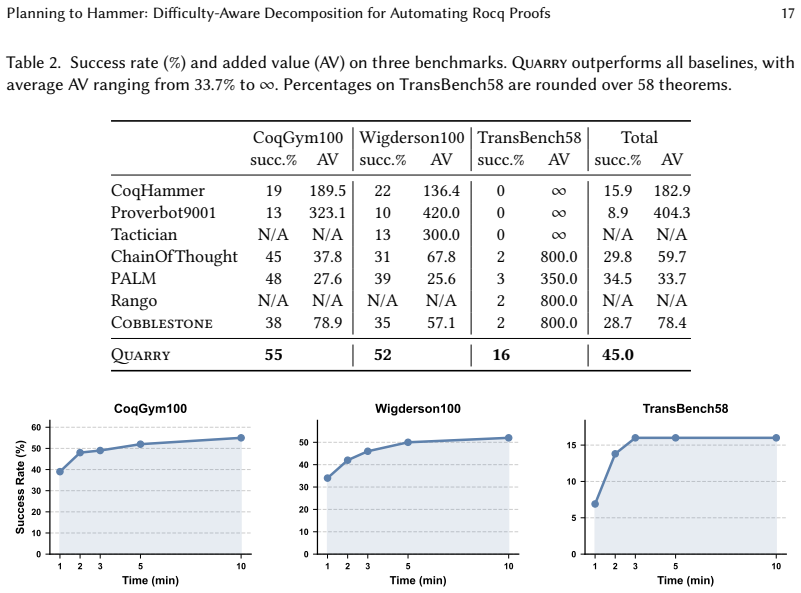
Quarry asks an LLM to propose multiple proof decompositions with arbitrary sublemmas, type-checks them in Rocq under admitted sublemmas, ranks the candidates by a proof-state-based difficulty model that predicts hammer solvability, and recursively proves sublemmas within a bounded budget, turning long proofs into sequences of hammer-solvable obligations and delivering 7% to 13% higher success rates than the strongest baseline across three Rocq benchmarks under a uniform 10-minute wall-clock limit.
What carries the argument
The proof-state-based difficulty model that estimates hammer solvability of LLM-proposed decompositions to enable ranking and recursive sublemma proving.
Load-bearing premise
The difficulty model accurately predicts which decompositions will be solvable by CoqHammer so that ranking selects effective paths.
What would settle it
A set of proof attempts where the model consistently ranks decompositions that later fail hammer solving above ones that succeed, causing overall failure within the 10-minute budget.
If this is right
- Long proofs reduce to sequences of short obligations that CoqHammer can discharge.
- Success rates rise 7% to 13% over baselines while cost stays predictable inside a fixed time limit.
- The same planning-plus-execution loop works with multiple frontier LLMs on multiple benchmarks.
- Neural planning and symbolic tactics coordinate without one replacing the other.
Where Pith is reading between the lines
- The same decomposition-ranking idea could be tested on Isabelle or other interactive provers that have strong automated tactics.
- If the difficulty model generalizes beyond CoqHammer, it might support hybrid automation for additional tactics or provers.
- Higher automation rates could shorten the time needed to verify larger codebases generated by AI tools.
Editorial analysis
A structured set of objections, weighed in public.
Referee Report
Summary. The manuscript presents Quarry, a planning-based proof synthesis framework for Rocq that separates LLM-driven proof decomposition (proposing sublemmas) from execution. It type-checks candidate decompositions under admitted sublemmas, ranks them via a proof-state-based difficulty model estimating CoqHammer solvability, and recursively discharges sublemmas within a uniform 10-minute wall-clock budget. The central empirical claim is that this yields 7-13% higher success rates than the strongest baseline across three Rocq benchmarks when using frontier LLMs.
Significance. If the results are robust, the work demonstrates a practical hybrid architecture that leverages LLM long-range planning while retaining the local rigor of symbolic tactics such as CoqHammer. This coordination approach, rather than end-to-end replacement, addresses a recognized bottleneck in interactive theorem proving and supplies a concrete, budget-constrained evaluation protocol that could be adopted by subsequent systems.
major comments (2)
- [§3] The difficulty model is load-bearing for the ranking and recursive decomposition claims (§3, difficulty-aware ranking paragraph), yet the manuscript supplies no training procedure, feature definition, or validation against actual hammer outcomes; without these, it is impossible to assess whether the model reliably predicts solvability or merely correlates with superficial proof-state properties.
- [§5] The reported 7-13% gains rest on comparisons to external baselines, but the evaluation section provides no information on benchmark definitions, baseline re-implementations, statistical significance tests, error bars, or data-exclusion rules; this absence prevents verification that the stated improvements support the central claim.
minor comments (2)
- [§3.2] Notation for the difficulty score and the precise interface between SerAPI and the ranking step could be clarified with a small pseudocode listing or equation.
- [Abstract] The abstract and introduction repeat the 7-13% figure without indicating whether it is an absolute or relative improvement; a single clarifying sentence would remove ambiguity.
Simulated Author's Rebuttal
We thank the referee for the careful reading and constructive feedback. We address each major comment below and will revise the manuscript to improve clarity and completeness where the concerns are valid.
read point-by-point responses
-
Referee: [§3] The difficulty model is load-bearing for the ranking and recursive decomposition claims (§3, difficulty-aware ranking paragraph), yet the manuscript supplies no training procedure, feature definition, or validation against actual hammer outcomes; without these, it is impossible to assess whether the model reliably predicts solvability or merely correlates with superficial proof-state properties.
Authors: We agree that the current description of the difficulty model in §3 is insufficiently detailed for assessing its reliability. The model is intended as a lightweight estimator of CoqHammer solvability based on proof-state features, but the manuscript does not provide the requested specifics. In the revised version we will expand the section to define the exact features, describe the training procedure (including the dataset construction and learning method), and report validation results comparing model predictions to actual hammer success rates on held-out proof states. This addition will directly address the concern about predictive power versus superficial correlation. revision: yes
-
Referee: [§5] The reported 7-13% gains rest on comparisons to external baselines, but the evaluation section provides no information on benchmark definitions, baseline re-implementations, statistical significance tests, error bars, or data-exclusion rules; this absence prevents verification that the stated improvements support the central claim.
Authors: We acknowledge that §5 currently lacks the level of detail needed for full reproducibility and verification of the reported gains. In the revised manuscript we will augment the evaluation section with: explicit definitions and sources for the three Rocq benchmarks, descriptions of baseline re-implementations (including any adaptations made), results of statistical significance tests with appropriate error bars or confidence intervals, and a clear statement of any data-exclusion criteria. These additions will allow independent assessment of whether the 7-13% improvements are robustly supported. revision: yes
Circularity Check
No significant circularity
full rationale
The paper describes an empirical system (Quarry) that combines LLM planning with CoqHammer execution and a difficulty model for ranking decompositions. All reported results are direct success-rate comparisons against external baselines under a fixed wall-clock budget; no equations, derivations, fitted parameters renamed as predictions, or load-bearing self-citations appear in the provided text. The architecture is presented as a pragmatic engineering combination rather than a mathematical derivation that reduces to its own inputs.
Axiom & Free-Parameter Ledger
read the original abstract
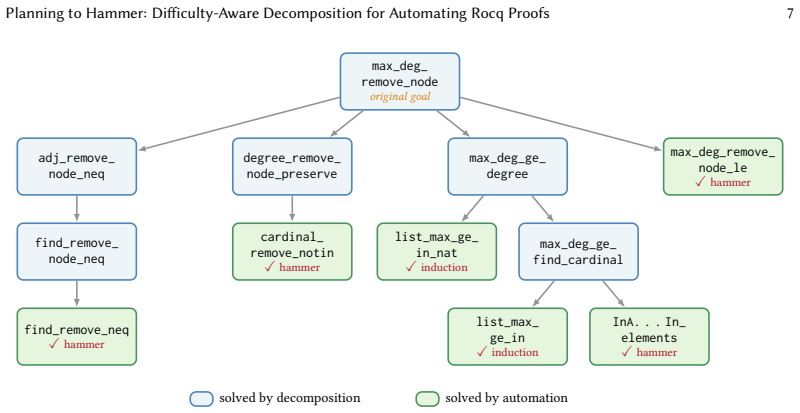
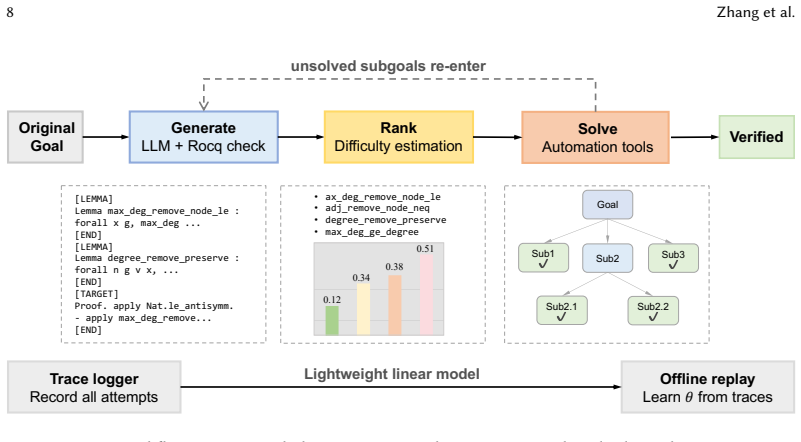
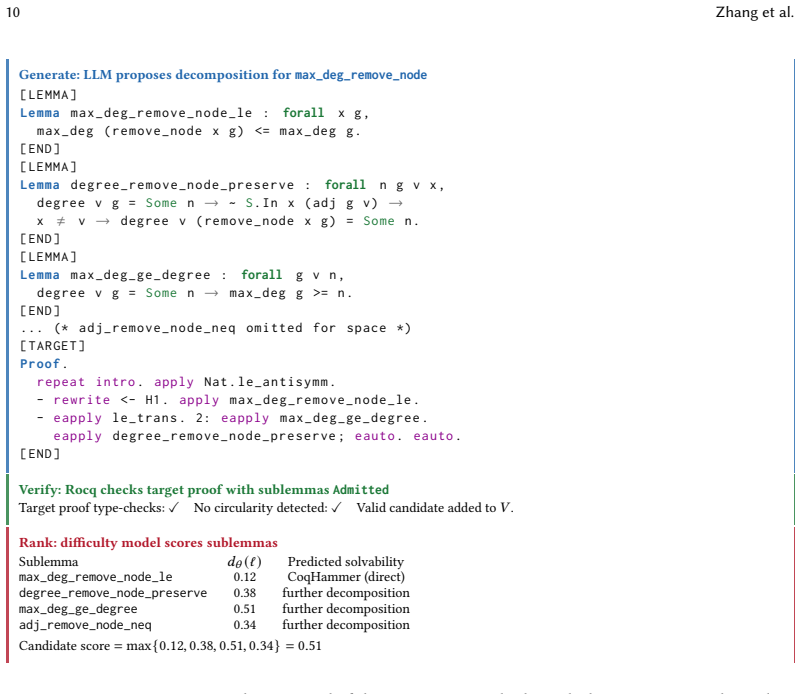
As AI-generated code proliferates, formal verification, particularly through interactive theorem provers such as Rocq and Isabelle, becomes increasingly important for ensuring software correctness. However, producing machine-checked proofs in such provers remains a bottleneck. Existing solutions bring complementary strengths to proof automation: large language models (LLMs) can propose high-level proof strategies but lack local rigor, while automated tactics such as CoqHammer can reliably discharge many local goals but lack long-range planning capabilities. To combine the best of both worlds, we present Quarry, a planning-based proof synthesis framework that separates proof planning from proof execution. Specifically, Quarry asks an LLM to actively propose multiple proof decompositions with arbitrary sublemmas, type-checks them in Rocq under temporarily admitted sublemmas, and ranks candidates using a proof-state-based difficulty model that estimates hammer solvability. It then recursively proves sublemmas within a bounded budget, effectively turning long proofs into sequences of hammer-solvable obligations. We implement Quarry on top of SerAPI and CoqHammer and evaluate it using multiple frontier LLMs across multiple benchmarks. The experimental results show that planning-based decomposition with solvability-aware ranking substantially improves automation while maintaining predictable cost. Under a uniform 10-minute wall-clock budget, Quarry improves over the strongest baseline by 7% to 13% in success rate across three Rocq benchmarks. These results demonstrate that reliable proof automation can be achieved by coordinating neural planning with symbolic execution rather than replacing either.
Figures
Forward citations
Cited by 1 Pith paper
-
BlueprintRepair: Typed Local Edits for Failed Lean Proof Blueprints
Typed local edits on Lean proof blueprints match free-form repair coverage on localized defects while using far fewer tokens and lower cost.
discussion (0)
Sign in with ORCID, Apple, or X to comment. Anyone can read and Pith papers without signing in.