REVIEW 3 minor 1 cited by
Pauli Correlation Encoding delivers competitive or superior solutions to combinatorial optimization problems on standard benchmarks.
Reviewed by Pith at T0; open to challenge. T0 means a machine referee read the full paper against a public rubric. the ladder, T0–T4 →
T0 review · grok-4.3
2026-07-03 23:44 UTC pith:OCCRVEZ7
load-bearing objection This is a straightforward benchmark of an existing encoding on QOPTLib problems that quantifies noise and hyperparameter effects but adds no new theory.
Benchmark of Pauli Correlation Encoding for different optimisation problems
The pith
A machine-rendered reading of the paper's core claim, the machinery that carries it, and where it could break.
Core claim
The proposed quantum-classical optimisation framework based on Pauli Correlation Encoding achieves competitive performance against the benchmark and, in several cases, obtains equivalent or even superior solutions. This holds after accounting for the effects of compression order, problem structure, hyperparameter choice, post-processing, limited shots, and hardware noise on both accuracy and optimisation dynamics.
What carries the argument
Pauli Correlation Encoding, a scheme that represents m binary variables using a polynomial number of qubits and forms the basis of the quantum-classical optimisation loop.
Load-bearing premise
The quantum-classical optimization framework based on Pauli Correlation Encoding can be effectively implemented and evaluated on the QOPTLib instances without significant unaccounted errors from hardware or encoding limitations.
What would settle it
Executing the same PCE optimisation runs on actual quantum hardware for the QOPTLib instances and observing that solution quality drops substantially below the reported benchmark levels due to unaccounted noise or encoding overhead would falsify the performance claim.
If this is right
- Different compression orders in the encoding produce measurable changes in final solution quality.
- Problem structure and hyperparameter settings directly affect how well the optimiser converges.
- Post-processing steps applied after the quantum-classical loop measurably raise solution quality.
- Shot-based execution and hardware noise alter both the accuracy of value estimates and the trajectory of the optimisation process.
- The framework remains usable in the NISQ regime and into the near fault-tolerant era.
Where Pith is reading between the lines
- If the polynomial qubit scaling holds for larger instances, the method could handle problems that exceed the reach of direct one-qubit-per-variable encodings.
- The observed noise tolerance suggests the approach could be paired with error-mitigation techniques already used in other hybrid algorithms.
- Extending the benchmark to additional problem families would clarify whether certain combinatorial structures favour PCE over alternative encodings.
- The role of post-processing implies that classical refinement steps may be a necessary component for reaching competitive performance.
Editorial analysis
A structured set of objections, weighed in public.
Referee Report
Summary. The manuscript benchmarks a quantum-classical optimization framework based on Pauli Correlation Encoding (PCE), which represents m binary variables with a polynomial number of qubits. It evaluates the approach on three classical optimization problems drawn from the QOPTLib benchmark, analyzing the effects of compression order, problem structure, hyperparameter selection, post-processing, shot-based execution, and hardware noise models on expected-value estimation accuracy and overall optimization dynamics. The central claim is that the PCE framework delivers competitive performance relative to the benchmark and, in several cases, equivalent or superior solutions.
Significance. If the controlled comparisons hold, the work supplies a practical, factor-by-factor assessment of PCE under NISQ-relevant conditions, explicitly quantifying how encoding compression, shot statistics, and noise influence solution quality. The inclusion of post-processing effects and hardware noise models adds concrete value for assessing deployability in the near fault-tolerant regime.
minor comments (3)
- [Abstract] The abstract refers to 'three classical optimisation problems' without naming them; explicitly identifying the problems (e.g., in the abstract or a dedicated table) would improve immediate context for readers.
- [Results] In the results tables or figures that report solution quality, ensure that the specific QOPTLib instance identifiers, shot counts, and compression orders are cross-referenced so that each data point can be traced back to the experimental configuration without ambiguity.
- [Methods] The description of the hardware noise model would benefit from a short explicit statement of how the simulated noise parameters were chosen relative to current device specifications.
Simulated Author's Rebuttal
We thank the referee for the constructive summary and for recommending minor revision. No specific major comments were listed in the report, so we have no individual points to address at this time. We are prepared to incorporate any additional feedback or minor suggestions that may be provided.
Circularity Check
No significant circularity identified
full rationale
The paper is an empirical benchmark study that evaluates the PCE encoding framework on QOPTLib instances for three optimization problems. It reports controlled experiments on compression order, hyperparameters, post-processing, shot counts, and hardware noise effects, with the central claim of competitive or superior solutions resting directly on these measured comparisons. No derivation chain, fitted parameter renamed as prediction, self-definitional relation, or load-bearing self-citation is present; the work is self-contained against external benchmarks.
Axiom & Free-Parameter Ledger
read the original abstract
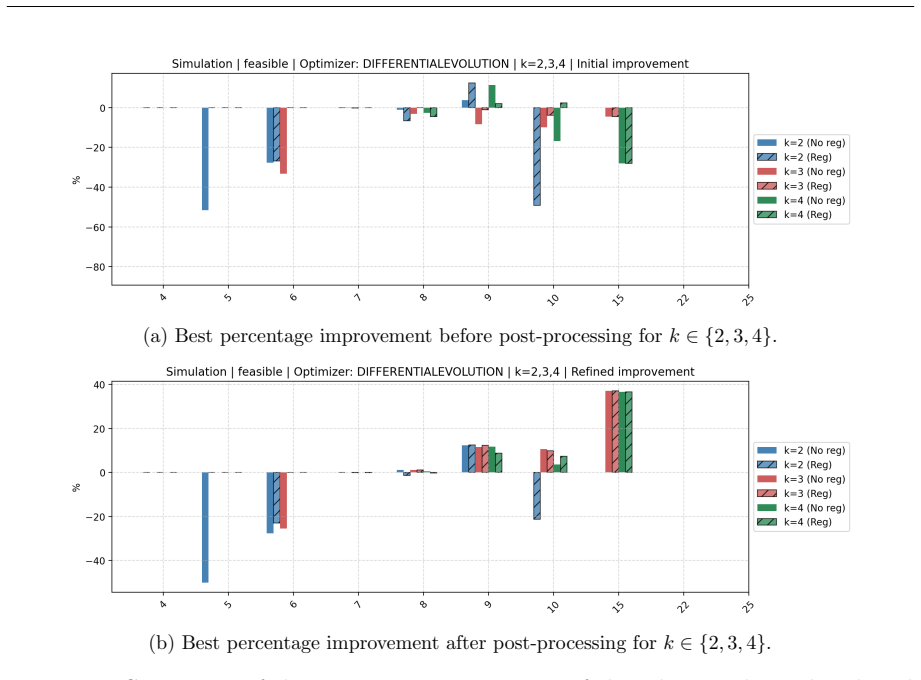
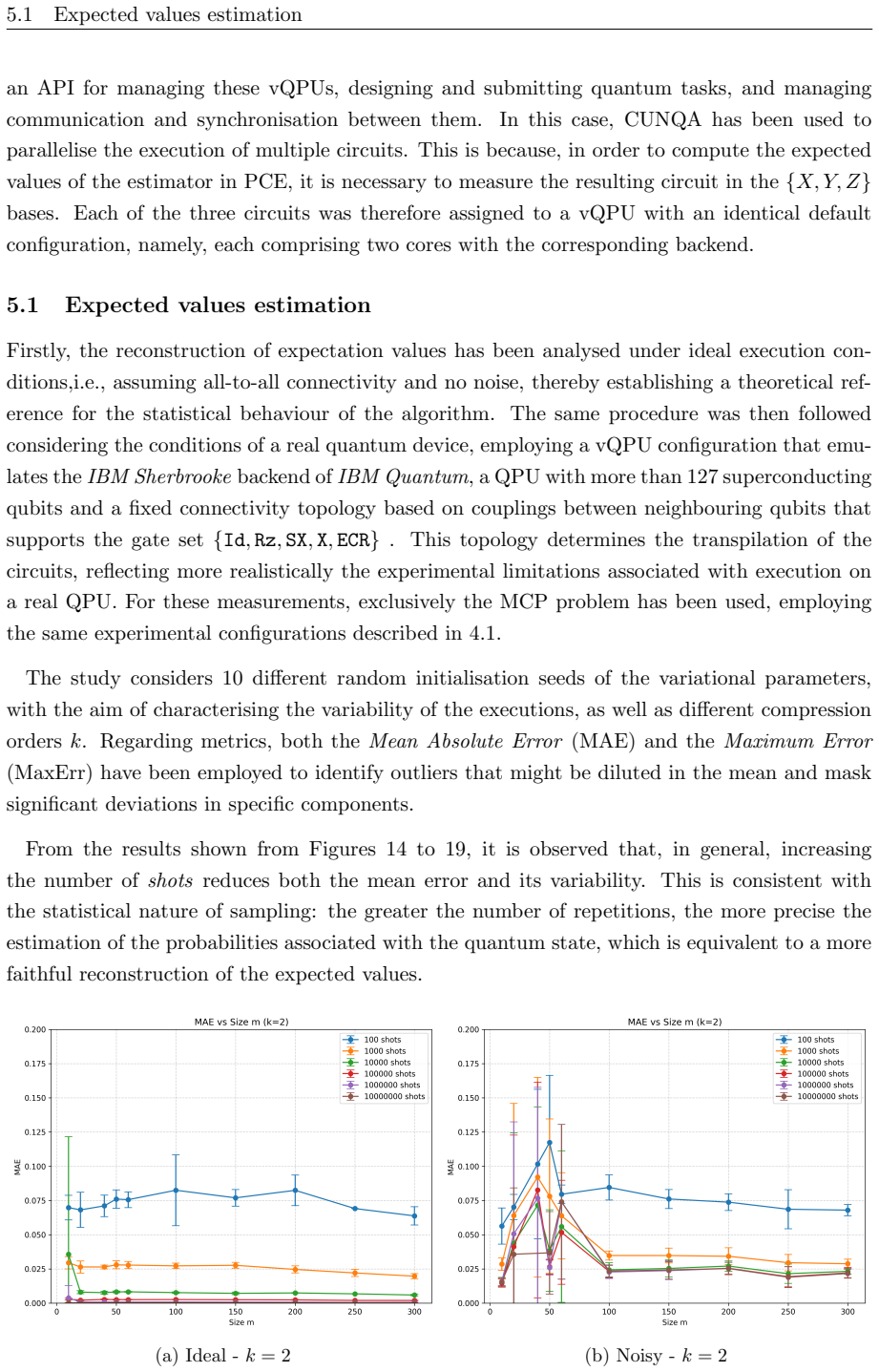
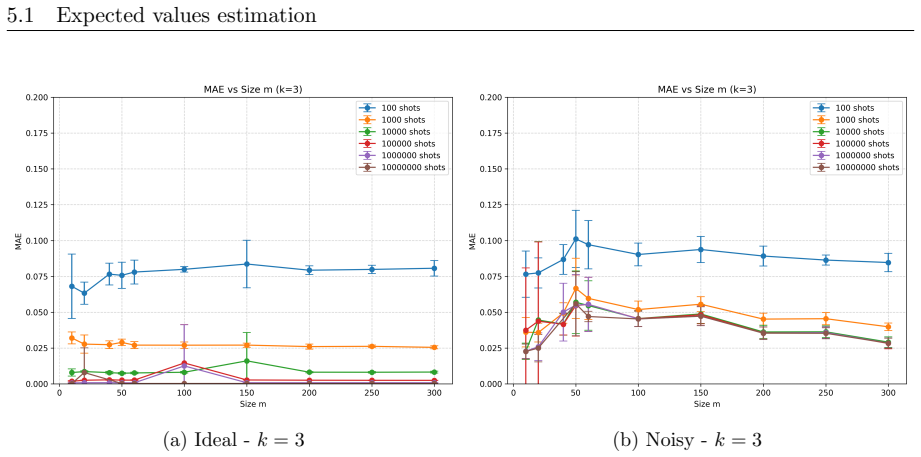
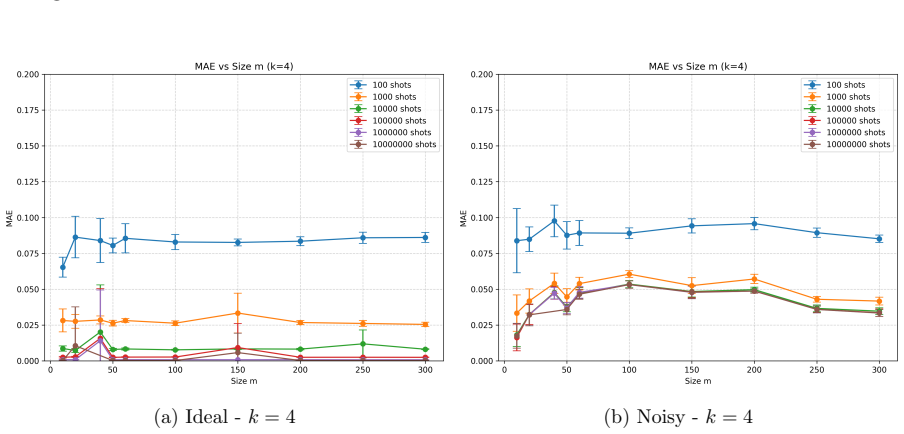
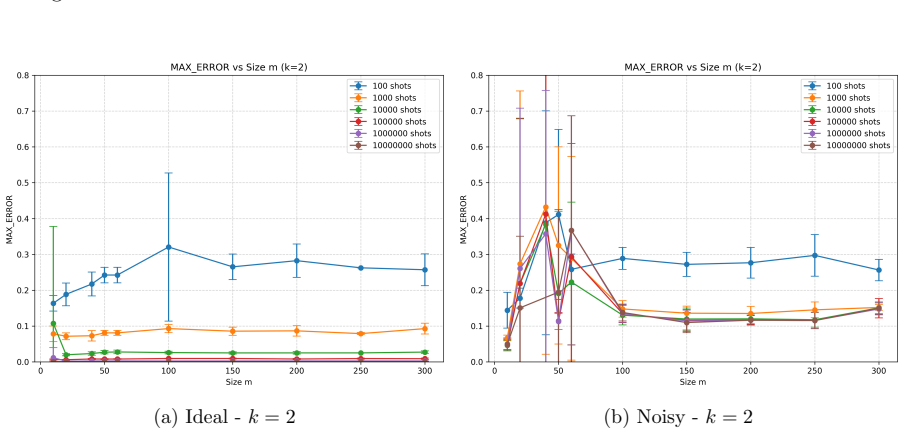
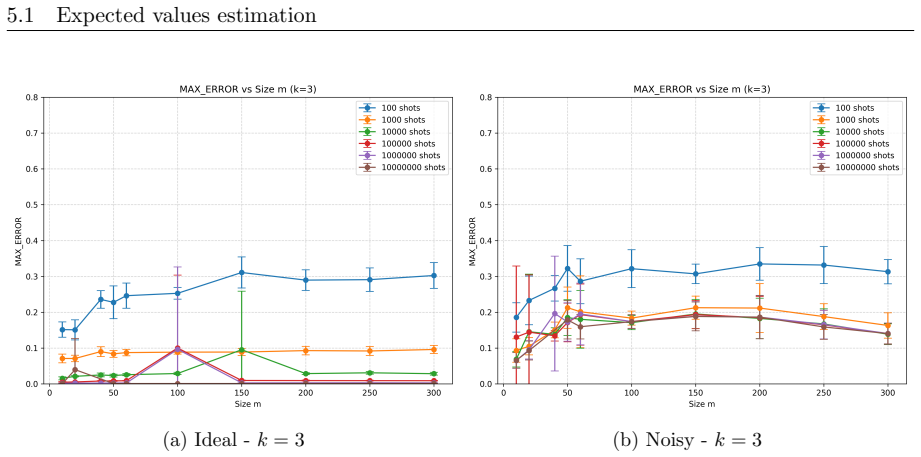
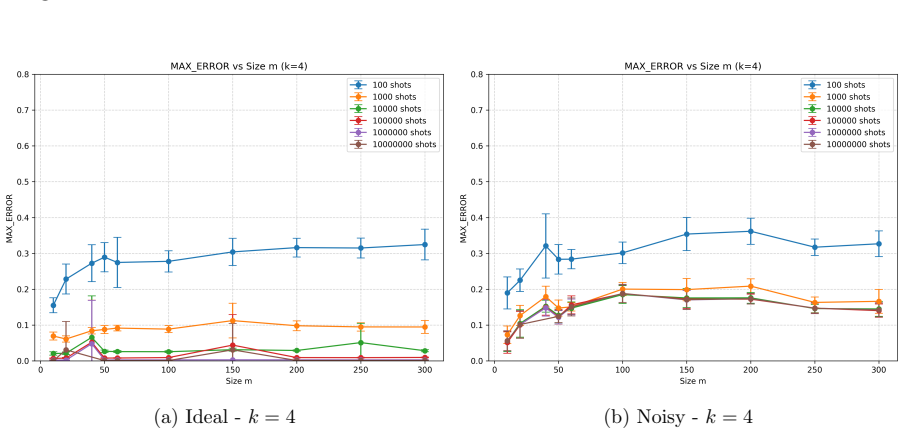
The continuous progress of quantum technologies has spurred the exploration of their potential applications across diverse fields, particularly in combinatorial optimisation. In this work, we study a quantum-classical optimisation framework based on Pauli Correlation Encoding, an encoding scheme that can represent m binary variables using a polynomial number of qubits. To evaluate the performance of the method, we use three classical optimisation problems against the instances of the QOPTLib benchmark. The study includes an analysis of the impact of the compression order of the encoding scheme, the problem structure, and hyperparameter selection on solution quality, as well as the role of post-processing in improving performance. Additionally, we study the effect of shot-based execution and hardware noise, showing how these factors influence both the accuracy of expected value estimation and the overall dynamics of the optimisation process. The results indicate that the proposed PCE-based framework achieves competitive performance against the benchmark and, in several cases, obtains equivalent or even superior solutions, highlighting its potential as an efficient encoding strategy for quantum optimisation in the NISQ and near fault-tolerant era.
Figures
Forward citations
Cited by 1 Pith paper
-
Efficiently Simulable Pauli Correlation Encoding
Free-fermion and IQP instantiations of Pauli Correlation Encoding run entirely classically and still give high-quality solutions on MaxCut, MIS, knapsack, and Max3SAT benchmarks.
Reference graph
Works this paper leans on
-
[1]
A Systematic Literature Review of Quantum Computing for Routing Problems , year=
Osaba, Eneko and Villar-Rodriguez, Esther and Oregi, Izaskun , journal=. A Systematic Literature Review of Quantum Computing for Routing Problems , year=
-
[2]
Feld, Sebastian and Roch, Christoph and Gabor, Thomas and Seidel, Christian and Neukart, Florian and Galter, Isabella and Mauerer, Wolfgang and Linnhoff-Popien, Claudia , year=. A Hybrid Solution Method for the Capacitated Vehicle Routing Problem Using a Quantum Annealer , volume=. Frontiers in ICT , publisher=
-
[3]
A Centroid-Based Heuristic Algorithm for the Capacitated Vehicle Routing Problem , volume =
Shin, Kwangcheol and Han, Sangyong , year =. A Centroid-Based Heuristic Algorithm for the Capacitated Vehicle Routing Problem , volume =
-
[4]
and García-Martín, Diego and Camilo, Giancarlo and Anandkumar, Anima and Aolita, Leandro , year=
Sciorilli, Marco and Borges, Lucas and Patti, Taylor L. and García-Martín, Diego and Camilo, Giancarlo and Anandkumar, Anima and Aolita, Leandro , year=. Towards large-scale quantum optimization solvers with few qubits , volume=. Nature Communications , publisher=
-
[5]
Faílde, Daniel and Viqueira, José Daniel and Mussa Juane, Mariamo and Gómez, Andrés , title =. Scientific Reports , year =
-
[6]
A Quantum Approximate Optimization Algorithm
A quantum approximate optimization algorithm , author=. arXiv preprint arXiv:1411.4028 , year=
work page internal anchor Pith review Pith/arXiv arXiv
-
[7]
QOPTLib: A Quantum Computing Oriented Benchmark for Combinatorial Optimization Problems , booktitle=
Osaba, Eneko and Villar-Rodriguez, Esther , year=. QOPTLib: A Quantum Computing Oriented Benchmark for Combinatorial Optimization Problems , booktitle=
-
[8]
A review on Quantum Approximate Optimization Algorithm and its variants , volume=
Blekos, Kostas and Brand, Dean and Ceschini, Andrea and Chou, Chiao-Hui and Li, Rui-Hao and Pandya, Komal and Summer, Alessandro , year=. A review on Quantum Approximate Optimization Algorithm and its variants , volume=. doi:10.1016/j.physrep.2024.03.002 , journal=
-
[9]
and Kindler, Guy and Mossel, E
Khot, S. and Kindler, Guy and Mossel, E. and O'Donnell, R. , year =. Optimal inapproximability results for MAX-CUT and other 2-variable CSPs? , volume =. Proceedings - Annual IEEE Symposium on Foundations of Computer Science, FOCS , doi =
-
[10]
Transactions of The Japanese Society for Artificial Intelligence , year=
Landscape analyses of search-space in travelling salesman problems , author=. Transactions of The Japanese Society for Artificial Intelligence , year=
-
[11]
NP-Hard Problems and Approximation Algorithms
Du, Ding-Zhu and Pardalos, Panos and Hu, Xiaodong and Wu, Weili. NP-Hard Problems and Approximation Algorithms. Introduction to Combinatorial Optimization. 2022
work page 2022
-
[12]
CUNQA: a Distributed Quantum Computing emulator for HPC , author=. 2025 , eprint=
work page 2025
-
[13]
Parameterized quantum circuits as machine learning models , volume=
Benedetti, Marcello and Lloyd, Erika and Sack, Stefan and Fiorentini, Mattia , year=. Parameterized quantum circuits as machine learning models , volume=. Quantum Science and Technology , publisher=. doi:10.1088/2058-9565/ab4eb5 , number=
-
[14]
Schuld, Maria and Sweke, Ryan and Meyer, Johannes Jakob , year=. Effect of Data Encoding on the Expressive Power of Variational Quantum-Machine-learning Models , volume=. Physical Review A , publisher=
- [15]
-
[16]
Larocca, Martín and Thanasilp, Supanut and Wang, Samson and Sharma, Kunal and Biamonte, Jacob and Coles, Patrick J. and Cincio, Lukasz and McClean, Jarrod R. and Holmes, Zoë and Cerezo, M. , year=. Barren plateaus in variational quantum computing , volume=. Nature Reviews Physics , publisher=. doi:10.1038/s42254-025-00813-9 , number=
-
[17]
Bodlaender, Hans L. and Jansen, Klaus. On the complexity of the maximum cut problem. STACS 94. 1994
work page 1994
-
[18]
Quantum Annealing for Combinatorial Optimization: Foundations, Architectures, Benchmarks, and Emerging Directions , author=. 2026 , eprint=
work page 2026
-
[19]
Wang, Zhihui and Hadfield, Stuart and Jiang, Zhang and Rieffel, Eleanor G. , year=. Quantum approximate optimization algorithm for MaxCut: A fermionic view , volume=. Physical Review A , publisher=. doi:10.1103/physreva.97.022304 , number=
-
[20]
Performance of the Quantum Approximate Optimization Algorithm on the Maximum Cut Problem , author=. 2018 , eprint=
work page 2018
-
[21]
Beyond quantum annealing: optimal control solutions to maxcut problems , volume=
Pecci, Giovanni and Wang, Ruiyi and Torta, Pietro and Mbeng, Glen Bigan and Santoro, Giuseppe , year=. Beyond quantum annealing: optimal control solutions to maxcut problems , volume=. Quantum Science and Technology , publisher=. doi:10.1088/2058-9565/ad60f2 , number=
-
[22]
Accuracy and Performance Evaluation of Quantum, Classical and Hybrid Solvers for the Max-Cut Problem , author=. 2024 , eprint=
work page 2024
-
[23]
A Tutorial on Formulating and Using QUBO Models , author=. 2019 , eprint=
work page 2019
-
[24]
Chanaleä Munien and Absalom E. Ezugwu , pages =. Metaheuristic algorithms for one-dimensional bin-packing problems: A survey of recent advances and applications , title =. Journal of Intelligent Systems , doi =. 2021 , lastchecked =
work page 2021
-
[25]
Two-Dimensional Bin Packing Problems , volume =
Lodi, Andrea and Martello, Silvano and Monaci, Michele and Vigo, Daniele , year =. Two-Dimensional Bin Packing Problems , volume =. Paradigms of Combinatorial Optimization: Problems and New Approaches , doi =
-
[26]
The Three-Dimensional Bin Packing Problem , volume =
Martello, Silvano and Pisinger, David and Vigo, Daniele , year =. The Three-Dimensional Bin Packing Problem , volume =. Operations Research , doi =
-
[27]
Algorithms for the variable-sized bin packing problem with time windows , volume =
Liu, Qiang and Cheng, Huibing and Tian, Tian and Wang, Yongsheng and Leng, Jiewu and Zhao, Rongli and Zhang, Hao and Lijun, Wei , year =. Algorithms for the variable-sized bin packing problem with time windows , volume =. Computers & Industrial Engineering , doi =
-
[28]
Hybrid quantum-classical heuristic for the bin packing problem , DOI=
de Andoin, Mikel Garcia and Osaba, Eneko and Oregi, Izaskun and Villar-Rodriguez, Esther and Sanz, Mikel , year=. Hybrid quantum-classical heuristic for the bin packing problem , DOI=. Proceedings of the Genetic and Evolutionary Computation Conference Companion , publisher=
-
[29]
V. Romero, Sebastián and Osaba, Eneko and Villar-Rodriguez, Esther and Oregi, Izaskun and Ban, Yue , year=. Hybrid approach for solving real-world bin packing problem instances using quantum annealers , volume=. Scientific Reports , publisher=. doi:10.1038/s41598-023-39013-9 , number=
-
[30]
Quantum and quantum-inspired optimization for solving the minimum bin packing problem , volume=
Bozhedarov, A A and Usmanov, S R and Salakhov, G V and Boev, A S and Kiktenko, E O and Fedorov, A K , year=. Quantum and quantum-inspired optimization for solving the minimum bin packing problem , volume=. Journal of Physics: Conference Series , publisher=. doi:10.1088/1742-6596/2701/1/012129 , number=
-
[31]
Garey, M. R. and Johnson, D. S. , edition =
- [32]
-
[33]
Combinatorial Optimization: Theory and Algorithms
The Traveling Salesman Problem. Combinatorial Optimization: Theory and Algorithms. 2008. doi:10.1007/978-3-540-71844-4_21
-
[34]
The Computational Complexity of the Traveling Salesman Problem , author=. 2012 , eprint=
work page 2012
-
[35]
Srinivasan, Karthik and Satyajit, Saipriya and Behera, Bikash and Panigrahi, Prasanta , year =. Efficient quantum algorithm for solving travelling salesman problem: An IBM quantum experience , doi =
-
[36]
Salehi Köken, Ozlem and Glos, Adam and Miszczak, Jaroslaw , year =. Unconstrained binary models of the travelling salesman problem variants for quantum optimization , volume =. Quantum Information Processing , doi =
- [37]
- [38]
-
[39]
and Gayialis, Sotiris and Kechagias, Evripidis , year =
Konstantakopoulos, Grigorios D. and Gayialis, Sotiris and Kechagias, Evripidis , year =. Vehicle routing problem and related algorithms for logistics distribution: a literature review and classification , journal =
-
[40]
On the Vehicle Routing Problem
Berman, Piotr and Das, Surajit K. On the Vehicle Routing Problem. Algorithms and Data Structures. 2005
work page 2005
-
[41]
Vehicle Routing Problem with Time Windows , isbn =
Kallehauge, Brian and Larsen, Jesper and Madsen, Oli and Solomon, Marius , year =. Vehicle Routing Problem with Time Windows , isbn =. Column Generation , doi =
-
[42]
Wassan, Naveed and Wassan, Niaz and Nagy, Gabor and Salhi, Said , year =. The Multiple Trip Vehicle Routing Problem with Backhauls: Formulation and a Two-Level Variable Neighbourhood Search , volume =. Computers & Operations Research , doi =
-
[43]
Feld, Sebastian and Roch, Christoph and Gabor, Thomas and Seidel, Christian and Neukart, Florian and Galter, Isabella and Mauerer, Wolfgang and Linnhoff-Popien, Claudia , year =. A Hybrid Solution Method for the Capacitated Vehicle Routing Problem Using a Quantum AnnealerData_Sheet_1.pdf , volume =. Frontiers in ICT , doi =
-
[44]
Feld, Sebastian and Roch, Christoph and Gabor, Thomas and Seidel, Christian and Neukart, Florian and Galter, Isabella and Mauerer, Wolfgang and Linnhoff-Popien, Claudia , year=. A Hybrid Solution Method for the Capacitated Vehicle Routing Problem Using a Quantum Annealer , volume=. doi:10.3389/fict.2019.00013 , journal=
-
[45]
New Hybrid Quantum Annealing Algorithms for Solving Vehicle Routing Problem , isbn =
Borowski, Michał and Karnas, Katarzyna and Błajda, Mateusz and Król, Krystian and Matyjasek, Artur and Burczyk, Damian and Szewczyk, Miron and Kutwin, Michał , year =. New Hybrid Quantum Annealing Algorithms for Solving Vehicle Routing Problem , isbn =
-
[46]
Solving Vehicle Routing Problem Using Quantum Approximate Optimization Algorithm , volume =
Azad, Utkarsh and Behera, Bikash and Ahmed, Emad and Panigrahi, Prasanta and Farouk, Ahmed , year =. Solving Vehicle Routing Problem Using Quantum Approximate Optimization Algorithm , volume =. IEEE Transactions on Intelligent Transportation Systems , doi =
-
[47]
Formulating and Solving Routing Problems on Quantum Computers , volume =
Harwood, Stuart and Gambella, Claudio and Trenev, Dimitar and Simonetto, Andrea and Bernal Neira, David and Greenberg, Donny , year =. Formulating and Solving Routing Problems on Quantum Computers , volume =. IEEE Transactions on Quantum Engineering , doi =
-
[48]
Javier and Díaz-Camacho, Guillermo and Faílde, Daniel and Llovo, Iago F
Barral, David and Cardama, F. Javier and Díaz-Camacho, Guillermo and Faílde, Daniel and Llovo, Iago F. and Mussa-Juane, Mariamo and Vázquez-Pérez, Jorge and Villasuso, Juan and Piñeiro, César and Costas, Natalia and Pichel, Juan C. and Pena, Tomás F. and Gómez, Andrés , year=. Review of Distributed Quantum Computing: From single QPU to High Performance Qu...
-
[49]
Optimization Strategies for Variational Quantum Algorithms in Noisy Landscapes , author=. 2025 , eprint=
work page 2025
-
[50]
Pauli Correlation Encoding for Budget-Constrained Optimization , author=. 2026 , eprint=
work page 2026
-
[51]
Quantum Computing in the NISQ era and beyond
Preskill, John , year=. Quantum Computing in the NISQ era and beyond , volume=. doi:10.22331/q-2018-08-06-79 , journal=
work page internal anchor Pith review doi:10.22331/q-2018-08-06-79 2018
-
[52]
Bharti, Kishor and Cervera-Lierta, Alba and Kyaw, Thi Ha and Haug, Tobias and Alperin-Lea, Sumner and Anand, Abhinav and Degroote, Matthias and Heimonen, Hermanni and Kottmann, Jakob S. and Menke, Tim and Mok, Wai-Keong and Sim, Sukin and Kwek, Leong-Chuan and Aspuru-Guzik, Alán , year=. Noisy intermediate-scale quantum algorithms , volume=. Reviews of Mo...
-
[53]
Cerezo, M. and Arrasmith, Andrew and Babbush, Ryan and Benjamin, Simon C. and Endo, Suguru and Fujii, Keisuke and McClean, Jarrod R. and Mitarai, Kosuke and Yuan, Xiao and Cincio, Lukasz and Coles, Patrick J. , year=. Variational quantum algorithms , volume=. Nature Reviews Physics , publisher=. doi:10.1038/s42254-021-00348-9 , number=
-
[54]
García-Martín, Diego and Larocca, Martín and Cerezo, M. , year=. Effects of noise on the overparametrization of quantum neural networks , volume=. Physical Review Research , publisher=. doi:10.1103/physrevresearch.6.013295 , number=
-
[55]
Limitations of optimization algorithms on noisy quantum devices , volume=
Stilck França, Daniel and García-Patrón, Raul , year=. Limitations of optimization algorithms on noisy quantum devices , volume=. Nature Physics , publisher=. doi:10.1038/s41567-021-01356-3 , number=
-
[56]
Variational quantum algorithms on cat qubits , author=. 2023 , eprint=
work page 2023
-
[57]
Fundamental limitations on optimization in variational quantum algorithms , author=. 2022 , eprint=
work page 2022
-
[58]
Approximate Solutions of Combinatorial Problems via Quantum Relaxations , volume =
Fuller, Bryce and Hadfield, Charles and Glick, Jennifer and Imamichi, Takashi and Itoko, Toshinari and Thompson, Richard and Jiao, Yang and Kagele, Marna and Blom-Schieber, Adriana and Raymond, Rudy and Mezzacapo, Antonio , year =. Approximate Solutions of Combinatorial Problems via Quantum Relaxations , volume =. IEEE Transactions on Quantum Engineering , doi =
-
[59]
Variational quantum optimization with multibasis encodings , volume =
Patti, Taylor and Kossaifi, Jean and Anandkumar, Anima and Yelin, Susanne , year =. Variational quantum optimization with multibasis encodings , volume =. Physical Review Research , doi =
-
[60]
Huber, Elias X. and Tan, Benjamin Y. L. and Griffin, Paul R. and Angelakis, Dimitris G. , year=. Exponential qubit reduction in optimization for financial transaction settlement , volume=. EPJ Quantum Technology , publisher=. doi:10.1140/epjqt/s40507-024-00262-w , number=
-
[61]
and Melnikov, Ar and Podobrii, M
Perelshtein, Michael and Pakhomchik, A. and Melnikov, Ar and Podobrii, M. and Termanova, Alena and Kreidich, I. and Nuriev, B. and Iudin, Sergei and Mansell, C. and Vinokur, Valerii , year =. NISQ-compatible approximate quantum algorithm for unconstrained and constrained discrete optimization , volume =. Quantum , doi =
-
[62]
A Variational Qubit-Efficient MaxCut Heuristic Algorithm , volume =
Tene-Cohen, Yovav and Kelman, Tomer and Lev, Ohad and Makmal, Adi , year =. A Variational Qubit-Efficient MaxCut Heuristic Algorithm , volume =. npj Quantum Information , doi =
-
[63]
Brazilian Journal of Physics , year =
Warm-Starting PCE for Traveling Salesman Problem , author =. Brazilian Journal of Physics , year =. doi:10.1007/s13538-025-01966-9 , publisher =
-
[64]
Large-scale portfolio optimization using Pauli Correlation Encoding , author=. 2025 , eprint=
work page 2025
-
[65]
Tan, Benjamin and Lemonde, Marc-Antoine and Thanasilp, Supanut and Tangpanitanon, Jirawat and Angelakis, Dimitris G. , year=. Qubit-efficient encoding schemes for binary optimisation problems , volume=. doi:10.22331/q-2021-05-04-454 , journal=
-
[66]
Qian, Wenyang and Basili, Robert A. M. and Eshaghian-Wilner, Mary Mehrnoosh and Khokhar, Ashfaq and Luecke, Glenn and Vary, James P. , year=. Comparative Study of Variations in Quantum Approximate Optimization Algorithms for the Traveling Salesman Problem , volume=. Entropy , publisher=. doi:10.3390/e25081238 , number=
-
[67]
Effectiveness of quantum annealing for continuous-variable optimization , author =. Phys. Rev. A , volume =. 2023 , month =
work page 2023
-
[68]
The D-Wave Advantage System: An Overview TECHNICAL REPORT , author=. 2020 , url=
work page 2020
-
[69]
Quantum variational algorithms are swamped with traps , volume =
Anschuetz, Eric and Kiani, Bobak , year =. Quantum variational algorithms are swamped with traps , volume =. Nature Communications , doi =
-
[70]
and Gacon, Julien and Tornow, Caroline and Bello, Luciano and Woerner, Stefan and Egger, Daniel J
Weidenfeller, Johannes and Valor, Lucia C. and Gacon, Julien and Tornow, Caroline and Bello, Luciano and Woerner, Stefan and Egger, Daniel J. , year=. Scaling of the quantum approximate optimization algorithm on superconducting qubit based hardware , volume=. doi:10.22331/q-2022-12-07-870 , journal=
-
[71]
Alleviating the quantum Big-M problem , volume=
Alessandroni, Edoardo and Ramos-Calderer, Sergi and Roth, Ingo and Traversi, Emiliano and Aolita, Leandro , year=. Alleviating the quantum Big-M problem , volume=. npj Quantum Information , publisher=. doi:10.1038/s41534-025-01067-0 , number=
discussion (0)
Sign in with ORCID, Apple, or X to comment. Anyone can read and Pith papers without signing in.