REVIEW 2 major objections 1 minor 1 cited by
Pretraining data composition can shift neural scaling laws for jet classification to favor more data over larger models.
Reviewed by Pith at T0; open to challenge. T0 means a machine referee read the full paper against a public rubric. the ladder, T0–T4 →
T0 review · grok-4.3
2026-06-30 11:25 UTC pith:X5WVKWM6
load-bearing objection Pretraining data composition can shift scaling exponents toward data-heavy regimes in jet classification, but the abstract leaves open whether architecture or fine-tuning choices drive the effect instead. the 2 major comments →
Towards Engineering Scaling Laws with Pretraining Data Composition
The pith
A machine-rendered reading of the paper's core claim, the machinery that carries it, and where it could break.
Core claim
For the task of classifying hadronic jets produced in high-energy collisions, the scaling behavior can be engineered towards requiring more data rather than larger models by inclusion of pretraining data which is more diverse and better aligned with the downstream classification task.
What carries the argument
Pretraining data composition, defined by its diversity and alignment with the jet classification task, which alters the power-law scaling exponents between performance, model size, and data volume.
Load-bearing premise
Differences in observed scaling exponents arise primarily from the pretraining data composition rather than from unstated choices in model architecture, optimizer, or downstream fine-tuning procedure.
What would settle it
An experiment that fixes architecture, optimizer, and fine-tuning procedure but varies only the diversity and alignment of the pretraining data and finds identical scaling exponents would falsify the central claim.
If this is right
- Scaling exponents become tunable by deliberate choice of pretraining data rather than fixed properties of the task.
- When simulators make data cheap, optimal compute allocation shifts toward larger datasets and smaller models.
- Performance on jet classification improves more rapidly with added examples once the pretraining mix is better aligned.
- The same simulator pipeline can be reused to generate task-specific pretraining sets that change scaling behavior.
Where Pith is reading between the lines
- The same data-composition approach could be tested in other domains that have cheap simulators, such as certain chemistry or materials tasks.
- Quantitative measures of data diversity and task alignment could be developed to predict the direction and size of scaling shifts in advance.
- Hybrid pretraining mixes that blend real collision data with simulated events might produce intermediate scaling regimes.
Editorial analysis
A structured set of objections, weighed in public.
Referee Report
Summary. The manuscript investigates neural scaling laws for hadronic jet classification in high-energy physics. It claims that pretraining data composition can be engineered—specifically by using more diverse and task-aligned synthetic data—to shift scaling behavior toward regimes that favor additional data over larger models, leveraging the availability of cheap high-fidelity simulators in particle physics.
Significance. If the central empirical claim holds after proper controls, the result would be significant for ML applications in HEP. It identifies a domain-specific lever (data composition) to influence scaling exponents in a setting where data is abundant relative to parameters, potentially enabling more efficient model development than in language or vision domains. The work also highlights an opportunity to move beyond passive observation of scaling laws toward active engineering.
major comments (2)
- [Methods / Experimental Setup] The central claim requires that observed differences in scaling exponents be attributable to pretraining data composition rather than confounding factors. The manuscript provides no description of whether model architecture, optimizer settings, learning-rate schedules, or downstream fine-tuning procedures were held fixed (or explicitly ablated) across data-composition variants. Without such controls the attribution cannot be isolated.
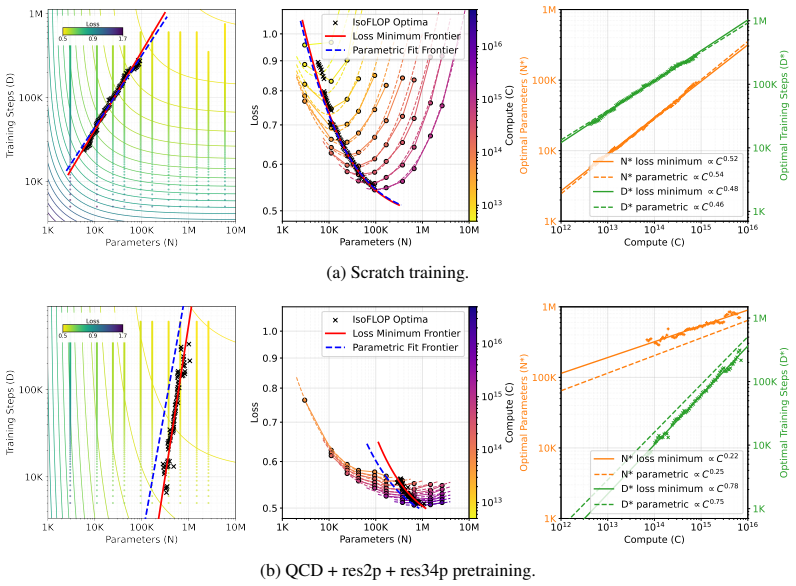
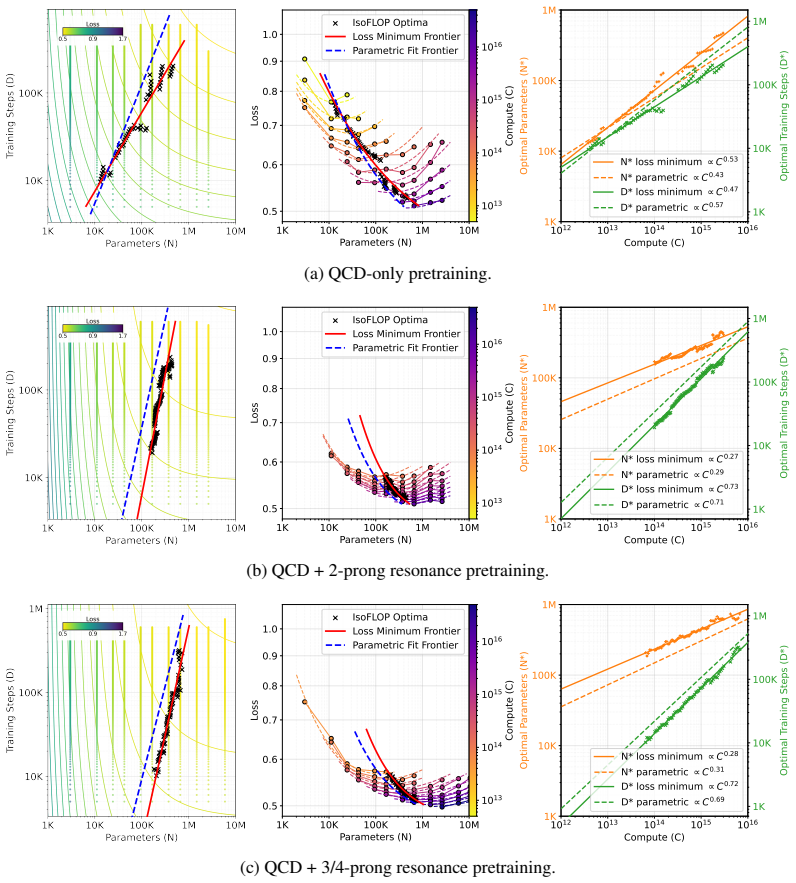
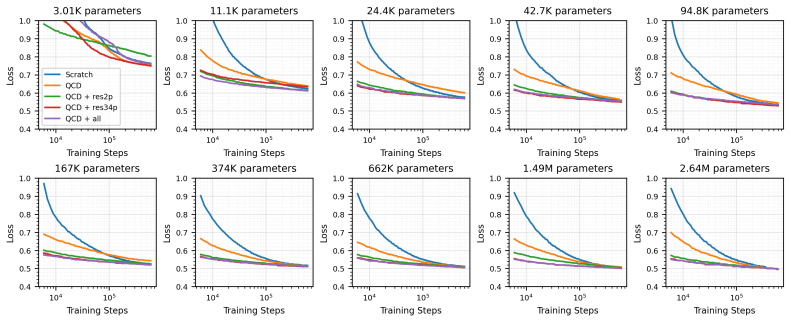
- [Results] No quantitative results, fitted scaling exponents, error bars, or tables comparing scaling regimes across data compositions are visible. The abstract states the claim at a high level only, preventing evaluation of effect size or statistical support for the data-vs-parameter shift.
minor comments (1)
- [Abstract] The abstract would be strengthened by a single sentence summarizing the specific jet classification task, datasets, and model family used.
Simulated Author's Rebuttal
We thank the referee for the careful review and constructive feedback. The two major comments identify areas where the manuscript can be strengthened for clarity and rigor. We address each point below and will incorporate revisions as noted.
read point-by-point responses
-
Referee: [Methods / Experimental Setup] The central claim requires that observed differences in scaling exponents be attributable to pretraining data composition rather than confounding factors. The manuscript provides no description of whether model architecture, optimizer settings, learning-rate schedules, or downstream fine-tuning procedures were held fixed (or explicitly ablated) across data-composition variants. Without such controls the attribution cannot be isolated.
Authors: We agree that explicit documentation of controls is necessary to support attribution to data composition. All experiments used the same model architecture, optimizer (AdamW), learning-rate schedule (cosine annealing with warmup), and fine-tuning protocol; these were not varied or ablated because the experimental design held them fixed by construction. The revised manuscript will add a dedicated Methods subsection that states these controls explicitly and notes that no hyperparameter ablations were performed on them. revision: yes
-
Referee: [Results] No quantitative results, fitted scaling exponents, error bars, or tables comparing scaling regimes across data compositions are visible. The abstract states the claim at a high level only, preventing evaluation of effect size or statistical support for the data-vs-parameter shift.
Authors: The manuscript presents scaling curves in the Results section that illustrate the shift toward data-heavy regimes. We acknowledge that fitted exponents, associated uncertainties, and a comparative table are not currently included and would improve evaluability. The revised version will add these quantitative elements, including the power-law fits, error estimates from the fitting procedure, and a summary table of scaling exponents across data compositions. revision: yes
Circularity Check
No circularity: empirical scaling comparisons are self-contained
full rationale
The manuscript describes an empirical study comparing scaling exponents for jet classification under different pretraining data compositions. No equations, fitted parameters, or predictions are presented that reduce to inputs by construction. No self-citation chains, uniqueness theorems, or ansatzes are invoked as load-bearing steps. The central claim rests on direct performance measurements across data variants, which constitutes independent empirical content rather than a definitional or fitted tautology.
Axiom & Free-Parameter Ledger
read the original abstract
Neural scaling laws describe how model performance improves as a power law in compute, model size, and dataset size. While well-established for large language models, these relationships are emerging for large models in particle physics. As with language, empirical studies show that the performance scales as a power law. However, unlike natural language or image domains, fundamental physics has high-fidelity simulators that produce synthetic data cheaply. This favors scaling regimes where additional data is cheaper than additional parameters, and allows the pretraining dataset itself to be engineered to influence the scaling. For the task of classifying hadronic jets produced in collisions of high-energy particle beams, we show that the scaling behavior can be engineered towards requiring more data rather than larger models by inclusion of pretraining data which is more diverse and better aligned with the downstream classification task.
Figures
Forward citations
Cited by 1 Pith paper
-
Predict before you train: Scaling Laws for particle physics foundation models
A Chinchilla-style law fit on ParticleViT runs below 10^19 FLOPs predicts held-out pretraining loss within ~1% at >100× compute and tracks downstream jet-tagging rejection.
Reference graph
Works this paper leans on
-
[1]
Scaling Laws for Neural Language Models
Jared Kaplan, Sam McCandlish, Tom Henighan, Tom B. Brown, Benjamin Chess, Rewon Child, Scott Gray, Alec Radford, Jeffrey Wu, and Dario Amodei. Scaling laws for neural language models.arXiv preprint arXiv:2001.08361, 2020
work page internal anchor Pith review Pith/arXiv arXiv 2001
-
[2]
Training compute-optimal large language models
Jordan Hoffmann, Sebastian Borgeaud, Arthur Mensch, Elena Buchatskaya, Trevor Cai, Eliza Rutherford, Diego de Las Casas, Lisa Anne Hendricks, Johannes Welbl, Aidan Clark, et al. Training compute-optimal large language models. InAdvances in Neural Information Pro- cessing Systems (NeurIPS), 2022
work page 2022
-
[3]
Overtones and nonlinearities in bi- nary black hole ringdowns.Phys
Vinicius Mikuni and Benjamin Nachman. OmniLearn: A method to simultaneously facilitate all jet physics tasks.Physical Review D, 111:054015, 2025. doi: 10.1103/PhysRevD.111. 054015
-
[4]
Wahid Bhimji, Chris Harris, Vinicius Mikuni, and Benjamin Nachman. OmniLearned: A foundation model framework for all tasks involving jet physics.Physical Review D, 113: 032020, 2026. doi: 10.1103/PhysRevD.113.032020
-
[5]
Joschka Birk, Anna Hallin, and Gregor Kasieczka. OmniJet-α: The first cross-task foundation model for particle physics.Machine Learning: Science and Technology, 5:035031, 2024. doi: 10.1088/2632-2153/ad66ad
-
[6]
Pretrained Event Classification Model for High Energy Physics Analysis
Joshua Ho, Benjamin Ryan Roberts, Shuo Han, and Haichen Wang. Pretrained Event Classifi- cation Model for High Energy Physics Analysis.arXiv preprint arXiv:2412.10665, 12 2024
work page internal anchor Pith review Pith/arXiv arXiv 2024
-
[7]
Congqiao Li, Antonios Agapitos, Jovin Drews, Javier Duarte, Dawei Fu, Leyun Gao, Raghav Kansal, Gregor Kasieczka, Louis Moureaux, Huilin Qu, Cristina Mantilla Suarez, and Qiang Li. Accelerating resonance searches via signature-oriented pre-training.arXiv preprint arXiv:2405.12972, 2024
-
[8]
Masked particle modeling on sets: towards self-supervised high energy physics foundation models.Mach
Tobias Golling, Lukas Heinrich, Michael Kagan, Samuel Klein, Matthew Leigh, Margarita Osadchy, and John Andrew Raine. Masked particle modeling on sets: towards self-supervised high energy physics foundation models.Mach. Learn. Sci. Tech., 5(3):035074, 2024. doi: 10.1088/2632-2153/ad64a8
-
[9]
Resimulation-based self-supervised learning for pretraining physics foundation models.Phys
Philip Harris, Jeffrey Krupa, Michael Kagan, Benedikt Maier, and Nathaniel Woodward. Resimulation-based self-supervised learning for pretraining physics foundation models.Phys. Rev. D, 111(3):032010, 2025. doi: 10.1103/PhysRevD.111.032010
-
[10]
Subash Katel, Haoyang Li, Zihan Zhao, Farouk Mokhtar, Javier Duarte, and Raghav Kansal. Learning Symmetry-Independent Jet Representations via Jet-Based Joint Embedding Predic- tive Architecture. InPostponed: Machine Learning and the Physical Sciences: Workshop at NeurIPS 2024, 12 2024
work page 2024
-
[11]
HEP-JEPA: A foundation model for collider physics using joint embedding predictive architecture
Jai Bardhan, Radhikesh Agrawal, Abhiram Tilak, Cyrin Neeraj, and Subhadip Mitra. HEP- JEPA: A foundation model for collider physics using joint embedding predictive architecture. arXiv preprint arXiv:2502.03933, 2 2025
-
[12]
Andrew J. Wildridge, Jack P. Rodgers, Ethan M. Colbert, Yao yao, Andreas W. Jung, and Miaoyuan Liu. Bumblebee: Foundation Model for Particle Physics Discovery. InPostponed: Machine Learning and the Physical Sciences: Workshop at NeurIPS 2024, 12 2024
work page 2024
-
[13]
Foundation models for high-energy physics.arXiv preprint arXiv:2509.21434, 2025
Anna Hallin. Foundation models for high-energy physics.arXiv preprint arXiv:2509.21434, 2025
-
[14]
FM4NPP: A scaling foundation model for nuclear and particle physics
David Park et al. FM4NPP: A scaling foundation model for nuclear and particle physics. In International Conference on Learning Representations (ICLR), 2026
work page 2026
-
[15]
Solving key challenges in collider physics with foun- dation models.Phys
Vinicius Mikuni and Benjamin Nachman. Solving key challenges in collider physics with foun- dation models.Phys. Rev. D, 111(5):L051504, 2025. doi: 10.1103/PhysRevD.111.L051504
-
[16]
https://arxiv.org/abs/2510.17960
Liam Parker et al. AION-1: Omnimodal Foundation Model for Astronomical Sciences.arXiv preprint arXiv:2510.17960, 10 2025. 10
-
[17]
Wells, Salman Habib, and John Wise
Bin Xia, Nesar Ramachandra, Azton I. Wells, Salman Habib, and John Wise. Multi-modal foundation model for cosmological simulation data, 2025. URLhttps://arxiv.org/abs/ 2510.07684
-
[18]
EveNet: A Foundation Model for Particle Collision Data Analysis
Ting-Hsiang Hsu et al. EveNet: A Foundation Model for Particle Collision Data Analysis. arXiv preprint arXiv:2601.17126, 1 2026
-
[19]
Particle trajectory representation learning with masked point modeling.Mach
Samuel Young, Yeon-jae Jwa, and Kazuhiro Terao. Particle trajectory representation learning with masked point modeling.Mach. Learn. Sci. Tech., 7(2):025023, 2026. doi: 10.1088/ 2632-2153/ae47b8
work page 2026
-
[20]
Samuel Young and Kazuhiro Terao. Panda: Self-distillation of Reusable Sensor-level Repre- sentations for High Energy Physics.arXiv preprint arXiv:2512.01324, 12 2025
-
[21]
Scaling laws in jet classification
Joshua Batson and Yonatan Kahn. Scaling laws in jet classification.SciPost Physics Core, 8: 034, 2025. doi: 10.21468/SciPostPhysCore.8.1.034
-
[22]
arXiv preprint arXiv:2602.15781 , year=
Matthias Vigl, Nicole Hartman, Michael Kagan, and Lukas Heinrich. Neural scaling laws for boosted jet tagging.arXiv preprint arXiv:2602.15781, 2026
-
[23]
Carpe Datum: Scaling behavior of transformers for heavy hadron flavor identification
ATLAS Collaboration. Carpe Datum: Scaling behavior of transformers for heavy hadron flavor identification. Technical report, CERN, Geneva, 2026. URLhttps:// cds.cern.ch/record/2953659. All figures including auxiliary figures are available at https://atlas.web.cern.ch/Atlas/GROUPS/PHYSICS/PUBNOTES/ATL-SOFT-PUB-2026-002
-
[24]
Scaling laws for amplitude surrogates.arXiv preprint arXiv:2601.13308, 2026
Henning Bahl, Victor Bres ´o-Pla, Anja Butter, and Joaquin Iturriza Ramirez. Scaling laws for amplitude surrogates.arXiv preprint arXiv:2601.13308, 2026
-
[25]
Ben Sorscher, Robert Geirhos, Shashank Shekhar, Surya Ganguli, and Ari S. Morcos. Beyond neural scaling laws: Beating power law scaling via data pruning. InAdvances in Neural Information Processing Systems (NeurIPS), 2022
work page 2022
-
[26]
Particle transformer for jet tagging
Huilin Qu, Congqiao Li, and Sitian Qian. Particle transformer for jet tagging. InInternational Conference on Machine Learning (ICML), 2022
work page 2022
-
[27]
Deep Learning Scaling is Predictable, Empirically
Joel Hestness, Sharan Narang, Newsha Ardalani, Gregory Diamos, Heewoo Jun, Hassan Kia- ninejad, Md. Mostofa Ali Patwary, Yang Yang, and Yanqi Zhou. Deep learning scaling is predictable, empirically.arXiv preprint arXiv:1712.00409, 2017
work page internal anchor Pith review Pith/arXiv arXiv 2017
-
[28]
arXiv preprint arXiv:2004.10802 , year =
Utkarsh Sharma and Jared Kaplan. A neural scaling law from the dimension of the data mani- fold.arXiv preprint arXiv:2004.10802, 2020
-
[29]
Explaining neural scaling laws , volume=
Yasaman Bahri, Ethan Dyer, Jared Kaplan, Jaehoon Lee, and Utkarsh Sharma. Explaining neural scaling laws.Proceedings of the National Academy of Sciences, 121(27), 2024. doi: 10.1073/pnas.2311878121
-
[30]
Niklas Muennighoff, Alexander M. Rush, Boaz Barak, Teven Le Scao, Aleksandra Piktus, Nouamane Tazi, Sampo Pyysalo, Thomas Wolf, and Colin Raffel. Scaling data-constrained language models. InAdvances in Neural Information Processing Systems (NeurIPS), 2023
work page 2023
-
[31]
Neural Scaling Laws for Jet Generation
Oz Amram, Darius A. Faroughy, Tjarko Gerdes, Anna Hallin, Gregor Kasieczka, Michael Kr¨amer, Humberto Reyes-Gonzalez, and David Shih. Neural Scaling Laws for Jet Generation. arXiv preprint arXiv:2605.28940, 5 2026
work page internal anchor Pith review Pith/arXiv arXiv 2026
-
[32]
Danny Hernandez, Jared Kaplan, Tom Henighan, and Sam McCandlish. Scaling laws for transfer.arXiv preprint arXiv:2102.01293, 2021
work page internal anchor Pith review Pith/arXiv arXiv 2021
-
[33]
Scaling laws for downstream task performance in machine translation
Berivan Isik, Natalia Ponomareva, Hussein Hazimeh, Dimitris Paparas, Sergei Vassilvitskii, and Sanmi Koyejo. Scaling laws for downstream task performance in machine translation. In International Conference on Learning Representations (ICLR), 2025
work page 2025
-
[34]
Reproducible scaling laws for contrastive language-image learning
Mehdi Cherti, Romain Beaumont, Ross Wightman, Mitchell Wortsman, Gabriel Ilharco, Cade Gordon, Christoph Schuhmann, Ludwig Schmidt, and Jenia Jitsev. Reproducible scaling laws for contrastive language-image learning. InIEEE/CVF Conference on Computer Vision and Pattern Recognition (CVPR), 2023. 11
work page 2023
-
[35]
Andrew Chappell and Leigh H. Whitehead. Application of transfer learning to neu- trino interaction classification.Eur . Phys. J. C, 82(12):1099, 2022. doi: 10.1140/epjc/ s10052-022-11066-6
-
[36]
GLU Variants Improve Transformer
Noam Shazeer. GLU variants improve transformer.arXiv preprint arXiv:2002.05202, 2020
work page internal anchor Pith review Pith/arXiv arXiv 2002
-
[37]
Decoupled Weight Decay Regularization
Ilya Loshchilov and Frank Hutter. Decoupled weight decay regularization, 2019. URLhttps: //arxiv.org/abs/1711.05101
work page internal anchor Pith review Pith/arXiv arXiv 2019
-
[38]
Transforming jet flavour tagging at ATLAS.Nature Commun., 17(1): 541, 2026
ATLAS Collaboration. Transforming jet flavour tagging at ATLAS.Nature Commun., 17(1): 541, 2026. doi: 10.1038/s41467-025-65059-6
-
[39]
Jan-Lucas Uslu, Kevin Greif, Daniel Whiteson, and Benjamin Nachman. BSMScaling: com- panion code for ”Towards Engineering Scaling Laws with Pretraining Data Composition”. https://github.com/Jaluus/BSMScaling, 2026. 12
work page 2026
discussion (0)
Sign in with ORCID, Apple, or X to comment. Anyone can read and Pith papers without signing in.