REVIEW 1 major objections 2 cited by
The wormhole length in sine-dilaton gravity equals DSSYK Krylov complexity and admits a five-loop semiclassical expansion at infinite temperature.
Reviewed by Pith at T0; open to challenge. T0 means a machine referee read the full paper against a public rubric. the ladder, T0–T4 →
T0 review · grok-4.3
2026-06-30 10:35 UTC pith:7FUTS6BW
load-bearing objection They extend the wormhole-Krylov match to five loops with a resummation of the slope, but the singular perturbation needs explicit checks on its range. the 1 major comments →
Higher-loop wormhole length in sine-dilaton gravity from DSSYK Krylov complexity
The pith
A machine-rendered reading of the paper's core claim, the machinery that carries it, and where it could break.
Core claim
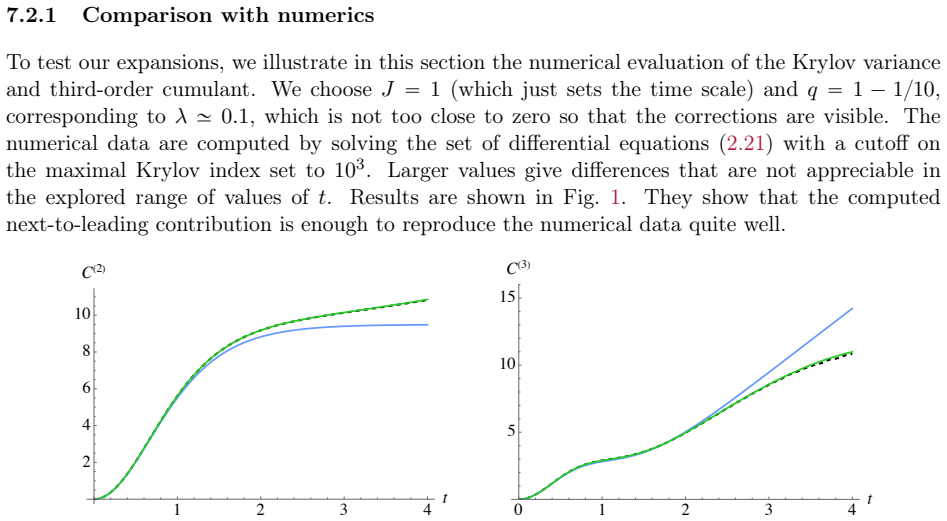
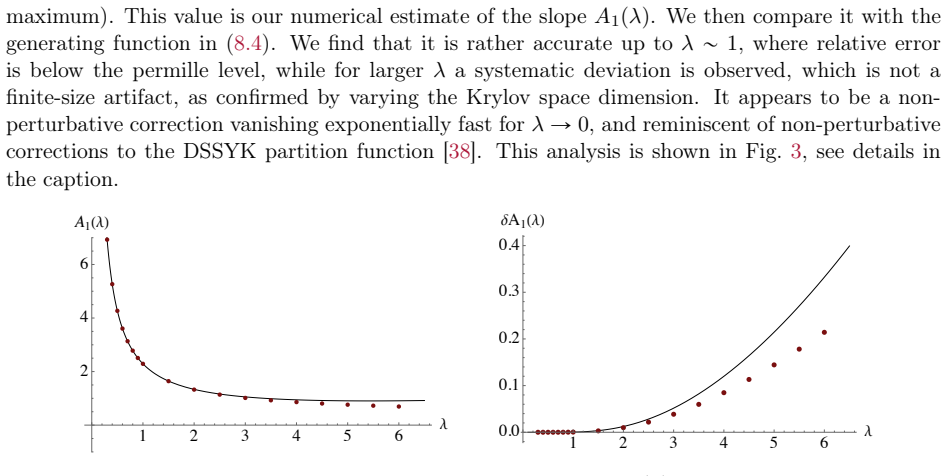
In the infinite temperature limit, the five-loop semiclassical expansion of DSSYK complexity is obtained by singular perturbation of the operator Liouville-type equations of motion; the same method yields the connected two- and three-point functions of the length operator via variance and third cumulant; for the large-time slope of the wormhole linear growth the perturbative series admits an all-order resummation and leading non-perturbative corrections are determined.
What carries the argument
Singular perturbation of the operator Liouville-type equations of motion, which generates the higher-loop corrections to complexity and thus to wormhole length.
Load-bearing premise
The singular perturbation method applied to the operator Liouville-type equations of motion remains valid and controllable through five loops in the infinite temperature limit without uncontrolled higher-order effects.
What would settle it
A numerical or analytic computation of the six-loop term in the infinite-temperature DSSYK complexity that deviates from the pattern predicted by the five-loop result and the resummation would falsify the claim.
If this is right
- The wormhole length grows linearly at large times with a slope given by the resummed series.
- The connected two- and three-point functions of the length operator at coincident points are obtained from the variance and third cumulant.
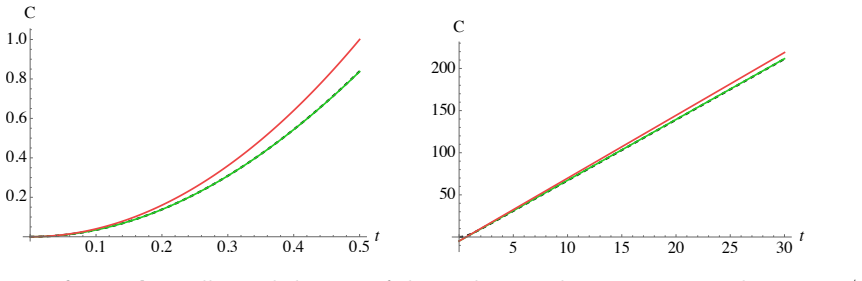
- Small-time and large-time asymptotics of complexity, variance, and cumulant follow from the same expansion.
- The method produces both perturbative coefficients and non-perturbative corrections to the slope.
Where Pith is reading between the lines
- The equality between wormhole length and complexity may allow gravity-side observables to be read off from SYK correlation functions at higher loops.
- The resummation technique could be tested by comparing against exact numerical diagonalization of finite-N SYK Hamiltonians in the double-scaled limit.
- If the pattern persists, the all-order slope might admit a closed-form expression in terms of known functions of the model parameters.
Editorial analysis
A structured set of objections, weighed in public.
Referee Report
Summary. The manuscript claims that the quantum wormhole length in sine-dilaton gravity equals the Krylov spread complexity in the double-scaled SYK model. In the infinite-temperature limit, it computes the five-loop semiclassical expansion of DSSYK complexity via singular perturbation of the operator Liouville-type equations of motion, extending prior one-loop results. It further evaluates the Krylov variance and third-order cumulant (related to connected correlators of the length operator), examines small- and large-time behaviors, and determines the all-order resummation of the perturbative series together with leading non-perturbative corrections for the large-time slope of the wormhole linear growth.
Significance. If the central equality and the five-loop computation hold, the work supplies a higher-order verification of the wormhole-complexity duality and introduces a controlled perturbative method that yields an all-order resummation for the slope. This strengthens the link between sine-dilaton gravity and DSSYK observables and could inform non-perturbative analyses in related models.
major comments (1)
- [singular perturbation analysis (five-loop computation)] The validity of the singular perturbation method applied to the operator Liouville-type equations of motion through five loops is load-bearing for the five-loop coefficients, the variance/cumulant results, and the claimed all-order resummation. The manuscript provides no explicit remainder bounds, a-priori error estimates, or cross-checks against an independent computation that would confirm higher-order operator corrections remain negligible up to O(ħ^5).
Simulated Author's Rebuttal
We thank the referee for their careful reading of the manuscript and for highlighting the importance of justifying the singular perturbation analysis. We address the major comment below.
read point-by-point responses
-
Referee: [singular perturbation analysis (five-loop computation)] The validity of the singular perturbation method applied to the operator Liouville-type equations of motion through five loops is load-bearing for the five-loop coefficients, the variance/cumulant results, and the claimed all-order resummation. The manuscript provides no explicit remainder bounds, a-priori error estimates, or cross-checks against an independent computation that would confirm higher-order operator corrections remain negligible up to O(ħ^5).
Authors: We agree that the absence of explicit remainder bounds or a priori error estimates constitutes a gap in the current presentation. The singular perturbation proceeds by recursively solving the operator Liouville equations order by order in ħ, with each correction determined by the lower-order solution; the five-loop coefficients are obtained directly from this recursion. In the revised manuscript we will add a dedicated subsection that (i) recalls the recursive structure and shows that the operator corrections at each order are suppressed by additional powers of the small parameter ħ, (ii) provides a heuristic bound on the remainder based on the growth of the perturbative coefficients observed through five loops, and (iii) demonstrates consistency with the known one-loop result and with the exact large-time slope obtained from the all-order resummation. An independent non-perturbative cross-check lies outside the perturbative framework of the present work; the internal consistency of the resummation, however, supplies a non-trivial check on the higher-order terms. revision: partial
Circularity Check
Central equality referenced from prior work; five-loop perturbative computation provides independent content
full rationale
The paper states that the quantum wormhole length equals the Krylov spread complexity as previously shown, then performs a new five-loop semiclassical expansion via singular perturbation of the operator Liouville-type equations of motion, extending one-loop results. This includes evaluation of variance, cumulants, small/large-time behavior, all-order resummation of the perturbative series for the large-time slope, and leading non-perturbative corrections. No load-bearing step reduces by construction to fitted inputs, self-definitions, or unverified self-citations; the perturbative extensions constitute independent computational content against the referenced identification.
Axiom & Free-Parameter Ledger
read the original abstract
The quantum wormhole length in sine-dilaton gravity has been shown to equal the Krylov spread complexity in the double-scaled SYK model. In the infinite temperature limit, we compute the five-loop semiclassical expansion of DSSYK complexity by singular perturbation of the operator Liouville-type equations of motion, extending the existing one-loop results. The same method is applied to evaluate the Krylov variance and third-order cumulant, related to the connected two- and three-point functions of the length operator at coincident points. The small- and large-time behaviour of these observables is also studied. In particular, for the large-time slope of the wormhole linear growth, we determine the all-order resummation of the perturbative series, and the leading non-perturbative corrections.
Figures
Forward citations
Cited by 2 Pith papers
-
Quantum JT Gravity in a box as a P\"oschl-Teller Scattering Problem
JT gravity in a box is quantized exactly by recasting its dynamics as Pöschl-Teller scattering, producing closed-form wavefunctions and correlators with finite-cutoff corrections beyond T Tbar.
-
Comments on holographic spread complexity
The momentum–spread-complexity relation requires generalized coherent states adapted to the spacetime symmetry algebra; semiclassical spreading alone cannot produce a momentum–complexity correspondence.
Reference graph
Works this paper leans on
-
[1]
Gapless Spin-Fluid Ground State in a Random Quantum Heisenberg Magnet
S. Sachdev and J. Ye,Gapless Spin Fluid Ground State in a Random, Quantum Heisenberg Magnet,Phys. Rev. Lett.70(1993) 3339 [cond-mat/9212030]
work page internal anchor Pith review Pith/arXiv arXiv 1993
-
[2]
Holographic metals and the fractionalized Fermi liquid
S. Sachdev,Holographic Metals and the Fractionalized Fermi Liquid,Phys. Rev. Lett.105 (2010) 151602 [1006.3794]
work page internal anchor Pith review Pith/arXiv arXiv 2010
-
[3]
Comments on the Sachdev-Ye-Kitaev model
J. Maldacena and D. Stanford,Remarks on the Sachdev-Ye-Kitaev Model,Phys. Rev. D94 (2016) 106002 [1604.07818]
work page internal anchor Pith review Pith/arXiv arXiv 2016
-
[4]
J. S. Cotler, G. Gur-Ari, M. Hanada, J. Polchinski, P. Saad, S. H. Shenker et al.,Black Holes and Random Matrices,JHEP05(2017) 118 [1611.04650]
work page internal anchor Pith review Pith/arXiv arXiv 2017
-
[5]
J. Maldacena, S. H. Shenker and D. Stanford,A Bound on Chaos,JHEP08(2016) 106 [1503.01409]
work page internal anchor Pith review Pith/arXiv arXiv 2016
-
[6]
Conformal symmetry and its breaking in two dimensional Nearly Anti-de-Sitter space
J. Maldacena, D. Stanford and Z. Yang,Conformal Symmetry and Its Breaking in Two Dimensional Nearly Anti-De-Sitter Space,PTEP2016(2016) 12C104 [1606.01857]. K. Jensen,Chaos in AdS2 Holography,Phys. Rev. Lett.117(2016) 111601 [1605.06098]. G. Sárosi,AdS 2 holography and the SYK model,PoSModave2017(2018) 001 [1711.08482]
work page internal anchor Pith review Pith/arXiv arXiv 2016
-
[7]
Towards a full solution of the large N double-scaled SYK model
M. Berkooz, M. Isachenkov, V. Narovlansky and G. Torrents,Towards a Full Solution of the LargeNDouble-Scaled Syk Model,JHEP03(2019) 079 [1811.02584]
work page internal anchor Pith review Pith/arXiv arXiv 2019
-
[8]
T. G. Mertens, G. J. Turiaci and H. L. Verlinde,Solving the Schwarzian via the Conformal Bootstrap,JHEP08(2017) 136 [1705.08408]
work page internal anchor Pith review Pith/arXiv arXiv 2017
-
[9]
An Investigation of AdS$_2$ Backreaction and Holography
J. Engelsöy, T. G. Mertens and H. Verlinde,An investigation of AdS2 backreaction and holography,JHEP07(2016) 139 [1606.03438]. T. G. Mertens and G. J. Turiaci,Solvable models of quantum black holes: a review on Jackiw–Teitelboim gravity,Living Rev. Rel.26(2023) 4 [2210.10846]
work page internal anchor Pith review Pith/arXiv arXiv 2016
-
[10]
Chord diagrams, exact correlators in spin glasses and black hole bulk reconstruction
M. Berkooz, P. Narayan and J. Simon,Chord Diagrams, Exact Correlators in Spin Glasses and Black Hole Bulk Reconstruction,JHEP08(2018) 192 [1806.04380]
work page internal anchor Pith review Pith/arXiv arXiv 2018
-
[11]
A Cordial Introduction to Double Scaled SYK,
M. Berkooz and O. Mamroud,A Cordial Introduction to Double Scaled Syk,Rept. Prog. Phys. 88(2025) 036001 [2407.09396]
-
[12]
Yang,The Quantum Gravity Dynamics of Near Extremal Black Holes,JHEP05(2019) 205 [1809.08647]
Z. Yang,The Quantum Gravity Dynamics of Near Extremal Black Holes,JHEP05(2019) 205 [1809.08647]. T. G. Mertens,The Schwarzian theory — origins,JHEP05(2018) 036 [1801.09605]. A. Blommaert, T. G. Mertens and H. Verschelde,The Schwarzian Theory - a Wilson Line Perspective,JHEP12(2018) 022 [1806.07765]. L. V. Iliesiu, S. S. Pufu, H. Verlinde and Y. Wang,An Ex...
-
[13]
Dynamical actions and q-representation theory for double-scaled SYK,
A. Blommaert, T. G. Mertens and S. Yao,Dynamical Actions and Q-Representation Theory for Double-Scaled Syk,JHEP02(2024) 067 [2306.00941]. 33
-
[14]
The dilaton gravity hologram of double-scaled SYK,
A. Blommaert, T. G. Mertens and J. Papalini,The Dilaton Gravity Hologram of Double-Scaled Syk,JHEP06(2025) 050 [2404.03535]
-
[15]
An entropic puzzle in periodic dilaton gravity and DSSYK,
A. Blommaert, A. Levine, T. G. Mertens, J. Papalini and K. Parmentier,An Entropic Puzzle in Periodic Dilaton Gravity and Dssyk,JHEP07(2025) 093 [2411.16922]
- [16]
-
[17]
Addendum to Computational Complexity and Black Hole Horizons
L. Susskind,Computational Complexity and Black Hole Horizons,Fortsch. Phys.64(2016) 24 [1403.5695]. D. Stanford and L. Susskind,Complexity and Shock Wave Geometries,Phys. Rev. D90 (2014) 126007 [1406.2678]. A. R. Brown, D. A. Roberts, L. Susskind, B. Swingle and Y. Zhao,Complexity, Action, and Black Holes,Phys. Rev. D93(2016) 086006 [1512.04993]. A. Belin...
work page internal anchor Pith review Pith/arXiv arXiv 2016
-
[18]
A bulk manifestation of Krylov complexity
E. Rabinovici, A. Sánchez-Garrido, R. Shir and J. Sonner,A bulk manifestation of Krylov complexity,JHEP08(2023) 213 [2305.04355]
-
[19]
Xu,On Chord Dynamics and Complexity Growth in Double-Scaled SYK,JHEP06(2025) 259 [2411.04251]
J. Xu,On Chord Dynamics and Complexity Growth in Double-Scaled SYK,JHEP06(2025) 259 [2411.04251]
-
[20]
M. Ambrosini, E. Rabinovici, A. Sánchez-Garrido, R. Shir and J. Sonner,Operator K-complexity in DSSYK: Krylov complexity equals bulk length,JHEP08(2025) 059 [2412.15318]
-
[21]
Quantum Dynamics in Krylov Space: Methods and Applications
P. Nandy, A. S. Matsoukas-Roubeas, P. Martínez-Azcona, A. Dymarsky and A. del Campo, Quantum dynamics in Krylov space: Methods and applications,Phys. Rept.1125-1128 (2025) 1 [2405.09628]. S. Baiguera, V. Balasubramanian, P. Caputa, S. Chapman, J. Haferkamp, M. P. Heller et al., Quantum Complexity in Gravity, Quantum Field Theory, and Quantum Information S...
work page internal anchor Pith review Pith/arXiv arXiv 2025
-
[22]
J. M. Maldacena,Eternal Black Holes in Anti-de Sitter,JHEP04(2003) 021 [hep-th/0106112]
work page internal anchor Pith review Pith/arXiv arXiv 2003
-
[23]
S. E. Aguilar-Gutierrez,Deforming the Double-Scaled SYK & Reaching the Stretched Horizon From Finite Cutoff Holography,2602.06113. S. E. Aguilar-Gutierrez, T. Kukolj and J. Seitz,Q-Askey Deformations of Double-Scaled Syk, 2605.13956
work page internal anchor Pith review Pith/arXiv arXiv
-
[24]
The Factorization Problem in Jackiw-Teitelboim Gravity,
D. Harlow and D. Jafferis,The Factorization Problem in Jackiw-Teitelboim Gravity,JHEP 02(2020) 177 [1804.01081]. D. Harlow and J.-q. Wu,Algebra of Diffeomorphism-Invariant Observables in Jackiw-Teitelboim Gravity,JHEP05(2022) 097 [2108.04841]. 34 A. R. Brown, H. Gharibyan, H. W. Lin, L. Susskind, L. Thorlacius and Y. Zhao,Complexity of Jackiw-Teitelboim g...
- [25]
- [26]
- [27]
- [28]
- [29]
-
[30]
K. Okuyama and K. Suzuki,Correlators of Double Scaled Syk at One-Loop,JHEP05(2023) 117 [2303.07552]
- [31]
-
[32]
L. Griguolo, J. Papalini, L. Russo and D. Seminara,A New Perspective on Dilaton Gravity at Finite Cutoff,2512.21774
-
[33]
B. Bhattacharjee, X. Cao, P. Nandy and T. Pathak,Operator Growth in Open Quantum Systems: Lessons from the Dissipative SYK,JHEP03(2023) 054 [2212.06180]. Y. Fu, K.-Y. Kim, K. Pal and K. Pal,Statistics and Complexity of Wavefunction Spreading in Quantum Dynamical Systems,JHEP06(2025) 139 [2411.09390]. H. A. Camargo, Y. Fu, V. Jahnke, K.-Y. Kim and K. Pal,H...
-
[34]
Krylov complexity in large q and double-scaled SYK model,
B. Bhattacharjee, P. Nandy and T. Pathak,Krylov Complexity in Large Q and Double-Scaled SYK Model,JHEP08(2023) 099 [2210.02474]. Y. Fu, H.-S. Jeong, K.-Y. Kim and J. F. Pedraza,Toward Krylov-Based Holography in Double-Scaled Syk,JHEP05(2026) 056 [2510.22658]. A. Grabarits and A. del Campo,Universal Growth of Krylov Complexity Across a Quantum Phase Transi...
-
[35]
P. Nandy,Tridiagonal Hamiltonians Modeling the Density of States of the Double-Scaled Syk Model,JHEP01(2025) 072 [2410.07847]. V. Balasubramanian, J. M. Magan, P. Nandi and Q. Wu,Spread Complexity and the Saturation of Wormhole Size,Phys. Rev. D113(2026) 046004 [2412.02038]. 35
-
[36]
Phase Transition in the Density of States of Quantum Spin Glasses
L. Erdős and D. Schröder,Phase Transition in the Density of States of Quantum Spin Glasses,Math. Phys. Anal. Geom.17(2014) 441 [1407.1552]
work page internal anchor Pith review Pith/arXiv arXiv 2014
-
[37]
D. E. Parker, X. Cao, A. Avdoshkin, T. Scaffidi and E. Altman,A Universal Operator Growth Hypothesis,Phys. Rev. X9(2019) 041017 [1812.08657]
work page Pith review arXiv 2019
-
[38]
W. Mück,Krylov complexity has it all,2605.28681
work page internal anchor Pith review Pith/arXiv arXiv
-
[39]
K. Okuyama,Non-Perturbative Corrections in the Semi-Classical Limit of Double-Scaled Syk, JHEP06(2025) 044 [2501.15501]
- [40]
-
[41]
Krylov complexity and orthogonal polynomials
W. Mück and Y. Yang,Krylov complexity and orthogonal polynomials,Nucl. Phys. B984 (2022) 115948 [2205.12815]. 36
work page Pith review arXiv 2022
discussion (0)
Sign in with ORCID, Apple, or X to comment. Anyone can read and Pith papers without signing in.