Proposal of quantum arrival-time measurement with a Bose-Einstein condensate
Pith reviewed 2026-06-26 16:43 UTC · model grok-4.3
The pith
A Bose-Einstein condensate setup measures arrival flux versus detector position to distinguish competing quantum arrival-time predictions.
A machine-rendered reading of the paper's core claim, the machinery that carries it, and where it could break.
Core claim
The proposed experimental setup using a Bose-Einstein condensate yields signals in the form of arrival flux as a function of detector position that allow unambiguous distinction between different theoretical predictions for quantum arrival times, while also solving practical problems associated with detector proximity to the system.
What carries the argument
Arrival flux recorded as a function of detector position, which replaces direct time measurement and produces distinguishable signals for competing models.
If this is right
- Different quantum arrival-time theories produce measurably different flux-versus-position curves.
- The method circumvents the need to place a detector close to or inside the quantum system.
- The setup provides a realistic route to experimental resolution of the arrival-time debate.
- Signals from the condensate can be used to test and compare specific theoretical predictions.
Where Pith is reading between the lines
- The same flux-position technique might be adapted to other cold-atom or trapped-particle systems to test arrival-time models.
- Successful distinction of signals would constrain which interpretations of quantum time are compatible with experiment.
- The approach could be extended by varying condensate density or interaction strength to probe sensitivity to system parameters.
Load-bearing premise
The arrival flux measured as a function of detector position will produce signals that unambiguously distinguish the predictions without the measurement process itself introducing ambiguities or requiring additional unstated modeling assumptions.
What would settle it
An experiment in which the computed or observed flux curves for different arrival-time theories are indistinguishable or overlap across the range of detector positions tested.
Figures

read the original abstract
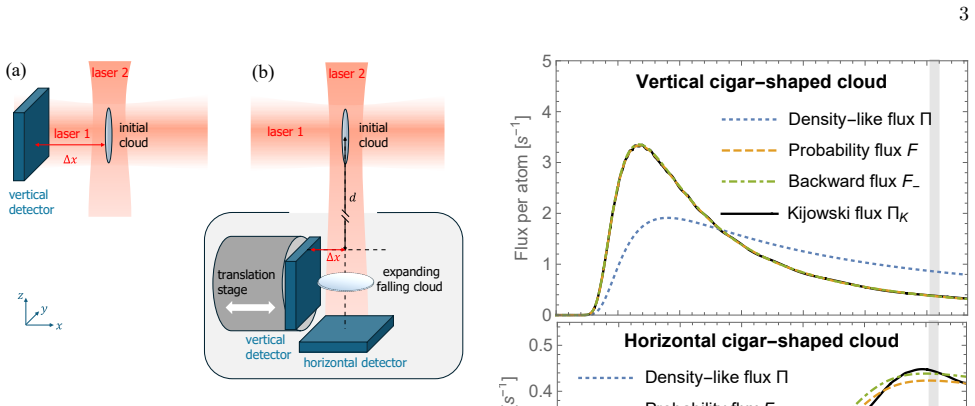
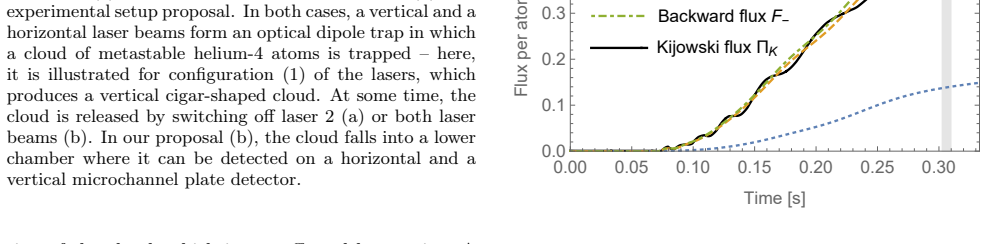
This work shows how a Bose-Einstein condensate of ultracold atoms could be used to address a long-standing question in quantum theory: how much time does it take for a particle to reach a detector? To this end, we propose a realistic experimental setup, whose key idea is not to measure arrival times directly, but the arrival flux on the detector as a function of its position. This novel approach not only solves practical issues with having a detector close to the system, but also results in signals that allow to unambiguously distinguish different theoretical predictions. This proposal raises prospects for resolving the decades-old debate on this fundamental issue.
Editorial analysis
A structured set of objections, weighed in public.
Referee Report
Summary. The manuscript proposes a Bose-Einstein condensate (BEC) based detector geometry to measure particle arrival flux J(x) as a function of detector position x, rather than direct arrival times, in order to produce signals that can unambiguously distinguish competing theoretical predictions (such as different POVMs for arrival time) while avoiding direct contact with the system.
Significance. If the central claim holds, the proposal would offer a concrete experimental route to test long-standing questions in quantum arrival-time theory using ultracold atoms, with the non-contact BEC approach providing a practical advantage over conventional detectors.
major comments (1)
- [Abstract] Abstract and proposal description: the claim that the measured arrival flux versus detector position 'results in signals that allow to unambiguously distinguish different theoretical predictions' is load-bearing for the entire proposal, yet the manuscript provides no explicit computation or modeling of J(x) under competing arrival-time operators (e.g., Kijowski versus other POVMs), nor any estimate of how finite-temperature effects, BEC interactions, or detector response would affect curve separation.
Simulated Author's Rebuttal
We thank the referee for the careful reading and the positive assessment of the proposal's potential significance. We address the single major comment below and will revise the manuscript to incorporate additional modeling as suggested.
read point-by-point responses
-
Referee: [Abstract] Abstract and proposal description: the claim that the measured arrival flux versus detector position 'results in signals that allow to unambiguously distinguish different theoretical predictions' is load-bearing for the entire proposal, yet the manuscript provides no explicit computation or modeling of J(x) under competing arrival-time operators (e.g., Kijowski versus other POVMs), nor any estimate of how finite-temperature effects, BEC interactions, or detector response would affect curve separation.
Authors: We agree that the current manuscript presents a conceptual proposal and does not contain explicit computations or numerical modeling of the position-dependent arrival flux J(x) for different arrival-time POVMs, nor quantitative estimates of the listed experimental imperfections. The claim of unambiguous distinction rests on the theoretical expectation that distinct time-of-arrival operators produce measurably different flux profiles when the detector position is varied, but this remains at the level of a qualitative argument. In the revised manuscript we will add a new section containing (i) a simplified one-dimensional calculation of J(x) for a Gaussian wave packet under the Kijowski POVM versus a reference operator (e.g., a naive time operator or the Aharonov-Bohm operator), demonstrating qualitative differences in the shape and peak location of J(x); (ii) order-of-magnitude estimates showing that, at the nK temperatures typical of BECs, thermal broadening remains smaller than the separation between the predicted curves; (iii) a discussion of mean-field interaction effects and how they can be suppressed by working at low density; and (iv) a brief treatment of finite detector efficiency and spatial resolution. These additions will make the central claim quantitative while preserving the non-contact advantage of the BEC detector geometry. revision: yes
Circularity Check
No circularity: proposal asserts experimental distinguishability without any derivation or fitted quantities
full rationale
The manuscript is an experimental proposal whose central assertion is that a BEC-based detector geometry will produce arrival-flux signals capable of distinguishing competing arrival-time distributions. No equations, ansatzes, fitted parameters, or self-citations appear in the provided text that could reduce a claimed prediction to its own inputs by construction. The distinguishability claim is presented as a modeling expectation rather than a derived result; therefore no load-bearing step satisfies any of the enumerated circularity patterns. This is the expected outcome for a pure proposal paper that does not attempt to derive or fit any observable from prior results of the same authors.
Axiom & Free-Parameter Ledger
Forward citations
Cited by 1 Pith paper
-
A universal time-of-arrival signature of Bose--Einstein condensation
Bose-Einstein condensation produces a universal cusp in the time-of-arrival statistics of a released trapped gas whose one-sided slope ratio equals the specific-heat ratio at the transition temperature.
Reference graph
Works this paper leans on
-
[1]
C. J. Pethick and H. Smith,Bose–Einstein Condensa- tion in Dilute Gases, 2nd ed. (Cambridge University Press, 2008)
2008
-
[2]
Castin,Condensats de Bose-Einstein(EDP Sci- ences, 2025)
Y. Castin,Condensats de Bose-Einstein(EDP Sci- ences, 2025)
2025
-
[3]
M. R. Andrews, C. G. Townsend, H.-J. Miesner, D. S. Durfee, D. M. Kurn, and W. Ketterle, Science275, 637 (1997)
1997
-
[4]
Muga and C
J. Muga and C. Leavens, Physics Reports338, 353 (2000)
2000
-
[5]
Pauli, inPrinciples of Quantum Theory I, En- cyclopedia of Physics, Vol
W. Pauli, inPrinciples of Quantum Theory I, En- cyclopedia of Physics, Vol. 5/1, edited by S. Flügge (Springer, 1958) p. 60
1958
-
[6]
Aharonov and D
Y. Aharonov and D. Bohm, Phys. Rev.122, 1649 (1961)
1961
-
[7]
Paul, Annalen der Physik464, 252 (1962)
H. Paul, Annalen der Physik464, 252 (1962)
1962
-
[8]
Allcock, Annals of Physics53, 253 (1969)
G. Allcock, Annals of Physics53, 253 (1969)
1969
-
[9]
Allcock, Annals of Physics53, 286 (1969)
G. Allcock, Annals of Physics53, 286 (1969)
1969
-
[10]
Allcock, Annals of Physics53, 311 (1969)
G. Allcock, Annals of Physics53, 311 (1969)
1969
-
[11]
Kijowski, Reports on Mathematical Physics6, 361 (1974)
J. Kijowski, Reports on Mathematical Physics6, 361 (1974)
1974
-
[12]
Werner, Annales de l’I.H.P
R. Werner, Annales de l’I.H.P. Physique théorique47, 5 429 (1987)
1987
-
[13]
N. Grot, C. Rovelli, and R. S. Tate, Phys. Rev. A54, 4676 (1996)
1996
-
[14]
Delgado and J
V. Delgado and J. G. Muga, Phys. Rev. A56, 3425 (1997)
1997
-
[15]
Aharonov, J
Y. Aharonov, J. Oppenheim, S. Popescu, B. Reznik, and W. G. Unruh, Phys. Rev. A57, 4130 (1998)
1998
-
[16]
C. R. Leavens, Phys. Rev. A58, 840 (1998)
1998
-
[17]
J. Muga, J. Palao, and C. Leavens, Physics Letters A 253, 21 (1999)
1999
-
[18]
K.-I. Aoki, A. Horikoshi, and E. Nakamura, Phys. Rev. A62, 022101 (2000)
2000
-
[19]
A. D. Baute, R. S. Mayato, J. P. Palao, J. G. Muga, and I. L. Egusquiza, Phys. Rev. A61, 022118 (2000)
2000
-
[20]
J. J. Włodarz, Phys. Rev. A65, 044103 (2002)
2002
-
[21]
E. A. Galapon, F. Delgado, J. G. Muga, and I. n. Egusquiza, Phys. Rev. A72, 042107 (2005)
2005
-
[22]
Anastopoulos and N
C. Anastopoulos and N. Savvidou, Journal of Mathe- matical Physics47, 122106 (2006)
2006
-
[23]
H.NittaandT.Kudo,Phys.Rev.A77,014102(2008)
2008
-
[24]
Anastopoulos and N
C. Anastopoulos and N. Savvidou, Phys. Rev. A86, 012111 (2012)
2012
-
[25]
Giovannetti, S
V. Giovannetti, S. Lloyd, and L. Maccone, Phys. Rev. D92, 045033 (2015)
2015
-
[26]
Maccone and K
L. Maccone and K. Sacha, Phys. Rev. Lett.124, 110402 (2020)
2020
-
[27]
Tumulka, Annals of Physics442, 168910 (2022)
R. Tumulka, Annals of Physics442, 168910 (2022)
2022
-
[28]
Jurić and H
T. Jurić and H. Nikolić, Eur. Phys. J. Plus137, 631 (2022)
2022
-
[29]
Ayatollah Rafsanjani, M
A. Ayatollah Rafsanjani, M. Kazemi, A. Bahram- pour, and M. Golshani, Communications Physics6, 195 (2023)
2023
-
[30]
S. Roncallo, K. Sacha, and L. Maccone, Quantum7, 968 (2023), arXiv:2205.02219v4
-
[31]
Anastopoulos and M.-E
C. Anastopoulos and M.-E. Plakitsi, Foundations3, 724 (2023)
2023
-
[32]
A. S. Tahvildar-Zadeh and S. Zhou, Detection time of dirac particles in one space dimension, inPhysics and the Nature of Reality: Essays in Memory of Detlef Dürr, edited by A. Bassi, S. Goldstein, R. Tu- mulka, and N. Zanghì (Springer International Publish- ing, Cham, 2024) pp. 187–201
2024
-
[33]
R. E. Araújo, R. Ximenes, and E. O. Dias, Phys. Rev. A109, 012221 (2024)
2024
-
[34]
Naidon, Phys
P. Naidon, Phys. Rev. A109, 063312 (2024)
2024
-
[35]
M. Beau, M. Barbier, R. Martellini, and L. Martellini, Phys. Rev. A110, 052217 (2024)
2024
-
[36]
M. Beau, T. Szczepanski, R. Martellini, and L. Martellini, Journal of Physics: Conference Series 3017, 012022 (2025)
2025
-
[37]
Reddiger, Philosophical Magazine , 1 (2026), 2508.11368
M. Reddiger, Philosophical Magazine , 1 (2026), 2508.11368
-
[38]
Kijowski, Phys
J. Kijowski, Phys. Rev. A59, 897 (1999)
1999
-
[39]
Leavens, Physics Letters A303, 154 (2002)
C. Leavens, Physics Letters A303, 154 (2002)
2002
-
[40]
Egusquiza, J
I. Egusquiza, J. Muga, B. Navarro, and A. Ruschhaupt, Physics Letters A313, 498 (2003)
2003
-
[41]
Leavens, Physics Letters A345, 251 (2005)
C. Leavens, Physics Letters A345, 251 (2005)
2005
-
[42]
Das and D
S. Das and D. Dürr, Sci Rep9, 2242 (2019)
2019
-
[43]
Das and W
S. Das and W. Struyve, Phys. Rev. A104, 042214 (2021)
2021
-
[44]
Goldstein, R
S. Goldstein, R. Tumulka, and N. Zanghì, Sci Rep14, 3775 (2024)
2024
- [45]
-
[46]
Goldstein, R
S. Goldstein, R. Tumulka, and N. Zanghì, Found Phys 54, 63 (2024)
2024
-
[47]
W. Cavendish, S. Das, M. Nöth, and A. A. Raf- sanjani, arXiv preprint quant-ph/2409.00161 (2024), arXiv:2409.00161 [quant-ph]
- [48]
-
[49]
Robert, O
A. Robert, O. Sirjean, A. Browaeys, J. Poupard, S. Nowak, D. Boiron, C. I. Westbrook, and A. Aspect, Science292, 461 (2001)
2001
-
[50]
Narevicius, A
E. Narevicius, A. Libson, C. G. Parthey, I. Chavez, J. Narevicius, U. Even, and M. G. Raizen, Phys. Rev. Lett.100, 093003 (2008)
2008
-
[51]
R. Dall, S. Hodgman, A. Manning, M. Johnsson, K. Baldwin, and A. Truscott, Nat Commun2, 291 (2011)
2011
-
[52]
R. G. Dall, A. G. Manning, S. S. Hodgman, W. RuG- way, K. V. Kheruntsyan, and A. G. Truscott, Nature Physics9, 341 (2013)
2013
-
[53]
Stopp, L
F. Stopp, L. Ortiz-Gutiérrez, H. Lehec, and F. Schmidt-Kaler, New Journal of Physics23, 063002 (2021)
2021
-
[54]
J. G. Muga, A. D. Baute, J. A. Damborenea, and I. L. Egusquiza, arXiv preprint quant-ph/0009111 (2000), arXiv:quant-ph/0009111 [quant-ph]
work page internal anchor Pith review Pith/arXiv arXiv 2000
-
[55]
D. N. Page and W. K. Wootters, Phys. Rev. D27, 2885 (1983)
1983
-
[56]
Aharonov and T
Y. Aharonov and T. Kaufherr, Phys. Rev. D30, 368 (1984)
1984
-
[57]
Madelung, Zeitschrift für Physik40, 322 (1927)
E. Madelung, Zeitschrift für Physik40, 322 (1927)
1927
-
[58]
W. R. McKinnon and C. R. Leavens, Phys. Rev. A51, 2748 (1995)
1995
-
[59]
Bohm, Phys
D. Bohm, Phys. Rev.85, 166 (1952)
1952
-
[60]
Bohm, Phys
D. Bohm, Phys. Rev.85, 180 (1952)
1952
-
[61]
Fényes, Zeitschrift für Physik132, 81 (1952), [A probabilistic foundation and interpretation of quan- tum mechanics]
I. Fényes, Zeitschrift für Physik132, 81 (1952), [A probabilistic foundation and interpretation of quan- tum mechanics]
1952
-
[62]
Nelson, Phys
E. Nelson, Phys. Rev.150, 1079 (1966)
1966
-
[63]
Nelson,Quantum fluctuations, Vol
E. Nelson,Quantum fluctuations, Vol. 108 (Princeton University Press, 1985)
1985
-
[64]
Werner, Journal of Mathematical Physics27, 793 (1986)
R. Werner, Journal of Mathematical Physics27, 793 (1986)
1986
-
[65]
J. A. Damborenea, I. L. Egusquiza, G. C. Hegerfeldt, and J. G. Muga, Phys. Rev. A66, 052104 (2002)
2002
-
[66]
Navarro, I
B. Navarro, I. L. Egusquiza, J. G. Muga, and G. C. Hegerfeldt, Journal of Physics B: Atomic, Molecular and Optical Physics36, 3899 (2003)
2003
-
[67]
Tumulka, Physics Letters A494, 129286 (2024)
R. Tumulka, Physics Letters A494, 129286 (2024)
2024
-
[68]
E. P. Gross, Nuovo Cimento20, 454 (1961)
1961
-
[69]
L. P. Pitaevskii, Zh. Eksp. Teor. Fiz.40, 646 (1961), [Sov. Phys.–JETP 13,451 (1961)]
1961
-
[70]
Naidon, L
P. Naidon, L. Happ, and D. Boiron, unpublished (2025)
2025
-
[71]
Ott, Reports on Progress in Physics79, 054401 (2016)
H. Ott, Reports on Progress in Physics79, 054401 (2016)
2016
-
[72]
Vassen, C
W. Vassen, C. Cohen-Tannoudji, M. Leduc, D. Boiron, C. I. Westbrook, A. Truscott, K. Baldwin, G. Birkl, P. Cancio, and M. Trippenbach, Rev. Mod. Phys.84, 175 (2012)
2012
-
[73]
R. Buecker, A. Perrin, S. Manz, T. Betz, C. Koller, T. Plisson, J. Rottmann, T. Schumm, and J. Schmiedmayer, NEW JOURNAL OF PHYSICS11, 10.1088/1367-2630/11/10/103039 (2009)
-
[74]
These oscillations are discussed in the companion study [70]
-
[75]
Bouton, R
Q. Bouton, R. Chang, A. L. Hoendervanger, F. No- grette, A. Aspect, C. I. Westbrook, and D. Clément, Phys. Rev. A91, 061402 (2015)
2015
-
[76]
PROPOSAL OF QUANTUM ARRIVAL-TIME MEASUREMENT WITH A BOSE-EINSTEIN CONDENSATE
See Supplemental Material. 6 SUPPLEMENTAL MATERIAL: “PROPOSAL OF QUANTUM ARRIVAL-TIME MEASUREMENT WITH A BOSE-EINSTEIN CONDENSATE” Pascal Naidon and Lucas Happ Few-Body Systems Physics Laboratory, RIKEN Nishina Centre, RIKEN, Wak¯ o, 351-0198 Japan Denis Boiron Université Paris-Saclay, Institut d’Optique Graduate School, CNRS, Laboratoire Charles Fabry, 9...
discussion (0)
Sign in with ORCID, Apple, or X to comment. Anyone can read and Pith papers without signing in.