A universal time-of-arrival signature of Bose--Einstein condensation
Pith reviewed 2026-07-02 18:35 UTC · model grok-4.3
The pith
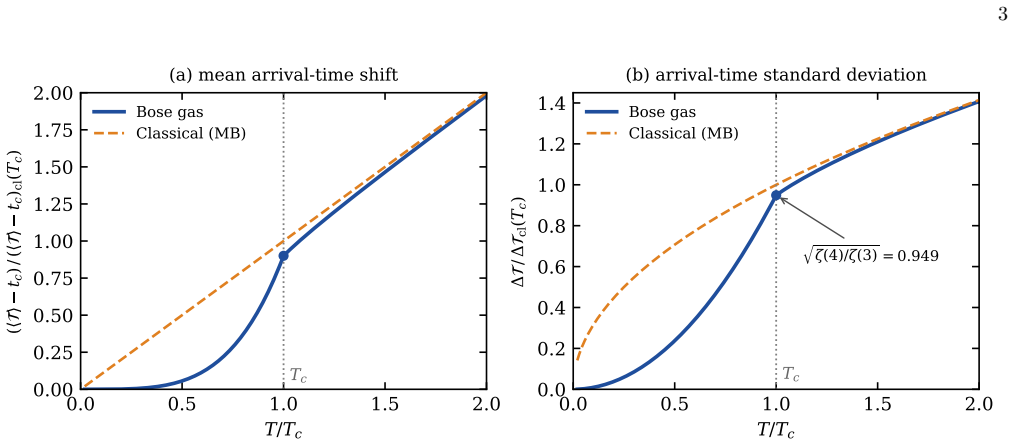
Bose-Einstein condensation produces a cusp in the time-of-arrival statistics of atoms released from a harmonic trap, with a universal one-sided slope ratio of 2.5556 that matches the specific-heat ratio.
A machine-rendered reading of the paper's core claim, the machinery that carries it, and where it could break.
Core claim
Bose-Einstein condensation produces a cusp in the time-of-arrival (TOA) statistics of a harmonically trapped gas released into free fall. In the semiclassical long time-of-flight regime with ε=σ_V/√(2gH)≪1, both the mean and standard deviation of the arrival time distribution, which are governed by the longitudinal velocity variance, remain continuous, but acquire a cusp whose one-sided slope ratio is universal within the ideal-gas far-field limit, R_∞=2.5556…, and equals the trapped-gas specific-heat ratio C(Tc−)/C(Tc+).
What carries the argument
The cusp in the mean and standard deviation of arrival times, whose one-sided slope ratio equals the specific-heat ratio at the transition.
If this is right
- Mean and standard deviation of arrival times remain continuous across Tc but their derivatives exhibit a discontinuity whose magnitude ratio is fixed at R_∞.
- The signature is universal inside the ideal-gas far-field limit.
- Finite atom number rounds the cusp without eliminating it.
- Weak interactions shift the cusp location only weakly while preserving its shape.
Where Pith is reading between the lines
- The same velocity-variance mechanism may produce analogous cusps in other time-domain observables once the gas is released.
- Experiments could test the prediction by varying trap frequency and release height to confirm the ε≪1 regime.
- The link to specific heat suggests the cusp ratio could serve as an independent thermometer for the transition in time-of-flight data.
- Extension to interacting gases would require checking whether the ratio remains close to the ideal value at the densities used in current traps.
Load-bearing premise
The analysis assumes the semiclassical long time-of-flight regime with ε=σ_V/√(2gH)≪1 in the ideal-gas far-field limit where mean and standard deviation of arrival times are governed by longitudinal velocity variance.
What would settle it
An experiment that measures the slopes of mean or standard-deviation arrival time versus temperature on either side of Tc and obtains a ratio different from 2.5556… or finds the cusp absent would falsify the central claim.
Figures


read the original abstract
We show that Bose--Einstein condensation produces a cusp in the time-of-arrival (TOA) statistics of a harmonically trapped gas released into free fall. In the semiclassical long time-of-flight regime, with $\epsilon=\sigma_V/\sqrt{2gH}\ll1$, both the mean and standard deviation of the arrival time distribution, which are governed by the longitudinal velocity variance, remain continuous, but acquire a cusp whose one-sided slope ratio is universal within the ideal-gas far-field limit, $\mathcal{R}_\infty=2.5556\ldots$, and equals the trapped-gas specific-heat ratio $C(Tc^-)/C(Tc^+)$. Finite atom number rounds the cusp and weak interactions perturb it only weakly, leaving a measurable time-domain signature of condensation.
Editorial analysis
A structured set of objections, weighed in public.
Referee Report
Summary. The manuscript shows that Bose-Einstein condensation in a harmonically trapped ideal Bose gas produces a cusp in the time-of-arrival (TOA) statistics when the gas is released into free fall. In the semiclassical long time-of-flight regime with ε=σ_V/√(2gH)≪1, both the mean and standard deviation of the arrival-time distribution (governed by longitudinal velocity variance) remain continuous across T_c but acquire a cusp whose one-sided slope ratio is universal in the ideal-gas far-field limit, R_∞=2.5556…, and equals the trapped-gas specific-heat ratio C(T_c^-)/C(T_c^+). Finite-N effects round the cusp while weak interactions perturb it only weakly.
Significance. If the central derivation holds, the work supplies a new, directly measurable time-domain signature of condensation whose slope ratio is fixed by standard thermodynamic quantities (via the virial theorem relating <v_z²> to E(T)/N and the long-TOF expansion). The result is parameter-free within the stated ideal-gas far-field limit, robust to the listed perturbations, and falsifiable by TOF experiments; these features strengthen its potential impact.
minor comments (2)
- The numerical value R_∞=2.5556… is given without an accompanying exact closed-form expression or explicit reference to the specific-heat ratio derivation; adding this would improve traceability.
- Figure captions and axis labels should explicitly state the value of ε used and confirm the far-field limit to allow direct comparison with the analytic R_∞.
Simulated Author's Rebuttal
We thank the referee for their careful reading of the manuscript, their accurate summary of the central result, and their recommendation to accept.
Circularity Check
No significant circularity detected
full rationale
The derivation links TOA mean/variance to longitudinal velocity variance in the ε ≪ 1 far-field limit, then uses the virial theorem to relate <v_z²> to total energy E(T)/N for the harmonic trap. The cusp slope ratio R_∞ therefore equals C(Tc−)/C(Tc+) by direct differentiation, which is a standard thermodynamic identity for the ideal Bose gas rather than a self-referential fit or imported uniqueness theorem. No load-bearing step reduces to a self-citation, ansatz smuggling, or renaming of an input; the result is a calculable consequence of the stated semiclassical assumptions and is externally verifiable against known specific-heat jumps.
Axiom & Free-Parameter Ledger
axioms (2)
- domain assumption Semiclassical approximation valid in the long time-of-flight regime
- domain assumption Ideal-gas limit in the far field
Reference graph
Works this paper leans on
-
[1]
C. J. Pethick and H. Smith,Bose–Einstein Condensation in Dilute Gases, 2nd ed. (Cambridge University Press, 2008)
work page 2008
-
[2]
F. Dalfovo, S. Giorgini, L. P. Pitaevskii, and S. Stringari, Rev. Mod. Phys.71, 463 (1999)
work page 1999
-
[3]
J. V. Gomes, A. Perrin, M. Schellekens, D. Boiron, C. I. Westbrook, and M. Belsley, Phys. Rev. A74, 053607 (2006)
work page 2006
- [4]
-
[5]
P. Szriftgiser, D. Gu´ ery-Odelin, M. Arndt, and J. Dal- ibard, Phys. Rev. Lett.77, 4 (1996)
work page 1996
- [6]
- [7]
- [8]
- [9]
- [10]
-
[11]
G. R. Allcock, Ann. Phys.53, 253 (1969)
work page 1969
-
[12]
N. Grot, C. Rovelli, and R. S. Tate, Phys. Rev. A54, 4676 (1996)
work page 1996
-
[13]
J. G. Muga and C. R. Leavens, Phys. Rep.338, 353 (2000)
work page 2000
-
[14]
M. Beau, M. Barbier, R. Martellini, and L. Martellini, Phys. Rev. A110, 052217 (2024)
work page 2024
-
[15]
C. R. Leavens, Phys. Rev. A58, 840 (1998)
work page 1998
- [16]
- [17]
- [18]
- [19]
- [20]
-
[21]
M. Beau, T. Szczepanski, R. Martellini, and L. Martellini, J. Phys.: Conf. Ser.3017, 012022 (2025)
work page 2025
-
[22]
A. del Campo, G. Garc´ ıa-Calder´ on, and J. G. Muga, Phys. Rep.476, 1 (2009)
work page 2009
- [23]
-
[24]
H. M¨ untinga, H. Ahlers, M. Krutzik, A. Wenzlawski, S. Arnold, D. Becker, K. Bongs, H. Dittus, H. Duncker, N. Gaaloul, C. Gherasim, E. Giese, C. Grzeschik, T. W. H¨ ansch, O. Hellmig, W. Herr, S. Herrmann, E. Kajari, S. Kleinert, C. L¨ ammerzahl, W. Lewoczko-Adamczyk, J. Malcolm, N. Meyer, R. Nolte, A. Peters, M. Popp, J. Reichel, A. Roura, J. Rudolph, M...
work page 2013
-
[25]
D. C. Avelineet al., Nature582, 193 (2020)
work page 2020
-
[26]
Fryeet al., EPJ Quantum Technol.8, 1 (2021)
K. Fryeet al., EPJ Quantum Technol.8, 1 (2021)
work page 2021
- [27]
-
[28]
Arrival times of an atomic Bose-Einstein condensate
P. Naidon, L. Happ, and D. Boiron, Arrival times of an atomic bose-einstein condensate (2026), arXiv:2606.20281 [cond-mat.quant-gas]
work page internal anchor Pith review Pith/arXiv arXiv 2026
-
[29]
Proposal of quantum arrival-time measurement with a Bose-Einstein condensate
P. Naidon, L. Happ, and D. Boiron, Proposal of quan- tum arrival-time measurement with a bose-einstein con- densate (2026), arXiv:2606.20278 [quant-ph]
work page internal anchor Pith review Pith/arXiv arXiv 2026
-
[30]
See Supplemental Material for detailed derivations of the semiclassical reduction, the trapped-gas velocity vari- ance, the cusp ratio, its identification with the specific- heat ratio, and the finite-Nrounding
-
[31]
S. Giorgini, L. P. Pitaevskii, and S. Stringari, Phys. Rev. A54, R4633(R) (1996). APPENDIX This Supplemental Material derives the results quoted in the main text, in the following order: the far-field semiclas- sical moments of the time of arrival (TOA) from the stochastic representation, by direct analogy with the single-particle results of Refs. [20, 21...
work page 1996
discussion (0)
Sign in with ORCID, Apple, or X to comment. Anyone can read and Pith papers without signing in.