REVIEW 4 major objections 3 minor 1 cited by
ELVA uses rule-based RL to rank negatives and close grain blindness in multimodal retrieval, lifting multi-grain queries by 13.1%.
Reviewed by Pith at T0; open to challenge. T0 means a machine referee read the full paper against a public rubric. the ladder, T0–T4 →
T0 review · grok-4.5
2026-07-12 13:15 UTC pith:ODX7VTLI
load-bearing objection Abstract-only UMR methods paper: ranking-driven rule-based RL for grain blindness plus a new multi-grain bench; flagship claim uncheckable without methods and ablations. the 4 major comments →
ELVA: Exploring Ranking-Driven Universal Multimodal Retrieval
The pith
A machine-rendered reading of the paper's core claim, the machinery that carries it, and where it could break.
Core claim
Treating negatives as an ordered spectrum rather than a single binary class, and optimizing that order with verifiable rule-based rewards, lets an MLLM encode the grain-level distinctions that ordinary contrastive learning discards, producing both higher overall retrieval accuracy and a large gain on multi-grain queries.
What carries the argument
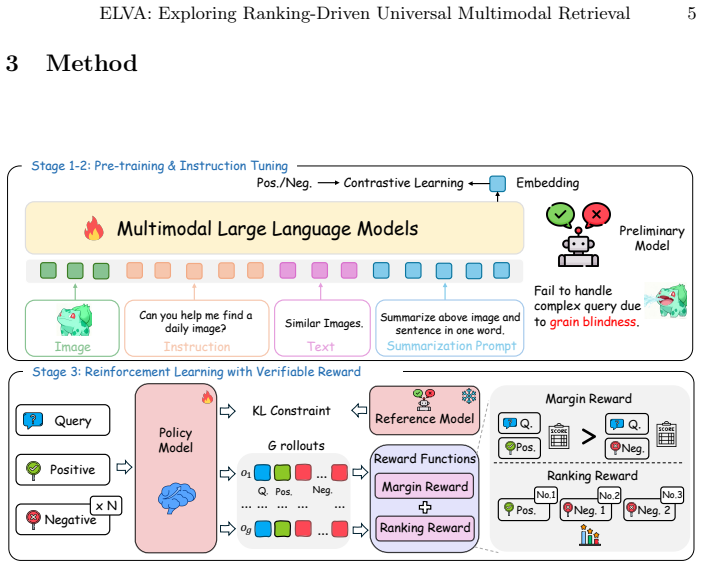
A rule-based RLVR extension that jointly maximizes the ranking of negatives by positive similarity and the positive–negative similarity gap, without any learned reward model or ranking labels.
Load-bearing premise
That simply ordering negatives by their similarity to the positive is a faithful enough proxy for the grain-level information the query actually requires, so that better ranking automatically yields better grain capture.
What would settle it
An ablation that keeps the same ranking-style loss but removes any grain-sensitive construction of the negatives, or a head-to-head comparison on MRBench against a pure contrastive baseline that has been given identical hard-negative mining; if the multi-grain gain disappears, the ranking-to-grain link is unsupported.
If this is right
- Standard contrastive UMR pipelines can be upgraded by swapping the binary loss for the ranking-driven rule rewards without collecting ranking labels.
- MRBench becomes a reusable diagnostic for whether a retrieval model is truly multi-grain or merely better at coarse matching.
- The same verifiable-reward pattern can be applied to other retrieval settings where negatives carry graded rather than binary information.
- Models trained this way should surface finer visual or textual attributes that binary contrastive training previously ignored.
Where Pith is reading between the lines
- Because the method needs no learned reward model, it may be cheaper to scale than preference-tuned alternatives that train a separate ranker.
- The 13.1% MRBench jump suggests that many existing SOTA numbers on coarse benchmarks may overstate true multi-grain competence.
- If the ranking signal is the real driver, one could test whether simply re-weighting negatives by similarity inside a contrastive loss already recovers most of the gain, isolating the contribution of the RL loop itself.
Editorial analysis
A structured set of objections, weighed in public.
Referee Report
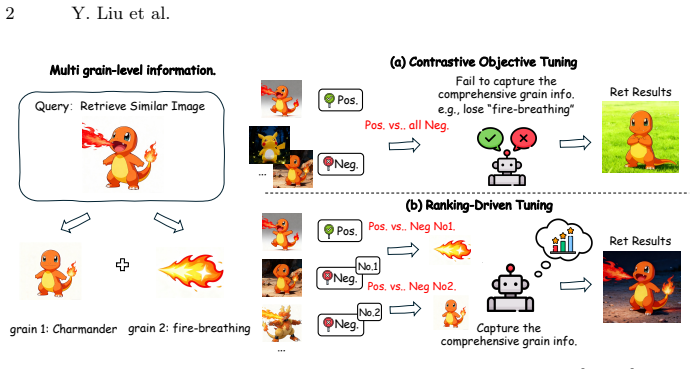
Summary. The manuscript proposes ELVA, a rule-based reinforcement-learning framework for Universal Multimodal Retrieval (UMR) with Multimodal Large Language Models. It identifies “grain blindness”—the claim that contrastive learning, by treating candidates as a binary positive/negative classification, discards grain-level cues carried by individual negatives that complex queries require. ELVA extends Reinforcement Learning with Verifiable Rewards (RLVR) to retrieval without a learned reward model or explicit ranking labels, using rule-based rewards that jointly rank negatives by similarity and enlarge the positive–negative similarity gap. The authors introduce MRBench for multi-grain query scenarios and report state-of-the-art results on standard retrieval benchmarks together with a 13.1% improvement on MRBench as evidence that grain blindness is mitigated.
Significance. If the causal story and numbers hold under full evaluation, ranking-driven rule-based RL would be a concrete alternative to pure contrastive adaptation of MLLMs for UMR, and a dedicated multi-grain benchmark would address a real evaluation gap. Explicit strengths claimed in the abstract include: (i) verifiable rule-based rewards without a learned reward model, (ii) exploration of ranking behavior without explicit ranking labels via RLVR, and (iii) a new multi-grain suite (MRBench) with a large reported gain. These are potentially valuable contributions, but their significance cannot be confirmed from the abstract alone because the load-bearing proxy (negative ranking ⇒ grain capture) and the construction of MRBench are not evidenced here.
major comments (4)
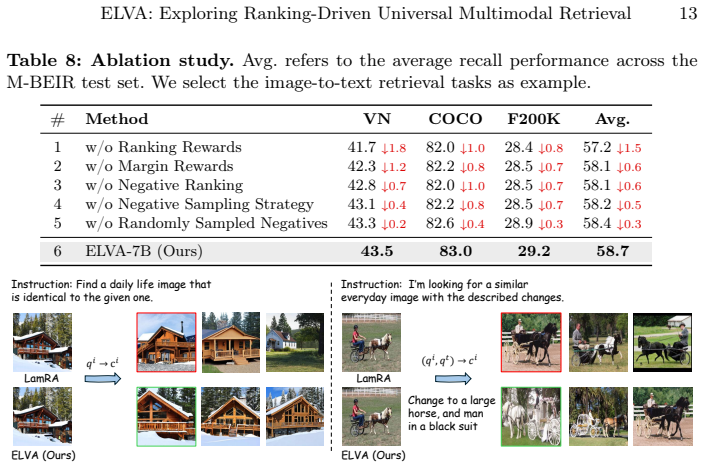
- [Abstract (method claim / grain blindness)] The central causal claim—that ranking negatives by similarity while enlarging the positive–negative gap induces grain-level learning rather than merely improving generic ranking metrics—is load-bearing for both method design and the interpretation of the 13.1% MRBench gain. The abstract asserts this link but provides no ablation, diagnostic, or analysis that isolates grain capture from ordinary ranking improvement. Without such evidence (e.g., controlled ablations of the ranking term vs. gap term, or grain-level error analysis), the flagship interpretation remains unsupported.
- [Abstract (MRBench / 13.1% claim)] MRBench is introduced by the same authors and is the primary showcase for the 13.1% multi-grain claim. Success on a self-defined multi-grain suite partially measures the problem the method was designed to solve. The abstract does not specify query construction, grain taxonomy, scoring protocol, or comparison to existing multi-granularity retrieval suites. Independent validation or transparent construction details are required before the 13.1% figure can be treated as decisive evidence of grain-blindness mitigation.
- [Abstract (RLVR / rule-based rewards)] The sufficiency of rule-based verifiable rewards (without a learned reward model or explicit ranking labels) is an ad-hoc axiom of the work. The abstract does not state the reward rules, ranking schedule, free parameters (weights, KL/penalty, batch negatives), or how exploration under RLVR is constrained for retrieval. These choices are free parameters that determine whether the proxy is faithful; they must be specified and ablated for the method claim to be reproducible and load-bearing.
- [Abstract (results)] Reported SOTA on “standard retrieval benchmarks” and the precise 13.1% MRBench gain cannot be checked against baselines, data splits, error bars, or statistical tests from the abstract alone. Until the full experimental section is available, neither the absolute performance claim nor the grain-blindness interpretation can be assessed as sound.
minor comments (3)
- [Abstract] The term “grain blindness” is introduced without a formal definition or operational measure in the abstract; a short formalization (what constitutes a grain, how blindness is scored) would help readers distinguish it from generic hard-negative or multi-granularity retrieval issues.
- [Abstract] “Ranking-driven universal multimodal retrieval” and “rule-based RL framework” are used densely; a one-sentence sketch of the reward signal (inputs → scalar/vector reward) would improve accessibility without requiring the full methods section.
- [Abstract] The abstract claims both SOTA on standard benchmarks and a large MRBench gain; naming the main baselines and the metric family (e.g., Recall@K, nDCG) would make the contribution easier to situate.
Circularity Check
Abstract-only review: no equation-level circularity; mild structural risk that MRBench is author-introduced and showcases the grain-blindness claim.
specific steps
-
other
[Abstract (MRBench introduction and 13.1% claim)]
"To more precisely measure grain blindness, we further introduce MRBench, a new benchmark specifically designed for multi-grain query scenarios. ELVA achieves state-of-the-art results across standard retrieval benchmarks, and its notable 13.1% improvement on MRBench further demonstrates its effectiveness in alleviating grain blindness."
MRBench is introduced by the same authors and is the primary quantitative showcase for the grain-blindness mitigation claim. Success on an author-defined multi-grain suite partially measures the problem the method was designed to solve. This is structural and mild: external standard-benchmark SOTA is also claimed, so the central result is not forced by the self-defined suite alone.
full rationale
Only the abstract is available, so no equations, reward definitions, or derivation chain can be inspected for self-definitional reductions or fitted-input-as-prediction. The abstract presents ELVA as a rule-based RLVR extension that ranks negatives by similarity and enlarges the positive-negative gap, then reports SOTA on standard external retrieval benchmarks plus a 13.1% gain on the newly introduced MRBench. Standard-benchmark SOTA is independent grounding. The sole mild circularity risk is structural: MRBench is introduced by the same authors and is the primary showcase for the multi-grain/grain-blindness claim, so success on a self-defined suite partially measures the problem the method was designed to solve. That is ordinary for a new benchmark and is not load-bearing for the external results; it does not rise to fitted-input-called-prediction or self-definitional circularity. No uniqueness theorems, ansatz smuggling, or self-citation chains appear in the abstract. Score 2 reflects one non-load-bearing self-defined evaluation suite; the central method claim remains untestable for circularity without the full text, but no circularity is exhibited by the available text.
Axiom & Free-Parameter Ledger
free parameters (2)
- rule-based reward weights / ranking reward schedule
- RL training hyperparameters (learning rate, KL/penalty, batch negatives)
axioms (4)
- domain assumption Contrastive binary positive/negative treatment causes models to overlook grain-level query information (grain blindness).
- ad hoc to paper Rule-based verifiable rewards without a learned reward model or explicit ranking labels suffice to induce useful ranking behavior in retrieval.
- domain assumption Ordering negatives by similarity to the positive enlarges the positive–negative gap in a way that encodes multi-grain query structure.
- standard math Standard multimodal contrastive / MLLM retrieval training setup and evaluation protocols.
invented entities (2)
-
ELVA framework
no independent evidence
-
MRBench
no independent evidence
Cite this review
Pith. "Pith review of ELVA: Exploring Ranking-Driven Universal Multimodal Retrieval." pith.science (2026). https://pith.science/paper/ODX7VTLI
@misc{pith2026260620280,
  author       = {Pith},
  title        = {Pith review of: ELVA: Exploring Ranking-Driven Universal Multimodal Retrieval},
  year         = {2026},
  howpublished = {\url{https://pith.science/paper/ODX7VTLI}},
  note         = {Machine review of arXiv:2606.20280}
}
read the original abstract
Leveraging Multimodal Large Language Models (MLLMs) via contrastive learning has become a mainstream paradigm for improving the performance of Universal Multimodal Retrieval (UMR). However, previous works have ignored the grain blindness when adapting the contrastive paradigm into retrieval tasks. Grain blindness refers to the tendency of the model to overlook grain-level information contained in the query, which is crucial for effectively handling complex queries. This stems from contrastive learning treating samples as a binary classification (positive/negative), while ignoring the different information carried by each negative sample. To address this, we argue that negatives should be treated differently according to their similarity to the positive sample, enabling the model to learn distinct grain information from each negative. In this paper, we introduce a simple but effective framework, called ELVA, a novel rule-based RL framework that mitigates grain blindness through ranking-driven MLLMs. 1) Instead of relying on reward models, we extend Reinforcement Learning with Verifiable Rewards (RLVR) to retrieval tasks, allowing the model to explore new ranking behaviors without explicit ranking labels. 2) By utilizing rule-based rewards, our approach jointly optimizes the ranking of negative samples while enlarging the similarity gap between positive and negative. To more precisely measure grain blindness, we further introduce MRBench, a new benchmark specifically designed for multi-grain query scenarios. ELVA achieves state-of-the-art results across standard retrieval benchmarks, and its notable 13.1% improvement on MRBench further demonstrates its effectiveness in alleviating grain blindness.
Figures
Forward citations
Cited by 1 Pith paper
-
GraphIR: Architecture-Level Search States for LLM-Guided Neural Architecture Evolution
GraphIR adds a structured architecture state to executable neural programs for LLM-guided NAS; benchmark gains are reported, but the CLRS evidence shows the 'evolved' architecture is essentially the initial one plus a...
discussion (0)
Sign in with ORCID, Apple, or X to comment. Anyone can read and Pith papers without signing in.