REVIEW 2 major objections 1 minor 1 cited by
A self-contained account of the WDM time-frequency basis for gravitational-wave analysis with slowly-varying noise.
Reviewed by Pith at T0; open to challenge. T0 means a machine referee read the full paper against a public rubric. the ladder, T0–T4 →
T0 review · grok-4.5
2026-07-12 13:04 UTC pith:HRCJE7TV
load-bearing objection Useful Part-I documentation of the known WDM basis for GW analysts; modest novelty, formal claims uncheckable from abstract alone. the 2 major comments →
The WDM Time-Frequency Transform in Gravitational-Wave Data Analysis I: Formalism
The pith
A machine-rendered reading of the paper's core claim, the machinery that carries it, and where it could break.
Core claim
For slowly-varying noise, the Wilson-Daubechies-Meyer (WDM) basis furnishes a practical middle ground between frequency-domain efficiency and time-domain generality; the paper supplies a self-contained derivation of its orthogonality and localization, the edge effects at DC and Nyquist, the forward and inverse transforms and their implementation, and the noise covariance matrix and likelihood expressed in that basis.
What carries the argument
The Wilson-Daubechies-Meyer (WDM) basis: an orthonormal time-frequency tiling whose good localization and exact transform pair allow the noise covariance and likelihood to be written directly in the time-frequency domain when the noise is slowly varying.
Load-bearing premise
Detector noise must vary slowly enough that the time-frequency representation and its associated covariance remain both accurate and cheaper than a pure time-domain treatment.
What would settle it
Apply the WDM transform and likelihood to real or simulated gravitational-wave data whose noise varies faster than the paper’s slow-variation regime and check whether the recovered covariance and detection statistics deviate systematically from a full time-domain calculation.
If this is right
- Analysts can implement forward and inverse WDM transforms with explicit control of DC and Nyquist edge effects.
- The noise covariance matrix can be written and inverted in the time-frequency domain for slowly-varying noise.
- Likelihood evaluations for gravitational-wave signals become intermediate in cost between pure frequency-domain and pure time-domain methods.
- The same basis can be reused across search, parameter-estimation, and noise-characterization pipelines once the transform is standardized.
Where Pith is reading between the lines
- The same documentation pattern could be repeated for other common time-frequency bases, reducing the barrier to adoption of non-Fourier methods.
- Once the WDM likelihood is standard, glitch-mitigation and non-stationary noise modeling may be performed directly in the time-frequency plane rather than by ad-hoc gating.
- Benchmarks against pure time-domain methods on real LIGO-Virgo noise stretches would quantify the computational gain claimed for the slow-variation regime.
Editorial analysis
A structured set of objections, weighed in public.
Referee Report
Summary. The manuscript aims to provide a self-contained, analyst-oriented account of time-frequency methods for gravitational-wave data analysis in the regime of slowly varying detector noise, with detailed derivations for the Wilson–Daubechies–Meyer (WDM) basis. According to the abstract, it documents orthogonality and time-frequency localization of the basis, edge effects at DC and Nyquist, practical forward and inverse transforms, and the construction of the noise covariance matrix and likelihood in the time-frequency domain, positioning WDM as a middle ground between frequency-domain efficiency and time-domain generality.
Significance. If the formal derivations and implementations hold, the paper would be a useful methodological and pedagogical reference for the gravitational-wave community, where frequency-domain methods are standard but time-frequency bases remain less systematically documented. Explicit treatment of edge effects, transform practice, and the TF-domain noise likelihood would lower the barrier to correct adoption of WDM methods. The contribution is primarily documentation and consolidation rather than a novel physical claim; its value rests on correctness, completeness, and clarity of the formal account.
major comments (2)
- Only the abstract was available for this review. The load-bearing claims—orthogonality of the WDM basis, quantitative localization, edge effects at DC/Nyquist, correctness of the forward/inverse transforms, and the TF-domain noise covariance and likelihood—cannot be checked for internal consistency, hidden assumptions, or error analysis without the body of the paper. A full technical assessment is therefore not possible from the material provided.
- Abstract: the regime of applicability is stated as “slowly-varying noise,” but no operational criterion, timescale, or error bound is given in the abstract. For the central claim that WDM is both accurate and computationally advantageous relative to pure time-domain methods, the full manuscript must supply a clear definition of that regime and, ideally, quantitative guidance on when the approximation fails.
minor comments (1)
- Abstract wording is clear and appropriately scoped for a methods/documentation paper; no presentation issues can be assessed beyond the abstract itself.
Circularity Check
No significant circularity; abstract documents WDM basis properties without self-referential or fitted-as-predicted claims.
full rationale
Only the abstract is available. It frames the paper as a self-contained pedagogical account of the Wilson-Daubechies-Meyer (WDM) time-frequency basis for gravitational-wave analysis under slowly-varying noise, covering orthogonality, localization, DC/Nyquist edge effects, forward/inverse transforms, and the noise covariance matrix and likelihood. No equations, fitted parameters renamed as predictions, uniqueness theorems, ansatz-by-citation, or load-bearing self-citations appear. The abstract does not claim a novel physical result that reduces by construction to its inputs; it documents a known basis and its practical use. Per the analyzer rules, circularity may be asserted only when a specific reduction can be quoted and exhibited; none exists here. Score 0 with empty steps is therefore the correct, proportionate finding. Possible multi-part-series self-citation risk is not visible in the abstract and does not raise the score.
Axiom & Free-Parameter Ledger
axioms (3)
- domain assumption Detector noise is slowly varying in time, so a time-frequency representation is both accurate and advantageous versus pure time-domain analysis.
- domain assumption The Wilson–Daubechies–Meyer (WDM) construction yields an orthogonal basis with good time-frequency localization suitable for GW data.
- standard math Standard linear-algebra and Fourier/wavelet transform machinery (orthogonality, covariance under linear transforms, Gaussian likelihood form).
read the original abstract
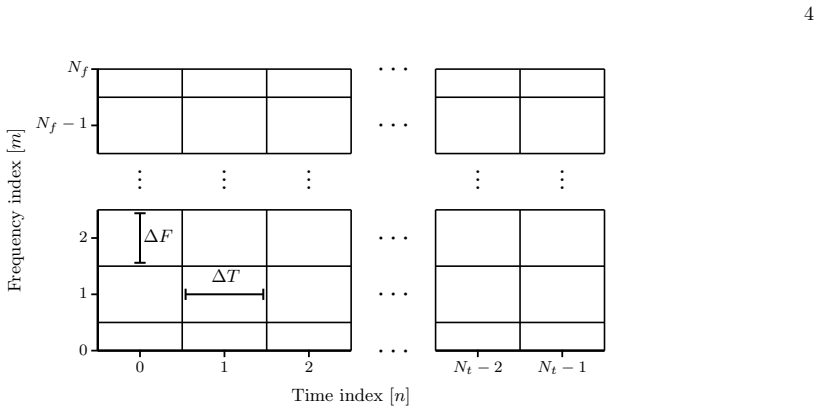
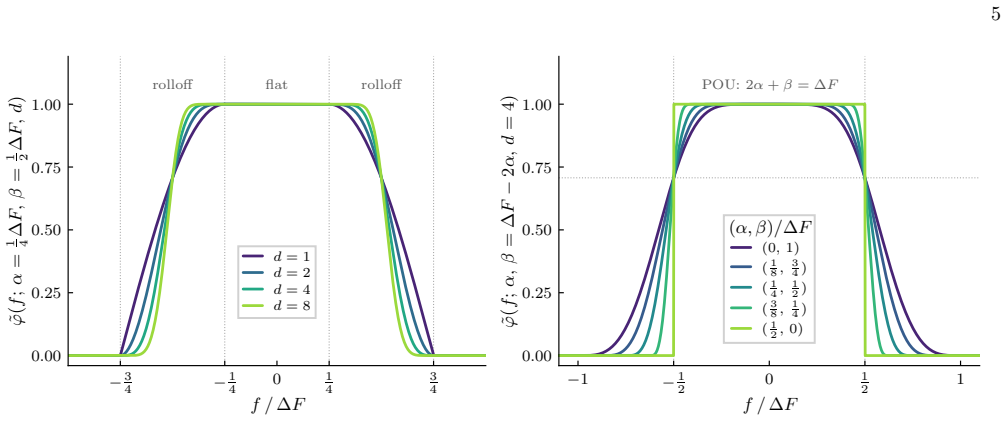
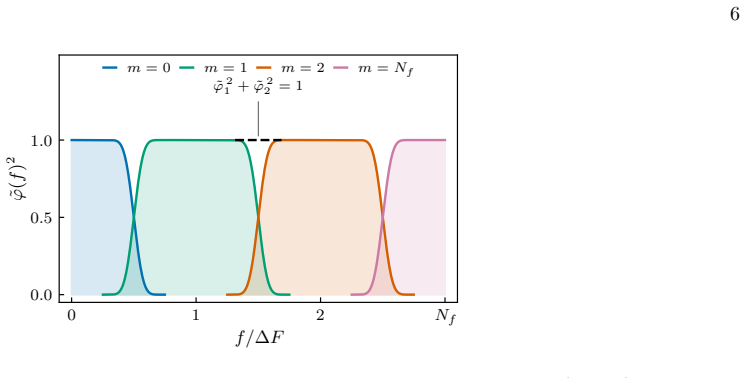
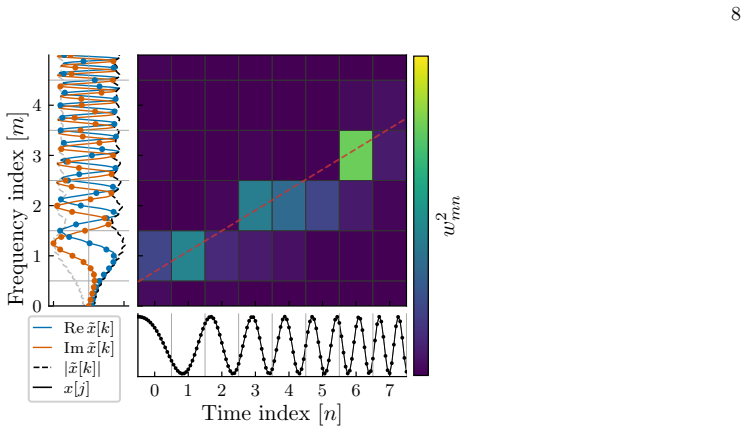
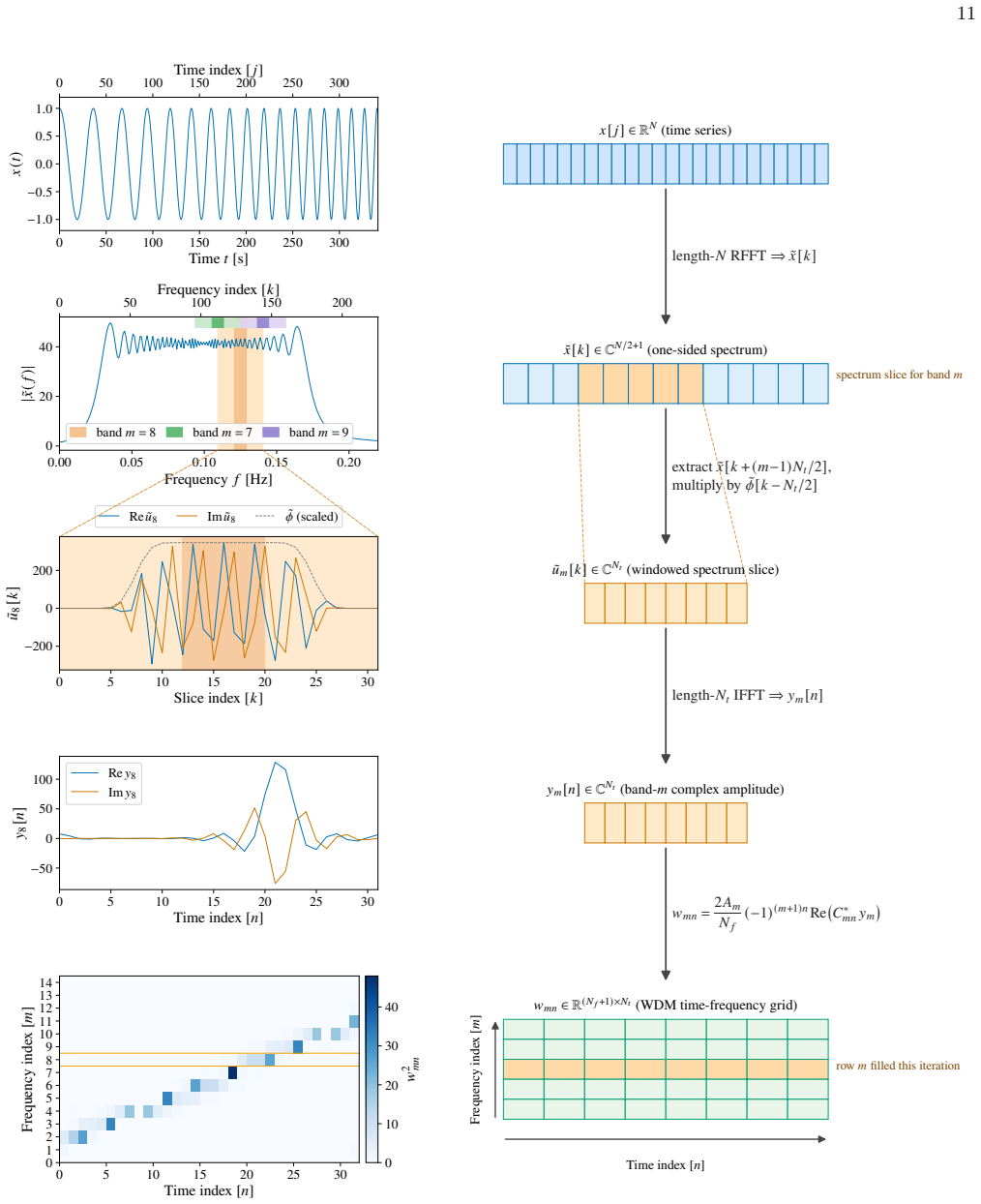
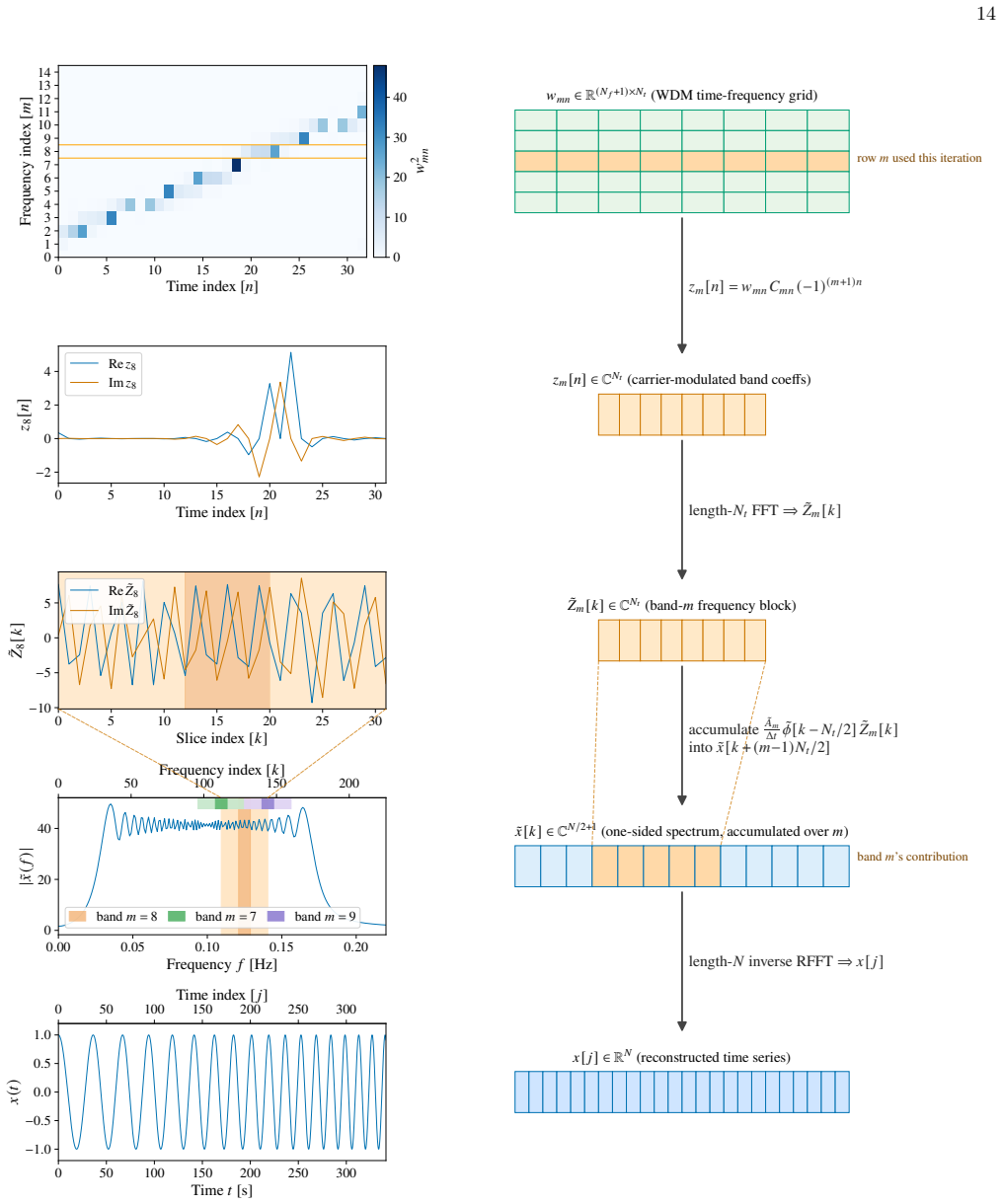
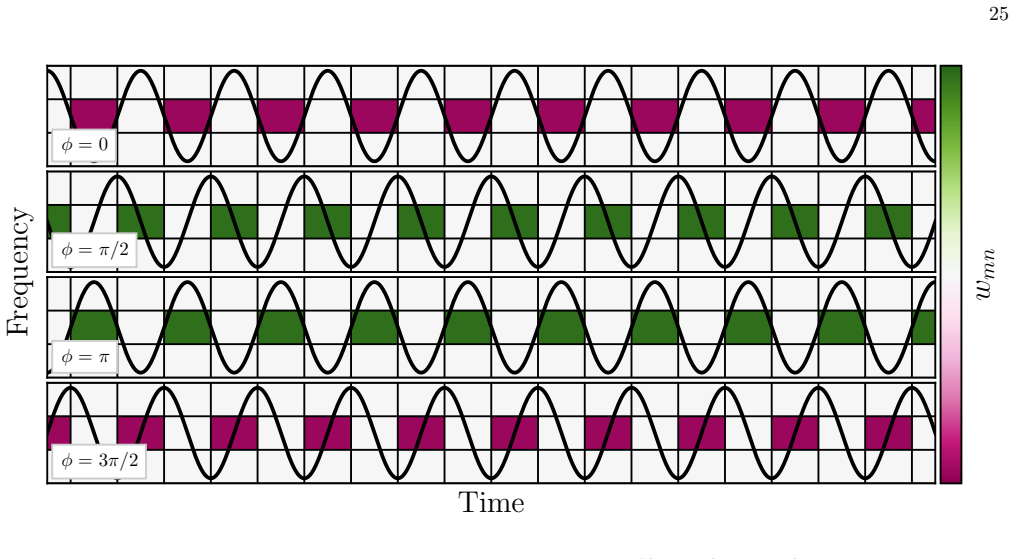
For slowly-varying noise, time-frequency methods offer a natural middle ground between the efficiency of the frequency domain and the generality of the more expensive time domain. Despite growing adoption, such methods remain less well documented and less familiar in the gravitational-wave literature, compared to the ubiquitous frequency domain. Aimed at gravitational-wave analysts, in this paper we present a self-contained account of time-frequency methods, detail derivations for a specific basis, namely the Wilson-Daubechies-Meyer (WDM) basis, and share intuition and lessons learned. We document key concepts: the orthogonality and good time-frequency localization of the basis, the edge effects at the DC and Nyquist frequencies, the forward and inverse transforms and their practical implementation, and the noise covariance matrix and likelihood in the time-frequency domain.
Figures
Forward citations
Cited by 1 Pith paper
-
Modeling non-stationary noise: applications in gravitational wave astronomy
A positive dynamic spectrum S(f,t) generalizes the stationary power spectrum by defining Gramian closed-form noise covariances in Fourier and Wilson-Daubechies wavelet bases for gravitational wave data.
discussion (0)
Sign in with ORCID, Apple, or X to comment. Anyone can read and Pith papers without signing in.