REVIEW 2 major objections 2 minor 1 cited by
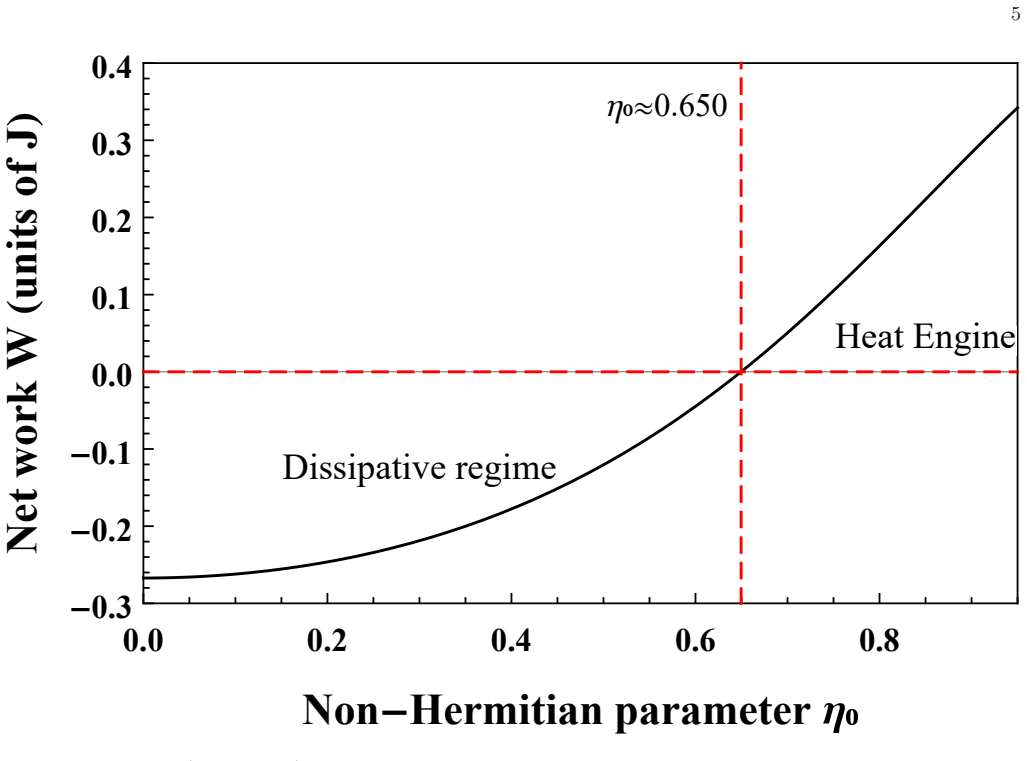
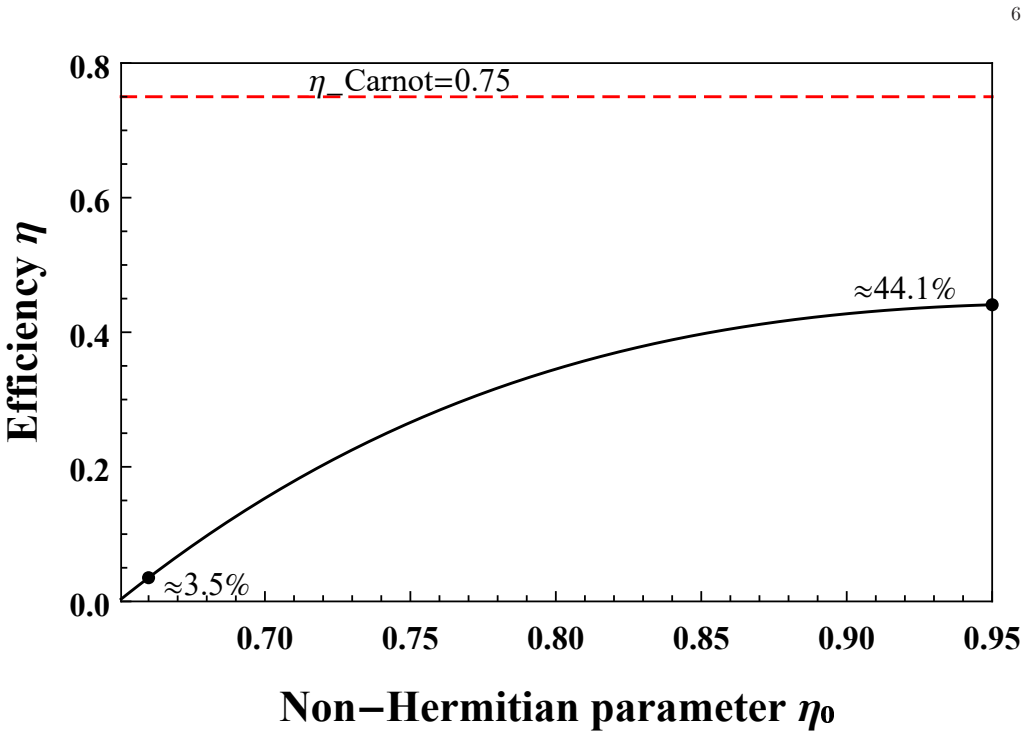
A non-Hermitian two-qubit XY model with staggered imaginary field realizes an idle-level quantum Otto engine in which tuning the non-Hermitian parameter drives a transition to heat-engine operation and raises efficiency.
Reviewed by Pith at T0; open to challenge. T0 means a machine referee read the full paper against a public rubric. the ladder, T0–T4 →
T0 review · grok-4.3
2026-06-29 05:20 UTC pith:PXMXIDDO
load-bearing objection The paper gives a spin-system realization of the idle-level engine but the field independence of the idle levels needs explicit eigenvalue verification to support the claimed mechanism. the 2 major comments →
Quantum Otto engine with field-decoupled idle levels in a non-Hermitian XY model
The pith
A machine-rendered reading of the paper's core claim, the machinery that carries it, and where it could break.
Core claim
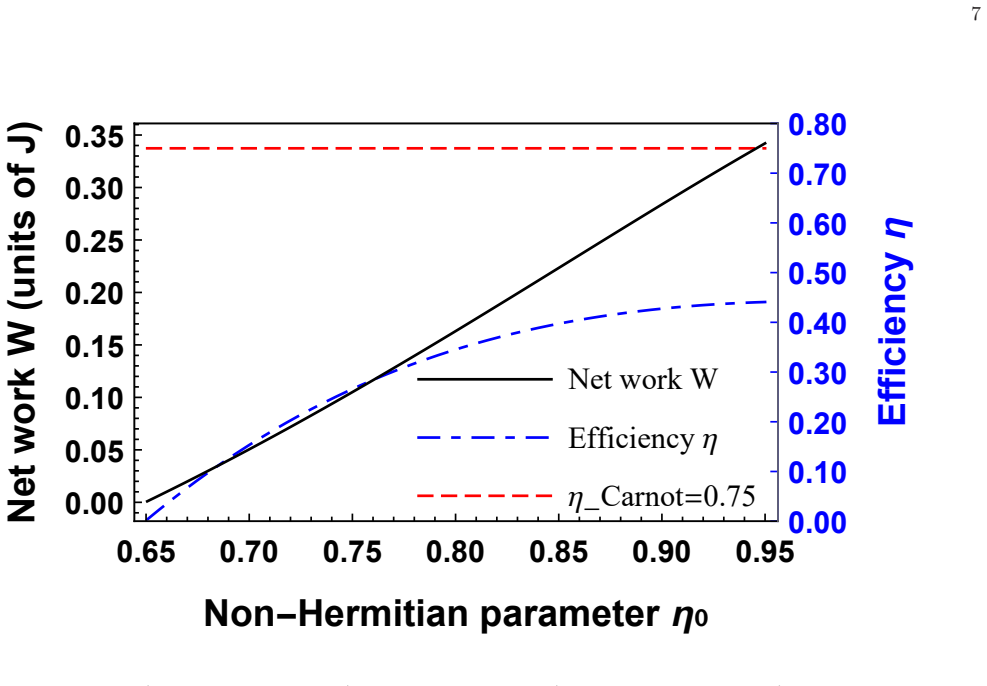
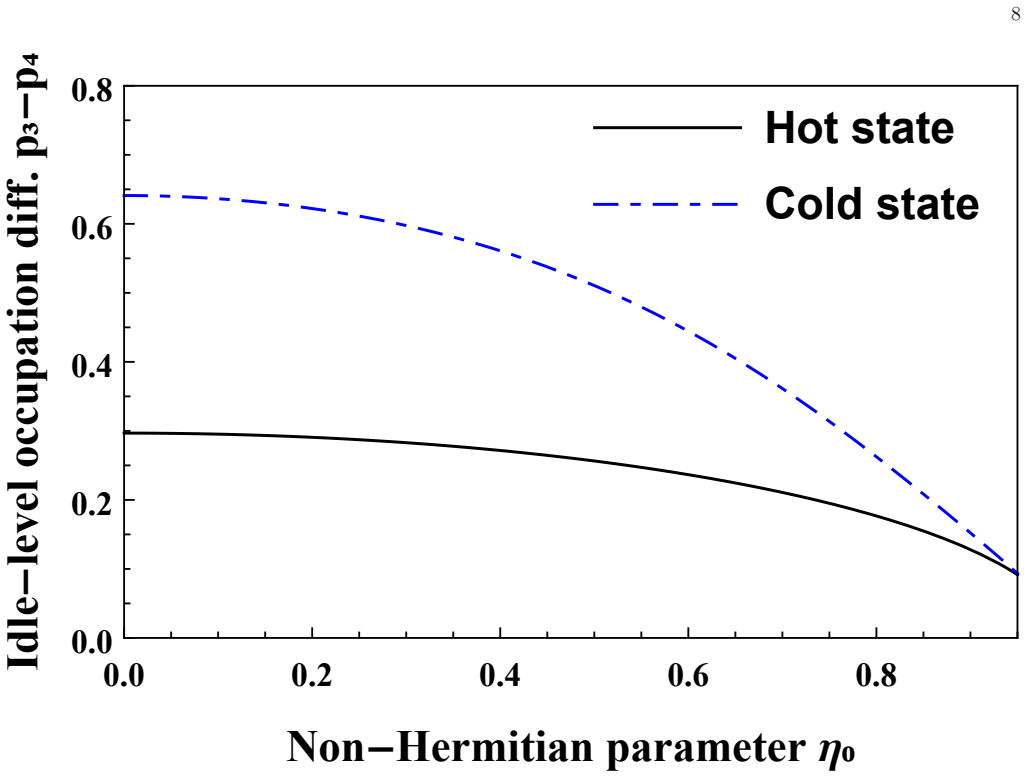
The non-Hermitian two-qubit XY model with staggered imaginary magnetic field constitutes the first microscopic spin realization of an idle-level quantum heat engine. Its spectrum decomposes into field-dependent working levels and field-independent idle levels; increasing the non-Hermitian parameter η0 within the unbroken PT-symmetric phase compresses the idle gap, redistributes level occupations, and thereby converts the cycle from dissipative to genuine heat-engine operation while increasing both output work and efficiency to a sizable fraction of the Carnot bound. The net-work expression possesses an η0-independent numerator and η0-dependent denominators mediated by hyperbolic cosines.
What carries the argument
The natural decomposition of the energy spectrum into external-field-dependent working levels and entirely field-independent idle levels, with the idle gap tuned by the non-Hermitian parameter η0.
Load-bearing premise
The energy spectrum of the system naturally decomposes into working levels that depend on the external field and idle levels that are entirely independent of it.
What would settle it
Direct measurement of net work versus η0 that checks whether the numerator stays constant while the denominators vary through hyperbolic cosines and efficiency rises toward the Carnot limit inside the PT-symmetric phase.
If this is right
- Tuning η0 within the unbroken PT-symmetric phase produces a continuous transition from negative net work to positive net work and positive heat absorption from the hot reservoir.
- Engine efficiency increases considerably and reaches a substantial fraction of the Carnot limit as η0 grows.
- The net-work expression has an η0-independent numerator whose denominators depend on η0 through hyperbolic-cosine functions of the idle gap.
- The performance enhancement remains robust under variations of the remaining model parameters.
- The same control mechanism can be realized in a trapped-ion quantum simulator.
Where Pith is reading between the lines
- Analogous idle-level decoupling might appear in other qubit or spin-chain Hamiltonians if their spectra can be arranged to separate field dependence in the same way.
- The occupation-weight redistribution could be verified experimentally by measuring steady-state populations in the hot and cold thermal states while scanning η0.
- Non-Hermitian control of idle gaps may extend to other thermodynamic cycles such as Carnot or Stirling engines realized in similar spin models.
Editorial analysis
A structured set of objections, weighed in public.
Referee Report
Summary. The manuscript investigates a quantum Otto cycle using a non-Hermitian two-qubit XY model with a staggered imaginary magnetic field. It claims that the energy spectrum naturally separates into a pair of external-field-dependent working levels and a pair of field-independent idle levels, providing the first microscopic spin realization of the idle-level quantum heat engine proposed by de Oliveira and Jonathan. Tuning the non-Hermitian parameter η₀ induces a continuous transition from a dissipative regime (negative net work) to genuine heat-engine operation, with both output work and efficiency enhanced; efficiency reaches a substantial fraction of the Carnot limit within the PT-symmetric phase. The enhancement is attributed to compression of the idle-level gap, which redistributes thermal occupations, while the net-work expression has an η₀-independent numerator whose denominators depend on η₀ via hyperbolic cosines. The work includes robustness checks, comparison to the Hermitian limit, and a trapped-ion experimental proposal.
Significance. If the claimed spectrum decomposition and the resulting performance gains are confirmed, the result supplies a concrete physical platform for the abstract idle-level engine concept and illustrates how non-Hermiticity can be used to control both operating mode and efficiency in a quantum heat engine. The explicit experimental proposal for trapped ions and the parameter-robustness analysis are concrete strengths that increase the work’s potential impact.
major comments (2)
- [Abstract and spectrum analysis section] The central claim that the model realizes the idle-level engine rests on the spectrum decomposing into working levels that depend on the external field h and idle levels that are completely independent of h. The abstract asserts this separation occurs naturally, yet the non-Hermitian term could in principle mix all levels. Explicit eigenvalue expressions (or a clear derivation showing ∂E_idle/∂h = 0) must be provided to confirm that the idle gap is field-independent while the working gap remains tunable; without this, the mechanism that keeps the net-work numerator η₀-independent cannot be verified.
- [Net-work expression and efficiency analysis] The abstract states that the net-work numerator is η₀-independent while the denominators depend on η₀ through hyperbolic cosines, and that performance gains arise from idle-gap compression. It is necessary to show the explicit net-work formula (presumably derived from the four-level occupations) and demonstrate that the observed enhancement is not an artifact of the fitting procedure or of the particular choice of η₀ range; otherwise the claim that non-Hermiticity provides genuine control remains unproven.
minor comments (2)
- [Abstract] The abstract mentions “a substantial fraction of the Carnot limit” without quoting the numerical value or the corresponding η₀; adding the concrete number would improve clarity.
- [Abstract] The experimental proposal for trapped ions is mentioned but not detailed in the abstract; a one-sentence outline of the required operations would help readers assess feasibility.
Simulated Author's Rebuttal
We thank the referee for the careful reading, positive assessment of significance, and constructive major comments. We address each point below and will revise the manuscript to incorporate the requested explicit derivations and formulas.
read point-by-point responses
-
Referee: [Abstract and spectrum analysis section] The central claim that the model realizes the idle-level engine rests on the spectrum decomposing into working levels that depend on the external field h and idle levels that are completely independent of h. The abstract asserts this separation occurs naturally, yet the non-Hermitian term could in principle mix all levels. Explicit eigenvalue expressions (or a clear derivation showing ∂E_idle/∂h = 0) must be provided to confirm that the idle gap is field-independent while the working gap remains tunable; without this, the mechanism that keeps the net-work numerator η₀-independent cannot be verified.
Authors: We agree that the explicit eigenvalue expressions and the derivative condition are necessary to rigorously establish the decomposition. In the revised manuscript we will insert a new subsection in the spectrum analysis that solves the characteristic equation of the 4×4 non-Hermitian Hamiltonian. The resulting eigenvalues factor into two h-dependent working levels and two completely h-independent idle levels, directly demonstrating ∂E_idle/∂h = 0. This derivation also shows why the numerator of the net-work expression remains independent of η₀. revision: yes
-
Referee: [Net-work expression and efficiency analysis] The abstract states that the net-work numerator is η₀-independent while the denominators depend on η₀ through hyperbolic cosines, and that performance gains arise from idle-gap compression. It is necessary to show the explicit net-work formula (presumably derived from the four-level occupations) and demonstrate that the observed enhancement is not an artifact of the fitting procedure or of the particular choice of η₀ range; otherwise the claim that non-Hermiticity provides genuine control remains unproven.
Authors: We will add the explicit net-work formula W_net = (numerator independent of η₀) / (denominators involving cosh(η₀)) together with the four-level thermal occupation expressions from which it is obtained. To rule out artifacts we will include additional panels showing W_net and efficiency versus η₀ over an extended interval (including the Hermitian limit η₀ = 0) and will compare the analytic curves with direct numerical evaluation of the cycle, confirming that the enhancement tracks the idle-gap compression rather than any fitting choice. revision: yes
Circularity Check
No circularity; spectrum decomposition and work expression are explicit derivations from the Hamiltonian
full rationale
The paper defines a concrete non-Hermitian XY Hamiltonian, computes its eigenvalues explicitly, and shows that two levels depend on the external field h while two do not. The net-work formula is then written in terms of those eigenvalues and thermal factors; the η0-independence of the numerator follows directly from the idle-level energies being independent of h (a structural feature of the 4×4 matrix, not a fit). No step equates a derived quantity to its own input by construction, no self-citation is load-bearing, and no ansatz is smuggled. The derivation chain is self-contained against the stated Hamiltonian and the external reference to de Oliveira & Jonathan.
Axiom & Free-Parameter Ledger
free parameters (1)
- η0
axioms (1)
- domain assumption Energy spectrum naturally decomposes into field-dependent working levels and field-independent idle levels.
read the original abstract
We investigated a quantum Otto cycle in a non-Hermitian two-qubit XY model with a staggered imaginary magnetic field. The energy spectrum of this system naturally decomposes into a pair of working levels that depend on the external field and a pair of idle levels that are entirely independent of it. Accordingly, the model represents the first concrete microscopic realization of the idle-level quantum heat engine proposed by de Oliveira and Jonathan [Phys. Rev. E \textbf{104}, 044133 (2021)] in a physical spin framework. According to our findings, tuning the non-Hermitian parameter $\eta_0$ drove a continuous transition from a dissipative regime, characterized by negative net work and net heat absorption from the hot reservoir, to genuine heat-engine operation while enhancing both output work and efficiency. Specifically, as $\eta_0$ increased within the stable phase with unbroken parity--time symmetry, the engine efficiency increased considerably and reached a substantial fraction of the Carnot limit. This joint performance enhancement originated from the compression of the idle-level gap, which redistributed the level-occupation weights in the hot and cold equilibrium states and thereby modulated the absorbed heat. Mathematically, the net-work expression had an $\eta_0$-independent numerator, but its denominators depended indirectly on $\eta_0$ through hyperbolic cosine functions, providing the basis for the idle-level control mechanism. We further thoroughly analyzed the robustness of these findings against parameter variations, critically compared non-Hermitian control with the Hermitian limit, and developed a concrete experimental proposal for trapped-ion quantum simulators. Together, our results demonstrate that non-Hermiticity serves as an indispensable tool for controlling both the operating mode and performance of a quantum engine.
Figures
Forward citations
Cited by 1 Pith paper
-
Non-Hermitian entropy production from fluctuation theorems
Post-selected fluctuation theorems yield a nonnegative entropy production Σ=⟨ΔS⟩+Ξ for non-Hermitian evolution, equal to a Petz–Rényi gap and sensitive to exceptional points via its coherent part.
Reference graph
Works this paper leans on
-
[1]
(1) and (3) are mathema tically equivalent
(3) Notably, because σ α 1 σ α 2 = σ α 2 σ α 1 for Pauli matrices, the Hamiltonians in Eqs. (1) and (3) are mathema tically equivalent. In the computational basis {|↑↑⟩, |↑↓⟩, |↓↑⟩, |↓↓⟩}, H assumes the following block-diagonal representation: H = − 2J h0 0 0 − 2J γ 0 − 2iJ η0 − 2J 0 0 − 2J 2iJ η0 0 − 2J γ 0 0 2 J h0 . (4) This structure decom...
-
[2]
A description of the complete diagonalization, including the construction of the biorthogonal eigenbasis, is provided in App endix A
(6) The idle-level eigenvalues are completely independent of h0. A description of the complete diagonalization, including the construction of the biorthogonal eigenbasis, is provided in App endix A. When |η0| < 1, the Hamiltonian has PT symmetry, admits a complete set of biortho gonal eigenvectors, and has purely real eigenvalues[ 30]. Notably, all calcul...
-
[3]
Tianchi T alents
(8) The eigenvalues can then be expressed as ∓ A, ∓ B. Accordingly, the partition function reduces to Z = 2 cosh(βA ) + 2 cosh(βB ), and the equilibrium internal energy has the following analytical for m: U (h, T ) = − A sinh(βA ) + B sinh(βB ) cosh(βA ) + cosh(βB ) . (9) The detailed derivation and verification of this expression are provid ed in Appendix...
-
[4]
(A8) It yields the following eigenvalues: E3 = − 2J √ 1 − η2 0, E 4 = +2J √ 1 − η2
= 0 . (A8) It yields the following eigenvalues: E3 = − 2J √ 1 − η2 0, E 4 = +2J √ 1 − η2
-
[5]
(A9) Following the approach of Li et al.[ 33], we define the following parameters: d3 = iη0 + √ 1 − η2 0, d 4 = iη0 − √ 1 − η2
-
[6]
(A12) To construct a biorthogonal basis for the non-Hermitian idle-level subspace, the left eigenvectors must be obtained (eigenvectors of H †)
(A10) Accordingly, the unnormalized right eigenvectors become |Ψ R 3 ⟩ = 1 √ 1 + |d3|2 (d3| ↑↓⟩+ | ↓↑⟩) , (A11) |Ψ R 4 ⟩ = 1 √ 1 + |d4|2 (d4| ↑↓⟩+ | ↓↑⟩) . (A12) To construct a biorthogonal basis for the non-Hermitian idle-level subspace, the left eigenvectors must be obtained (eigenvectors of H †). These left eigenvectors satisfy ⟨Ψ L k |H = Ek⟨Ψ L k |, ...
-
[7]
(A15) Biorthogonal normalization The biorthonormality condition is ⟨Ψ L i |Ψ R j ⟩ = δij. The corresponding diagonal normalization constants ci = ⟨Ψ L i |Ψ R i ⟩ are c3 = 1 + d3d∗ 5 = 2 √ 1 − η2 0 ( √ 1 − η2 0 + iη0 ) , (A16) c4 = 1 + d4d∗ 6 = 2 √ 1 − η2 0 ( √ 1 − η2 0 − iη0 ) . (A17) Following the approach of Li et al.[ 33], we leave the left eigenvector...
-
[8]
95, the gap is 2 B = 4 J √ 1 − 0
(B2) For η0 = 0 . 95, the gap is 2 B = 4 J √ 1 − 0. 952 ≈ 4J × 0. 312 ≈ 1. 25J, which remains sizable. Given a typical cycle time τ ≫ 1/J , A34 ≪ 1 is easily satisfied. By comparison, for η0 = 0 . 99, the gap decreases to ≈ 0. 56J, increasing A34 by a factor of approximately five and making adiabaticity more difficult to maintain. Accordingly, the condition η...
2081
-
[9]
Gemmer, M
J. Gemmer, M. Michel, and G. Mahler, Quantum Thermodynamics: Emergence of Thermodynamic Behav ior Within Composite Quantum Systems , Lecture Notes in Physics Vol. 784 (Springer, Berlin, 2009)
2009
-
[10]
Vinjanampathy and J
S. Vinjanampathy and J. Anders, Quantum thermodynamics , Contemp. Phys. 57, 545 (2016)
2016
-
[11]
Goold, M
J. Goold, M. Huber, A. Riera, L. del Rio, and P. Skrzypczyk , The role of quantum information in thermodynamics—A topical review, J. Phys. A: Math. Theor. 49, 143001 (2016)
2016
-
[12]
Binder, L
F. Binder, L. A. Correa, C. Gogolin, J. Anders, and G. Ades so (eds.), Thermodynamics in the Quantum Regime: Funda- mental Aspects and New Directions , Fundamental Theories of Physics Vol. 195 (Springer, Cham, 2018)
2018
-
[13]
O. Abah, J. Roßnagel, G. Jacob, S. Deffner, F. Schmidt-Kal er, K. Singer, and E. Lutz, Single-Ion Heat Engine at Maximum Power, Phys. Rev. Lett. 109, 203006 (2012)
2012
-
[14]
Roßnagel, S
J. Roßnagel, S. T. Dawkins, K. N. Tolazzi, O. Abah, E. Lutz , F. Schmidt-Kaler, and K. Singer, A single-atom heat engine , Science 344, 1250091 (2014)
2014
-
[15]
Klatzow, J
J. Klatzow, J. N. Becker, P. M. Ledingham, C. Weinzettl, K . T. Kaczmarek, D. J. Saunders, J. Nunn, I. A. Walmsley, R. Uzdin, and E. Poem, Experimental Demonstration of Quantu m Effects in the Operation of Microscopic Heat Engines, Phys. Rev. Lett. 122, 110601 (2019)
2019
-
[16]
J. P. S. Peterson, T. B. Batalh˜ ao, M. Herrera, A. M. Souza , R. S. Sarthour, I. S. Oliveira, and R. M. Serra, Experimenta l Characterization of a Spin Quantum Heat Engine, Phys. Rev. L ett. 123, 240601 (2019)
2019
-
[17]
Alicki, The quantum open system as a model of the heat en gine, J
R. Alicki, The quantum open system as a model of the heat en gine, J. Phys. A: Math. Gen. 12, L103 (1979)
1979
-
[18]
Kosloff, A quantum mechanical open system as a model of a heat engine, J
R. Kosloff, A quantum mechanical open system as a model of a heat engine, J. Chem. Phys. 80, 1625 (1984)
1984
-
[19]
Geva and R
E. Geva and R. Kosloff, A quantum-mechanical heat engine operating in finite time. A model consisting of spin-1/2 syst ems as the working fluid, J. Chem. Phys. 96, 3054 (1992)
1992
-
[20]
H. T. Quan, Y. X. Liu, C. P. Sun, and F. Nori, Quantum therm odynamic cycles and quantum heat engines, Phys. Rev. E 76, 031105 (2007)
2007
-
[21]
Kosloff and Y
R. Kosloff and Y. Rezek, The quantum harmonic Otto cycle, Entropy 19, 136 (2017)
2017
-
[22]
C. M. Bender and S. Boettcher, Real Spectra in Non-Hermi tian Hamiltonians Having PT Symmetry, Phys. Rev. Lett. 80, 5243 (1998)
1998
-
[23]
C. M. Bender, Making sense of non-Hermitian Hamiltonia ns, Rep. Prog. Phys. 70, 947 (2007)
2007
-
[24]
El-Ganainy, K
R. El-Ganainy, K. G. Makris, M. Khajavikhan, Z. H. Mussl imani, S. Rotter, and D. N. Christodoulides, Non-Hermitian physics and PT symmetry, Nat. Phys. 14, 11 (2018)
2018
-
[25]
V. V. Konotop, J. Yang, and D. A. Zezyulin, Nonlinear wav es in PT -symmetric systems, Rev. Mod. Phys. 88, 035002 (2016)
2016
-
[26]
L. Feng, R. El-Ganainy, and L. Ge, Non-Hermitian photon ics based on parity–time symmetry, Nat. Photonics 11, 752 (2017)
2017
-
[27]
˙S. K. ¨Ozdemir, S. Rotter, F. Nori, and L. Yang, Parity–time symmet ry and exceptional points in photonics, Nat. Mater. 18, 783 (2019)
2019
-
[28]
C. E. R¨ uter, K. G. Makris, R. El-Ganainy, D. N. Christod oulides, M. Segev, and D. Kip, Observation of parity–time symmetry in optics, Nat. Phys. 6, 192 (2010)
2010
-
[29]
Ashida, Z
Y. Ashida, Z. Gong, and M. Ueda, Non-Hermitian physics, Adv. Phys. 69, 249 (2020)
2020
-
[30]
Lin and Z
S. Lin and Z. Song, Non-Hermitian heat engine with all-q uantum-adiabatic-process cycle, J. Phys. A: Math. Theor. 49, 475301 (2016)
2016
-
[31]
Insinga, B
A. Insinga, B. Andresen, P. Salamon, and R. Kosloff, Quan tum heat engines: Limit cycles and exceptional points, Phys . Rev. E 97, 062153 (2018)
2018
-
[32]
Zhang, J.-Q
J.-W. Zhang, J.-Q. Zhang, G.-Y. Ding, J.-C. Li, J.-T. Bu , B. Wang, L.-L. Yan, S.-L. Su, L. Chen, F. Nori, ˙S. K. ¨Ozdemir, F. Zhou, H. Jing, and M. Feng, Dynamical control of quantum he at engines using exceptional points, Nat. Commun. 13, 6225 (2022)
2022
-
[33]
S. K. Manikandan, S. Ghosh, and S. Nandi, J. Phys. A: Math . Theor. 52, 185302 (2019)
2019
-
[34]
Colin and A
S. Colin and A. Matzkin, Non-locality and time-depende nt boundary conditions: A Klein-Gordon perspective, EPL 130, 50003 (2020). 15
2020
-
[35]
R. A. Alves, A. Guerreiro, and M. Navarro-C ´ ıa, Bridging the hydrodynamic Drude model and local transformation opt ics theory, Phys. Rev. B 101, 235412 (2020)
2020
-
[36]
Dolezal and R
J. Dolezal and R. L. Jack, Long-ranged correlations in l arge deviations of local clustering, Phys. Rev. E 103, 052132 (2021)
2021
-
[37]
Khandelwal, N
S. Khandelwal, N. Brunner, and G. Haack, Signatures of L iouvillian Exceptional Points in a Quantum Thermal Machine , PRX Quantum 2, 040346 (2021)
2021
-
[38]
Mostafazadeh, Pseudo-Hermitian representation of quantum mechanics, Int
A. Mostafazadeh, Pseudo-Hermitian representation of quantum mechanics, Int. J. Geom. Methods Mod. Phys. 7, 1191 (2010)
2010
-
[39]
T. R. de Oliveira and D. Jonathan, Efficiency gain and bidi rectional operation of quantum engines with decoupled inte rnal levels, Phys. Rev. E 104, 044133 (2021)
2021
-
[40]
M. F. Anka, T. R. de Oliveira, and D. Jonathan, Work and effi ciency fluctuations in a quantum Otto cycle with idle levels, Phys. Rev. E 109, 064129 (2024)
2024
-
[41]
Li, P.-P
Y. Li, P.-P. Zhang, L.-Z. Hu, Y.-L. Xu, and X.-M. Kong, Gr ound-state and thermal entanglements in non-Hermitian XY system with real and imaginary magnetic fields, Quantum Inf. Process. 22, 277 (2023)
2023
-
[42]
Gardas, S
B. Gardas, S. Deffner, and A. Saxena, Non-Hermitian quan tum thermodynamics, Sci. Rep. 6, 23408 (2016)
2016
-
[43]
C. D. Bruzewicz, J. Chiaverini, R. McConnell, and J. M. S age, Trapped-ion quantum computing: Progress and challeng es, Appl. Phys. Rev. 6, 021314 (2019)
2019
-
[44]
J. Li, Z. Luo, T. Xin, H. Wang, D. Lu, and B. Zeng, Experime ntal implementation of efficient quantum pseudorandomness on a 12-spin system, Phys. Rev. Lett. 123, 030502 (2019)
2019
-
[45]
Campisi, P
M. Campisi, P. H¨ anggi, and P. Talkner, Colloquium: Qua ntum fluctuation relations: Foundations and applications, Rev. Mod. Phys. 83, 771 (2011)
2011
-
[46]
Seifert, Stochastic thermodynamics, fluctuation th eorems and molecular machines, Rep
U. Seifert, Stochastic thermodynamics, fluctuation th eorems and molecular machines, Rep. Prog. Phys. 75, 126001 (2012)
2012
-
[47]
Jarzynski, Nonequilibrium equality for free energy differences, Phys
C. Jarzynski, Nonequilibrium equality for free energy differences, Phys. Rev. Lett. 78, 2690 (1997)
1997
-
[48]
G. E. Crooks, Nonequilibrium measurements of free ener gy differences for microscopically reversible Markovian sy stems, J. Stat. Phys. 90, 1481 (1999)
1999
-
[49]
Esposito, U
M. Esposito, U. Harbola, and S. Mukamel, Nonequilibriu m fluctuations, fluctuation theorems, and counting statisti cs in quantum systems, Rev. Mod. Phys. 81, 1665 (2009)
2009
-
[50]
Brollo, A
A. Brollo, A. del Campo and A. Bastianello, Universal effi ciency boost in prethermal quantum heat engines at negative temperature, Nat. Commun. 16,10593 (2025)
2025
-
[51]
W. K. Wootters, Entanglement of formation of an arbitra ry state of two qubits, Phys. Rev. Lett. 80, 2245 (1998)
1998
-
[52]
Amico, R
L. Amico, R. Fazio, A. Osterloh, and V. Vedral, Entangle ment in many-body systems, Rev. Mod. Phys. 80, 517 (2008)
2008
-
[53]
Horodecki, P
R. Horodecki, P. Horodecki, M. Horodecki, and K. Horode cki, Quantum entanglement, Rev. Mod. Phys. 81, 865 (2009)
2009
-
[54]
Chitambar and G
E. Chitambar and G. Gour, Quantum resource theories, Re v. Mod. Phys. 91, 025001 (2019)
2019
discussion (0)
Sign in with ORCID, Apple, or X to comment. Anyone can read and Pith papers without signing in.