REVIEW 1 major objections 1 cited by
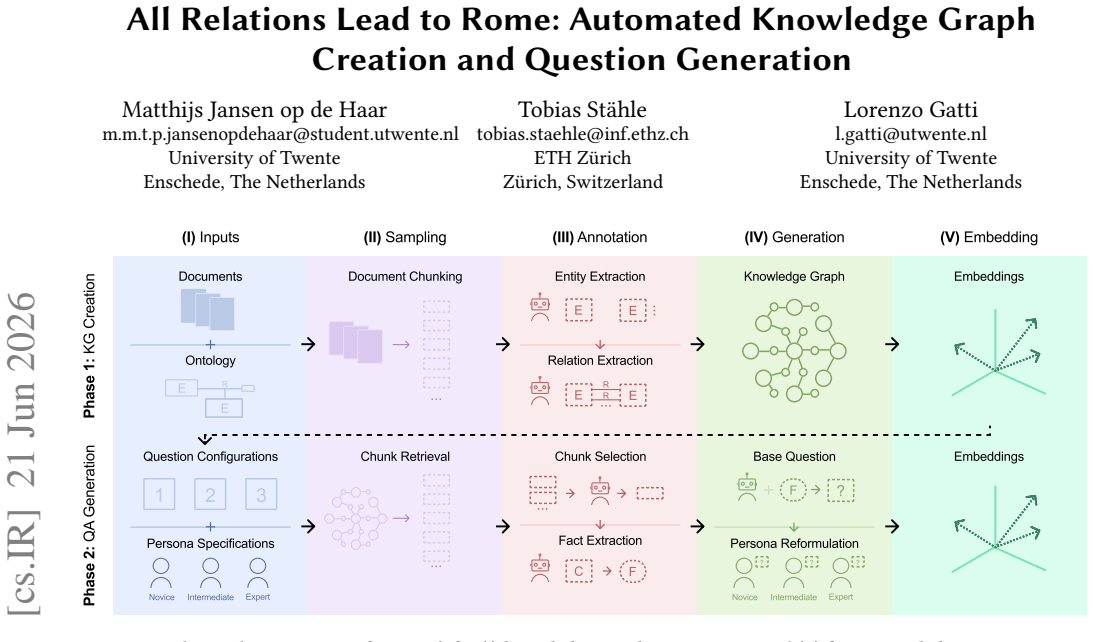
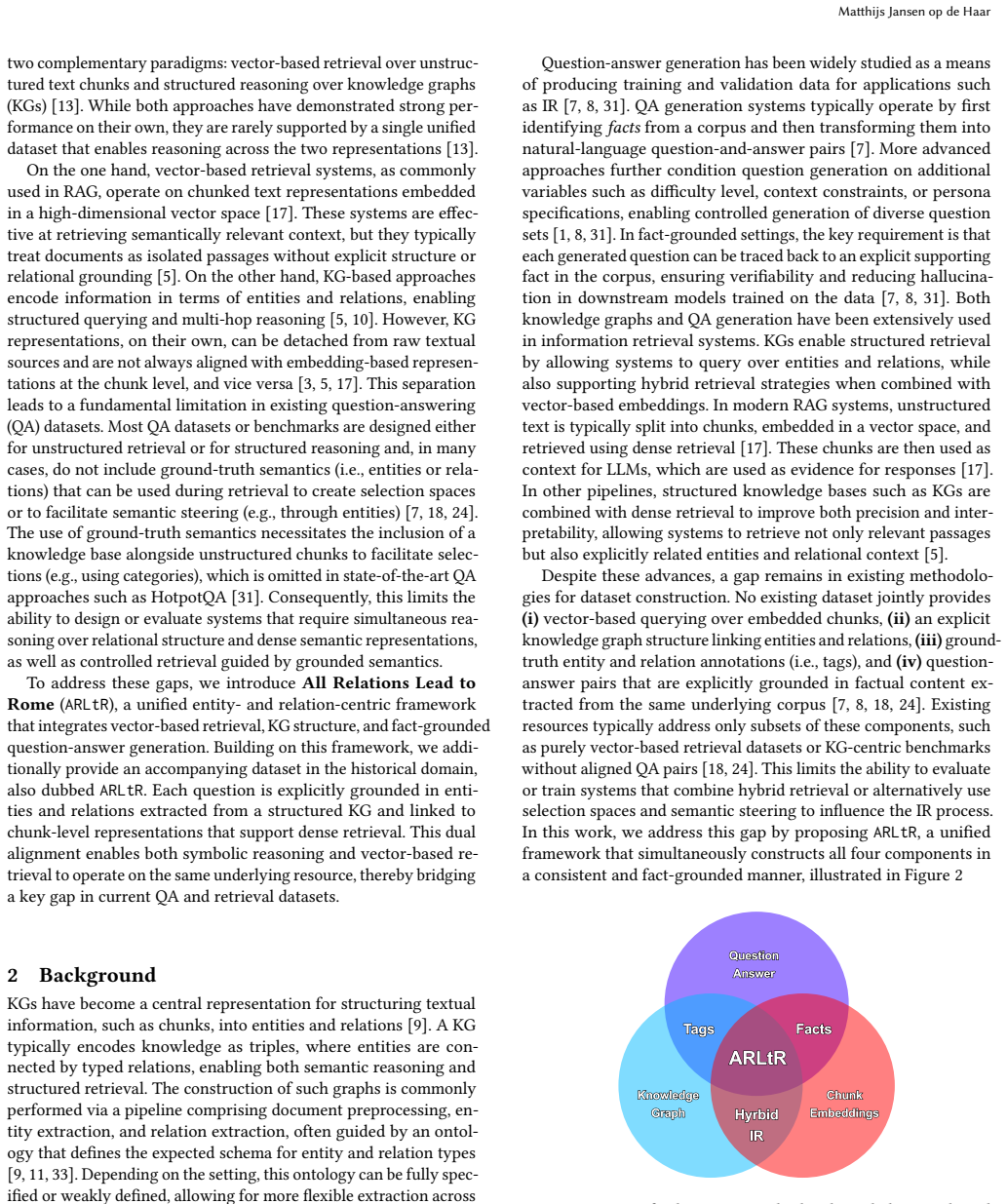
ARLtR jointly constructs a knowledge graph, embeddings, and question-answer pairs all grounded in extracted entities, relations, and textual evidence.
Reviewed by Pith at T0; open to challenge. T0 means a machine referee read the full paper against a public rubric. the ladder, T0–T4 →
T0 review · grok-4.3
2026-07-03 23:25 UTC pith:JYAADSAA
load-bearing objection ARLtR gives a Roman Empire dataset for hybrid KG-vector work but supplies zero evidence on extraction accuracy. the 1 major comments →
All Relations Lead to Rome: Automated Knowledge Graph Creation and Question Generation
The pith
A machine-rendered reading of the paper's core claim, the machinery that carries it, and where it could break.
Core claim
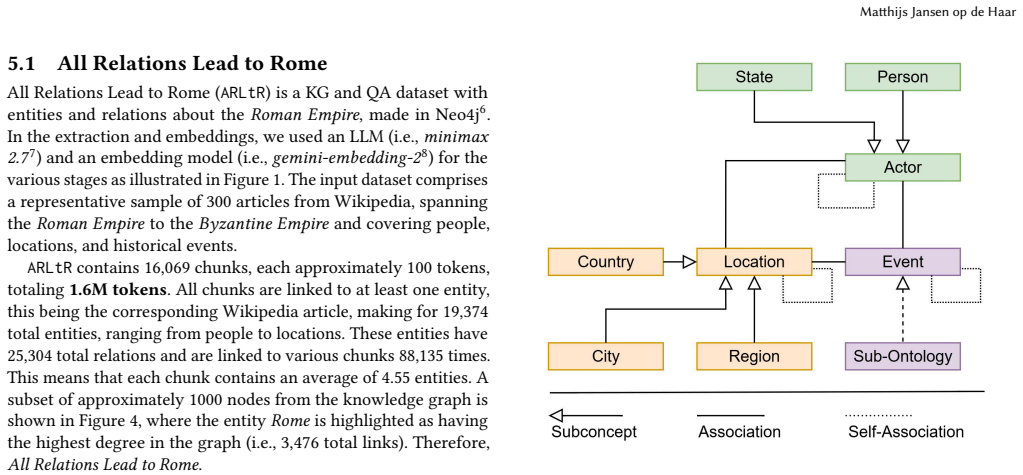
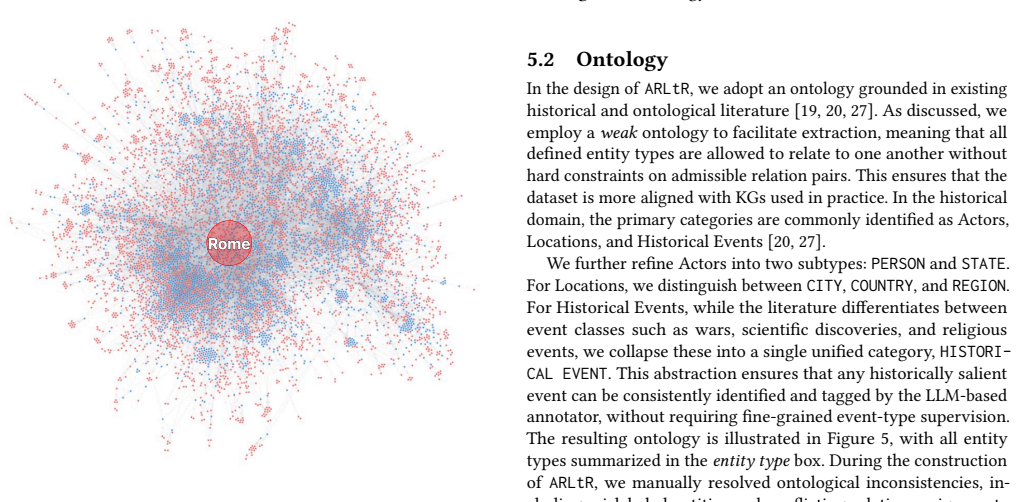
ARLtR is a unified framework for automated knowledge graph construction and fact-grounded question-answer generation. It jointly produces a knowledge graph, embeddings, and question-answer pairs that are explicitly grounded in extracted entities, relations, and supporting textual evidence. The framework is instantiated as a historical dataset centered on the Roman Empire that contains over 19,000 entities, 16,000 chunks, and 8,400 question-answer pairs.
What carries the argument
The ARLtR framework, which couples symbolic graph representations with dense retrieval representations through shared entities, relations, and textual evidence.
Load-bearing premise
The automated extraction process produces accurate entities, relations, and fact-grounded questions without substantial errors or the need for manual correction.
What would settle it
Manual review of a sample of the generated question-answer pairs revealing that many answers are not supported by the cited text chunks or that entities and relations contain frequent factual errors would show the outputs are not reliably grounded.
If this is right
- Enables direct evaluation of hybrid retrieval systems that combine vector-based search over text with reasoning over the knowledge graph.
- Supplies ground-truth entities, relations, and fact-grounded question-answer pairs aligned with the underlying corpus for benchmarking.
- Supports development of semantic steering methods that operate on both the graph and embedding spaces within one coherent resource.
- Allows the same automated pipeline to be run on other corpora to produce additional aligned datasets.
Where Pith is reading between the lines
- The same grounding mechanism could be used to create training data for retrieval-augmented generation models that must cite specific text and graph paths.
- Applying the pipeline to scientific papers might produce question sets that test whether models can retrieve both passages and related concepts.
- The explicit alignment between chunks, entities, and questions offers a way to measure how much a model relies on the graph versus the raw text during answer generation.
Editorial analysis
A structured set of objections, weighed in public.
Referee Report
Summary. The manuscript introduces All Relations Lead to Rome (ARLtR), a unified framework for automated knowledge graph construction and fact-grounded question-answer generation from text corpora. It claims to jointly produce a KG, embeddings, and QA pairs explicitly grounded in extracted entities, relations, and textual evidence, and instantiates this on a Roman Empire historical corpus yielding over 19,000 entities, 16,000 chunks, and 8,400 QA pairs, released on Hugging Face to support evaluation of hybrid retrieval systems.
Significance. If the automated extraction reliably produces accurate grounded representations, the work would provide a valuable unified benchmark bridging vector retrieval and symbolic KG reasoning, addressing a noted gap in existing datasets. The public dataset release is a concrete strength that enables reproducibility and development of hybrid IR methods.
major comments (1)
- [Abstract] Abstract: The central claim that ARLtR 'jointly constructs a knowledge graph, embeddings, and question-answer pairs that are explicitly grounded in extracted entities, relations, and supporting textual evidence' is load-bearing, yet the description supplies output sizes (19k entities, 8.4k QA pairs) with no extraction method details, precision/recall metrics, human validation results, or error analysis on a held-out sample. This prevents verification of whether the grounding holds without substantial manual correction.
Simulated Author's Rebuttal
We thank the referee for their constructive feedback and positive note on the dataset release. We address the single major comment below.
read point-by-point responses
-
Referee: [Abstract] Abstract: The central claim that ARLtR 'jointly constructs a knowledge graph, embeddings, and question-answer pairs that are explicitly grounded in extracted entities, relations, and supporting textual evidence' is load-bearing, yet the description supplies output sizes (19k entities, 8.4k QA pairs) with no extraction method details, precision/recall metrics, human validation results, or error analysis on a held-out sample. This prevents verification of whether the grounding holds without substantial manual correction.
Authors: The abstract is intentionally high-level. The full manuscript details the extraction pipeline in Sections 3 (KG construction via LLM-based entity/relation extraction with chunk grounding) and 4 (QA generation), including prompts, post-processing, and alignment to source text. We agree that precision/recall, human validation, and error analysis on a held-out sample are absent from the current version and constitute a genuine gap. We will add these in the revision, reporting results from manual review of a 200-triple sample plus QA pair validation. revision: yes
Circularity Check
No circularity: construction framework with no derivations or fitted predictions
full rationale
The paper describes an automated framework for building a knowledge graph, embeddings, and QA pairs from a corpus, instantiated as the ARLtR dataset. No mathematical derivations, equations, parameter fitting, or predictions are present in the abstract or described structure. The central output is a constructed resource whose grounding depends on the extraction pipeline's accuracy (an empirical claim, not a definitional loop). No self-citation chains, ansatzes, or renamings of known results are invoked as load-bearing steps. This is a standard engineering contribution whose validity rests on external validation metrics, not internal reduction to inputs.
Axiom & Free-Parameter Ledger
read the original abstract
Large language models have substantially improved information retrieval and question answering; however, existing datasets generally support either vector-based retrieval over unstructured text or reasoning over knowledge graphs, without providing a unified representation that combines both paradigms. Moreover, current benchmarks rarely provide ground-truth entities, relations, and fact-grounded question-answer pairs aligned with the underlying corpus. To address this gap, we introduce All Relations Lead to Rome (ARLtR), a unified framework for automated knowledge graph construction and fact-grounded question-answer generation. ARLtR jointly constructs a knowledge graph, embeddings, and question-answer pairs that are explicitly grounded in extracted entities, relations, and supporting textual evidence. We further instantiate the framework as a historical dataset centered on the Roman Empire, comprising over 19,000 entities, 16,000 chunks, and 8,400 question-answer pairs (https://huggingface.co/datasets/FaynePro/all-relations-lead-to-rome). By tightly coupling symbolic graph representations with dense retrieval representations, ARLtR facilitates the evaluation and development of hybrid retrieval systems and semantic steering approaches within a single coherent resource.
Figures
Forward citations
Cited by 1 Pith paper
-
GuidedRAG: Semantic Steering of Retrieval-Augmented Generation
Pre-filtering a RAG knowledge base by user semantics before retrieval improves relevance and cuts search cost; measured gains rely on gold semantic labels.
Reference graph
Works this paper leans on
-
[1]
Persona-SQ: A Personalized Suggested Question Generation Framework For Real-world Documents
2025. Persona-SQ: A Personalized Suggested Question Generation Framework For Real-world Documents. InProceedings of the 2025 Conference of the Nations of the Americas Chapter of the Association for Computational Linguistics: Human Language Technologies (System Demonstrations), Nouha Dziri, Sean (Xiang) Ren, and Shizhe Diao (Eds.). 210–247. doi:10.18653/v1...
-
[2]
Dang Anh-Hoang, Vu Tran, and Le-Minh Nguyen. 2025. Survey and analysis of hallucinations in large language models: attribution to prompting strategies or model behavior.Frontiers in Artificial IntelligenceVolume 8 - 2025 (2025). doi:10.3389/frai.2025.1622292
-
[3]
Xin Dong, Evgeniy Gabrilovich, Geremy Heitz, et al. 2014. Knowledge vault: a web-scale approach to probabilistic knowledge fusion. InProceedings of the 20th ACM SIGKDD International Conference on Knowledge Discovery and Data Mining. 601–610. doi:10.1145/2623330.2623623
-
[4]
Mohnish Dubey, Debayan Banerjee, Debanjan Chaudhuri, et al . 2018. EARL: Joint Entity and Relation Linking for Question Answering over Knowledge Graphs. InThe Semantic Web – ISWC 2018: 17th International Semantic Web Conference, Monterey, CA, USA, October 8–12, 2018, Proceedings, Part I. 108–126. doi:10.1007/978-3-030-00671-6_7
-
[5]
Darren Edge, Ha Trinh, Newman Cheng, et al . 2025. From Local to Global: A Graph RAG Approach to Query-Focused Summarization. arXiv:2404.16130 [cs.CL] https://arxiv.org/abs/2404.16130
work page internal anchor Pith review Pith/arXiv arXiv 2025
-
[6]
Amer Farea, Zhen Yang, Kien Duong, et al. 2025. Evaluation of Question An- swering Systems: Complexity of Judging a Natural Language.ACM Comput. Surv.58, 1 (2025), 1–43. doi:10.1145/3744663
- [7]
-
[8]
Shash Guo, Lizi Liao, Cuiping Li, et al . 2024. A survey on neural question generation: methods, applications, and prospects. InProceedings of the Thirty- Third International Joint Conference on Artificial Intelligence. Article 889, 8038– 8047 pages. doi:10.24963/ijcai.2024/889
-
[9]
Aidan Hogan, Eva Blomqvist, Michael Cochez, et al. 2021. Knowledge Graphs. 54, 4, Article 71 (2021), 37 pages. doi:10.1145/3447772
-
[10]
Yizheng Huang and Jimmy Xiangji Huang. 2026. A Survey on Retrieval- Augmented Text Generation for Large Language Models.ACM Comput. Surv.58, 12, Article 300 (2026), 38 pages. doi:10.1145/3805774
-
[11]
Shaoxiong Ji, Shirui Pan, Erik Cambria, et al . 2022. A Survey on Knowledge Graphs: Representation, Acquisition, and Applications.IEEE Transactions on Neural Networks and Learning Systems33, 2 (2022), 494–514. doi:10.1109/TNNLS. 2021.3070843
-
[12]
Mandar Joshi, Eunsol Choi, Daniel Weld, et al. 2017. TriviaQA: A Large Scale Distantly Supervised Challenge Dataset for Reading Comprehension. InProceed- ings of the 55th Annual Meeting of the Association for Computational Linguistics (Volume 1: Long Papers). 1601–1611. doi:10.18653/v1/P17-1147
-
[13]
Amir Abbas Kamalipour, Shahrokh Asadi, and Mohammad Mahyar Amiri Chimeh. 2026. From vectors to knowledge graphs: A comprehensive analy- sis of modern retrieval-augmented generation architectures.Computer Science Review61 (2026), 100925. doi:10.1016/j.cosrev.2026.100925
-
[14]
Yuri Kuratov, Aydar Bulatov, Petr Anokhin, et al . 2024. In Search of Needles in a 11M Haystack: Recurrent Memory Finds What LLMs Miss. arXiv:2402.10790 [cs.CL] https://arxiv.org/abs/2402.10790
work page Pith review arXiv 2024
-
[15]
Tom Kwiatkowski, Jennimaria Palomaki, Olivia Redfield, et al. 2019. Natural Questions: A Benchmark for Question Answering Research.Transactions of the Association for Computational Linguistics7 (2019), 452–466. doi:10.1162/tacl_a_ 00276
-
[16]
Yunshi Lan, Gaole He, Jinhao Jiang, et al . 2023. Complex Knowledge Base Question Answering: A Survey.IEEE Transactions on Knowledge and Data Engineering35, 11 (2023), 11196–11215. doi:10.1109/TKDE.2022.3223858
-
[17]
Patrick Lewis, Ethan Perez, Aleksandra Piktus, et al. 2020. Retrieval-augmented generation for knowledge-intensive NLP tasks. InProceedings of the 34th In- ternational Conference on Neural Information Processing Systems. Article 793, 9459–9474 pages
work page 2020
- [18]
-
[19]
Albert Meroño-Peñuela, Ashkan Ashkpour, Marieke van Erp, et al. 2015. Semantic technologies for historical research: A survey.Semantic Web6, 6 (2015), 539–564. doi:10.3233/SW-140158
-
[20]
Gabor Nagypal. 2005. History ontology building: The technical view. InPro- ceedings of the 16th International Conference of the Association for History and Computing (AHC 2005). Royal Netherlands Academy of Arts and Sciences, 207– 214
work page 2005
-
[21]
Antti Oulasvirta, Mikael Wahlström, and K. Anders Ericsson. 2011. What does it mean to be good at using a mobile device? An investigation of three levels of experience and skill.International Journal of Human-Computer Studies69, 3 (2011), 155–169. doi:10.1016/j.ijhcs.2010.11.003
-
[22]
Fabio Petroni, Aleksandra Piktus, Angela Fan, et al. 2021. KILT: a Benchmark for Knowledge Intensive Language Tasks. InProceedings of the 2021 Conference of the North American Chapter of the Association for Computational Linguistics: Human Language Technologies. 2523–2544. doi:10.18653/v1/2021.naacl-main.200
-
[23]
Haritz Puerto, Gözde Şahin, and Iryna Gurevych. 2023. MetaQA: Combining Expert Agents for Multi-Skill Question Answering. InProceedings of the 17th Con- ference of the European Chapter of the Association for Computational Linguistics. 3566–3580. doi:10.18653/v1/2023.eacl-main.259
-
[24]
Mikhail Salnikov, Hai Le, Prateek Rajput, et al. 2023. Large Language Models Meet Knowledge Graphs to Answer Factoid Questions. InProceedings of the 37th Pacific Asia Conference on Language, Information and Computation. 635–644. https://aclanthology.org/2023.paclic-1.63/
work page 2023
-
[25]
Richard Benjamins, and Dieter Fensel
Rudi Studer, V. Richard Benjamins, and Dieter Fensel. 1998. Knowledge en- gineering: principles and methods.Data Knowl. Eng.25, 1–2 (1998), 161–197. doi:10.1016/S0169-023X(97)00056-6
-
[26]
Alon Talmor and Jonathan Berant. 2018. The Web as a Knowledge-Base for Answering Complex Questions. InProceedings of the 2018 Conference of the North American Chapter of the Association for Computational Linguistics: Human Language Technologies, Volume 1 (Long Papers). 641–651. doi:10.18653/v1/N18- 1059
-
[27]
Esther Travé Allepuz, Pablo del Fresno Bernal, and Alfred Mauri Martí. 2020. Ontology-Mediated Historical Data Modeling: Theoretical and Practical Tools for an Integrated Construction of the Past.Information11, 4 (2020). doi:10.3390/ info11040182
work page 2020
-
[28]
Elena Volkanovska. 2025. A Study of Errors in the Output of Large Language Models for Domain-Specific Few-Shot Named Entity Recognition.Journal for Language Technology and Computational Linguistics38, 2 (2025), 31–42. doi:10. 21248/jlcl.38.2025.281
work page 2025
-
[29]
Yuze Wang, Mingxiang Shi, Xiulei Qin, et al. 2025. Research on Construction and Application of Knowledge Graph in Science and Technology Field Based on Large Language Model. InProceedings of the 2025 6th International Conference on Education, Knowledge and Information Management. 343–349. doi:10.1145/ 3756580.3756635
-
[30]
Jason Wei, Xuezhi Wang, Dale Schuurmans, et al. 2022. Chain-of-thought prompt- ing elicits reasoning in large language models. InProceedings of the 36th Interna- tional Conference on Neural Information Processing Systems. Article 1800
work page 2022
-
[31]
Zhilin Yang, Peng Qi, Saizheng Zhang, et al . 2018. HotpotQA: A Dataset for Diverse, Explainable Multi-hop Question Answering. InProceedings of the 2018 Conference on Empirical Methods in Natural Language Processing. 2369–2380. doi:10.18653/v1/D18-1259
-
[32]
Wen-tau Yih, Matthew Richardson, Chris Meek, et al. 2016. The Value of Semantic Parse Labeling for Knowledge Base Question Answering. InProceedings of the All Relations Lead to Rome: Automated Knowledge Graph Creation and Question Generation 54th Annual Meeting of the Association for Computational Linguistics (Volume 2: Short Papers). 201–206. doi:10.1865...
-
[33]
Lingfeng Zhong, Jia Wu, Qian Li, et al . 2023. A Comprehensive Survey on Automatic Knowledge Graph Construction.ACM Comput. Surv.56, 4, Article 94 (2023), 62 pages. doi:10.1145/3618295
-
[34]
Yutao Zhu, Huaying Yuan, Shuting Wang, et al. 2025. Large Language Models for Information Retrieval: A Survey.ACM Trans. Inf. Syst.44, 1, Article 12 (2025), 54 pages. doi:10.1145/3748304 Matthijs Jansen op de Haar A Persona Descriptions and Prompt In this section, we present the persona descriptions used in ARLtR for reformulating each base question. Thes...
discussion (0)
Sign in with ORCID, Apple, or X to comment. Anyone can read and Pith papers without signing in.