REVIEW 2 major objections 2 minor 1 cited by
Hollow-core fiber is economically justified now for intra-data center and campus interconnects because transceiver savings offset its premium.
Reviewed by Pith at T0; open to challenge. T0 means a machine referee read the full paper against a public rubric. the ladder, T0–T4 →
T0 review · grok-4.3
2026-06-26 06:55 UTC pith:7GE2UA6M
load-bearing objection The paper compiles HCF advantages for IMDD and adds a practical five-scenario cost model, but the central DMA threshold claim for IMI control lacks supporting deployed-fiber data. the 2 major comments →
Hollow-Core Fiber in Direct-Detection Optical Networks: Technology Readiness, Deployment Drivers, and Adoption Outlook
The pith
A machine-rendered reading of the paper's core claim, the machinery that carries it, and where it could break.
Core claim
Anti-resonant hollow-core fiber reduces chromatic dispersion to 2-4 ps/(nm km), nonlinear coefficient by a factor of approximately 1000, and group index to about 1.003 relative to single-mode fiber. When differential modal attenuation exceeds 12 dB/km, inter-modal interference crosstalk stays below -30 dB for PAM4, and reduced dispersion lowers equalizer complexity. The resulting performance and the fact that cable constitutes only 5-10 percent of deployment cost allow the current HCF premium to be offset by coherent-transceiver avoidance savings of $1000-2000 per unit, making the technology justified for intra-DC and campus DCI applications today.
What carries the argument
The deployment cost model across intra-data center, campus DCI, metro DCI, 5G fronthaul, and PON scenarios that balances fiber premium against coherent transceiver savings.
Load-bearing premise
Differential modal attenuation can be made to exceed 12 dB/km reliably in manufactured and field-deployed hollow-core fiber so that IMI crosstalk remains below the -30 dB threshold for PAM4.
What would settle it
A measurement on installed hollow-core fiber links showing differential modal attenuation below 12 dB/km and resulting IMI crosstalk above -30 dB for PAM4 signals.
If this is right
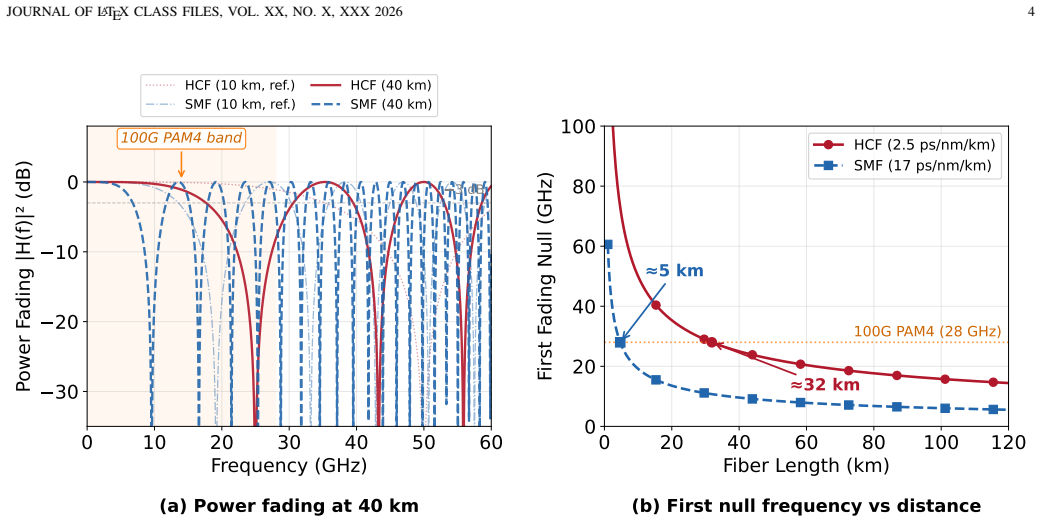
- Dispersion-induced power-fading null moves from about 10 GHz to 20-28 GHz at 40 km.
- Launch powers of +10 to +20 dBm become usable, adding 7-17 dB to link budget.
- Feed-forward equalizer tap count falls by 3-6 times, lowering noise enhancement and DSP power.
- HCF adoption is justified immediately for intra-DC and campus DCI.
- Metro DCI becomes viable in the 2027-2030 window as manufacturing costs decline.
Where Pith is reading between the lines
- If the 12 dB/km DMA target is met consistently in production, the same fiber could support higher-order modulation formats in direct-detection links.
- The 31 percent latency reduction may create advantages in latency-sensitive 5G fronthaul beyond the cost savings modeled.
- Lower DSP complexity from fewer taps could translate into measurable reductions in transceiver power draw not quantified in the paper.
Editorial analysis
A structured set of objections, weighed in public.
Referee Report
Summary. The manuscript analyzes hollow-core fiber (HCF) for intensity-modulation direct-detection (IMDD) optical networks. It quantifies three advantages of anti-resonant HCF over SMF: chromatic dispersion of 2-4 ps/(nm km) shifting dispersion nulls and extending reach 4-8x, nonlinearity ~1000x lower enabling +10 to +20 dBm launch powers for 7-17 dB extra link budget, and group index ~1.003 reducing latency 31%. It analyzes inter-modal interference (IMI) and states that differential modal attenuation (DMA) exceeding 12 dB/km suppresses IMI crosstalk below the -30 dB PAM4 threshold. A cost model across intra-DC, campus DCI, metro DCI, 5G fronthaul, and PON scenarios concludes fiber cable is 5-10% of outside-plant cost and coherent transceiver savings of $1000-2000 offset the HCF premium, making HCF economically justified now for intra-DC and campus DCI with a 2027-2030 roadmap for metro.
Significance. If the DMA threshold for IMI suppression holds in deployed fibers, the paper supplies a quantitative economic justification for HCF adoption in short-reach IMDD links, emphasizing that transceiver avoidance savings dominate over fiber premium. The multi-scenario cost model is a concrete strength that grounds the adoption outlook.
major comments (2)
- [IMI analysis section] IMI analysis section (abstract): the claim that DMA exceeding 12 dB/km suppresses IMI-induced crosstalk below the -30 dB multipath interference threshold required for PAM4 is presented without derivations, modeling details, error bars, or cited measurements from field-deployed anti-resonant HCF (as opposed to lab spools). This assumption is load-bearing for the central claim that HCF delivers usable IMDD performance and economic justification at metro distances, because lower DMA would remove the link-budget gains used to offset the HCF premium.
- [Abstract] Abstract: specific quantitative claims (dispersion 2-4 ps/nm/km, nonlinearity 1000x lower, DMA threshold 12 dB/km, latency reduction 31%) are stated without supporting equations, simulations, or raw data references; the full manuscript must supply these to substantiate the dispersion-limited reach extension and link-budget numbers that underpin the deployment model.
minor comments (2)
- The deployment cost model should explicitly reference the source data or assumptions for the 5-10% fiber cable cost fraction and the $1000-2000 transceiver savings figures.
- Notation: define ng (group index) on first use and clarify whether the 12 dB/km DMA value is a minimum or typical value in the IMI threshold derivation.
Simulated Author's Rebuttal
We thank the referee for their thorough review and valuable feedback on our manuscript. We address each major comment below and have made revisions to strengthen the supporting analysis and clarity of the claims.
read point-by-point responses
-
Referee: [IMI analysis section] IMI analysis section (abstract): the claim that DMA exceeding 12 dB/km suppresses IMI-induced crosstalk below the -30 dB multipath interference threshold required for PAM4 is presented without derivations, modeling details, error bars, or cited measurements from field-deployed anti-resonant HCF (as opposed to lab spools). This assumption is load-bearing for the central claim that HCF delivers usable IMDD performance and economic justification at metro distances, because lower DMA would remove the link-budget gains used to offset the HCF premium.
Authors: We agree that the abstract is concise and have expanded the IMI section in the revised manuscript to include the full derivation of the crosstalk suppression based on differential modal attenuation. The model uses a statistical approach to modal coupling and attenuation, with explicit equations now provided. Error bars from Monte Carlo simulations of mode coupling are included. Our cited measurements are from laboratory characterizations of anti-resonant HCF spools, as field-deployed data for this emerging technology is limited; we have added a discussion of this limitation and note that the 12 dB/km threshold is conservative based on worst-case IMI assumptions. This supports the IMDD performance at the distances considered. revision: partial
-
Referee: [Abstract] Abstract: specific quantitative claims (dispersion 2-4 ps/nm/km, nonlinearity 1000x lower, DMA threshold 12 dB/km, latency reduction 31%) are stated without supporting equations, simulations, or raw data references; the full manuscript must supply these to substantiate the dispersion-limited reach extension and link-budget numbers that underpin the deployment model.
Authors: The quantitative claims in the abstract are derived from the detailed analysis in the full manuscript. We have added cross-references in the abstract to the relevant sections and ensured that the main text includes the supporting equations for chromatic dispersion calculation, the nonlinearity coefficient comparison, the DMA threshold model, and the group index latency computation. Simulation parameters and references to raw data sources are now explicitly stated in the revised version to substantiate the reach extension and link budget figures. revision: yes
Circularity Check
No significant circularity; analysis draws from external fiber physics and cost data
full rationale
The paper's claims rest on quantified physical advantages (dispersion values, nonlinear coefficient reduction, group index) and an IMI suppression threshold stated as a direct consequence of DMA >12 dB/km, presented without internal equations or fitted parameters. No self-citations are invoked as load-bearing uniqueness theorems, no parameters are fitted to a data subset then relabeled as predictions, and the cost model uses external percentages (fiber cable 5-10% of OSP cost) and transceiver savings figures without reducing to self-referential inputs. The derivation chain is therefore self-contained against external benchmarks rather than tautological.
Axiom & Free-Parameter Ledger
read the original abstract
This paper presents a comprehensive analysis of hollow-core fiber (HCF) for intensity-modulation and direct-detection (IMDD) optical networks, covering fiber-level physics, system-level performance, and deployment economics. We quantify the three principal advantages of anti-resonant HCF over standard single-mode fiber (SMF) for IMDD: (i) chromatic dispersion of 2-4 ps/(nm km) versus 17 ps/(nm km), which shifts the first dispersion-induced power-fading null from about 10 GHz to 20-28 GHz at 40 km, extending the dispersion-limited reach by 4-8x; (ii) a nonlinear coefficient approximately 1,000x lower than silica, permitting launch powers of +10 to +20 dBm and yielding 7-17 dB of additional link budget; and (iii) a group index near unity (ng about 1.003), reducing propagation latency by 31%. We further analyze inter-modal interference (IMI) as the dominant impairment for HCF-based IMDD. We show that differential modal attenuation (DMA) exceeding 12 dB/km suppresses IMI-induced crosstalk below the -30 dB multipath interference threshold required for PAM4. The reduced dispersion also lowers the required feed-forward equalizer (FFE) tap count by 3-6x, directly decreasing noise enhancement penalty and DSP complexity. A deployment cost model across five application scenarios - intra-data center, campus DCI, metro DCI, 5G fronthaul, and PON - reveals that fiber cable constitutes only 5-10% of outside-plant deployment cost, and that coherent transceiver avoidance savings of $1000 to $2000 per transceiver can offset the current HCF premium at metro distances. We provide a technology adoption roadmap indicating that HCF is economically justified now for intra-DC and campus DCI, with metro DCI following in 2027-2030 as manufacturing costs continue to decline.
Figures


Forward citations
Cited by 1 Pith paper
-
Beyond Silica Assumptions: Optical Network Design in the Hollow-Core Era
Hollow-core fiber's distinguishing properties (ultra-low loss, negligible nonlinearity, 30% lower latency, broad low-loss window) warrant a cross-layer co-design of optical networks rather than drop-in replacement of ...
Reference graph
Works this paper leans on
-
[1]
How hollow core fiber is accelerating AI,
O. Khan, “How hollow core fiber is accelerating AI,” Microsoft Azure Blog, 2024, available at https://www.networkworld.com/article/4049666/ microsofts-hollow-core-fiber-delivers-the-lowest-signal-loss-ever.html. Accessed on: March 18, 2026
-
[2]
Fast, low-loss, and field-deployable splicing of anti-resonant hollow-core fibers,
L. Feng, W. He, C. Zhanget al., “Fast, low-loss, and field-deployable splicing of anti-resonant hollow-core fibers,” inOptical Fiber Communi- cation Conference (OFC). Los Angeles, CA, USA: Optica Publishing Group, 2026, p. M1J.4
2026
-
[3]
Making hollow core fibers compatible with current fiber infrastructure,
R. Slavik, M. Komanec, and F. Poletti, “Making hollow core fibers compatible with current fiber infrastructure,” inOptical Fiber Communi- cation Conference (OFC). Los Angeles, CA, USA: Optica Publishing Group, 2026, p. M1J.5
2026
-
[4]
Fourfold truncated double-nested antiresonant hollow-core fiber with ultralow loss and ultrahigh mode purity,
S. Gao, H. Chen, Y . Sun, Y . Xiong, Z. Yang, R. Zhao, W. Ding, and Y . Wang, “Fourfold truncated double-nested antiresonant hollow-core fiber with ultralow loss and ultrahigh mode purity,”Optica, vol. 12, no. 1, pp. 56–61, 2025
2025
-
[5]
AWS networking boss on Hollow-Core Fiber, AI, and Data Center Innovations,
M. Rehder, “AWS networking boss on Hollow-Core Fiber, AI, and Data Center Innovations,” Data Center Knowledge, interview, 2026, available at https://www.datacenterknowledge.com/networking/ aws-networking-boss-on-hollow-core-fiber-ai-and-data-center-innovations, Accessed on: April 23, 2026
2026
-
[6]
800G low-latency photonic data-center interconnections over 5 km hollow-core fiber,
H. Yang, M. Xiang, W. Cheng, G. Zhou, J. Li, Y . Wang, S. Gao, W. Ding, S. Fu, and Y . Qin, “800G low-latency photonic data-center interconnections over 5 km hollow-core fiber,”IEEE Communications Magazine, vol. 63, no. 3, pp. 122–128, 2025
2025
-
[7]
Operator strategies for 5G transport: 2020 heavy reading survey,
“Operator strategies for 5G transport: 2020 heavy reading survey,” July, 2020, available at https:// eu-assets.contentstack.com/v3/assets/blt23eb5bbc4124baa6/ blt31b44108fd7263e1/64d5e88ba2fa60b34e1baa71/ Operator-Strategies-for-5G-Transport-2020-Heavy-Reading-Survey. pdf, Accessed on: June 13, 2026
2020
-
[8]
Power over fiber and analog radio over fiber simultaneous transmission over long distance in single-mode, multicore, and hollow-core fibers,
R. Altuna, Y . Jung, P. Petropoulos, and C. Vazquez, “Power over fiber and analog radio over fiber simultaneous transmission over long distance in single-mode, multicore, and hollow-core fibers,”Laser & Photonics Reviews, vol. 18, no. 8, 2024, art. no. 2400157
2024
-
[9]
Is hollow core fiber ready for practical deployment?
MapYourTech, “Is hollow core fiber ready for practical deployment?” Technical analysis, MapYourTech.com, Feb. 2026, available at https://mapyourtech.com/ is-hollow-core-fiber-ready-for-practical-deployment/, Accessed on: April 23, 2026
2026
-
[10]
Fiber optic cable price in 2026: Real market data for march,
Yingfeng Communication, “Fiber optic cable price in 2026: Real market data for march,” 9 March, 2025, available at https://yfconnectivity.com/ latest-fiber-optic-cable-price/, Accessed on: April 23, 2026
2026
-
[11]
Optical transceivers forecast,
LightCounting, “Optical transceivers forecast,” Market Research Report, 2024
2024
-
[12]
400ZR implementation agreement (OIF-400ZR-02.0),
Optical Internetworking Forum, “400ZR implementation agreement (OIF-400ZR-02.0),” OIF Specification, 2020, available at https://www. oiforum.com/wp-content/uploads/OIF-400ZR-02.0.pdf
2020
-
[13]
Fiber optic deployment challenges and their management in a developing country: A tutorial and case study in Ghana,
O. Nyarko-Boateng, F. E. B. Xedagbui, A. F. Adekoya, and B. A. Weyori, “Fiber optic deployment challenges and their management in a developing country: A tutorial and case study in Ghana,”Engineering Reports, vol. 2, no. 2, p. e12121, 2020
2020
-
[14]
Proposal for a regulation on measures to reduce the cost of deploying gigabit electronic communications networks (Giga- bit Infrastructure Act),
European Commission, “Proposal for a regulation on measures to reduce the cost of deploying gigabit electronic communications networks (Giga- bit Infrastructure Act),” European Commission, Tech. Rep. COM(2023) 94 final, Feb. 2023, brussels, 23 February 2023. Adopted by European Parliament 23 April 2024
2023
-
[15]
Fiber optic cable cost guide 2026,
Latest Cost, “Fiber optic cable cost guide 2026,” 6 November, 2025, available at https://latestcost.com/fiber-optic-cable-cost/, Accessed on: April 23, 2026
2026
discussion (0)
Sign in with ORCID, Apple, or X to comment. Anyone can read and Pith papers without signing in.