REVIEW 2 major objections 1 minor 2 cited by
RG running of neutrino mixing parameters interferes with mass ordering measurements at JUNO, but the near detector restores sensitivity by measuring those parameters.
Reviewed by Pith at T0; open to challenge. T0 means a machine referee read the full paper against a public rubric. the ladder, T0–T4 →
T0 review · grok-4.3
2026-06-25 23:32 UTC pith:A4B4SM26
load-bearing objection The paper maps specific RG beta functions onto JUNO's slow and fast modes and suggests TAO can disentangle them to protect mass-ordering sensitivity, but the separability claim rests on an assumption that needs explicit checks. the 2 major comments →
Disentangle RG Running Parameters with Medium-Baseline Reactor Experiments
The pith
A machine-rendered reading of the paper's core claim, the machinery that carries it, and where it could break.
Core claim
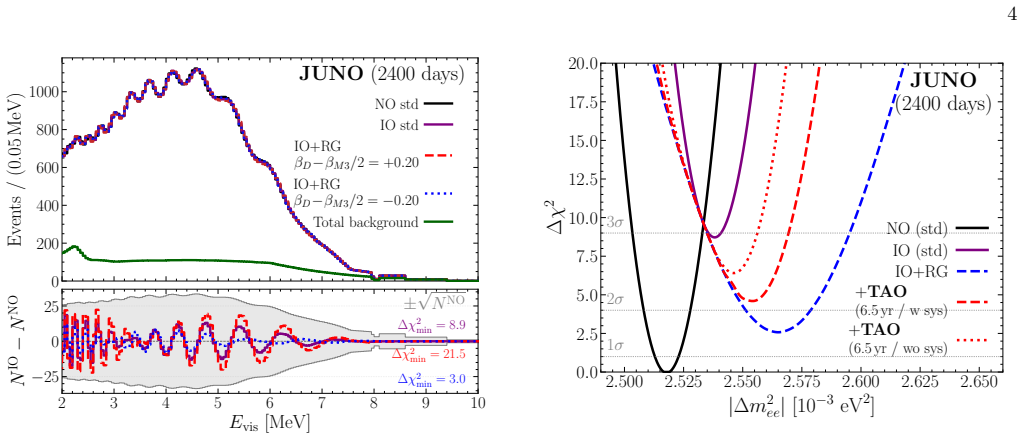
The fast oscillation mode at JUNO, which primarily determines the neutrino mass ordering, receives corrections from the beta functions of the Dirac CP phase and one Majorana CP phase; these effects can be disentangled and removed using supplementary measurements of the running parameters from the JUNO-TAO near detector.
What carries the argument
The RG beta functions of the PMNS parameters (specifically β_s for the solar mixing angle, β_δD for the Dirac phase, and β_M1, β_M3 for the Majorana phases) that alter the amplitudes and phases of the slow and fast oscillation modes.
Load-bearing premise
The beta functions of the mixing angles and CP phases are known well enough that their effects on the oscillation modes can be isolated and corrected using near-detector data without introducing new degeneracies.
What would settle it
A calculation showing that the RG corrections to the fast mode cannot be separated from the mass-ordering signal even after including constraints from the near detector.
If this is right
- The amplitude of the slow mode receives a correction from the solar-angle beta function β_s.
- The phase of the slow mode is shifted by the Majorana-phase beta function β_M1.
- The fast mode receives corrections from the Dirac-phase beta function β_δD and the Majorana-phase beta function β_M3.
- These corrections can reduce sensitivity to the neutrino mass ordering.
- The JUNO-TAO near detector supplies the measurements needed to restore that sensitivity.
Where Pith is reading between the lines
- Analyses of other medium-baseline reactor setups may need to treat RG running parameters as additional nuisance parameters when extracting mass ordering.
- Global neutrino fits that combine multiple experiments could incorporate energy-dependent running to avoid systematic biases in mass-ordering determinations.
Editorial analysis
A structured set of objections, weighed in public.
Referee Report
Summary. The manuscript examines how renormalization group (RG) running beta functions of the neutrino mixing angles and leptonic CP phases modify the slow and fast oscillation modes at JUNO. It argues that corrections from β_s and β_M1 affect the slow mode while β_δD and β_M3 affect the fast mode, with the latter interfering with mass-ordering extraction; the JUNO-TAO near detector is proposed to measure the RG parameters and thereby restore the ordering sensitivity.
Significance. If the claimed separability holds and the near-detector data can isolate the beta-function effects without new degeneracies, the result would be relevant for precision analyses at medium-baseline reactor experiments, identifying a previously under-appreciated systematic in mass-ordering determinations and illustrating a concrete use for near-detector constraints.
major comments (2)
- [Abstract] Abstract: the central claim that JUNO-TAO restores mass-ordering sensitivity by supplying independent measurements of the RG beta functions (β_s, β_δD, β_M1, β_M3) is load-bearing but unsupported by any explicit demonstration that these parameters can be extracted from the near-detector spectrum without introducing correlations with Δm²_31 or θ_13 that would degrade the ordering fit.
- [Abstract] Abstract: the statement that RG running 'can then interfere to deteriorate the sensitivity' of the fast mode assumes the beta functions remain separable from the standard PMNS parameters in the oscillation probability; no quantitative test or degeneracy analysis is referenced to establish that this separability survives in a joint fit.
minor comments (1)
- Notation for the beta functions (β_s, β_δD, β_M1, β_M3) is introduced without reference to the explicit renormalization-group equations or the effective mixing parameters they modify at reactor baselines.
Simulated Author's Rebuttal
We thank the referee for the careful review and constructive comments on our manuscript. The two major comments correctly identify that the abstract claims would benefit from explicit supporting analysis on parameter extraction and separability. We address each point below and will revise the manuscript to incorporate the requested demonstrations.
read point-by-point responses
-
Referee: [Abstract] Abstract: the central claim that JUNO-TAO restores mass-ordering sensitivity by supplying independent measurements of the RG beta functions (β_s, β_δD, β_M1, β_M3) is load-bearing but unsupported by any explicit demonstration that these parameters can be extracted from the near-detector spectrum without introducing correlations with Δm²_31 or θ_13 that would degrade the ordering fit.
Authors: We agree that the abstract presents the restoration claim without referencing the supporting near-detector fits. The body of the manuscript contains simulations of the TAO spectrum used to constrain the beta functions, but we will add an explicit discussion of the extracted parameter correlations (including with Δm²_31 and θ_13) and update the abstract to reference these results. A new paragraph and correlation table will be included in the revised version. revision: yes
-
Referee: [Abstract] Abstract: the statement that RG running 'can then interfere to deteriorate the sensitivity' of the fast mode assumes the beta functions remain separable from the standard PMNS parameters in the oscillation probability; no quantitative test or degeneracy analysis is referenced to establish that this separability survives in a joint fit.
Authors: The manuscript derives the RG-corrected probability and performs fits that treat the beta functions as additional parameters, implicitly assuming separability due to their distinct functional forms. However, we acknowledge the absence of an explicit joint-fit degeneracy study. We will add a dedicated subsection with multi-parameter fit results demonstrating that the beta-function effects remain separable from the standard PMNS parameters without significant degradation of the mass-ordering sensitivity. revision: yes
Circularity Check
No significant circularity in derivation chain
full rationale
The paper's central claim treats RG beta functions (β_s, β_δD, β_M1, β_M3) as external inputs whose effects on slow/fast oscillation modes are analyzed at JUNO baselines, with JUNO-TAO positioned as an independent supplementary measurement. No quoted equations or steps reduce any prediction to a fitted quantity defined by the same data, nor invoke self-citation chains or ansatze that collapse the result to its inputs by construction. The derivation remains self-contained against the standard PMNS framework and external RG evolution assumptions.
Axiom & Free-Parameter Ledger
read the original abstract
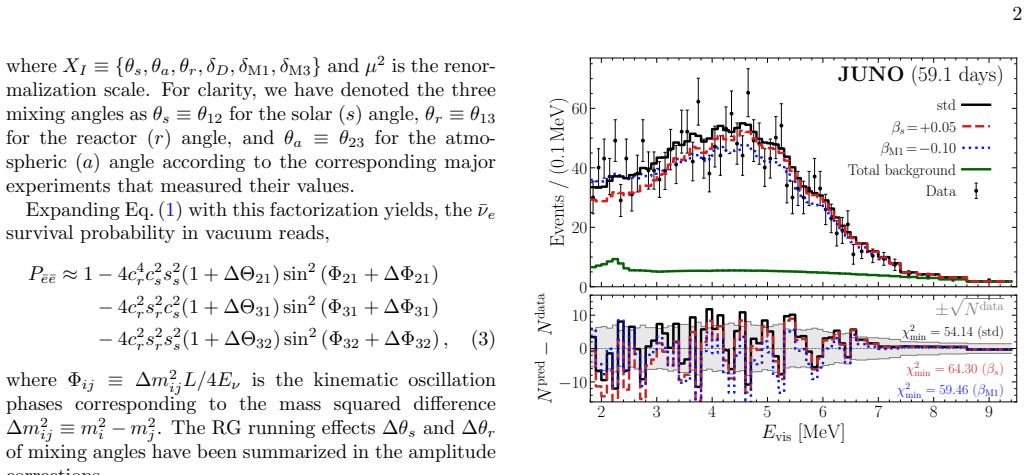
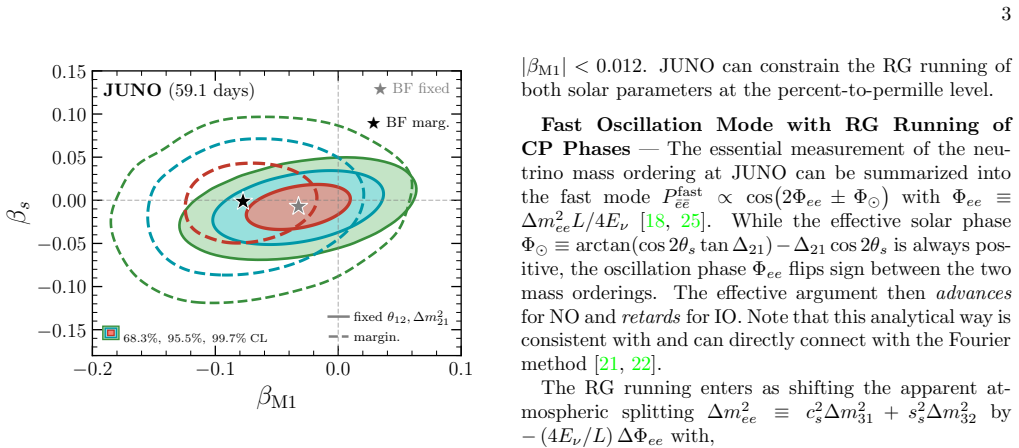
We study how the renormalization group running beta functions of mixing angles and leptonic CP phases affect the slow and fast oscillation modes at JUNO. While the slow mode is modulated by the solar parameters, its amplitude can also be affected by the solar angle beta function $\beta_s$ and its phase by the Majorana CP phase counterpart $\beta_{\rm M1}$. On the other hand, the fast mode also receives corrections from the beta functions of the Dirac CP phase $\delta_D$ and the Majorana CP phase $\delta_{\rm M3}$. Since the fast mode is essentially the one measuring the neutrino mass ordering, the RG running effect can then interfere to deteriorate the sensitivity. Fortunately, the JUNO-TAO near detector can provide supplementary measurements of the RG running parameters to restore the mass ordering sensitivity. Since the rephasing phases $\delta_{\rm M1}$ and $\delta_{\rm M3}$ can be shifted by a vector-like rephasing for Dirac neutrinos, their running is physical only in the Majorana case. In consolidated, the mild preference for a nonzero $\beta_{\rm M1}$ by the current JUNO data thus hints the Majorana nature of neutrinos.
Figures
Forward citations
Cited by 2 Pith papers
-
Neutrino cuboid for normal mass ordering and tribimaximal flavor mixing
A cuboid mass ansatz that sets mass angles equal to mixing angles predicts a nearly degenerate normal spectrum whose deviations from tribimaximal mixing are fixed by the observed mass-squared ratio.
-
Neutrino cuboid for normal mass ordering and tribimaximal flavor mixing
A geometric 'flavor cuboid' ansatz conjectures that neutrino mixing angles equal mass-parametrization angles, predicting a nearly degenerate normal mass ordering and a testable correlation among mixing angles and mass...
discussion (0)
Sign in with ORCID, Apple, or X to comment. Anyone can read and Pith papers without signing in.