REVIEW 5 major objections 5 minor 2 cited by
This paper claims that OPPO, a reinforcement-learning method that rewards precise cue coverage and penalizes hallucinated modality claims, makes emotion-reasoning models both more accurate and more faithful.
Reviewed by Pith at T0; open to challenge. T0 means a machine referee read the full paper against a public rubric. the ladder, T0–T4 →
T0 review · deepseek-v4-flash
2026-08-02 10:12 UTC pith:VPJ4JGWN
load-bearing objection A plausible RL recipe for multimodal emotion reasoning, but the faithfulness benchmark is rigged toward 'No' answers, so the headline perception gains aren't yet interpretable. the 5 major comments →
Omni-Perception Policy Optimization for Multimodal Emotion Reasoning
The pith
A machine-rendered reading of the paper's core claim, the machinery that carries it, and where it could break.
Core claim
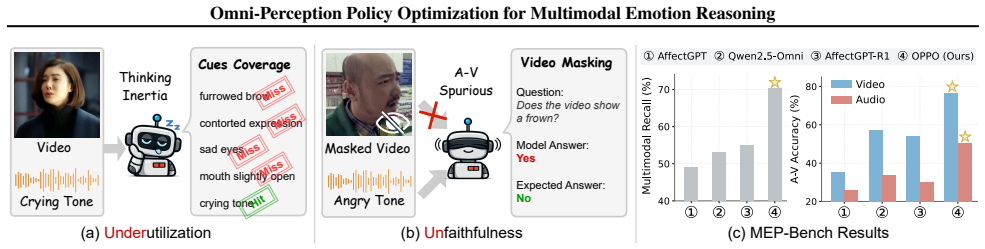
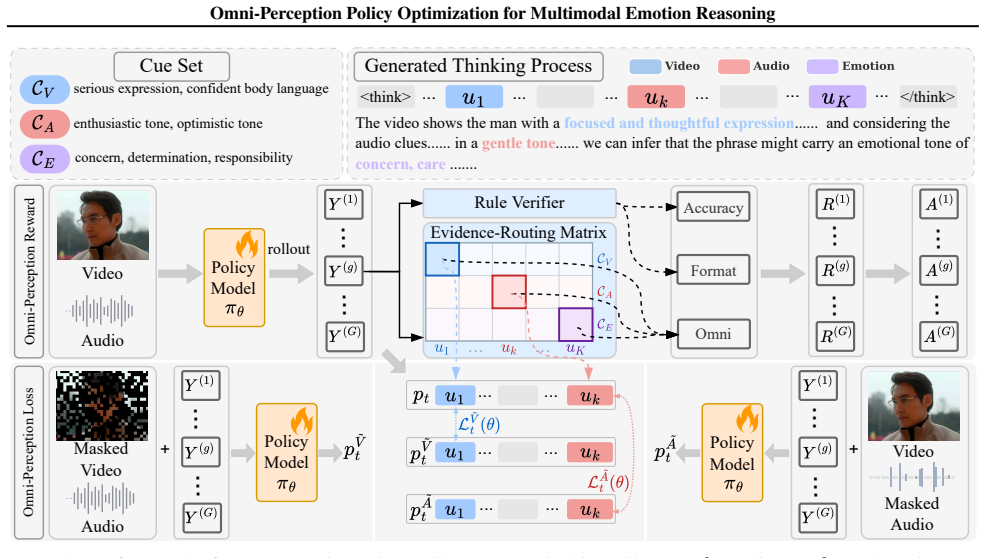
The central claim is that the two dominant failure modes of emotion-oriented omni-modal LLMs—underutilization of visual/acoustic evidence and cross-modal hallucination—can be corrected in one reinforcement-learning loop. OPPO first decomposes each ground-truth reasoning paragraph into atomic visual, acoustic, and emotion cues, then rewards the policy when its thinking clauses semantically cover those cues. It also compares the policy's token distributions under the full input versus video-masked or audio-masked inputs, applying a KL penalty only to tokens matched to the masked modality, so the model is pushed to retract modality-specific claims rather than to shift its whole distribution. Th
What carries the argument
The load-bearing object is the Evidence-Routing Matrix, whose rows are ground-truth visual, acoustic, and emotion cues, columns are clauses of the generated thinking, and entries are cosine similarities between embedded cue texts and embedded clause texts. This matrix simultaneously drives the Omni-Perception Reward—by taking each cue's best-matching clause as a coverage hit—and identifies which generated tokens are modality-specific, by assigning each retained clause to the modality of its best-matching cue. The Omni-Perception Loss then maximizes KL divergence between full-input and masked-input distributions on exactly those tokens, enforcing that statements about a modality genuinely dep
Load-bearing premise
The method assumes that ground-truth reasoning text can be automatically decomposed into the complete, correctly labeled set of visual, acoustic, and emotion cues, and that embedding similarity reliably detects whether a generated clause covers each cue; if this decomposition is incomplete or mislabeled, OPPO is rewarded and penalized for the wrong evidence, and MEP-Bench reports the same bias as a gain.
What would settle it
Construct a copy of MEP-Bench in which the ground-truth reasoning is manually pruned of one visual cue and one audio cue, then measure OPPO's reward and cue recall: if recall still rises and masked-probe accuracy still improves while the pruned cues remain uncovered, the method is optimizing coverage of the extraction pipeline's artifacts rather than genuine modality grounding. A sharper test: flip the modality label of a cue (mark a visual cue as audio) and check whether the video-masked faithfulness gain reverses.
If this is right
- If OPPO is correct, emotion reasoning can be substantially improved by directly optimizing perception: cue recall rises from about 58% to 70%, approaching human-oracle levels, while end-task accuracy also increases.
- Targeted, token-level KL penalties under unimodal masking are more effective than global masking penalties; global penalties can destabilize training and even degrade faithfulness.
- MEP-Bench provides a reusable diagnostic that separates utilization from faithfulness, exposing failure modes that accuracy alone hides.
- The improvements transfer across fine-grained emotion recognition, basic emotion recognition, and sentiment analysis, suggesting that perception-grounded RL benefits a broad range of MER tasks.
- The synergy between the loss and reward—where the loss appears to expand the faithful information channel and the reward converts that capacity into cue coverage—means that either component alone is insufficient.
Where Pith is reading between the lines
- Editorial inference: The same reward-loss decomposition could transfer to other multimodal reasoning domains where faithfulness is judged by recovering human-annotated evidence, such as medical image reporting or video question answering; the cue extraction step would need to be adapted to each domain's annotation style.
- Editorial inference: Because the reward relies on embedding similarity rather than exact phrase matching, it may systematically favor generic cues and under-credit novel but valid evidence a human would accept; an independent human judgment study could test whether the reward tracks reasoning quality beyond the annotated cue set.
- Editorial inference: The masking-ratio and threshold sweeps in the paper are consistent with an information-channel view: the loss sets an upper bound on how much modality-specific information can be recovered, and the reward converts that capacity into concrete coverage. A testable prediction is that gains should shrink when the embedding model cannot distinguish cues across modalities.
- Editorial inference: A simpler alternative—rewarding only the final emotion label—would not address faithfulness, because a model can produce correct answers while hallucinating evidence. The paper's diagnostic results suggest that reasoning-grounded evaluation should become standard alongside label accuracy.
Editorial analysis
A structured set of objections, weighed in public.
Referee Report
Summary. The paper argues that emotion-oriented Omni-MLLMs underutilize multimodal cues in their reasoning and produce unfaithful modality-specific claims under unimodal masking. It introduces MEP-Bench, a diagnostic benchmark for utilization (cue recall) and faithfulness (POPE-style probes under masking), and OPPO, a GRPO-based RL method with two components: an Omni-Perception Reward that scores coverage of GPT-5-extracted visual, acoustic, and emotion cues via embedding cosine similarity, and an Omni-Perception Loss that applies a KL penalty to modality-specific tokens when a modality is masked. Experiments report state-of-the-art results on MER-UniBench and MME-Emotion, and large gains on MEP-Bench utilization and faithfulness over a strong Baseline.
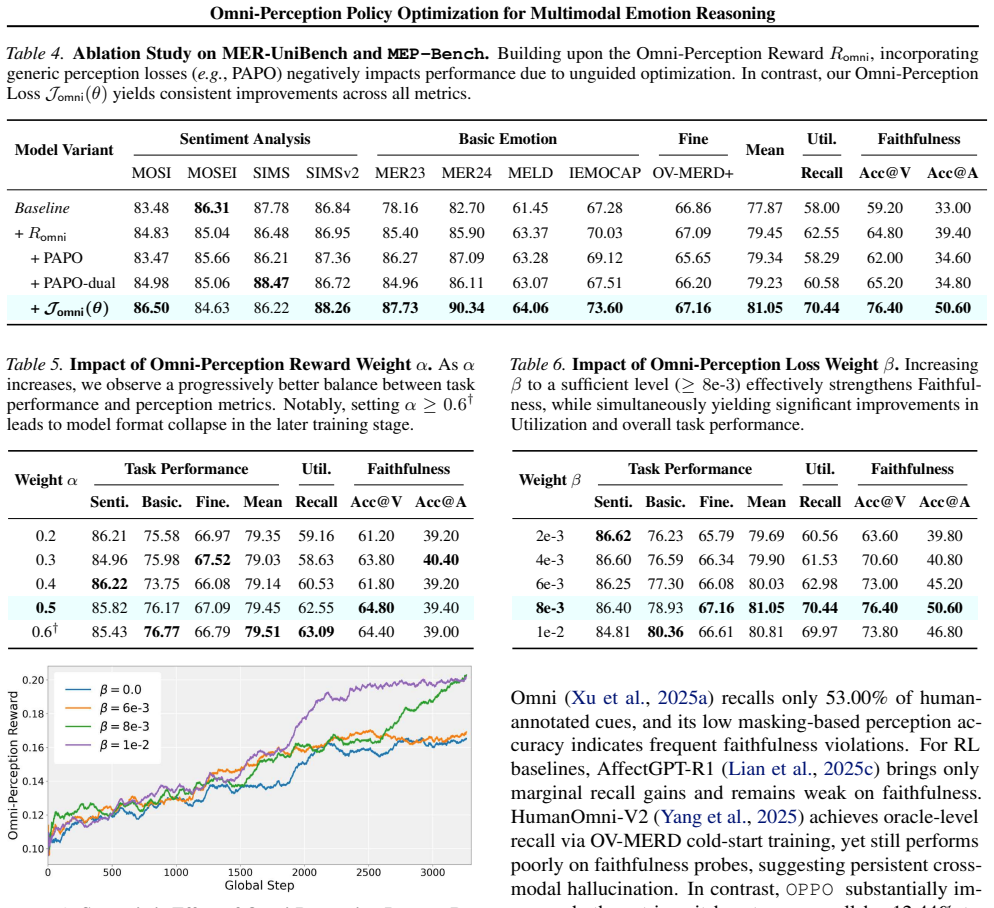
Significance. If the results hold, OPPO would be a practical and well-motivated step toward grounded multimodal emotion reasoning, and MEP-Bench could be a reusable diagnostic. The ablation in Table 4 is a strength: it isolates the reward, the proposed loss, and PAPO-style alternatives under a common baseline, and the paper's single-final-checkpoint evaluation protocol is more honest than per-dataset checkpoint selection. The qualitative examples in Appendix F are useful for understanding the intended behavior. However, the main evaluation metrics are partly entangled with the training objectives, and the faithfulness probe design does not by itself distinguish reduced hallucination from a refusal heuristic. These issues are load-bearing for the abstract's central claims, so the empirical conclusions are currently not fully supported.
major comments (5)
- [§4.2, Table 1, Appendix F] The faithfulness probes are all negative-example questions: the queried modality is masked, so 'No' is always the correct answer. OPPO's Omni-Perception Loss (Eq. 10) explicitly encourages the policy to change its distribution on modality-specific tokens when that modality is masked, so a learned refusal heuristic ('when video is absent, deny any visual claim') simultaneously maximizes the training objective and the MEP-Bench faithfulness score. The qualitative examples in Appendix F show OPPO consistently answering 'No' in concise form, exactly the signature of such a heuristic. Without control probes in which the queried cue is actually present (so 'Yes' is correct) and without false-'No' rates, the reported Acc@V/Acc@A gains cannot be interpreted as reduced cross-modal hallucination. Please add such controls and report balanced accuracy or d'.
- [§3.1 vs §4.2] The MEP-Bench utilization metric is computed with the same ingredients as the Omni-Perception Reward: Qwen3-Embedding and max-cosine matching of atomic cues, with thresholds 0.6 (MEP-Bench) and 0.5 (training, Eq. 3). Thus the +12.4 recall improvement is largely a re-measurement of the training objective, not an independent assessment of 'utilization'. Moreover, the cue extraction stage is never validated: no human agreement is reported for GPT-5 (training) or Qwen2.5-7B (evaluation) cue decomposition, and Appendix E's extraction prompt does not even request the emotion cues C_E used in Eq. (4). Please add a human-judged cue-coverage sample and/or use a different embedder and extraction pipeline for evaluation.
- [§4.3, Table 3] MME-Emotion was originally scored by GPT-4o; the paper re-scores all models with gemini-3.1-flash-lite-preview because GPT-4o is not available. This changes the evaluation instrument, so the absolute scores in Table 3 are not comparable with published MME-Emotion results, and the claim that 'OPPO achieves the best overall performance' is a claim about a modified benchmark. Please calibrate the new judge on a subset scored by the original judge (or report agreement), and either state the comparison is on 'MME-Emotion (Gemini judge)' or provide original-judge numbers for the key baselines.
- [Tables 2-4] No error bars or multiple seeds are reported. GRPO-based RL is stochastic, and the MEP-Bench test set contains only 300 samples and 500 probes, so the 3-5 point differences between OPPO and Baseline could be within run-to-run noise. Please run at least 3 independent RL seeds for Baseline and OPPO (and ideally for the Table 4 ablations), reporting mean±std, or bootstrap confidence intervals for the diagnostic metrics.
- [§3, C.3, Table 2] The MER-UniBench 'state-of-the-art' claim compares OPPO with AffectGPT-R1 under different training recipes: AffectGPT-R1 uses SFT on full MER-Caption+ and RL on 1k MER2025-OV samples, while OPPO uses 5k SFT and RL on the rest of MER-Caption+. Since the data split is known to affect RL outcomes (the authors themselves motivate their Baseline this way in C.3), the comparison is confounded. To support 'SoTA', please train an AffectGPT-R1 variant on the same 5k/remaining split and compare, or clearly restrict the claim to 'OPPO > Baseline under the authors' split'.
minor comments (5)
- [§3.2, Eq. (10)] The sets T_V and T_A are described as 'tokens' but are defined from clauses matched to cue types. The token-to-clause mapping is not specified; clarify how clause-level matching converts to token-level KL penalties.
- [Figure 3] The y-axis is unlabeled; specify what 'reward value' denotes (e.g., converged Romni, Rtotal, or a smoothed estimate).
- [Appendix A] Eq. (12) defines the quantity called conditional mutual information as an expectation of D_KL over X, with m not formalized as a random variable. This is not standard conditional mutual information. If this theoretical framing is retained, please formalize the variables or describe it as a heuristic information-theoretic analogy.
- [Appendix E] The extraction prompt outputs only 'visual cues' and 'audio cues', but Section 3.1 requires a third category of emotion cues (C_E) for the reward in Eq. (4). Please provide the actual prompt used for emotion-cue extraction, or explain how C_E is derived.
- [§4.2] MEP-Bench construction is described as 'cue-rich instances' filtered to 300 samples, but the filtering criteria and the average number of cues per sample are not given. Please provide these details and state whether OV-MERD samples used for MEP-Bench overlap with the OPPO training data.
Circularity Check
MEP-Bench utilization and faithfulness scores largely re-measure OPPO's own reward and loss; the SoTA claims on external benchmarks remain independent.
specific steps
-
self definitional
[Section 3.1 (Eqs. 1-4) vs. Section 4.2 (MEP-Bench construction)]
""For each ground-truth cue c, we measure whether it is covered by at least one clause ... Mc,k = cos(e(c),e(uk)) (1) ... s(c) = 1/(1−δ) max(M(c)−δ,0) (3) ... Romni = ... (4)" and in Section 4.2: "Utilization is measured by cue recall, where Qwen2.5-7B-Instruct decomposes human annotations and the generated thinking process into atomic cues that are subsequently embedded by Qwen3-Embedding; a ground-truth cue is recalled if its maximum cosine similarity to any generated cue exceeds 0.6.""
MEP-Bench utilization is the same operation as the trained Omni-Perception Reward: both embed ground-truth cues and generated clauses with Qwen3-Embedding, compute cosine similarity, and threshold. The reward (Eqs. 3-4) directly optimizes this coverage during RL (Rtotal includes αRomni), using δ=0.5; the benchmark then reports recall with threshold 0.6 on the same cosine matching. The reported "substantial improvement" in MEP-Bench utilization therefore partly re-measures the training signal by construction, rather than providing independent evidence of cue utilization.
-
self definitional
[Section 3.2 (Eqs. 6-10) vs. Section 4.2 (MEP-Bench faithfulness) and Appendix F]
""Second, an Omni-Perception Loss compares the policy under full and unimodally masked inputs, applying a KL penalty only to modality-specific evidence tokens to suppress cross-modal hallucination." and "Faithfulness is evaluated via a POPE-style unimodal masking probe ... we construct 500 probe questions per modality targeting masked evidence (e.g., mask video and ask 'Does the video show a frown?'). Under masking ... an affirmative answer signals hallucination, ensuring that correct refusals reflect genuine resistance to spurious priors.""
The faithfulness probe asks about evidence from a masked modality, where only 'No' is correct; the Omni-Perception Loss explicitly trains the model to change its behavior on modality-specific tokens when that modality is masked (Eqs. 6-10). Thus the reported Acc@V/Acc@A gains on MEP-Bench are a direct measure of the intervention the loss implements, not an independent test. The qualitative examples (Appendix F) show OPPO answering 'No' concisely under masking, consistent with a learned refusal/suppression heuristic; without 'Yes' controls or false-'No' rates, the score cannot distinguish genuine grounded perception from the trained suppression policy.
full rationale
The paper's core external claims—state-of-the-art performance on MER-UniBench and MME-Emotion—are measured with independent benchmarks and do not depend on OPPO's reward or loss definitions; those results are self-contained evidence against full circularity. However, the two MEP-Bench diagnostic claims are partially circular. Utilization on MEP-Bench is computed with the same cue-embedding/cosine-threshold recipe that constitutes the Omni-Perception Reward (Eqs. 1-4), so OPPO is trained to maximize the very quantity the benchmark reports. Faithfulness on MEP-Bench is evaluated by unimodal-masking probes, while the Omni-Perception Loss is specifically designed to change modality-specific token distributions under identical unimodal masking; the benchmark therefore partly re-measures the training intervention. The absence of 'Yes' control probes and false-'No' rates further weakens the faithfulness interpretation, though this is a validity concern rather than a definitional reduction. Overall, the independent external benchmarks keep the paper from being wholly circular, but the headline MEP-Bench gains are substantially by construction.
Axiom & Free-Parameter Ledger
free parameters (5)
- delta (evidence similarity threshold) =
0.5
- alpha (omni-perception reward weight) =
0.5
- beta (omni-perception loss weight) =
8e-3
- rho (mask ratio) =
0.7
- MEP-Bench recall threshold =
0.6
axioms (5)
- domain assumption Ground-truth reasoning text decomposes into atomic visual, acoustic, and emotion cues; GPT-5 extraction is complete and does not introduce new evidence.
- domain assumption Cosine similarity in an embedding space reliably measures whether a generated clause semantically covers a ground-truth cue.
- ad hoc to paper Assumption A.1: ground-truth evidence C_m is a deterministic function of modality m and conditionally independent of other modalities given m.
- ad hoc to paper Assumption A.2: the masked policy is a variational approximation of the true marginal distribution over evidence tokens.
- domain assumption Under unimodal masking, correct behavior for modality-specific probe questions is to retract or weaken claims about the masked modality.
Cite this review
Pith. "Pith review of Omni-Perception Policy Optimization for Multimodal Emotion Reasoning." pith.science (2026). https://pith.science/paper/VPJ4JGWN
@misc{pith2026260625325,
  author       = {Pith},
  title        = {Pith review of: Omni-Perception Policy Optimization for Multimodal Emotion Reasoning},
  year         = {2026},
  howpublished = {\url{https://pith.science/paper/VPJ4JGWN}},
  note         = {Machine review of arXiv:2606.25325}
}
read the original abstract
We find that current emotion-oriented Omni-MLLMs still lack reliable omni-modal perception: they (i) underutilize multimodal cues in their reasoning trajectories and (ii) exhibit unfaithful behavior, often hallucinating modality-specific statements from other modalities. Building on these insights, we propose OPPO (Omni-Perception Policy Optimization), a reinforcement learning framework that explicitly optimizes multimodal perception. First, an Omni-Perception Reward decomposes ground-truth reasoning into fine-grained visual, acoustic, and emotion cues and rewards trajectories that semantically recover these cues. Second, an Omni-Perception Loss compares the policy under full and unimodally masked inputs, applying a KL penalty only to modality-specific evidence tokens to suppress cross-modal hallucination. We further introduce MEP-Bench, a diagnostic benchmark that quantifies utilization and faithfulness. Experiments show that OPPO achieves state-of-the-art performance on MER-UniBench and MME-Emotion, while substantially improving utilization and faithfulness scores on MEP-Bench, highlighting the importance of sufficient and faithful omni perception for multimodal emotion reasoning.
Figures
Forward citations
Cited by 2 Pith papers
-
Enjoy Your Talk: A Human-Centered Benchmark for Multi-Turn Dialogue with Decoupled User Simulation, Target Modeling, and Judging
A three-party-decoupled multi-turn chat benchmark finds closed and open models nearly tied on subjective empathy/persona scores but separated by up to 9× on objective intent tracking, with reasoning and persona format...
-
Enjoy Your Talk: A Human-Centered Benchmark for Multi-Turn Dialogue with Decoupled User Simulation, Target Modeling, and Judging
A 17-model benchmark with a decoupled simulator/judge design finds frontier chatbots indistinguishable on subjective warmth but sharply separated on long-horizon intent tracking, with a reasoning-mode gain that appear...
Reference graph
Works this paper leans on
-
[1]
eyes closed
Visual Cues:Extract specific phrases describing facial expressions, body language, or scene details mentioned in the text. • Examples: “eyes closed”, “serious expression”, “looking down”, “furrowed brows”, “clenched fists” • Keywords to look for: “expression”, “face”, “body”, “posture”, “gesture”, “looking”, “eyes”, “video clues” 2.Audio Cues:Extract spec...
-
[2024]
URL https://api.semanticscholar. org/CorpusID:274859421. 11 Omni-Perception Policy Optimization for Multimodal Emotion Reasoning Ye, C., Chen, W., Song, P., Liu, X., Zhang, L., and Mao, Z. Multi-round mutual emotion-cause pair extraction for emotion-attributed video captioning. InProceedings of the 33rd ACM International Conference on Multimedia, pp. 3320...
Pith/arXiv arXiv 2025
-
[3539]
URL https://doi.ieeecomputersociety.org/ 10.1109/TPAMI.2026.3692227
doi: 10.1109/TPAMI.2026.3692227. URL https://doi.ieeecomputersociety.org/ 10.1109/TPAMI.2026.3692227. Wang, X., Zhao, N., Han, Z., Guo, D., and Yang, X. Au- grefer: Advancing 3d visual grounding via cross-modal augmentation and spatial relation-based referring. In Proceedings of the AAAI Conference on Artificial Intelli- gence, volume 39, pp. 8006–8014, 2...
arXiv 2026
discussion (0)
Sign in with ORCID, Apple, or X to comment. Anyone can read and Pith papers without signing in.