REVIEW 2 major objections 4 minor 1 cited by
Earth's core emits sub-eV dark photons that current skipper-CCD experiments already constrain in new kinetic-mixing territory.
Reviewed by Pith at T0; open to challenge. T0 means a machine referee read the full paper against a public rubric. the ladder, T0–T4 →
T0 review · grok-4.5
2026-07-12 12:03 UTC pith:ETHJN7VY
load-bearing objection Solid exploratory recast that already turns existing skipper-CCD data into new dark-photon limits from Earth's core; the emission formula is the only soft spot and the author flags it. the 2 major comments →
Thermal Emission of Dark Photons from Earth's Core
The pith
A machine-rendered reading of the paper's core claim, the machinery that carries it, and where it could break.
Core claim
Thermal emission of longitudinal dark photons from the Earth's iron core, once normalized to measured plasma frequencies, yields a surface flux large enough that existing skipper-CCD absorption bounds already carve into previously allowed kinetic-mixing parameter space, while Oscura projections can improve those bounds by two to three orders of magnitude near 10^{-4} eV.
What carries the argument
The resonant longitudinal emission power density (Eq. 4) evaluated at the empirical plasma frequency of iron (ω_p = 3.5 or 5.0 eV), which converts the core's thermal photon bath into a calculable dark-photon flux that can be directly compared with absorption rates in skipper-CCD detectors.
Load-bearing premise
The classical resonant-emission formula derived for stellar plasmas remains a fair order-of-magnitude estimate when applied to the degenerate electron gas of the Earth's iron core once an empirical plasma frequency is inserted.
What would settle it
A refined calculation of dark-photon production that incorporates the full core temperature-density profile, Thomas-Fermi screening, and the measured optical response of iron, followed by a direct re-analysis of SENSEI or DAMIC-M single-electron data with that flux, would confirm or refute the claimed new exclusion.
Editorial analysis
A structured set of objections, weighed in public.
Referee Report
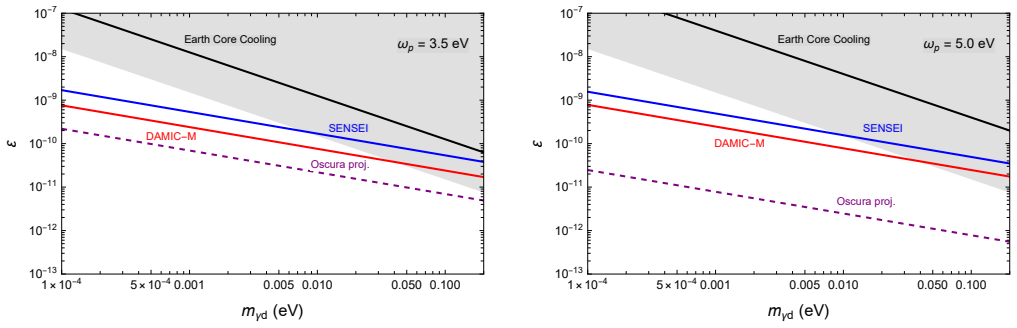
Summary. The manuscript estimates thermal emission of sub-eV dark photons from Earth's iron core via kinetic mixing ε. It adopts a simplified two-zone core model (inner solid Fe at ~6000 K, outer molten Fe at ~5000 K) and inserts empirically measured plasma frequencies ω_p = 3.5 or 5.0 eV into the resonant longitudinal emission power formula of An, Pospelov & Pradler (Eq. 4). The resulting total power P_tot_L (Eq. 8) is compared with the terrestrial heat-flow bound L_⊕ ~ 10^19 erg s^{-1} to obtain a cooling constraint, and is converted into a surface flux F_⊕ that is recast onto published SENSEI and DAMIC-M absorption limits (and Oscura projections) via the photoelectric cross-section at E = ω_p (Eqs. 10–13). The abstract and Figs. 1–2 claim that existing skipper-CCD data already exclude previously open (m_γd, ε) space and that Oscura can improve existing bounds by two to three orders of magnitude near m_γd ~ 10^{-4} eV.
Significance. If the emission-rate adaptation is reliable at the order-of-magnitude level claimed, the work supplies a novel, intermediate-density probe of light dark photons that sits between laboratory and stellar environments. The algebraic recast of published experimental ε limits onto the terrestrial flux is transparent, parameter choices are varied explicitly, and the resulting curves open a concrete experimental target for skipper-CCD detectors. The paper is therefore of genuine interest to the dark-photon and direct-detection communities, provided the central emission formula is placed on firmer footing or its uncertainty is quantified.
major comments (2)
- Formalism section and Eq. (4): the resonant longitudinal power formula is taken from classical, non-degenerate stellar-plasma calculations. The only justification offered is that Π_L has the same leading high-density behavior in the classical (T/m_e ≪ 1) and degenerate (v_F ≪ 1) limits (citing Braaten & Segel). That asymptotic statement does not automatically guarantee that the full resonant emission rate, after thermal averaging and conversion probability, remains accurate to better than an O(1)–O(10) factor once the medium is a cold, degenerate Fermi sea of iron whose plasma frequency is itself reduced by bound-electron screening. Because every numerical bound and projection (Eqs. 8, 12 and Figs. 1–2) scales linearly with this power, the claimed new exclusions and the Oscura reach rest on an unquantified systematic. A more controlled estimate of the emission rate in a degenerate metal,
- Results section, Thomas-Fermi screening paragraph: the argument that screening can be neglected rests on a rough comparison λ_TF^{-1} ≲ 1.3 keV ~ q_e. For resonant emission at E ~ ω_p the momentum transfer is ~2 keV, so the comparison is only marginal. Given that the empirical ω_p already incorporates screening effects that reduce the naive free-electron value by a factor of ~3, a quantitative assessment of residual Debye/Thomas-Fermi corrections to the emission rate is needed; otherwise the O(1) uncertainty already present in the classical-to-degenerate adaptation is compounded.
minor comments (4)
- Abstract and Summary: the language “constrain new dark photon parameter space” and “reach two to three orders of magnitude below existing bounds” should be softened to match the paper’s own characterization of the treatment as “approximate” and “exploratory” until the emission-rate uncertainty is quantified.
- Figs. 1–2: the gray shaded region is described as an “approximate functional fit … obtained with the help of ChatGPT.” A brief statement of the fitting procedure or a reference to the underlying data points would improve reproducibility.
- Eq. (8) and surrounding text: the numerical prefactors 63.1 (6.28) × 10^{39} should be accompanied by a short derivation or ancillary file so that the volume integrals over the two core zones can be checked independently.
- Introduction: the parenthetical remark that stellar dynamics can yield stronger bounds is correct but under-emphasized; a sentence clarifying that the terrestrial probe is complementary rather than competitive would help set expectations.
Circularity Check
No circularity: emission formula, heat-flow bound, photoelectric cross-section and experimental ε limits are all taken from independent external literature; free parameters are varied explicitly.
full rationale
The paper's derivation chain is linear and externally sourced. The resonant longitudinal power density (Eq. 4) is taken from An, Pospelov & Pradler (stellar-plasma calculations); the Earth heat-flow ceiling L_⊕ ∼ 10^19 erg s^-1 is taken from the geo-axion literature; the absorption rate formula and photoelectric cross-section are standard; and the numerical ε_exp values are taken from published SENSEI, DAMIC-M and Oscura results. These inputs are then combined algebraically (total power o surface flux F_⊕ o equality with DM flux) to recast the experimental limits onto the (m_γd, ε) plane. No parameter is fitted to the target data and then re-used as a prediction; the only free choices (ω_p = 3.5 or 5.0 eV, core temperatures and radii) are stated up front and shown in separate figures. Self-citations (the author's earlier geo-axion paper and the Caputo-Essig review) supply background or the gray exclusion region but are not load-bearing for the new numerical bounds. The paper itself labels the treatment approximate and exploratory; that is a correctness caveat, not circularity. Consequently the circularity score is zero.
Axiom & Free-Parameter Ledger
free parameters (4)
- plasma frequency ω_p =
3.5 or 5.0 eV
- outer-core mean temperature T_out =
≈5000 K
- Earth-core heat-flow bound L_⊕ =
∼10^{19} erg s^{-1}
- inner- and outer-core radii and temperatures =
r_in≈1220 km, T_in≈6000 K; r_out≈3480 km, T_out≈5000 K
axioms (4)
- ad hoc to paper The resonant longitudinal dark-photon emission power per unit volume (Eq. 4) derived for classical stellar plasmas remains a fair order-of-magnitude estimate for the degenerate Fermi sea of iron once an empirical ω_p is inserted.
- domain assumption Thomas-Fermi screening can be neglected because λ_TF^{-1} is comparable to the typical momentum transfer q_e ∼ few keV.
- domain assumption The photoelectric absorption cross-section evaluated at E = m_γd (or ω_p) applies equally to non-relativistic dark-matter dark photons and to relativistic Earth-core dark photons.
- domain assumption Standard kinetic mixing of a Stueckelberg dark photon with the photon induces the interaction ε e A_d · J_em.
read the original abstract
Dark photons in the sub-eV regime may be produced by the Earth's hot core, representing a much less extreme environment than stellar cores. We consider this possibility and estimate constraints on the kinetic mixing parameter $\varepsilon$ that governs dark photon coupling to charged particles, using Earth core cooling arguments, as well as dark matter direct detection bounds from SENSEI and DAMIC-M experiments. Our estimates suggest that the current results from these experiments constrain new dark photon parameter space. We also find that the proposed Oscura experiment may reach two to three orders of magnitude below existing bounds on $\varepsilon$, for dark photon masses $\sim 10^{-4}$ eV, depending on the assumed parameters characterizing the Earth core.
Figures
Forward citations
Cited by 1 Pith paper
-
Enhanced Rydberg-Atom Superheterodyne Detection of Hidden-Photon Dark Matter on Chips
A chip-scale Rydberg-atom superheterodyne receiver inside a compact high-frequency cavity could search for hidden-photon dark matter in the 5×10^-5–7×10^-4 eV mass range with sensitivity down to ε~10^-11.
Reference graph
Works this paper leans on
-
[1]
Earth Core Cooling
(solid blue) and DAMIC-M [28] experiments (solid red). The last line is a projection for the proposed Oscura experiment [29] (dashed purple). Here, we have setω p = 3.5eV . we may expect the above screening not have a significant ef- fect on our estimates. Also, sinceT /E F ≪1for the Earth core system, thermal effects on the physical parameters of Fe can ...
-
[2]
N. Arkani-Hamed, D. P. Finkbeiner, T. R. Slatyer, and N. Weiner, A Theory of Dark Matter, Phys. Rev. D79, 015014 (2009), arXiv:0810.0713 [hep-ph]
Pith/arXiv arXiv 2009
-
[3]
Holdom, Two U(1)’s and Epsilon Charge Shifts, Phys
B. Holdom, Two U(1)’s and Epsilon Charge Shifts, Phys. Lett. B166, 196 (1986)
1986
-
[4]
E. C. G. Stueckelberg, Interaction energy in electrodynamics and in the field theory of nuclear forces, Helv. Phys. Acta11, 225 (1938)
1938
-
[5]
A. Caputo and R. Essig, The Dark Photon: a 2026 Perspective (2026) arXiv:2603.08430 [hep-ph]
Pith/arXiv arXiv 2026
-
[6]
M. Pospelov, A. Ritz, and M. B. V oloshin, Secluded WIMP Dark Matter, Phys. Lett. B662, 53 (2008), arXiv:0711.4866 [hep-ph]
Pith/arXiv arXiv 2008
-
[7]
C. J. Davies, Cooling history of earth’s core with high thermal conductivity, Physics of the Earth and Planetary Interiors247, 65 (2015)
2015
-
[8]
J. N. Bahcall, A. M. Serenelli, and S. Basu, 10,000 standard solar models: a Monte Carlo simulation, Astrophys. J. Suppl. 4 165, 400 (2006), arXiv:astro-ph/0511337
Pith/arXiv arXiv 2006
-
[9]
H. Davoudiasl and P. Huber, Thermal production of axions in the Earth, Phys. Rev. D79, 095024 (2009), arXiv:0903.0618 [hep-ph]
Pith/arXiv arXiv 2009
-
[10]
A. Mirizzi, J. Redondo, and G. Sigl, Microwave Background Constraints on Mixing of Photons with Hidden Photons, JCAP 03, 026, arXiv:0901.0014 [hep-ph]
-
[11]
J. Jaeckel and A. Ringwald, The Low-Energy Frontier of Particle Physics, Ann. Rev. Nucl. Part. Sci.60, 405 (2010), arXiv:1002.0329 [hep-ph]
Pith/arXiv arXiv 2010
-
[12]
Dimopoulos, G
S. Dimopoulos, G. D. Starkman, and B. W. Lynn, Atomic En- hancements in the Detection of Weakly Interacting Particles, Phys. Lett. B168, 145 (1986)
1986
-
[13]
F. T. Avignone, III, R. L. Brodzinski, S. Dimopoulos, G. D. Starkman, A. K. Drukier, D. N. Spergel, G. Gelmini, and B. W. Lynn, Laboratory Limits on Solar Axions From an Ultralow Background Germanium Spectrometer, Phys. Rev. D35, 2752 (1987)
1987
-
[14]
H. An, M. Pospelov, J. Pradler, and A. Ritz, Direct Detection Constraints on Dark Photon Dark Matter, Phys. Lett. B747, 331 (2015), arXiv:1412.8378 [hep-ph]
Pith/arXiv arXiv 2015
-
[15]
I. M. Bloch, R. Essig, K. Tobioka, T. V olansky, and T.-T. Yu, Searching for Dark Absorption with Direct Detection Experi- ments, JHEP06, 087, arXiv:1608.02123 [hep-ph]
-
[16]
Y . Hochberg, T. Lin, and K. M. Zurek, Absorption of light dark matter in semiconductors, Phys. Rev. D95, 023013 (2017), arXiv:1608.01994 [hep-ph]
Pith/arXiv arXiv 2017
-
[17]
A. C. Shekar, B. Dutta, B. Hu, A. Schneider, and L. Strigari, work in progress (2026)
2026
-
[18]
F. Wu, S. Wu, C.-Z. Wang, K.-M. Ho, R. M. Wentzcovitch, and Y . Sun, Melting temperature of iron under the earth’s inner core condition from deep machine learning, Geoscience Fron- tiers15, 101925 (2024)
2024
-
[19]
Nautiyal and S
T. Nautiyal and S. Auluck, Electronic structure of ferromag- netic iron: Fermi surface, Physical Review B32, 6424 (1985)
1985
-
[20]
H. An, M. Pospelov, and J. Pradler, New stellar constraints on dark photons, Phys. Lett. B725, 190 (2013), arXiv:1302.3884 [hep-ph]
Pith/arXiv arXiv 2013
-
[21]
H. An, M. Pospelov, and J. Pradler, Dark Matter Detectors as Dark Photon Helioscopes, Phys. Rev. Lett.111, 041302 (2013), arXiv:1304.3461 [hep-ph]
Pith/arXiv arXiv 2013
-
[22]
E. Braaten and D. Segel, Neutrino energy loss from the plasma process at all temperatures and densities, Phys. Rev. D48, 1478 (1993), arXiv:hep-ph/9302213
Pith/arXiv arXiv 1993
-
[23]
Kumar and S
M. Kumar and S. Auluck, Effect of pressure on the magneto- optical properties of bcc and bct iron, Physica B: Condensed Matter390, 185 (2007)
2007
-
[24]
J. K. Butler, M. Martinez, R. Kilci, and G. A. Evans, Optical properties of iron to 30 ev, Materials Sciences and Applications 12, 622 (2021)
2021
-
[25]
J. P. Marton and B. D. Jordan, Optical properties of aggregated metal systems: Interband transitions, Phys. Rev. B15, 1719 (1977)
1977
-
[26]
G. G. Raffelt,Stars as laboratories for fundamental physics: The astrophysics of neutrinos, axions, and other weakly inter- acting particles(1996)
1996
-
[27]
O’Hare, Axionlimits: Repository of axion and dark photon constraints,https://github.com/cajohare/ AxionLimits(2020), accessed: May 2025
C. O’Hare, Axionlimits: Repository of axion and dark photon constraints,https://github.com/cajohare/ AxionLimits(2020), accessed: May 2025
2020
-
[28]
P. Adariet al.(SENSEI), First Direct-Detection Results on Sub- GeV Dark Matter Using the SENSEI Detector at SNOLAB, Phys. Rev. Lett.134, 011804 (2025), arXiv:2312.13342 [astro- ph.CO]
Pith/arXiv arXiv 2025
-
[29]
Aggarwalet al.(DAMIC-M), Probing Benchmark Models of Hidden-Sector Dark Matter with DAMIC-M, Phys
K. Aggarwalet al.(DAMIC-M), Probing Benchmark Models of Hidden-Sector Dark Matter with DAMIC-M, Phys. Rev. Lett. 135, 071002 (2025), arXiv:2503.14617 [hep-ex]
Pith/arXiv arXiv 2025
-
[30]
Aguilar-Arevaloet al.(Oscura), The Oscura Experiment, (2022), arXiv:2202.10518 [astro-ph.IM]
A. Aguilar-Arevaloet al.(Oscura), The Oscura Experiment, (2022), arXiv:2202.10518 [astro-ph.IM]
Pith/arXiv arXiv 2022
-
[31]
J. Tiffenberg, M. Sofo-Haro, A. Drlica-Wagner, R. Essig, Y . Guardincerri, S. Holland, T. V olansky, and T.-T. Yu (SEN- SEI), Single-electron and single-photon sensitivity with a sil- icon Skipper CCD, Phys. Rev. Lett.119, 131802 (2017), arXiv:1706.00028 [physics.ins-det]
Pith/arXiv arXiv 2017
-
[32]
I. M. Blochet al.(SENSEI), SENSEI at SNOLAB: Single- Electron Event Rate and Implications for Dark Matter, Phys. Rev. Lett.134, 161002 (2025), arXiv:2410.18716 [astro- ph.CO]
arXiv 2025
-
[33]
P. Salucci, F. Nesti, G. Gentile, and C. F. Martins, The dark matter density at the Sun’s location, Astron. Astrophys.523, A83 (2010), arXiv:1003.3101 [astro-ph.GA]
Pith/arXiv arXiv 2010
-
[34]
M. Pospelov, A. Ritz, and M. B. V oloshin, Bosonic super- WIMPs as keV-scale dark matter, Phys. Rev. D78, 115012 (2008), arXiv:0807.3279 [hep-ph]. 5
Pith/arXiv arXiv 2008
discussion (0)
Sign in with ORCID, Apple, or X to comment. Anyone can read and Pith papers without signing in.