REVIEW 4 minor 1 cited by
The 8.36-eV thorium transition is a uniquely sensitive probe of fundamental constants and dark matter.
Reviewed by Pith at T0; open to challenge. T0 means a machine referee read the full paper against a public rubric. the ladder, T0–T4 →
T0 review · deepseek-v4-flash
2026-08-02 10:03 UTC pith:GULHG3BU
load-bearing objection A genuinely useful survey of the 229Th literature, honest about what is and isn't known; the sensitivity numbers are programmatic scaling estimates, not a derived result, and the paper mostly says so itself.
The ²²⁹Th Isomer: Nuclear Structure, Clocks, and Tests of Fundamental Physics
The pith
A machine-rendered reading of the paper's core claim, the machinery that carries it, and where it could break.
Core claim
The paper's central claim is that the anomalously low 8.36 eV transition energy of 229mTh is not a lucky accident but the residual of a near-cancellation between large, competing energy contributions: the Coulomb energy difference ΔV_C and the strong-interaction difference ΔV_N between the isomer and ground state both lie at the MeV scale, and their difference is ~8 eV. Because the transition frequency is the small difference of two large terms, the fractional frequency response to variations of α and of the hadronic parameter X_q = m_q/Λ_QCD is amplified by the ratios ΔV_C/ℏω and ΔV_N/ℏω, i.e., by factors of order 10^4–10^5. The review further claims that, on the structure side, the near-de
What carries the argument
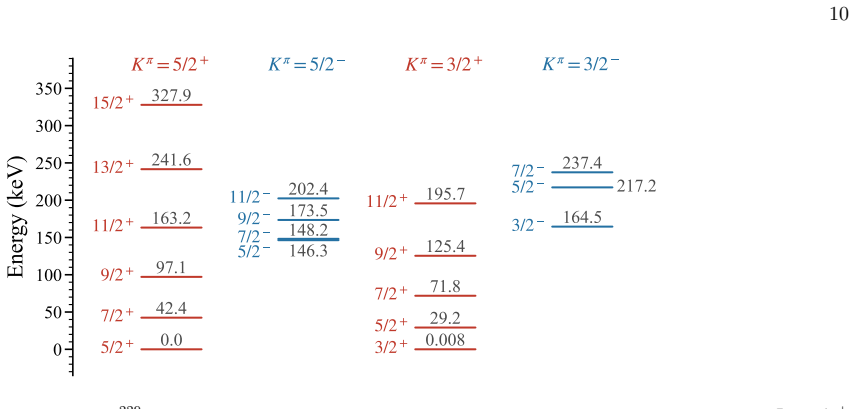
The central object is the near-degenerate pair of neutron Nilsson orbitals 5/2+[633] (ground state) and 3/2+[631] (isomer), whose M1 transition is forbidden in the axially symmetric limit, so that Coriolis mixing between their rotational bands and octupole-deformation-induced parity mixing carry the transition amplitude. The amplifying mechanism is the ratio identity K_α ≈ ΔV_C/ℏω and K_q ≈ ΔV_N/ℏω, which converts MeV-scale cancellations into 10^4–10^5 enhancement of the fractional frequency response.
Load-bearing premise
The sensitivity enhancement argument assumes that the MeV-scale Coulomb and strong-interaction contributions to the transition energy are sufficiently independent that their near-cancellation leaves fractional response coefficients K_α ≈ ΔV_C/ℏω and K_q ≈ ΔV_N/ℏω at the 10^4–10^5 level; if the two contributions are correlated, or the nuclear matrix element is suppressed, the amplification could be far smaller. The paper itself flags that the precise coefficient is model depen
What would settle it
A long-term frequency comparison between a 229Th nuclear clock and multiple atomic clocks that yields a null drift at a level inconsistent with K_α~10^4 would falsify the large-enhancement claim; a more direct falsifier would be an ab initio many-body calculation that reproduces the 8.36 eV splitting and shows ΔV_C and ΔV_N are strongly correlated, thereby collapsing K_α to order unity.
If this is right
- A 229Th nuclear clock could bound or detect time variation of α and of the light-quark mass/QCD scale at levels beyond current atomic-clock limits, and probe hadronic ultralight dark matter couplings in the 10^-21–10^-19 eV mass range.
- Closed-loop solid-state Th:CaF2 clocks have reached fractional instability ~10^-12/√(τ/s), with projected accuracy near 10^-19 for trapped-ion platforms, enabling relativistic geodesy and equivalence-principle tests.
- Nuclear-structure models that omit octupole correlations systematically fail to reproduce the isomeric magnetic moment and B(M1); including them is necessary but not sufficient, since the predicted μ_IS still varies by a factor of several across models.
- If the predicted low-lying 5/2− parity partner near 15 keV exists, the Schiff moment of 229Th would be enhanced by about an order of magnitude, strengthening T-violation searches.
- The long radiative lifetime (~10^3 s) and shielding of nuclear spins imply a quality factor Q~10^19–10^20, motivating nuclear quantum information architectures based on trapped 229Th ions or doped crystals.
Where Pith is reading between the lines
- If the cancellation mechanism is generic rather than accidental, other heavy deformed nuclei with near-degenerate Nilsson partners could host additional few-eV transitions; a systematic survey of Nilsson level crossings near the Fermi surface might identify candidate nuclides for future nuclear clocks.
- The pseudospin-partner relation between 3/2+[631] and 5/2+[633] suggests the near-degeneracy might be rooted in a dynamical symmetry of the mean field; if confirmed, it would guide the search for other low-energy transitions.
- The enhancement factors K_α and K_q could be measured directly by comparing a 229Th nuclear clock against a suite of atomic clocks over years; such a measurement would also test whether the assumed independence of ΔV_C and ΔV_N holds in nature.
- A resonant electronic-bridge or highly charged ion experiment that observes the isomer decay in different charge states could indirectly measure the bare nuclear transition matrix element, testing the model-dependent B(M1) spread now spanning 0.005–0.024 W.u.
Editorial analysis
A structured set of objections, weighed in public.
Referee Report
Summary. This review surveys the 229Th isomeric transition from three angles: experimental spectroscopy and clock development, nuclear-structure theory, and applications to fundamental-physics searches. It traces the measurement history from indirect gamma-ray estimates to the 2024 VUV frequency-comb value and the 2026 closed-loop solid-state clocks, compares the main clock platforms (trapped ions, highly charged ions, solid-state hosts, thin films), and reviews nuclear models ranging from Nilsson-plus-Coriolis to CQOM-DSM, PSM, Skyrme HFBCS, MR-DFT, MR-CDFT, and RDFT particle-rotor calculations. The final sections discuss enhanced sensitivity to variations of alpha and quark masses, ultralight dark matter, Schiff moments, Lorentz/equivalence-principle tests, and nuclear quantum information ideas. The paper is explicitly transparent that no current nuclear model reproduces the ~8 eV isomer energy as a genuine prediction and that the observed energy is treated as an experimental constraint.
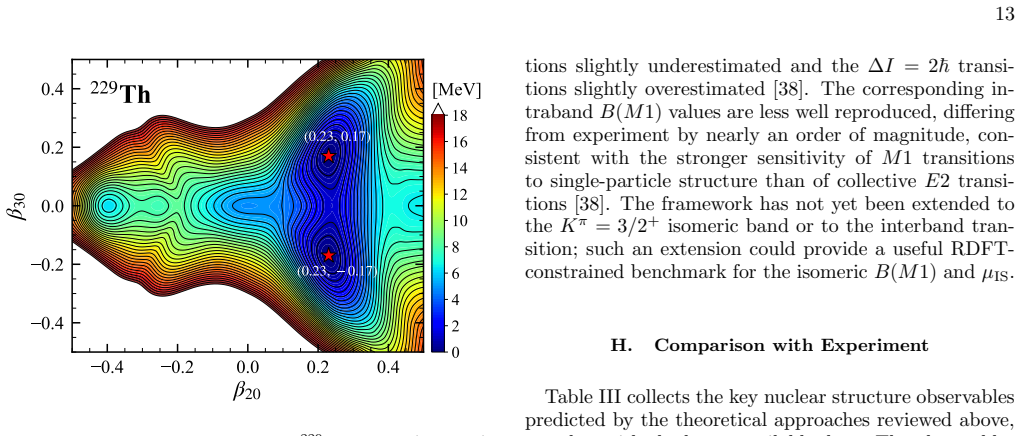
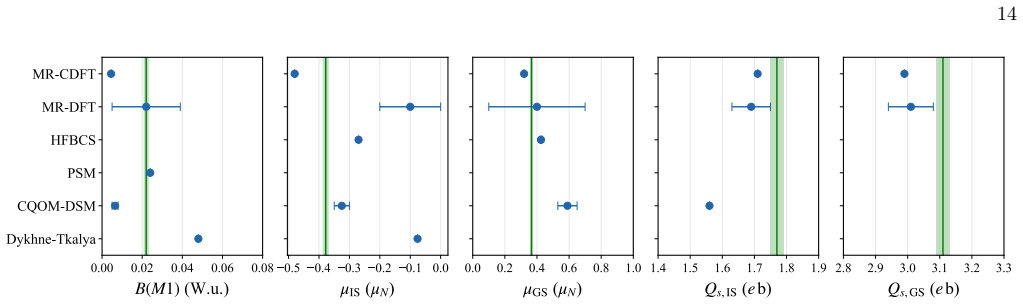
Significance. If judged as a review, this is a timely and valuable synthesis of a fast-moving field. Its main strengths are completeness (covering 2024–2026 milestones), balanced comparison of models in Table III and Fig. 6, and honesty about limitations: Sec. III.H states plainly that the ~8 eV energy is not predicted by any model and that CQOM-DSM takes experimental energies as input. The fundamental-physics section is also appropriately hedged in the main text, noting that the 10^4–10^5 enhancement factors are model dependent and subject to cancellations. The inclusion of an original MDC-RMF consistency check (Fig. 5) is a useful cross-check. The review will serve as a useful entry point for nuclear-structure and precision-metrology readers, even though several model agreements rely on adjusted parameters rather than parameter-free predictions.
minor comments (4)
- [Abstract and Sec. IV.A, Eq. (12)] The abstract's phrase 'MeV-scale nuclear contributions' is stronger than what the body supports. Sec. III.H concedes that no current model reproduces the ~8 eV splitting, and Eq. (12) is a heuristic estimate. A simple uniform-sphere estimate using the measured δ⟨r²⟩ = 0.0097(26) fm² [53] gives ΔV_C ≈ 0.1–0.3 MeV, implying K_α ≈ 1–3×10^4 rather than 10^5. I suggest adding one sentence near Eq. (12) that presents this estimate and labels 10^5 as a naive upper bound, and softening 'MeV-scale' to 'sub-MeV-to-MeV-scale' in the abstract.
- [Sec. IV.A, Eqs. (12)–(13)] The derivation of K_α and K_q assumes that the strong-interaction contribution is α-independent and that ΔV_C and ΔV_N add linearly. This is an assumption of the heuristic scaling argument, not an output of the nuclear-structure models reviewed in Sec. III. Although Ref. [39] is the original source and the text mentions model dependence, the assumptions underlying Eqs. (12)–(13) should be stated explicitly as assumptions, especially because the models in Sec. III do not reproduce the eV-scale energy.
- [Table III and Sec. III.H] Several entries in Table III are not parameter-free: CQOM-DSM uses q_R = 0.6–0.8, the RAT-PRM calculation uses ξ = 0.4 and an adjusted g_n = −0.062, and the PSM uses slightly adjusted Nilsson and pairing parameters. The text discloses these choices, but a one-sentence caption warning that 'several theoretical entries involve adjusted parameters and should be compared as model benchmarks rather than parameter-free predictions' would help prevent over-interpretation by readers.
- [Sec. II.A heading] The heading 'F rom Indirect Measurement to Laser Excitation' contains a typographical artifact: 'F rom' should be 'From'.
Circularity Check
No significant circularity: the 8 eV energy is explicitly treated as an experimental constraint, and the sensitivity estimate is a flagged scaling heuristic rather than a fitted prediction.
full rationale
The paper makes no pretense of deriving the 8 eV isomer energy; it states 'no current theoretical framework can predict this ~8 eV transition energy with the required accuracy' and 'the observed isomer energy should therefore be regarded as an experimental constraint rather than as a benchmark already explained by nuclear-structure theory.' The sensitivity amplification in Eqs. (11)-(13) is introduced as 'a simple scaling argument' and immediately qualified: 'the precise coefficient is model dependent and can be affected by cancellations among nuclear contributions.' No parameter is fitted to the 8 eV energy and then renamed a prediction; Delta_V_C and Delta_V_N are assumed to be MeV-scale rather than extracted from the observable being 'predicted.' The model comparisons in Sec. III are benchmarked against external measurements (B(M1)=0.022 W.u., mu_IS=-0.378(8) mu_N, quadrupole moments), and adjusted inputs such as q_R, xi=0.4, and g_n=-0.062 are disclosed rather than presented as parameter-free predictions. Self-citations (MDC-RMF method, pseudospin reviews, trapped-ion proposals) are methodological or peripheral and are not load-bearing for the central claim. The PSM and CQOM-DSM statements about reproducing band-head energies are transparent fitting descriptions, not disguised predictions. No equation reduces by construction to its own input, so per the required standard there is no circular step.
Axiom & Free-Parameter Ledger
free parameters (5)
- CQOM-DSM gyromagnetic quenching factor q_R =
0.6–0.8
- RAT-PRM Coriolis attenuation factor ξ =
0.4
- RAT-PRM valence neutron g-factor g_n =
-0.062
- PSM pairing strengths G1/G2 and Nilsson (κ, μ) adjustments =
G1=16.32 MeV, G2=11.81 MeV; neutron N=6 (κ, μ) slightly adjusted
- Coulomb energy difference ΔV_C entering K_α =
≈ MeV (model-dependent)
axioms (6)
- domain assumption The 229Th ground and isomeric states are predominantly the deformed Nilsson orbitals 5/2+[633] and 3/2+[631].
- domain assumption Octupole deformation/correlations are present in 229Th and are required to reproduce the ordering and electromagnetic properties.
- domain assumption The eV-scale isomer energy results from a near-cancellation of independent MeV-scale Coulomb and strong interaction contributions, so fractional sensitivity to α and X_q is enhanced by ΔV/ω.
- domain assumption Electromagnetic observables (B(M1), μ, Q_s) are valid benchmarks for nuclear wave functions even when the 8 eV energy is not reproduced.
- standard math The standard many-body tools used in the reviewed calculations (Nilsson mean field, BCS pairing, angular-momentum and parity projection, Hill-Wheeler mixing) are reliable enough for 229Th.
- domain assumption The measured transition energy 8.355733554021(8) eV is accepted as the reference value for sensitivity estimates and model comparisons.
read the original abstract
The $^{229}$Th nucleus possesses an isomeric state at an excitation energy of $\sim 8$ eV, the lowest known nuclear transition energy, placing its frequency in the vacuum-ultraviolet range and making it directly accessible to laser spectroscopy. In this review, we discuss the $^{229}$Th isomer from three connected perspectives: experimental spectroscopy and clock development, nuclear structure theory, and applications to precision tests of fundamental physics. We first trace the experimental progress from indirect $\gamma$-ray energy inference to resonant laser excitation, absolute frequency comparison with an atomic clock, and feedback-loop operation of a solid-state nuclear clock, and discuss trapped-ion, highly charged ion, and solid-state platforms together with mechanisms for nuclear-state manipulation and readout. We then review, from the nuclear-structure perspective, how the near-degeneracy of the $5/2^+[633]$ and $3/2^+[631]$ neutron Nilsson configurations, together with Coriolis mixing and octupole correlations, underlies the anomalously low transition energy and its electromagnetic properties. Comparisons among different phenomenological and microscopic models show that octupole correlations are a common structural ingredient, while magnetic moments and transition strengths remain sensitive tests of the calculated wave functions. Finally, we discuss how the near-cancellation of MeV-scale nuclear contributions into an eV-scale transition can enhance sensitivity to variations of fundamental constants, signatures of ultralight dark matter, CP-violating interactions, Lorentz-invariance violation, and possible nuclear quantum technologies.
Figures
Forward citations
Cited by 1 Pith paper
-
A First Bound on the Moffat Energy and Thorium--229 Clock as a Probe of the Nonlocal Time-Energy Structure
First bounds on the nonlocality scale E_M from 229Th nuclear clock data: E_M > 22.3 MeV directly, > 1.72 GeV with nuclear enhancement, and TeV-scale for assumed nuclear reference energies.
Reference graph
Works this paper leans on
-
[1]
G. D. Dracoulis, P. M. Walker, and F. G. Kondev, Rep. Prog. Phys.79, 076301 (2016)
2016
-
[2]
Walker and Z
P. Walker and Z. Podoly´ ak, Phys. Scr.95, 044004 (2020)
2020
-
[3]
G. W. Misch, T. M. Sprouse, M. R. Mumpower, A. J. Couture, C. L. Fryer, B. S. Meyer, and Y. Sun, Symme- try13, 1831 (2021)
2021
-
[4]
F. G. Kondev, M. Wang, W. J. Huang, S. Naimi, and G. Audi, Chin. Phys. C45, 030001 (2021)
2021
-
[5]
S. Garg, B. Maheshwari, B. Singh, Y. Sun, A. Goel, and A. K. Jain, At. Data Nucl. Data Tables150, 101546 (2023)
2023
-
[6]
Aprahamian and Y
A. Aprahamian and Y. Sun, Nature Phys.1, 81 (2005)
2005
-
[7]
Seiferle, L
B. Seiferle, L. von der Wense, P. V. Bilous, I. Amers- dorffer, C. Lemell, F. Libisch, S. Stellmer, T. Schumm, C. E. D¨ ullmann, A. P´ alffy, and P. G. Thirolf, Nature 573, 243 (2019)
2019
-
[8]
U. C. Perera, H. W. T. Morgan, E. R. Hudson, and A. Derevianko, Phys. Rev. Lett.135, 123001 (2025)
2025
-
[9]
E. V. Tkalya, JETP Lett.55, 211 (1992)
1992
-
[10]
Peik and C
E. Peik and C. Tamm, Europhys. Lett.61, 181 (2003)
2003
-
[11]
Sikorsky, J
T. Sikorsky, J. Geist, D. Hengstler, S. Kempf, L. Gastaldo, C. Enss, C. Mokry, J. Runke, C. E. D¨ ullmann, P. Wobrauschek, K. Beeks, V. Rosecker, J. H. Sterba, G. Kazakov, T. Schumm, and A. Fleis- chmann, Phys. Rev. Lett.125, 142503 (2020)
2020
-
[12]
C. J. Campbell, A. G. Radnaev, A. Kuzmich, V. A. Dzuba, V. V. Flambaum, and A. Derevianko, Phys. Rev. Lett.108, 120802 (2012)
2012
-
[13]
E. Peik, T. Schumm, M. S. Safronova, A. P´ alffy, J. Weit- enberg, and P. G. Thirolf, Quantum Sci. Technol.6, 034002 (2021)
2021
-
[14]
L. A. Kroger and C. W. Reich, Nucl. Phys. A259, 29 (1976)
1976
-
[15]
B. R. Beck, J. A. Becker, P. Beiersdorfer, G. V. Brown, K. J. Moody, J. B. Wilhelmy, F. S. Porter, C. A. Kil- bourne, and R. L. Kelley, Phys. Rev. Lett.98, 142501 (2007)
2007
-
[16]
Tiedau, M
J. Tiedau, M. V. Okhapkin, K. Zhang, J. Thielk- ing, G. Zitzer, E. Peik, F. Schaden, T. Pronebner, I. Morawetz, L. T. De Col, F. Schneider, A. Leitner, M. Pressler, G. A. Kazakov, K. Beeks, T. Sikorsky, and T. Schumm, Phys. Rev. Lett.132, 182501 (2024)
2024
-
[17]
Elwell, C
R. Elwell, C. Schneider, J. Jeet, J. E. S. Terhune, H. W. T. Morgan, A. N. Alexandrova, H. B. Tran Tan, A. Derevianko, and E. R. Hudson, Phys. Rev. Lett.133, 013201 (2024)
2024
-
[18]
Zhang, L
C. Zhang, L. von der Wense, J. F. Doyle, J. S. Higgins, T. Ooi, H. U. Friebel, J. Ye, R. Elwell, J. E. S. Ter- hune, H. W. T. Morgan, A. N. Alexandrova, H. B. Tran Tan, A. Derevianko, and E. R. Hudson, Nature636, 603 (2024)
2024
-
[19]
Zhang, T
C. Zhang, T. Ooi, J. S. Higgins, J. F. Doyle, L. von der Wense, K. Beeks, A. Leitner, G. A. Kazakov, P. Li, P. G. Thirolf, T. Schumm, and J. Ye, Nature633, 63 (2024)
2024
-
[20]
W. G. Rellergert, D. DeMille, R. R. Greco, M. P. Hehlen, J. R. Torgerson, and E. R. Hudson, Phys. Rev. Lett.104, 200802 (2010)
2010
-
[21]
von der Wense, B
L. von der Wense, B. Seiferle, S. Stellmer, J. Weiten- berg, G. Kazakov, A. P´ alffy, and P. G. Thirolf, Phys. Rev. Lett.119, 132503 (2017)
2017
-
[22]
G. A. Kazakov, A. N. Litvinov, V. I. Romanenko, L. P. Yatsenko, A. V. Romanenko, M. Schreitl, G. Winkler, and T. Schumm, New J. Phys.14, 083019 (2012)
2012
-
[23]
W. Wang, F. Zou, S. Fritzsche, and Y. Li, Phys. Rev. Lett.133, 223001 (2024)
2024
-
[24]
Hiraki, K
T. Hiraki, K. Okai, M. Bartokos, K. Beeks, H. Fuji- moto, Y. Fukunaga, H. Haba, Y. Kasamatsu, S. Ki- tao, A. Leitner, T. Masuda, M. Guan, N. Nagasawa, R. Ogake, M. Pimon, M. Pressler, N. Sasao, F. Schaden, T. Schumm, M. Seto, Y. Shigekawa, K. Shimizu, T. Sikorsky, K. Tamasaku, S. Takatori, T. Watanabe, A. Yamaguchi, Y. Yoda, A. Yoshimi, and K. Yoshimura, ...
2024
-
[25]
Schaden, T
F. Schaden, T. Riebner, I. Morawetz, L. T. De Col, G. A. Kazakov, K. Beeks, T. Sikorsky, T. Schumm, K. Zhang, V. Lal, G. Zitzer, J. Tiedau, M. V. Okhapkin, and E. Peik, Phys. Rev. Res.7, L022036 (2025)
2025
-
[26]
L. T. De Col, T. Riebner, I. Morawetz, F. Schnei- der, N. Sempelmann, J. Schlachet-L´ epinay, F. Schaden, M. Bartokos, G. A. Kazakov, K. Beeks, B. Gerstenecker, M. Pimon, S. Lahs, A. Hellerschmied, T. Lercher, J. Premper, A. Niessner, M. Matus, H. Denker, 20 M. Cizek, O. Cip, V. Lal, G. Zitzer, V. Petrov, J. Tiedau, M. V. Okhapkin, E. Peik, and T. Schumm,...
Pith/arXiv arXiv 2026
-
[27]
B. Huang, G. Yan, Q. Xiao, W. Bu, Z. Zhang, C. Zhao, C. Yan, Z.-A. Chen, P. Zhang, G. Penyazkov, Z. Zhan, L. Yan, Y. Wang, L. Li, S. Li, X. Qian, X. Liu, Q. He, T. Sun, H. Tian, B. Lu, N. Ma, J. Li, Y. Wu, Q. Gong, Y. Li, H. Shi, X. Li, L. Ma, S. Zhu, Y. Mo, J. Lin, L. You, Y. Lin, X. Zhang, Y. Hang, L. Su, and S. Ding, A nuclear clock based on 229th (202...
Pith/arXiv arXiv 2026
-
[28]
B. R. Mottelson and S. G. Nilsson, Phys. Rev.99, 1615 (1955)
1955
-
[29]
Barci, G
V. Barci, G. Ardisson, G. Barci-Funel, B. Weiss, O. El Samad, and R. K. Sheline, Phys. Rev. C68, 034329 (2003)
2003
-
[30]
A. M. Dykhne and E. V. Tkalya, J. Exp. Theor. Phys. Lett.67, 251 (1998)
1998
-
[31]
P. A. Butler and W. Nazarewicz, Rev. Mod. Phys.68, 349 (1996)
1996
-
[32]
Minkov and A
N. Minkov and A. P´ alffy, Phys. Rev. Lett.118, 212501 (2017)
2017
-
[33]
Minkov and A
N. Minkov and A. P´ alffy, Phys. Rev. Lett.122, 162502 (2019)
2019
-
[34]
Chen, L.-J
Z.-R. Chen, L.-J. Wang, and Y. Wu, Phys. Lett. B869, 139858 (2025)
2025
-
[35]
Minkov, A
N. Minkov, A. P´ alffy, P. Quentin, and L. Bonneau, Phys. Rev. C110, 034327 (2024)
2024
-
[36]
A. Restrepo-Giraldo, J. Dobaczewski, J. Bonnard, and X. Sun, Radiative decay and electromagnetic mo- ments in 229th determined within nuclear DFT (2026), arXiv:2602.02429 [nucl-th]
Pith/arXiv arXiv 2026
-
[37]
E. F. Zhou and J. M. Yao, Microscopic study of low- lying states in odd-mass nuclei for atomic electric dipole moment searches (2025), arXiv:2511.05984 [nucl-th]
arXiv 2025
-
[38]
Wang and P.-W
Y.-Y. Wang and P.-W. Zhao, Chin. Phys. B35, 020603 (2026)
2026
-
[39]
V. V. Flambaum, Phys. Rev. Lett.97, 092502 (2006)
2006
-
[40]
Fuchs, F
E. Fuchs, F. Kirk, E. Madge, C. Paranjape, E. Peik, G. Perez, W. Ratzinger, and J. Tiedau, Phys. Rev. X 15, 021055 (2025)
2025
-
[41]
Caputo, D
A. Caputo, D. Gazit, H. W. Hammer, J. Kopp, G. Paz, G. Perez, and K. Springmann, Phys. Rev. C112, L031302 (2025)
2025
-
[42]
V. V. Flambaum, Phys. Rev. C99, 035501 (2019)
2019
-
[43]
V. V. Flambaum, Phys. Rev. Lett.117, 072501 (2016)
2016
-
[44]
V. A. Dzuba and V. V. Flambaum, Phys. Rev. A111, 053109 (2025)
2025
-
[45]
W. Wang, K. Zhang, K.-M. Xu, and S.-G. Zhou, Hyperfine-resolved laser excitation and detection of nuclear isomer in trapped 229th3+ ions (2026), arXiv:2604.27614 [physics.atom-ph]
Pith/arXiv arXiv 2026
-
[46]
S.-C. Yu, X. Hua, X. Tong, C.-B. Li, and L. She, Chin. Phys. Lett.42, 120302 (2025)
2025
-
[47]
J. Wang, H. Miao, S. Ding, and D. E. Liu, Direct nuclear-level qubits using trapped th-229 ions: A plat- form for entanglement and universal quantum informa- tion processing (2025), arXiv:2508.10626 [quant-ph]
Pith/arXiv arXiv 2025
-
[48]
W.-T. Gan, Z. Li, C. Wang, X. Hua, and X. Tong, Chin. Phys. B35, 023703 (2026)
2026
-
[49]
C.-C. Zhao, L. Li, S.-M. Li, Q.-R. Gong, P.-X. Zhang, Y. Hang, L.-S. Ma, and S.-N. Zhu, Chin. Phys. B35, 020602 (2026)
2026
-
[50]
Yu, C.-B
S.-C. Yu, C.-B. Li, and L. She, Chin. Phys. B35, 023701 (2026)
2026
-
[51]
D. G. Burke, P. E. Garrett, T. Qu, and R. A. Naumann, Phys. Rev. C42, R499 (1990)
1990
-
[52]
Von Der Wense, B
L. Von Der Wense, B. Seiferle, M. Laatiaoui, J. B. Neu- mayr, H.-J. Maier, H.-F. Wirth, C. Mokry, J. Runke, K. Eberhardt, C. E. D¨ ullmann, N. G. Trautmann, and P. G. Thirolf, Nature533, 47 (2016)
2016
-
[53]
Yamaguchi, Y
A. Yamaguchi, Y. Shigekawa, H. Haba, H. Kikunaga, K. Shirasaki, M. Wada, and H. Katori, Nature629, 62 (2024)
2024
-
[54]
Ruchowska, W
E. Ruchowska, W. A. P l´ ociennik, J. ˙Zylicz, H. Mach, J. Kvasil, A. Algora, N. Amzal, T. B¨ ack, M. J. G. Borge, R. Boutami, P. A. Butler, J. Cederk¨ all, B. Cederwall, B. Fogelberg, L. M. Fraile, H. O. U. Fynbo, E. Hagebø, P. Hoff, H. Gausemel, A. Jungclaus, R. Kaczarowski, A. Kerek, W. Kurcewicz, K. Lagergren, E. Nacher, B. Rubio, A. Syntfeld, O. Teng...
2006
-
[55]
Kraemer, J
S. Kraemer, J. Moens, M. Athanasakis-Kaklamanakis, S. Bara, K. Beeks, P. Chhetri, K. Chrysalidis, A. Claessens, T. E. Cocolios, J. G. M. Correia, H. Witte, R. Ferrer, S. Geldhof, R. Heinke, N. Hosseini, M. Huyse, U. Koster, Y. Kudryavtsev, M. Laatiaoui, R. Lica, G. Magchiels, V. Manea, C. Merckling, L. M. C. Pereira, S. Raeder, T. Schumm, S. Sels, P. G. T...
2023
-
[56]
Masuda, A
T. Masuda, A. Yoshimi, A. Fujieda, H. Fujimoto, H. Haba, H. Hara, T. Hiraki, H. Kaino, Y. Kasamatsu, S. Kitao, K. Konashi, Y. Miyamoto, K. Okai, S. Okubo, N. Sasao, M. Seto, T. Schumm, Y. Shigekawa, K. Suzuki, S. Stellmer, K. Tamasaku, S. Uetake, M. Watanabe, T. Watanabe, Y. Yasuda, A. Yam- aguchi, Y. Yoda, T. Yokokita, M. Yoshimura, and K. Yoshimura, Nat...
2019
-
[57]
Wang, Z.-R
Y. Wang, Z.-R. Xiao, H.-Z. Zhang, L.-Q. Hua, and X.-J. Liu, Chin. Phys. B35, 020601 (2026)
2026
-
[58]
H.-Y. Lan, D. Wu, M.-Z. Wang, Z.-Y. Chen, J.-F. Lv, Y.-H. Xia, Z.-N. Wang, W. Luo, X.-L. Xu, and X.-Q. Yan, Adv. Sci.13, e23384 (2026)
2026
-
[59]
Ahmad, J
I. Ahmad, J. E. Gindler, R. R. Betts, R. R. Chasman, and A. M. Friedman, Phys. Rev. Lett.49, 1758 (1982)
1982
-
[60]
R. G. Helmer and C. W. Reich, Phys. Rev. C49, 1845 (1994)
1994
-
[61]
G. M. Irwin and K. H. Kim, Phys. Rev. Lett.79, 990 (1997)
1997
-
[62]
R. W. Shaw, J. P. Young, S. P. Cooper, and O. F. Webb, Phys. Rev. Lett.82, 1109 (1999)
1999
-
[63]
X. Zhao, Y. N. Martinez de Escobar, R. Rundberg, E. M. Bond, A. Moody, and D. J. Vieira, Phys. Rev. Lett.109, 160801 (2012)
2012
-
[64]
Peik and K
E. Peik and K. Zimmermann, Phys. Rev. Lett.111, 018901 (2013)
2013
-
[65]
Thielking, M
J. Thielking, M. V. Okhapkin, P. G lowacki, D. M. Meier, L. Von Der Wense, B. Seiferle, C. E. D¨ ullmann, P. G. Thirolf, and E. Peik, Nature556, 321 (2018)
2018
-
[66]
Yamaguchi, H
A. Yamaguchi, H. Muramatsu, T. Hayashi, N. Yuasa, K. Nakamura, M. Takimoto, H. Haba, K. Konashi, M. Watanabe, H. Kikunaga, K. Maehata, N. Y. Ya- masaki, and K. Mitsuda, Phys. Rev. Lett.123, 222501 21 (2019)
2019
-
[67]
Y. Shigekawa, A. Yamaguchi, K. Tokoi, N. Sato, H. Kikunaga, K. Shirasaki, Y. Kasamatsu, M. Wada, and H. Haba, Nat. Phys. 10.1038/s41567-026-03251-1 (2026)
-
[68]
C. W. Reich and R. G. Helmer, Phys. Rev. Lett.64, 271 (1990)
1990
-
[69]
H. Ton, S. Roodbergen, J. Brasz, and J. Blok, Nucl. Phys. A155, 245 (1970)
1970
-
[70]
Gerstenkorn, P
S. Gerstenkorn, P. Luc, J. Verges, D. W. Englekemeir, J. E. Gindler, and F. S. Tomkins, J. Phys. France35, 483 (1974)
1974
-
[71]
C. E. Bemis, F. K. McGowan, J. Ford, J. L. C., W. T. Milner, R. L. Robinson, P. H. Stelson, G. A. Leander, and C. W. Reich, Phys. Scr.38, 657 (1988)
1988
-
[72]
C. J. Campbell, A. G. Radnaev, and A. Kuzmich, Phys. Rev. Lett.106, 223001 (2011)
2011
-
[73]
Seiferle, L
B. Seiferle, L. Von Der Wense, and P. G. Thirolf, Phys. Rev. Lett.118, 042501 (2017)
2017
-
[74]
Shigekawa, A
Y. Shigekawa, A. Yamaguchi, K. Suzuki, H. Haba, T. Hiraki, H. Kikunaga, T. Masuda, S. Nishimura, N. Sasao, A. Yoshimi, and K. Yoshimura, Phys. Rev. C104, 024306 (2021)
2021
-
[75]
J. C. Berengut, V. A. Dzuba, V. V. Flambaum, and S. G. Porsev, Phys. Rev. Lett.102, 210801 (2009)
2009
-
[76]
von der Wense and B
L. von der Wense and B. Seiferle, Eur. Phys. J. A56, 277 (2020)
2020
-
[77]
P. V. Bilous, H. Bekker, J. C. Berengut, B. Seiferle, L. von der Wense, P. G. Thirolf, T. Pfeifer, J. R. C. L´ opez-Urrutia, and A. P´ alffy, Phys. Rev. Lett.124, 192502 (2020)
2020
-
[78]
Zitzer, J
G. Zitzer, J. Tiedau, C. E. D¨ ullmann, M. V. Okhapkin, and E. Peik, Phys. Rev. A111, L050802 (2025)
2025
-
[79]
V. F. Strizhov and E. V. Tkalya, Sov. Phys. JETP72, 387 (1991)
1991
-
[80]
X. Ma, W. Q. Wen, Z. K. Huang, H. B. Wang, Y. J. Yuan, M. Wang, Z. Y. Sun, L. J. Mao, J. C. Yang, H. S. Xu, G. Q. Xiao, and W. L. Zhan, Phys. Scr.T166, 014012 (2015)
2015
discussion (0)
Sign in with ORCID, Apple, or X to comment. Anyone can read and Pith papers without signing in.