REVIEW 3 major objections 1 cited by
RolloutPipe starts GRPO training before a full rollout finishes, cutting end-to-end time 30–42% without using stale data.
Reviewed by Pith at T0; open to challenge. T0 means a machine referee read the full paper against a public rubric. the ladder, T0–T4 →
T0 review · grok-4.5
2026-07-12 11:51 UTC pith:NP4UKVHL
load-bearing objection Clean systems fix for GRPO idle time: real 30–42% wall-clock gains under fixed-weight on-policy semantics; the unmeasured dynamics claim is the only soft spot that matters. the 3 major comments →
RolloutPipe: Overlapping Pipelined Rollout and Training in Disaggregated On-Policy LLM Reinforcement Learning
The pith
A machine-rendered reading of the paper's core claim, the machinery that carries it, and where it could break.
Core claim
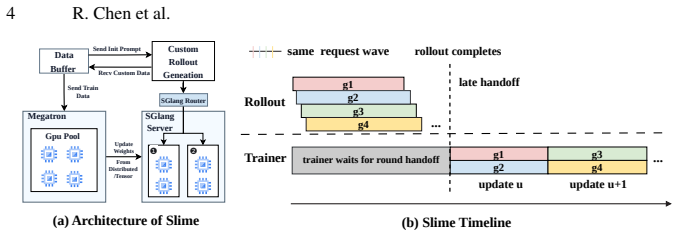
In disaggregated on-policy GRPO, the serial rollout-then-train barrier can be broken without stale data by treating the complete group as the pipeline unit: each group is dispatched to the trainer FIFO the moment it materializes under fixed rollout weights, so the first logical update begins before the remaining groups finish generation. Frontier-first admission further concentrates capacity so those early groups arrive earlier and more steadily. The result is substantial wall-clock overlap of rollout and training while optimizer-step boundaries and weight refresh still follow the original U-group logical updates.
What carries the argument
Complete-group pipelining (CGP) together with frontier-group dispatch (FGD). CGP appends each fully materialized GRPO group to a trainer FIFO as soon as it is ready and dispatches the earliest U groups once they accumulate; FGD is a Rollout-node admission policy that keeps only the Fw earliest groups in service so the frontier needed for the next batch finishes first.
Load-bearing premise
That changing only the order and timing of group dispatch—not the samples, advantages, or gradient path—leaves training dynamics and final model quality identical to the serial baseline.
What would settle it
Run the same Qwen3-1.7B GRPO schedule under serial Slime versus CGP+FGD and compare reward curves, intermediate accuracy trajectories, and final exact-match scores on the four benchmarks; any systematic divergence would falsify the claim that only wall-clock placement of work has changed.
Editorial analysis
A structured set of objections, weighed in public.
Referee Report
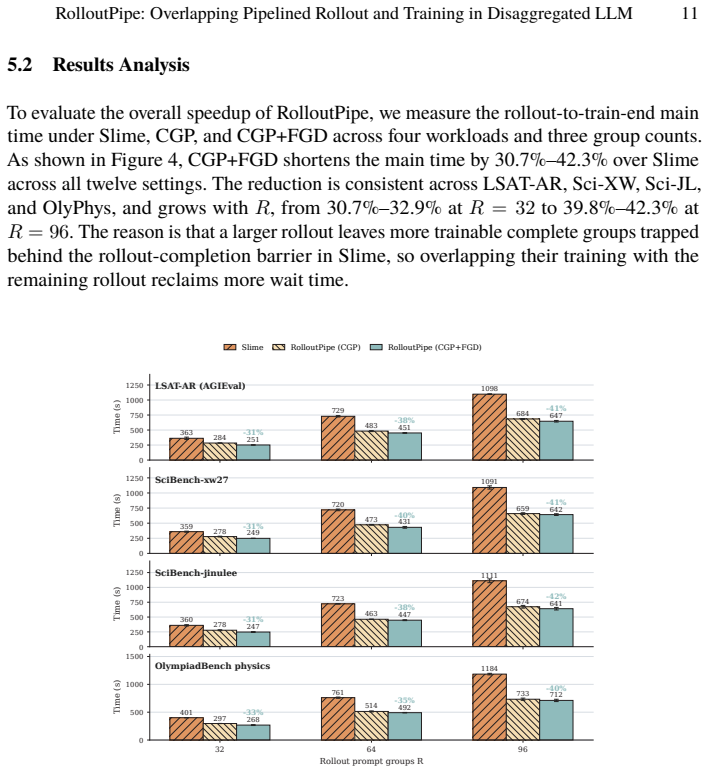
Summary. RolloutPipe targets idle trainer GPUs in disaggregated, synchronous on-policy GRPO RLVR systems that wait for a full rollout before training. It pipelines at the complete-group boundary via two mechanisms: complete-group pipelining (CGP), which hands each materialized group to a trainer FIFO as soon as it is ready, and frontier-group dispatch (FGD), a Rollout-node admission policy that prioritizes the Fw groups needed for the next U-group logical update. All groups in a round still share fixed rollout weights, and optimizer steps remain on U=B/K complete groups, so the authors claim on-policy correctness is preserved while training overlaps remaining rollout. On Qwen3-1.7B across four reasoning/science workloads and R∈{32,64,96} (twelve settings), CGP+FGD shortens rollout-to-train-end time by 30.7%–42.3% and cuts trainer waiting ratio by 37%–76% versus native Slime, with response length and trainer compute time essentially unchanged.
Significance. The paper addresses a concrete, practically important inefficiency in modern disaggregated RLVR stacks: serial rollout-then-train leaves training GPUs idle for roughly half the end-to-end window even though early complete groups are already valid GRPO units. The design is cleanly scoped—it refines synchronization granularity from whole-round to complete-group without introducing stale weights—and the timing evaluation is careful: four workloads × three R values × three configurations, four-round means with sample SDs, plus explicit checks that response length and active trainer compute (Table 1, Fig. 5) are invariant. CGP accounts for most of the gain; FGD tightens frontier arrival. If the systems claims hold under broader models and the learning-dynamics premise is either measured or carefully qualified, this is a useful systems contribution for on-policy GRPO post-training infrastructure.
major comments (3)
- §5.3 asserts that because CGP/FGD change only dispatch timing and order—not samples, advantages, or gradient computation—training dynamics and convergence remain consistent with Slime. That is a modeling premise, not a measured result. FGD reorders group completion (Eqs. 5–6, Alg. 1) and CGP changes the temporal order of U-group optimizer steps inside a round (R/U steps per rollout under fixed B,K). SGD is order-dependent, so intermediate weights after each logical update can differ even when every sample is on-policy under fixed rollout weights. The paper reports only response length and trainer compute time (Fig. 5, Table 1); no reward curves, accuracy trajectories, or final benchmark scores compare Slime vs. CGP/CGP+FGD. Either add such measurements over the same four rounds/workloads, or substantially qualify the claim to “on-policy data under fixed rollout weights” and discuss possi
- All end-to-end results use a single small backbone (Qwen3-1.7B) with a fixed disaggregated layout (2×A100 rollout, 8×RTX 4090 train). §5.1 argues that CGP/FGD are scheduling policies independent of model architecture and should generalize, but no scaling evidence is given (larger models, different TP/DP, different rollout:train GPU ratios, or longer sequences where materialization and transfer costs change). The reported 30.7%–42.3% main-time reduction and waiting-ratio gains are therefore demonstrated only in a narrow regime. At least one larger-model or alternate resource-ratio setting, or a clear limitation statement with predicted failure modes, is needed to support the generality implied by the abstract and conclusion.
- FGD’s frontier width is fixed at Fw=U=2 with no sensitivity study (§5.1, §3.3). The claimed supply-stabilizing benefit of FGD (tighter first-dispatch range, 2.5%–11.4% extra main-time reduction over CGP alone) depends on this choice. Without varying Fw (e.g., Fw∈{1,2,4,U}) or reporting frontier-arrival gap distributions beyond the R=96 dispatch ranges in §5.2, it is hard to know whether FGD’s contribution is robust or an artifact of matching Fw to U under the authors’ memory budget. A short ablation of Fw would make the second mechanism’s contribution load-bearing rather than anecdotal.
Circularity Check
No circularity: empirical systems speedups measured against external baseline; on-policy claim is design argument, not a fitted or self-defined prediction.
full rationale
RolloutPipe is an empirical systems paper. Its load-bearing claims are wall-clock reductions (rollout-to-train-end 30.7%–42.3%, trainer waiting ratio 37%–76%) measured against native Slime on Qwen3-1.7B across four workloads and twelve (R, config) settings. Those quantities are external observables (timestamps, wait/(wait+compute)), not quantities defined from fitted parameters that are then re-derived. CGP and FGD are scheduling policies: CGP hands complete groups to the trainer FIFO as soon as group materialization finishes (Eq. 2–3); FGD admits only frontier groups of width Fw (Eq. 5–6, Alg. 1). Neither step equates a prediction to its own input by construction. The on-policy-correctness argument is a design invariant (fixed rollout weights for all R groups in a round; optimizer steps still on U=B/K complete groups), not a circular algebraic identity or a self-citation uniqueness theorem. Citations to Slime, Megatron, SGLang, and async RL systems are infrastructure baselines or contrast cases, not load-bearing self-proofs of the measured speedups. Absence of reward/accuracy curves is an evidence gap about training dynamics, not circularity. Score 0; steps empty.
Axiom & Free-Parameter Ledger
free parameters (4)
- frontier width Fw =
2
- update width U = B/K =
2
- group size K and global batch B =
K=8, B=16
- rollout group count R =
32/64/96
axioms (4)
- domain assumption GRPO advantages require the full group of K responses (mean and std) before any sample is trainable.
- domain assumption All groups of a round share the same fixed rollout weights; weight refresh occurs only after the trainer drains every logical update of that round.
- domain assumption Default SGLang request-level FIFO is group-oblivious and therefore produces large frontier-group arrival gaps.
- ad hoc to paper Trainer compute time and response length are invariant under reordering of complete-group dispatch.
invented entities (2)
-
Complete-Group Pipelining (CGP)
independent evidence
-
Frontier-Group Dispatch (FGD)
independent evidence
read the original abstract
Large language model (LLM) post-training for reasoning increasingly relies on reinforcement learning with verifiable rewards (RLVR), where models learn from ground-truth feedback on mathematical, logical, and scientific tasks. To enable flexible resource allocation and support heterogeneous training setups, modern RLVR systems adopt disaggregated architectures that decouple rollout generation and policy training across independent GPU pools. However, existing synchronous on-policy GRPO (Group Relative Policy Optimization) RLVR systems finish an entire rollout before starting training, leaving the trainer GPU pool idle while rollout is still ongoing. Asynchronous RL pipelines overlap the two stages, but at the cost of training on stale data. To address these challenges, we propose RolloutPipe, a post-training framework for disaggregated RLVR systems, which turns the fixed-weight rollout into a complete-group pipeline where trainable groups move to the trainer while later groups are still being generated. RolloutPipe achieves this through two techniques including complete-group pipelining (CGP) and frontier-group dispatch (FGD). CGP dispatches each trainable complete group to the trainer FIFO as soon as group materialization finishes, and FGD is an admission policy on the Rollout node that first admits requests for the frontier groups needed to form the next training batch, so that trainer-ready groups arrive earlier and more steadily. The design starts training before the rollout completes while maintaining on-policy correctness. Evaluated on Qwen3-1.7B across four reasoning and science benchmarks and twelve rollout settings, RolloutPipe shortens the rollout-to-train-end time by 30.7%-42.3%, and lowers the trainer waiting ratio by 37%-76% compared to Slime, a state-of-the-art rollout and training system.
Figures



Forward citations
Cited by 1 Pith paper
-
Molt: A Scalable PyTorch-Native Training Framework for Agentic Reinforcement Learning
Molt is a lean, readable PyTorch-native RL training framework that reports statistically comparable step-time throughput to a Megatron-based stack, with the caveat that the head-to-head comparison measured throughput only.
Reference graph
Works this paper leans on
-
[1]
arXiv preprint arXiv:2505.24298 (2025)
Fu, W., Gao, J., Shen, X., Zhu, C., Mei, Z., He, C., Xu, S., Wei, G., Mei, J., Wang, J., Yang, T., Yuan, B., Wu, Y.: AReaL: A large-scale asynchronous reinforcement learning system for language reasoning. arXiv preprint arXiv:2505.24298 (2025)
Pith/arXiv arXiv 2025
-
[2]
Nature645(8081), 633–638 (2025)
Guo, D., Yang, D., Zhang, H., et al.: DeepSeek-R1 incentivizes reasoning in LLMs through reinforcement learning. Nature645(8081), 633–638 (2025)
2025
-
[3]
arXiv preprint arXiv:2507.01663 (2025)
Han,Z.,You,A.,Wang,H.,Luo,K.,Yang,G.,Shi,W.,Chen,M.,Zhang,S.,Lan,Z.,Deng,C., Ji, H., Liu, W., Huang, Y., Zhang, Y., Pan, C., Wang, J., Huang, X., Li, C., Wu, J.: AsyncFlow: An asynchronous streaming RL framework for efficient LLM post-training. arXiv preprint arXiv:2507.01663 (2025)
Pith/arXiv arXiv 2025
-
[4]
In: Proceedings of the 62nd Annual Meeting of the Association for Computational Linguistics (Volume 1: Long Papers)
He, C., Luo, R., Bai, Y., Hu, S., Thai, Z., Shen, J., Hu, J., Han, X., Huang, Y., Zhang, Y., Liu, J., Qi, L., Liu, Z., Sun, M.: OlympiadBench: A challenging benchmark for promoting AGI with olympiad-level bilingual multimodal scientific problems. In: Proceedings of the 62nd Annual Meeting of the Association for Computational Linguistics (Volume 1: Long Pa...
2024
-
[5]
In: Proceedings of the 2025 Conference on Empirical Methods in Natural Language Processing: System Demonstrations
Hu, J., Wu, X., Shen, W., Liu, J.K., Wang, W., Jiang, S., Wang, H., Chen, H., Chen, B., Fang, W., Xianyu, Cao, Y., Xu, H., Liu, Y.: OpenRLHF: A Ray-based easy-to-use, scalable and high-performance RLHF framework. In: Proceedings of the 2025 Conference on Empirical Methods in Natural Language Processing: System Demonstrations. pp. 656–666 (2025)
2025
-
[6]
In: Proceedings of the 8th International Conference on Cognitive Computing
Li,B.,Zeng,Q.,Ren,P.,Chen,H.,Geng,Y.,Zhang,L.J.:Anadaptivehotrankingalgorithmfor popular item recommendation in the express industry. In: Proceedings of the 8th International Conference on Cognitive Computing. Lecture Notes in Computer Science, vol. 15426, pp. 71–87. Springer (2025)
2025
-
[7]
In: Proceedings of the 9th International Conference on Cognitive Computing
Liu,B.,Ning,Y.,He,S.,Guo,F.,Jia,S.,Zhu,L.:Amultimodalretrieval-augmentedgeneration system for intelligent question answering. In: Proceedings of the 9th International Conference on Cognitive Computing. Lecture Notes in Computer Science, vol. 16156, pp. 3–19. Springer (2026)
2026
-
[8]
In: Proceedings of the 13th USENIX Symposium on Operating Systems Design and Implementation
Moritz, P., Nishihara, R., Wang, S., Tumanov, A., Liaw, R., Liang, E., Elibol, M., Yang, Z., Paul, W., Jordan, M.I., Stoica, I.: Ray: A distributed framework for emerging AI applica- tions. In: Proceedings of the 13th USENIX Symposium on Operating Systems Design and Implementation. pp. 561–577 (2018),
2018
-
[9]
In: Proceedings of the InternationalConferenceforHighPerformanceComputing,Networking,StorageandAnalysis
Narayanan,D.,Shoeybi,M.,Casper,J.,LeGresley,P.,Patwary,M.,Korthikanti,V.,Vainbrand, D., Kashinkunti, P., Bernauer, J., Catanzaro, B., Phanishayee, A., Zaharia, M.: Efficient large- scale language model training on GPU clusters using Megatron-LM. In: Proceedings of the InternationalConferenceforHighPerformanceComputing,Networking,StorageandAnalysis. pp. 1–...
2021
-
[10]
In: Advances in Neural Information Processing Systems
Ouyang, L., Wu, J., Jiang, X., Almeida, D., Wainwright, C., Mishkin, P., Zhang, C., Agarwal, S., Slama, K., Ray, A., Schulman, J., Hilton, J., Kelton, F., Miller, L., Simens, M., Askell, A., Welinder, P., Christiano, P.F., Leike, J., Lowe, R.: Training language models to follow instructions with human feedback. In: Advances in Neural Information Processin...
2022
-
[11]
In: Proceedings of the Twentieth European Conference on Computer Systems
Sheng, G., Zhang, C., Ye, Z., Wu, X., Zhang, W., Zhang, R., Peng, Y., Lin, H., Wu, C.: HybridFlow: A flexible and efficient RLHF framework. In: Proceedings of the Twentieth European Conference on Computer Systems. pp. 1279–1297 (2025)
2025
-
[12]
In: Proceedings of the 41st International Conference on Machine Learning
Wang, X., Hu, Z., Lu, P., Zhu, Y., Zhang, J., Subramaniam, S., Loomba, A.R., Zhang, S., Sun, Y., Wang, W.: SciBench: Evaluating college-level scientific problem-solving abilities of large language models. In: Proceedings of the 41st International Conference on Machine Learning. Proceedings of Machine Learning Research, vol. 235, pp. 50622–50649 (2024),
2024
-
[13]
Xu, M., Wu, J., Song, S., Srirama, S.N., Javad, B., Ranjan, R., Jha, D.N., Wang, S., Tian, W., Xu, H., Li, L., Mo, Z., Ren, S., Kunz, T., Kochovski, P., Stankovski, V., Ye, K., Xu, C., Buyya, R.: Cloud-native and distributed systems for efficient and scalable large language models – a research agenda (2026),
2026
-
[14]
In: Proceedings of the 9th International Conference on Cognitive Computing
Zhang,W.:AI-Drivene-commercetrafficengine:Amulti-agentsystemforoptimizingamazon sales. In: Proceedings of the 9th International Conference on Cognitive Computing. Lecture Notes in Computer Science, vol. 16156, pp. 65–73. Springer (2026)
2026
-
[15]
In: Advances in Neural Information Processing Systems
Zheng, L., Yin, L., Xie, Z., Sun, C., Huang, J., Yu, C.H., Cao, S., Kozyrakis, C., Stoica, I., Gonzalez, J.E., Barrett, C.W., Sheng, Y.: SGLang: Efficient execution of structured language model programs. In: Advances in Neural Information Processing Systems. vol. 37, pp. 62557– 62583 (2024). ,
2024
-
[16]
In: Findings of the Association for Computational Linguistics: North American Chapter of the Association for Computational Linguistics 2024
Zhong, W., Cui, R., Guo, Y., Liang, Y., Lu, S., Wang, Y., Saied, A., Chen, W., Duan, N.: AGIEval: A human-centric benchmark for evaluating foundation models. In: Findings of the Association for Computational Linguistics: North American Chapter of the Association for Computational Linguistics 2024. pp. 2299–2314 (2024)
2024
-
[17]
In: Proceedings 16 R
Zhong,Y.,Zhang,Z.,Wu,B.,Liu,S.,Chen,Y.,Wan,C.,Hu,H.,Xia,L.,Ming,R.,Zhu,Y.,Jin, X.: Optimizing RLHF training for large language models with stage fusion. In: Proceedings 16 R. Chen et al. of the 22nd USENIX Symposium on Networked Systems Design and Implementation. pp. 489–503 (2025),
2025
-
[18]
GitHub repository (2025),
Zhu, Z., Xie, C., Lv, X., slime Contributors: slime: An LLM post-training framework for RL scaling. GitHub repository (2025),
2025
discussion (0)
Sign in with ORCID, Apple, or X to comment. Anyone can read and Pith papers without signing in.