REVIEW 3 major objections 4 minor 1 cited by
A geometry-conditioned Fourier neural operator learns the one-step solution map of 2D cubic nonlinear Schrödinger equation on both rational and irrational tori and reproduces their distinct Sobolev-norm growth.
Reviewed by Pith at T0; open to challenge. T0 means a machine referee read the full paper against a public rubric. the ladder, T0–T4 →
A Fourier neural operator conditioned on the torus aspect-ratio parameter learns NLS dynamics and reproduces stronger H²-norm growth on rational tori than on irrational tori.
T0 review reviewed 2026-08-02 challenge →
load-bearing objection Solid FNO-for-NLS bench work undercut by an unverified Sobolev claim: the plot that matters has no ground-truth curves. the 3 major comments →
Geometry-Conditioned Fourier Neural Operators for Cubic Nonlinear Schrodinger Dynamics on Periodic Domains
The pith
A machine-rendered reading of the paper's core claim, the machinery that carries it, and where it could break.
The reading
Core claim
The central claim is that the geometry of the torus—encoded solely through the anisotropic Laplacian eigenvalues λ_k=m²+ω²ℓ² and supplied to the network as a constant input channel—is enough for a learned operator to distinguish the two cascade regimes. The model outputs the next snapshot from the real and imaginary parts plus ω², and after training on one-step pairs, it is applied autoregressively for long-time prediction. The numerical results show the predicted H² curves for ω²=1 grow faster than for ω²=√2, matching the theoretical prediction that rational tori have richer resonances and hence stronger high-frequency energy transfer. The ablations indicate that removing the ω² channel deg
What carries the argument
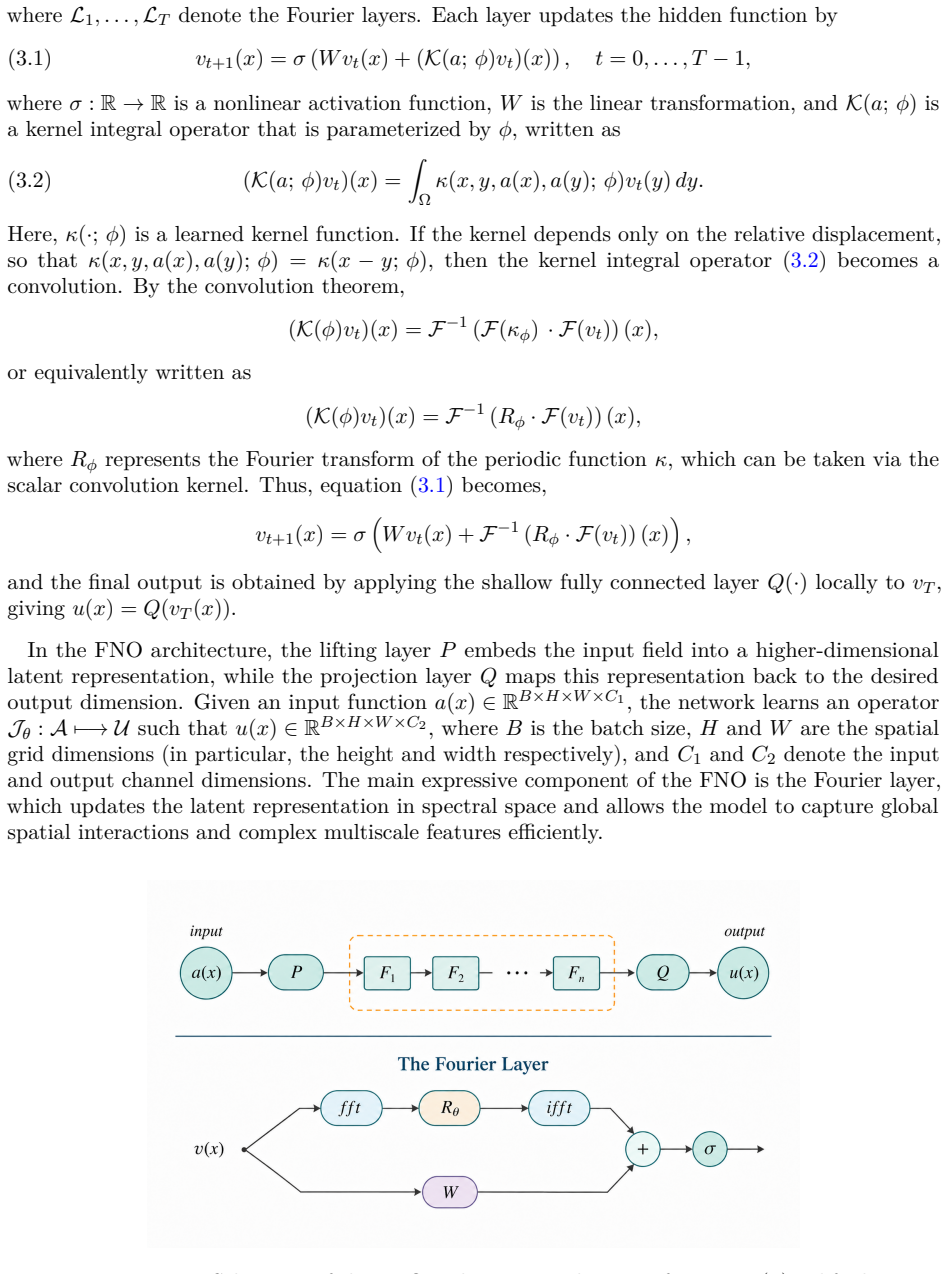
The central object is the geometry-conditioned Fourier neural operator, whose input is the complex solution fields plus the aspect ratio ω² as a constant channel. The geometry enters the PDE through the anisotropic Laplacian eigenvalues λ_k=m²+ω²ℓ²; rational ω² gives commensurate eigenvalues and many exact resonances, while irrational ω² decouples the resonance conditions and suppresses cascades. The FNO parameterizes spectral convolutions on a truncated set of Fourier modes and learns a one-step map; long-time predictions are generated by feeding outputs back as inputs. An a posteriori error estimate bounds the learned-solution error by the initial error, the residual, and a truncation term
Load-bearing premise
The whole conclusion rests on the assumption that the 64-by-64 grid and the network's 12 retained frequencies still capture the fine-scale oscillations that determine how fast the Sobolev norm grows; the paper does not check whether refining the grid changes the result, so the predicted difference between the two tori could come from the truncation rather than from the physics.
What would settle it
Train or evaluate the same network at a finer learning grid (e.g., 128×128 or 256×256) and with a larger retained-mode count, with an adequate training budget, and compare the rational-versus-irrational H²-growth gap; if the gap shrinks or reverses relative to the 64×64 / K=12 configuration, the reported geometry-dependent behavior is an artifact of the truncation.
If this is right
- If the claim holds, a single geometry-conditioned FNO can cheaply approximate long-time NLS dynamics for different aspect ratios without re-solving the PDE.
- The reproduced H²-growth gap implies the learned operator has internalized the resonance structure, not just fitted individual trajectories.
- The ablation results suggest that feeding the PDE parameter explicitly improves generalization, particularly when the parameter changes the qualitative dynamics.
- The error estimate offers a formal guarantee that the learned surrogate tracks the reference solver up to truncation and residual errors, giving a principled way to choose the number of retained Fourier modes.
Where Pith is reading between the lines
- The same conditioning trick—adding a parameter that changes the dispersion relation—could extend to other PDE families with anisotropic Laplacians or waveguide geometries, where the resonance set depends on a scalar parameter.
- A natural next experiment would train the model on a continuum of ω² values between rational and irrational and see whether the predicted cascade rate interpolates smoothly; the paper only tests the two endpoints.
- The resolution-convergence concern in the weakest assumption is directly testable: if the rational-versus-irrational H² gap persists at a 128×128 or 256×256 learning grid with adequate retained modes, the claim is robust.
- The approach suggests an alternative to hard-coding physical constraints: rather than explicitly identifying resonant quartets, the network can learn the resonance structure from data when the geometry parameter is provided.
Editorial analysis
A structured set of objections, weighed in public.
Referee Report
Summary. The paper proposes a geometry-conditioned Fourier neural operator (FNO) for the two-dimensional cubic defocusing nonlinear Schrödinger equation on rational and irrational tori. The model takes the real and imaginary parts of the current solution together with the constant aspect-ratio channel ω² as input, is trained to approximate the one-step solution operator, and is evaluated autoregressively over long time horizons. The main scientific claim is that the learned operator captures the dynamics on both geometries and reproduces the distinct Sobolev-norm behavior reported in the analysis literature: stronger H²-growth on the rational torus and more constrained growth on the irrational torus. The paper also includes an a posteriori error estimate (Theorem 3.1), a data-generation and training description, numerical comparisons of solution fields and L² errors, and ablation studies over Fourier-mode count, activation function, layer depth, and geometry conditioning.
Significance. If the central claim were quantitatively established, the work would be a useful demonstration of operator learning for geometry-dependent spectral transfer in dispersive PDEs, and it would support the use of geometry-aware surrogates for studies of weak turbulence. The manuscript is clearly written, the experiments are reproducible in principle, and Theorem 3.1 is a valid a posteriori error estimate for an idealized continuous-time model. However, the central Sobolev-reproduction claim is not actually verified against reference trajectories, and the theoretical estimate is not connected to the trained network, so the significance of the empirical results as evidence for the paper's headline claim is limited.
major comments (3)
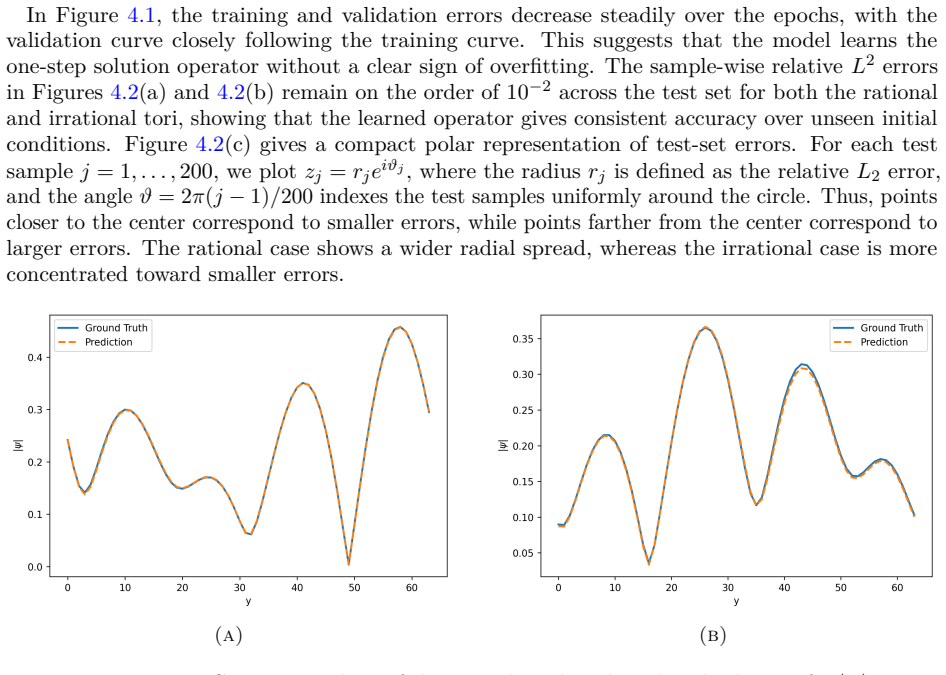
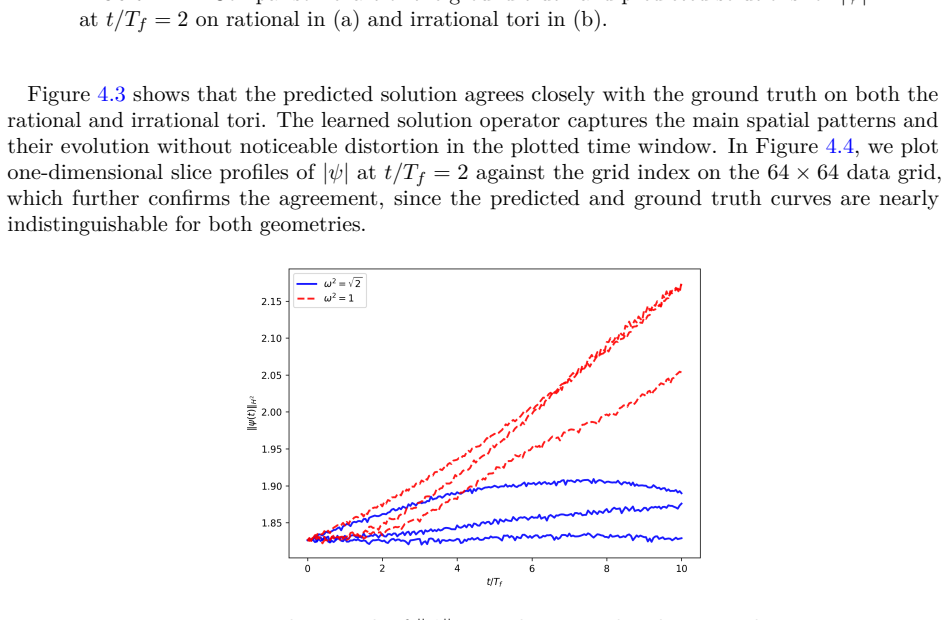
- [§4.2, Figure 4.5] The central claim that the learned operator reproduces the distinct H²-growth behavior is supported only by Figure 4.5, which plots predicted H² norms for three test realizations per geometry and contains no ground-truth reference curves. Because the training data are generated by a solver that already exhibits the rational-vs-irrational difference, such a plot can only demonstrate in-distribution consistency, not that the operator has learned the underlying physics. To make the claim quantitative, the authors should overlay the downsampled (64×64) ground-truth H² trajectories on Figure 4.5 and also report the relative H² error between prediction and reference for the test set. Without this, the qualitative separation in Figure 4.5 is not evidence that the model reproduces the reference Sobolev behavior.
- [§3, Theorem 3.1] Theorem 3.1 is conditional on an unverified residual. The theorem assumes the learned solution ψθ satisfies a continuous-time frequency-restricted equation with a residual rθ (3.4), but the FNO is a discrete autoregressive map trained on one-step pairs, and the residual rθ(t) is never computed, bounded, or shown to be small for the trained network. The FNO also operates on a 64×64 grid with only K=12 retained Fourier modes per direction (§4.1.2), so its output is not a solution of the equation in the theorem. As stated, the theorem is a valid statement about an idealized continuous-time model but has no demonstrated connection to the numerical experiments; the paper should either compute/estimate rθ for the trained operator or explicitly present the theorem as a purely theoretical consistency result that does not support the empirical claims.
- [§4.1 and §4.1.2] The paper does not provide a resolution-convergence study to justify that the 64×64 learning grid with K=12 retained Fourier modes per direction preserves the high-frequency content that drives H²-norm growth. H² norms weight modes by |k|², and the reference data are generated on a 256×256 grid and then downsampled to 64×64; the distinguishing cascade dynamics may live above the retained or aliased modes. Without experiments at higher resolution or with a comparison of H² curves at different K values, the rational-vs-irrational separation in Figure 4.5 could be a numerical artifact of truncation/aliasing rather than the geometry-dependent spectral transfer claimed. At minimum, the authors should overlay the H² curves obtained from the downsampled reference and show that the learned model tracks them within a quantified error.
minor comments (4)
- [§2.5, near Eq. (2.6)] The text refers to 'The cubic nonlinearity in (3.3)' when discussing the Fourier system, but the relevant equation is (2.6). Several later references to equation numbers are similarly off by one section.
- [§2.6, Theorem 2.5] The statement contains a typographical error: 'log∥ψ_N^0∥_{H^1}≤C log N' is likely intended to be '∥ψ_N^0∥_{H^1}≤C log N'. The current form is ungrammatical.
- [§4.3.2 and §4.3.3] The main architecture uses GELU activation and four Fourier layers, but the ablations show that Sigmoid and two layers give the lowest mean errors. The authors should briefly justify why the default settings were chosen for the main experiments, or at least acknowledge that the best configuration differs from the one used.
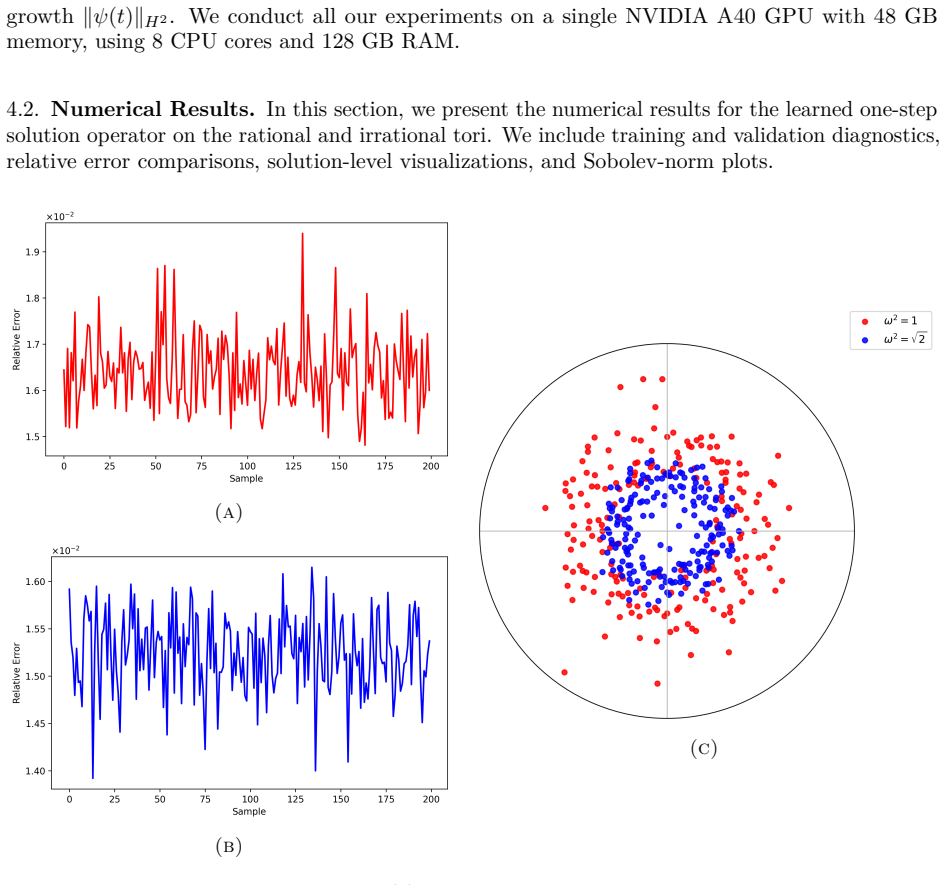
- [§4.2, Figure 4.2(c)] The polar representation of test-set errors lacks axis labels and a clear scale; the text describes the construction, but a reader cannot read off error magnitudes from the figure alone.
Circularity Check
No circularity found: the model is a data-driven surrogate validated on held-out trajectories, and its H^2 reproduction is an in-distribution consistency check, not a derivation from its own inputs.
full rationale
None of the six circularity patterns occurs. The central claim is a surrogate-model validation: the FNO is trained on one-step input/output pairs generated by a Fourier pseudospectral reference solver for ω²=1 and ω²=√2, then autoregressively evaluated on held-out random-phase initial data. The H²-growth separation in Figure 4.5 is a diagnostic computed from the learned rollouts, not a fitted parameter; because the training data already contain the solver's rational-vs-irrational difference, the agreement is an in-distribution consistency check, which is the standard and legitimate content of an operator-learning benchmark. The paper does not present this as an independent first-principles derivation of the cascade difference; it explicitly attributes that physics to [13] and says only that the learned operator 'reproduces' it. The conclusion limits the claim: 'the model is trained entirely on data generated by a numerical solver, so the quality of the learned operator depends on the accuracy, resolution, and time horizon of the numerical data.' Theorem 3.1 is a self-contained Grönwall-type a posteriori estimate with residual and truncation terms; it does not assume the target H² behavior. No load-bearing self-citation is present: [13], [12], [6], and [27] are external sources, while self-citations [23], [24], and [35] appear only in non-central contexts (literature review and future directions). The absence of a ground-truth overlay in Figure 4.5 and the resolution/aliasing question are presentation and correctness concerns, not circularity. No equation or fitted parameter reduces by construction to the claimed output, so no circular step can be exhibited by quote.
Axiom & Free-Parameter Ledger
free parameters (7)
- R (initial H^s norm) =
1.8263
- s (Sobolev index for data) =
2
- K (retained Fourier modes) =
12
- Fourier-layer depth =
4
- Activation function =
GELU
- T_f and T_max =
T_f=2π, T_max=10T_f
- Learning grid =
64×64
axioms (6)
- domain assumption Global well-posedness and Sobolev-norm bounds for the cubic NLS on irrational tori (Theorem 2.6 / Corollary 2.7 of [13])
- standard math H^s is a Banach algebra for s>1 (Lemma 2.4)
- standard math Bernstein-type inequalities for frequency projections (Lemma 2.3)
- domain assumption The 2π-periodic anisotropic Laplacian formulation is equivalent to the scaled torus after rescaling the y variable
- domain assumption The reference Fourier pseudospectral solver with two-thirds dealiasing yields ground-truth solutions accurate enough for the claims
- ad hoc to paper The FNO autoregressive rollout can be represented as a continuous-time solution of a residual-perturbed truncated NLS (Theorem 3.1)
Cite this review
Pith. "Pith review of Geometry-Conditioned Fourier Neural Operators for Cubic Nonlinear Schrodinger Dynamics on Periodic Domains." pith.science (2026). https://pith.science/paper/BI6QNFS3
@misc{pith2026260627459,
  author       = {Pith},
  title        = {Pith review of: Geometry-Conditioned Fourier Neural Operators for Cubic Nonlinear Schrodinger Dynamics on Periodic Domains},
  year         = {2026},
  howpublished = {\url{https://pith.science/paper/BI6QNFS3}},
  note         = {Machine review of arXiv:2606.27459}
}
abstract
We consider the cubic nonlinear Schr\"odinger (NLS) equation on two-dimensional flat tori with varying aspect ratios. In this formulation, the choice of aspect ratio governs the Fourier resonance structure, so rational and irrational geometries can exhibit different high-frequency cascade behaviors. We present a geometry-conditioned Fourier neural operator (FNO) for the cubic defocusing NLS equation, where the input consists of the real and imaginary parts of the solution together with the aspect-ratio parameter \(\omega^2\). The model is trained to approximate the one-step solution operator and is evaluated on unseen trajectories generated from random-phase initial data using Fourier pseudospectral method. Our numerical experiments show that the learned operator captures the main solution dynamics on both tori and reproduces the distinct Sobolev norm behavior of the two geometries, with stronger \(H^2\)-growth on the rational torus and more constrained behavior on the irrational torus, consistent with the findings of \cite{hrabski2021energy}. We perform ablation studies to examine the roles of retained Fourier modes, activation functions, Fourier-layer depth, and explicit geometry conditioning. The results indicate that including $\omega^2$ improves long-time predictive accuracy, especially for the rational geometry, and supports the use of geometry-aware neural operators for learning spectral-transfer phenomena in nonlinear dispersive partial differential equations.
Figures
Forward citations
Cited by 1 Pith paper
-
Operator-Split Bayesian Learning for Elliptic PDEs with Unequal Interior and Boundary Data
An operator-split Bayesian posterior, which pushes independent neural-network posteriors for the source and boundary through the elliptic solution map, contracts around the true solution at a near-minimax rate.
Reference graph
Works this paper leans on
-
[1]
W. Bao. The nonlinear Schrödinger equation and applications in Bose-Einstein condensation and plasma physics. InDynamics in models of coarsening, coagulation, condensation and quantization, pages 141–239. World Scientific, 2007
2007
-
[2]
W. Bao, S. Jin, and P. A. Markowich. Numerical Study of Time-Splitting Spectral Discretiza- tions of Nonlinear Schrödinger Equations in the Semiclassical Regimes.SIAM Journal on Scientific Computing, 25(1):27–64, 2003
2003
-
[3]
Bourgain
J. Bourgain. On the growth in time of higher Sobolev norms of smooth solutions of Hamiltonian PDE.International Mathematics Research Notices, (6):277–304, 1996
1996
-
[4]
Colliander, M
J. Colliander, M. Keel, G. Staffilani, H. Takaoka, and T. Tao. Transfer of energy to high frequencies in the cubic defocusing nonlinear Schrödinger equation.Inventiones Mathematicae, 181(1):39–113, 2010
2010
-
[5]
M. Cranmer, S. Greydanus, S. Hoyer, P. Battaglia, D. Spergel, and S. Ho. Lagrangian Neural Networks.arXiv preprint arXiv:2003.04630, 2020
Pith/arXiv arXiv 2003
-
[6]
Deng and P
Y. Deng and P. Germain. Growth of Solutions to NLS on Irrational Tori.International Mathematics Research Notices, 2019(9):2919–2950, 2019
2019
-
[7]
Giuliani and M
F. Giuliani and M. Guardia. Sobolev norms explosion for the cubic NLS on irrational tori. Nonlinear Analysis, 220:112865, 2022
2022
-
[8]
Y. Gong, Q. Wang, Y. Wang, and J. Cai. A conservative Fourier pseudo-spectral method for the nonlinear Schrödinger equation.Journal of Computational Physics, 328:354–370, 2017
2017
-
[9]
Greydanus, M
S. Greydanus, M. Dzamba, and J. Yosinski. Hamiltonian Neural Networks. InAdvances in Neural Information Processing Systems, volume 32, 2019
2019
-
[10]
Z. Hani, B. Pausader, N. Tzvetkov, and N. Visciglia. Modified scattering for the cubic Schrödinger equation on product spaces and applications.Forum of Mathematics, Pi, 3:e4, 2015
2015
-
[11]
Hernández, A
Q. Hernández, A. Badias, D. González, F. Chinesta, and E. Cueto. Structure-preserving neural networks.Journal of Computational Physics, 426:109950, 2021
2021
-
[12]
Herr and B
S. Herr and B. Kwak. Global well-posedness of the cubic nonlinear schrödinger equation on $\mathbb{t} ˆ{2}$.Inventiones mathematicae, 2026
2026
-
[13]
A. Hrabski, Y. Pan, G. Staffilani, and B. Wilson. Energy transfer for solutions to the nonlinear Schröodinger equation on irrational tori.arXiv preprint arXiv:2107.01459, 2021
Pith/arXiv arXiv 2021
-
[14]
A. D. Jagtap and G. E. Karniadakis. Extended physics-informed neural networks (xpinns): A generalized space-time domain decomposition based deep learning framework for nonlinear partial differential equations.Communications in Computational Physics, 28(5):2002–2041, 2020
2002
-
[15]
A. D. Jagtap, E. Kharazmi, and G. E. Karniadakis. Conservative physics-informed neural networks on discrete domains for conservation laws: Applications to forward and inverse problems.Computer Methods in Applied Mechanics and Engineering, 365:113028, 2020
2020
-
[16]
P. Jin, Z. Zhang, A. Zhu, Y. Tang, and G. E. Karniadakis. Sympnets: Intrinsic structure- preserving symplectic networks for identifying hamiltonian systems.Neural Networks, 132:166– 179, 2020
2020
-
[17]
Kovachki, S
N. Kovachki, S. Lanthaler, and S. Mishra. On universal approximation and error bounds for Fourier neural operators.Journal of Machine Learning Research, 22(290):1–76, 2021
2021
-
[18]
Kovachki, Z
N. Kovachki, Z. Li, B. Liu, K. Azizzadenesheli, K. Bhattacharya, A. M. Stuart, and A. Anand- kumar. Neural Operator: Learning Maps Between Function Spaces with Applications to PDEs. Journal of Machine Learning Research, 24(89):1–97, 2023. 19
2023
-
[19]
Z. Li, N. B. Kovachki, K. Azizzadenesheli, B. Liu, K. Bhattacharya, A. M. Stuart, and A. Anandkumar. Neural Operator: Graph Kernel Network for Partial Differential Equations. arXiv preprint arXiv:2003.03485, 2020
Pith/arXiv arXiv 2003
-
[20]
Z. Li, N. B. Kovachki, K. Azizzadenesheli, B. Liu, K. Bhattacharya, A. M. Stuart, and A. Anandkumar. Fourier Neural Operator for Parametric Partial Differential Equations. In International Conference on Learning Representations, 2021
2021
-
[21]
L. Lu, P. Jin, G. Pang, Z. Zhang, and G. E. Karniadakis. Learning nonlinear operators via DeepONet based on the universal approximation theorem of operators.Nature Machine Intelligence, 3(3):218–229, 2021
2021
-
[22]
A. C. Newell and J. V. Moloney.Nonlinear Optics. Addison-Wesley, 1992
1992
-
[23]
V. Obieke and E. Oguadimma. Structure-preserving physics-informed neural network for the Korteweg–de Vries (KdV) equation.arXiv preprint arXiv:2511.00418, 2025
Pith/arXiv arXiv 2025
-
[24]
V. C. Obieke, C. Chukwuemeka, and E. E. Oguadimma. Structure-informed neural operators for long-time prediction of parametric hamiltonian pdes.arXiv preprint arXiv:2606.14913, 2026
Pith/arXiv arXiv 2026
-
[25]
E. E. Oguadimma, M. A. F. Elbarkawy, D. O. Oranugo, H. E. Salem, M. Bayram, and O. J. Obulezi. A Foundational Review of Ordinary Differential Equation Solution Methods and Their Inherent Symmetries.Boletim da Sociedade Paranaense de Matemática, 44(8):1–27, 2026
2026
-
[26]
S. A. Orszag. On the Elimination of Aliasing in Finite-Difference Schemes by Filtering High-Wavenumber Components.Journal of the Atmospheric Sciences, 28(6):1074–1074, 1971
1971
-
[27]
Planchon, N
F. Planchon, N. Tzvetkov, and N. Visciglia. On the Growth of Sobolev norms for NLS on 2- and 3-Dimensional Manifolds.Analysis & PDE, 10(5):1123–1147, 2017
2017
-
[28]
Raissi, P
M. Raissi, P. Perdikaris, and G. E. Karniadakis. Physics-informed neural networks: A deep learning framework for solving forward and inverse problems involving nonlinear partial differential equations.Journal of Computational Physics, 378:686–707, 2019
2019
-
[29]
Ren and S.-F
H.-M. Ren and S.-F. Tian. The evolution process of the solutions for the coupled nonlinear Schrödinger equations via Fourier neural operator approach.Mathematics and Computers in Simulation, 239:1082–1096, 2026
2026
-
[30]
Sirignano and K
J. Sirignano and K. Spiliopoulos. DGM: A deep learning algorithm for solving partial differential equations.Journal of Computational Physics, 375:1339–1364, 2018
2018
-
[31]
Staffilani and B
G. Staffilani and B. Wilson. Stability of the cubic nonlinear Schrödinger equation on an irrational torus.SIAM Journal on Mathematical Analysis, 52(2):1318–1342, 2020
2020
-
[32]
Sulem and P.-L
C. Sulem and P.-L. Sulem.The Nonlinear Schrödinger Equation: Self-Focusing and Wave Collapse, volume 139 ofApplied Mathematical Sciences. Springer, 1999
1999
-
[33]
J. A. C. Weideman and B. M. Herbst. Split-Step Methods for the Solution of the Nonlinear Schrödinger Equation.SIAM Journal on Numerical Analysis, 23(3):485–507, 1986
1986
-
[34]
G. Wen, Z. Li, K. Azizzadenesheli, A. Anandkumar, and S. M. Benson. U-FNO—An enhanced fourier neural operator-based deep-learning model for multiphase flow.Advances in Water Resources, 163:104180, 2022
2022
-
[35]
B. Wilson and X. Yu. Modified Scattering of Cubic Nonlinear Schrödinger Equation on Rescaled Waveguide Manifolds.arXiv preprint arXiv:2207.07248, 2022
Pith/arXiv arXiv 2022
-
[36]
W. Xiao, T. Gao, K. Liu, J. Duan, and M. Zhao. Fourier neural operator based fluid–structure interaction for predicting the vesicle dynamics.Physica D: Nonlinear Phenomena, 463:134145, 2024
2024
-
[37]
H. You, Q. Zhang, C. J. Ross, C.-H. Lee, and Y. Yu. Learning deep implicit Fourier neural operators (IFNOs) with applications to heterogeneous material modeling.Computer Methods in Applied Mechanics and Engineering, 398:115296, 2022
2022
-
[38]
B. Yu. The deep Ritz method: A deep learning-based numerical algorithm for solving variational problems.Communications in Mathematics and Statistics, 6(1):1–12, 2018
2018
-
[39]
V. E. Zakharov. Stability of Periodic Waves of Finite Amplitude on the Surface of a Deep Fluid.Journal of Applied Mechanics and Technical Physics, 9(2):190–194, 1968
1968
-
[40]
Y. Zang, G. Bao, X. Ye, and H. Zhou. Weak adversarial networks for high-dimensional partial differential equations.Journal of Computational Physics, 411:109409, 2020. 20
2020
-
[41]
Zhong, Z
M. Zhong, Z. Yan, and S.-F. Tian. Data-driven parametric soliton-rogon state transitions for nonlinear wave equations using deep learning with Fourier neural operator.Communications in Theoretical Physics, 75:025001, 2023
2023
-
[42]
Y. D. Zhong, B. Dey, and A. Chakraborty. Symplectic ODE-Net: Learning Hamiltonian Dynamics with Control. InInternational Conference on Learning Representations, 2020. Emmanuel E. Oguadimma Department of Mathematics, Oregon State University Kidder Hall 368 Corvallis, OR 97331 Email address:oguadime@oregonstate.edu Victory C. Obieke Department of Mathematic...
2020
This paper was first reviewed by deepseek-v4-flash on August 2, 2026.
discussion (0)
Sign in with ORCID, Apple, or X to comment. Anyone can read and Pith papers without signing in.