REVIEW 3 major objections 6 minor 1 cited by
Current world-generation models do not reliably remember objects that leave the camera and change while off-screen.
Reviewed by Pith at T0; open to challenge. T0 means a machine referee read the full paper against a public rubric. the ladder, T0–T4 →
T0 review · grok-4.5
2026-07-14 17:13 UTC pith:FMUZ4NF3
load-bearing objection Solid diagnostic benchmark that actually isolates object permanence under joint camera and scene dynamics; the failure claim holds if you read ORS with CamCtrl. the 3 major comments →
MemoBench: Benchmarking World Modeling in Dynamically Changing Environments
The pith
A machine-rendered reading of the paper's core claim, the machinery that carries it, and where it could break.
Core claim
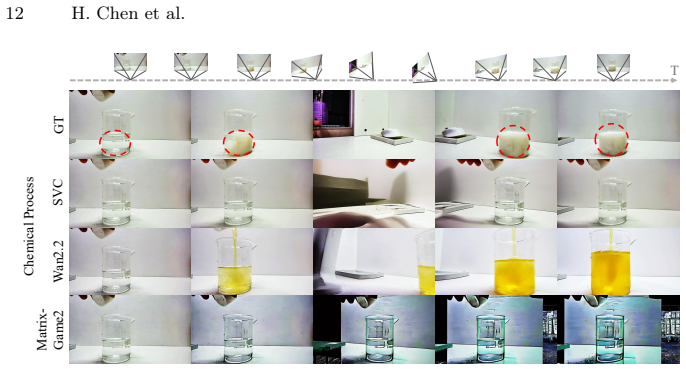
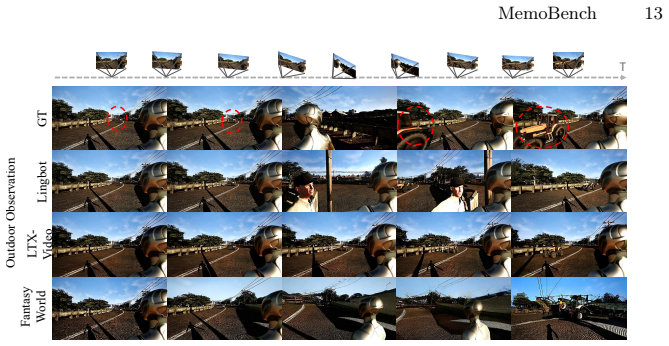
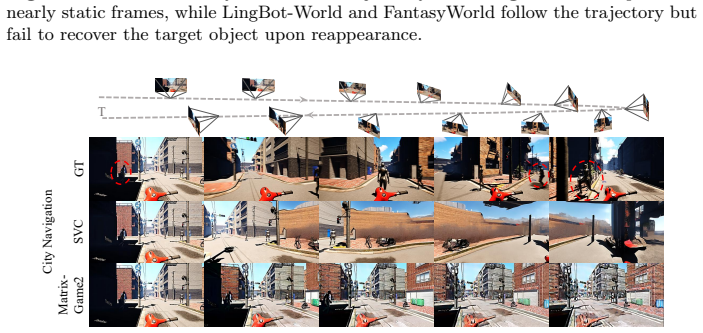
No current state-of-the-art world generation model reliably maintains a persistent representation of objects that leave the field of view and continue to evolve: Object Reappearance Score never exceeds 0.6, Continuity of Memory VQA stays near half for models that actually execute the trajectory, and camera conditioning alone does not produce object permanence.
What carries the argument
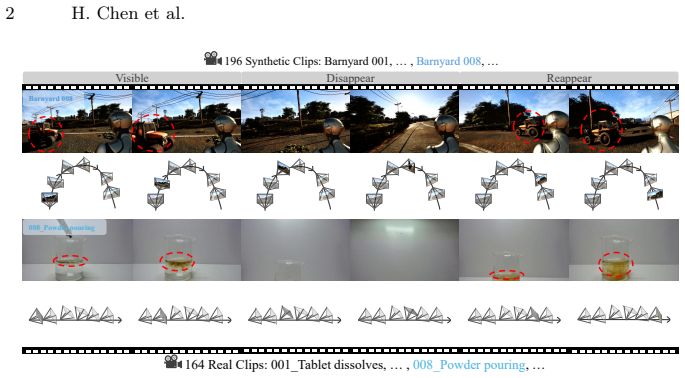
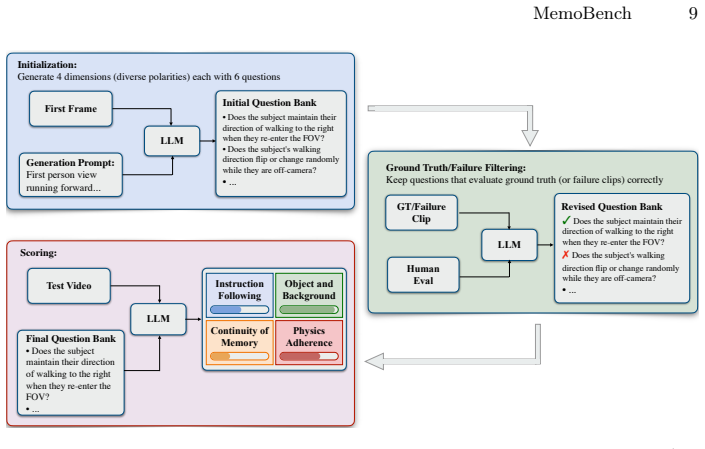
The disappear-and-reappear paradigm (Visible–Disappear–Reappear phases with annotated keyframes), scored by the Object Reappearance Score (SAM-3 detection rate and confidence in the reappear phase) together with polarity-balanced VQA on Continuity of Memory.
Load-bearing premise
That the SAM-3 detection score and the filtered LLM questions actually measure off-screen object memory rather than detector quirks, residual on-screen cues, or wording artifacts.
What would settle it
A model that both follows large camera rotations and still scores ORS well above 0.6 with Continuity-of-Memory VQA clearly above chance on the same 360-clip suite would overturn the claim that memory is the present bottleneck.
If this is right
- Object permanence must be trained for explicitly; camera trajectory control and higher visual quality do not automatically produce it.
- Evaluation protocols that ignore camera inactivity will systematically over-rate static generators on consistency metrics.
- Future world models need persistent state representations that continue to evolve while content is unobserved.
- Benchmarks that combine dynamic cameras with ongoing physical state change become necessary for claims of world simulation.
Where Pith is reading between the lines
- The same protocol could be extended to multi-object scenes and longer occlusion gaps to test whether failures compound with scene complexity.
- Training objectives that penalize reappearance mismatch against held-out ground-truth state may close the gap faster than scaling rendering quality alone.
- Embodied agents that rely on these generators for off-screen reasoning will inherit the same memory failures until the bottleneck is addressed.
Editorial analysis
A structured set of objections, weighed in public.
Referee Report
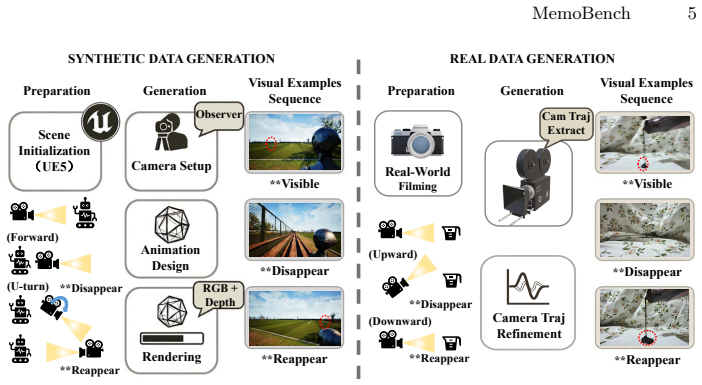
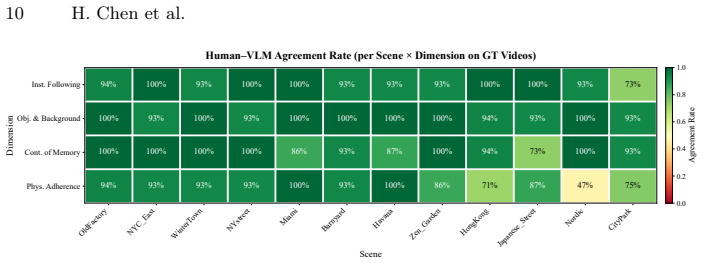
Summary. MemoBench introduces a diagnostic benchmark for world/video generation that tests memory consistency under simultaneous camera motion and scene dynamics via a disappear-and-reappear (Visible–Disappear–Reappear) protocol: a target undergoes a physical process, leaves the field of view, and must be recovered in its evolved state upon return. The authors release 360 GT clips (196 synthetic UE5, 164 real indoor state-change sequences) with camera trajectories and depth, and an evaluation suite combining automated metrics (visual quality, motion/geometry consistency, Object Reappearance Score via SAM-3, pixel fidelity, camera controllability) with Gemini-judged polarity-balanced VQA across four pillars, validated against human agreement (92.9%, κ=0.85 on GT). Ten open models (CI2V, 3D/NVS, I2V) are evaluated; the main empirical claim is that no model reliably maintains object memory across occlusion (ORS ≤ 0.6; Continuity of Memory remains weak for models that actually move), that camera inactivity inflates consistency scores, and that camera conditioning alone does not yield object permanence.
Significance. The paper fills a clear gap relative to WorldScore, VBench, VideoPhy, and related world-model benchmarks: prior work either keeps targets continuously visible or tests occlusion only in static scenes. The V–D–R construction with ongoing physical change is a useful, falsifiable probe of off-screen state, and the multi-metric design (especially joint reading of ORS with Camera Controllability, motion-gated subsets, per-phase fidelity, and human-validated VQA) is careful enough to support the headline finding that current generators lack reliable object permanence. Strengths include released data/code/leaderboard intent, extensive supplementary ablations (ORS coverage/prompt sweeps, metric sensitivity, pose sanity checks, Wan2.2 conditioning ablation), and explicit diagnosis of inactivity confounds. If the result holds under the stated controls, it is a timely diagnostic contribution for world-model and camera-controllable video research.
major comments (3)
- [§3.4 Eq. (6); Abstract; §1] §3.4, Eq. (6) and Abstract/§1 framing: The paper’s central promise is recovery of the target “in its updated state” after an off-screen physical process. ORS, however, is a detection-and-confidence score (SAM-3 text-prompted masks in the R phase); it does not score whether melting, pouring, dissolution, etc., progressed correctly during D. State correctness is only indirectly captured by GT-aligned PSNR/SSIM/LPIPS and by Continuity of Memory / Physics VQA. This is a load-bearing mismatch between claim language and the primary named memory metric. Please either (i) tighten abstract/intro/conclusion language so ORS is clearly “reappearance detectability,” not full state memory, and elevate phase-aware fidelity + memory VQA as the state-aware evidence, or (ii) add an explicit state-aware check on real clips (e.g., process-specific VQA or attribute probes) and report it alongside ORS.
- [§4.1–4.2; Tables 2–3; Table S5] §4.1–4.2 and Tables 2–3: The inactivity confound is correctly identified (LTX-Video), and motion-gated results in Table S5 help, but the main-text leaderboard still ranks models on ORS and Continuity of Memory without a primary, always-on inactivity gate (e.g., CamCtrl or total rotation threshold as a filter or co-reported constraint). Because the strongest claim is about memory under disappear-and-reappear—not under static viewpoints—main results should either restrict ORS/Cont.Mem. reporting to clips/models above a stated CamCtrl (or GT-rotation) threshold, or present a single joint score that cannot be gamed by inactivity. Without that, readers can still misread LTX-Video’s high consistency/memory numbers as competitive object permanence.
- [§3.1; §3.4 Camera Controllability; §A.7.5] §3.1–3.2 real-world pipeline and §3.4 Camera Controllability: Real extrinsics are estimated with MapAnything then smoothed; CamCtrl and trajectory-conditioned generation for real clips therefore depend on estimated, not instrumented, poses. §A.7.5 validates GT integrity mainly on synthetic poses and reports ATE distributions, but does not quantify MapAnything error against a held-out real calibration or multi-view ground truth. If real pose noise is large, CamCtrl rankings and “trajectory following” claims on the real subset are partially confounded. Please report a real-pose validation (or restrict CamCtrl primary claims to synthetic clips with exported UE5 poses) and state the limitation explicitly in the main text.
minor comments (6)
- [Abstract; §1; §4] Abstract says “eight” models; §1 contributions and §4 say “ten.” Align counts throughout (including abstract).
- [Table 1; §2] Table 1 lists MemoBench as the only Obj. Perm. benchmark; briefly note any concurrent or related object-permanence / occlusion tests outside world-generation (even if not full V–D–R dynamics) to avoid overclaiming uniqueness of the cognitive framing.
- [§3.4; §A.7.4] Eqs. (4)–(5) use α=0.7 and top-k=40% without main-text justification; point to §A.7.4 sensitivity (Kendall τ) earlier so readers know rankings are stable.
- [Fig. 1; Figs. 5–7] Fig. 1 and qualitative figures (Figs. 5–7, S11–S16) would benefit from explicit V/D/R phase markers on the timeline and a short caption note when the target’s physical state should have changed off-screen.
- [§3.2; §5] Dataset scale (360 clips) is fine for a diagnostic suite but is small relative to some compared benchmarks in Table 1; a short limitations paragraph on coverage (indoor real only; 30 processes; synthetic game-engine physics) would help set expectations.
- [Abstract; §A.7] Minor typos/spacing: “Videogenerationmodelsaspiretosimulatedynamicenviron-” style line-break artifacts appear in the abstract PDF text; clean for camera-ready. Also “Object Revisit Score” vs “Object Reappearance Score” in §A.7.
Circularity Check
No circularity: MemoBench is an empirical benchmark whose claims are measurements on external GT clips, not derivations forced by definition or self-citation.
full rationale
The paper’s load-bearing claim is empirical—that evaluated world generators fail to recover updated object state after disappear-and-reappear under simultaneous camera and scene dynamics—not a first-principles derivation. Metrics (ORS via SAM-3, phase-wise PSNR/SSIM/LPIPS, CamCtrl via MapAnything ATE, ImageReward, and Gemini VQA after GT/failure filtering) are defined independently of any model’s training objective and scored against curated ground-truth videos and human-validated questions (92.9% agreement, κ=0.85). Hyperparameters (α=0.7, top-k patches, coverage filters, τ) are fixed evaluation design choices; ablations (Tables S3–S7) show rank stability rather than fitting the target conclusion. Camera-inactivity inflation is diagnosed and gated (Table S5), not used to force rankings. Self-citations are ordinary related-work/context and do not underwrite uniqueness or forbid alternatives. Nothing reduces by construction to a fitted input renamed as prediction.
Axiom & Free-Parameter Ledger
free parameters (5)
- Motion smoothness temperature τ =
0.15
- Object consistency top-k and mix α =
k=40%, α=0.7
- Geo3D consistency mix α =
α=0.7
- ORS mask coverage band =
0.05%–50% (fallback 0.05%–70%)
- Camera controllability floor θ0 =
10 degrees
axioms (5)
- domain assumption Object permanence under partial observability is a necessary diagnostic of world modeling for video generators.
- domain assumption SAM-3 text-prompted masks with coverage filtering are a valid proxy for target reappearance recognition across viewpoint change.
- domain assumption An LLM/VLM judge (Gemini-3.1-Pro) answering filtered Yes/No questions is a reliable semantic scorer for generated video.
- domain assumption MapAnything feed-forward poses and Depth Anything V2 depths are accurate enough for CamCtrl and Geo3D metrics on generated frames.
- ad hoc to paper Standard min–max/sigmoid normalizations and phase splits from human keyframes yield comparable 0–100 scores across models with different lengths/FPS.
invented entities (3)
-
MemoBench disappear-and-reappear paradigm (V–D–R with ongoing physical process)
independent evidence
-
Object Reappearance Score (ORS)
no independent evidence
-
Four VQA diagnostic pillars (Instruction Following, Object & Background, Continuity of Memory, Physics Adherence)
independent evidence
read the original abstract
Video generation models aspire to simulate dynamic environments, and several benchmarks now evaluate memory consistency across frames. However, most assess consistency only while the target remains in view, and the few that force objects out of view evaluate static scenes where nothing changes during occlusion. To bridge this gap, we introduce MemoBench, a diagnostic benchmark built around the disappear-and-reappear paradigm in dynamically changing environments: a target object undergoes a physical process, disappears from view, and must be correctly recovered in its updated state upon reappearance. We curate 360 ground-truth clips spanning synthetic and real-world scenes, and design an evaluation suite combining automated metrics with VQA-based assessment across four diagnostic pillars. Evaluation of eight state-of-the-art models reveals key insights and open challenges regarding memory consistency under the disappear-and-reappear paradigm.
Figures
Forward citations
Cited by 1 Pith paper
-
Persistent Computational State: A Session-Centric Runtime for Generative World Models
World-model persistence failures are partly a serving-layer bug: restoring the runtime's non-recomputable state (observation+RNG, memory bank, or KV context) after an excursion reproduces the never-left continuation b...
discussion (0)
Sign in with ORCID, Apple, or X to comment. Anyone can read and Pith papers without signing in.