REVIEW 3 major objections 6 minor 1 cited by
The paper claims that an annealed blend of on-policy distillation and reinforcement learning, gated by turn-level disagreement-uncertainty weights, lets small language-model agents surpass their teachers on multi-turn interactive tasks.
Reviewed by Pith at T0; open to challenge. T0 means a machine referee read the full paper against a public rubric. the ladder, T0–T4 →
T0 review · deepseek-v4-flash
2026-08-02 09:52 UTC pith:L7ZR4SLJ
load-bearing objection Nice hybrid method, but single-run validation maxima make the 'consistently outperforms' claim premature; referee-worthy after more seeds and a code release. the 3 major comments →
ATOD: Annealed Turn-Aware On-Policy Distillation for Multi-Turn Agentic Tasks
The pith
A machine-rendered reading of the paper's core claim, the machinery that carries it, and where it could break.
Core claim
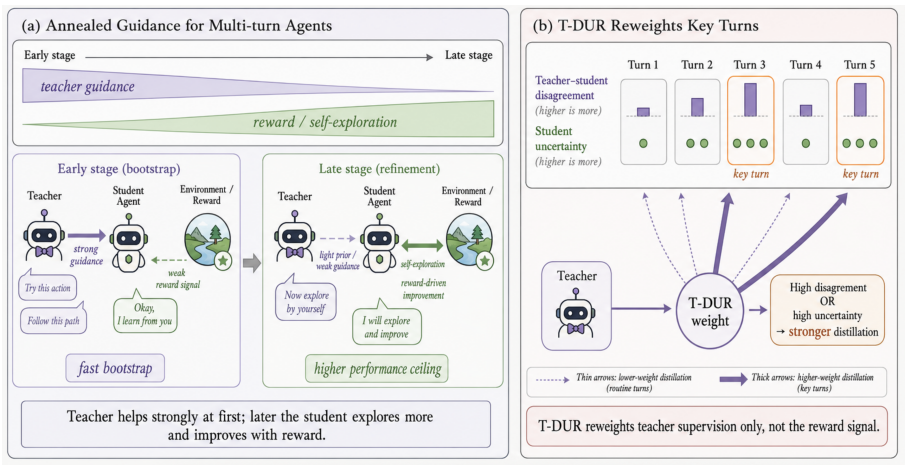
On its own terms, the paper's central discovery is that a student trained on a single hybrid token-level advantage A_t = κ(s) A_OPD_t + ρ(s) A_GRPO_t can first imitate a teacher quickly and then move beyond it. The annealing schedule reduces κ(s) from 1.0 to 0.1 and raises ρ(s) from 1.0 to 2.0 over 80 training steps, so early updates are mostly teacher-guided and later updates are mostly reward-guided. T-DUR assigns each turn a soft weight w_k = 1 − (1 − d̃_k)(1 − h̃_k), where d̃_k and h̃_k are per-trajectory normalized teacher–student disagreement and student uncertainty; this reweights only the OPD term. The reported outcome is that across three benchmarks and three student sizes ATOD impr
What carries the argument
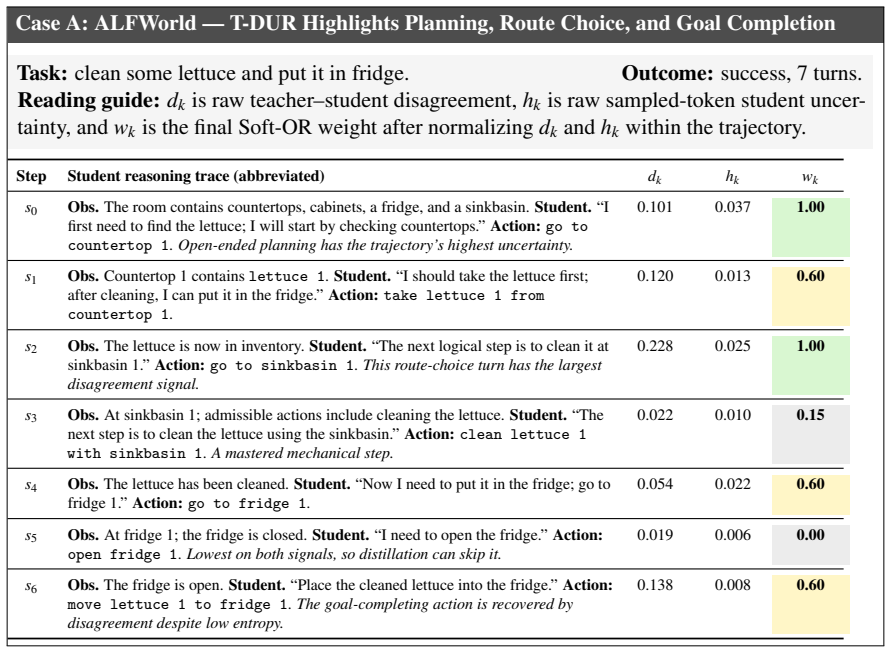
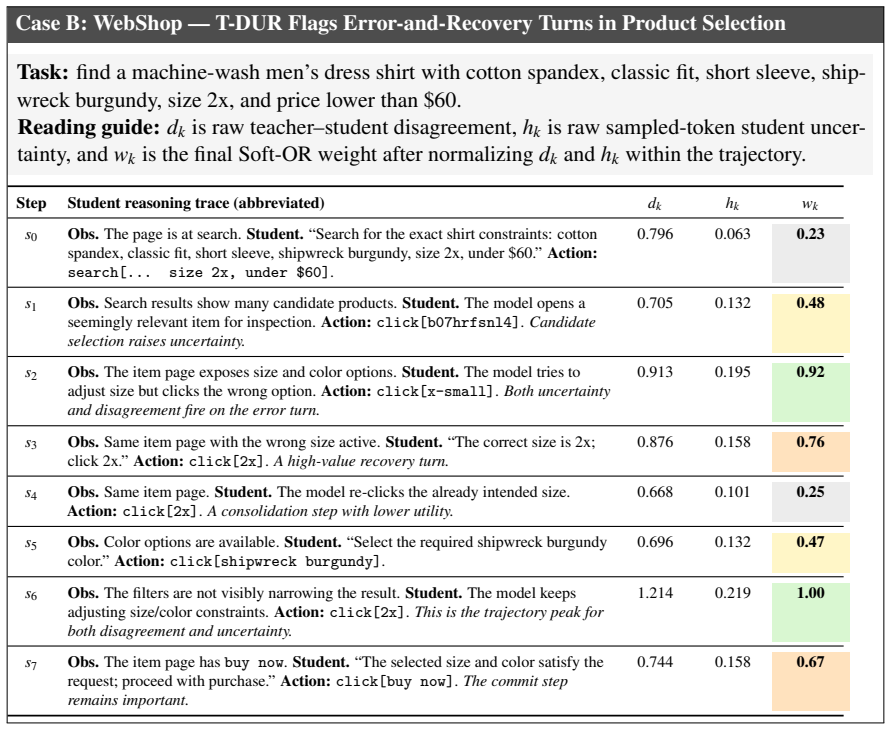
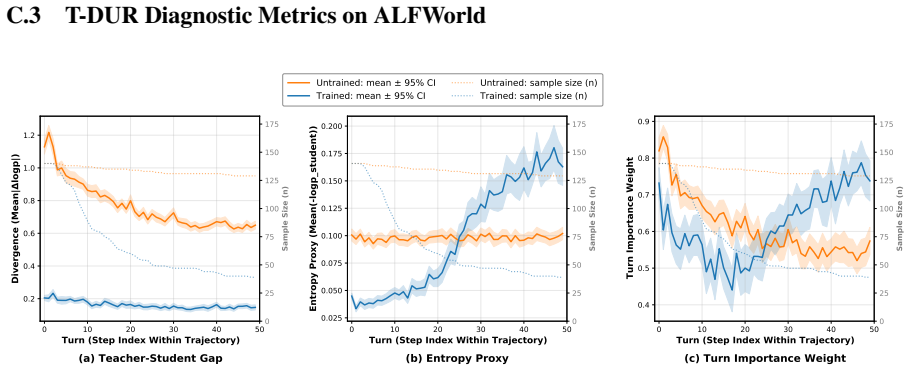
The load-bearing object is the hybrid advantage A_t = κ(s) Δlog p_t w_{k(t)} + ρ(s) A_GRPO_t, inserted into the standard clipped GRPO surrogate. κ and ρ follow a linear anneal over 80 steps (κ: 1.0→0.1, ρ: 1.0→2.0), which makes the update teacher-dominated early and reward-dominated late. T-DUR is the soft turn-gating function w_k = 1 − (1 − d̃_k)(1 − h̃_k), built from per-trajectory min-max normalized disagreement and entropy proxies computed only from sampled-token log-probabilities; it decides where within a long trajectory the teacher supervision is applied without touching the reward signal.
Load-bearing premise
The load-bearing premise is that the hand-set annealing schedule (κ decaying 1.0→0.1, ρ growing 1.0→2.0 over 80 steps) and T-DUR's per-trajectory normalization are robust across tasks rather than tuned to ALFWorld/WebShop/Search-QA, and that single-run maximum validation numbers are representative enough to support 'consistently outperforms'.
What would settle it
Run the same 150-step protocol with 5–10 random seeds for ATOD, OPD, SOD, and TCOD on the three benchmarks and compare distributions of peak validation success. If ATOD's mean is within one standard deviation of OPD or TCOD on Search-QA, or if a fixed-coefficient OPD/RL mixture beats the annealed schedule on ALFWorld for a 0.6B student, the paper's consistency claim would be contradicted.
If this is right
- A small student model can exceed its teacher on interactive benchmarks, not merely converge to it, when imitation is followed by reward-driven refinement.
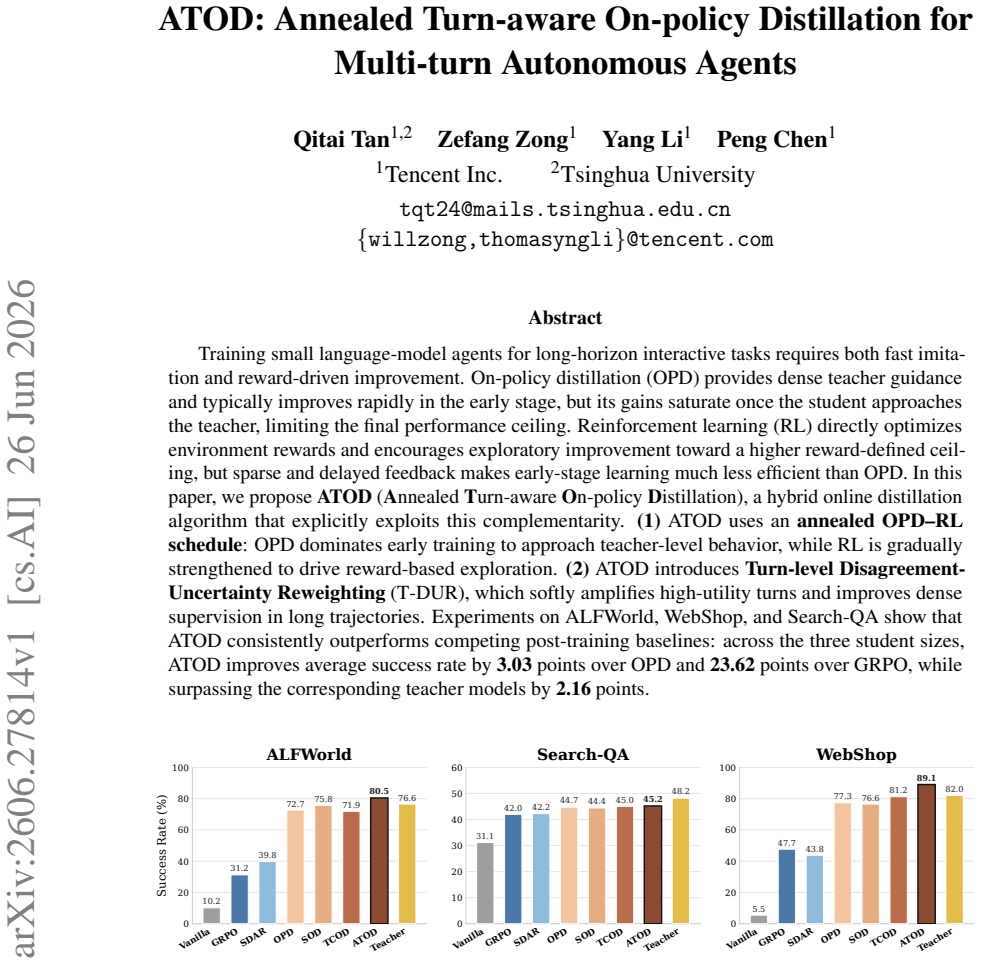
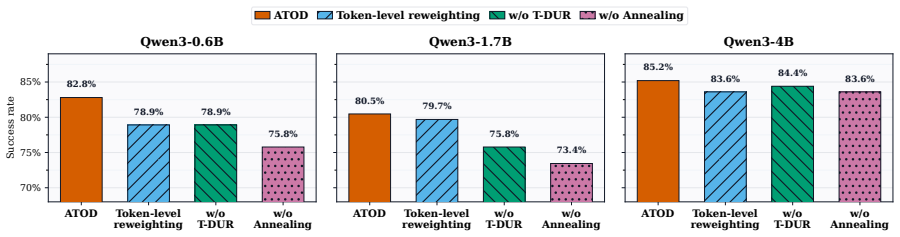
- Removing the annealed schedule is the most costly ablation—on ALFWorld the 0.6B student drops from 82.8% to 75.8%—so the transition from teacher guidance to reward optimization is doing the main work.
- Turn-level reweighting beats both token-level reweighting and uniform turn weights, meaning the turn is a stable, semantically meaningful unit for allocating dense supervision in agentic trajectories.
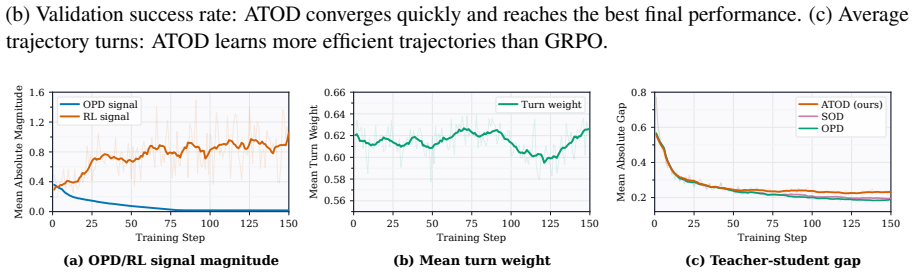
- The final κ floor (0.1) keeps a weak teacher anchor that is claimed to reduce severe drift and reward hacking while still allowing beyond-teacher improvement.
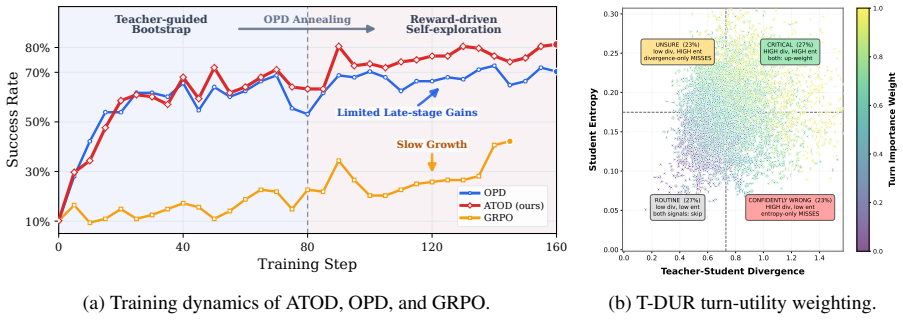
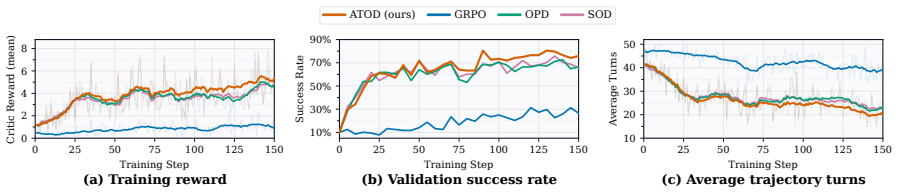
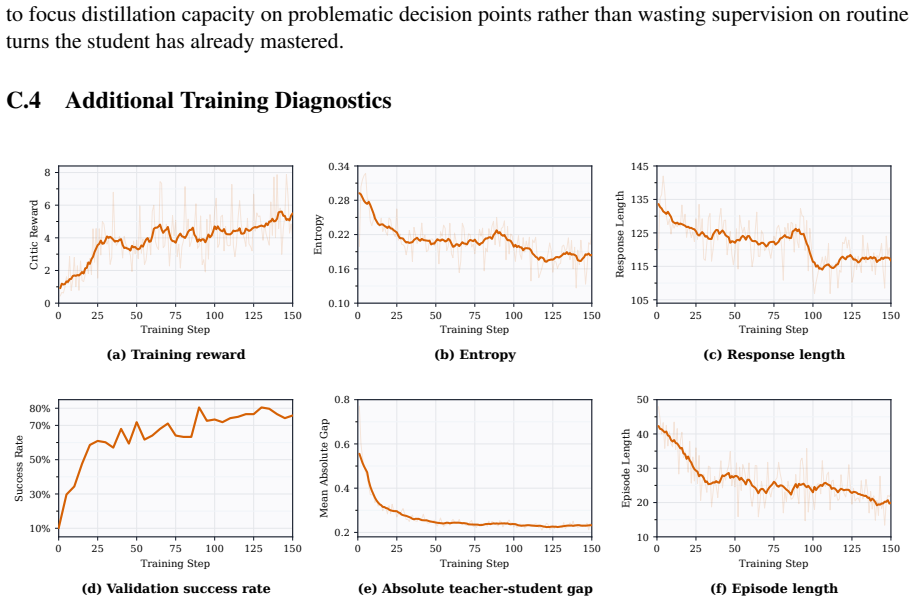
- Training dynamics show ATOD combines the fast bootstrap of OPD with continued late-stage gains, and learns shorter trajectories than GRPO on ALFWorld.
Where Pith is reading between the lines
- Editorial inference: the annealing recipe is not specific to distillation; any pairing of a dense-early signal with a sparse-reward signal could be scheduled the same way, and the paper does not test that generalization.
- Editorial inference: because the Search-QA margin over the next-best baseline is about 0.2 points and the reported numbers are single-run maximums, repeated-seed variance estimates are the natural next check before treating 'consistently outperforms' as settled.
- Editorial inference: T-DUR's per-trajectory normalization should make it portable to new environments without per-task scale tuning, but portability is only demonstrated here on three benchmarks.
- Editorial inference: the beyond-teacher effect appears concentrated on tasks where reward can correct teacher mistakes (ALFWorld, WebShop); on knowledge-heavy Search-QA the student stays within about 1 point of the teacher, so a harder reasoning benchmark would test whether the schedule generalizes.
Editorial analysis
A structured set of objections, weighed in public.
Referee Report
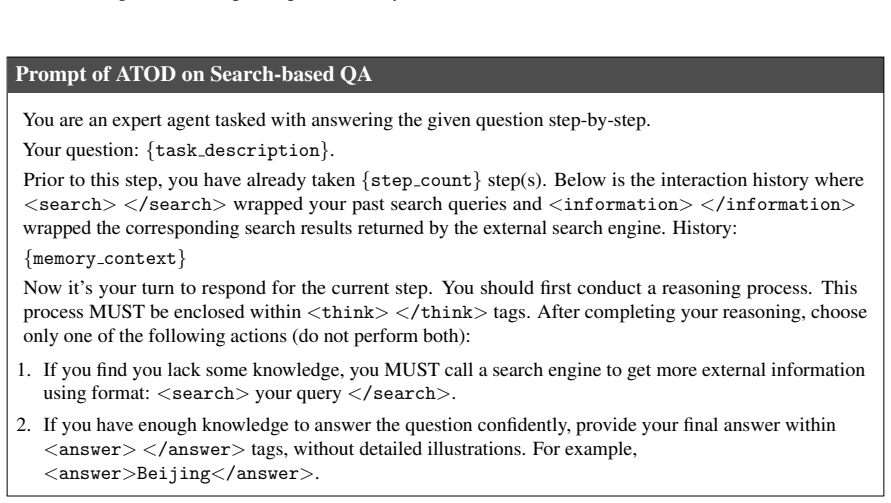
Summary. The paper proposes ATOD (Annealed Turn-aware On-policy Distillation), a post-training algorithm for small language-model agents on multi-turn interactive tasks. ATOD combines on-policy distillation (OPD) with GRPO-style RL in a single token-level advantage, annealing the OPD coefficient down and the RL coefficient up over training. It also introduces T-DUR, a turn-level weighting scheme based on student-teacher disagreement and student uncertainty, applied only to the OPD term. The method is evaluated on ALFWorld, WebShop, and Search-QA with Qwen3-0.6B/1.7B/4B students, reporting success rates and trajectory lengths against GRPO, SDAR, OPD, SOD, and TCOD. The central claims are that ATOD consistently outperforms all baselines and surpasses the corresponding teacher models on average, with ablations showing both annealing and T-DUR contribute on ALFWorld.
Significance. If the empirical claims hold, ATOD is a useful and simple contribution: the annealed OPD-RL schedule directly addresses the cold-start/ceiling tradeoff between imitation and reward optimization, and the turn-level T-DUR weighting is a plausible mechanism for focusing dense supervision on high-utility decisions. The paper is clearly written, the algorithm is fully specified in Algorithm 1, and the ALFWorld ablations (Fig. 4) show that both proposed components help. The diagnostic plots in Figs. 5-6 and the appendix case studies are consistent with the intended training dynamics. However, the load-bearing empirical claim of 'consistently outperforms' is currently supported only by single-run maximum-validation numbers with no variance estimates, and there are several internal inconsistencies that call for verification before the results can be accepted.
major comments (3)
- [§5.1, Table 1, §5.2 Obs 1] All results are maximum validation success rates from single training runs, with no standard deviations, seeds, or significance tests. On Search-QA, ATOD's margins over the strongest baseline TCOD are only 0.29, 0.19, and 0.73 percentage points for the 0.6B, 1.7B, and 4B students, respectively. These margins are smaller than typical seed-to-seed variation in on-policy RL, and selecting the maximum over the 150-step curve inflates expected performance, possibly differently across methods. Thus the 'consistently outperforms all baselines' claim is not empirically established. Please report multiple seeds with mean±std, or at least a rerun with different seeds for the small-margin cases.
- [Table 1, Qwen3-4B block] In the Qwen3-4B student block, the 'GRPO†' row (76.56/18.95/48.19/2.51/82.03/6.21/68.93) is numerically identical to the 'Qwen3-4B GRPO (Teacher)' reference row, even though the teacher for this block is Qwen3-30B-A3B GRPO. This appears to be a copy-paste error or an unintended reuse of the teacher as the GRPO baseline. It directly affects the aggregate margin over GRPO (23.62 points) and the 4B-student comparison. Please correct the table and re-verify the underlying experimental records.
- [§5.2 Obs 1] The text states that ATOD 'achieves competitive Search-QA performance within 1% of the teacher.' This is contradicted by Table 1: for the 0.6B, 1.7B, and 4B students, the gaps to the relevant teacher are 5.86, 2.98, and 1.37 percentage points, respectively. The claim is also internally inconsistent with the same paragraph's statement that ATOD surpasses the teacher only on ALFWorld and WebShop. Please correct this factual misstatement.
minor comments (6)
- [Abstract] The abstract in the full text reports a 3.03-point improvement over OPD, while §5.2 and Table 1 support 4.16 points (the value in the separate abstract block). This inconsistency should be fixed.
- [§4.3, Appendix A.2] The OPD advantage in Eq. (9) contains log πθ(a_t|s_t), which depends on the parameters being optimized. Appendix A.2 states that Δlog p_t is 'treated as detached,' but this stop-gradient is not stated in the main text or Algorithm 1. Please clarify whether the implementation detaches the advantage; otherwise the gradient derivation differs from the implemented objective.
- [§4.2, Table 2] The method text uses κ(s) and ρ(s), while the hyperparameter table uses β_kl and β_rl for the same quantities. Unify the notation for reproducibility.
- [§5.1, Figure 2a] Figure 2a appears to be a schematic illustration, but the text refers to 'validation dynamics' as if they were measured data. Please label it as illustrative or provide the actual curves.
- [§5.3, Figure 4] The ALFWorld ablations are informative, but they are also single-run maximum values. Reporting variance would strengthen the claim that both T-DUR and annealing are beneficial across model sizes.
- [§4.2, Annealing robustness] The annealing schedule (κ: 1.0→0.1, ρ: 1.0→2.0, T=80) is fixed across tasks, but no sensitivity analysis is provided. If the schedule is robust, a small perturbation study would support the 'consistently' claim; if it is tuned per task, this should be disclosed.
Circularity Check
No circularity: ATOD's central claim is an empirical benchmark result, not a derivation that reduces to its own inputs.
full rationale
ATOD's central claim—that it 'consistently outperforms all baselines and even surpasses the corresponding teacher models'—is an empirical outcome measured on ALFWorld, WebShop, and Search-QA, not a quantity obtained by fitting parameters and then renaming the fit as a prediction. The hybrid advantage in Eq. (8) combines the OPD signal (Eq. 9) and the GRPO advantage (Eq. 2), with annealing coefficients (Eqs. 11–12) and T-DUR weights (Eqs. 13–16) computed from on-the-fly student/teacher log-probabilities and environment rewards. None of these quantities is fitted to the reported success rates, and no equation forces ATOD to outperform OPD, GRPO, or the teacher. Indeed, OPD and GRPO are limiting cases of the hybrid objective (ρ=0 and κ=0 respectively), and the annealed combination plus T-DUR could in principle reduce performance, so the reported superiority is an empirical finding rather than a construction-level identity. The references to prior OPD-family work (SOD, TCOD, token-importance studies) are motivational and baseline-related, not load-bearing self-citations or imported uniqueness theorems; moreover, the cited works are not by the present authors. Appendix A.3's Claim 1 is a standard martingale-difference unbiasedness statement, not a circular derivation. The abstract/full-text discrepancy in the OPD margin (4.16 vs 3.03 points) and the reliance on single-run maximum validation with no error bars are reporting and evidence-quality concerns, not circularity. The paper therefore contains no step in which a predicted result is equivalent by construction to its inputs.
Axiom & Free-Parameter Ledger
free parameters (7)
- OPD coefficient κ(s) =
1.0 → 0.1 (linear over T=80)
- RL coefficient ρ(s) =
1.0 → 2.0 (linear over T=80)
- Annealing window T =
80 training steps
- Group size G =
8
- Training steps =
150
- T-DUR normalization denominator threshold =
1e-8
- Student sampling temperature =
1.0
axioms (4)
- domain assumption Teacher token distributions provide a useful dense supervision signal on student-visited states.
- domain assumption GRPO's group-relative advantage with group size 8 gives a signal that is low-variance enough to drive reward-based improvement.
- domain assumption Turn-level disagreement d_k and entropy h_k (Eqs. 13–14) are reliable proxies for distillation utility.
- standard math The reverse-KL OPD objective in Eq. 5 is a valid sampled estimator when using importance ratios.
read the original abstract
Training small language-model agents for long-horizon interactive tasks requires both fast imitation and reward-driven improvement. On-policy distillation (OPD) provides dense teacher guidance and typically improves rapidly in the early stage, but its gains saturate once the student approaches the teacher, limiting the final performance ceiling. Reinforcement learning (RL) directly optimizes environment rewards and encourages exploratory improvement toward a higher reward-defined ceiling, but sparse and delayed feedback makes early-stage learning much less efficient than OPD. In this paper, we propose ATOD (Annealed Turn-aware On-policy Distillation), a hybrid online distillation algorithm that explicitly exploits this complementarity. (1) ATOD uses an annealed OPD-RL schedule: OPD dominates early training to approach teacher-level behavior, while RL is gradually strengthened to drive reward-based exploration. (2) ATOD introduces Turn-level Disagreement-Uncertainty Reweighting (T-DUR), which softly amplifies high-utility turns and improves dense supervision in long trajectories. Experiments on ALFWorld, WebShop, and Search-QA show that ATOD consistently outperforms competing post-training baselines: across the three student sizes, ATOD improves average success rate by 4.16 points over OPD and 23.62 points over GRPO, while surpassing the corresponding teacher models by 2.16 points.
Figures
Forward citations
Cited by 1 Pith paper
-
SAF-OPD: Stable Advantage Fusion for On-Policy Distillation
SAF stabilizes RLVR+on-policy-distillation training by sparsifying, bounding, warming up, and annealing the teacher-token advantage, improving aggregate math/code scores by 0.51–2.70% over fixed-coefficient fusion.
Reference graph
Works this paper leans on
-
[1]
Narasimhan, and Yuan Cao
Shunyu Yao, Jeffrey Zhao, Dian Yu, Nan Du, Izhak Shafran, Karthik R. Narasimhan, and Yuan Cao. React: Synergizing reasoning and acting in language models. InInternational Conference on Learning Representations, 2023
2023
-
[2]
Toolformer: Language models can teach themselves to use tools
Timo Schick, Jane Dwivedi-Yu, Roberto Dess`ı, Roberta Raileanu, Maria Lomeli, Eric Hambro, Luke Zettlemoyer, Nicola Cancedda, and Thomas Scialom. Toolformer: Language models can teach themselves to use tools. InAdvances in Neural Information Processing Systems, 2023
2023
-
[3]
Alfworld: Aligning text and embodied environments for interactive learning
Mohit Shridhar, Xingdi Yuan, Marc-Alexandre C ˆot´e, Yonatan Bisk, Adam Trischler, and Matthew Hausknecht. Alfworld: Aligning text and embodied environments for interactive learning. In International Conference on Learning Representations, 2021
2021
-
[4]
Webshop: Towards scalable real-world web interaction with grounded language agents
Shunyu Yao, Howard Chen, John Yang, and Karthik Narasimhan. Webshop: Towards scalable real-world web interaction with grounded language agents. InAdvances in Neural Information Processing Systems, 2022
2022
-
[5]
Bowen Jin, Hansi Zeng, Zhenrui Yue, Jinsung Yoon, Sercan Arik, Dong Wang, Hamed Zamani, and Jiawei Han. Search-r1: Training llms to reason and leverage search engines with reinforcement learning.arXiv preprint arXiv:2503.09516, 2025
Pith/arXiv arXiv 2025
-
[6]
Proximal policy optimization algorithms.arXiv preprint arXiv:1707.06347, 2017
John Schulman, Filip Wolski, Prafulla Dhariwal, Alec Radford, and Oleg Klimov. Proximal policy optimization algorithms.arXiv preprint arXiv:1707.06347, 2017
Pith/arXiv arXiv 2017
-
[7]
Zhihong Shao, Peiyi Wang, Qihao Zhu, Runxin Xu, Junxiao Song, et al. Deepseekmath: Pushing the limits of mathematical reasoning in open language models.arXiv preprint arXiv:2402.03300, 2024
Pith/arXiv arXiv 2024
-
[8]
Deepseek-r1: Incentivizing reasoning capability in llms via reinforcement learning
DeepSeek-AI, Daya Guo, Dejian Yang, Haowei Zhang, Junxiao Song, Peiyi Wang, Qihao Zhu, Runxin Xu, et al. Deepseek-r1: Incentivizing reasoning capability in llms via reinforcement learning. Nature, 645:633–638, 2025
2025
-
[9]
Qiying Yu, Zheng Zhang, Ruofei Zhu, Yufeng Yuan, Xiaochen Zuo, Yu Yue, Weinan Dai, Tiantian Fan, Gaohong Liu, Lingjun Liu, Xin Liu, Haibin Lin, Zhiqi Lin, Bole Ma, Guangming Sheng, Yuxuan Tong, Chi Zhang, Mofan Zhang, Wang Zhang, Hang Zhu, Jinhua Zhu, Jiaze Chen, Jiangjie Chen, Chengyi Wang, Hongli Yu, Yuxuan Song, Xiangpeng Wei, Hao Zhou, Jingjing Liu, W...
Pith/arXiv arXiv 2025
-
[10]
Archer: Training language model agents via hierarchical multi-turn rl
Yifei Zhou, Andrea Zanette, Jiayi Pan, Sergey Levine, and Aviral Kumar. Archer: Training language model agents via hierarchical multi-turn rl. InProceedings of the 41st International Conference on Machine Learning, pages 62178–62209, 2024
2024
-
[11]
Webrl: Training llm web agents via self-evolving online curriculum reinforcement learning
Zehan Qi, Xiao Liu, Iat Long Iong, Hanyu Lai, Xueqiao Sun, Wenyi Zhao, Yu Yang, Xinyue Yang, Jiadai Sun, Shuntian Yao, Tianjie Zhang, Wei Xu, Jie Tang, and Yuxiao Dong. Webrl: Training llm web agents via self-evolving online curriculum reinforcement learning. InInternational Conference on Learning Representations, 2025
2025
-
[12]
Group-in-group policy optimization for llm agent training.arXiv preprint arXiv:2505.10978, 2025
Lang Feng, Zhenghai Xue, Tingcong Liu, and Bo An. Group-in-group policy optimization for llm agent training.arXiv preprint arXiv:2505.10978, 2025
Pith/arXiv arXiv 2025
-
[13]
Agentic reinforced policy optimization.arXiv preprint arXiv:2507.19849, 2025
Guanting Dong, Hangyu Mao, Kai Ma, Licheng Bao, Yifei Chen, Zhongyuan Wang, Zhongxia Chen, Jiazhen Du, Huiyang Wang, Fuzheng Zhang, Guorui Zhou, Yutao Zhu, Ji-Rong Wen, and Zhicheng Dou. Agentic reinforced policy optimization.arXiv preprint arXiv:2507.19849, 2025. 10
Pith/arXiv arXiv 2025
-
[14]
On-policy distillation of language models: Learning from self-generated mistakes
Rishabh Agarwal, Nino Vieillard, Yongchao Zhou, Piotr Stanczyk, Sabela Ramos Garea, Matthieu Geist, and Olivier Bachem. On-policy distillation of language models: Learning from self-generated mistakes. InInternational Conference on Learning Representations, 2024
2024
-
[15]
Minillm: Knowledge distillation of large language models
Yuxian Gu, Li Dong, Furu Wei, and Minlie Huang. Minillm: Knowledge distillation of large language models. InInternational Conference on Learning Representations, 2024
2024
-
[16]
Entropy-aware on-policy distillation of language models.arXiv preprint arXiv:2603.07079, 2026
Woogyeol Jin, Taywon Min, Yongjin Yang, Swanand Ravindra Kadhe, Yi Zhou, Dennis Wei, Nathalie Baracaldo, and Kimin Lee. Entropy-aware on-policy distillation of language models.arXiv preprint arXiv:2603.07079, 2026
Pith/arXiv arXiv 2026
-
[17]
On-policy context distillation for language models.arXiv preprint arXiv:2602.12275, 2026
Tianzhu Ye, Li Dong, Xun Wu, Shaohan Huang, and Furu Wei. On-policy context distillation for language models.arXiv preprint arXiv:2602.12275, 2026
Pith/arXiv arXiv 2026
-
[18]
Ijun Jang, Jewon Yeom, Juan Yeo, Hyunggu Lim, and Taesup Kim. Stable on-policy distillation through adaptive target reformulation.arXiv preprint arXiv:2601.07155, 2026
Pith/arXiv arXiv 2026
-
[19]
Wenkai Yang, Weijie Liu, Ruobing Xie, Kai Yang, Saiyong Yang, and Yankai Lin. Learning beyond teacher: Generalized on-policy distillation with reward extrapolation.arXiv preprint arXiv:2602.12125, 2026
Pith/arXiv arXiv 2026
-
[20]
Jiaqi Wang, Wenhao Zhang, Weijie Shi, Yaliang Li, and James Cheng. Tcod: Exploring temporal cur- riculum in on-policy distillation for multi-turn autonomous agents.arXiv preprint arXiv:2604.24005, 2026
Pith/arXiv arXiv 2026
-
[21]
Qiyong Zhong, Mao Zheng, Mingyang Song, Xin Lin, Jie Sun, Houcheng Jiang, Xiang Wang, and Junfeng Fang. Sod: Step-wise on-policy distillation for small language model agents.arXiv preprint arXiv:2605.07725, 2026
Pith/arXiv arXiv 2026
-
[22]
Tip: Token importance in on-policy distillation.arXiv preprint arXiv:2604.14084, 2026
Yuanda Xu, Hejian Sang, Zhengze Zhou, Ran He, Zhipeng Wang, and Alborz Geramifard. Tip: Token importance in on-policy distillation.arXiv preprint arXiv:2604.14084, 2026
Pith/arXiv arXiv 2026
-
[23]
Siyan Zhao, Zhihui Xie, Mengchen Liu, Jing Huang, Guan Pang, Feiyu Chen, and Aditya Grover. Self-distilled reasoner: On-policy self-distillation for large language models.arXiv preprint arXiv:2601.18734, 2026
Pith/arXiv arXiv 2026
-
[24]
Hao Wang, Guozhi Wang, Han Xiao, Yufeng Zhou, Yue Pan, Jichao Wang, Ke Xu, Yafei Wen, Xiaohu Ruan, Xiaoxin Chen, and Honggang Qi. Skill-sd: Skill-conditioned self-distillation for multi-turn llm agents.arXiv preprint arXiv:2604.10674, 2026
Pith/arXiv arXiv 2026
-
[25]
Self-distilled agentic reinforcement learning.arXiv preprint arXiv:2605.15155, 2026
Zhengxi Lu, Zhiyuan Yao, Zhuowen Han, Zi-Han Wang, Jinyang Wu, Qi Gu, Xunliang Cai, Weiming Lu, Jun Xiao, Yueting Zhuang, and Yongliang Shen. Self-distilled agentic reinforcement learning.arXiv preprint arXiv:2605.15155, 2026
Pith/arXiv arXiv 2026
-
[26]
Dai, Jakob Uszkoreit, Quoc Le, and Slav Petrov
Tom Kwiatkowski, Jennimaria Palomaki, Olivia Redfield, Michael Collins, Ankur Parikh, Chris Alberti, Danielle Epstein, Illia Polosukhin, Jacob Devlin, Kenton Lee, Kristina Toutanova, Llion Jones, Matthew Kelcey, Ming-Wei Chang, Andrew M. Dai, Jakob Uszkoreit, Quoc Le, and Slav Petrov. Natural questions: A benchmark for question answering research.Transact...
2019
-
[27]
Triviaqa: A large scale distantly supervised challenge dataset for reading comprehension
Mandar Joshi, Eunsol Choi, Daniel Weld, and Luke Zettlemoyer. Triviaqa: A large scale distantly supervised challenge dataset for reading comprehension. InProceedings of the 55th Annual Meeting of the Association for Computational Linguistics, pages 1601–1611, 2017
2017
-
[28]
Cohen, Ruslan Salakhutdinov, and Christopher D
Zhilin Yang, Peng Qi, Saizheng Zhang, Yoshua Bengio, William W. Cohen, Ruslan Salakhutdinov, and Christopher D. Manning. Hotpotqa: A dataset for diverse, explainable multi-hop question answering. InProceedings of the 2018 Conference on Empirical Methods in Natural Language Processing, pages 2369–2380, 2018. 11
2018
-
[29]
Musique: Multihop questions via single-hop question composition.Transactions of the Association for Computational Linguistics, 10:539–554, 2022
Harsh Trivedi, Niranjan Balasubramanian, Tushar Khot, and Ashish Sabharwal. Musique: Multihop questions via single-hop question composition.Transactions of the Association for Computational Linguistics, 10:539–554, 2022
2022
-
[30]
Smith, and Mike Lewis
Ofir Press, Muru Zhang, Sewon Min, Ludwig Schmidt, Noah A. Smith, and Mike Lewis. Measuring and narrowing the compositionality gap in language models. InFindings of the Association for Computational Linguistics: EMNLP 2023, 2023. 12 Appendix Contents A Method and Algorithmic Details 14 A.1 Complete Training Algorithm . . . . . . . . . . . . . . . . . . . ...
2023
-
[31]
If you find you lack some knowledge, you MUST call a search engine to get more external information using format:<search>your query</search>
-
[32]
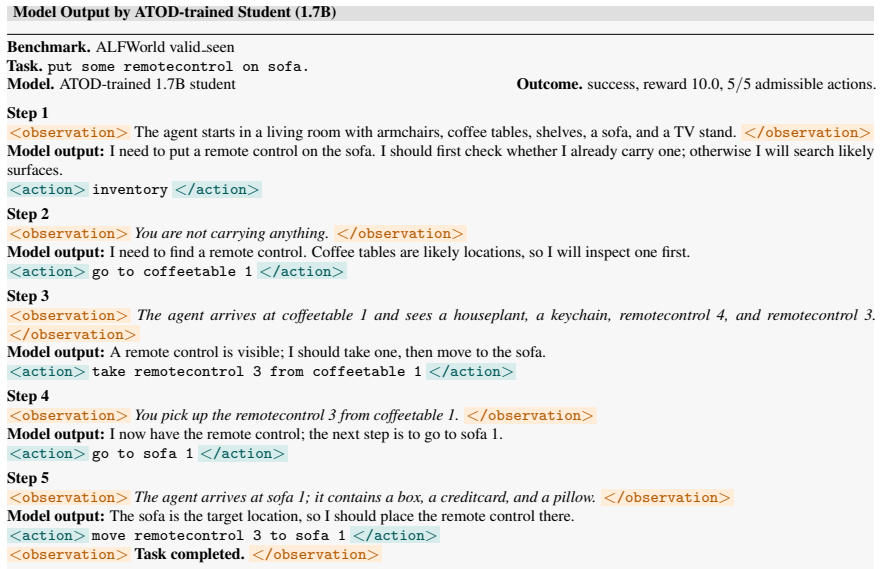
I first need to find the lettuce; I will start by checking countertops
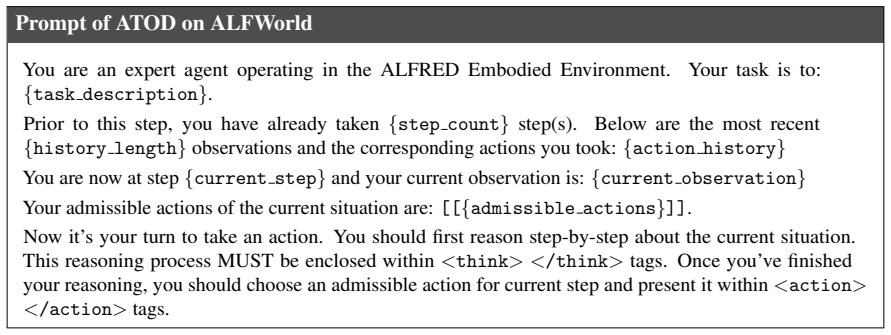
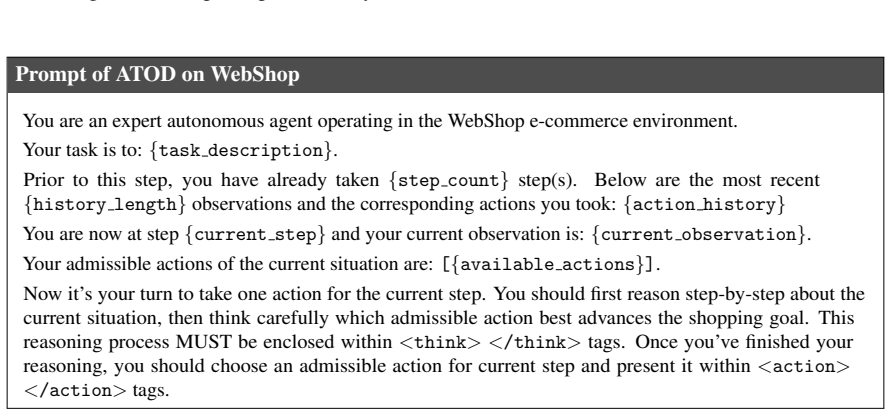
If you have enough knowledge to answer the question confidently, provide your final answer within <answer> </answer>tags, without detailed illustrations. For example, <answer>Beijing</answer>. Figure 8: Prompt template used by ATOD for the Search-based QA task environment. Prompt of ATOD on WebShop You are an expert autonomous agent operating in the WebSh...
discussion (0)
Sign in with ORCID, Apple, or X to comment. Anyone can read and Pith papers without signing in.