REVIEW 2 major objections 4 minor 1 cited by
The paper establishes that radio emission from the galaxies themselves is a necessary contaminant in small-scale galaxy–tSZ cross-correlations, and that explicitly modeling it removes the apparent negative galaxy–hot-gas signal reported in
Reviewed by Pith at T0; open to challenge. T0 means a machine referee read the full paper against a public rubric. the ladder, T0–T4 →
T0 review · deepseek-v4-flash
2026-08-02 09:51 UTC pith:O6HD7U6O
load-bearing objection The Planck BIC case for radio contamination is solid and the sign-flip claim is credible, but the small-scale result rests on one power-law radio SED fitted at Planck scales and applied to ACT with no external radio check. the 2 major comments →
Thermal Sunyaev-Zel'dovich cross-correlations with unWISE galaxies: disentangling radio contamination, dust properties, and electron pressure
The pith
A machine-rendered reading of the paper's core claim, the machinery that carries it, and where it could break.
Core claim
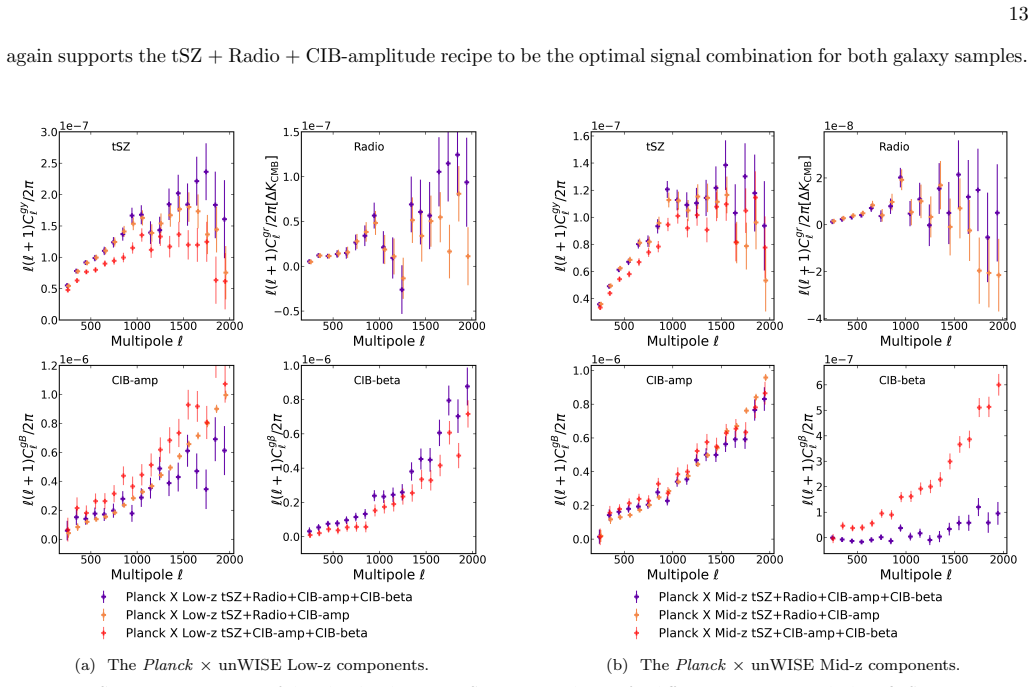
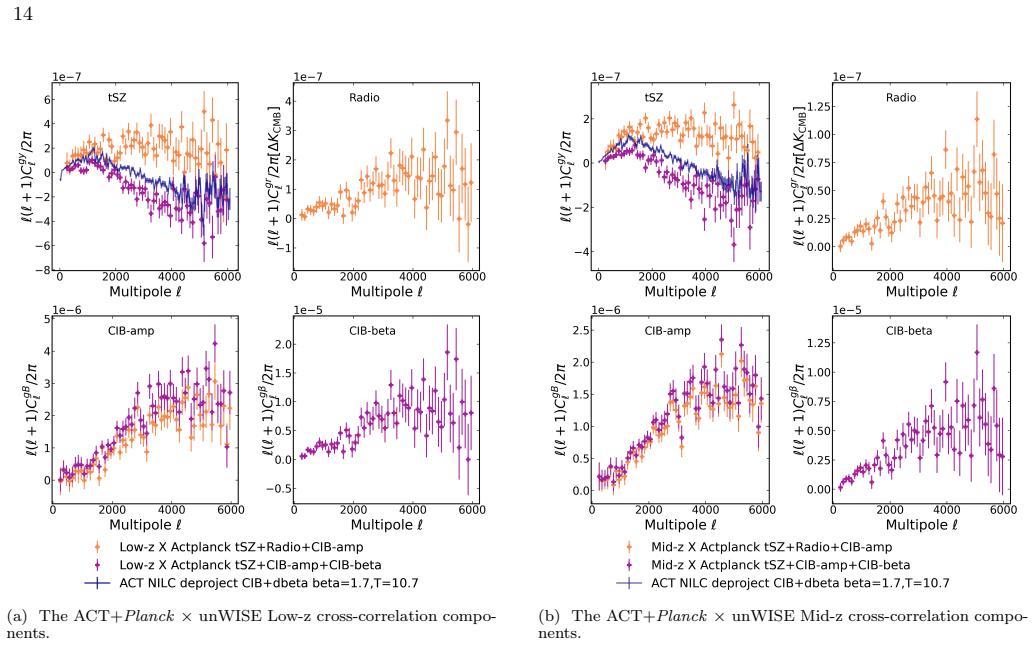
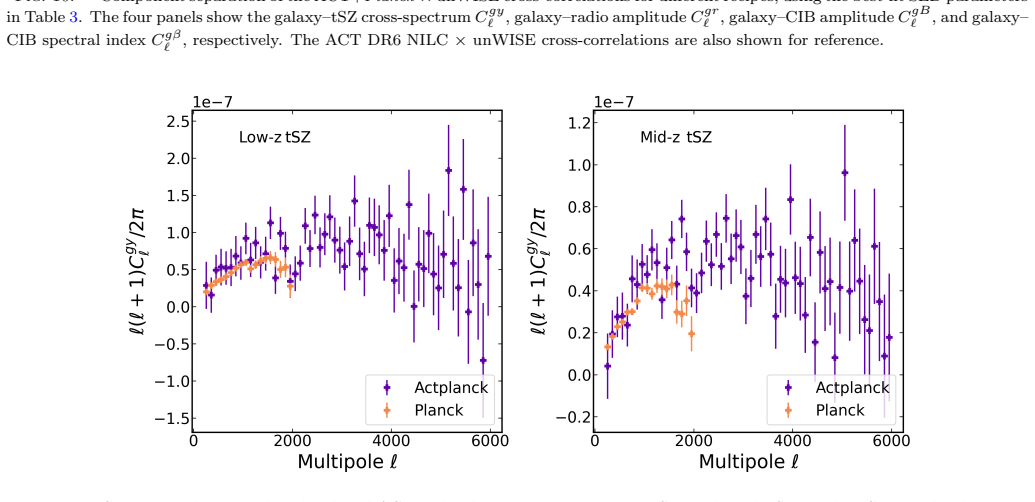
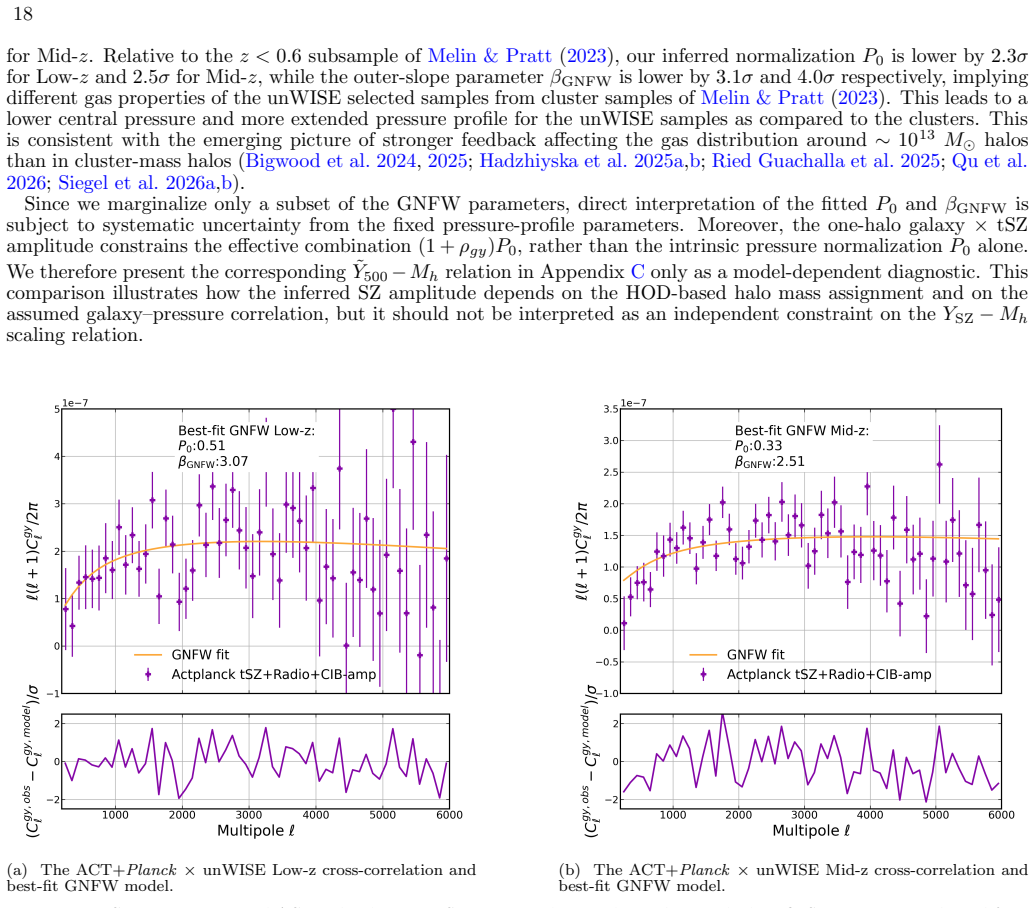
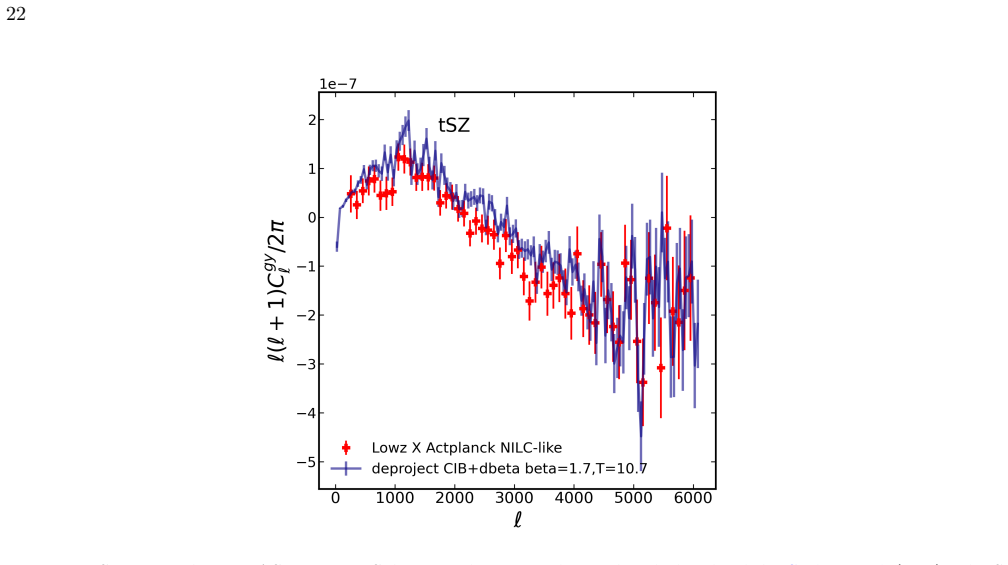
At its core, the paper establishes that radio contamination is a required component of any small-scale galaxy–tSZ cleaning procedure, not a subdominant correction. Using Planck's nine bands for model selection, a three-component recipe (tSZ + radio + CIB-amplitude) is preferred over radio-less recipes by BIC at 9.5σ (Low-z) and 11σ (Mid-z). Applied to ACT+Planck maps, the recipe removes the apparent negative galaxy–tSZ cross-correlation seen in the fiducial NILC reconstruction; cleaned spectra stay positive to ℓ ≈ 6000, match Planck-only results on overlapping scales, and fit a halo model with a two-parameter generalized NFW pressure profile.
What carries the argument
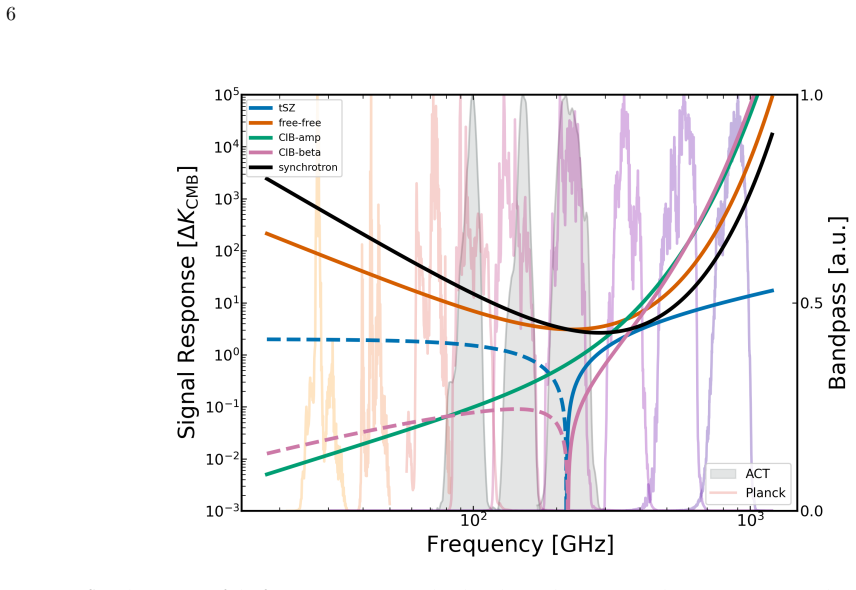
The central object is a harmonic-space component-separation model: each observed galaxy–temperature cross-spectrum is a linear combination of component cross-spectra times passband-averaged spectral responses. The tSZ response is fixed; the CIB is a modified blackbody with index β0 and temperature T0 (plus an optional first-order variation term); the radio component is a single power law with effective index βr. With fixed SED parameters, component amplitudes follow from a generalized least-squares estimate (Eq. 9); the SED parameters are fit to nine Planck bands, with BIC model selection. This selects tSZ + radio + CIB-amplitude, then applies it to three ACT+Planck bands to recover small-sc
Load-bearing premise
The cleaning assumes that the single radio spectral index fitted to Planck data on large scales (200 < ℓ < 2000) also describes radio emission on ACT's small scales (up to ℓ ≈ 6000), and that Planck and ACT masks remove the same sources; if the small-scale radio population has a different spectrum, power would be mis-attributed to tSZ.
What would settle it
Cross-match the unWISE Low-z and Mid-z galaxies to a deep radio catalog and measure the mean radio spectral index of matched sources between ~1 and 30 GHz, then extrapolate to 90–220 GHz with a physically motivated SED; alternatively, repeat the ACT+Planck component separation with the central galaxy regions masked. If the positive high-ℓ signal disappears when central pixels are masked, or if the fitted radio amplitude disagrees with radio source counts, the cleaning would be shown to over-attribute power to tSZ.
If this is right
- The apparent negative galaxy–tSZ cross-correlation reported from ACT DR6 NILC maps at ℓ > 2000 is an artifact of unmodeled radio foregrounds, not a real deficit of hot gas around low-mass halos.
- Small-scale galaxy–tSZ measurements that rely on CIB deprojection alone should be re-examined; agreement with CIB-deprojected maps is not sufficient to certify radio-cleanness.
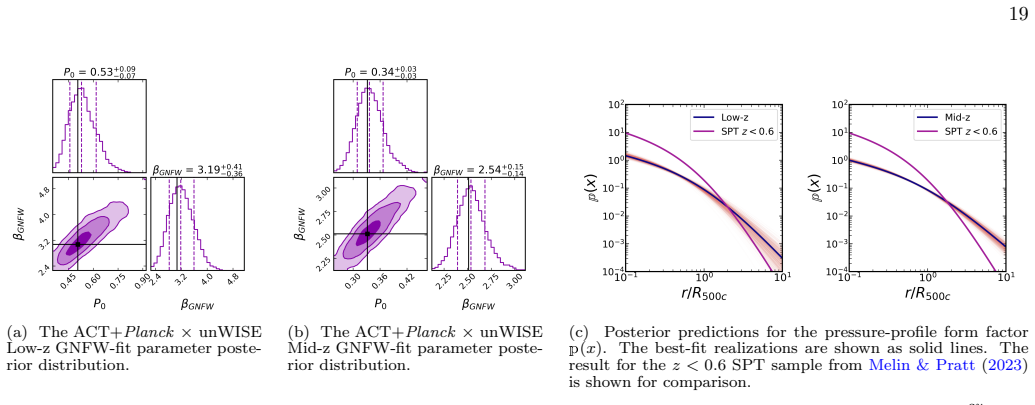
- The cleaned spectra place positive constraints on the electron pressure profile around ~10^13 solar-mass halos, with a lower normalization and shallower outer slope than cluster-calibrated GNFW profiles, consistent with stronger feedback in low-mass halos.
- The fitted effective radio spectral indices (β_r ≈ −2.18 for Low-z, −2.62 for Mid-z) imply a mixture of free-free and synchrotron emission correlated with the galaxy samples.
- The same component-separation machinery yields galaxy–radio and galaxy–CIB cross-spectra that can be studied as physical probes in their own right.
Where Pith is reading between the lines
- Editorial inference: the radio-cleaning recipe should be tested against external radio source counts; if the fitted radio amplitudes do not match the counts, the single-power-law spectral assumption would need revision.
- Editorial inference: the strategy of using broad-frequency Planck-like coverage for SED selection before applying high-resolution maps is a generic template for future CMB surveys with more bands.
- Editorial inference: if the positive high-ℓ signal is real, galaxy–tSZ cross-correlations may become a cleaner low-mass gas probe than previously thought, sharpening the profile comparison with clusters into a feedback diagnostic around 10^13 solar masses.
- Editorial inference: because contamination is sample-dependent (higher-redshift samples would favor CIB-δβ over radio), the conclusions should not be blindly applied to other galaxy selections; each sample requires its own SED model selection.
Editorial analysis
A structured set of objections, weighed in public.
Referee Report
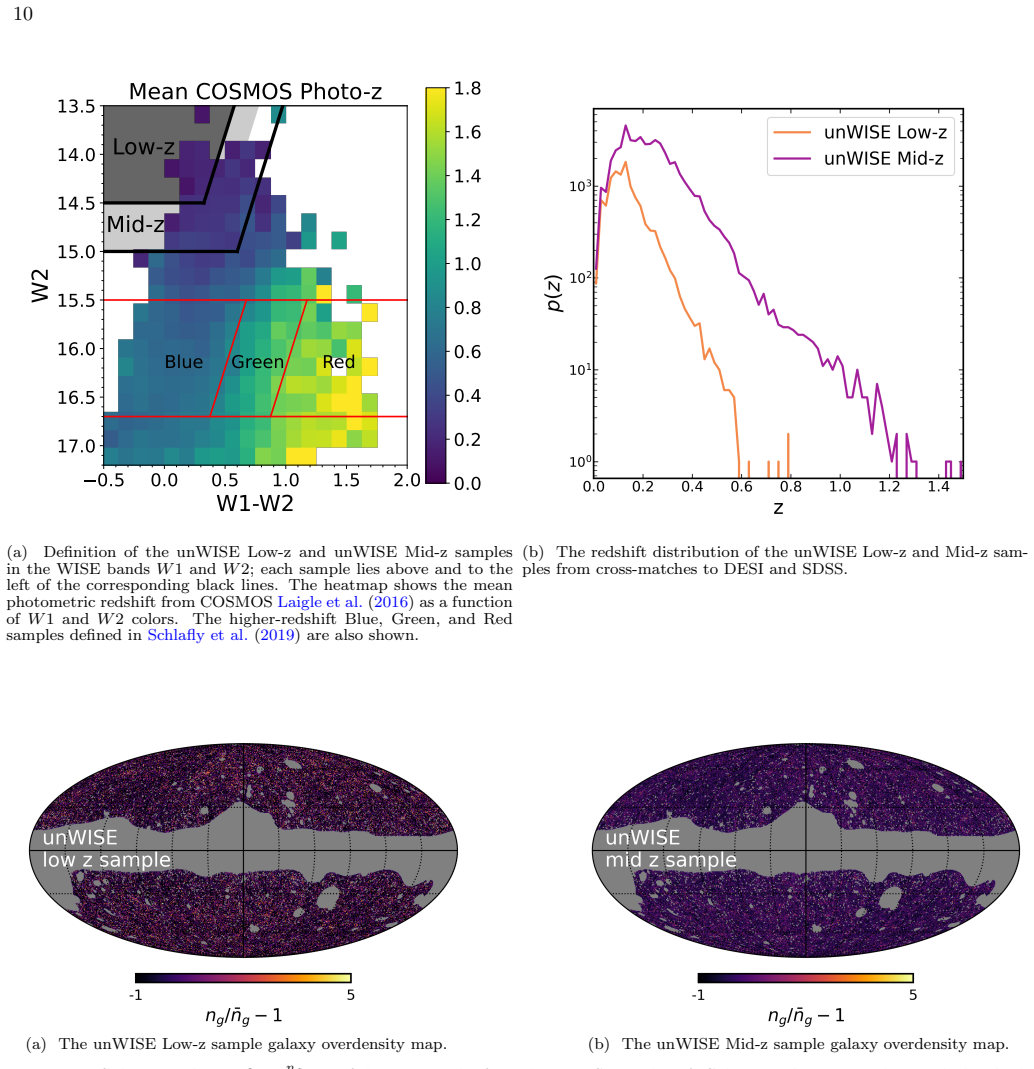
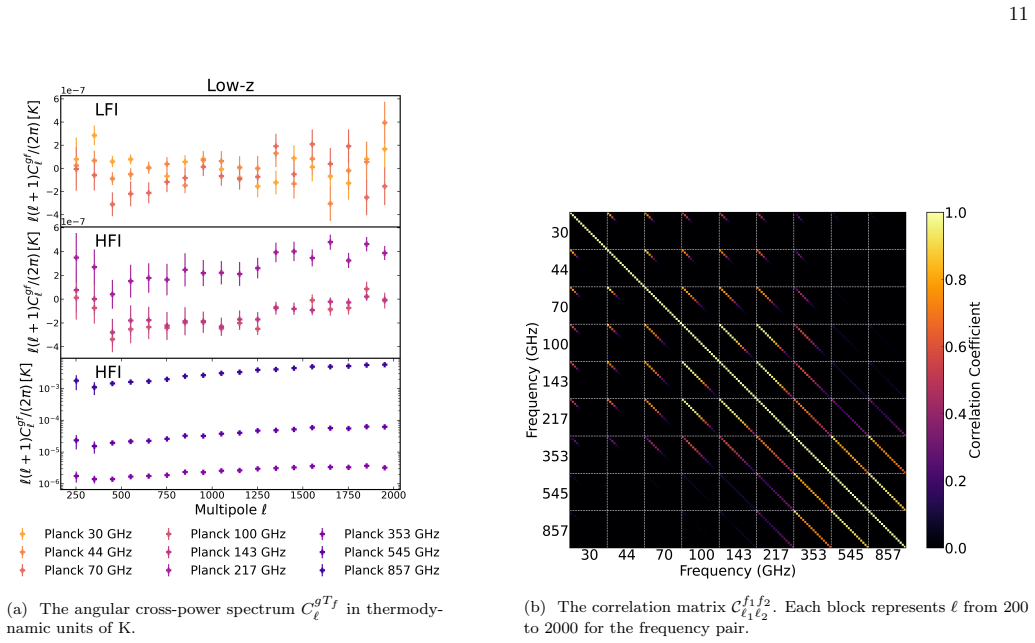
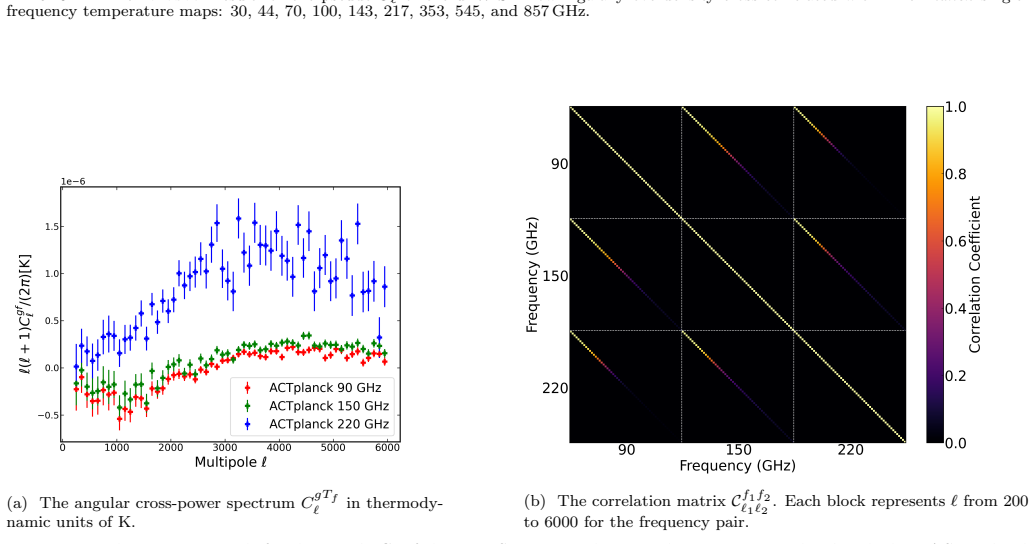
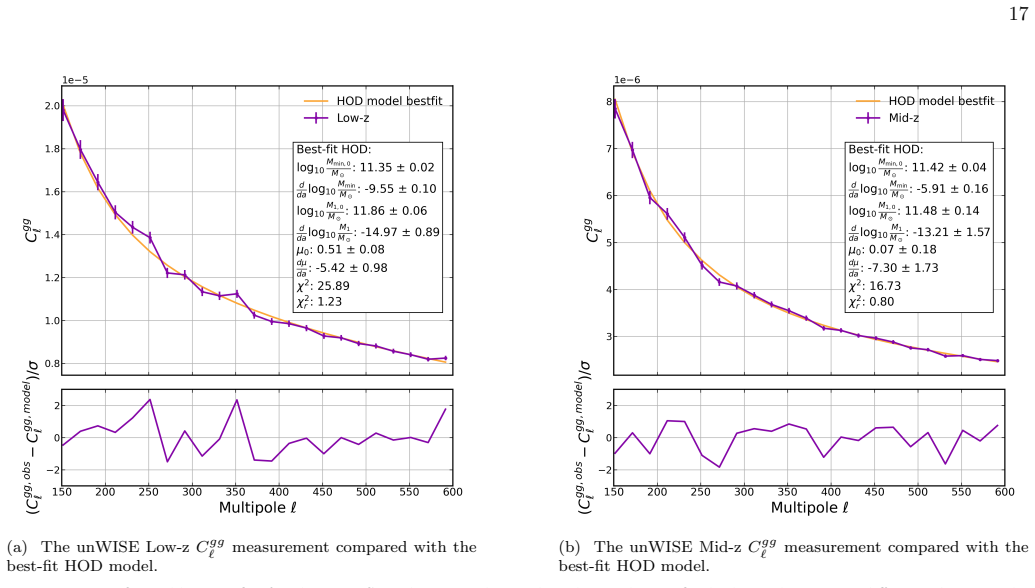
Summary. This paper performs harmonic-space multi-frequency component separation of galaxy-temperature cross-spectra between two low-redshift unWISE samples (Low-z and Mid-z) and Planck PR4 plus ACT DR6 maps. Using the nine Planck bands, the authors compare spectral recipes and report that a three-component model (tSZ + radio + CIB amplitude) is strongly preferred over radio-less recipes, with ΔBIC ≈ 90 (Low-z) and 120 (Mid-z), corresponding to quoted significances of 9.5σ and 11σ. The fitted effective radio spectral indices (βr ≈ −2.18 and −2.62) lie between free-free and synchrotron values. Applying this recipe to ACT+Planck coadds yields tSZ×galaxy spectra that remain positive to ℓ ≈ 6000, removing the negative small-scale signal seen in the ACT DR6 NILC map and in no-radio fits. The cleaned spectra are then compared with a halo model using HOD-calibrated galaxy clustering and a two-parameter GNFW pressure profile.
Significance. If correct, the paper resolves an important discrepancy in low-mass tSZ measurements: the negative ACT DR6 galaxy–y cross-correlation at ℓ ≳ 2000 would be a foreground artifact rather than a real suppression, and the true low-halo-mass signal would be positive and consistent with ordinary pressure profiles. The analysis has real strengths: the harmonic-space method directly models correlated radio and CIB contributions; the BIC preference for a radio component is large; the fitted βr values are physically plausible; the radio parameters are stable when the CIB-δβ term is added; and Planck-only and ACT+Planck extractions are broadly consistent on overlapping scales. The main risk is that the cleaning step is built on a single radio SED template fitted at Planck scales and applied at ACT arcminute scales, with no external radio validation; the central conclusion would invert if that template is wrong. The halo-model interpretation is also more illustrative than constraining, as the authors partly acknowledge in Appendix C.
major comments (2)
- [§4.1.1, §4.2, Eq. (22)] The cleaning procedure assumes that the effective radio SED is a single power law, with βr fitted to Planck-only cross-spectra at 200<ℓ<2000 (Table 3) and then held fixed for ACT+Planck coadds at ℓ up to 6000. Because N_f=N_s=3, the GLS in Eq. (9) has exactly as many amplitudes as data per ℓ-bin; a mismatch between the true radio SED and this template is therefore not diluted but projected directly onto the tSZ and CIB amplitudes. The paper itself flags the source-masking consistency caveat in §6 but does not test it, and no external radio catalog or small-scale SED information is used. Given that the headline conclusion is that the ACT DR6 negative signal is a radio artifact and the true signal is positive, this single-template assumption is load-bearing. Please add a direct validation or an explicit bracketing of possible SED variation (e.g., radio-source stacking, a scale-dependent βr
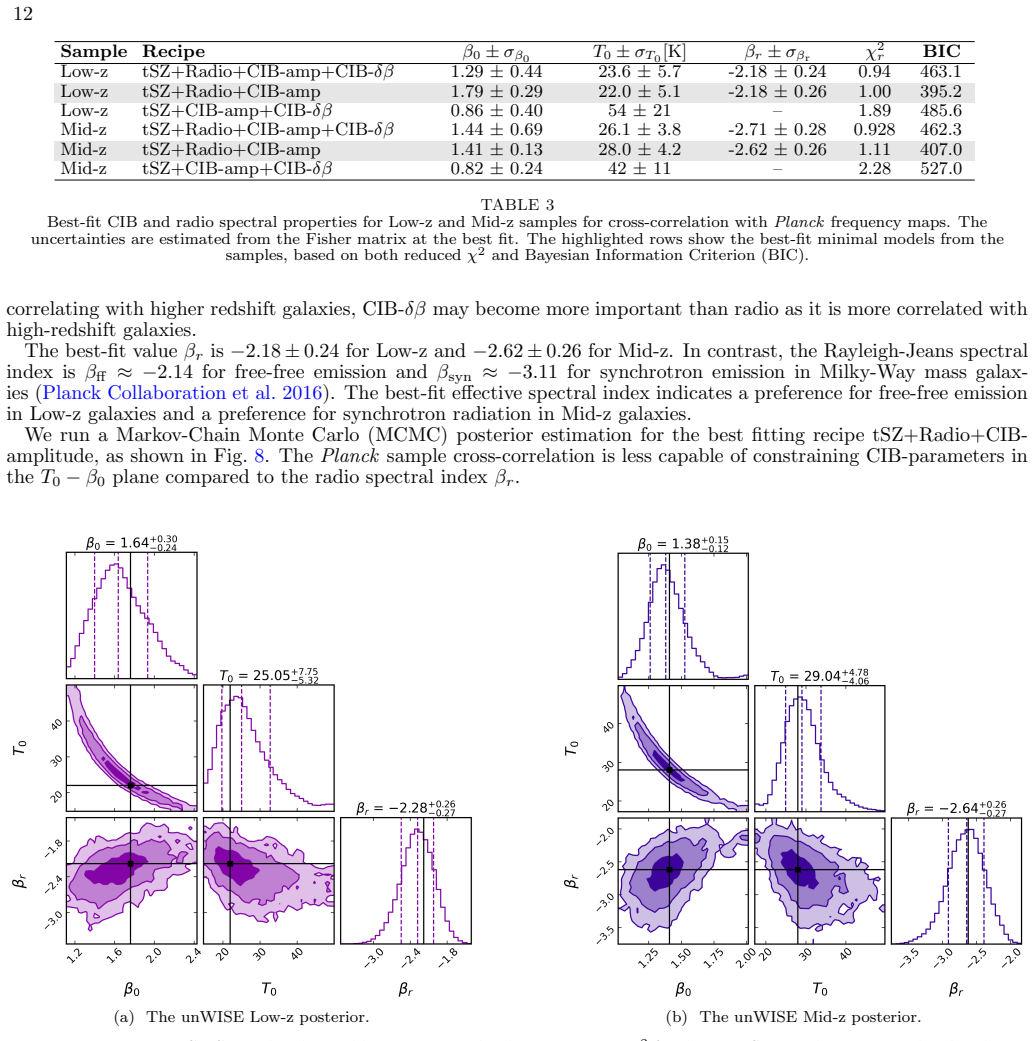
- [§4.2, Eq. (10), Table 3] The error bars on the component-separated C_gy (Figs. 10–11) and the subsequent GNFW fits are computed for fixed best-fit SED parameters. Equation (10) gives the conditional covariance of the GLS amplitudes given (β0, T0, βr), so the uncertainties on β0, T0, and βr reported in Table 3 are not propagated. At 90–220 GHz the tSZ, radio, and CIB responses are strongly degenerate (Fig. 1), so this omission may be material to the claim that the cleaned signal 'remains positive to ℓ≃6000'. Please marginalize over the SED parameter posteriors (e.g., using the Fig. 8 MCMC samples) or quantify the resulting inflation of the error bars.
minor comments (4)
- [§2.2] The paragraph beginning 'We now specify the frequency response coefficients...' appears twice verbatim, once before Eq. (11) and once after. Please remove the duplication.
- [Abstract and Table 3] The abstract quotes βr = −2.18 ± 0.24 for Low-z, while Table 3 lists −2.18 ± 0.26 for the adopted three-component recipe (and −2.18 ± 0.24 for the four-component recipe). Please make the quoted uncertainties consistent and clarify which value is used.
- [§4.1.1, Eq. (24)] The conversion from ΔBIC = 90/120 to '9.5σ'/'11σ' is not defined. BIC differences and Gaussian significances are not equivalent; please report the Δχ² for the nested comparison or the likelihood ratio, and state explicitly how the sigma values are obtained.
- [Fig. 11 and §4.2] The agreement between Planck-only and ACT+Planck extractions is not a fully independent cross-check, because the ACT+Planck maps are coadds containing Planck data and Planck dominates at ℓ ≲ 1500. This should be stated when the agreement is used as a validation.
Circularity Check
No significant circularity: the radio-cleaned spectrum is a fitted extrapolation with acknowledged assumptions, not an identity or a self-citation chain.
full rationale
The paper's central chain is: fit SED parameters (beta0, T0, beta_r) and choose a component recipe using the nine Planck cross-spectra (Sec. 4.1.1, Table 3), solve for per-multipole component amplitudes with the GLS estimator (Eq. 9), apply the preferred recipe to ACT+Planck coadds at higher multipoles, and then describe the cleaned C_gy with a halo model. At no point is a claimed prediction identical to a fitted input. The high-multipole ACT signal (ell > 2000) is new data, so the positive cleaned spectrum is not statistically forced by the Planck model selection; the radio template is an extrapolation, with a scale-dependent-SED risk that the authors themselves flag in Sec. 6 as an assumption about consistency of source removal and masking across surveys. That is a systematic limitation, not circularity. The halo-model section fits P0 and beta to the same cleaned C_gy, but the paper explicitly identifies the degeneracy P0_eff = (1 + rho_gy) P0 (Eq. C1) and labels the Y_SZ-M_h comparison a 'model-dependent diagnostic' rather than an independent constraint. Self-citations (Krolewski et al. 2020 for sample definitions, Afshordi et al. 2007 for motivation, LoVerde & Afshordi 2008 for the Limber approximation) are not load-bearing. The derivation is therefore self-contained in the relevant sense; the main caveats are model risk and extrapolation, not circular reduction.
Axiom & Free-Parameter Ledger
free parameters (11)
- CIB emissivity index β0 =
1.79±0.29 (Low-z); 1.41±0.13 (Mid-z)
- CIB effective dust temperature T0 =
22.0±5.1 K (Low-z); 28.0±4.2 K (Mid-z)
- Effective radio spectral index βr =
-2.18±0.24 (Low-z); -2.62±0.26 (Mid-z)
- Per-multipole-bin component amplitudes C_gS^i_ℓ (tSZ, radio, CIB) =
solved per ℓ-bin via GLS (Eq. 9)
- HOD log10 Mmin,0 =
11.35±0.02 (Low-z); 11.42±0.04 (Mid-z)
- HOD d log10 Mmin/da =
-9.55±0.10 (Low-z); -5.91±0.16 (Mid-z)
- HOD log10 M1,0 =
11.86±0.06 (Low-z); 11.48±0.14 (Mid-z)
- HOD d log10 M1/da =
-14.97±0.89 (Low-z); -13.21±1.57 (Mid-z)
- GNFW pressure normalization P0 =
0.53+0.09/-0.07 (Low-z); 0.34±0.03 (Mid-z)
- GNFW outer slope β =
3.19+0.46/-0.36 (Low-z); 2.54+0.15/-0.14 (Mid-z)
- Galaxy–pressure correlation ρ_gy =
absorbed into P0,eff; 1+ρ_gy not separately constrained
axioms (8)
- standard math Limber approximation is accurate for the wide galaxy kernels (δz ~ 0.2)
- domain assumption Tinker et al. (2008) mass function and Tinker et al. (2010) bias describe the halo population
- domain assumption HOD form of Zheng et al. (2007) with fixed σlogM=0.4, α=1, M0=10^7 M⊙ and fc=1
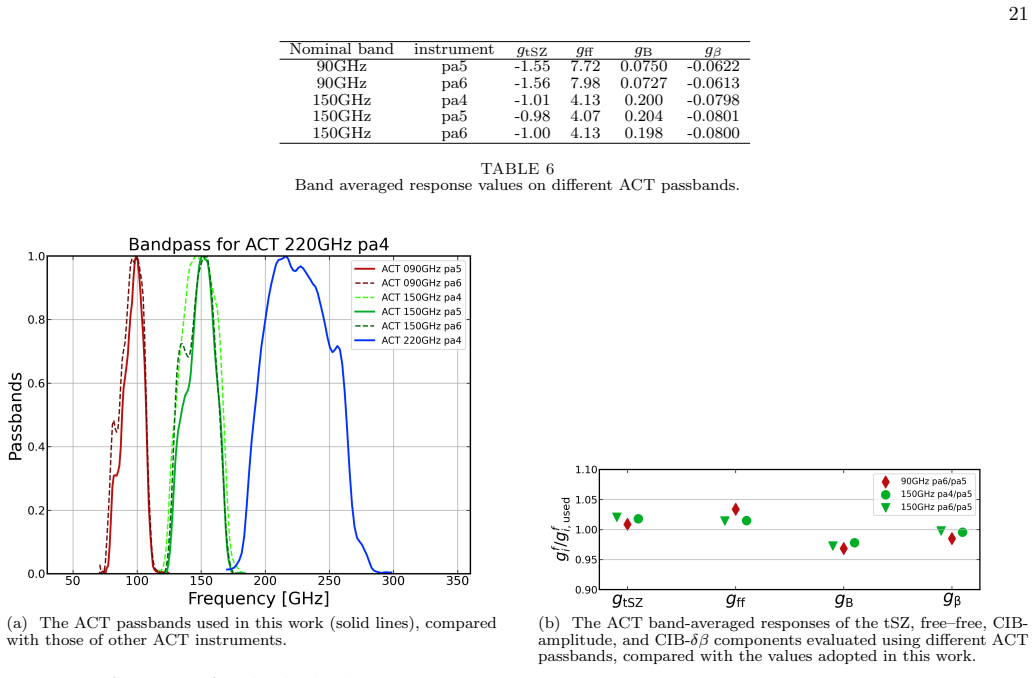
- domain assumption GNFW pressure shape parameters c500=1.07, α=1.05, γ=0.55, αP=0.12 from z<0.6 cluster sample (Melin & Pratt 2023) apply to ~10^13 M⊙ halos
- ad hoc to paper Radio emission correlated with the galaxy samples has a single power-law SED, scale-independent from ℓ=200 to 6000, and identical in Planck and ACT maps
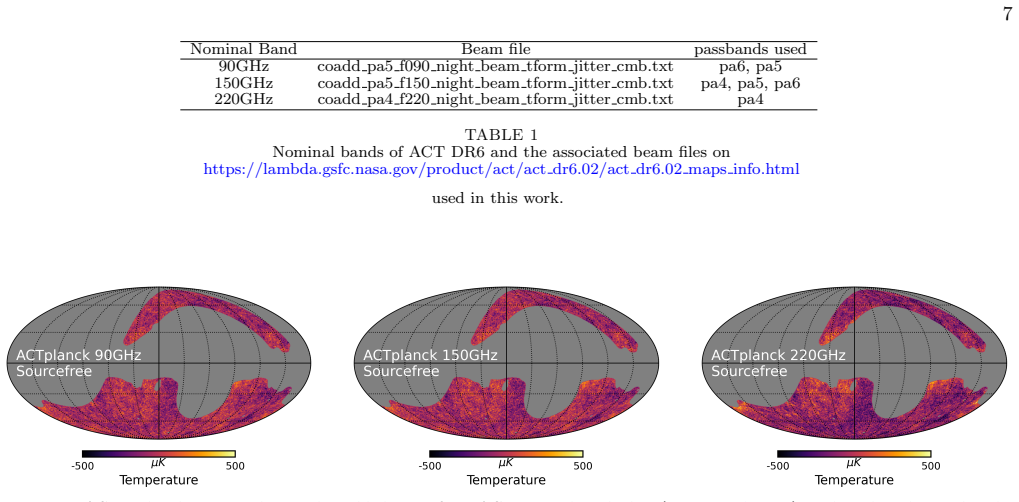
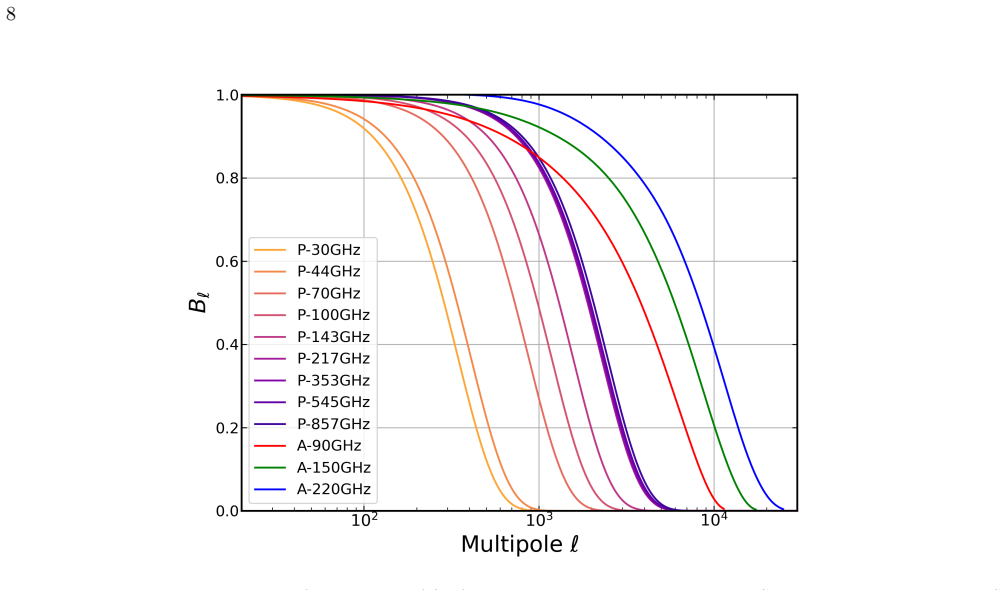
- domain assumption Gaussian beam approximations for Planck bands and adopted ACT passband assignments (PA5/PA4)
- standard math Component separation is identifiable when Nf ≥ Ns, with G block-diagonal over multipoles
- domain assumption Covariance is well approximated by the NaMaster analytic window-convolved Gaussian using smooth fits to measured autospectra as templates
read the original abstract
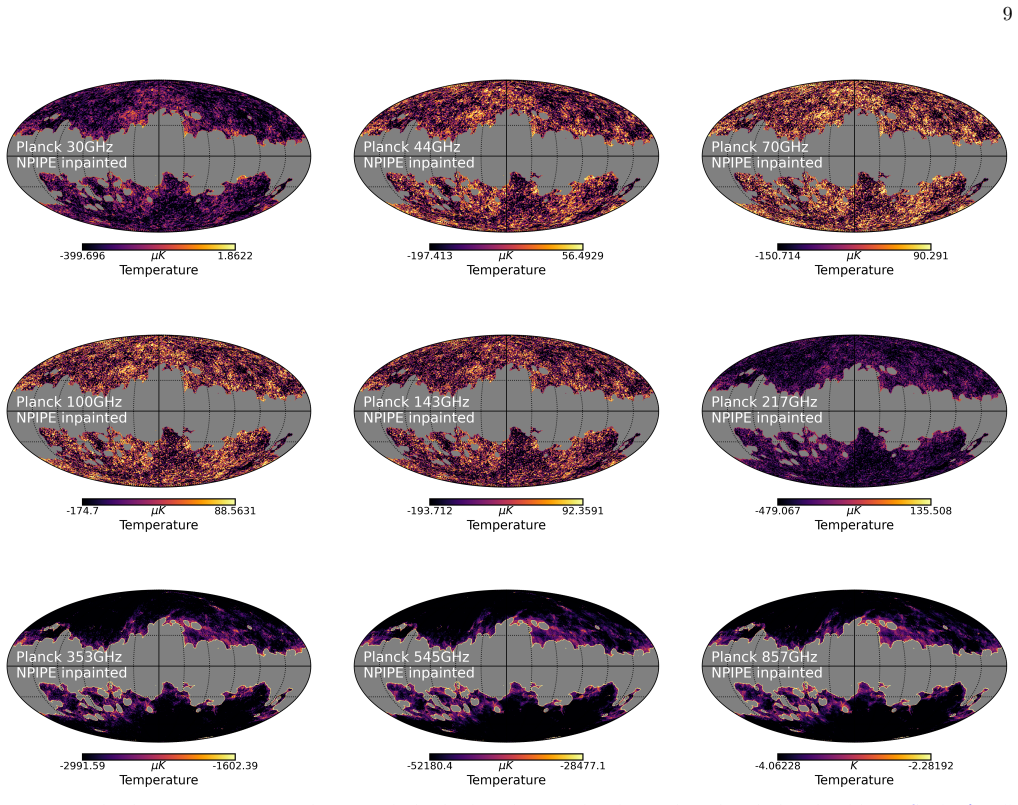
Cross-correlations between the thermal Sunyaev-Zel'dovich (tSZ) effect and galaxy surveys provide a sensitive probe of hot gas in low-mass halos, but on the angular scales of greatest astrophysical interest they are also highly vulnerable to residual foreground contamination. We analyze the cross-correlation of two low-redshift unWISE galaxy samples with Planck PR4 and ACT DR6 microwave temperature sky maps directly in harmonic space, fitting simultaneously for correlated tSZ, cosmic infrared background (CIB), and radio emission. Using the nine Planck bands to perform model selection, we find that a three-component model consisting of tSZ, radio emission, and a CIB amplitude term is strongly preferred over a model that omits radio contamination, with a significance of $9.5\sigma$ for the unWISE Low-z sample and $11\sigma$ for the unWISE Mid-z sample respectively. For the unWISE Low-z sample ($\bar{z}=0.14$) the preferred Planck fit gives an effective CIB emissivity index $\beta_0=1.79\pm0.29$, an effective CIB dust temperature $T_0=22.0\pm5.1 K$, and a radio spectral index $\beta_r=-2.18\pm0.24$; for the unWISE Mid-z sample ($\bar{z}=0.23$) we find $\beta_0=1.41\pm0.13$, $T_0=28.0\pm4.2 K$, and $\beta_r=-2.62\pm0.26$. We apply this radio-inclusive recipe to the ACT+Planck 90, 150, and 220 GHz maps to obtain the best small-scale measurements. This removes the apparent negative galaxy-tSZ cross-correlation seen in the fiducial ACT DR6 NILC reconstruction and in no-radio fits. The cleaned tSZ cross unWISE spectra remain positive to $\ell \simeq 6000$ and are broadly consistent with the Planck-only reconstruction on overlapping scales. We show that these radio-cleaned spectra are well described by a conventional halo model calibrated to the galaxy population and a two-parameter generalized NFW electron pressure profile.
Figures
Forward citations
Cited by 1 Pith paper
-
Analytical covariances for catalogue-based pseudo-$C_\ell$s
A new analytic method computes disconnected covariance matrices for catalogue-based pseudo-Cℓ power spectra by smoothing source positions and treating self-pair shot noise exactly.
Reference graph
Works this paper leans on
-
[1]
, " * write output.state after.block = add.period write newline
ENTRY address archiveprefix author booktitle chapter edition editor howpublished institution eprint journal key month note number organization pages publisher school series title type volume year label extra.label sort.label short.list INTEGERS output.state before.all mid.sentence after.sentence after.block FUNCTION init.state.consts #0 'before.all := #1 ...
-
[2]
write newline
" write newline "" before.all 'output.state := FUNCTION n.dashify 't := "" t empty not t #1 #1 substring "-" = t #1 #2 substring "--" = not "--" * t #2 global.max substring 't := t #1 #1 substring "-" = "-" * t #2 global.max substring 't := while if t #1 #1 substring * t #2 global.max substring 't := if while FUNCTION word.in bbl.in " " * FUNCTION format....
-
[3]
2019, , 2019, 056
Ade , P., Aguirre , J., Ahmed , Z., et al. 2019, , 2019, 056
2019
-
[4]
Afshordi , N., Lin , Y.-T., Nagai , D., & Sanderson , A. J. R. 2007, , 378, 293
2007
-
[5]
2020, , 249, 3
Ahumada , R., Allende Prieto , C., Almeida , A., et al. 2020, , 249, 3
2020
-
[6]
2017, , 465, 4853
Alam , S., Miyatake , H., More , S., Ho , S., & Mandelbaum , R. 2017, , 465, 4853
2017
-
[7]
Alonso, D., Sanchez, J., Slosar, A., & Collaboration, L. D. E. S. 2019, Monthly Notices of the Royal Astronomical Society, 484, 4127
2019
-
[8]
2018, , 473, 4318
Ando , S., Benoit-L \'e vy , A., & Komatsu , E. 2018, , 473, 4318
2018
-
[9]
W., Piffaretti , R., et al
Arnaud , M., Pratt , G. W., Piffaretti , R., et al. 2010, , 517, A92
2010
-
[10]
R., Pfrommer , C., & Sievers , J
Battaglia , N., Bond , J. R., Pfrommer , C., & Sievers , J. L. 2012 a , , 758, 74
2012
-
[11]
R., Pfrommer , C., & Sievers , J
Battaglia , N., Bond , J. R., Pfrommer , C., & Sievers , J. L. 2012 b , , 758, 75
2012
-
[12]
R., Pfrommer , C., & Sievers , J
Battaglia , N., Bond , J. R., Pfrommer , C., & Sievers , J. L. 2013, , 777, 123
2013
-
[13]
2024, , 534, 655
Bigwood , L., Amon , A., Schneider , A., et al. 2024, , 534, 655
2024
-
[14]
2025, arXiv e-prints, arXiv:2510.15822
Bigwood , L., Yamamoto , M., Siegel , J., et al. 2025, arXiv e-prints, arXiv:2510.15822
arXiv 2025
-
[15]
1999, , 310, 97
Birkinshaw , M. 1999, , 310, 97
1999
-
[16]
E., Holder , G
Carlstrom , J. E., Holder , G. P., & Reese , E. D. 2002, , 40, 643
2002
-
[17]
& Ostriker , J
Cen , R. & Ostriker , J. P. 1999, , 514, 1
1999
-
[18]
D., et al
Chadayammuri , U., Bogd \'a n , \'A ., Oppenheimer , B. D., et al. 2022, , 936, L15
2022
-
[19]
Chandran , J., Remazeilles , M., & Barreiro , R. B. 2023, , 526, 5682
2023
-
[20]
Chandran , J., Remazeilles , M., & Barreiro , R. B. 2026, arXiv e-prints, arXiv:2603.17799
Pith/arXiv arXiv 2026
-
[21]
E., Alonso , D., Krause , E., et al
Chisari , N. E., Alonso , D., Krause , E., et al. 2019, , 242, 2
2019
-
[22]
C., & Abitbol , M
Chluba , J., Hill , J. C., & Abitbol , M. H. 2017, , 472, 1195
2017
-
[23]
S., Duivenvoorden , A
Coulton , W., Madhavacheril , M. S., Duivenvoorden , A. J., et al. 2024, , 109, 063530
2024
-
[24]
de Graaff , A., Cai , Y.-C., Heymans , C., & Peacock , J. A. 2019, , 624, A48
2019
-
[25]
G., et al
DESI Collaboration , Abdul Karim , M., Adame , A. G., et al. 2026, , 171, 285
2026
-
[26]
2017, Astronomische Nachrichten, 338, 293
Eckert , D., Ettori , S., Pointecouteau , E., et al. 2017, Astronomische Nachrichten, 338, 293
2017
-
[27]
Fixsen , D. J. 2009, , 707, 916
2009
-
[28]
W., Lang , D., & Goodman , J
Foreman-Mackey , D., Hogg , D. W., Lang , D., & Goodman , J. 2013, PASP, 125, 306
2013
-
[29]
2019, JCAP, 11, 043
Garc \' a-Garc \' a, C., Alonso, D., & Bellini, E. 2019, JCAP, 11, 043
2019
-
[30]
M., Hivon , E., Banday , A
G \'o rski , K. M., Hivon , E., Banday , A. J., et al. 2005, , 622, 759
2005
-
[31]
S., Sailer , N., & Zhou , R
Hadzhiyska , B., Ferraro , S., Farren , G. S., Sailer , N., & Zhou , R. 2025 a , , 112, 123507
2025
-
[32]
2025 b , , 112, 083509
Hadzhiyska , B., Ferraro , S., Ried Guachalla , B., et al. 2025 b , , 112, 083509
2025
-
[33]
A., Puchwein, E., Sijacki, D., Schwope, A., & Klein, M
Henden, N. A., Puchwein, E., Sijacki, D., Schwope, A., & Klein, M. 2019, Monthly Notices of the Royal Astronomical Society, 489, 2439
2019
-
[34]
M., Netterfield , C
Hivon , E., G \'o rski , K. M., Netterfield , C. B., et al. 2002, , 567, 2
2002
-
[35]
A., et al
Ishiyama , T., Prada , F., Klypin , A. A., et al. 2021, , 506, 4210
2021
-
[36]
Koukoufilippas , N., Alonso , D., Bilicki , M., & Peacock , J. A. 2020, , 491, 5464
2020
-
[37]
Kravtsov , A. V. & Borgani , S. 2012, , 50, 353
2012
-
[38]
F., & White, M
Krolewski, A., Ferraro, S., Schlafly, E. F., & White, M. 2020, Journal of Cosmology and Astroparticle Physics, 2020, 047
2020
-
[39]
J., Ilbert , O., et al
Laigle , C., McCracken , H. J., Ilbert , O., et al. 2016, , 224, 24
2016
-
[40]
2014, , 147, 108
Lang , D. 2014, , 147, 108
2014
-
[41]
H., Mo , H
Lim , S. H., Mo , H. J., Li , R., et al. 2018, , 854, 181
2018
-
[42]
Limber , D. N. 1953, , 117, 134
1953
-
[43]
H., Ferraro , S., Schaan , E., et al
Liu , R. H., Ferraro , S., Schaan , E., et al. 2025, , 112, 083561
2025
-
[44]
& Afshordi, N
LoVerde, M. & Afshordi, N. 2008, Phys. Rev. D, 78, 123506
2008
-
[45]
& Hill, J
McCarthy, F. & Hill, J. C. 2024, , 109, 023528
2024
-
[46]
& Hill, J
McCarthy , F. & Hill, J. C. 2024, , 109, 023528
2024
-
[47]
& Madhavacheril, M
McCarthy, F. & Madhavacheril, M. S. 2021, Phys. Rev. D, 103, 103515
2021
-
[48]
G., Schaye , J., Bird , S., & Le Brun , A
McCarthy , I. G., Schaye , J., Bird , S., & Le Brun , A. M. C. 2017, , 465, 2936
2017
-
[49]
& Pratt , G
Melin , J.-B. & Pratt , G. W. 2023, , 678, A197
2023
-
[50]
E., et al
Naess , S., Aiola , S., Austermann , J. E., et al. 2020, , 2020, 046
2020
-
[51]
J., et al
Naess , S., Guan , Y., Duivenvoorden , A. J., et al. 2025, , 2025, 061
2025
-
[52]
F., Frenk , C
Navarro , J. F., Frenk , C. S., & White , S. D. M. 1997, , 490, 493
1997
-
[53]
2020, , 2020, 044
Nicola , A., Alonso , D., S \'a nchez , J., et al. 2020, , 2020, 044
2020
-
[54]
Planck Collaboration , Adam , R., Ade , P. A. R., et al. 2016, , 594, A10
2016
-
[55]
Planck Collaboration , Ade , P. A. R., Aghanim , N., et al. 2014, , 571, A30
2014
-
[56]
Planck Collaboration , Ade , P. A. R., Aghanim , N., et al. 2013, , 557, A52
2013
-
[57]
J., et al
Planck Collaboration , Akrami , Y., Andersen , K. J., et al. 2020, , 643, A42
2020
-
[58]
J., Ried Guachalla , B., Schaan , E., et al
Qu , F. J., Ried Guachalla , B., Schaan , E., et al. 2026, arXiv e-prints, arXiv:2604.19744
Pith/arXiv arXiv 2026
-
[59]
J., Sherwin , B
Qu , F. J., Sherwin , B. D., Madhavacheril , M. S., et al. 2024, , 962, 112
2024
-
[60]
L., Shaw , L., Zahn , O., et al
Reichardt , C. L., Shaw , L., Zahn , O., et al. 2012, , 755, 70
2012
-
[61]
2025, , 112, 103512
Ried Guachalla , B., Schaan , E., Hadzhiyska , B., et al. 2025, , 112, 103512
2025
-
[62]
Sarazin , C. L. 1986, Reviews of Modern Physics, 58, 1
1986
-
[63]
F., Meisner , A
Schlafly , E. F., Meisner , A. M., & Green , G. M. 2019, , 240, 30
2019
-
[64]
2026 a , [ [arXiv] 2512.02954 ]
Siegel , J., Bigwood , L., Amon , A., et al. 2026 a , [ [arXiv] 2512.02954 ]
Pith/arXiv arXiv 2026
-
[65]
C., Amon , A., McCarthy , I
Siegel , J. C., Amon , A., McCarthy , I. G., et al. 2026 b , , 1003, 151
2026
-
[66]
Sunyaev , R. A. & Zeldovich , Y. B. 1972, Comments on Astrophysics and Space Physics, 4, 173
1972
-
[67]
2019, , 625, A67
Tanimura , H., Aghanim , N., Douspis , M., Beelen , A., & Bonjean , V. 2019, , 625, A67
2019
-
[68]
V., Klypin , A., et al
Tinker , J., Kravtsov , A. V., Klypin , A., et al. 2008, , 688, 709
2008
-
[69]
L., Robertson , B
Tinker , J. L., Robertson , B. E., Kravtsov , A. V., et al. 2010, , 724, 878
2010
-
[70]
P., Schaye , J., Booth , C
van Daalen , M. P., Schaye , J., Booth , C. M., & Dalla Vecchia , C. 2011, , 415, 3649
2011
-
[71]
P., Wang , L., Zemcov , M., et al
Viero , M. P., Wang , L., Zemcov , M., et al. 2013, , 772, 77
2013
-
[72]
Voit , G. M. 2005, Reviews of Modern Physics, 77, 207
2005
-
[73]
2019, , 215, 7
Walker , S., Simionescu , A., Nagai , D., et al. 2019, , 215, 7
2019
-
[74]
2021, , 651, A76
Yan , Z., van Waerbeke , L., Tr \"o ster , T., et al. 2021, , 651, A76
2021
-
[75]
J., et al
Yuan , S., Zhang , H., Ross , A. J., et al. 2024, , 530, 947
2024
-
[76]
2024 a , , 690, A267
Zhang , Y., Comparat , J., Ponti , G., et al. 2024 a , , 690, A267
2024
-
[77]
2024 b , , 690, A268
Zhang , Y., Comparat , J., Ponti , G., et al. 2024 b , , 690, A268
2024
-
[78]
L., & Zehavi , I
Zheng , Z., Coil , A. L., & Zehavi , I. 2007, , 667, 760
2007
-
[79]
2019, Journal of Open Source Software, 4, 1298
Zonca, A., Singer, L., Lenz, D., et al. 2019, Journal of Open Source Software, 4, 1298
2019
discussion (0)
Sign in with ORCID, Apple, or X to comment. Anyone can read and Pith papers without signing in.