REVIEW 3 major objections 4 minor 1 cited by
The paper extends Noise-Directed Adaptive Remapping (NDAR) from binary to integer-domain optimization, arguing that native qudit encodings best exploit amplitude-damping-like noise when the all-zeros state is a feasible attractor.
Reviewed by Pith at T0; open to challenge. T0 means a machine referee read the full paper against a public rubric. the ladder, T0–T4 →
T0 review · deepseek-v4-flash
2026-08-04 04:34 UTC pith:JF3RHYBK
load-bearing objection A useful but overclaimed roadmap paper: the NDAR-to-integer generalization and encoding comparison are real, yet the 'best-of-category' verdict lacks numerical support and one key noise-profile assumption remains unexamined. the 3 major comments →
Noise-Directed Adaptive Remapping for Integer Optimization: from qubits to (encoded) qudits
The pith
A machine-rendered reading of the paper's core claim, the machinery that carries it, and where it could break.
Core claim
NDAR's four ingredients—a known noise attractor, a feasible attractor encoding, a unique gauge-selection rule, and practical circuit remappings—carry over from binary to d-level integer domains. With qudits, each target string admits ((d−1)!)^n compatible gauges instead of one; the paper picks shift gauges X^{r_u} that keep the cost 2-local while multiplying terms by roots of unity. For qubit encodings, domain-wall is the best NDAR fit (all-zeros is valid, prefix-flip gauges change only signs), one-hot the worst (all-zeros invalid), binary favorable when k is a power of 2. So native qudits score best on the paper's criteria.
What carries the argument
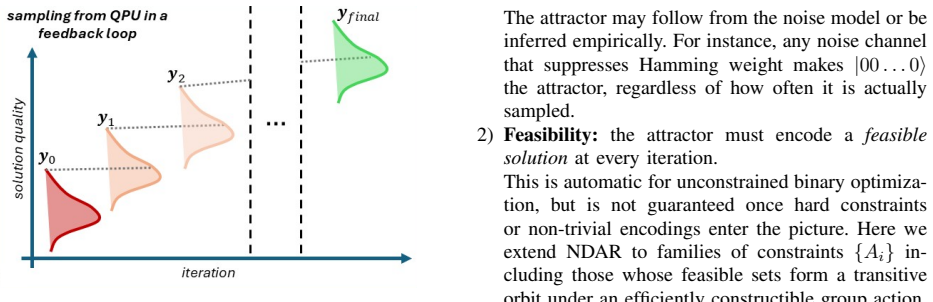
The machinery is the NDAR loop itself, specialized to integer domains. At each iteration, the algorithm samples from a noisy quantum optimizer, takes the best feasible sample, and applies a gauge transformation P that sends the noise attractor |0...0> to that sample, so the next run is biased toward better solutions. The two physical ingredients doing the work are the generalized amplitude-damping channel, whose fixed point is |0...0>, and the gauge group: bitflips for binary, shift operators X for native qudits, and prefix-flips for domain-wall encoding. The paper's contribution is a set of criteria—attractor feasibility, gauge selection, and practical circuit remapping—that decide whether
Load-bearing premise
The load-bearing premise is that amplitude-damping-like noise keeps steering outputs toward the |0...0> state across every iteration and after the gauge-remapped circuits—especially qudit shift gauges, whose noise profile is argued for qubits but not demonstrated for qudits—are compiled; the paper concedes in Sec. V that dephasing-dominated or higher-temperature regimes weaken this attractor picture.
What would settle it
Run NDAR-QAOA on the same Max-k-coloring instance in qudit-native and domain-wall encodings on a device whose noise is characterized. If the qudit-native version does not show a monotone increase in best-found cost across iterations, or if the empirical attractor of the compiled gauge-remapped circuit is not |0...0> (e.g., the all-zeros state is not the most probable outcome under idle noise), the paper's central claim is falsified. A simpler probe: prepare the uniform superposition, apply a shift gauge and idle, and check if the output distribution is still biased toward low excitation number
If this is right
- NDAR can be applied to integer-domain problems such as graph coloring without adding penalty terms for encoding constraints, provided the attractor is feasible and the gauge group preserves circuit structure.
- Encoding choice for near-term quantum optimization should include a noise-aware criterion: whether the device's attractor state encodes a valid solution and whether gauges keep the ansatz cheap to compile.
- Qudit-native processors—whose photon loss is naturally modeled by generalized amplitude damping—become the most natural NDAR target, with the ((d−1)!)^n gauge multiplicity as a tunable asset.
- Among qubit encodings of integer variables, domain-wall encoding is the strongest NDAR fit, while one-hot encoding is the weakest because the all-zeros attractor is an invalid codeword.
- The Max-k-colorable subgraph example carries the framework to NP-hard problems beyond MaxCut, since MaxCut is the k=2 special case.
Where Pith is reading between the lines
- A concrete test follows from the attractor assumption: on a dephasing-dominated device with comparable gate fidelities, NDAR's iteration-over-iteration gains should be smaller than on an amplitude-damping-dominated device; this is a prediction the paper does not itself run.
- The phase factors introduced by qudit shift gauges mean the compiled circuit is not simply sign-flipped; whether the noise profile survives compilation and repeated remapping is an open empirical question, and answering it would tighten or overturn the qudit-native recommendation.
- The gauge-selection freedom suggests a route to permutation domains such as the traveling salesperson: choose transposition gauges that map the attractor to the best tour and preserve the mixer structure, if the feasible set forms a transitive orbit.
- One could build a device-encoding selection protocol from this framework: measure which attractor the hardware actually has, check it against each candidate encoding's feasible set, and pick the encoding whose gauges compile with the fewest added gates.
Editorial analysis
A structured set of objections, weighed in public.
Referee Report
Summary. The paper extends Noise-Directed Adaptive Remapping (NDAR) from unconstrained binary optimization to integer-domain problems over Z_d^n. It identifies four ingredients needed for NDAR beyond bitstrings—attractor knowledge, feasibility of the attractor, a gauge-selection rule, and practical circuit remappings—and analyzes them for qudit-native, binary, one-hot, 01-hot, and domain-wall qubit encodings, using Max-k-colorable subgraph as a running example. Concrete gauge families are proposed: qudit shift gauges (Eq. 14) and prefix-flip gauges (Eq. 21). The central conclusion, summarized in Table I, is that native qudit encodings exhibit a 'best-of-category' combination of properties. The paper is purely analytical; it contains no numerical simulations or hardware demonstrations.
Significance. If the conclusions hold, the paper provides a useful new criterion for encoding selection in near-term quantum optimization: the feasibility of the noise attractor and the preservation of the noise profile under gauge remapping. The mathematical development is clear and the proposed gauges are explicit and checkable; the resource comparison in Table I is informative. However, the evaluative claims—'distinct advantages,' 'best-of-category'—are not backed by numerical evidence, and one load-bearing technical step (noise-profile preservation under qudit shift gauges) is asserted rather than demonstrated. The paper would be a valuable framework contribution if these gaps are addressed or the claims are appropriately qualified.
major comments (3)
- [Sec. III-C, Eq. (14), and Sec. V item (ii)] The central 'best-of-category' claim for qudit-native encodings requires that the qudit shift gauge V(r)=X^{r_1}...X^{r_n} preserves the generalized amplitude-damping attractor |00...0> after compilation across NDAR iterations. The paper argues this for qubit bitflip gauges because the circuit is unchanged up to sign changes. For the qudit shift gauge, Eq. (14) shows the cost Hamiltonian acquires phases omega^{m(r_u-r_v)}, so the compiled phase separator requires modified diagonal phase gates whose parameters vary with r each iteration. The paper does not analyze how the effective noise channel transforms under the compiled circuit (e.g., SUM, Fourier, and diagonal-phase decompositions). Without such an analysis or numerical noise-model simulation, the attractor stability across iterations—an explicit requirement of NDAR ingredient 4 (Sec. II-B)—is not established for the qudit shift gau
- [Abstract, Table I, Sec. IV] The paper repeatedly states that it 'demonstrate[s]' distinct advantages and a 'best-of-category' combination for qudit-native encodings, but no numerical simulations, noisy-circuit experiments, or hardware results are reported. Every comparison is analytical and rests on the assumed attractor. For a heuristic meta-algorithm, even a small-scale noisy simulation of Max-k-colorable for the five encodings (or a one-iteration effective output-distribution calculation) would substantiate the evaluative claims. As written, 'best-of-category' is an unsupported evaluation rather than a demonstrated result. If the intended contribution is purely a design-space analysis, the authors should say so explicitly and temper the claims accordingly.
- [Sec. II-B, Algorithm 1, and Sec. IV-C] The feasibility ingredient is essentially definitional: the |00...0> attractor is feasible for qudit-native, binary, domain-wall, and 01-hot by construction, and infeasible for one-hot by construction. Consequently, the ordering in Table I is largely a restatement of the framework's assumptions. This is not necessarily an error, but the paper should more clearly distinguish between properties that follow from the chosen criteria and properties that require empirical verification. The current phrasing, especially in the 'Outlook' paragraphs, makes the conclusions sound more strongly supported than they are.
minor comments (4)
- [Sec. IV-B2] The statement that the projector for the |00...0> color 'contains a number of terms that grows exponentially with k' should be quantified: as written, 2^{-(k-1)} prod (I + Z_i) indeed expands to 2^{k-1} terms, which is exponential, but the sentence could be clearer.
- [Table I] The row 'Probability q of valid string' for the 01-hot encoding is listed as q <= 1, but the text explains that the |00...0> state is valid in this encoding. It may be worth clarifying that q=1 for 01-hot only if the circuit preserves the encoding subspace, which the table does not make explicit.
- [Eq. (14) and following text] The transformation rule is written as 'V†HV=...' but the sentence introduces V as 'V=V(r)'. The notation is understandable, but a brief restatement ('where V=V(r)') would improve readability.
- [References] References [58] and [59] are listed as 'to appear' or 'arXiv (to appear)'. If these are not yet available, the authors should consider citing only published or arXiv-available versions, or marking them clearly as private communications/preprints.
Circularity Check
No significant circularity: the encoding comparison follows from explicitly stated NDAR criteria; the qudit shift-gauge noise-profile gap is an unproven assumption, not a circular reduction.
full rationale
Walked the derivation chain. Sec. II-B introduces four NDAR ingredients (attractor, feasibility, gauge selection, practical circuit remappings), explicitly abstracted from the prior NDAR paper [1]. Sec. III applies these to logical qudits; Sec. IV applies them to binary, one-hot, 01-hot, and domain-wall qubit encodings. Table I is a property/count summary, not a a hidden tautology: resource counts, feasibility of |0...0>, and term locality are computed independently from the stated encodings and Eqs. (12)-(14), Sec. IV-B. The one-hot exclusion follows from the feasibility requirement plus the assumed amplitude-damping attractor |0...0>, which the paper motivates from the qudit amplitude-damping channel (Eq. 8) and explicitly says can be replaced ('Other attractors can be accommodated with minimal changes'). That is a conditional analysis, not a definitional circle. The underlying benefit of NDAR is cited to [1], a published Rigetti experiment; that is external, falsifiable evidence, not a circular self-citation chain. The paper also flags its own limitation at Sec. V item (ii): 'Dephasing-dominated or higher-temperature regimes weaken the attractor picture,' and it does not demonstrate that compiled qudit shift gauges (Eq. 14) preserve the noise profile across iterations. That is an unproven assumption or correctness risk, but not a reduction of a result to its input. No fitted parameters are relabeled as predictions, and no uniqueness theorem is imported from the authors. Therefore no significant circularity is present.
Axiom & Free-Parameter Ledger
axioms (4)
- domain assumption Dominant device noise is (generalized) amplitude damping steering outputs toward |0...0⟩, with the bias persisting across gauge-remapped iterations.
- domain assumption The greedy remapping rule — map the attractor to the best sampled solution at each iteration — improves solution quality.
- standard math Cost functions over Z_n^k map to diagonal Hamiltonians with eigenvalues c(y); per-edge NEQ penalties are implementable via projectors or Z^m Z^{−m} terms.
- ad hoc to paper Qudit shift gauges (Eq. 14) and prefix-flip gauges (Eq. 21) compile to circuit families whose noise profile is approximately preserved across iterations.
read the original abstract
We extend Noise-Directed Adaptive Remapping (NDAR), a recently proposed heuristic meta-algorithm that leverages device noise as a computational resource, to optimization problems over discrete (integer) domains. While originally introduced for unconstrained binary optimization, the proposed generalization introduces additional gauge degrees of freedom at the logical level, such that the gauge transformation applied at each iteration is no longer unique, allowing tailoring to particular encodings or quantum hardware. We identify encoding-dependent requirements for NDAR beyond binary domains: feasibility of the noise attractor, existence of compatible gauge transformations that preserve an efficiently implementable circuit family, and a systematic way to select the transform to apply at each step. We analyze these criteria for qudit-native and for binary, one-hot, and domain-wall qubit encodings, using the Max-k-colorable subgraph problem as a running example. We demonstrate that these encodings can exhibit distinct advantages and tradeoffs when integrated within the NDAR framework, particularly in how noise-induced dynamics interact with the solution landscape and choice of encoding. Our results indicate that NDAR-guided noise considerations provide a new criterion for comparing device-level encoding choices for quantum optimization. Finally, we outline directions toward experimental realization in superconducting qudit devices and further algorithmic improvements.
Figures
Forward citations
Cited by 1 Pith paper
-
Separating Geometry From Interference in Constrained Quantum Optimization
For product-space constrained quantum optimization, the mixer's absolute amplitude transport reduces to a Hamming-shell Markov chain; a certified success bound then requires a phase-alignment condition that the paper ...
Reference graph
Works this paper leans on
-
[1]
Improving quantum approximate optimization by noise-directed adaptive remapping,
F. B. Maciejewski, J. Biamonte, S. Hadfield, and D. Venturelli, “Improving quantum approximate optimization by noise-directed adaptive remapping,”Quantum, vol. 9, p. 1906, 2025
1906
-
[2]
A quantum approximate optimization algorithm,
E. Farhi, J. Goldstone, and S. Gutmann, “A quantum approximate optimization algorithm,”arXiv preprint arXiv:1411.4028, 2014
Pith/arXiv arXiv 2014
-
[3]
From the quantum approximate optimization algorithm to a quantum alternating operator ansatz,
S. Hadfield, Z. Wang, B. O’gorman, E. G. Rieffel, D. Venturelli, and R. Biswas, “From the quantum approximate optimization algorithm to a quantum alternating operator ansatz,”Algorithms, vol. 12, no. 2, p. 34, 2019
2019
-
[4]
Challenges and opportunities for quantum informa- tion hardware,
D. D. Awschalom, H. Bernien, R. Hanson, W. D. Oliver, and J. Vuˇckovi´c, “Challenges and opportunities for quantum informa- tion hardware,”Science, vol. 390, no. 6777, pp. 1004–1010, 2025
2025
-
[5]
Challenges and opportunities in quantum optimization,
A. Abbas, A. Ambainis, B. Augustino, A. B ¨artschi, H. Buhrman, C. Coffrin, G. Cortiana, V . Dunjko, D. J. Egger, B. G. Elmegreen, et al., “Challenges and opportunities in quantum optimization,” Nature Reviews Physics, pp. 1–18, 2024
2024
-
[6]
Qudits and high- dimensional quantum computing,
Y . Wang, Z. Hu, B. C. Sanders, and S. Kais, “Qudits and high- dimensional quantum computing,”Frontiers in Physics, vol. 8, p. 589504, 2020
2020
-
[7]
Construction of a qudit using schr ¨odinger cat states and generation of hybrid entanglement between a discrete-variable qudit and a continuous- variable qudit,
Q.-P. Su, T. Liu, Y . Zhang, and C.-P. Yang, “Construction of a qudit using schr ¨odinger cat states and generation of hybrid entanglement between a discrete-variable qudit and a continuous- variable qudit,”Physical Review A, vol. 104, no. 3, p. 032412, 2021
2021
-
[8]
Quantum information scrambling on a superconducting qutrit processor,
M. S. Blok, V . V . Ramasesh, D. I. Schuster, and I. Siddiqi, “Quantum information scrambling on a superconducting qutrit processor,”Physical Review X, vol. 11, p. 021010, 2021
2021
-
[9]
A programmable qudit-based quan- tum processor,
Y . Chi, J. Huang, Z. Zhang, J. Mao, Z. Zhou, X. Chen, C. Zhai, J. Bao, T. Dai, H. Yuan,et al., “A programmable qudit-based quan- tum processor,”Nature communications, vol. 13, no. 1, p. 1166, 2022
2022
-
[10]
Universal qudit quantum computation with trapped ions,
M. Ringbauer, M. Meth, L. Postler, R. Stricker, I. Pogorelov, B. P. Lanyon, R. Blatt, and T. Monz, “Universal qudit quantum computation with trapped ions,”Nature Physics, vol. 18, pp. 1053– 1057, 2022
2022
-
[11]
Two-qutrit quantum al- gorithms on a programmable superconducting processor,
T. Roy, Z. Li, E. Kapit, and D. Schuster, “Two-qutrit quantum al- gorithms on a programmable superconducting processor,”Physical Review Applied, vol. 19, no. 6, p. 064024, 2023
2023
-
[12]
The2t-qutrit, a two-mode bosonic qutrit,
A. Denys and A. Leverrier, “The2t-qutrit, a two-mode bosonic qutrit,”Quantum, vol. 7, p. 1032, 2023
2023
-
[13]
Empowering a qudit- based quantum processor by traversing the dual bosonic ladder,
L. B. Nguyen, N. Goss, K. Siva, Y . Kim, E. Younis, B. Qing, A. Hashim, D. I. Santiago, and I. Siddiqi, “Empowering a qudit- based quantum processor by traversing the dual bosonic ladder,” Nature Communications, vol. 15, no. 1, p. 7117, 2024
2024
-
[14]
Benchmarking the performance of a high-q cavity qudit using random unitaries,
N. Bornman, T. Roy, J. A. Job, N. Anand, G. N. Perdue, S. Zorzetti, and M. S. Alam, “Benchmarking the performance of a high-q cavity qudit using random unitaries,”Quantum Science and Technology, vol. 10, no. 2, p. 025062, 2025
2025
-
[15]
Ultracoherent super- conducting cavity-based multiqudit platform with error-resilient control,
T. Kim, T. Roy, X. You, A. C. Li, H. Lamm, O. Pronitchev, M. Bal, S. Garattoni, F. Crisa, D. Bafia,et al., “Ultracoherent super- conducting cavity-based multiqudit platform with error-resilient control,”arXiv preprint arXiv:2506.03286, 2025
Pith/arXiv arXiv 2025
-
[16]
Near- term application engineering challenges in emerging supercon- ducting qudit processors,
D. Venturelli, E. Gustafson, D. Kurkcuoglu, and S. Zorzetti, “Near- term application engineering challenges in emerging supercon- ducting qudit processors,”arXiv preprint arXiv:2506.05608, 2025
Pith/arXiv arXiv 2025
-
[17]
Domain wall encoding of discrete variables for quantum annealing and qaoa,
N. Chancellor, “Domain wall encoding of discrete variables for quantum annealing and qaoa,”Quantum Science and Technology, vol. 4, no. 4, p. 045004, 2019
2019
-
[18]
Ising formulations of many NP problems,
A. Lucas, “Ising formulations of many NP problems,”Frontiers in physics, vol. 2, p. 5, 2014
2014
-
[19]
On the representation of Boolean and real functions as hamiltonians for quantum computing,
S. Hadfield, “On the representation of Boolean and real functions as hamiltonians for quantum computing,”ACM Transactions on Quantum Computing, vol. 2, p. 1–21, Dec. 2021
2021
-
[20]
Hybrid quantum- classical algorithms for approximate graph coloring,
S. Bravyi, A. Kliesch, R. Koenig, and E. Tang, “Hybrid quantum- classical algorithms for approximate graph coloring,”Quantum, vol. 6, p. 678, 2022
2022
-
[21]
Encoding trade-offs and design toolkits in quantum algorithms for discrete optimiza- tion: coloring, routing, scheduling, and other problems,
N. P. Sawaya, A. T. Schmitz, and S. Hadfield, “Encoding trade-offs and design toolkits in quantum algorithms for discrete optimiza- tion: coloring, routing, scheduling, and other problems,”Quantum, vol. 7, p. 1111, Sept. 2023
2023
-
[22]
Numerical gate synthesis for quantum heuristics on bosonic quantum processors,
A. B. ¨Ozg¨uler and D. Venturelli, “Numerical gate synthesis for quantum heuristics on bosonic quantum processors,”Frontiers in Physics, vol. 10, p. 900612, 2022
2022
-
[23]
Quantum approximate optimization algorithm for qudit systems,
Y . Deller, S. Schmitt, M. Lewenstein, S. Lenk, M. Federer, F. Jendrzejewski, P. Hauke, and V . Kasper, “Quantum approximate optimization algorithm for qudit systems,”Physical Review A, vol. 107, no. 6, p. 062410, 2023
2023
-
[24]
A. Apte, S. Boulebnane, Y . Jin, S. Omanakuttan, M. A. Perlin, and R. Shaydulin, “Quantum approximate optimization of integer graph problems and surpassing semidefinite programming for max-k-cut,”arXiv preprint arXiv:2602.05956, 2026
Pith/arXiv arXiv 2026
-
[25]
Bosonic quantum codes for amplitude damping,
I. L. Chuang, D. W. Leung, and Y . Yamamoto, “Bosonic quantum codes for amplitude damping,”Physical Review A, vol. 56, no. 2, p. 1114, 1997
1997
-
[26]
Quantum error-correcting codes for qudit amplitude damping,
M. Grassl, L. Kong, Z. Wei, Z.-Q. Yin, and B. Zeng, “Quantum error-correcting codes for qudit amplitude damping,”IEEE Trans- actions on Information Theory, vol. 64, no. 6, pp. 4674–4685, 2018
2018
-
[27]
Noise-adapted qudit codes for amplitude-damping noise,
S. Dutta, D. Biswas, and P. Mandayam, “Noise-adapted qudit codes for amplitude-damping noise,”Physical Review A, vol. 111, no. 3, p. 032438, 2025
2025
-
[28]
Quantification and character- ization of leakage errors,
C. J. Wood and J. M. Gambetta, “Quantification and character- ization of leakage errors,”Physical Review A, vol. 97, no. 3, p. 032306, 2018
2018
-
[29]
Universal pulses for superconducting qudit ladder gates,
B. Li, F. C ´ardenas-L´opez, A. Lupascu, and F. Motzoi, “Universal pulses for superconducting qudit ladder gates,”PRX Quantum, vol. 6, no. 3, p. 030357, 2025
2025
-
[30]
Ausiello, P
G. Ausiello, P. Crescenzi, G. Gambosi, V . Kann, A. Marchetti- Spaccamela, and M. Protasi,Complexity and approximation: Combinatorial optimization problems and their approximability properties. Springer Science & Business Media, 2012
2012
-
[31]
Stabilizer states and clifford operations for systems of arbitrary dimensions and modular arithmetic,
E. Hostens, J. Dehaene, and B. De Moor, “Stabilizer states and clifford operations for systems of arbitrary dimensions and modular arithmetic,”Physical Review A, vol. 71, no. 4, p. 042315, 2005
2005
-
[32]
Ancilla-driven quantum computation for qudits and continuous variables,
T. Proctor, M. Giulian, N. Korolkova, E. Andersson, and V . Kendon, “Ancilla-driven quantum computation for qudits and continuous variables,”Physical Review A, vol. 95, no. 5, p. 052317, 2017
2017
-
[33]
Highly-efficient quantum fourier transformations for certain non-abelian groups,
E. M. Murairi, M. S. Alam, H. Lamm, S. Hadfield, and E. Gustafson, “Highly-efficient quantum fourier transformations for certain non-abelian groups,”Physical Review D, vol. 110, no. 7, p. 074501, 2024
2024
-
[34]
Quantum circuit synthesis with qudit phase gadget method,
S. Yang, L. Xu, G. Tian, and X. Sun, “Quantum circuit synthesis with qudit phase gadget method,”arXiv preprint arXiv:2504.12710, 2025
Pith/arXiv arXiv 2025
-
[35]
Universal control of an oscillator with dispersive coupling to a qubit,
S. Krastanov, V . V . Albert, C. Shen, C.-L. Zou, R. W. Heeres, B. Vlastakis, R. J. Schoelkopf, and L. Jiang, “Universal control of an oscillator with dispersive coupling to a qubit,”Physical Review A, vol. 92, no. 4, p. 040303, 2015
2015
-
[36]
Cavity state manipulation using photon-number selective phase gates,
R. W. Heeres, B. Vlastakis, E. Holland, S. Krastanov, V . V . Albert, L. Frunzio, L. Jiang, and R. J. Schoelkopf, “Cavity state manipulation using photon-number selective phase gates,” Physical review letters, vol. 115, no. 13, p. 137002, 2015
2015
-
[37]
Efficient, direct compilation of su (n) operations into snap & displacement gates,
J. Job, “Efficient, direct compilation of su (n) operations into snap & displacement gates,”arXiv preprint arXiv:2307.11900, 2023
Pith/arXiv arXiv 2023
-
[38]
Qudit gate de- composition dependence for lattice gauge theories,
D. M. K ¨urkc ¸¨uoglu, H. Lamm, and A. Maestri, “Qudit gate de- composition dependence for lattice gauge theories,”arXiv preprint arXiv:2410.16414, 2024
Pith/arXiv arXiv 2024
-
[39]
Investigating parameter trainability in the snap-displacement protocol of a qudit system,
O. Ogunkoya, K. Morris, and D. M. K ¨urkc ¸¨uoglu, “Investigating parameter trainability in the snap-displacement protocol of a qudit system,”Physica Scripta, vol. 100, no. 7, p. 075109, 2025
2025
-
[40]
Fast universal control of an oscillator with weak dispersive coupling to a qubit,
A. Eickbusch, V . Sivak, A. Z. Ding, S. S. Elder, S. R. Jha, J. Venkatraman, B. Royer, S. M. Girvin, R. J. Schoelkopf, and M. H. Devoret, “Fast universal control of an oscillator with weak dispersive coupling to a qubit,”Nature Physics, vol. 18, no. 12, pp. 1464–1469, 2022
2022
-
[41]
Conditional-not displacement: Fast mul- tioscillator control with a single qubit,
A. A. Diringer, E. Blumenthal, A. Grinberg, L. Jiang, and S. Hacohen-Gourgy, “Conditional-not displacement: Fast mul- tioscillator control with a single qubit,”Physical Review X, vol. 14, no. 1, p. 011055, 2024
2024
-
[42]
M. Lapointe-Majoret al., “Optimizing pulse shapes of an echoed conditional displacement gate in a superconducting bosonic sys- tem,”arXiv preprint arXiv:2408.05299, 2024
Pith/arXiv arXiv 2024
-
[43]
Dynamics of qudit gates and effects of spectator modes on optimal control pulses,
A. B. ¨Ozg¨uler and J. A. Job, “Dynamics of qudit gates and effects of spectator modes on optimal control pulses,”Physical Review A, vol. 109, no. 5, p. 052404, 2024
2024
-
[44]
Elementary gates for quantum computation,
A. Barenco, C. H. Bennett, R. Cleve, D. P. DiVincenzo, N. Mar- golus, P. Shor, T. Sleator, J. A. Smolin, and H. Weinfurter, “Elementary gates for quantum computation,”Physical review A, vol. 52, no. 5, p. 3457, 1995
1995
-
[45]
Evidence of scaling advantage for the quantum approximate op- timization algorithm on a classically intractable problem,
R. Shaydulin, C. Li, S. Chakrabarti, M. DeCross, D. Herman, N. Kumar, J. Larson, D. Lykov, P. Minssen, Y . Sun,et al., “Evidence of scaling advantage for the quantum approximate op- timization algorithm on a classically intractable problem,”Science Advances, vol. 10, no. 22, p. eadm6761, 2024
2024
-
[46]
S. A. Hadfield,Quantum algorithms for scientific computing and approximate optimization. Columbia University, 2018
2018
-
[47]
Xy mix- ers: Analytical and numerical results for the quantum alternating operator ansatz,
Z. Wang, N. C. Rubin, J. M. Dominy, and E. G. Rieffel, “Xy mix- ers: Analytical and numerical results for the quantum alternating operator ansatz,”Physical Review A, vol. 101, no. 1, p. 012320, 2020
2020
-
[48]
Asymptotic improvements to quantum circuits via qutrits,
P. Gokhale, J. M. Baker, C. Duckering, N. Brown, K. R. Brown, and F. T. Chong, “Asymptotic improvements to quantum circuits via qutrits,” inProceedings of the 46th International Symposium on Computer Architecture (ISCA), pp. 554–566, ACM, 2019
2019
-
[49]
Exploration of superconducting multi-mode cavity architectures for quantum computing,
A. Reineri, S. Zorzetti, T. Roy, and X. You, “Exploration of superconducting multi-mode cavity architectures for quantum computing,” in2023 IEEE International Conference on Quantum Computing and Engineering (QCE), vol. 1, pp. 1342–1348, IEEE, 2023
2023
-
[50]
Y . Liu, S. Singh, K. C. Smith, E. Crane, J. M. Martyn, A. Eick- busch, A. Schuckert, R. D. Li, J. Sinanan-Singh, M. B. Soley, et al., “Hybrid oscillator-qubit quantum processors: Instruction set architectures, abstract machine models, and applications,”arXiv preprint arXiv:2407.10381, 2024
arXiv 2024
-
[51]
High-fidelity parametric beamsplitting with a parity- protected converter,
Y . Lu, A. Maiti, J. W. O. Garmon, S. Ganjam, Y . Liu, J. Cao, B. J. Chapman, T. Tsunoda, A. Eickbusch, R. J. Schoelkopf, and M. H. Devoret, “High-fidelity parametric beamsplitting with a parity- protected converter,”Nature Communications, vol. 14, p. 5767, 2023
2023
-
[52]
Error-detectable bosonic entangling gates with a noisy ancilla,
T. Tsunoda, J. D. Teoh, W. D. Kalfus, S. Rosenblum, A. Eick- busch, N. E. Frattini, P. Reinhold, R. J. Schoelkopf, M. H. Devoret, L. Jiang, and S. M. Girvin, “Error-detectable bosonic entangling gates with a noisy ancilla,”PRX Quantum, vol. 4, no. 2, p. 020354, 2023
2023
-
[53]
Fast sideband control of a weakly coupled multimode bosonic memory,
Y . Huang, S. DiNapoli, G. Rockwood, A. Vrajitoarea, S. Boutin, W.-L. Ma, T. Roy, and S. Chakram, “Fast sideband control of a weakly coupled multimode bosonic memory,”arXiv preprint arXiv:2503.10623, 2025
Pith/arXiv arXiv 2025
-
[54]
Simulating electronic structure on bosonic quantum computers,
R. Dutta, N. Cao, A. Bhattacharyya, J. Mead, A. Pal,et al., “Simulating electronic structure on bosonic quantum computers,” Journal of Chemical Theory and Computation, vol. 21, p. 2281, 2025
2025
-
[55]
Qudit dynamical decoupling on a superconducting quantum processor,
V . Tripathi, N. Goss, A. Vezvaee, L. B. Nguyen, I. Siddiqi, and D. A. Lidar, “Qudit dynamical decoupling on a superconducting quantum processor,”Physical Review Letters, vol. 134, no. 5, p. 050601, 2025
2025
-
[56]
Uniformly decaying sub- spaces for error-mitigated quantum computation,
N. Suri, J. Saied, and D. Venturelli, “Uniformly decaying sub- spaces for error-mitigated quantum computation,”Physical Review A, vol. 110, no. 4, p. 042621, 2024
2024
-
[57]
Harnessing intrinsic noise for quantum simulation of open quantum systems,
S. Dambal, A. Sone, and Y . Zhang, “Harnessing intrinsic noise for quantum simulation of open quantum systems,”arXiv preprint arXiv:2510.21075, 2025
arXiv 2025
-
[58]
En- hancing ndar with delay-gate-induced amplitude damping,
W.-H. Tam, H. Matsuyama, R. Sakai, and Y . Yamashiro, “En- hancing ndar with delay-gate-induced amplitude damping,”arXiv preprint arXiv:2504.12628, 2025
Pith/arXiv arXiv 2025
-
[59]
Quantum ap- proximate optimization via noise-directed adaptive warm-starting,
F. Maciejewski, S. Hadfield, O. Wallis, G. Pennington, S. Brand- hofer, S. Woerner, D. J. Egger, and D. Venturelli, “Quantum ap- proximate optimization via noise-directed adaptive warm-starting,” arXiv (to appear), 2026
2026
-
[60]
Non-binary unitary error bases and quantum codes,
E. Knill, “Non-binary unitary error bases and quantum codes,” arXiv preprint quant-ph/9608048, 1996
Pith/arXiv arXiv 1996
-
[61]
Fault-tolerant quantum computation with higher- dimensional systems,
D. Gottesman, “Fault-tolerant quantum computation with higher- dimensional systems,”Chaos, Solitons & Fractals, vol. 10, no. 10, pp. 1749–1758, 1999
1999
-
[62]
Nonbinary quantum stabilizer codes,
A. Ashikhmin and E. Knill, “Nonbinary quantum stabilizer codes,”IEEE Transactions on Information Theory, vol. 47, no. 7, pp. 3065–3072, 2001
2001
-
[63]
Qudit surface codes and gauge theory with finite cyclic groups,
S. S. Bullock and G. K. Brennen, “Qudit surface codes and gauge theory with finite cyclic groups,”Journal of Physics A: Mathematical and Theoretical, vol. 40, no. 13, p. 3481, 2007
2007
-
[64]
Fault-tolerant resource comparison of qudit and qubit encodings for diagonal quadratic operators,
S. Godwood, D. M. K ¨urkc ¸¨uo˘glu, G. N. Perdue, M. Maneyro, and A. Roggero, “Fault-tolerant resource comparison of qudit and qubit encodings for diagonal quadratic operators,”arXiv preprint arXiv:2604.26792, 2026
Pith/arXiv arXiv 2026
-
[65]
Warm-starting quantum optimization,
D. J. Egger, J. Mare ˇcek, and S. Woerner, “Warm-starting quantum optimization,”Quantum, vol. 5, p. 479, 2021
2021
-
[66]
A non-variational quantum ap- proach to the job shop scheduling problem,
M. A. Lopez-Ruiz, E. L. Tucker, E. M. Arnold, E. Epifanovsky, A. Kaushik, and M. Roetteler, “A non-variational quantum ap- proach to the job shop scheduling problem,”arXiv preprint arXiv:2510.26859, 2025
arXiv 2025
-
[67]
Quantum-enhanced markov chain monte carlo for combinatorial optimization,
K. V . Marshall, D. J. Egger, M. Garn, F. Schiavello, S. Brand- hofer, C. Zoufal, and S. Woerner, “Quantum-enhanced markov chain monte carlo for combinatorial optimization,”arXiv preprint arXiv:2602.06171, 2026
arXiv 2026
-
[68]
Iterative warm-start optimization with quantum imaginary time evolution,
P. C. Lotshaw, T. Morris, S. Hadfield, and R. Bennink, “Iterative warm-start optimization with quantum imaginary time evolution,” arXiv preprint arXiv:2604.26047, 2026
Pith/arXiv arXiv 2026
-
[69]
A multilevel approach for solving large-scale qubo problems with noisy hybrid quantum approximate optimization,
F. B. Maciejewski, B. G. Bach, M. Dupont, P. A. Lott, B. Sundar, D. E. B. Neira, I. Safro, and D. Venturelli, “A multilevel approach for solving large-scale qubo problems with noisy hybrid quantum approximate optimization,” in2024 IEEE High Performance Ex- treme Computing Conference (HPEC), pp. 1–10, IEEE, 2024
2024
-
[70]
Quantum ap- proximate optimization algorithm pseudo-boltzmann states,
P. D ´ıez-Valle, D. Porras, and J. J. Garc ´ıa-Ripoll, “Quantum ap- proximate optimization algorithm pseudo-boltzmann states,”Phys- ical review letters, vol. 130, no. 5, p. 050601, 2023
2023
-
[71]
Approximate boltzmann distribu- tions in quantum approximate optimization,
P. C. Lotshaw, G. Siopsis, J. Ostrowski, R. Herrman, R. Alam, S. Powers, and T. S. Humble, “Approximate boltzmann distribu- tions in quantum approximate optimization,”Physical Review A, vol. 108, no. 4, p. 042411, 2023
2023
discussion (0)
Sign in with ORCID, Apple, or X to comment. Anyone can read and Pith papers without signing in.