REVIEW 3 major objections 5 minor 1 cited by
LLM compression of financial filings can flip investment decisions even when the short text stays fluent and factually plausible.
Reviewed by Pith at T0; open to challenge. T0 means a machine referee read the full paper against a public rubric. the ladder, T0–T4 →
T0 review · grok-4.5
2026-07-12 11:01 UTC pith:CXSXNTH3
load-bearing objection Solid empirical paper: compression can flip LLM investment judgments above a reread floor, and multi-candidate source auditing helps; the load-bearing soft spot is the single LLM judge, not the experimental craft. the 3 major comments →
When Summaries Distort Decisions: Information Fidelity in LLM-Compressed Financial Analysis
The pith
A machine-rendered reading of the paper's core claim, the machinery that carries it, and where it could break.
Core claim
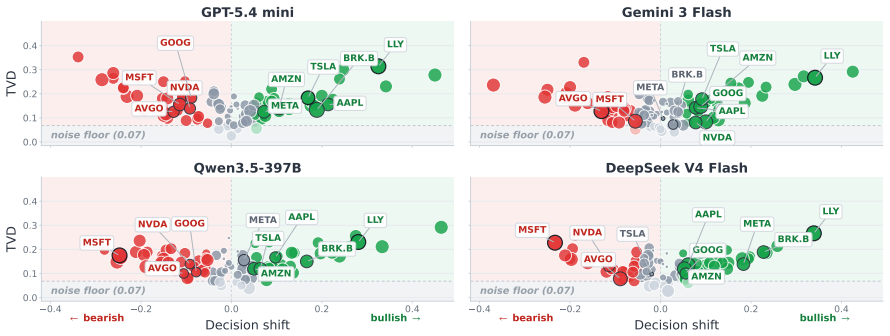
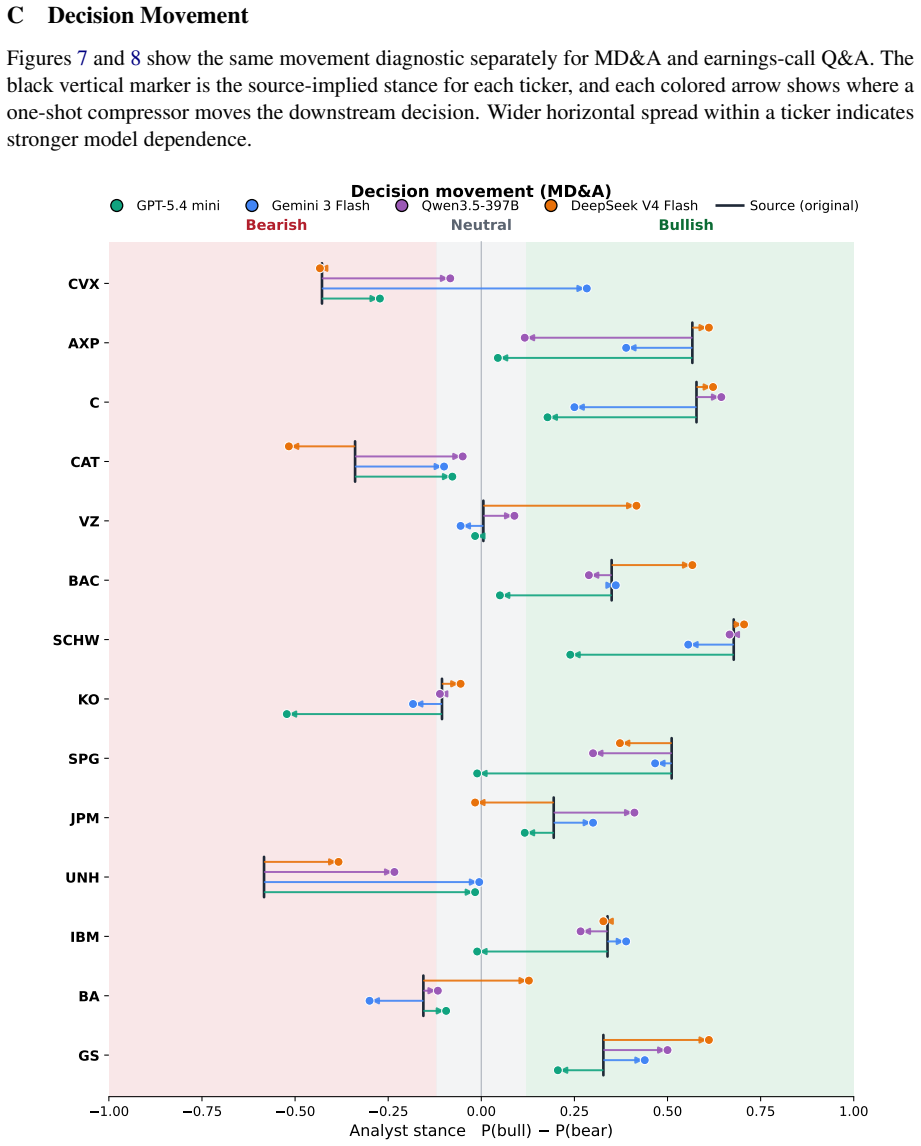
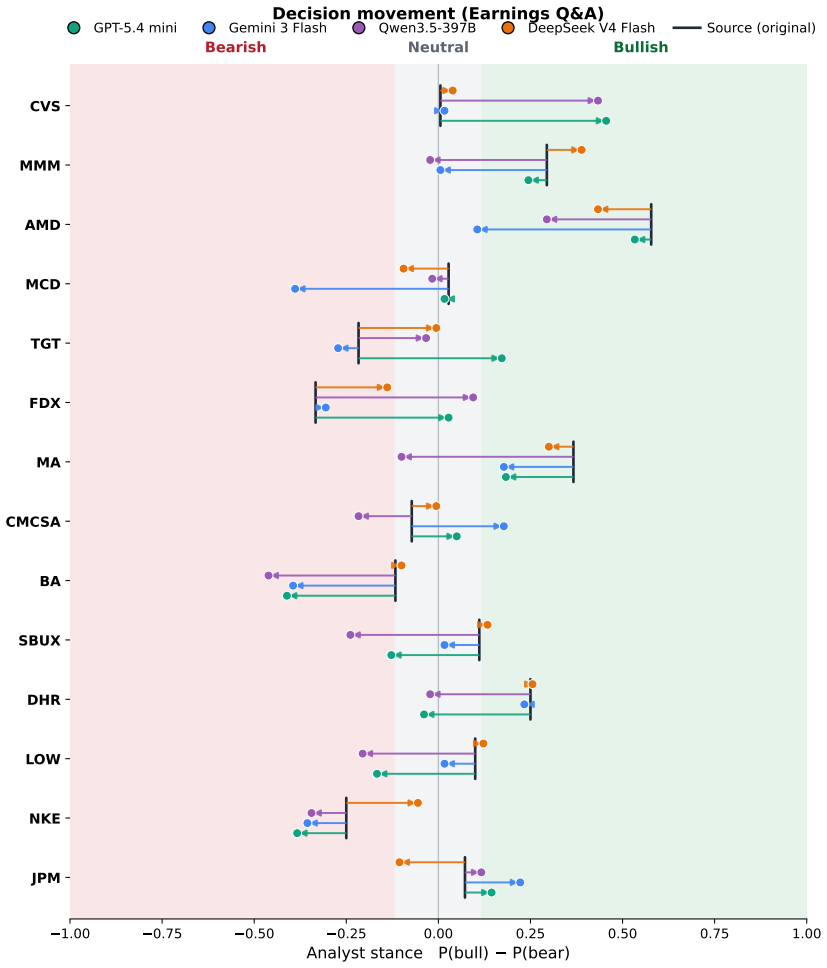
On real S&P 100 quarterly MD&A sections and earnings-call transcripts, one-shot LLM compression under a fixed bullet budget more than doubles decision-flip rates above a no-compression rereading floor, while also shifting belief distributions. The loss is not only random degradation: compressors drop context facts disproportionately and different models tilt the same source in different directions. Agentic Context Compression, which generates multiple contextualized candidates and audits disagreements against short source spans, reduces those flips more than naive prompting, chunking, token pruning, or simple multi-model merging under the same budget.
What carries the argument
Information fidelity: a compression has high fidelity when the decision-model belief it induces stays close to the belief induced by the original source, measured by top-decision flip rate and total variation distance under a fixed budget. Agentic Context Compression carries the fix by generating multiple contextualized candidates, grepping the source for disagreements, and selecting the intact candidate with lower overclaim risk and better source-locus coverage.
Load-bearing premise
The paper treats flips and belief shifts from one three-class LLM decision model as a faithful stand-in for real investment judgment, without human analysts or market outcomes.
What would settle it
Have independent human analysts (or a held-out panel of decision models) read the same original sources and the same compressed bullets under the fixed budget: if excess decision flips vanish relative to rereading noise, or if source-audited multi-candidate selection no longer reduces those flips, the measured fidelity claim fails.
Editorial analysis
A structured set of objections, weighed in public.
Referee Report
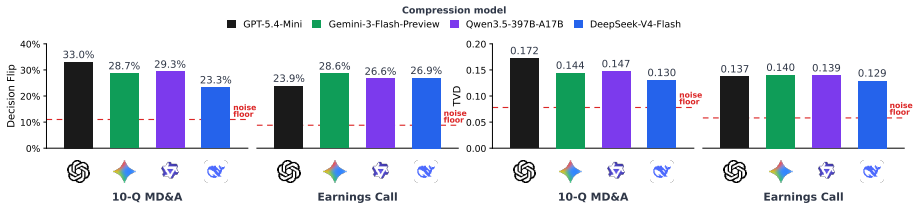
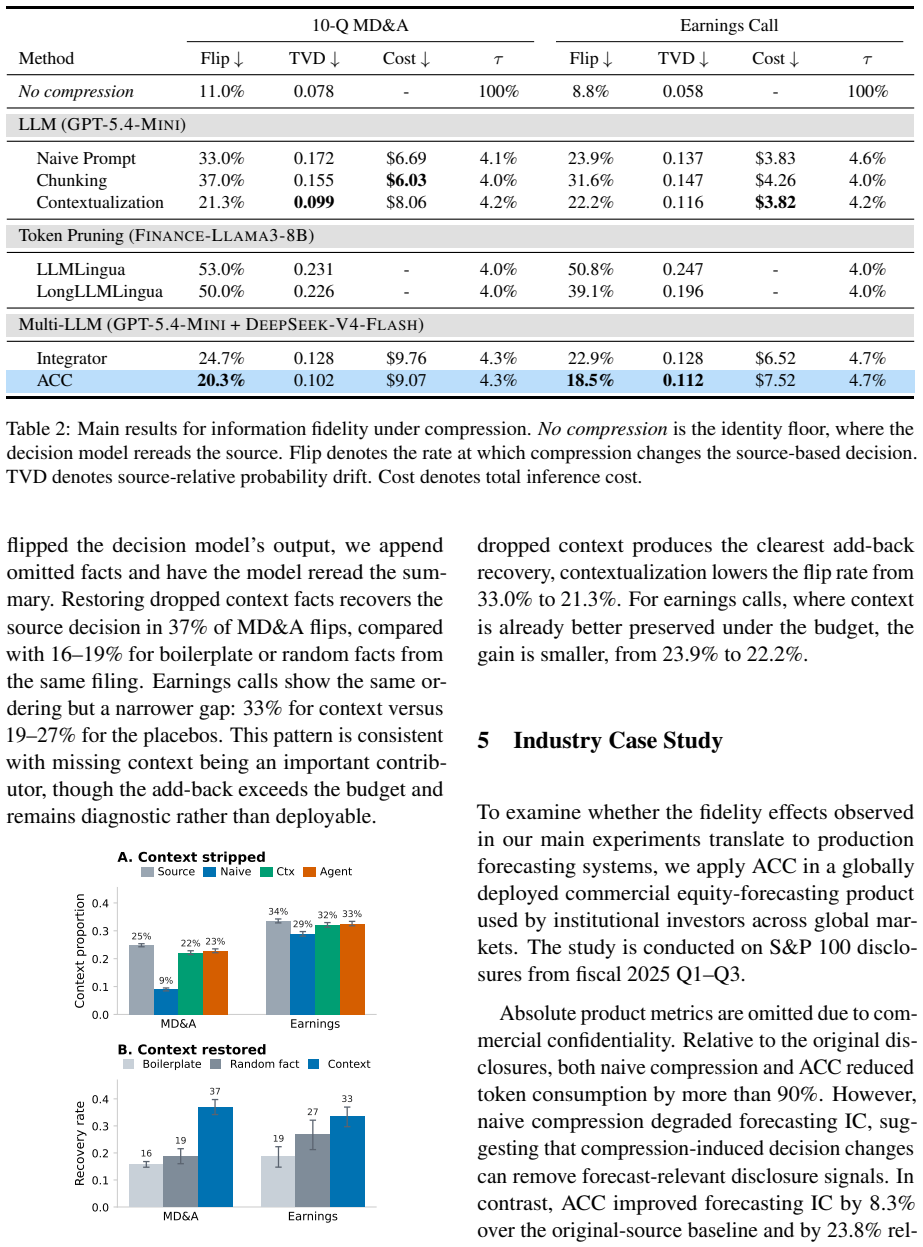
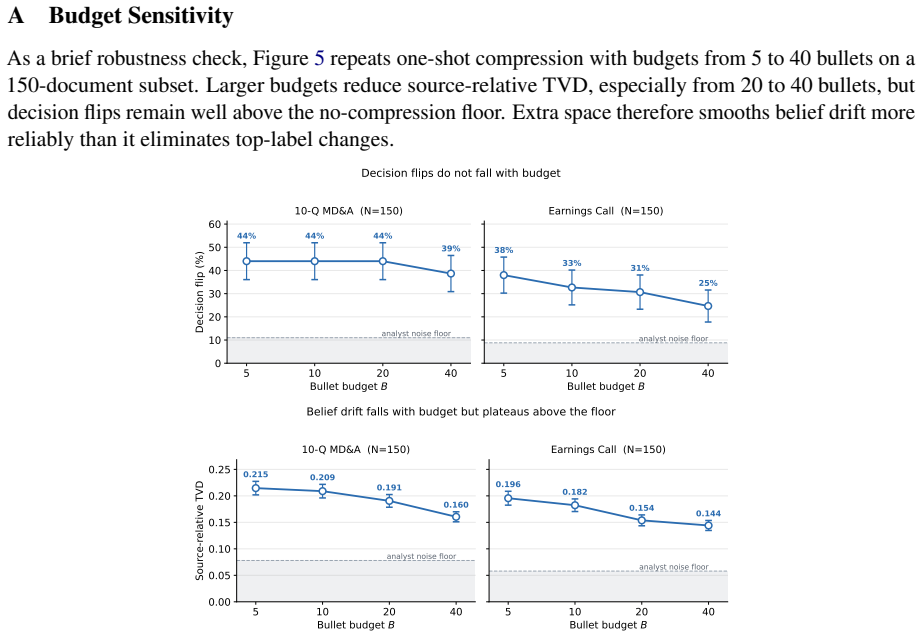
Summary. The paper argues that LLM context compression of financial disclosures can change the investment judgment supported by the original source even when the compressed text remains fluent and factually plausible. It defines information fidelity as source-relative decision preservation, operationalized by Decision Flip rate and total variation distance (TVD) between a fixed decision model’s bear/neutral/bull beliefs on the full source versus the compressed text (Eqs. 2–5). On S&P 100 10-Q MD&A and earnings-call transcripts, one-shot compressors exceed a rereading noise floor; the authors diagnose decontextualization (selective loss of context facts) and model dependency (compressor-specific decision tilts), and propose Agentic Context Compression (ACC), which generates multiple contextualized candidates and audits disagreements against source spans. Under a fixed 20-bullet budget, ACC reduces flips relative to naive and multi-LLM baselines (Table 2), with supporting diagnostics in Figures 2–4 and a commercial forecasting case study.
Significance. If the measured flips largely reflect genuine loss of decision-relevant context rather than judge idiosyncrasy, the paper supplies a useful evaluation criterion for financial and agentic compression that goes beyond reconstruction, factuality, or token efficiency. The experimental design is careful on several dimensions: fixed bullet budget, explicit rereading noise floor, decision-model reliability (Table 1), multiple compressors and baselines including token pruning and an integrator, a fact-role inventory with add-back recovery (Figure 4), and budget-sensitivity checks (Appendix A). ACC is a concrete, source-grounded procedure rather than a purely prompt-level tweak. These elements make the work a credible contribution to high-stakes LLM evaluation and agentic context engineering, provided the decision-proxy assumption is strengthened.
major comments (3)
- Section 3.1 and Eqs. (2)–(5) define information fidelity solely via one decision model E (Gemini-3.1-Flash-Lite) over a three-class next-quarter return regime (prompt D.5). Table 1 establishes re-read stability (self-agreement, Fleiss’ κ), not that E’s top label matches human investment judgment or is independent of compressor families. Because several compressors are frontier LLMs and one is Gemini-family, flips and TVD can partly measure judge–compressor disagreement about which caveats matter rather than source-decision preservation. This is load-bearing for the central claim and for interpreting Table 2 and Figures 2–3. At minimum the paper should (i) re-evaluate a substantial subset with at least one independent judge model and, if feasible, a small human-analyst panel, and (ii) report flip/TVD agreement across judges; otherwise claims should be scoped explicitly as “decision-model
- Section 5 reports that ACC improved forecasting IC by 8.3% over the original-source baseline and 23.8% over naive compression while cutting source-relative flips by 59.5%, with absolute product metrics omitted for confidentiality. These numbers are used to argue real-world relevance of fidelity, but they are non-reproducible and still sit inside a commercial stack that may share modeling choices with the paper’s decision framing. Either provide a reproducible public proxy (e.g., open IC-style evaluation on the same S&P 100 panel with a fixed forecasting head) or move the case study to a clearly labeled anecdotal appendix and avoid quantitative claims that cannot be audited.
- Figure 4B’s add-back diagnostic is important evidence that missing context facts drive flips, but restored context exceeds the fixed budget B that defines the compression task (Eq. 1). The main ACC gains in Table 2 are therefore only partially explained by the decontextualization mechanism under the same constraint that the method must satisfy. The paper should either (a) run a budget-respecting recovery/selection ablation (e.g., swap in context facts while dropping lower-value bullets) or (b) clearly separate the diagnostic from the deployable claim and quantify how much of ACC’s flip reduction is attributable to better context retention within B versus multi-model adjudication.
minor comments (5)
- Figure 2 caption and text refer to a “noise floor” of 11.0%/8.8% flips, while Table 2’s “No compression” row reports the same quantities with TVD; keep notation and naming identical across figure and table.
- In Section 3.2, “Contextualization” is described as revisiting the source when candidates miss interpretive detail, but the boxed prompt D.2 is a single-pass instruction; clarify whether multi-pass selection is actually implemented or only aspirational.
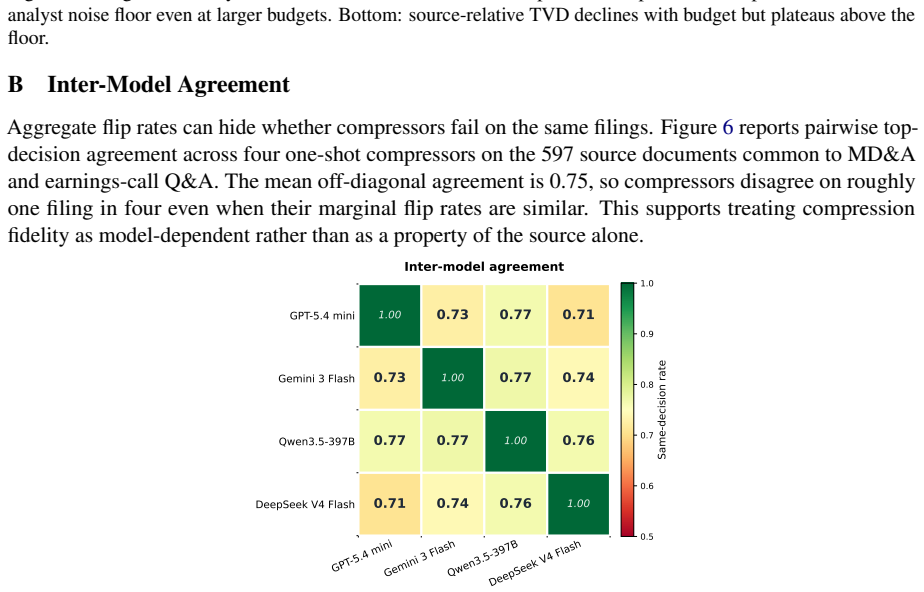
- Appendix B reports mean off-diagonal inter-compressor agreement of 0.75; stating N and whether agreement is on induced decisions after compression (as the caption suggests) versus on raw labels would help readers interpret model dependency.
- Cost columns in Table 2 are useful but units and pricing assumptions are unspecified; a short note on model APIs and date would improve reproducibility of the efficiency comparison.
- Typos/style: abstract and introduction use “information fidelity” consistently, but occasional phrasing such as “its loss” (Section 3.1) has an unclear antecedent; a light copy-edit pass would help.
Circularity Check
Empirical methods paper: Flip/TVD and ACC results are measured, not forced by construction or self-citation.
full rationale
This paper defines information fidelity operationally (source-relative decision preservation via Flip and TVD under a fixed decision model E), then measures compression methods on real 10-Q MD&A and earnings-call data. That is metric definition plus experiment, not a derivation that reduces a claimed prediction to its inputs. Flip (Eq. 4) and TVD (Eq. 5) compare independent reads of source vs compressed text; the no-compression re-read floor and Table 1 self-agreement only bound judge noise, they do not force method rankings. ACC selects among candidates by source-span overclaim risk and locus coverage and is instructed not to use decision labels or probabilities, so its lower flip rates in Table 2 are not tautological. Contextualization is deliberately aimed at decision-relevant framing, but that is objective design under a fixed budget, not a fitted parameter renamed as prediction. Self-citations (e.g. Lee et al. 2025, Kong et al. 2026) motivate model bias and evaluation concerns; they are not uniqueness theorems or load-bearing premises that forbid alternatives. No self-definitional loop, fitted-input-as-prediction, ansatz-via-citation, or renaming of a known result as a first-principles claim appears in the derivation chain. Validity concerns about E as a proxy for human judgment belong outside circularity.
Axiom & Free-Parameter Ledger
free parameters (4)
- bullet budget B =
20
- decision-model averaging runs R =
3
- next-quarter return regime thresholds =
±5%
- ACC agent minimum source checks =
≥4
axioms (4)
- ad hoc to paper A compressed context has high information fidelity iff the decision-model belief it induces stays close to the belief induced by the full source (top-label flip and TVD).
- domain assumption An LLM decision model reading only the provided disclosure (no prices, priors, or external knowledge) is an adequate proxy for the investment judgment that should be preserved.
- domain assumption Atomic facts can be role-labeled as headline, context, or boilerplate such that context facts are the decision-calibrating caveats/offsets/comparisons.
- standard math Standard LLM API sampling and prompt-following behavior is stable enough that multi-run averages and cross-model comparisons are meaningful.
invented entities (3)
-
information fidelity (decision-preserving compression criterion)
no independent evidence
-
Agentic Context Compression (ACC)
no independent evidence
-
decontextualization diagnostic (headline vs context fact stripping)
no independent evidence
read the original abstract
Financial decision-makers face more information than they can directly inspect, making context compression necessary. Yet when large language models (LLMs) compress financial source material, they can alter the investment judgment supported by the original source. We frame this problem as information fidelity: compression loses fidelity when it changes the decision induced by the source. In agentic systems, such losses may recur across intermediate steps and amplify throughout the decision process. Across financial filings and earnings-call transcripts, we find that LLM-based compression can produce fluent and factually plausible compressed contexts that nevertheless alter downstream decisions. We analyze two diagnostic patterns associated with fidelity loss: decontextualization, where salient evidence is retained but separated from the caveats and contextual qualifiers needed for correct interpretation, and model dependency, where different compressors expose different views of the same source. We then propose Agentic Context Compression, which generates multiple candidate compressions and audits their disagreements against the original source. Our results suggest that financial compression should be evaluated not only by efficiency or factuality, but also by its ability to preserve decision-relevant context.
Figures

Forward citations
Cited by 1 Pith paper
-
Where Facts Go Missing: A Layerwise Taxonomy and Per-Layer Attribution of Information Omission in Air-Gapped LLMAgent Pipelines
In a controlled 75,476-trial stress test, about 73% of omitted-fact failures in LLM agent pipelines are traced to deterministic middleware (redaction, pagination, truncation) rather than model behavior.
Reference graph
Works this paper leans on
-
[1]
LongLLMLingua: Accelerating and enhanc- ing LLMs in long context scenarios via prompt com- pression. InProceedings of the 62nd Annual Meeting of the Association for Computational Linguistics (Vol- ume 1: Long Papers), pages 1658–1677, Bangkok, Thailand. Association for Computational Linguistics. Minki Kang, Wei-Ning Chen, Dongge Han, Huseyin A. Inan, Luka...
Pith/arXiv arXiv 2025
-
[2]
Weronika Łajewska, Momchil Hardalov, Laura Aina, Neha Anna John, Hang Su, and Lluís Màrquez
LLMs Corrupt Your Documents When You Delegate.Preprint, arXiv:2604.15597. Weronika Łajewska, Momchil Hardalov, Laura Aina, Neha Anna John, Hang Su, and Lluís Màrquez. 2025. Understanding and Improving Information Preserva- tion in Prompt Compression for LLMs.Preprint, arXiv:2503.19114. Hoyoung Lee, Junhyuk Seo, Suhwan Park, Junhyeong Lee, Wonbin Ahn, Chan...
Pith/arXiv arXiv 2025
-
[3]
EDGAR-CRAWLER: From Raw Web Doc- uments to Structured Financial NLP Datasets. In Companion Proceedings of the ACM on Web Confer- ence 2025, WWW ’25, pages 761–764, New York, NY , USA. Association for Computing Machinery. Kawin Mayilvaghanan, Siddhant Gupta, and Ayush Kumar. 2025. Spot the BlindSpots: Systematic Identification and Quantification of Fine-Gr...
Pith/arXiv arXiv 2025
-
[4]
In2024 IEEE International Conference on Big Data, pages 6614–6623
Evaluating Company-specific Biases in Fi- nancial Sentiment Analysis using Large Language Models. In2024 IEEE International Conference on Big Data, pages 6614–6623. IEEE. Yucheng Ning, Xixun Lin, Fang Fang, and Yanan Cao
-
[5]
MAD-Fact: A Multi-Agent Debate Frame- work for Long-Form Factuality Evaluation in LLMs. Preprint, arXiv:2510.22967. Valeria Pastorino and Nafise Sadat Moosavi. 2025. Frame In, Frame Out: Measuring Framing Bias in LLM-Generated News Summaries.Preprint, arXiv:2505.05406. Uwe Peters and Benjamin Chin-Yee. 2025. Generaliza- tion Bias in Large Language Model S...
arXiv 2025
-
[6]
Long-form Factuality in Large Language Mod- els. InAdvances in Neural Information Processing Systems. Qizheng Zhang, Changran Hu, Shubhangi Upasani, Boyuan Ma, Fenglu Hong, Vamsidhar Kamanuru, Jay Rainton, Chen Wu, Mengmeng Ji, Hanchen Li, Ur- mish Thakker, James Zou, and Kunle Olukotun. 2026. Agentic context engineering: Evolving contexts for self-improv...
Pith/arXiv arXiv 2026
-
[7]
If a fact contains both a headline result and a qualifier that changes how the result should be read, choose "context"
-
[8]
headline
If it is a standalone KPI/result/metric/guidance/capital-allocation fact, choose "headline"
-
[9]
boilerplate
If it is generic, procedural, definitional, or only broadly relevant, choose "boilerplate". Output exactly one JSON object and no prose: {"labels": [{"fact_id": 0, "role": "<headline|context|boilerplate>", "context_function": "<none|caveat|offset|comparison| expectation_framing|causal_driver|timing_durability|scope_magnitude|risk_condition>", "target_head...
discussion (0)
Sign in with ORCID, Apple, or X to comment. Anyone can read and Pith papers without signing in.