REVIEW 4 major objections 3 cited by
Hallucinations in vision-language models arise when feed-forward layers inject language priors that override visual evidence gathered by attention, and attenuating those layers at inference reduces the errors.
Reviewed by Pith at T0; open to challenge. T0 means a machine referee read the full paper against a public rubric. the ladder, T0–T4 →
T0 review · grok-4.5
2026-07-12 10:57 UTC pith:N22IRFYJ
load-bearing objection Clean single-pass FFN attenuation that works, but the language-prior story is still correlational and the gains shrink on stronger models. the 4 major comments →
FADE: Mitigating Hallucinations by Reducing Language-Prior Dominance in Large Vision-Language Models
The pith
A machine-rendered reading of the paper's core claim, the machinery that carries it, and where it could break.
Core claim
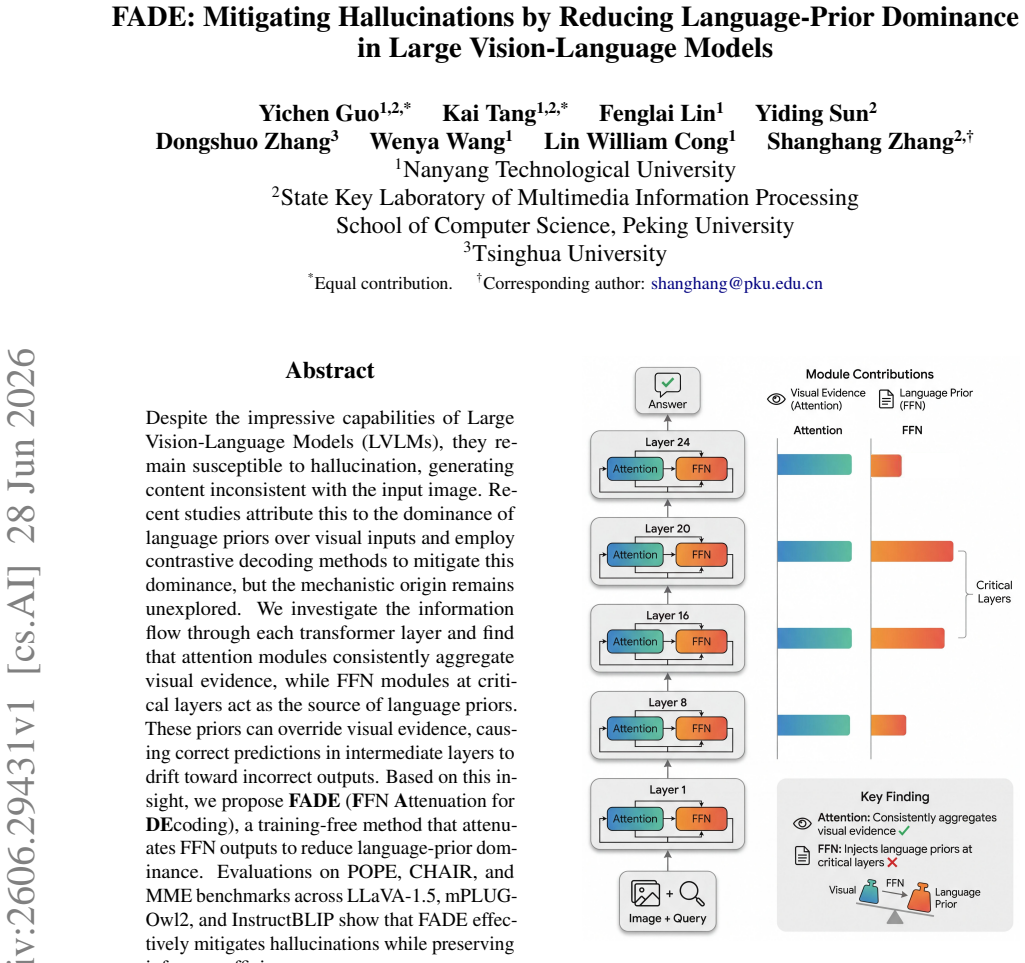
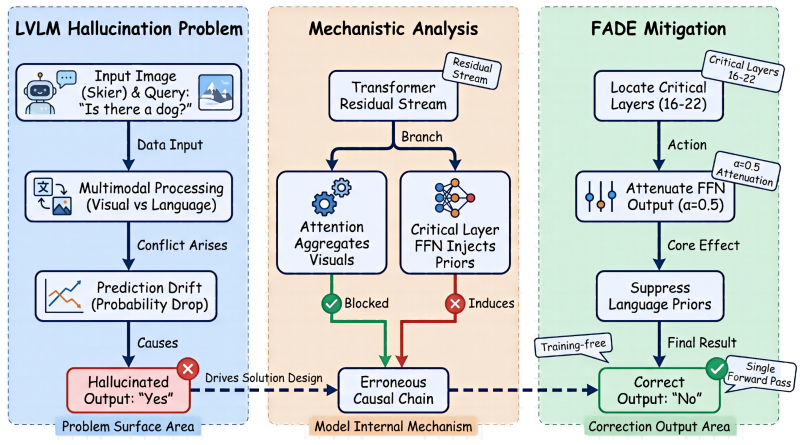
Across transformer layers of LVLMs, attention consistently aggregates visual evidence toward correct answers, while FFN modules at a critical mid-to-late band are the source of language priors that can override that evidence and produce the observed late-layer prediction drift; therefore attenuating only those FFN outputs reduces language-prior dominance and mitigates hallucination.
What carries the argument
FADE (FFN Attenuation for Decoding): at selected critical layers, replace the residual update h ← h̃ + FFN(h̃) with h ← h̃ + (1−α)·FFN(h̃), a single scalar scale applied only at those layers in one forward pass.
Load-bearing premise
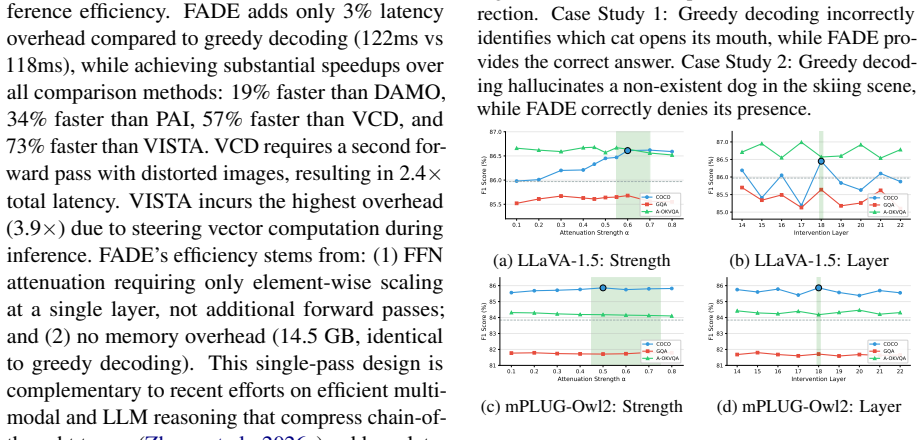
The critical-layer band found by a small differential-logit analysis on one 7B model, and a single attenuation strength, can be transferred by proportional mapping to other architectures and tasks without wiping out useful knowledge stored in the same feed-forward layers.
What would settle it
If, on a held-out set of hallucinated versus correct samples, attenuating the claimed critical FFN layers either fails to reverse the late-layer drop in correct-token probability or produces larger hallucination rates than leaving those layers alone while attenuating earlier or later layers, the central mechanism claim fails.
Editorial analysis
A structured set of objections, weighed in public.
Referee Report
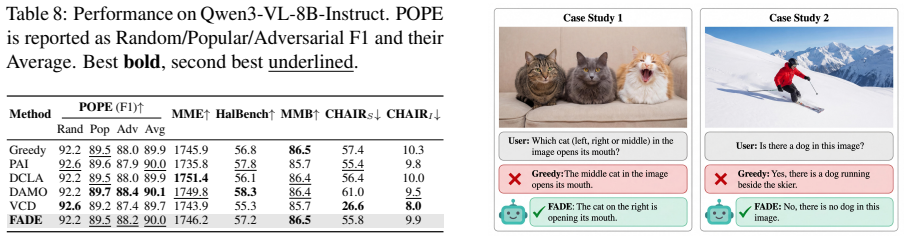
Summary. The paper argues that LVLM hallucinations arise because attention modules consistently aggregate visual evidence toward correct answers while FFN modules at critical mid-to-late layers inject language priors that can override that evidence, producing prediction drift. Using residual-stream decompositions and a differential logit-lens correct-direction metric on LLaVA-1.5-7B, the authors identify layers 16–22 as the critical band. They propose FADE, a training-free intervention that multiplies FFN outputs by (1−α) at selected layers (Eq. 5), and evaluate it on POPE, CHAIR, MME, MMHal-Bench and related suites across LLaVA-1.5 (7B/13B), mPLUG-Owl2, InstructBLIP, InternVL3-8B and Qwen2.5/3-VL. FADE is frequently best or second-best among training-free baselines, with only ~3% latency overhead.
Significance. If the mechanistic story holds, the paper supplies a more targeted account of language-prior dominance than output-level contrastive decoding and motivates a single-pass, architecture-agnostic fix with clear efficiency advantages (Table 9). The empirical method is practical, code is released, and evaluation spans multiple architectures and six benchmarks—including open-ended MMHal-Bench and next-generation models—which is a genuine strength relative to many training-free hallucination papers. Even if the language-prior attribution is only partially correct, a simple FFN attenuation recipe that preserves general capability would still be useful to practitioners.
major comments (4)
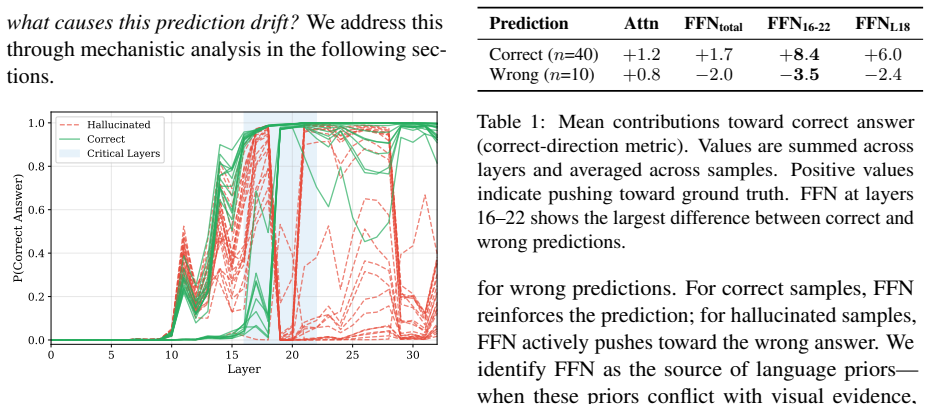
- §3.3, Table 1 and Eqs. (3)–(4): The causal claim that FFN modules are the source of language priors rests on a differential logit-lens analysis of only 50 POPE-Adversarial samples of LLaVA-1.5-7B. C^(l) is positive for attention on both correct and wrong samples and negative for FFN on wrong samples, but this is correlational: the metric does not establish that the FFN contribution is language-prior content rather than any residual update that happens to point the wrong way. Without an isolation experiment (e.g., swapping or ablating FFN vs. attention residuals, or intervening on language-only vs. vision-language inputs at the same layers), the mechanistic origin claim that frames the paper remains suggestive rather than demonstrated.
- §3.4 and Appendix D: Critical-layer transfer is asserted via proportional mid-to-late mapping (e.g., L18 on 32-layer 7B → L34 on 40-layer 13B), yet optimal layers and α vary substantially by task and architecture—POPE prefers α≈0.5–0.7 at mid-late layers, CHAIR prefers α=1.0 at L20, MME requires α=0.02–0.05 and sometimes early layers (Appendix B, Tables 14–18). This undermines the claim of a stable, architecture-agnostic critical band and makes FADE look closer to per-task hyperparameter search than a single mechanistic intervention. A controlled transfer protocol (fix layers from analysis only, freeze α, report zero-shot transfer) is needed to support the central narrative.
- §3.1–3.4 and Limitations: The paper notes that FFNs store factual knowledge (Geva et al., 2021; Meng et al., 2022) yet does not test whether attenuating the same critical FFNs degrades useful non-visual knowledge or closed-book factual recall. Given that MME cognition and open-ended generation are sensitive to α, a load-bearing check is missing: measure knowledge/VQA degradation under the same α/layer settings used for hallucination mitigation. Without this, the claim that FADE “preserves visual evidence while suppressing language priors” is incomplete.
- Tables 2–8: Gains are often small (≈0.5–2 F1 on POPE; mixed CHAIR/MME results) and sometimes FADE is only second-best or tied with greedy on stronger models (Qwen2.5/3-VL, InternVL3). The abstract and contribution bullets overstate “effective mitigation” relative to the effect sizes. Please report statistical significance or bootstrap intervals on the main tables and temper claims where improvements are within noise of greedy decoding.
Circularity Check
No definitional or constructional circularity: mechanistic analysis motivates FADE; reported gains are measured on external benchmarks independent of the 50-sample decomposition.
full rationale
The paper's derivation chain is observational then interventional, not self-definitional. Prediction drift (Fig. 3) and the differential logit-lens decomposition (Eqs. 3–4, Table 1) on 50 POPE-Adversarial samples of LLaVA-1.5-7B motivate identifying mid-to-late FFN layers as the intervention site; FADE then scales those FFN outputs by (1−α) (Eq. 5). Success is scored on held-out POPE/CHAIR/MME (and further models) metrics that are not algebraic rearrangements of the 50-sample C^(l) statistics, nor of the fitted α. Hyperparameter choice (layer band, α) is ordinary selection on the evaluation suite—selection bias, not a fitted input renamed as a prediction. Citations for residual-stream and logit-lens methodology (Elhage et al., Geva et al., Belrose et al.) are external and not load-bearing uniqueness claims by the same authors. No equation reduces a reported F1/CHAIR/MME number to a constant fixed by construction. The skeptic's concern that the FFN contribution is correlational rather than proven 'language prior' content is a correctness/mechanism issue, not circularity. Score 0 with empty steps is therefore the honest finding.
Axiom & Free-Parameter Ledger
free parameters (2)
- attenuation strength α =
0.6 (POPE LLaVA), 1.0 (CHAIR), 0.02 (MME), etc.
- critical layer indices =
layers 16–22 band; typically layer 18 (POPE) or 20 (CHAIR)
axioms (4)
- domain assumption Residual-stream decomposition: each layer’s contribution can be isolated as Attn then FFN additions to the residual (Elhage et al. 2021).
- domain assumption Differential logit-lens projections faithfully measure each component’s push toward correct vs incorrect tokens.
- domain assumption FFN layers function as key-value memories that can store and inject language priors (Geva et al. 2021; Meng et al. 2022).
- ad hoc to paper Proportional mid-to-late layer mapping transfers the critical band across architectures of different depth.
invented entities (2)
-
critical-layer band (layers 16–22 / proportional equivalents)
no independent evidence
-
FADE (FFN Attenuation for Decoding)
independent evidence
read the original abstract
Despite the impressive capabilities of Large Vision-Language Models (LVLMs), they remain susceptible to hallucination, generating content inconsistent with the input image. Recent studies attribute this to the dominance of language priors over visual inputs and employ contrastive decoding methods to mitigate this dominance, but the mechanistic origin remains unexplored. We investigate the information flow through each transformer layer and find that attention modules consistently aggregate visual evidence, while FFN modules at critical layers act as the source of language priors. These priors can override visual evidence, causing correct predictions in intermediate layers to drift toward incorrect outputs. Based on this insight, we propose FADE (FFN Attenuation for DEcoding), a training-free method that attenuates FFN outputs to reduce language-prior dominance. Evaluations on POPE, CHAIR, and MME benchmarks across LLaVA-1.5, mPLUG-Owl2, and InstructBLIP show that FADE effectively mitigates hallucinations while preserving inference efficiency.
Figures
Forward citations
Cited by 3 Pith papers
-
SPARK: Susceptibility-Guided Profiling and Steering of Latent Reasoning States in Large Language Models
Length-controlled hidden-state susceptibility diagnoses under-activated reasoning in LLMs and guides selective test-time steering that lifts MATH-500 accuracy by roughly 2–3 points.
-
SeeMe: Mitigating Hallucinations in Large Vision-Language Models through Effective Visual Token Engineering
Restructuring visual tokens via cross-modal prune–merge–refine consistently lowers hallucination rates on MME, POPE and AMBER across four 7B LVLMs without any training.
-
Better Starts, Better Ends: Bootstrapped Iterative Self-Reasoning Distillation for Compressed Reasoning
Warm-starting on-policy self-distillation with a correctness-filtered, prompt-switched SFT bootstrap improves compression and accuracy of reasoning traces across math benchmarks.
Reference graph
Works this paper leans on
-
[1]
Hallucination of multimodal large language models: A survey.Preprint, arXiv:2404.18930. Nora Belrose, Igor Ostrovsky, Lev McKinney, Zach Fur- man, Logan Smith, Danny Halawi, Stella Biderman, and Jacob Steinhardt. 2023. Eliciting latent predic- tions from transformers with the tuned lens.arXiv preprint arXiv:2303.08112. Yen-Chun Chen, Linjie Li, Licheng Yu...
Pith/arXiv arXiv 2023
-
[2]
Advances in Neural Information Processing Systems, 37:133571–133599
Code: Contrasting self-generated description to combat hallucination in large multi-modal models. Advances in Neural Information Processing Systems, 37:133571–133599. Sicong Leng, Hang Zhang, Guanzheng Chen, Xin Li, Shijian Lu, Chunyan Miao, and Lidong Bing
-
[3]
Mitigating object hallucinations in large vision- language models through visual contrastive decod- ing. InProceedings of the IEEE/CVF Conference on Computer Vision and Pattern Recognition, pages 13872–13882. Chenxi Li, Yichen Guo, Benfang Qian, Jinhao You, Kai Tang, Yaosong Du, Zonghao Zhang, and Xiande Huang. 2025a. Map: Mitigating hallucinations in lar...
arXiv 2022
-
[4]
Intervene-all-paths: Unified mitigation of lvlm hallucinations across alignment formats.Preprint, arXiv:2511.17254. Alec Radford, Jong Wook Kim, Chris Hallacy, Aditya Ramesh, Gabriel Goh, Sandhini Agarwal, Girish Sas- try, Amanda Askell, Pamela Mishkin, Jack Clark, and 1 others. 2021. Learning transferable visual models from natural language supervision. ...
arXiv 2021
-
[5]
InFindings of the Association for Computational Linguistics: ACL 2024, pages 13088–13110
Aligning large multimodal models with factu- ally augmented rlhf. InFindings of the Association for Computational Linguistics: ACL 2024, pages 13088–13110. Zhongxiang Sun, Xiaoxue Zang, Kai Zheng, Jun Xu, Xiao Zhang, Weijie Yu, Yang Song, and Han Li
2024
-
[6]
InInternational Conference on Learning Repre- sentations, volume 2025, pages 50250–50279
Redeep: Detecting hallucination in retrieval- augmented generation via mechanistic interpretabil- ity. InInternational Conference on Learning Repre- sentations, volume 2025, pages 50250–50279. Kai Tang, Jinhao You, Xiuqi Ge, Hanze Li, Yichen Guo, and Xiande Huang. 2025. Mitigating hallucinations via inter-layer consistency aggregation in large vision- lan...
Pith/arXiv arXiv 2025
-
[7]
mplug-owl2: Revolutionizing multi-modal large language model with modality collaboration. In Proceedings of the ieee/cvf conference on computer vision and pattern recognition, pages 13040–13051. Tianyu Yu, Yuan Yao, Haoye Zhang, Taiwen He, Yifeng Han, Ganqu Cui, Jinyi Hu, Zhiyuan Liu, Hai-Tao Zheng, Maosong Sun, and 1 others. 2024. Rlhf-v: Towards trustwo...
arXiv 2024
discussion (0)
Sign in with ORCID, Apple, or X to comment. Anyone can read and Pith papers without signing in.