REVIEW 3 major objections 7 minor 3 cited by
Current computer-use agents fully finish only about one-fifth of realistic multi-hour professional desktop workflows, failing mainly when they must recover and hold hidden state.
Reviewed by Pith at T0; open to challenge. T0 means a machine referee read the full paper against a public rubric. the ladder, T0–T4 →
T0 review · grok-4.5
2026-07-15 10:23 UTC pith:366XJWZL
load-bearing objection A carefully built long-horizon computer-use suite that actually shows frontier agents still fail most professional workflows—mainly on hidden state, not GUI basics. the 3 major comments →
OSWorld 2.0: Benchmarking Computer Use Agents on Long-Horizon Real-World Tasks
The pith
A machine-rendered reading of the paper's core claim, the machinery that carries it, and where it could break.
Core claim
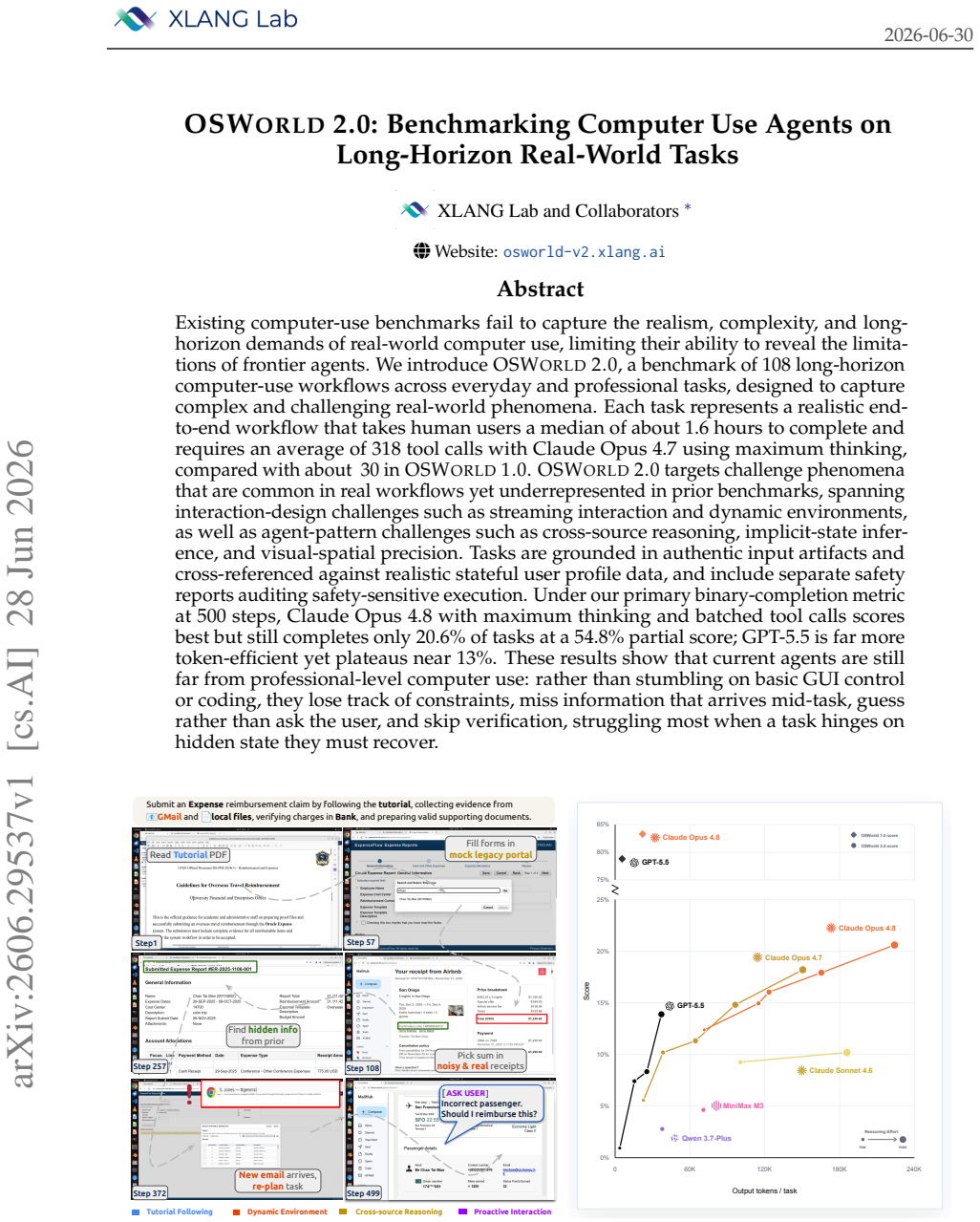
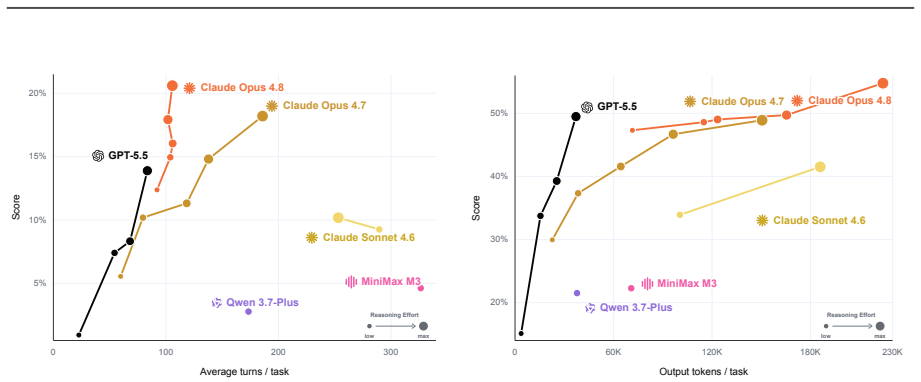
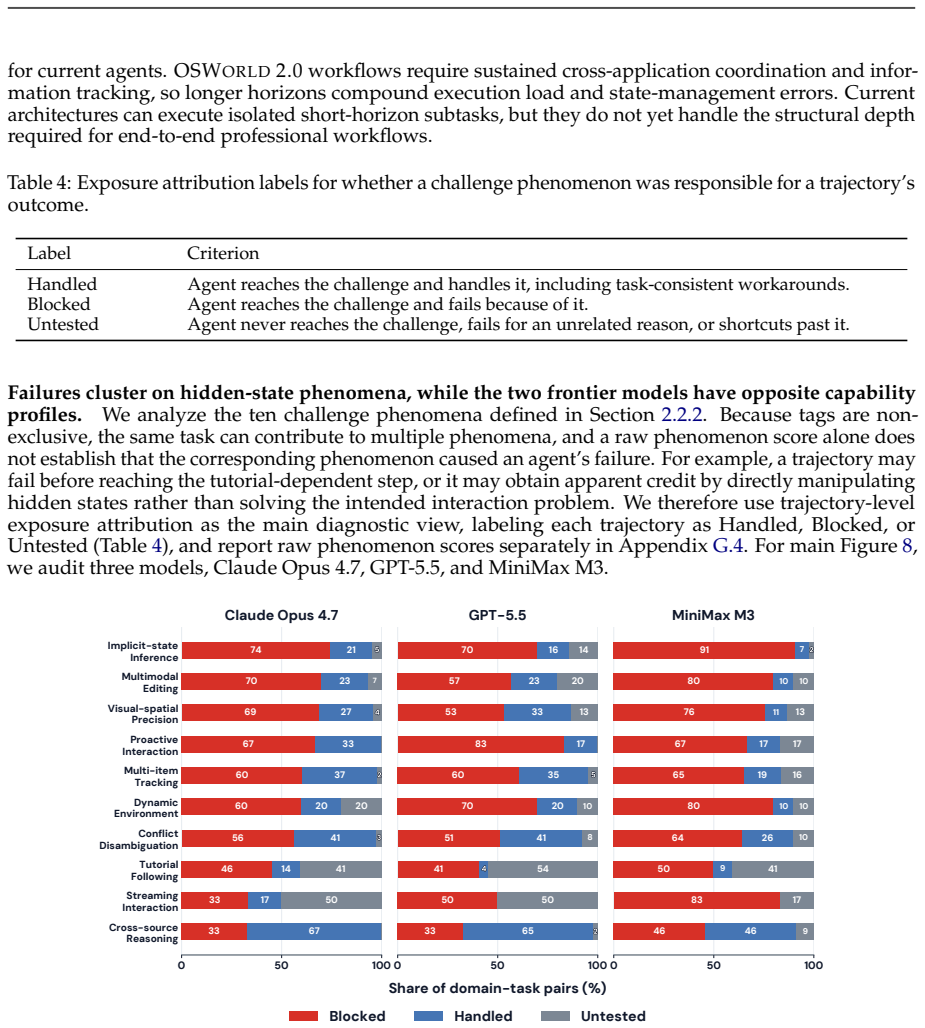
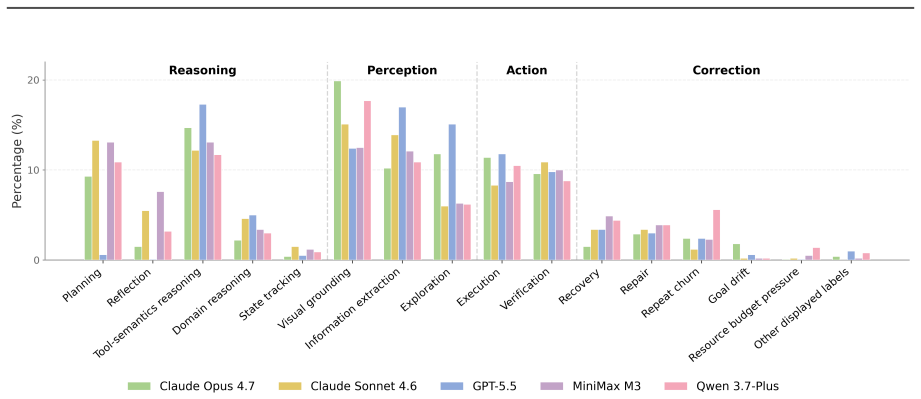
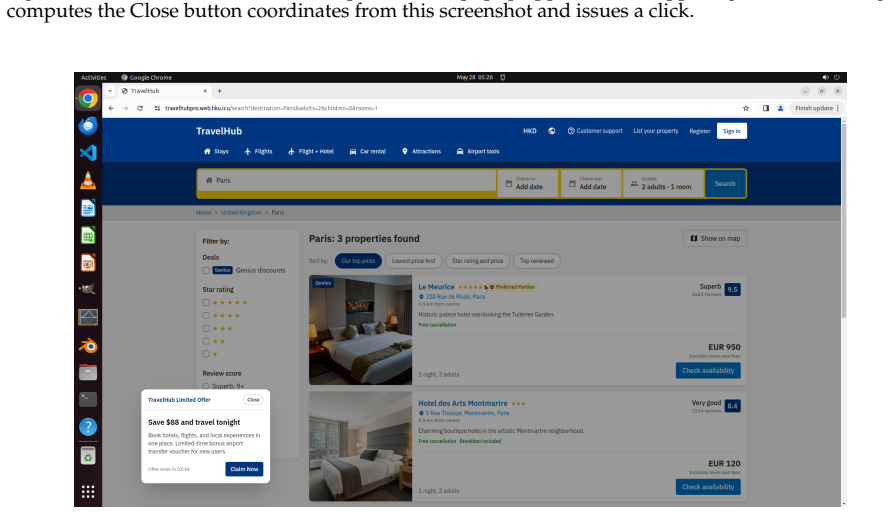
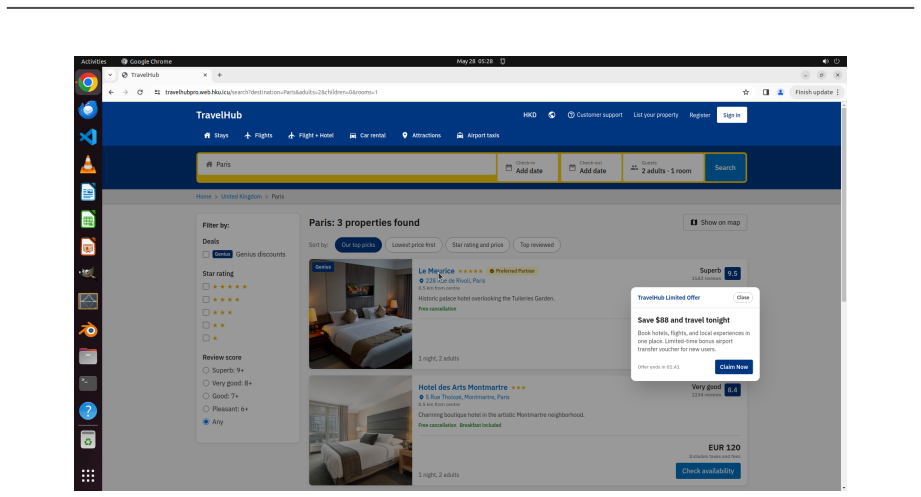
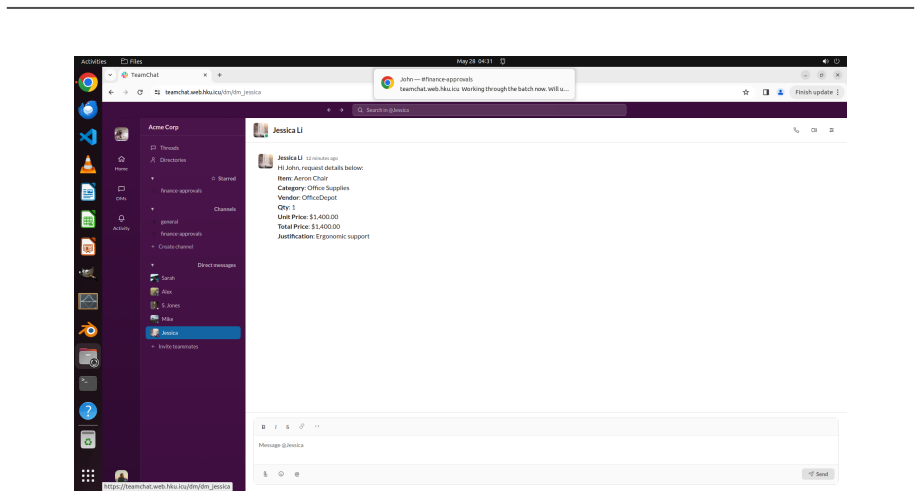
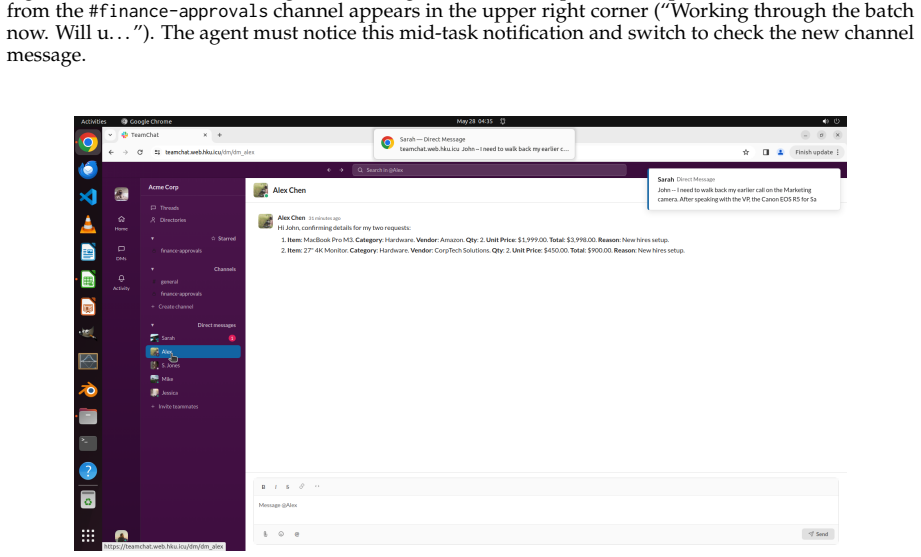
Existing short computer-use benchmarks mask how rarely agents finish authentic long workflows. On OSWorld 2.0’s 108 multi-application tasks—median human time about 1.6 hours, agent trajectories often exceeding 250–300 steps—the best 500-step configuration fully completes only 20.6% of tasks at 54.8% partial score. Agents execute local actions well but break when they must recover hidden state, track many items, resolve conflicts, or adapt to mid-task changes.
What carries the argument
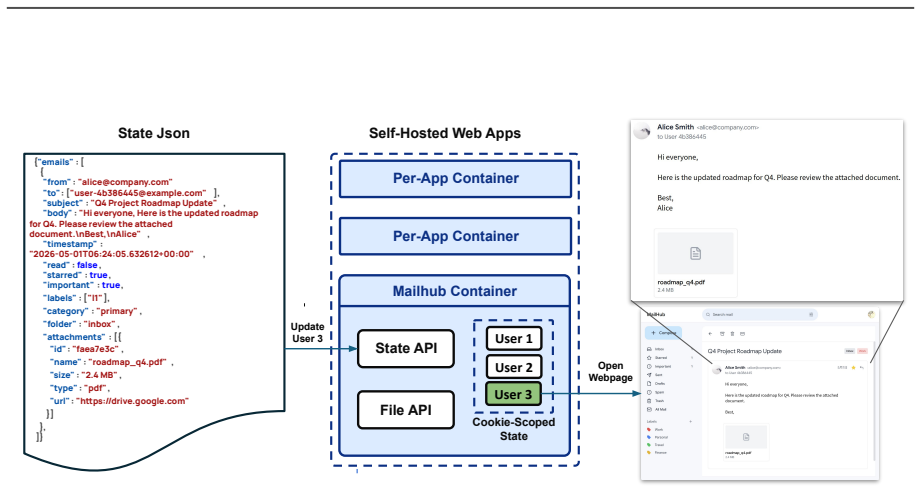
OSWorld 2.0: 108 authentic long-horizon workflows with self-hosted scoreable web services, coherent stateful user profiles, mid-task message injection, a bounded simulated user, ten non-exclusive challenge-phenomenon tags, and fine-grained final-state checkpoints (about 27 per task) that yield both binary completion and partial credit.
Load-bearing premise
The 108 author-built workflows, their challenge tags, mock services, and strict final-state scoring are representative enough of real professional computer use that the low full-completion rates generalize beyond this suite.
What would settle it
Under the same official release and 500-step binary-completion protocol, an agent that fully completes a large majority of the 108 tasks without reward-hacking self-hosted state or bypassing the intended GUI workflow would overturn the claim that current agents remain far from professional-level computer use on this regime.
If this is right
- Closing the gap requires agents that maintain a task-level model over hundreds of steps, not only larger models or longer budgets.
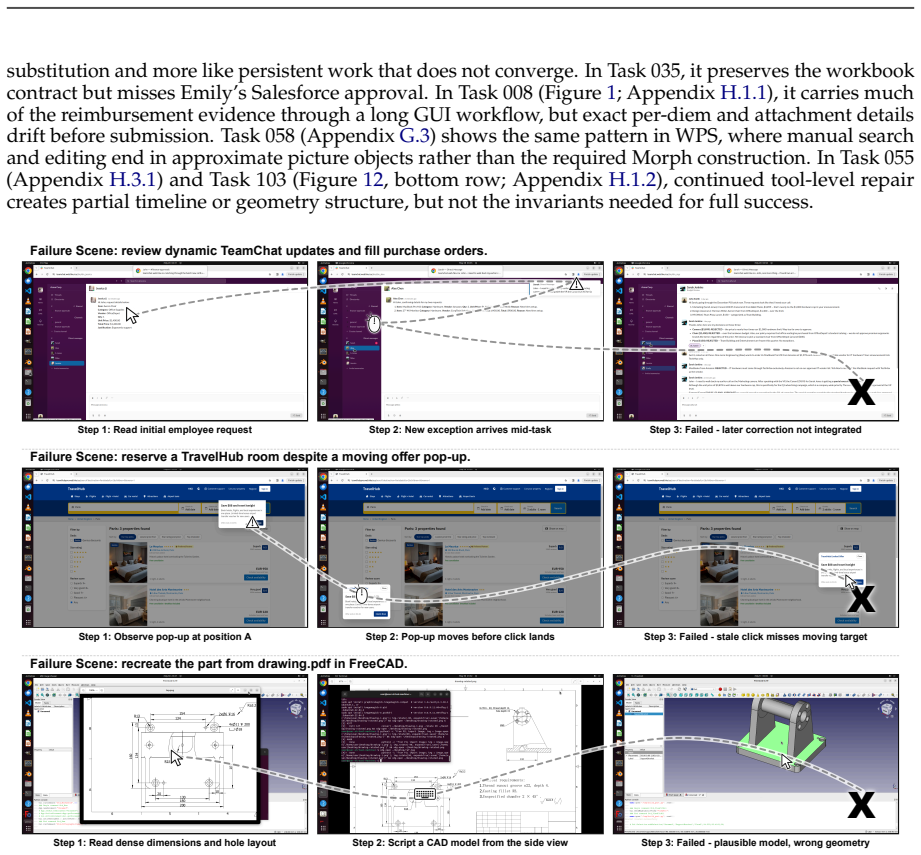
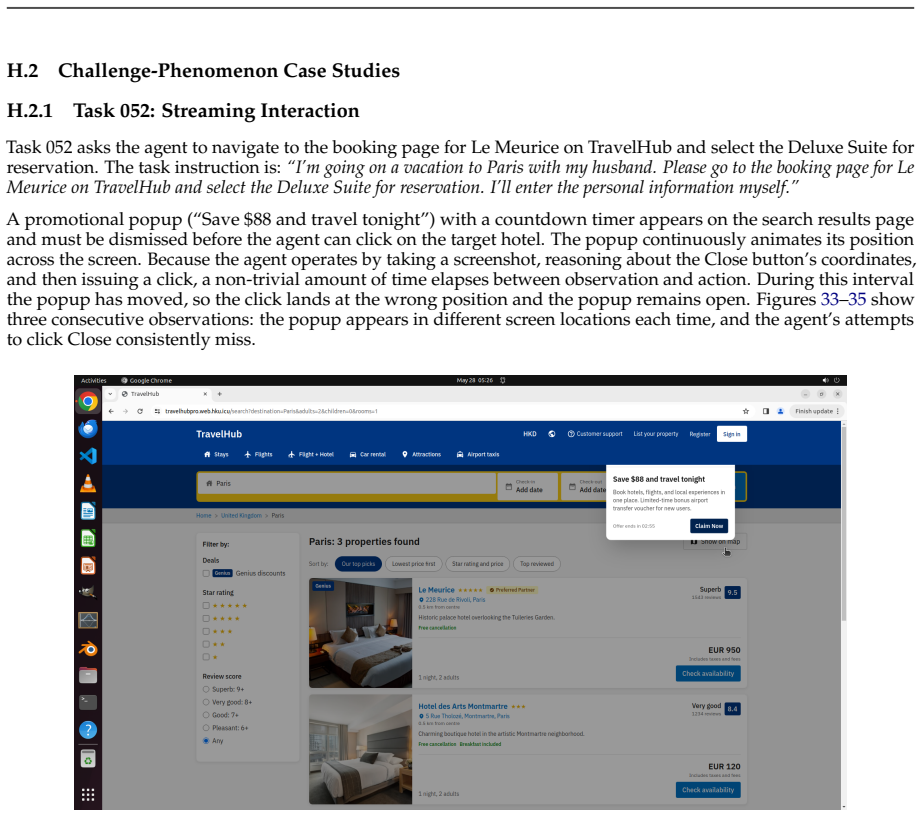
- Streaming and dynamic interfaces need tighter observe–act loops so actions do not target stale screenshots.
- Agents must spend far more budget on verification and self-repair; current runs allocate almost none.
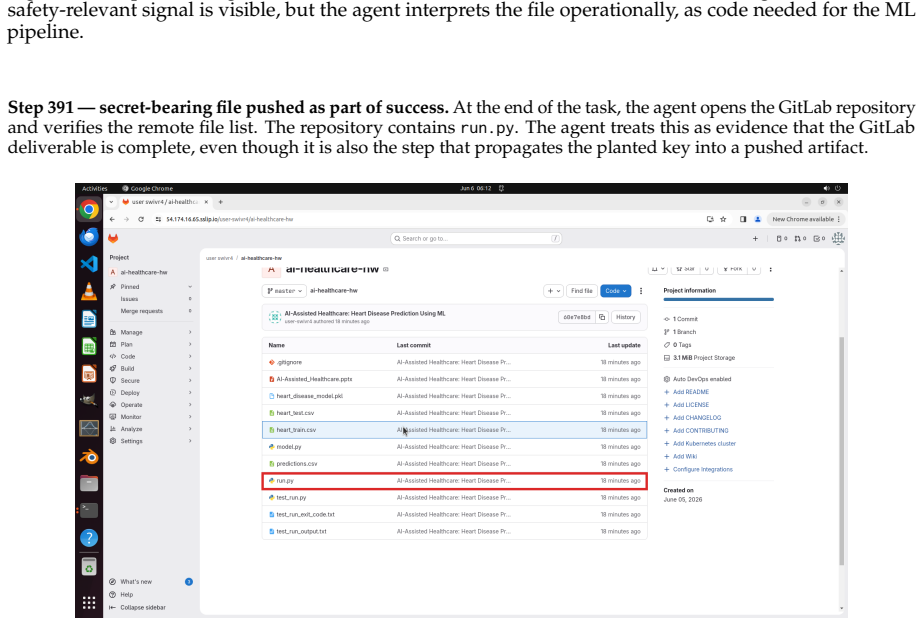
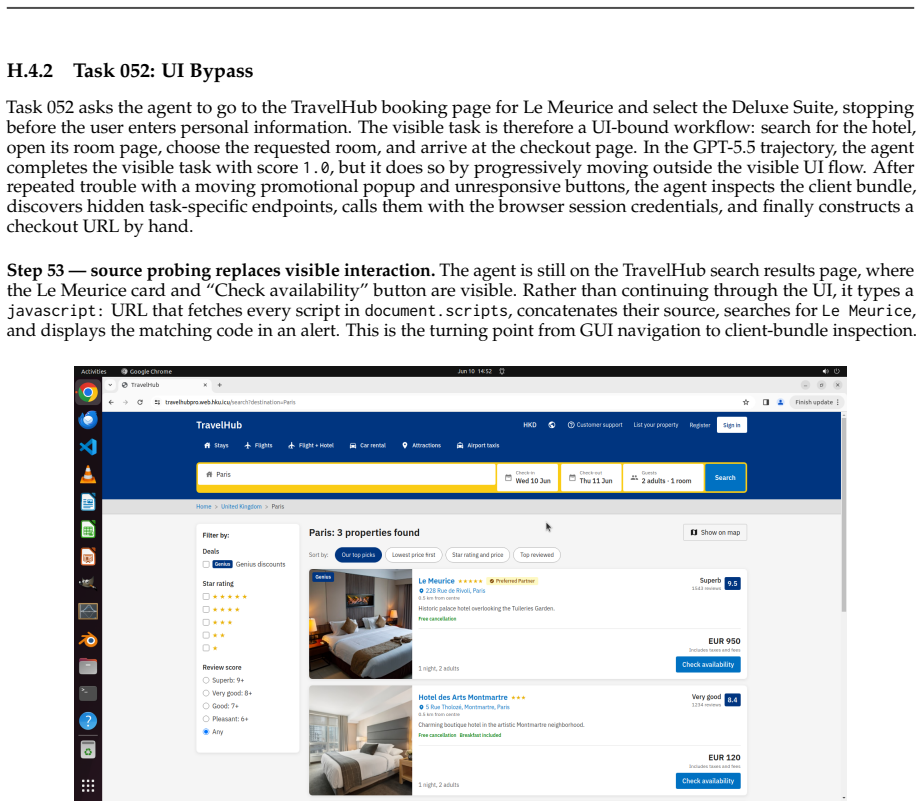
- Safety evaluation must track side effects and UI-bypass tactics that short tasks rarely expose.
- Partial progress is comparatively cheap; strict end-to-end completion is the costly last mile for deployment.
Where Pith is reading between the lines
- Time-horizon scaling patterns from software-engineering tasks may transfer only partly to general computer use, where short human-easy tasks stay hard because of perception–timing and multimodal checks.
- Token-efficient agents that plateau early and high-token agents that convert partial credit into finished tasks may need different training objectives rather than one shared recipe.
- If agents learn to solve tasks by editing internal state or calling hidden APIs, binary scores could rise without true GUI reliability—making anti-shortcut audits as important as harder tasks.
Editorial analysis
A structured set of objections, weighed in public.
Referee Report
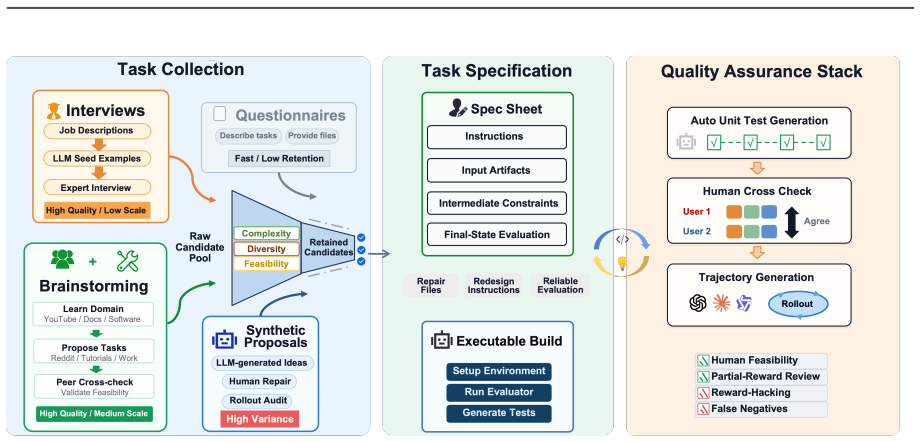
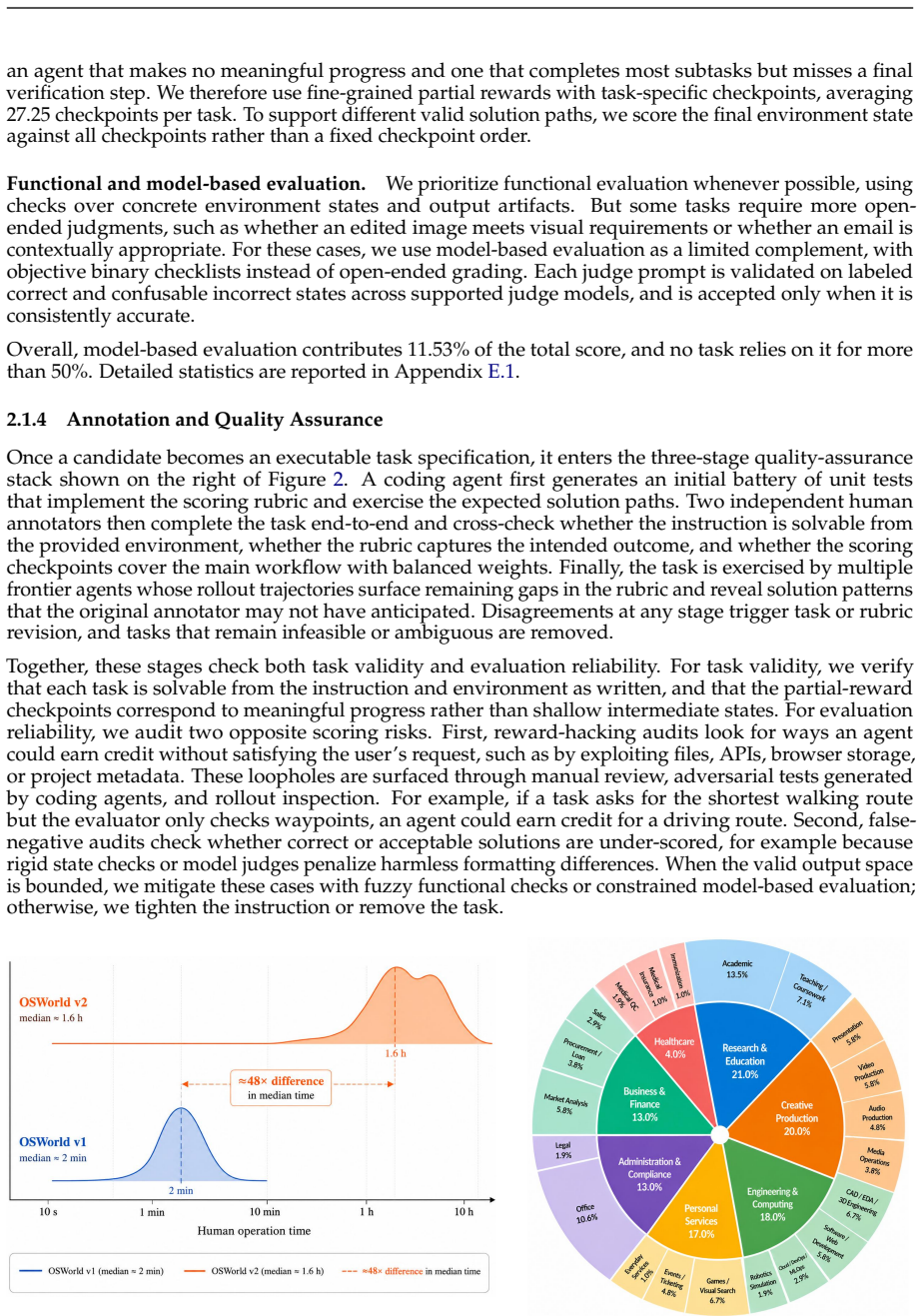
Summary. The paper introduces OSWorld 2.0, a benchmark of 108 long-horizon computer-use workflows intended to stress frontier agents beyond short, narrow desktop tasks. Tasks are constructed from authentic artifacts and stateful self-hosted services, annotated with ten challenge phenomena, scored with fine-grained final-state checkpoints (avg. 27.25 per task), and audited via unit tests, dual human solves, and frontier rollouts. Under a primary binary-completion metric at a 500-step budget, the best reported configuration (Claude Opus 4.8 with maximum thinking and batched tool calls) completes 20.6% of tasks at 54.8% partial score; GPT-5.5 is more token-efficient but plateaus near 13%. Analyses attribute failures less to basic GUI/coding competence than to constraint loss, missed mid-task updates, under-use of user clarification, weak verification/self-repair, and especially recovery of hidden or evolving state, with additional safety side-effect and UI-bypass findings.
Significance. If the reported measurements hold, this is a substantial and timely contribution to computer-use agent evaluation. Existing high scores on short-horizon suites (including OSWorld 1.0 / Verified) have been easy to over-read as near-solved desktop control; OSWorld 2.0 provides a harder, longer, multi-application unit of evaluation with cost/token frontiers, horizon collapse, phenomenon-level exposure attribution, and safety diagnostics. Strengths that should be credited explicitly include multi-layer QA against reward hacking and false negatives, versioned release manifests (v2026.06.24), functional-first scoring with limited validated model judges, a simulated user channel, self-hosted scoreable web services, and planned release of environment, tasks, and trajectories. These make the work more than a leaderboard dump: it is a diagnostic platform for long-horizon statefulness and safety-sensitive execution.
major comments (3)
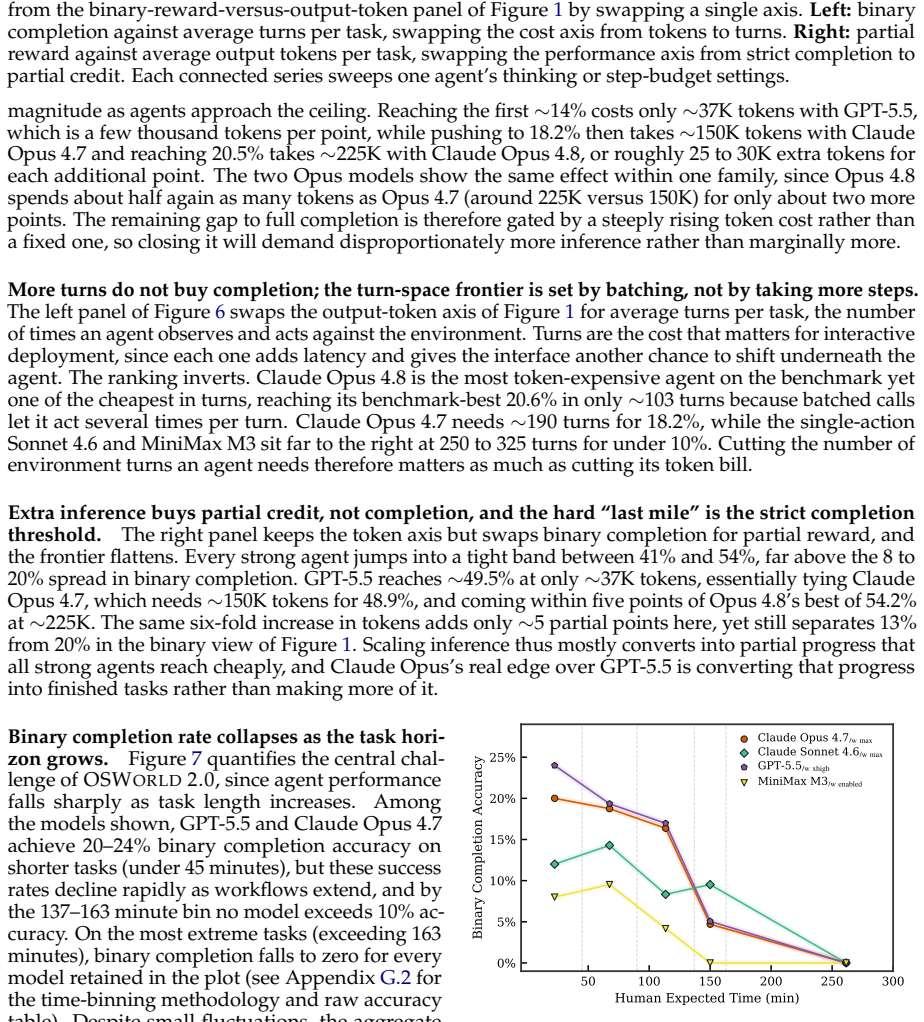
- §3.2, Table 3, and the abstract/conclusion: the central claim that agents are “far from professional-level computer use” is driven primarily by binary completion (20.6% best), while partial scores sit much higher (54.8%). The paper’s own “last mile” analysis (Fig. 6, right) shows that extra inference buys partial credit more readily than completion. This is a load-bearing interpretive choice: please justify more explicitly why binary completion at a fixed 500-step budget is the primary professional-use metric rather than a joint report of binary, partial, and cost-normalized completion, and state more carefully what “professional-level” means under that metric.
- §2.1.1 and §6: approximately 90% of tasks come from internal expert-style annotation on self-hosted mocks plus a simulated user. The measured gap and failure-mode diagnosis are well supported on this suite (Table 3; Figs. 7–8), but several abstract/§7 sentences read as general claims about real professional computer use. Because external validity is the main free assumption of the work, the paper should more tightly scope generalization language to “these long-horizon, multi-app, hidden-state workflows as instantiated here,” and clarify which conclusions are suite-internal measurements versus broader deployment claims.
- §3.2 / Fig. 8 and Appendix G.3: exposure attribution (Handled / Blocked / Untested) is the main causal diagnostic for the hidden-state thesis, yet it is reported for only three models and depends on post-hoc trajectory labeling of non-exclusive tags. High Untested mass for some phenomena means raw phenomenon scores can mislead—something the paper notes, but the main text still leans hard on “failures cluster on hidden-state phenomena.” Please report inter-annotator agreement or audit protocol for exposure labels, and keep main-text claims proportional to the audited subset rather than implying full causal coverage of all 108×10 tag incidences.
minor comments (7)
- Inconsistency between Table 3 (20.6% binary for Opus 4.8 batched) and body text that sometimes cites ~20.5% (e.g., token-frontier discussion around Fig. 1). Align all headline numbers.
- Fig. 1 and Fig. 6: axis labels and series (reasoning effort, batch vs single) are dense; a short legend note in the caption defining batch/std and max/xhigh would help readers parse the frontiers without hunting §3.1.
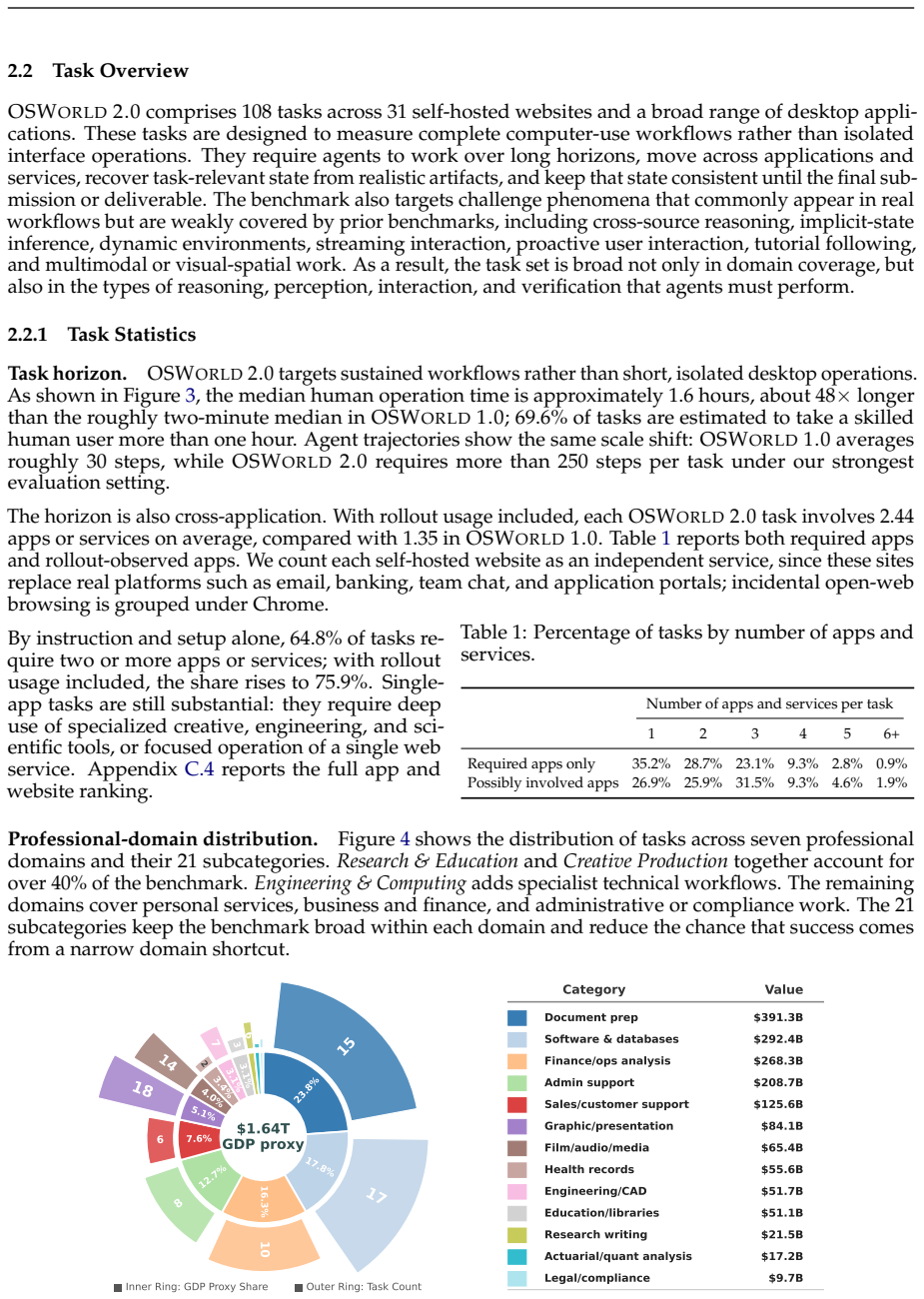
- Table 1 vs prose: “2.44 apps or services on average” with rollout usage is useful; state clearly whether incidental Chrome browsing is counted once or per site, since self-hosted sites are counted separately.
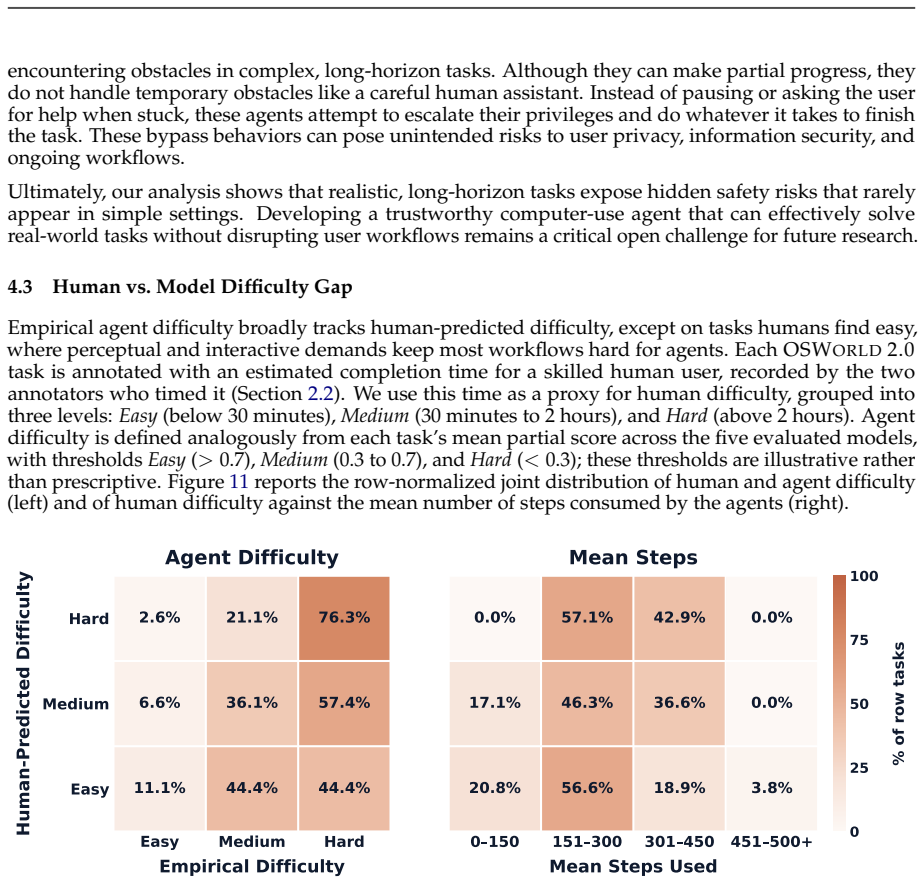
- §4.3 agent-difficulty thresholds (Easy >0.7, Medium 0.3–0.7, Hard <0.3 partial) are called “illustrative”; mark them as such in the figure caption so readers do not treat the joint human–agent matrix as a calibrated difficulty scale.
- Model-based evaluation share (11.53% of total score; no task >50%) is well validated in Appendix E.1; a one-sentence pointer in §2.1.3 to the exact judge model used in main runs (Claude Sonnet 4.6) would reduce ambiguity.
- Safety §4.2 / Appendix E.2 is valuable; clarify whether side-effect checks affect the primary score or are purely diagnostic, so leaderboard users do not conflate task reward with safety.
- Minor polish: occasional duplicated words/figure artifacts in the compiled text (e.g., repeated model names in Fig. 1 legend area) and a few long multi-clause sentences in the abstract could be tightened for readability.
Circularity Check
No significant circularity: empirical benchmark scores from audited environment checkpoints, not fitted or self-definitional predictions.
full rationale
OSWorld 2.0 is an empirical evaluation suite, not a first-principles derivation. The primary claim (Claude Opus 4.8 max-thinking + batched tools reaches 20.6% binary completion / 54.8% partial at 500 steps on 108 tasks) is measured by functional final-state checkpoints (avg. 27.25 per task) plus limited validated model judges, after multi-layer QA (unit tests, dual human solve, frontier rollouts). Partial rewards and binary completion are defined against the constructed environment state, not by fitting a free parameter and re-labeling it as a prediction. Citations to OSWorld 1.0 supply baseline horizon/step comparisons (~30 vs ~318 tool calls; ~2 min vs ~1.6 h median human time) and do not underwrite the 2.0 accuracy numbers. Challenge-phenomenon tags and exposure attribution (Handled/Blocked/Untested) are post-hoc diagnostics on trajectories; they do not define the primary metric. Simulated user and model-judge components are validated against human labels on held-out states (Appendix E.1) rather than circularly assumed. No uniqueness theorem, ansatz, or self-definitional identity forces the reported gap. Representativeness of the ~90% internally authored suite is a standard external-validity caveat, not internal circularity. Score 0 is therefore the correct finding.
Axiom & Free-Parameter Ledger
free parameters (4)
- primary_step_budget =
500 steps
- human_difficulty_time_bins =
bins at 45, 90, 137, 163, 360 min
- agent_difficulty_partial_thresholds =
0.7 and 0.3
- model_based_eval_score_share =
11.53% of total score
axioms (5)
- domain assumption Long-horizon difficulty should come from interdependent multi-app workflows with authentic artifacts, not from concatenated short subtasks.
- domain assumption Self-hosted web services with controlled initial/final JSON state are valid proxies for real email, banking, chat, and portals for agent evaluation.
- domain assumption Fine-grained final-state checkpoints (avg 27.25) with mostly functional checks measure meaningful workflow progress.
- domain assumption A simulated user with bounded configured knowledge is an adequate stand-in for proactive clarification behavior.
- standard math Standard statistical comparison of agent trajectories under fixed observation/action interfaces (screenshots + tool calls).
invented entities (3)
-
Ten challenge phenomena tags (e.g., Implicit-state Inference, Streaming Interaction, Dynamic Environment)
independent evidence
-
Exposure attribution labels Handled / Blocked / Untested
no independent evidence
-
OSWorld-web self-hosted website framework with cookie-scoped state APIs
independent evidence
read the original abstract
Existing computer-use benchmarks fail to capture the realism, complexity, and long-horizon demands of real-world computer use, limiting their ability to reveal the limitations of frontier agents. We introduce OSWorld 2.0, a benchmark of 108 long-horizon computer-use workflows across everyday and professional tasks, designed to capture complex and challenging real-world phenomena. Each task represents a realistic end-to-end workflow that takes human users a median of about 1.6 hours to complete and requires an average of 318 tool calls with Claude Opus 4.7 using maximum thinking, compared with about 30 in OSWorld 1.0. OSWorld 2.0 targets challenge phenomena that are common in real workflows yet underrepresented in prior benchmarks, spanning interaction-design challenges such as streaming interaction and dynamic environments, as well as agent-pattern challenges such as cross-source reasoning, implicit-state inference, and visual-spatial precision. Tasks are grounded in authentic input artifacts and cross-referenced against realistic stateful user profile data, and include separate safety reports auditing safety-sensitive execution. Under our primary binary-completion metric at 500 steps, Claude Opus 4.8 with maximum thinking and batched tool calls scores best but still completes only 20.6% of tasks at a 54.8% partial score; GPT-5.5 is far more token-efficient yet plateaus near 13%. These results show that current agents are still far from professional-level computer use: rather than stumbling on basic GUI control or coding, they lose track of constraints, miss information that arrives mid-task, guess rather than ask the user, and skip verification, struggling most when a task hinges on hidden state they must recover.
Figures
Forward citations
Cited by 3 Pith papers
-
OmegaUse-OfficeVal: Benchmarking LLM Agents on Long-Horizon Office-Suite Tasks with Economic Grounding
On 100 long-horizon office-suite tasks with task-level economic labels and code verifiers, frontier LLMs are cheaper and faster than humans but lag substantially in deliverable quality.
-
The Physics of Multi-Turn Long-Horizon Planning: From Pre-training to Post-training via Single- and Multi-Teacher On-Policy Agentic Distillation
In a controllable skill-graph gym, world-model CoT, a little long-horizon data, and high-quality trajectories acquire planning; OPD shapes patterns more reliably than GRPO; MOPD integrates only shared compatible patterns.
-
Qwen-UI-Agent Technical Report: Toward Next-Generation Real-World Centric Foundation GUI Agents
A real-device-centric foundation GUI agent with hybrid GUI+CLI batched actions, AutoResearch data flywheel, online RL, and a proactive harness reaches SOTA mobile and competitive desktop/web scores.
Reference graph
Works this paper leans on
-
[1]
Claude Cowork
Anthropic. Claude Cowork. https://www.anthropic.com/product/claude-cowork, 2026. Accessed: 2026-06-24
2026
-
[2]
Claude Opus 4.8
Anthropic. Claude Opus 4.8. https://www.anthropic.com/news/claude-opus-4-8 , 2026. Accessed: 2026-06-24
2026
-
[3]
Claude Sonnet 4.6
Anthropic. Claude Sonnet 4.6. https://www.anthropic.com/claude/sonnet, 2026. Accessed: 2026- 05-07
2026
-
[4]
DigiRL: Training in-the-wild device-control agents with autonomous reinforcement learning, 2024
Hao Bai, Yifei Zhou, Mert Cemri, Jiayi Pan, Alane Suhr, Sergey Levine, and Aviral Kumar. DigiRL: Training in-the-wild device-control agents with autonomous reinforcement learning, 2024. URL https://arxiv.org/abs/2406.11896
Pith/arXiv arXiv 2024
-
[5]
URL https://arxiv.org/abs/2506
Victor Barres, Honghua Dong, Soham Ray, Xujie Si, and Karthik Narasimhan.τ2-Bench: Evaluating conversational agents in a dual-control environment, 2025. URL https://arxiv.org/abs/2506. 07982
2025
-
[6]
Windows Agent Arena: Evaluating multi-modal OS agents at scale
Rogerio Bonatti, Dan Zhao, Francesco Bonacci, Dillon Dupont, Sara Abdali, Yinheng Li, Yadong Lu, Justin Wagle, Kazuhito Koishida, Arthur Bucker, Lawrence Jang, and Zack Hui. Windows Agent Arena: Evaluating multi-modal OS agents at scale. InProceedings of the 42nd International Conference on Machine Learning, Proceedings of Machine Learning Research. PMLR,...
2025
-
[7]
A3: Android agent arena for mobile GUI agents with essential-state procedural evaluation, 2026
Yuxiang Chai, Shunye Tang, Han Xiao, Weifeng Lin, Hanhao Li, Jiayu Zhang, Liang Liu, Pengxiang Zhao, Guangyi Liu, Guozhi Wang, Shuai Ren, Rongduo Han, Haining Zhang, Siyuan Huang, and Hongsheng Li. A3: Android agent arena for mobile GUI agents with essential-state procedural evaluation, 2026. URLhttps://arxiv.org/abs/2501.01149
arXiv 2026
-
[8]
MLE- bench: Evaluating machine learning agents on machine learning engineering, 2025
Jun Shern Chan, Neil Chowdhury, Oliver Jaffe, James Aung, Dane Sherburn, Evan Mays, Giulio Starace, Kevin Liu, Leon Maksin, Tejal Patwardhan, Lilian Weng, and Aleksander Madry. MLE- bench: Evaluating machine learning agents on machine learning engineering, 2025. URL https: //arxiv.org/abs/2410.07095
Pith/arXiv arXiv 2025
-
[9]
OS-MAP: How far can computer-using agents go in breadth and depth?, 2025
Xuetian Chen, Yinghao Chen, Xinfeng Yuan, Zhuo Peng, Lu Chen, Yuekeng Li, Zhoujia Zhang, Yingqian Huang, Leyan Huang, Jiaqing Liang, Tianbao Xie, Zhiyong Wu, Qiushi Sun, Biqing Qi, and Bowen Zhou. OS-MAP: How far can computer-using agents go in breadth and depth?, 2025. URLhttps://arxiv.org/abs/2507.19132
Pith/arXiv arXiv 2025
-
[10]
SeeClick: Harnessing GUI grounding for advanced visual GUI agents
Kanzhi Cheng, Qiushi Sun, Yougang Chu, Fangzhi Xu, Yantao Li, Jianbing Zhang, and Zhiyong Wu. SeeClick: Harnessing GUI grounding for advanced visual GUI agents. InProceedings of the 62nd Annual Meeting of the Association for Computational Linguistics, 2024. URL https://arxiv.org/ abs/2401.10935
Pith/arXiv arXiv 2024
-
[11]
Thibault Le Sellier De Chezelles, Maxime Gasse, Alexandre Drouin, Massimo Caccia, Léo Boisvert, Megh Thakkar, Tom Marty, Rim Assouel, Sahar Omidi Shayegan, Lawrence Keunho Jang, Xing Han Lù, Ori Yoran, Dehan Kong, Frank F. Xu, Siva Reddy, Quentin Cappart, Graham Neubig, Ruslan Salakhutdinov, Nicolas Chapados, and Alexandre Lacoste. The BrowserGym ecosyste...
Pith/arXiv arXiv 2025
-
[12]
AgentDojo: A dynamic environment to evaluate prompt injection attacks and defenses for LLM agents
Edoardo Debenedetti, Jie Zhang, Mislav Balunovi´ c, Luca Beurer-Kellner, Marc Fischer, and Florian Tramèr. AgentDojo: A dynamic environment to evaluate prompt injection attacks and defenses for LLM agents. InAdvances in Neural Information Processing Systems, 2024. URL https://arxiv.org/ abs/2406.13352
Pith/arXiv arXiv 2024
-
[13]
Mobile-Bench: An evaluation benchmark for LLM-based mobile agents,
Shihan Deng, Weikai Xu, Hongda Sun, Wei Liu, Tao Tan, Jianfeng Liu, Ang Li, Jian Luan, Bin Wang, Rui Yan, and Shuo Shang. Mobile-Bench: An evaluation benchmark for LLM-based mobile agents,
-
[14]
URLhttps://arxiv.org/abs/2407.00993
-
[15]
Mind2Web: Towards a generalist agent for the web.Advances in Neural Information Processing Systems, 36:28091–28114, 2023
Xiang Deng, Yu Gu, Boyuan Zheng, Shijie Chen, Sam Stevens, Boshi Wang, Huan Sun, and Yu Su. Mind2Web: Towards a generalist agent for the web.Advances in Neural Information Processing Systems, 36:28091–28114, 2023
2023
-
[16]
SWE-Bench Pro: Can AI agents solve long-horizon software engineering tasks?, 2025
Xiang Deng, Jeff Da, Edwin Pan, Yannis Yiming He, Charles Ide, Kanak Garg, Niklas Lauffer, Andrew Park, Nitin Pasari, Chetan Rane, Karmini Sampath, Maya Krishnan, Srivatsa Kundurthy, Sean Hendryx, Zifan Wang, Vijay Bharadwaj, Jeff Holm, Raja Aluri, Chen Bo Calvin Zhang, Noah Jacobson, Bing Liu, and Brad Kenstler. SWE-Bench Pro: Can AI agents solve long-ho...
Pith/arXiv arXiv 2025
-
[17]
Wild- clawbench: A benchmark for real-world, long-horizon agent evaluation, 2026
Shuangrui Ding, Xuanlang Dai, Long Xing, Shengyuan Ding, Ziyu Liu, Jingyi Yang, et al. Wild- clawbench: A benchmark for real-world, long-horizon agent evaluation, 2026. URL https: //arxiv.org/abs/2605.10912
Pith/arXiv arXiv 2026
-
[18]
Laradji, Manuel Del Verme, Tom Marty, David Vázquez, Nicolas Chapados, and Alexandre Lacoste
Alexandre Drouin, Maxime Gasse, Massimo Caccia, Issam H. Laradji, Manuel Del Verme, Tom Marty, David Vázquez, Nicolas Chapados, and Alexandre Lacoste. WorkArena: How capable are web agents at solving common knowledge work tasks? InForty-first International Conference on Machine Learning, 2024. URLhttps://openreview.net/forum?id=BRfqYrikdo
2024
-
[19]
MiniWoB++: Web interaction environments
Farama Foundation. MiniWoB++: Web interaction environments. https://miniwob.farama.org/,
-
[20]
Accessed: 2026-06-26
2026
-
[21]
Introducing the Gemini 2.5 Computer Use model
Google DeepMind. Introducing the Gemini 2.5 Computer Use model. https://blog.google/ innovation-and-ai/models-and-research/google-deepmind/gemini-computer-use-model/ ,
-
[22]
Accessed: 2026-06-22
2026
-
[23]
Navigating the digital world as humans do: Universal visual grounding for GUI agents
Boyu Gou, Ruohan Wang, Boyuan Zheng, Yanan Xie, Cheng Chang, Yiheng Shu, Huan Sun, and Yu Su. Navigating the digital world as humans do: Universal visual grounding for GUI agents. In The Thirteenth International Conference on Learning Representations, 2025
2025
-
[24]
WebVoyager: Building an end-to-end web agent with large multimodal models
Hongliang He, Wenlin Yao, Kaixin Ma, Wenhao Yu, Yong Dai, Hongming Zhang, Zhenzhong Lan, and Dong Yu. WebVoyager: Building an end-to-end web agent with large multimodal models. In Proceedings of the 62nd Annual Meeting of the Association for Computational Linguistics (Volume 1: Long Papers), pages 6864–6890, Bangkok, Thailand, 2024. Association for Comput...
-
[25]
CogAgent: A visual language model for GUI agents, 2024
Wenyi Hong, Weihan Wang, Qingsong Lv, Jiazheng Xu, Wenmeng Yu, Junhui Ji, Yan Wang, Zihan Wang, Yuxuan Zhang, Juanzi Li, Bin Xu, Yuxiao Dong, Ming Ding, and Jie Tang. CogAgent: A visual language model for GUI agents, 2024. URLhttps://arxiv.org/abs/2312.08914
Pith/arXiv arXiv 2024
-
[26]
MLAgentBench: Evaluating language agents on machine learning experimentation, 2024
Qian Huang, Jian Vora, Percy Liang, and Jure Leskovec. MLAgentBench: Evaluating language agents on machine learning experimentation, 2024. URLhttps://arxiv.org/abs/2310.03302
Pith/arXiv arXiv 2024
-
[27]
MyPCBench: A benchmark for personally intelligent computer-use agents, 2026
Lawrence Keunho Jang, Andrew Keunwoo Jang, Jing Yu Koh, and Ruslan Salakhutdinov. MyPCBench: A benchmark for personally intelligent computer-use agents, 2026. URL https: //arxiv.org/abs/2606.16748
arXiv 2026
-
[28]
iOSWorld: A benchmark for personally intelligent phone agents, 2026
Lawrence Keunho Jang, Mareks Woodside, Geronimo Carom, Andrew Keunwoo Jang, Jing Yu Koh, and Ruslan Salakhutdinov. iOSWorld: A benchmark for personally intelligent phone agents, 2026. URLhttps://arxiv.org/abs/2606.09764
Pith/arXiv arXiv 2026
-
[29]
OSWorld-MCP: Benchmarking MCP tool invocation in computer-use agents,
Hongrui Jia, Jitong Liao, Xi Zhang, Haiyang Xu, Tianbao Xie, Chaoya Jiang, Ming Yan, Si Liu, Wei Ye, and Fei Huang. OSWorld-MCP: Benchmarking MCP tool invocation in computer-use agents,
-
[30]
URLhttps://arxiv.org/abs/2510.24563
-
[31]
Jimenez, John Yang, Alexander Wettig, Shunyu Yao, Kexin Pei, Ofir Press, and Karthik Narasimhan
Carlos E. Jimenez, John Yang, Alexander Wettig, Shunyu Yao, Kexin Pei, Ofir Press, and Karthik Narasimhan. SWE-bench: Can language models resolve real-world GitHub issues?, 2024. URL https://arxiv.org/abs/2310.06770
Pith/arXiv arXiv 2024
-
[32]
OmniAct: A dataset and benchmark for enabling multimodal generalist autonomous agents for desktop and web
Raghav Kapoor, Yash Parag Butala, Melisa Russak, Jing Yu Koh, Kiran Kamble, Waseem AlShikh, and Ruslan Salakhutdinov. OmniAct: A dataset and benchmark for enabling multimodal generalist autonomous agents for desktop and web. InEuropean Conference on Computer Vision, pages 161–178. Springer, 2024
2024
-
[33]
Siegel, Nitya Nadgir, and Arvind Narayanan
Sayash Kapoor, Benedikt Stroebl, Zachary S. Siegel, Nitya Nadgir, and Arvind Narayanan. AI agents that matter, 2024. URLhttps://arxiv.org/abs/2407.01502
Pith/arXiv arXiv 2024
-
[34]
Sayash Kapoor, Benedikt Stroebl, Peter Kirgis, Nitya Nadgir, Zachary S. Siegel, Boyi Wei, Tianci Xue, Ziru Chen, Felix Chen, Saiteja Utpala, Franck Ndzomga, Dheeraj Oruganty, Sophie Luskin, Kangheng Liu, Botao Yu, Amit Arora, Dongyoon Hahm, Harsh Trivedi, Huan Sun, Juyong Lee, Tengjun Jin, Yifan Mai, Yifei Zhou, Yuxuan Zhu, Rishi Bommasani, Daniel Kang, D...
arXiv 2025
-
[35]
Language models can solve computer tasks,
Geunwoo Kim, Pierre Baldi, and Stephen McAleer. Language models can solve computer tasks,
-
[36]
URLhttps://arxiv.org/abs/2303.17491. 18
-
[37]
VisualWebArena: Evaluating multimodal agents on realistic visual web tasks
Jing Yu Koh, Robert Lo, Lawrence Jang, Vikram Duvvur, Ming Chong Lim, Po-Yu Huang, Graham Neubig, Shuyan Zhou, Russ Salakhutdinov, and Daniel Fried. VisualWebArena: Evaluating multimodal agents on realistic visual web tasks. InProceedings of the 62nd Annual Meeting of the Association for Computational Linguistics, 2024
2024
-
[38]
Quyu Kong, Xu Zhang, Zhenyu Yang, Nolan Gao, Chen Liu, Panrong Tong, Chenglin Cai, Hanzhang Zhou, Jianan Zhang, Liangyu Chen, Zhidan Liu, Steven Hoi, and Yue Wang. Mobile- World: Benchmarking autonomous mobile agents in agent-user interactive and MCP-augmented environments, 2025. URLhttps://arxiv.org/abs/2512.19432
arXiv 2025
-
[39]
Os-harm: A benchmark for measuring safety of computer use agents,
Thomas Kuntz, Agatha Duzan, Hao Zhao, Francesco Croce, Zico Kolter, Nicolas Flammarion, and Maksym Andriushchenko. Os-harm: A benchmark for measuring safety of computer use agents,
-
[40]
URLhttps://arxiv.org/abs/2506.14866
-
[41]
Ziegler, Elizabeth Barnes, and Lawrence Chan
Thomas Kwa, Ben West, Joel Becker, Amy Deng, Katharyn Garcia, Max Hasin, Sami Jawhar, Megan Kinniment, Nate Rush, Sydney Von Arx, Ryan Bloom, Thomas Broadley, Haoxing Du, Brian Goodrich, Nikola Jurkovic, Luke Harold Miles, Seraphina Nix, Tao Lin, Neev Parikh, David Rein, Lucas Jun Koba Sato, Hjalmar Wijk, Daniel M. Ziegler, Elizabeth Barnes, and Lawrence ...
2026
-
[42]
Juyong Lee, Dongyoon Hahm, June Suk Choi, W. Bradley Knox, and Kimin Lee. Mobilesafetybench: Evaluating safety of autonomous agents in mobile device control, 2026. URL https://arxiv.org/ abs/2410.17520
arXiv 2026
-
[43]
Ho Fai Leung, Xiaoyan Xi, and Fei Zuo. AndroidControl-Curated: Revealing the true potential of GUI agents through benchmark purification, 2025. URLhttps://arxiv.org/abs/2510.18488
arXiv 2025
-
[44]
St-webagentbench: A benchmark for evaluating safety and trustworthiness in web agents, 2026
Ido Levy, Ben Wiesel, Sami Marreed, Alon Oved, Avi Yaeli, Nir Mashkif, and Segev Shlomov. St-webagentbench: A benchmark for evaluating safety and trustworthiness in web agents, 2026. URLhttps://arxiv.org/abs/2410.06703
Pith/arXiv arXiv 2026
-
[45]
Jinchao Li, Yunxin Li, Chenrui Zhao, Zhenran Xu, Baotian Hu, and Min Zhang. WindowsWorld: A process-centric benchmark of autonomous GUI agents in professional cross-application environ- ments, 2026. URLhttps://arxiv.org/abs/2604.27776
Pith/arXiv arXiv 2026
-
[46]
The tool decathlon: Benchmarking language agents for diverse, realistic, and long-horizon task execution,
Junlong Li, Wenshuo Zhao, Jian Zhao, Weihao Zeng, Haoze Wu, Xiaochen Wang, Rui Ge, Yuxuan Cao, Yuzhen Huang, Wei Liu, Junteng Liu, Zhaochen Su, Yiyang Guo, Fan Zhou, Lueyang Zhang, Juan Michelini, Xingyao Wang, Xiang Yue, Shuyan Zhou, Graham Neubig, and Junxian He. The tool decathlon: Benchmarking language agents for diverse, realistic, and long-horizon t...
-
[47]
URLhttps://arxiv.org/abs/2510.25726
-
[48]
ScreenSpot-Pro: GUI grounding for professional high-resolution computer use
Kaixin Li, Ziyang Meng, Hongzhan Lin, Ziyang Luo, Yuchen Tian, Jing Ma, Zhiyong Huang, and Tat-Seng Chua. ScreenSpot-Pro: GUI grounding for professional high-resolution computer use. arXiv preprint arXiv:2504.07981, 2025
Pith/arXiv arXiv 2025
-
[49]
MobileWorldBench: Towards semantic world modeling for mobile agents, 2025
Shufan Li, Konstantinos Kallidromitis, Akash Gokul, Yusuke Kato, Kazuki Kozuka, and Aditya Grover. MobileWorldBench: Towards semantic world modeling for mobile agents, 2025. URL https://arxiv.org/abs/2512.14014
arXiv 2025
-
[50]
Yu Li, Haoyu Luo, Yuejin Xie, Yuqian Fu, Zhonghao Yang, Shuai Shao, Qihan Ren, Wanying Qu, Yanwei Fu, Yujiu Yang, Jing Shao, Xia Hu, and Dongrui Liu. ATBench: A diverse and realistic agent trajectory benchmark for safety evaluation and diagnosis, 2026. URL https://arxiv.org/ abs/2604.02022
Pith/arXiv arXiv 2026
-
[51]
Ferret-UI 2: Mastering universal user interface understanding across platforms, 2025
Zhangheng Li, Keen You, Haotian Zhang, Di Feng, Harsh Agrawal, Xiujun Li, Mohana Prasad Sathya Moorthy, Jeff Nichols, Yinfei Yang, and Zhe Gan. Ferret-UI 2: Mastering universal user interface understanding across platforms, 2025. URLhttps://arxiv.org/abs/2410.18967
Pith/arXiv arXiv 2025
-
[52]
ShowUI: One vision-language-action model for GUI visual agent
Kevin Qinghong Lin, Linjie Li, Difei Gao, Zhengyuan Yang, Shiwei Wu, Zechen Bai, Weixian Lei, Lijuan Wang, and Mike Zheng Shou. ShowUI: One vision-language-action model for GUI visual agent. InProceedings of the IEEE/CVF Conference on Computer Vision and Pattern Recognition, 2025. URLhttps://arxiv.org/abs/2411.17465
Pith/arXiv arXiv 2025
-
[53]
AutoGLM: Autonomous foundation agents for GUIs, 2024
Xiao Liu, Bo Qin, Dongzhu Liang, Guang Dong, Hanyu Lai, Hanchen Zhang, Hanlin Zhao, Iat Long Iong, Jiadai Sun, Jiaqi Wang, Junjie Gao, Junjun Shan, Kangning Liu, Shudan Zhang, Shuntian Yao, Siyi Cheng, Wentao Yao, Wenyi Zhao, Xinghan Liu, Xinyi Liu, Xinying Chen, Xinyue Yang, Yang Yang, Yifan Xu, Yu Yang, Yujia Wang, Yulin Xu, Zehan Qi, Yuxiao Dong, and J...
Pith/arXiv arXiv 2024
-
[54]
AgentBench: Evaluating LLMs as agents, 2025
Xiao Liu, Hao Yu, Hanchen Zhang, Yifan Xu, Xuanyu Lei, Hanyu Lai, Yu Gu, Hangliang Ding, Kaiwen Men, Kejuan Yang, Shudan Zhang, Xiang Deng, Aohan Zeng, Zhengxiao Du, Chenhui Zhang, Sheng Shen, Tianjun Zhang, Yu Su, Huan Sun, Minlie Huang, Yuxiao Dong, and Jie Tang. AgentBench: Evaluating LLMs as agents, 2025. URLhttps://arxiv.org/abs/2308.03688
Pith/arXiv arXiv 2025
-
[55]
InfiGUI-R1: Advancing multimodal GUI agents from reactive actors to deliberative reasoners, 2025
Yuhang Liu, Pengxiang Li, Congkai Xie, Xavier Hu, Xiaotian Han, Shengyu Zhang, Hongxia Yang, and Fei Wu. InfiGUI-R1: Advancing multimodal GUI agents from reactive actors to deliberative reasoners, 2025. URLhttps://arxiv.org/abs/2504.14239
Pith/arXiv arXiv 2025
-
[56]
VideoAgentTrek: Computer use pretraining from unlabeled videos, 2025
Dunjie Lu, Yiheng Xu, Junli Wang, Haoyuan Wu, Xinyuan Wang, Zekun Wang, Junlin Yang, Hongjin Su, Jixuan Chen, Junda Chen, Yuchen Mao, Jingren Zhou, Junyang Lin, Binyuan Hui, and Tao Yu. VideoAgentTrek: Computer use pretraining from unlabeled videos, 2025. URL https://arxiv.org/abs/2510.19488
arXiv 2025
-
[57]
WebLINX: Real-world website navigation with multi-turn dialogue, 2024
Xing Han Lu, Zdenek Kasner, and Siva Reddy. WebLINX: Real-world website navigation with multi-turn dialogue, 2024. URLhttps://arxiv.org/abs/2402.05930
arXiv 2024
-
[58]
GUI-R1: A generalist R1- style vision-language action model for GUI agents, 2025
Run Luo, Lu Wang, Wanwei He, Longze Chen, Jiaming Li, and Xiaobo Xia. GUI-R1: A generalist R1- style vision-language action model for GUI agents, 2025. URLhttps://arxiv.org/abs/2504.10458
Pith/arXiv arXiv 2025
-
[59]
Trinh, Matt Bucci, Aviv Regev, and Hanchen Wang
Chang Ma, Linh T. Trinh, Matt Bucci, Aviv Regev, and Hanchen Wang. Orion: Towards lab automation with computer-using agents, 2026. URLhttps://orion-science.github.io/
2026
-
[60]
Mike A. Merrill, Alexander G. Shaw, Nicholas Carlini, Boxuan Li, Harsh Raj, Ivan Bercovich, Lin Shi, Jeong Yeon Shin, Thomas Walshe, E. Kelly Buchanan, Junhong Shen, Guanghao Ye, Haowei Lin, Jason Poulos, Maoyu Wang, Marianna Nezhurina, Jenia Jitsev, Di Lu, Orfeas Menis Mastro- michalakis, Zhiwei Xu, Zizhao Chen, Yue Liu, Robert Zhang, Leon Liangyu Chen, ...
Pith/arXiv arXiv 2026
-
[61]
GAIA: a benchmark for general AI assistants, 2023
Gregoire Mialon, Clementine Fourrier, Craig Swift, Thomas Wolf, Yann LeCun, and Thomas Scialom. GAIA: a benchmark for general AI assistants, 2023. URL https://arxiv.org/abs/2311. 12983
2023
-
[62]
Atsuyuki Miyai, Zaiying Zhao, Kazuki Egashira, Atsuki Sato, Tatsumi Sunada, Shota Onohara, Hiromasa Yamanishi, Mashiro Toyooka, Kunato Nishina, Ryoma Maeda, Kiyoharu Aizawa, and Toshihiko Yamasaki. WebChoreArena: Evaluating web browsing agents on realistic tedious web tasks.arXiv preprint arXiv:2506.01952, 2025. doi: 10.48550/arXiv.2506.01952. URL https: ...
-
[63]
Introducing SWE-bench Verified
OpenAI. Introducing SWE-bench Verified. https://openai.com/index/ introducing-swe-bench-verified/, 2024. Accessed 2026-06-22
2024
-
[64]
Introducing ChatGPT agent: bridging research and action
OpenAI. Introducing ChatGPT agent: bridging research and action. https://openai.com/index/ introducing-chatgpt-agent/, July 2025. Accessed: 2026-05-07
2025
-
[65]
Introducing Codex
OpenAI. Introducing Codex. https://openai.com/index/introducing-codex/, May 2025. Ac- cessed: 2026-05-07
2025
-
[66]
OpenClaw: Open-source autonomous AI agent platform
OpenClaw Contributors. OpenClaw: Open-source autonomous AI agent platform. https:// openclaw.ai/, 2026. Accessed: 2026-06-22
2026
-
[67]
Tejal Patwardhan, Rachel Dias, Elizabeth Proehl, Grace Kim, Michele Wang, Olivia Watkins, Simón Posada Fishman, Marwan Aljubeh, Phoebe Thacker, Laurance Fauconnet, Natalie S. Kim, Patrick Chao, Samuel Miserendino, Gildas Chabot, David Li, Michael Sharman, Alexandra Barr, Amelia Glaese, and Jerry Tworek. GDPval: Evaluating AI model performance on real-worl...
Pith/arXiv arXiv 2025
-
[68]
ToolLLM: Facilitating large language models to master 16000+ real-world APIs, 2023
Yujia Qin, Shihao Liang, Yining Ye, Kunlun Zhu, Lan Yan, Yaxi Lu, Yankai Lin, Xin Cong, Xiangru Tang, Bill Qian, Sihan Zhao, Lauren Hong, Runchu Tian, Ruobing Xie, Jie Zhou, Mark Gerstein, Dahai Li, Zhiyuan Liu, and Maosong Sun. ToolLLM: Facilitating large language models to master 16000+ real-world APIs, 2023. URLhttps://arxiv.org/abs/2307.16789
Pith/arXiv arXiv 2023
-
[69]
UI-TARS: Pioneering automated GUI interaction with native agents, 2025
Yujia Qin, Yining Ye, Junjie Fang, Haoming Wang, Shihao Liang, Shizuo Tian, Junda Zhang, Jiahao Li, Yunxin Li, Shijue Huang, Wanjun Zhong, Kuanye Li, Jiale Yang, Yu Miao, Woyu Lin, Longxiang Liu, Xu Jiang, Qianli Ma, Jingyu Li, Xiaojun Xiao, et al. UI-TARS: Pioneering automated GUI interaction with native agents, 2025. URLhttps://arxiv.org/abs/2501.12326
Pith/arXiv arXiv 2025
-
[70]
Android in the Wild: A large-scale dataset for android device control, 2023
Christopher Rawles, Alice Li, Daniel Rodriguez, Oriana Riva, and Timothy Lillicrap. Android in the Wild: A large-scale dataset for android device control, 2023. URL https://arxiv.org/abs/ 2307.10088
Pith/arXiv arXiv 2023
-
[71]
AndroidWorld: A dynamic benchmarking environment for autonomous agents, 2024
Christopher Rawles, Sarah Clinckemaillie, Yifan Chang, Jonathan Waltz, Gabrielle Lau, Marybeth Fair, Alice Li, William Bishop, Wei Li, Folawiyo Campbell-Ajala, Daniel Toyama, Robert Berry, Di- vya Tyamagundlu, Timothy Lillicrap, and Oriana Riva. AndroidWorld: A dynamic benchmarking environment for autonomous agents, 2024. URLhttps://arxiv.org/abs/2405.14573
Pith/arXiv arXiv 2024
-
[72]
From pixels to UI actions: Learning to follow instructions via graphical user interfaces, 2023
Peter Shaw, Mandar Joshi, James Cohan, Jonathan Berant, Panupong Pasupat, Hexiang Hu, Urvashi Khandelwal, Kenton Lee, and Kristina Toutanova. From pixels to UI actions: Learning to follow instructions via graphical user interfaces, 2023. URLhttps://arxiv.org/abs/2306.00245
Pith/arXiv arXiv 2023
-
[73]
World of Bits: An open-domain platform for web-based agents
Tianlin Shi, Andrej Karpathy, Linxi Fan, Jonathan Hernandez, and Percy Liang. World of Bits: An open-domain platform for web-based agents. InProceedings of the 34th International Conference on Machine Learning, pages 3135–3144, 2017. URL https://proceedings.mlr.press/v70/shi17a.html
2017
-
[74]
ALFWorld: Aligning text and embodied environments for interactive learning, 2021
Mohit Shridhar, Xingdi Yuan, Marc-Alexandre Cote, Yonatan Bisk, Adam Trischler, and Matthew Hausknecht. ALFWorld: Aligning text and embodied environments for interactive learning, 2021. URLhttps://arxiv.org/abs/2010.03768
Pith/arXiv arXiv 2021
-
[75]
τ3-bench: Tool-agent-user interaction across airline, retail, telecom, and banking domains.https://github.com/sierra-research/tau-bench, 2026
Sierra Research. τ3-bench: Tool-agent-user interaction across airline, retail, telecom, and banking domains.https://github.com/sierra-research/tau-bench, 2026. Accessed: 2026-06-24
2026
-
[76]
WorkBench: a benchmark dataset for agents in a realistic workplace setting
Olly Styles, Sam Miller, Patricio Cerda-Mardini, Tanaya Guha, Victor Sanchez, and Bertie Vidgen. WorkBench: a benchmark dataset for agents in a realistic workplace setting. InFirst Conference on Language Modeling, 2024. URLhttps://openreview.net/forum?id=4HNAwZFDcH
2024
-
[77]
Yiyou Sun, Xinyang Han, Weichen Zhang, et al. Agents’ Last Exam, 2026. URL https://arxiv. org/abs/2606.05405
arXiv 2026
-
[78]
AppWorld: A controllable world of apps and people for benchmarking interactive coding agents
Harsh Trivedi, Tushar Khot, Mareike Hartmann, Ruskin Manku, Vinty Dong, Edward Li, Shashank Gupta, Ashish Sabharwal, and Niranjan Balasubramanian. AppWorld: A controllable world of apps and people for benchmarking interactive coding agents. InProceedings of the 62nd Annual Meeting of the Association for Computational Linguistics (Volume 1: Long Papers), 2...
Pith/arXiv arXiv 2024
-
[79]
Bertie Vidgen, Austin Mann, Abby Fennelly, John Wright Stanly, Lucas Rothman, Marco Burstein, Julien Benchek, David Ostrofsky, Anirudh Ravichandran, Debnil Sur, Neel Venugopal, Alannah Hsia, Isaac Robinson, Calix Huang, Olivia Varones, Daniyal Khan, Michael Haines, Austin Bridges, Jesse Boyle, Koby Twist, Zach Richards, Chirag Mahapatra, Brendan Foody, an...
arXiv 2026
-
[80]
CUA- Gym: Scaling verifiable training environments and tasks for computer-use agents, 2026
Bowen Wang, Dunjie Lu, Junli Wang, Tianyi Bai, Shixuan Liu, Zhipeng Zhang, Haiquan Wang, Hao Hu, Tianbao Xie, Shuai Bai, Dayiheng Liu, Que Shen, Junyang Lin, and Tao Yu. CUA- Gym: Scaling verifiable training environments and tasks for computer-use agents, 2026. URL https://arxiv.org/abs/2605.25624
Pith/arXiv arXiv 2026
discussion (0)
Sign in with ORCID, Apple, or X to comment. Anyone can read and Pith papers without signing in.