TRACE: Temporal Relationship-Aware Conversational Entrainment Detection in Dyadic Speech
Reviewed by Pith T0 review T1 audit T2 compute T3 formal T4 kernel 2026-06-30 06:00 UTCgrok-4.3pith:6K6E6AEBrecord.jsonopen to challenge →
The pith
TRACE detects emotional entrainment in dyadic speech at 97.01 percent accuracy by modeling conversations as ordered acoustic sequences.
A machine-rendered reading of the paper's core claim, the machinery that carries it, and where it could break.
Core claim
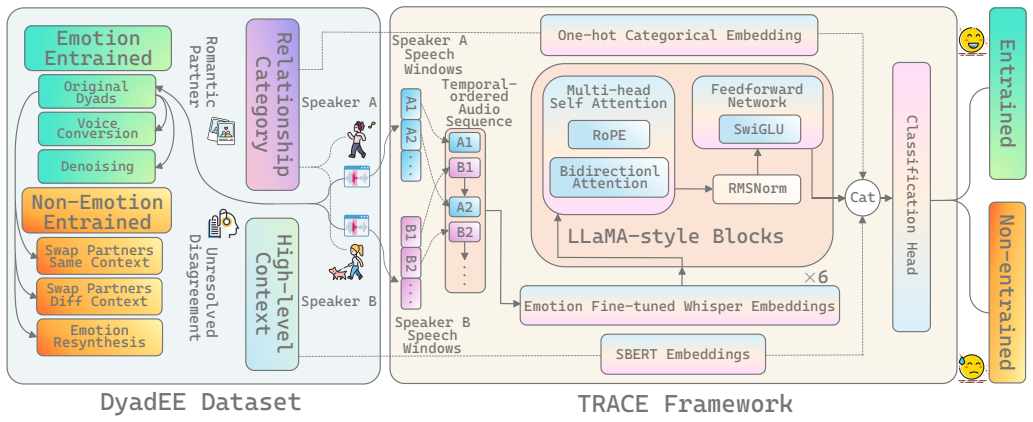
TRACE models each dyadic interaction as an ordered sequence of acoustic embeddings drawn from emotion fine-tuned Whisper representations at the window level, treating the full sample as an interaction trace. This approach captures temporal relationships and context that pooled methods miss, yielding 97.01 percent accuracy on the DyadEE dataset that mixes real entrained conversations with synthetically disrupted ones.
What carries the argument
TRACE, the window-level framework that converts dyadic speech into ordered sequences of acoustic embeddings and processes them as interaction traces to incorporate temporal and relationship context.
If this is right
- Adding explicit conversational context and relationship signals raises detection accuracy above methods that ignore sequence order.
- Window-level ordered embeddings outperform utterance pooling for entrainment tasks.
- The DyadEE construction of real-plus-synthetic pairs supplies a workable training signal for distinguishing entrained from non-entrained states.
- The same trace representation can be applied to other dyadic affective phenomena once labeled data exist.
Where Pith is reading between the lines
- The method could extend to real-time monitoring inside spoken dialogue systems so agents can adjust their own emotional pacing mid-conversation.
- If the trace approach generalizes, it may reduce the need for hand-crafted entrainment features in favor of end-to-end sequence models.
- Future datasets could replace synthetic disruption with naturally occurring low-entrainment pairs collected from the same speakers across different social contexts.
Load-bearing premise
The synthetic interactions made by partner swapping and emotion resynthesis accurately stand in for the absence of emotional entrainment that occurs in real conversations.
What would settle it
A controlled test in which TRACE accuracy drops to baseline levels when evaluated on a separate collection of naturally occurring non-entrained dyadic recordings would show the central claim does not hold.
Figures
read the original abstract
With the proliferation of speech AI agents, understanding emotional entrainment in conversational interaction has become increasingly important. Emotional entrainment is shaped by social relationships and conversational context, influencing affective coordination over time. We introduce DyadEE, a dataset for emotional entrainment detection in dyadic speech interactions, containing both emotionally entrained conversations and synthetic interactions where entrainment is disrupted through partner swapping and emotion resynthesis. We further propose TRACE, a window-level framework that models dyadic interaction as ordered sequences of acoustic embeddings derived from emotion fine-tuned Whisper representations, treating each sample as an interaction trace rather than pooled utterances. Experimental results on DyadEE show that incorporating conversational context and relationship information improves emotional entrainment detection, with TRACE achieving the best accuracy of 97.01%.
Editorial analysis
A structured set of objections, weighed in public.
Referee Report
Summary. The paper introduces the DyadEE dataset containing real emotionally entrained dyadic speech interactions alongside synthetic non-entrained samples generated by partner swapping and emotion resynthesis. It proposes TRACE, a window-level detection framework that represents each dyadic sample as an ordered sequence of acoustic embeddings extracted from emotion fine-tuned Whisper representations rather than pooled utterances. Experiments on DyadEE report that TRACE achieves 97.01% accuracy and that adding conversational context and relationship information improves performance over baselines.
Significance. If the synthetic non-entrained class is shown to be free of resynthesis artifacts, the dataset and temporal modeling approach would provide a useful resource for studying relationship-aware entrainment in conversational speech, with direct relevance to speech AI agents.
major comments (1)
- [Abstract] Abstract: The headline accuracy of 97.01% and the claim that context/relationship modeling improves detection both depend on DyadEE labels being valid (real entrained vs. synthetic non-entrained). No quantitative validation—acoustic distance metrics between real and resynthesized segments, human perceptual ratings of naturalness, or ablation using real non-entrained dyads—is described to rule out the possibility that Whisper embeddings exploit consistent resynthesis artifacts (timbre mismatch, timing discontinuities, or emotion-model artifacts) rather than entrainment dynamics.
minor comments (1)
- [Abstract] The abstract refers to 'relationship information' being incorporated but does not specify the input representation or fusion mechanism used in TRACE.
Simulated Author's Rebuttal
We thank the referee for highlighting the importance of validating the synthetic non-entrained samples in DyadEE. This is a substantive concern regarding the interpretability of our results, and we address it directly below.
read point-by-point responses
-
Referee: [Abstract] Abstract: The headline accuracy of 97.01% and the claim that context/relationship modeling improves detection both depend on DyadEE labels being valid (real entrained vs. synthetic non-entrained). No quantitative validation—acoustic distance metrics between real and resynthesized segments, human perceptual ratings of naturalness, or ablation using real non-entrained dyads—is described to rule out the possibility that Whisper embeddings exploit consistent resynthesis artifacts (timbre mismatch, timing discontinuities, or emotion-model artifacts) rather than entrainment dynamics.
Authors: We agree that the absence of explicit validation leaves open the possibility that performance reflects resynthesis artifacts rather than entrainment. In the revised manuscript we will add: (1) acoustic distance metrics (e.g., Mel-cepstral distortion and cosine similarity on Whisper embeddings) comparing real and resynthesized segments; (2) a human perceptual rating study on naturalness of a subset of synthetic samples; and (3) discussion of why obtaining matched real non-entrained dyads is difficult, together with any feasible ablation that can be performed. These additions will be reported in a new subsection of the experiments and will qualify the headline claims accordingly. revision: yes
Circularity Check
No circularity: purely empirical evaluation on constructed dataset
full rationale
The paper reports an empirical accuracy (97.01%) on the DyadEE dataset created via partner swapping and emotion resynthesis. No equations, derivations, or first-principles predictions are described in the provided text. The performance figure is presented as an experimental measurement rather than a quantity obtained by fitting parameters to the target metric or by self-referential definition. The central claim (context/relationship modeling improves detection) rests on standard ML evaluation rather than any load-bearing self-citation chain or ansatz that reduces to the input labels by construction. This is the normal case for an applied detection paper.
Axiom & Free-Parameter Ledger
Forward citations
Cited by 1 Pith paper
-
SPEARBench: A Benchmark for Naturalness Evaluation in Streaming Speech-to-Speech Language Models
An open-source benchmark for speech-to-speech models shows that current systems produce intelligible audio but diverge from human conversational behavior in latency, dialect consistency, emotional entrainment, and prosody.
discussion (0)
Sign in with ORCID, Apple, or X to comment. Anyone can read and Pith papers without signing in.