REVIEW 2 major objections 2 minor 1 cited by
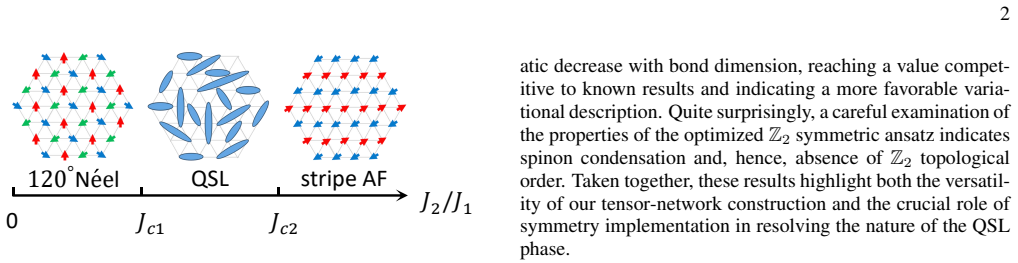
The J1-J2 Heisenberg model on the triangular lattice transitions directly from 120° Néel order to a gapless quantum spin liquid at J2/J1 ≈ 0.08, consistent with a U(1) Dirac spin liquid.
Reviewed by Pith at T0; open to challenge. T0 means a machine referee read the full paper against a public rubric. the ladder, T0–T4 →
T0 review · grok-4.3
2026-07-01 04:02 UTC pith:IVKMEW3C
load-bearing objection PEPS up to D=7 on the J1-J2 triangular model finds a low-J2 transition to a putative gapless QSL, but the Z2-symmetric ansatz may simply be unable to hold topological order at these bond dimensions. the 2 major comments →
Investigation of the J₁-J₂ Heisenberg model on the triangular lattice: A study with projected entangled-pair states
The pith
A machine-rendered reading of the paper's core claim, the machinery that carries it, and where it could break.
Core claim
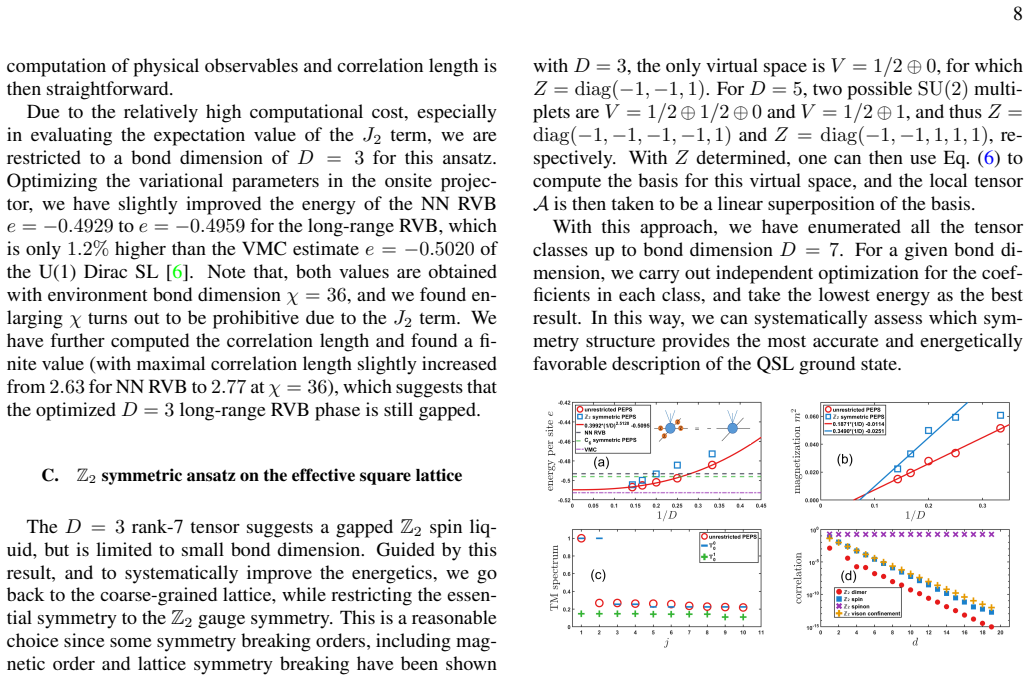
The central claim is that the intervening quantum spin liquid phase is gapless or critical and most naturally consistent with a U(1) Dirac spin liquid scenario. This follows from the observation that fully symmetric Z2 resonating valence bond states and generic Z2-symmetric PEPS of larger bond dimension, when optimized, exhibit spinon condensation together with vison confinement, thereby precluding Z2 topological order, while magnetic order collapses at J2/J1 ≈ 0.08.
What carries the argument
Infinite projected entangled-pair states (PEPS) with enforced Z2 symmetry, which serve as variational wavefunctions that can represent both magnetic order and topological states but break toward gapless behavior upon optimization.
Load-bearing premise
The assumption that condensation of spinons and confinement of visons observed in optimized Z2-symmetric PEPS at finite bond dimension reflects the intrinsic physics of the true ground state rather than a finite-D artifact or optimization bias.
What would settle it
A simulation at substantially larger bond dimension, or with an independent method such as DMRG, that finds persistent Z2 topological order or deconfined visons inside the putative QSL phase would falsify the gapless U(1) Dirac interpretation.
If this is right
- Magnetic order collapses directly at J2/J1 ≈ 0.08 without an intervening ordered phase.
- Optimized Z2-symmetric PEPS of bond dimension up to 7 exhibit simultaneous spinon condensation and vison confinement.
- The stripe antiferromagnetic phase is representable inside the PEPS ansatz via unitary rotation or spontaneous order.
- The QSL phase lacks Z2 topological order and is therefore gapless or critical.
Where Pith is reading between the lines
- The finding that enforced Z2 symmetry is unstable under optimization suggests that variational searches for topological spin liquids on this lattice may systematically favor gapless states.
- Similar PEPS or tensor-network studies on related frustrated models could test whether U(1) Dirac liquids generically emerge when Z2 order is disallowed by energetics.
- The direct transition implies that any experimental signature of the QSL, such as specific-heat or susceptibility data, should match predictions for a Dirac spectrum rather than a gapped Z2 liquid.
Editorial analysis
A structured set of objections, weighed in public.
Referee Report
Summary. The manuscript uses infinite PEPS to study the J1-J2 Heisenberg model on the triangular lattice. It reports a direct transition at J2/J1≈0.08 from the 120° Néel state to a putative QSL, and finds that optimization of Z2-symmetric PEPS (D=3 to D=7) causes spinon condensation and vison confinement, precluding Z2 topological order and favoring a gapless U(1) Dirac spin liquid scenario. The stripe phase is captured via unitary rotation or spontaneous order.
Significance. If the variational conclusions hold, the work supplies concrete numerical evidence on the symmetry and gap structure of the debated intermediate phase, using symmetry-constrained tensor networks to probe excitation behavior. The explicit construction of a D=3 Z2 RVB state and the observation of condensation under optimization are useful technical contributions to the literature on this model.
major comments (2)
- [Abstract and QSL symmetry discussion] Abstract and the paragraph on the role of PEPS symmetry in the QSL: the central inference that spinon condensation plus vison confinement under Z2-symmetric optimization (D≤7) implies the true ground state lacks Z2 order and is consistent with U(1) Dirac relies on the assumption that the variational manifold is expressive enough to represent a gapped Z2 QSL if it were the ground state. No D-extrapolation of the vison gap, topological order parameters, or entanglement spectrum is reported, so the observed confinement could be an artifact of limited bond dimension rather than intrinsic physics.
- [Transition and magnetic order results] Results on the Néel-to-QSL transition (J2/J1≈0.08): the claim of a direct transition signaled by collapse of magnetic order is obtained within the PEPS ansatz; however, the manuscript does not present a direct comparison of the variational energies or order parameters against symmetry-unconstrained or higher-D runs that might stabilize a different intermediate phase, leaving open whether the transition point and the absence of Z2 order are robust.
minor comments (2)
- Notation for the bond dimension D and the definition of the Z2 symmetry projectors should be made uniform between the D=3 RVB construction and the D=7 optimizations.
- The manuscript would benefit from an explicit statement of the variational energy per site for the optimized D=7 states relative to the D=3 RVB state to quantify the improvement.
Simulated Author's Rebuttal
We thank the referee for the careful reading and valuable comments on our manuscript. Below we provide point-by-point responses to the major comments, indicating where we agree and where revisions or clarifications will be incorporated.
read point-by-point responses
-
Referee: [Abstract and QSL symmetry discussion] Abstract and the paragraph on the role of PEPS symmetry in the QSL: the central inference that spinon condensation plus vison confinement under Z2-symmetric optimization (D≤7) implies the true ground state lacks Z2 order and is consistent with U(1) Dirac relies on the assumption that the variational manifold is expressive enough to represent a gapped Z2 QSL if it were the ground state. No D-extrapolation of the vison gap, topological order parameters, or entanglement spectrum is reported, so the observed confinement could be an artifact of limited bond dimension rather than intrinsic physics.
Authors: We agree that an explicit D-extrapolation of the vison gap or topological diagnostics would provide stronger evidence and that its absence leaves open the possibility of a finite-D artifact. At the same time, the consistent flow toward spinon condensation and vison confinement is observed already at D=3 and persists through D=7 when starting from a Z2-symmetric initial state; this trend within an increasingly expressive manifold supports our interpretation that the variational minimum does not accommodate stable Z2 topological order. In the revised manuscript we will add a dedicated paragraph discussing the bond-dimension dependence and explicitly acknowledging the lack of extrapolation as a limitation of the present study. revision: partial
-
Referee: [Transition and magnetic order results] Results on the Néel-to-QSL transition (J2/J1≈0.08): the claim of a direct transition signaled by collapse of magnetic order is obtained within the PEPS ansatz; however, the manuscript does not present a direct comparison of the variational energies or order parameters against symmetry-unconstrained or higher-D runs that might stabilize a different intermediate phase, leaving open whether the transition point and the absence of Z2 order are robust.
Authors: The symmetry-constrained optimization is the central methodological choice of the work precisely to test whether a gapped Z2 QSL can be stabilized; an unconstrained ansatz would not isolate this question. The reported transition point is defined by the vanishing of the magnetic order parameter within the same family of states used to probe the QSL. While higher-D or fully unconstrained calculations could in principle alter the location of the transition, they lie outside the scope of the symmetry-focused analysis presented here. We therefore do not plan to add such comparisons, as they would not directly address the stability of Z2 order under the symmetry constraint. revision: no
Circularity Check
No significant circularity; derivation is self-contained
full rationale
The paper reports direct variational optimization of infinite PEPS wavefunctions (D up to 7) on the microscopic J1-J2 Hamiltonian under explicit symmetry constraints. The central observation—that optimized Z2-symmetric states exhibit spinon condensation and vison confinement—is an output of the energy minimization procedure rather than a re-derivation or renaming of any fitted input. No self-definitional loops, fitted parameters re-labeled as predictions, or load-bearing self-citations appear in the reported chain. The symmetry choices and bond-dimension limits are stated as methodological choices whose consequences are measured, not presupposed.
Axiom & Free-Parameter Ledger
free parameters (1)
- J2/J1 transition ratio
axioms (1)
- domain assumption Infinite PEPS with bond dimension D≤7 and enforced Z2 symmetry can faithfully approximate the ground state of the model in the putative QSL regime
read the original abstract
The nature of the quantum spin liquid (QSL) phase in the frustrated $J_1$-$J_2$ Heisenberg model on the triangular lattice remains an open and actively debated problem. In this work, we employ the infinite projected entangled-pair state (PEPS) to systematically investigate the model under different symmetry constraints. Our simulations reveal a direct transition from the $120^\circ$ N\'eel state to a putative QSL at $J_2/J_1\approx 0.08$, signaled by the collapse of magnetic order. We further show that, through either an appropriate unitary rotation or spontaneous spin long-range order, the stripe antiferromagnetic phase can also be accurately captured within the infinite PEPS framework. A central focus of our study is the role played by the PEPS symmetry in approximating the QSL ground-state sandwiched between the two magnetic phases. We first found that a fully-symmetric topological $\mathbb{Z}_2$ Resonating Valence Bond state, which can be written as a simple PEPS with bond dimension $D=3$, exhibits a reasonably good variational energy. Motivated by this finding, we have further constructed generic $\mathbb{Z}_2$-symmetric PEPS of larger bond dimension (up to $D=7$). We found that, under wavefunction optimization, spinons condense and, simultaneously, topological vison excitations get confined, hence precluding $\mathbb{Z}_2$ topological order. This strongly indicates the gapless (or critical) nature of the QSL phase, which is most naturally consistent with a U(1) Dirac spin liquid scenario.
Figures
Forward citations
Cited by 1 Pith paper
-
Fast two-dimensional tensor-network contraction via subspace iteration
A new CTMRG variant, SI-CTMRG, substitutes QR-based subspace iteration for the dominant large SVD, shifting cost to tensor contractions and enabling state-of-the-art iPEPS calculations on a single H100 GPU.
Reference graph
Works this paper leans on
-
[1]
Further,T 1 0 and T0 1 show the same spectrum, with leading eigenvalues show- ing multi-fold degeneracy in magnitude (see Fig. 10(c)). This behavior is consistent with breakingZ 2 ×Z 2 symmetry of the transfer operator toZ 2 symmetry in the boundary state, where simultaneously acting withZon the bra and ket layer leaves the boundary state invariant. Howev...
-
[2]
L. Savary and L. Balents, Quantum spin liquids: a review, Re- ports on Progress in Physics80, 016502 (2016)
work page 2016
-
[3]
P. Anderson, Resonating valence bonds: A new kind of insula- tor?, Materials Research Bulletin8, 153 (1973)
work page 1973
-
[4]
Y . Zhou, K. Kanoda, and T.-K. Ng, Quantum spin liquid states, Rev. Mod. Phys.89, 025003 (2017)
work page 2017
- [5]
- [6]
-
[7]
Y . Iqbal, W.-J. Hu, R. Thomale, D. Poilblanc, and F. Becca, Spin liquid nature in the heisenbergJ 1 −J 2 triangular antifer- romagnet, Phys. Rev. B93, 144411 (2016)
work page 2016
-
[8]
S.-S. Gong, W. Zheng, M. Lee, Y .-M. Lu, and D. N. Sheng, Chiral spin liquid with spinon fermi surfaces in the spin- 1 2 tri- angular heisenberg model, Phys. Rev. B100, 241111(R) (2019)
work page 2019
-
[9]
S. Hu, W. Zhu, S. Eggert, and Y .-C. He, Dirac spin liquid on the spin-1/2triangular heisenberg antiferromagnet, Phys. Rev. Lett.123, 207203 (2019)
work page 2019
-
[10]
Y . Shen, Y .-D. Li, H. Wo, Y . Li, S. Shen, B. Pan, Q. Wang, H. C. Walker, P. Steffens, M. Boehm, Y . Hao, D. L. Quintero-Castro, L. W. Harriger, M. D. Frontzek, L. Hao, S. Meng, Q. Zhang, G. Chen, and J. Zhao, Evidence for a spinon fermi surface in a triangular-lattice quantum-spin-liquid candidate, Nature540, 559–562 (2016)
work page 2016
-
[11]
J. A. M. Paddison, M. Daum, Z. Dun, G. Ehlers, Y . Liu, M. B. Stone, H. Zhou, and M. Mourigal, Continuous excitations of the triangular-lattice quantum spin liquid YbMgGaO 4, Nature Phys.13, 117 (2017)
work page 2017
-
[12]
Y . Li, D. Adroja, D. V oneshen, R. I. Bewley, Q. Zhang, A. A. Tsirlin, and P. Gegenwart, Nearest-neighbour resonating va- lence bonds in YbMgGaO4, Nat. Commun.8, 15814 (2017)
work page 2017
-
[13]
A. O. Scheie, M. Lee, K. Wang, P. Laurell, E. S. Choi, D. Pa- jerowski, Q. Zhang, J. Ma, H. D. Zhou, S. Lee, S. M. Thomas, M. O. Ajeesh, P. F. S. Rosa, A. Chen, V . S. Zapf, M. Heyl, C. D. Batista, E. Dagotto, J. E. Moore, and D. A. Tennant, Spectrum and low-energy gap in triangular quantum spin liquid NaYbSe2, arXiv:2406.17773 (2024)
- [14]
-
[15]
S. N. Saadatmand and I. P. McCulloch, Detection and charac- terization of symmetry-broken long-range orders in the spin- 1 2 triangular heisenberg model, Phys. Rev. B96, 075117 (2017)
work page 2017
-
[16]
Y .-F. Jiang and H.-C. Jiang, Nature of quantum spin liquids of thes= 1 2 heisenberg antiferromagnet on the triangular lattice: A parallel dmrg study, Phys. Rev. B107, L140411 (2023)
work page 2023
-
[17]
S. Jiang, S. R. White, S. A. Kivelson, and H.-C. Jiang, Competing states in theS= 1/2triangular-latticeJ 1-J2 Heisenberg model: a dynamical density-matrix renormaliza- tion group study, arXiv e-prints , arXiv:2602.14892 (2026), arXiv:2602.14892 [cond-mat.str-el]
work page internal anchor Pith review arXiv 2026
-
[18]
F. Ferrari and F. Becca, Dynamical structure factor of the J1 −J 2 heisenberg model on the triangular lattice: Magnons, spinons, and gauge fields, Phys. Rev. X9, 031026 (2019)
work page 2019
-
[19]
N. E. Sherman, M. Dupont, and J. E. Moore, Spectral function of theJ 1 −J 2 heisenberg model on the triangular lattice, Phys. Rev. B107, 165146 (2023)
work page 2023
-
[20]
M. Drescher, L. Vanderstraeten, R. Moessner, and F. Pollmann, Dynamical signatures of symmetry-broken and liquid phases in ans= 1 2 heisenberg antiferromagnet on the triangular lattice, Phys. Rev. B108, L220401 (2023)
work page 2023
- [21]
-
[22]
O. Kovalska, E. Pag `es Fontanella, B. Schneider, H.-H. Tu, and J. von Delft, Revisiting theJ 1-J2 Heisenberg Model on a Triangular Lattice: Quasi-Degenerate Ground States and Phase Competition, arXiv e-prints , arXiv:2603.08650 (2026), arXiv:2603.08650 [cond-mat.str-el]
-
[23]
Renormalization algorithms for Quantum-Many Body Systems in two and higher dimensions
F. Verstraete and J. I. Cirac, Renormalization algorithms for quantum-many body systems in two and higher dimensions, arXiv:cond-mat/0407066 (2004)
work page internal anchor Pith review Pith/arXiv arXiv 2004
-
[24]
J. I. Cirac, D. P ´erez-Garc´ıa, N. Schuch, and F. Verstraete, Ma- trix product states and projected entangled pair states: Con- cepts, symmetries, theorems, Rev. Mod. Phys.93, 045003 (2021)
work page 2021
-
[25]
S. Jiang and Y . Ran, Symmetric tensor networks and practical simulation algorithms to sharply identify classes of quantum phases distinguishable by short-range physics, Phys. Rev. B92, 104414 (2015)
work page 2015
-
[26]
M. Mambrini, R. Or ´us, and D. Poilblanc, Systematic construc- tion of spin liquids on the square lattice from tensor networks with su(2) symmetry, Phys. Rev. B94, 205124 (2016)
work page 2016
-
[27]
J.-Y . Chen, L. Vanderstraeten, S. Capponi, and D. Poilblanc, Non-abelian chiral spin liquid in a quantum antiferromagnet re- vealed by an ipeps study, Phys. Rev. B98, 184409 (2018)
work page 2018
-
[28]
J.-Y . Chen, S. Capponi, A. Wietek, M. Mambrini, N. Schuch, and D. Poilblanc,SU(3) 1 chiral spin liquid on the square lat- tice: A view from symmetric projected entangled pair states, Phys. Rev. Lett.125, 017201 (2020)
work page 2020
-
[29]
R. Chi, Y . Liu, Y . Wan, H.-J. Liao, and T. Xiang, Spin excita- tion spectra of anisotropic spin-1/2triangular lattice heisenberg antiferromagnets, Phys. Rev. Lett.129, 227201 (2022)
work page 2022
-
[30]
L. Vanderstraeten, J. Haegeman, P. Corboz, and F. Verstraete, Gradient methods for variational optimization of projected entangled-pair states, Phys. Rev. B94, 155123 (2016)
work page 2016
- [31]
-
[32]
T. Nishino and K. Okunishi, Corner Transfer Matrix Renormal- ization Group Method, J. Phys. Soc. Jpn.65, 891 (1996)
work page 1996
-
[33]
R. Or ´us and G. Vidal, Simulation of two-dimensional quantum systems on an infinite lattice revisited: Corner transfer matrix for tensor contraction, Phys. Rev. B80, 094403 (2009)
work page 2009
- [34]
-
[35]
Corboz, Variational optimization with infinite projected entangled-pair states, Phys
P. Corboz, Variational optimization with infinite projected entangled-pair states, Phys. Rev. B94, 035133 (2016)
work page 2016
-
[36]
H.-J. Liao, J.-G. Liu, L. Wang, and T. Xiang, Differentiable pro- gramming tensor networks, Phys. Rev. X9, 031041 (2019)
work page 2019
-
[37]
J. Nocedal and S. J. Wright,Numerical Optimization, 2nd ed. (Springer, New York, NY , USA, 2006)
work page 2006
- [38]
-
[39]
M. Rader and A. M. L ¨auchli, Finite correlation length scaling in lorentz-invariant gapless ipeps wave functions, Phys. Rev. X 8, 031030 (2018)
work page 2018
- [40]
-
[41]
J. Naumann, J. Eisert, and P. Schmoll, Variational optimization of projected entangled-pair states on the triangular lattice, Phys. Rev. B113, 045117 (2026)
work page 2026
-
[42]
D. Heidarian, S. Sorella, and F. Becca, Spin- 1 2 heisenberg model on the anisotropic triangular lattice: From magnetism to a one-dimensional spin liquid, Phys. Rev. B80, 012404 (2009)
work page 2009
-
[43]
D. Poilblanc and M. Mambrini, Quantum critical phase with infinite projected entangled paired states, Phys. Rev. B96, 014414 (2017)
work page 2017
-
[44]
S. Niu, J. Hasik, J.-Y . Chen, and D. Poilblanc, Chiral spin liq- uids on the kagome lattice with projected entangled simplex states, Phys. Rev. B106, 245119 (2022). 12
work page 2022
-
[45]
H.-Y . Lee, R. Kaneko, T. Okubo, and N. Kawashima, Gapless kitaev spin liquid to classical string gas through tensor net- works, Phys. Rev. Lett.123, 087203 (2019)
work page 2019
- [46]
-
[47]
D. Poilblanc, N. Schuch, D. P´erez-Garc´ıa, and J. I. Cirac, Topo- logical and entanglement properties of resonating valence bond wave functions, Phys. Rev. B86, 014404 (2012)
work page 2012
-
[48]
J.-Y . Chen and D. Poilblanc, Topological Z 2 resonating- valence-bond spin liquid on the square lattice, Phys. Rev. B97, 161107 (2018)
work page 2018
-
[49]
K. Duivenvoorden, M. Iqbal, J. Haegeman, F. Verstraete, and N. Schuch, Entanglement phases as holographic duals of anyon condensates, Phys. Rev. B95, 235119 (2017)
work page 2017
- [50]
-
[51]
M. Iqbal and N. Schuch, Entanglement order parameters and critical behavior for topological phase transitions and beyond, Phys. Rev. X11, 041014 (2021)
work page 2021
- [52]
-
[53]
F. A. Bais and J. K. Slingerland, Condensate-induced transi- tions between topologically ordered phases, Phys. Rev. B79, 045316 (2009)
work page 2009
-
[54]
S. Sachdev, Kagome´- and triangular-lattice heisenberg antifer- romagnets: Ordering from quantum fluctuations and quantum- disordered ground states with unconfined bosonic spinons, Phys. Rev. B45, 12377 (1992)
work page 1992
-
[55]
M. Rispler, K. Duivenvoorden, and N. Schuch, Long-range or- der and symmetry breaking in projected entangled-pair state models, Phys. Rev. B92, 155133 (2015)
work page 2015
-
[56]
S. Budaraju, A. Parola, Y . Iqbal, F. Becca, and D. Poilblanc, Monopole excitations in theu(1)dirac spin liquid on the trian- gular lattice, Phys. Rev. B111, 125150 (2025)
work page 2025
-
[57]
Dynamical dimer structure factor of the triangular $S=1/2$ Heisenberg antiferromagnet
M. Drescher, L. Vanderstraeten, R. Moessner, F. Pollmann, and J. Knolle, Dynamical dimer structure factor of the trian- gularS= 1/2Heisenberg antiferromagnet, arXiv e-prints , arXiv:2604.24868 (2026), arXiv:2604.24868 [cond-mat.str-el]
work page internal anchor Pith review Pith/arXiv arXiv 2026
discussion (0)
Sign in with ORCID, Apple, or X to comment. Anyone can read and Pith papers without signing in.