REVIEW 3 major objections 6 minor 76 references
This paper introduces SI-CTMRG, a CTMRG variant that replaces the large truncated SVD with QR-based subspace iteration and a small SVD, shifting the computational bottleneck to tensor contractions and achieving speedups of up to two orders
Reviewed by Pith at T0; open to challenge. T0 means a machine referee read the full paper against a public rubric. the ladder, T0–T4 →
T0 review · deepseek-v4-flash
2026-08-01 23:56 UTC pith:GMVSFKHS
load-bearing objection A genuine algorithmic advance for CTMRG contraction on GPUs, with credible benchmarks; the recycling heuristic needs more validation but the core idea is sound. the 3 major comments →
Fast two-dimensional tensor-network contraction via subspace iteration
The pith
A machine-rendered reading of the paper's core claim, the machinery that carries it, and where it could break.
Core claim
SI-CTMRG's central claim is that the accuracy of standard CTMRG can be preserved without ever performing an exact large SVD. Instead, a handful of QR subspace iterations track the dominant singular subspaces of the effective environment, a small SVD of a (χ+p)-dimensional projected matrix fixes the basis, and the resulting projectors are recycled once the subspace settles. The paper argues that this is not merely a speed-up trick: because the QR iteration is an implicit power method, the projectors converge to the same fixed point as the exact SVD projectors, so the environment tensors converge element-wise and backpropagation can be done through the fixed-point equation rather than through
What carries the argument
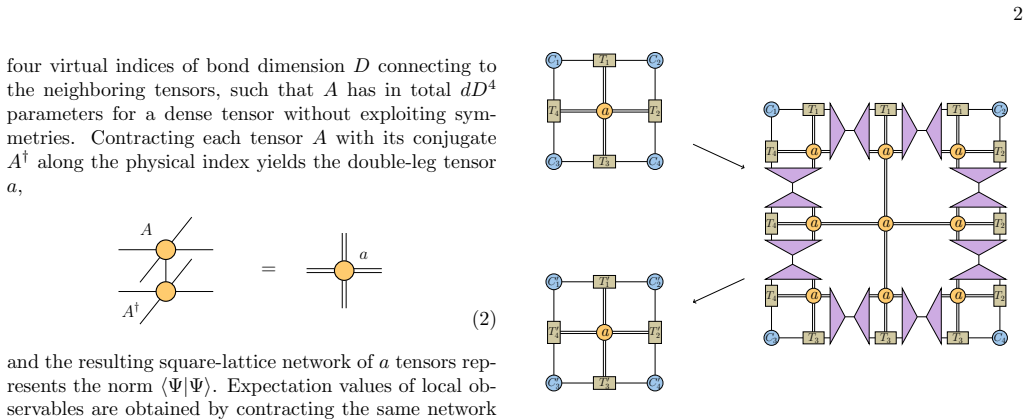
The central object is the QR-based projector pair. At each step, isometries X_n and Y_n are refined by the recurrences X_n R_x = MᵀM X_{n−1} and L_y Y_n = Y_{n−1} MMᵀ, then orthonormalized by QR/LQ; the large SVD of M is replaced by the small SVD of ρ = Y_n M X_n, truncated to χ singular values, and the projectors are rebuilt from u, v and the isometries. The gauge-fixing update Y_n ← uᵀY_n, X_n ← X_n v makes the environment converge element-wise, and after about five warm-up steps the isometries are recycled, so projector construction reduces to contractions that scale as χ³D⁴.
Load-bearing premise
The algorithm assumes that after roughly five warm-up QR subspace iterations, the recycled isometries span the dominant singular subspaces of the CTMRG environment accurately enough that a small-SVD truncation reproduces the exact-SVD fixed point; this can fail if the environment's singular values decay slowly or the environment shifts during optimization.
What would settle it
Compare SI-CTMRG and standard CTMRG on a model with a gapless or critical spectrum (e.g., the square-lattice Heisenberg model or a critical classical model) at fixed χ and D, monitoring the principal angles between recycled and exact subspaces and the resulting energy error; if the error does not vanish or the subspace misalignment stays above the 1e-3 threshold as χ grows, the five-iteration recycling assumption is falsified.
If this is right
- Large-D iPEPS optimizations become practical on GPUs: the authors report speedups up to 680× at D=6 over standard CTMRG on the same GPU, and up to 1600× comparing CPU-standard to GPU-SI.
- The method produces a new benchmark ground-state energy e0 = −0.55184(4) and magnetization m0 = 0.1492(33) for the triangular Heisenberg antiferromagnet, improving on prior iPEPS estimates, in about ten hours on one GPU.
- Fixed-point automatic differentiation becomes memory-light because backpropagation runs through a single CTMRG step rather than through the full iteration history, so memory use no longer scales with the number of CTMRG iterations.
- Because the scheme applies to multi-site unit cells (demonstrated for a 3×3 cell), it extends beyond single-site iPEPS to generic lattice models.
- The bottleneck shift means decomposition cost is no longer the limiting factor; at D=8, χ=224, decompositions account for less than 2% of runtime, so further optimizations of contraction order and GPU kernels will drive future speedups.
Where Pith is reading between the lines
- The power-iteration assumption ties the method's reliability to the spectral gap of the environment; models with near-degenerate or slowly decaying singular spectra may need more than five warm-up iterations or larger oversampling p, and the paper's sin²θ < 1e-3 recycling criterion is only checked during forward CTMRG, not across the whole optimization trajectory.
- The success here suggests that randomized/iterative linear-algebra schemes could replace exact SVDs in other tensor-network contraction algorithms (e.g., TRG-family methods) whose bottlenecks are similarly dominated by large decompositions.
- A direct stress test would apply SI-CTMRG to a gapless or critical two-dimensional model and compare environment accuracy against standard CTMRG at fixed χ and D; deviations would indicate when the recycled bases stop being faithful.
- The reported speedups are for a single-site ansatz; multi-site unit cells require warm-up initialization for each site's isometries, so the effective speedup for unit-cell calculations may be smaller, though still substantial.
Editorial analysis
A structured set of objections, weighed in public.
Referee Report
Summary. The paper introduces SI-CTMRG, a variant of CTMRG for iPEPS contraction in which the costly truncated SVD of the effective environment M (dimension N = χD^2) is replaced by QR-based subspace iteration onto a (χ+p)-dimensional subspace and a small SVD of ρ = Y^T M X. The central claims are (i) the dominant cost shifts from O(χ^3D^6) SVDs to O(χ^3D^4) tensor contractions, giving speedups of up to two orders of magnitude on CPU/GPU and up to 680× on H100 at D=6; (ii) recycling the isometries X,Y after roughly five warm-up steps preserves CTMRG accuracy; (iii) the method combines with fixed-point automatic differentiation; and (iv) on the triangular Heisenberg antiferromagnet it reaches state-of-the-art iPEPS energies with extrapolated e0 = -0.55184(4) and m0 = 0.1492(33) on a single H100 GPU in about 10 hours.
Significance. If the algorithmic and physics claims hold, this is a practically important contribution. The core idea is well motivated: replacing large SVDs with smaller, contraction-dominated operations is a natural fit for GPU acceleration and could extend CTMRG to larger χ and D in a wide range of iPEPS applications. The paper provides a clear algorithmic outline, a reproducible implementation (Ref. [71]), and a demanding benchmark problem. However, the central speedup and the equivalence of the SI-CTMRG fixed point to that of exact CTMRG rest on an empirical recycling assumption that is not supported by an error bound or by systematic numerical validation. The physics benchmark also shows an energy that lies about 1.6×10^-4 below the NQS reference, with no discussion of that tension. The paper is therefore promising and likely correct in its main algorithmic components, but the evidence as presented is not yet sufficient for the strength of the claims.
major comments (3)
- [QR-based projector, Step 4] The claim that recycled X,Y 'rarely need updating' after about five warm-up steps is load-bearing for both the O(χ^3D^4) cost and for the equivalence of SI-CTMRG to standard CTMRG. The paper provides no error bound and no singular-spectrum analysis: subspace iteration convergence depends on the gap σ_{χ+1}/σ_χ of M^T M, which is model- and χ-dependent. The only empirical support is the single D=5, χ=100 run in Fig. 2(a). The recycling criterion sin^2θ < 1e-3 is stated to be checked only during forward CTMRG, not through L-BFGS steps or D-ramping. If the subspace drifts, Eq. (5) updates must be repeated and the stated complexity is no longer guaranteed; if the drift is undetected, the SI-CTMRG fixed point is not the exact-CTMRG fixed point and the implicit-function gradient of Eq. (9) differentiates a different map. This gap must be addressed, for example by tracking principal angles thro
- [Differentiable fixed point, Eq. (9)] The implicit-function theorem used in Eq. (9) requires the CTMRG iteration map to be differentiable at the fixed point. In SI-CTMRG the map depends on the discrete choice between recycling and updating X,Y, controlled by the threshold sin^2θ < 1e-3; this introduces a nonsmooth switch. In addition, the random initialization of X_0 and Y_0 (Eq. (5) area) means that, unless the subspace iteration has fully converged, different runs could reach different fixed points. The paper does not state conditions under which the fixed-point map is differentiable or verify them numerically. Please add a regularity discussion and empirical checks on the existence and uniqueness of the SI-CTMRG fixed point for fixed A and χ.
- [Triangular Heisenberg benchmark, Table I and Fig. 3] The extrapolated energy e0 = -0.55184(4) lies about 1.6×10^-4 below the NQS result e0 = -0.55168(2) from Ref. [54], i.e., roughly eight combined standard errors, yet the paper does not discuss this tension. The FCLS extrapolation uses five points without per-D error bars and a single linear form in 1/ξ*^3 (energy) and 1/ξ* (magnetization). The claimed uncertainties of 0.00004 and 0.0033 are therefore difficult to interpret. Please provide a robustness analysis of the extrapolation (e.g., dropping endpoints, including a higher-order term, or varying the definition of ξ*) and discuss the relationship to the NQS energy. This is important because the 'state-of-the-art' claim goes beyond the algorithmic contribution and depends on the extrapolation reliability.
minor comments (6)
- [Eq. (7)] The displayed equation defining P_l and P_r is hard to parse: the placements of '= P_l' and 'P_r =' are ambiguous. Please rewrite so that each projector is defined with explicit indices and dimensions.
- [Eq. (5)] The expression 'L_y Y_n = Y_{n-1} M M^T' presumably denotes an LQ decomposition; please define L_y and clarify the shapes of X_n and Y_n after each update, especially the role of the oversampling parameter p.
- [Recycling criterion] The definition of sin^2θ = (1/χ) Σ_i sin^2θ_i should specify whether θ_i are the principal angles between successive X subspaces, successive Y subspaces, or a combined measure. Also clarify whether the χ-dimensional truncation of the (χ+p)-dimensional range is used.
- [Algorithm description, Step 4] The text says 'after the first ~5 warm-up steps following step 1', but Step 1 is not explicitly numbered in the displayed list. Please ensure the cross-reference is clear.
- [End Matter] The End Matter states that for larger unit cells 'initial warm-up procedures are required to initialize the environment tensors before applying power iterations', which appears to contradict the main-text statement that random Gaussian initialization followed by ~5 subspace iterations suffices. Please reconcile these statements.
- [Fig. 2(c)] The speedup ratios are reported as 'up to 680x' on the GPU and 'up to 1600' for CTMRG_CPU/SI-CTMRG_GPU. Please make explicit that the latter combines an algorithmic gain with a hardware difference, and state the precise χ and D values for the quoted maxima.
Circularity Check
No significant circularity: SI-CTMRG's small-SVD projector construction is a standard subspace-iteration approximation of the exact CTMRG SVD, and its benchmark results are validated externally rather than derived from fitted inputs.
full rationale
The central algorithmic step is Eqs. (5)-(7): X_n and Y_n are obtained by power iteration on M^T M and M M^T, and the projectors are assembled from the small SVD of rho = Y_n^T M X_n. This is a standard subspace-iteration / randomized low-rank approximation: if X_n and Y_n span the dominant (chi+p)-dimensional subspaces, the truncated SVD of rho reproduces the truncated SVD of M. No parameter of the algorithm is fitted to the target energies or magnetizations; p is a fixed oversampling parameter and the sin^2(theta) < 1e-3 recycling threshold is an empirical convergence criterion, not a fitted value. The benchmark in Fig. 2(a) compares SI-CTMRG against standard CTMRG on the same model, and the final extrapolated e0 and m0 are compared with independent iPEPS and ViT results [12,53,54]; although Ref. [12] shares an author, the comparison is external and not used as an input to the derivation. The use of the authors' prior QR-CTMRG [47] is motivational ('Based on this observation, we propose...') rather than a load-bearing uniqueness theorem, and the convergence to the SVD subspace is justified by standard power-iteration / randomized-SVD theory with cited external references [49-52]. The heuristic that about five warm-up steps suffice is a performance/robustness assumption; if it fails, the complexity or fixed-point claims weaken, but that is a correctness risk, not a circularity. There is no step in which a fitted quantity is renamed as a prediction or in which a target result is assumed by definition.
Axiom & Free-Parameter Ledger
free parameters (3)
- oversampling parameter p =
p=5 for Fig. 2; p=0.15*chi for the large-scale runs
- recycling alignment threshold sin^2(theta) < 1e-3 =
1e-3
- number of warm-up subspace steps (~5) =
~5
axioms (4)
- domain assumption The QR-based power iteration on M^T M converges to the dominant singular subspace of M for generic iPEPS environments M.
- domain assumption The CTMRG fixed-point environment exists and is unique for the iPEPS contraction problem.
- domain assumption The triangular Heisenberg ground state is well described by a single-site spiral iPEPS ansatz with a fixed wave vector k = (2pi/3, 2pi/3).
- domain assumption FCLS (finite correlation length scaling) extrapolation to D -> infinity is valid for the triangular Heisenberg model.
read the original abstract
The corner transfer matrix renormalization group (CTMRG) is one of the standard contraction methods for infinite projected entangled-pair states (iPEPS), but its computational cost is dominated by repeated truncated singular value decompositions (SVDs). We introduce subspace-iteration CTMRG (SI-CTMRG), a QR-based projector construction that replaces each large-matrix SVD with an SVD of a much smaller matrix. The resulting algorithm shifts the dominant cost from decompositions to tensor contractions, making it highly suited to GPU acceleration and yielding speedups of up to two orders of magnitude over standard CTMRG. We demonstrate the efficiency and accuracy of the method for the triangular-lattice Heisenberg antiferromagnet, reaching state-of-the-art iPEPS results on a single H100 GPU in approximately 10 hours of computation.
Figures


Reference graph
Works this paper leans on
-
[1]
(3)), where the oversampling parameterpdenotes a small number of additional environment states
At each CTMRG step, one subspace-iteration up- date refines the isometries (rangefinders)X n,Y n toward the dominant (χ+p)-dimensional subspaces ofM(the effective environment of the virtual bonds, as shown in Eq. (3)), where the oversampling parameterpdenotes a small number of additional environment states. The isometries are initialized with random Gauss...
-
[2]
The SVD used to compute the projectors is there- fore performed only on the small (χ+p)×(χ+p) matrix ρ=Y n M Xn =u s v†, and is truncated toχsingular values, i.e.,ρ≈u χ sχ v† χ, Yn M Xn = u s v† (6)
-
[3]
The (χ+p)× (χ+p) unitary matricesu, vfrom the small SVD ofρ fix the basis within the (χ+p)-dimensional subspaces represented byX n andY n
The projectors for the CTMRG step are reassem- bled with: ˜C2 ˜C3 Xn vχ s−1/2χ = Pl s−1/2χ u†χ Yn ˜C4 ˜C1Pr = (7) where the updated isometries are applied. The (χ+p)× (χ+p) unitary matricesu, vfrom the small SVD ofρ fix the basis within the (χ+p)-dimensional subspaces represented byX n andY n. They are absorbed back into the updated isometries to be used ...
-
[4]
(8) and sign- fixing of the SVD [58], CTMRG approaches a fixed point at whichCandTconverge element-wise
With the gauge-fixing step in Eq. (8) and sign- fixing of the SVD [58], CTMRG approaches a fixed point at whichCandTconverge element-wise. Consequently, the dominant subspaces also stabilize, which allows us to recycleX n andY n across CTMRG iterations. In prac- tice, after the first∼5 warm-up steps following step 1, the recycled bases rarely need updatin...
-
[5]
Niesen and P
I. Niesen and P. Corboz, SciPost Phys.3, 030 (2017)
2017
- [6]
-
[7]
Y. Nishio, N. Maeshima, A. Gendiar, and T. Nishino, (2004), arXiv:cond-mat/0401115
Pith/arXiv arXiv 2004
-
[8]
Jordan, R
J. Jordan, R. Or´ us, G. Vidal, F. Verstraete, and J. I. Cirac, Phys. Rev. Lett.101, 250602 (2008)
2008
-
[9]
Liao, Z.-Y
H.-J. Liao, Z.-Y. Xie, J. Chen, Z.-Y. Liu, H.-D. Xie, R.- Z. Huang, B. Normand, and T. Xiang, Phys. Rev. Lett. 118, 137202 (2017)
2017
-
[10]
J. L. Jim´ enezet al., Nature592, 370 (2021)
2021
-
[11]
S. S. Jahromi, R. Or´ us, M. Kargarian, and A. Langari, Phys. Rev. B98, 155108 (2018)
2018
-
[12]
Hasik, D
J. Hasik, D. Poilblanc, and F. Becca, SciPost Phys.10, 012 (2021)
2021
-
[13]
Hasik, M
J. Hasik, M. V. Damme, D. Poilblanc, and L. Vander- straeten, Phys. Rev. Lett.129, 177201 (2022)
2022
-
[14]
W.-Y. Liu, J. Hasik, S.-S. Gong, D. Poilblanc, W.-Q. Chen, and Z.-C. Gu, Phys. Rev. X12, 031039 (2022)
2022
- [15]
-
[16]
H.-Y. Lee, R. Kaneko, L. E. Chern, T. Okubo, Y. Yamaji, N. Kawashima, and Y. B. Kim, Nat. Commun.11, 1639 (2020)
2020
-
[17]
Hasik and P
J. Hasik and P. Corboz, Phys. Rev. Lett.133, 176502 (2024)
2024
-
[18]
P. Schmoll, J. Naumann, E. L. Weerda, J. Eisert, and Y. Iqbal, (2024), arXiv:2407.07145
Pith/arXiv arXiv 2024
-
[19]
Corboz, Y
P. Corboz, Y. Zhang, B. Ponsioen, and F. Mila, Phys. Rev. Lett.136, 186701 (2026)
2026
-
[20]
Zhang, A
Y. Zhang, A. Sinha, M. M. Rams, and J. Dziarmaga, Phys. Rev. B113, 085113 (2026)
2026
-
[21]
L. Ma, W.-L. Tu, D. Poilblanc, and J.-Y. Chen, (2026), arXiv:2606.31021
Pith/arXiv arXiv 2026
-
[22]
Corboz, T
P. Corboz, T. M. Rice, and M. Troyer, Phys. Rev. B90, 035142 (2014)
2014
-
[23]
Ponsioen, S
B. Ponsioen, S. S. Chung, and P. Corboz, Phys. Rev. B 100, 195141 (2019)
2019
-
[24]
Ponsioen, S
B. Ponsioen, S. S. Chung, and P. Corboz, Phys. Rev. B 108, 205154 (2023)
2023
-
[25]
H. Chen, T. Neupert, and J. Hasik, (2025), arXiv:2512.20697
Pith/arXiv arXiv 2025
-
[26]
J.-Y. Chen, L. Vanderstraeten, S. Capponi, and D. Poil- blanc, Phys. Rev. B98, 184409 (2018)
2018
-
[27]
S. S. Chung and P. Corboz, Phys. Rev. B100, 035134 (2019)
2019
-
[28]
Gauth´ e, S
O. Gauth´ e, S. Capponi, M. Mambrini, and D. Poilblanc, Phys. Rev. B101, 205144 (2020)
2020
-
[29]
E. L. Weerda and M. Rizzi, Phys. Rev. B109, L241117 (2024)
2024
-
[30]
Nietneret al., Quantum4, 328 (2020)
A. Nietneret al., Quantum4, 328 (2020)
2020
-
[31]
Nishino and K
T. Nishino and K. Okunishi, J. Phys. Soc. Jpn.65, 891 (1996)
1996
-
[32]
Nishino and K
T. Nishino and K. Okunishi, J. Phys. Soc. Jpn.66, 3040 (1997)
1997
-
[33]
Or´ us and G
R. Or´ us and G. Vidal, Phys. Rev. B80, 094403 (2009)
2009
-
[34]
Corboz, S
P. Corboz, S. R. White, G. Vidal, and M. Troyer, Phys. Rev. B84, 041108(R) (2011)
2011
-
[35]
Z. Y. Xie, J. Chen, M. P. Qin, J. W. Zhu, L. P. Yang, and T. Xiang, Phys. Rev. B86, 045139 (2012)
2012
-
[36]
Zauner-Stauber, L
V. Zauner-Stauber, L. Vanderstraeten, M. T. Fishman, F. Verstraete, and J. Haegeman, Phys. Rev. B97, 045145 (2018)
2018
-
[37]
M. T. Fishman, L. Vanderstraeten, V. Zauner-Stauber, J. Haegeman, and F. Verstraete, Phys. Rev. B98, 235148 (2018)
2018
-
[38]
Vanderstraeten, J
L. Vanderstraeten, J. Haegeman, and F. Verstraete, Phys. Rev. B105, 195140 (2022)
2022
-
[39]
Levin and C
M. Levin and C. P. Nave, Phys. Rev. Lett.99, 120601 (2007)
2007
-
[40]
Zhang, S
X.-Y. Zhang, S. Liang, H.-J. Liao, W. Li, and L. Wang, Phys. Rev. B108, 085103 (2023)
2023
-
[41]
Evenbly and G
G. Evenbly and G. Vidal, Phys. Rev. Lett.115, 180405 (2015)
2015
-
[42]
Corboz, Phys
P. Corboz, Phys. Rev. B94, 035133 (2016)
2016
-
[43]
Vanderstraeten, J
L. Vanderstraeten, J. Haegeman, P. Corboz, and F. Ver- straete, Phys. Rev. B94, 155123 (2016)
2016
-
[44]
Liao, J.-G
H.-J. Liao, J.-G. Liu, L. Wang, and T. Xiang, Phys. Rev. X9, 031041 (2019)
2019
-
[45]
A. D. S. Richards and E. S. Sørensen, (2025), arXiv:2503.13900
Pith/arXiv arXiv 2025
-
[46]
Francuz, N
A. Francuz, N. Schuch, and B. Vanhecke, Phys. Rev. Res. 7, 013237 (2025)
2025
-
[47]
Haghshenas, S.-S
R. Haghshenas, S.-S. Gong, and D. N. Sheng, Phys. Rev. B99, 174423 (2019). 7
2019
- [48]
-
[49]
Naumann, E
J. Naumann, E. L. Weerda, J. Eisert, M. Rizzi, and P. Schmoll, Phys. Rev. B111, 235116 (2025)
2025
-
[50]
E. J. Nystr¨ om, Acta Math.54, 185 (1930)
1930
-
[51]
Unfried, J
J. Unfried, J. Hauschild, and F. Pollmann, Phys. Rev. B 107, 155133 (2023)
2023
-
[52]
Zhang, Q
Y. Zhang, Q. Yang, and P. Corboz, Phys. Rev. B113, L201106 (2026)
2026
-
[53]
Yang and P
Q. Yang and P. Corboz, Phys. Rev. B113, 085109 (2026)
2026
-
[54]
Halko, P.-G
N. Halko, P.-G. Martinsson, and J. A. Tropp, SIAM Rev. 53, 217 (2011)
2011
-
[55]
L. Wang, I. Piˇ zorn, and F. Verstraete, Phys. Rev. B83, 134421 (2011)
2011
-
[56]
C. K. I. Williams and M. Seeger, inAdvances in Neural Information Processing Systems, Vol. 13 (2001) p. 682
2001
-
[57]
Nakatsukasa, (2020), arXiv:2009.11392
Y. Nakatsukasa, (2020), arXiv:2009.11392
Pith/arXiv arXiv 2020
- [58]
-
[59]
L. L. Viteritti, R. Rende, S. Sachdev, and G. Carleo, (2026), arXiv:2602.02665
arXiv 2026
-
[60]
H. N. Phien, J. A. Bengua, H. D. Tuan, P. Corboz, and R. Or´ us, Phys. Rev. B92, 035142 (2015)
2015
-
[61]
Huang, P
Y.-K. Huang, P. Chen, and Y.-J. Kao, Phys. Rev. B86, 235102 (2012)
2012
-
[62]
G. H. Golub and C. F. V. Loan,Matrix Computations, 4th ed. (Johns Hopkins University Press, Baltimore, 2013)
2013
-
[63]
R. Bro, E. Acar, and T. G. Kolda, Journal of Chemo- metrics22, 135 (2008)
2008
-
[64]
H. C. Jiang, Z. Y. Weng, and T. Xiang, Phys. Rev. Lett. 101, 090603 (2008)
2008
-
[65]
Bauer, P
B. Bauer, P. Corboz, A. M. L¨ auchli, L. Messio, K. Penc, M. Troyer, and F. Mila, Phys. Rev. B85, 125116 (2012)
2012
-
[66]
Czarnik, J
P. Czarnik, J. Dziarmaga, and P. Corboz, Phys. Rev. B 99, 035115 (2019)
2019
-
[67]
Xieet al., Phys
Z.-Y. Xieet al., Phys. Rev. B101, 220409(R) (2020)
2020
-
[68]
Capriotti, A
L. Capriotti, A. E. Trumper, and S. Sorella, Phys. Rev. Lett.82, 3899 (1999)
1999
-
[69]
S. R. White and A. L. Chernyshev, Phys. Rev. Lett.99, 127004 (2007)
2007
-
[70]
Bauer, P
B. Bauer, P. Corboz, R. Or´ us, and M. Troyer, Phys. Rev. B83, 125106 (2011)
2011
-
[71]
Niesen and P
I. Niesen and P. Corboz, Phys. Rev. B97, 245146 (2018)
2018
-
[72]
M. M. Rams, P. Czarnik, and L. Cincio, Phys. Rev. X8, 041033 (2018)
2018
-
[73]
Vanhecke, J
B. Vanhecke, J. Hasik, F. Verstraete, and L. Vander- straeten, Phys. Rev. Lett.129, 200601 (2022)
2022
-
[74]
Singh, R
S. Singh, R. N. C. Pfeifer, and G. Vidal, Phys. Rev. B 83, 115125 (2011)
2011
-
[76]
Fast two-dimensional tensor- network contraction via subspace iteration
Y. Zhang, Code for “Fast two-dimensional tensor- network contraction via subspace iteration”,https:// github.com/erwinzhang1217/SI-CTMRG(2026). End Matter Larger unit-cell CTMRG.—While in the main text we focused on the single-site iPEPS ansatz, SI-CTMRG can be generalized to arbitrary unit cells of sizeL x ×L y that are tiled periodically over the infini...
2026
-
[1600]
The main source of this improvement is that, in 0 50 100 150 200 250 300 350 400 optimization step k 10 3 10 2 10 1 |Ek − Eref| (a) CTMRG SI-CTMRG 2 3 4 5 6 bond dimension D 100 101 102 103 104 time per step [s] (b) CTMRG GPU CTMRG CPU SI-CTMRG GPU SI-CTMRG CPU 2 3 4 5 6 bond dimension D 100 101 102 103 speedup (c) GPU: CTMRG/SI-CTMRG CPU: CTMRG/SI-CTMRG ...
2020
discussion (0)
Sign in with ORCID, Apple, or X to comment. Anyone can read and Pith papers without signing in.