REVIEW 2 major objections 5 minor 1 cited by
A 27-million-parameter bidirectional Mamba model, pre-trained with scatter-guided masking that follows radar physics, matches or beats far larger CNN and Transformer SAR foundation models on seven classification and detection benchmarks.
Reviewed by Pith at T0; open to challenge. T0 means a machine referee read the full paper against a public rubric. the ladder, T0–T4 →
A Mamba-based MAE with three-level scatter-guided masking and two-stage ImageNet-to-SAR pre-training yields SOTA or near-SOTA SAR ATR performance at ~27M parameters.
T0 review reviewed 2026-07-12 challenge →
load-bearing objection Solid systems paper: 27M bidirectional Mamba + scatter-guided MAE beats heavier SAR foundation models on most of seven public benchmarks; the SG-MAE lift is real but under-ablated. the 2 major comments →
SAMBA: A Scatter-Guided Masked Bidirectional Mamba Foundation Model for SAR Target Recognition
The pith
A machine-rendered reading of the paper's core claim, the machinery that carries it, and where it could break.
The reading
Core claim
Under two-stage cross-domain self-supervised pre-training, the SAMBA architecture (mid-sequence CLS token inside a bidirectional Mamba encoder, SG-MAE hierarchical masking, SpatialMix decoder) yields state-of-the-art or best-in-class accuracy on most metrics across seven SAR classification and detection datasets while using roughly one-third the parameters of the next-best Transformer baseline; the same backbone trained with standard random MAE masking is substantially weaker in the few-shot regime.
What carries the argument
SG-MAE (Scatter-Guided Masked Autoencoder): a three-level hierarchical masking procedure that first builds a local-density ratio map, then samples multi-scale irregular blocks, then modulates patch probabilities by measured scatterer contrast so that the pretext task is forced to reconstruct the physically informative regions of a SAR image.
Load-bearing premise
The hand-crafted three-level density-and-contrast masking rules truly encode SAR electromagnetic scattering physics rather than merely fitting the particular pre-training collection and the seven evaluation datasets.
What would settle it
Train the identical Mamba backbone once with SG-MAE and once with ordinary random MAE on a held-out SAR sensor or frequency band never seen in the 186 K pre-training set; if the few-shot transfer gap disappears or reverses, the physical-prior claim fails.
If this is right
- Linear-complexity state-space backbones become practical drop-in replacements for Transformers in high-resolution SAR foundation models.
- Few-shot SAR classification and detection can be improved simply by changing the masking schedule to respect scatterer density, without collecting more labels.
- Two-stage ImageNet-then-SAR pre-training is confirmed as the preferred recipe for all tested backbones, including Mamba.
- Lightweight SpatialMix-style decoders can replace quadratic self-attention in the reconstruction head without loss of transfer performance.
Where Pith is reading between the lines
- If SG-MAE truly captures scattering physics, the same density-and-contrast mask schedule should transfer to polarimetric or multi-frequency SAR with only coefficient re-tuning.
- The mid-sequence CLS token idea may improve any bidirectional state-space vision model, not only SAR ones.
- Failure of SG-MAE on non-target-centric SAR tasks (e.g., large-area land-cover mapping) would indicate the method is specialized to discrete strong scatterers rather than general SAR imagery.
Editorial analysis
A structured set of objections, weighed in public.
Referee Report
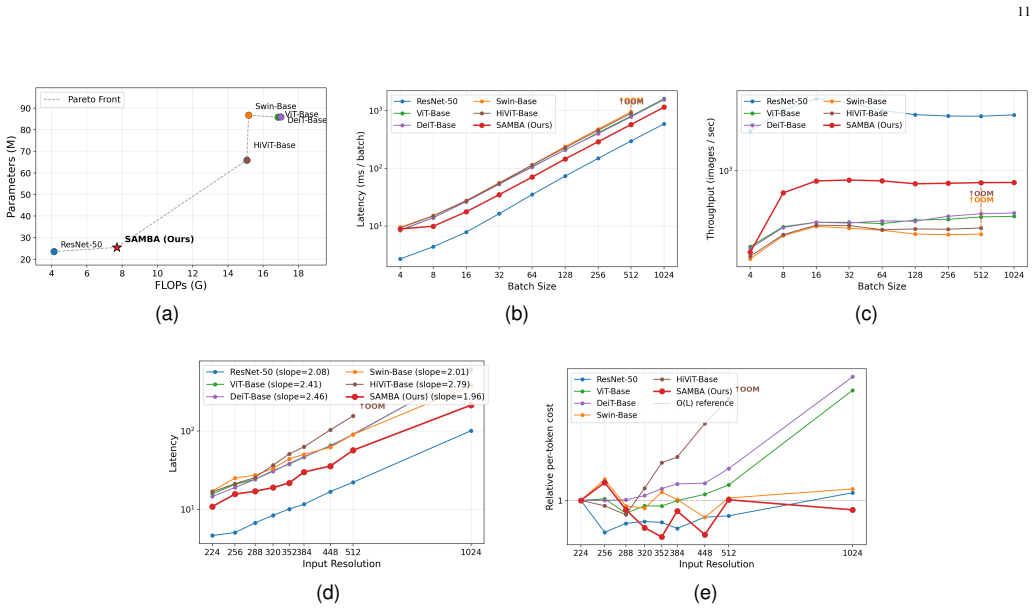
Summary. The paper proposes SAMBA, a self-supervised foundation model for SAR ATR that replaces Transformer backbones with a linear-complexity bidirectional Mamba encoder (mid-sequence CLS token, overlapped patch embedding), introduces a three-level Scattering-Guided MAE (SG-MAE) masking strategy driven by local scatterer density, multi-scale blocks, and contrast-modulated probabilities (Algorithm 1), and uses a lightweight SpatialMix decoder of depthwise Conv1d + channel MLP. A two-stage ImageNet-then-186K-SAR pre-training pipeline is used. On the same Mamba backbone, SG-MAE improves 5/10/20-shot accuracy from 72.9/78.9/82.1 to 80.6/83.6/88.1 (Table II). Across seven public classification and detection benchmarks the model reports best or second-best numbers on most metrics while using only 27 M parameters, with efficiency plots (Fig. 4) confirming near-linear scaling.
Significance. If the reported gains hold under proper controls, the work supplies a practical, open-source (code + weights promised) linear-time alternative to Transformer SAR foundation models and shows that injecting simple SAR scattering priors into the MAE mask can materially improve few-shot transfer. The clean backbone-and-pretraining isolation in Table II and the multi-task evaluation on seven public datasets are genuine strengths; the efficiency analysis further supports deployability on high-resolution SAR. The contribution is therefore of clear interest to the SAR ATR and remote-sensing foundation-model communities, provided the SG-MAE lift is shown to be robust rather than a single-run or single-component artifact.
major comments (2)
- Table II (Mamba rows, two-stage setting) attributes a large few-shot jump (72.9/78.9/82.1 → 80.6/83.6/88.1) solely to SG-MAE versus ordinary random MAE. Section III-B and Algorithm 1 define three hierarchical levels with free parameters (ratio_delta, block-size probabilities 0.3/0.4/0.3, α, β, T=μ+1.2σ). No ablation that independently enables/disables each level while holding the Mamba backbone and two-stage schedule fixed is reported, nor are multi-seed means and standard deviations. Without these controls the central claim that the hierarchical scattering-guided design is responsible for the lift remains under-supported and could be driven by a single tunable component or run variance.
- Downstream SOTA rankings in Tables III–IV are likewise single-run point estimates. Several metrics already show the method second-best (MSTAR 5-shot, SAR-ACD 30 %, some mAP50 entries). Given that the paper’s strongest claim is “SOTA on most metrics,” at least multi-seed statistics or an explicit statement of variance for the key detection and few-shot numbers is needed before the ranking can be treated as reliable.
minor comments (5)
- Hyper-parameter values for α, β, mask_ratio and ratio_delta used in the final SG-MAE runs are never stated; only the functional forms appear in Eq. (7) and Algorithm 1. Please list the concrete settings.
- Fig. 3 caption and surrounding text claim that SG-MAE “concentrates more on regions with target strong scatterers,” yet no quantitative mask-coverage statistics (e.g., fraction of strong-scatterer pixels masked) are supplied to support the visual comparison.
- Notation inconsistency: the abstract and title use “SAMBA” while the introduction occasionally writes “scattering-guided bidirectional Mamba (SAMBA)”; keep a single expanded form.
- Several author names and affiliations contain obvious typos (e.g., “Sunping Xiao” vs “Shunping Xiao,” “Zhaoyu GU” capitalization). Clean the front-matter.
- Related-work Table I lists “SAMBA 2026”; the arXiv stamp is 2026, but the year column should be consistent with the actual publication year once known.
Circularity Check
No significant circularity: SAMBA is an empirical SSL architecture paper whose claims rest on held-out public-benchmark measurements, not on predictions that reduce to their own inputs by construction.
full rationale
The paper’s load-bearing claims are architectural (linear-complexity Bi-Mamba encoder with mid-sequence CLS, SpatialMix decoder) and empirical (few-shot and detection numbers under a two-stage ImageNet→186K-SAR pre-training schedule). Performance is reported on independent public datasets (MSTAR, FUSAR-Ship, SAR-ACD, SSDD, SARDet-100K, SIVED, SAR-Aircraft) that are not part of the pre-training objective, so the evaluation loop does not close on the training signal. SG-MAE is a hand-designed three-level masking heuristic (density ratio map, multi-scale blocks with fixed 0.3/0.4/0.3, scatterer-contrast modulation with free α, β); the paper presents it as a design choice guided by SAR scattering priors and then measures transfer accuracy, not as a first-principles derivation that “predicts” a quantity already fixed by those same coefficients. No equation equates a claimed prediction to a fitted constant; no uniqueness theorem is imported from the authors’ prior work to forbid alternatives; self-citations (e.g., Adv-STMamba, air-target intent papers) appear only as related-work context and do not underwrite the SOTA tables. Missing ablations and single-run variance are experimental-rigor concerns, not circularity. The derivation chain is therefore self-contained against external benchmarks.
Axiom & Free-Parameter Ledger
free parameters (4)
- global mask_ratio and ratio_delta
- block-size sampling probabilities (0.3, 0.4, 0.3 for 1×1 / 2×2 / 4×4)
- scatterer-contrast coefficients α, β and threshold T=μ+1.2σ
- patch size P, stride S, state dimension N, expansion E
axioms (3)
- domain assumption Discriminative information in SAR imagery is concentrated in a sparse set of high-intensity electromagnetic scatterers; background regions are largely redundant for recognition.
- domain assumption Selective state-space models (Mamba) with bidirectional scanning and a mid-sequence CLS token can aggregate global spatial context under linear complexity.
- ad hoc to paper Two-stage pre-training (ImageNet SSL then SAR SSL) is superior to single-domain pre-training for SAR transfer.
invented entities (2)
-
SG-MAE three-level hierarchical masking
no independent evidence
-
SpatialMix decoder unit
no independent evidence
Cite this review
Pith. "Pith review of SAMBA: A Scatter-Guided Masked Bidirectional Mamba Foundation Model for SAR Target Recognition." pith.science (2026). https://pith.science/paper/6Q5PPEQX
@misc{pith2026260631668,
  author       = {Pith},
  title        = {Pith review of: SAMBA: A Scatter-Guided Masked Bidirectional Mamba Foundation Model for SAR Target Recognition},
  year         = {2026},
  howpublished = {\url{https://pith.science/paper/6Q5PPEQX}},
  note         = {Machine review of arXiv:2606.31668}
}
read the original abstract
Synthetic aperture radar automatic target recognition (SAR ATR) is critical for Earth observation and defense, but its practical deployment is constrained by scarce annotated training data. Self-supervised pre-training alleviates this label bottleneck, yet prevailing Transformer architectures incur prohibitive quadratic computational complexity, and conventional universal masking neglects the unique electromagnetic scattering properties intrinsic to SAR imagery. To address these limitations, we propose SAMBA (Scattering-Guided Bidirectional Mamba), an efficient self-supervised pre-training foundation model for SAR target interpretation. Our framework features three core innovations: (i) a linear-complexity Mamba encoder with a mid-sequence class token to mitigate computational bottlenecks; (ii) a three-level hierarchical Scattering-Guided Masked Autoencoder (SG-MAE) masking strategy guided by SAR physical priors, aligning the pretext task with SAR's intrinsic imaging mechanism; (iii) a lightweight SpatialMix feature interaction module to enhance cross-region feature fusion. We also design a two-stage cross-domain pre-training pipeline to optimize the overall pre-training process. Extensive evaluations demonstrate that SAMBA consistently delivers superior performance across all pre-training configurations, with substantially fewer parameters than both CNN and Transformer baselines. Compared with the default masking strategy in standard MAE, the proposed SG-MAE strategy further boosts the model's few-shot transfer capability. Benchmarking on seven downstream datasets covering classification and detection tasks shows SAMBA achieves state-of-the-art (SOTA) performance on most metrics, fully validating its robust generalizability across diverse SAR interpretation tasks. Source code and pre-trained weights are publicly available at https://github.com/mynswkk/SAMBA.
Figures



Forward citations
Cited by 1 Pith paper
-
SARATR-X-v2: Scale-Aware Structural Pre-Training for SAR Foundation Models
A learnable-weighted fusion of six fixed, speckle-robust structural operators as the masked pre-training target transfers better than pixel targets on 10 of 12 SAR benchmarks.
Reference graph
Works this paper leans on
-
[1]
Review of synthetic aperture radar automatic target recognition: A dual perspective on classical and deep learning techniques,
J. Slesinski and D. Wierzbicki, “Review of synthetic aperture radar automatic target recognition: A dual perspective on classical and deep learning techniques,”IEEE J. Sel. Top. Appl. Earth Observations Remote Sensing, vol. 18, pp. 18 978–19 024, 2025
2025
-
[2]
Principal component maximization: A novel method for SAR image recovery from raw data without system parameters,
H. Yang, L. Chen, S.-S. Zuo, Z. Liu, and J. Yang, “Principal component maximization: A novel method for SAR image recovery from raw data without system parameters,”IEEE Trans. on Image Process., vol. 35, pp. 1231–1245, 2026
2026
-
[3]
Arbitrary-direction SAR ship detection method for multiscale imbal- ance,
Z. Sun, X. Leng, X. Zhang, Z. Zhou, B. Xiong, K. Ji, and G. Kuang, “Arbitrary-direction SAR ship detection method for multiscale imbal- ance,”IEEE Trans. Geosci. Remote Sensing, vol. 63, pp. 1–21, 2025
2025
-
[4]
Recent advances in deep-learning-based SAR image target detection and recognition,
P. Lang, X. Fu, J. Dong, H. Yang, J. Yin, J. Yang, and M. Martorella, “Recent advances in deep-learning-based SAR image target detection and recognition,”IEEE J. Sel. Top. Appl. Earth Observations Remote Sensing, vol. 18, pp. 6884–6915, 2025
2025
-
[5]
Cross-sensor SAR image target detection based on dynamic feature discrimination and center-aware calibration,
X. Zhang, S. Zhang, Z. Sun, C. Liu, Y . Sun, K. Ji, and G. Kuang, “Cross-sensor SAR image target detection based on dynamic feature discrimination and center-aware calibration,”IEEE Trans. Geosci. Re- mote Sensing, vol. 63, pp. 1–17, 2025
2025
-
[6]
Lightweight SAR ship detection via pearson correlation and nonlocal distillation,
Y . Zhang, W. Cai, J. Guo, H. Kong, Y . Huang, and X. Ding, “Lightweight SAR ship detection via pearson correlation and nonlocal distillation,” IEEE Geosci. Remote Sensing Lett., vol. 22, pp. 1–5, 2025
2025
-
[7]
MaDiNet: Mamba diffusion network for SAR target detection,
J. Zhou, Y . Liu, B. Peng, L. Liu, and X. Li, “MaDiNet: Mamba diffusion network for SAR target detection,”IEEE Trans. Circuits Syst. Video Technol., vol. 35, no. 11, pp. 10 787–10 800, Nov. 2025
2025
-
[8]
Target-aspect domain continual learning for SAR target recognition,
H. Chen, C. Du, J. Zhu, and D. Guo, “Target-aspect domain continual learning for SAR target recognition,”IEEE Transactions on Geoscience and Remote Sensing, vol. 63, pp. 1–14, 2025
2025
-
[9]
Distributed spaceborne SAR: A review of systems, applications, and the road ahead,
C. Hu, Y . Li, Z. Chen, F. Liu, Q. Zhang, A. V . Monti-Guarnieri, S. Hobbs, A. Anghel, and M. Datcu, “Distributed spaceborne SAR: A review of systems, applications, and the road ahead,”IEEE Geosci. Remote Sens. Mag., vol. 13, no. 2, pp. 329–361, Jun. 2025. 12 Input Truth Swin ConvNeXt ResNet-50 SAMBA Fig. 5. Visualization of detection on SIVED dataset
2025
-
[10]
DiffDet4SAR: Diffusion-based aircraft target detection network for SAR images,
J. Zhou, C. Xiao, B. Peng, Z. Liu, L. Liu, Y . Liu, and X. Li, “DiffDet4SAR: Diffusion-based aircraft target detection network for SAR images,”IEEE Geosci. Remote Sensing Lett., vol. 21, pp. 1–5, 2024
2024
-
[11]
Target recognition in single-channel SAR images based on the complex-valued convolutional neural network with data augmentation,
R. Wang, Z. Wang, K. Xia, H. Zou, and J. Li, “Target recognition in single-channel SAR images based on the complex-valued convolutional neural network with data augmentation,”IEEE Trans. Aerosp. Electron. Syst., pp. 1–8, 2022
2022
-
[12]
SAR despeckling using multiobjective neural network trained with generic statistical samples,
S. Vitale, G. Ferraioli, A. C. Frery, V . Pascazio, D.-X. Yue, and F. Xu, “SAR despeckling using multiobjective neural network trained with generic statistical samples,”IEEE Trans. Geosci. Remote Sensing, vol. 61, pp. 1–12, 2023
2023
-
[13]
A robust one-stage detector for multiscale ship detection with complex background in massive SAR images,
X. Yang, X. Zhang, N. Wang, and X. Gao, “A robust one-stage detector for multiscale ship detection with complex background in massive SAR images,”IEEE Trans. Geosci. Remote Sensing, vol. 60, pp. 1–12, 2022
2022
-
[14]
Scattering-point-guided RPN for 13 oriented ship detection in SAR images,
Y . Zhang, D. Lu, X. Qiu, and F. Li, “Scattering-point-guided RPN for 13 oriented ship detection in SAR images,”Remote Sensing, vol. 15, no. 5, p. 1411, Mar. 2023
2023
-
[15]
Unpaired speckle extraction for SAR despeckling,
H. Lin, Y . Zhuang, Y . Huang, and X. Ding, “Unpaired speckle extraction for SAR despeckling,”IEEE Trans. Geosci. Remote Sensing, vol. 61, pp. 1–14, 2023
2023
-
[16]
Conditional diffusion for SAR to optical image translation,
X. Bai, X. Pu, and F. Xu, “Conditional diffusion for SAR to optical image translation,”IEEE Geosci. Remote Sensing Lett., vol. 21, pp. 1– 5, 2024
2024
-
[17]
Limited-data SAR ATR causal method via dual-invariance interven- tion,
C. Wang, R. Xu, Y . Huang, J. Pei, C. Huang, W. Zhu, and J. Yang, “Limited-data SAR ATR causal method via dual-invariance interven- tion,”IEEE Trans. Geosci. Remote Sensing, vol. 63, pp. 1–19, 2025
2025
-
[18]
A novel CFAR-based ship detection method using range-compressed data for spaceborne SAR system,
C. Wang, B. Guo, J. Song, F. He, and C. Li, “A novel CFAR-based ship detection method using range-compressed data for spaceborne SAR system,”IEEE Trans. Geosci. Remote Sensing, vol. 62, pp. 1–15, 2024
2024
-
[19]
A sentinel-1 SAR-based global 1-km resolution soil moisture data product: Algorithm and preliminary assessment,
D. Fan, T. Zhao, X. Jiang, A. Garc ´ıa-Garc´ıa, T. Schmidt, L. Samaniego, S. Attinger, H. Wu, Y . Jiang, J. Shi, L. Fan, B.-H. Tang, W. Wagner, W. Dorigo, A. Gruber, F. Mattia, A. Balenzano, L. Brocca, T. Jagdhuber, J.-P. Wigneron, C. Montzka, and J. Peng, “A sentinel-1 SAR-based global 1-km resolution soil moisture data product: Algorithm and preliminary...
2025
-
[20]
SAR data applications in earth observation: An overview,
A. Tsokas, M. Rysz, P. M. Pardalos, and K. Dipple, “SAR data applications in earth observation: An overview,”Expert Systems with Applications, vol. 205, p. 117342, Nov. 2022
2022
-
[21]
Target classification using the deep convolutional networks for SAR images,
S. Chen, H. Wang, F. Xu, and Y .-Q. Jin, “Target classification using the deep convolutional networks for SAR images,”IEEE Trans. Geosci. Remote Sensing, vol. 54, no. 8, pp. 4806–4817, Aug. 2016
2016
-
[22]
HRSID: A high-resolution SAR images dataset for ship detection and instance segmentation,
S. Wei, X. Zeng, Q. Qu, M. Wang, H. Su, and J. Shi, “HRSID: A high-resolution SAR images dataset for ship detection and instance segmentation,”IEEE Access, vol. 8, pp. 120 234–120 254, 2020
2020
-
[23]
A SAR dataset of ship detection for deep learning under complex backgrounds,
Y . Wang, C. Wang, H. Zhang, Y . Dong, and S. Wei, “A SAR dataset of ship detection for deep learning under complex backgrounds,”Remote Sensing, vol. 11, no. 7, p. 765, Mar. 2019
2019
-
[24]
What, where, and how to transfer in SAR target recognition based on deep CNNs,
Z. Huang, Z. Pan, and B. Lei, “What, where, and how to transfer in SAR target recognition based on deep CNNs,”IEEE Trans. Geosci. Remote Sensing, vol. 58, no. 4, pp. 2324–2336, Apr. 2020
2020
-
[25]
Squeeze and excitation rank faster R-CNN for ship detection in SAR images,
Z. Lin, K. Ji, X. Leng, and G. Kuang, “Squeeze and excitation rank faster R-CNN for ship detection in SAR images,”IEEE Geosci. Remote Sensing Lett., vol. 16, no. 5, pp. 751–755, May 2019
2019
-
[26]
CRTransSar: A visual transformer based on contextual joint representation learning for SAR ship detection,
R. Xia, J. Chen, Z. Huang, H. Wan, B. Wu, L. Sun, B. Yao, H. Xiang, and M. Xing, “CRTransSar: A visual transformer based on contextual joint representation learning for SAR ship detection,”Remote Sensing, vol. 14, no. 6, p. 1488, Mar. 2022
2022
-
[27]
Convolutional neural network with data augmentation for SAR target recognition,
J. Ding, B. Chen, H. Liu, and M. Huang, “Convolutional neural network with data augmentation for SAR target recognition,”IEEE Geosci. Remote Sensing Lett., pp. 1–5, 2016
2016
-
[28]
LS-SSDD-v1.0: A deep learning dataset dedicated to small ship detection from large-scale sentinel-1 SAR images,
T. Zhang, X. Zhang, X. Ke, X. Zhan, J. Shi, S. Wei, D. Pan, J. Li, H. Su, Y . Zhou, and D. Kumar, “LS-SSDD-v1.0: A deep learning dataset dedicated to small ship detection from large-scale sentinel-1 SAR images,”Remote Sensing, vol. 12, no. 18, p. 2997, Sep. 2020
2020
-
[29]
Target discrimination based on weakly supervised learning for high-resolution SAR images in complex scenes,
L. Du, H. Dai, Y . Wang, W. Xie, and Z. Wang, “Target discrimination based on weakly supervised learning for high-resolution SAR images in complex scenes,”IEEE Trans. Geosci. Remote Sensing, vol. 58, no. 1, pp. 461–472, Jan. 2020
2020
-
[30]
Domain knowledge powered two-stream deep network for few-shot SAR vehicle recognition,
L. Zhang, X. Leng, S. Feng, X. Ma, K. Ji, G. Kuang, and L. Liu, “Domain knowledge powered two-stream deep network for few-shot SAR vehicle recognition,”IEEE Trans. Geosci. Remote Sensing, vol. 60, pp. 1–15, 2022
2022
-
[31]
Active style-content dual- branch domain adaptation for semi-supervised SAR object detection,
X. Yang, Q. Xie, Y . Yang, and N. Wang, “Active style-content dual- branch domain adaptation for semi-supervised SAR object detection,” IEEE Trans. on Image Process., vol. 35, pp. 3835–3849, 2026
2026
-
[32]
Building change detection in VHR SAR images via unsupervised deep transcoding,
S. Saha, F. Bovolo, and L. Bruzzone, “Building change detection in VHR SAR images via unsupervised deep transcoding,”IEEE Trans. Geosci. Remote Sensing, vol. 59, no. 3, pp. 1917–1929, Mar. 2021
1917
-
[33]
Mamba-UDA: Mamba unsuper- vised domain adaptation for SAR ship detection,
H. Tu, W. Wang, Y . Guo, and S. Chen, “Mamba-UDA: Mamba unsuper- vised domain adaptation for SAR ship detection,”IEEE Geosci. Remote Sensing Lett., vol. 22, pp. 1–5, 2025
2025
-
[34]
Speckle2V oid: Deep self-supervised SAR despeckling with blind-spot convolutional neural networks,
A. B. Molini, D. Valsesia, G. Fracastoro, and E. Magli, “Speckle2V oid: Deep self-supervised SAR despeckling with blind-spot convolutional neural networks,”IEEE Trans. Geosci. Remote Sensing, vol. 60, pp. 1–17, 2022
2022
-
[35]
Pre- dicting gradient is better: Exploring self-supervised learning for SAR ATR with a joint-embedding predictive architecture,
W. Li, W. Yang, T. Liu, Y . Hou, Y . Li, Z. Liu, Y . Liu, and L. Liu, “Pre- dicting gradient is better: Exploring self-supervised learning for SAR ATR with a joint-embedding predictive architecture,”ISPRS Journal of Photogrammetry and Remote Sensing, vol. 218, pp. 326–338, Dec. 2024
2024
-
[36]
ORSATR- x: A foundation model based on differential-and-excitation networks for optical remote sensing object recognition,
C. Mo, Y . Liu, J. Zhang, Z. Yu, Z. Liu, T. Liu, and L. Liu, “ORSATR- x: A foundation model based on differential-and-excitation networks for optical remote sensing object recognition,” inProceedings of the IEEE/CVF Conference on Computer Vision and Pattern Recognition (CVPR), Denver, CO, USA, Jun. 2026, pp. 27 849–27 860
2026
-
[37]
Masked au- toencoders are scalable vision learners,
K. He, X. Chen, S. Xie, Y . Li, P. Dollar, and R. Girshick, “Masked au- toencoders are scalable vision learners,” in2022 IEEE/CVF Conference on Computer Vision and Pattern Recognition (CVPR). New Orleans, LA, USA: IEEE, Jun. 2022, pp. 15 979–15 988
2022
-
[38]
Feature guided masked autoencoder for self-supervised learning in remote sensing,
Y . Wang, H. H. Hern ´andez, C. M. Albrecht, and X. X. Zhu, “Feature guided masked autoencoder for self-supervised learning in remote sensing,”IEEE J. Sel. Top. Appl. Earth Observations Remote Sensing, vol. 18, pp. 321–336, 2025
2025
-
[39]
SARATR-X: Toward building a foundation model for SAR target recognition,
W. Li, W. Yang, Y . Hou, L. Liu, Y . Liu, and X. Li, “SARATR-X: Toward building a foundation model for SAR target recognition,”IEEE Trans. on Image Process., vol. 34, pp. 869–884, 2025
2025
-
[40]
Self-supervised feature representation for SAR image target classification using contrastive learning,
H. Pei, M. Su, G. Xu, M. Xing, and W. Hong, “Self-supervised feature representation for SAR image target classification using contrastive learning,”IEEE J. Sel. Top. Appl. Earth Observations Remote Sensing, vol. 16, pp. 9246–9258, 2023
2023
-
[41]
Self- supervised contrastive learning on cross-augmented samples for SAR target recognition,
X. Liu, C. Wang, J. Pei, W. Huo, Y . Zhang, Y . Huang, and Z. Sun, “Self- supervised contrastive learning on cross-augmented samples for SAR target recognition,” in2023 IEEE Radar Conference (RadarConf23). San Antonio, TX, USA: IEEE, May 2023, pp. 1–6
2023
-
[42]
Dual consistency alignment based self-supervised learning for SAR target recognition with speckle noise resistance,
Y . Zhai, J. Liao, B. Sun, Z. Jiang, Z. Ying, W. Wang, A. Genovese, V . Pi- uri, and F. Scotti, “Dual consistency alignment based self-supervised learning for SAR target recognition with speckle noise resistance,”IEEE J. Sel. Top. Appl. Earth Observations Remote Sensing, vol. 16, pp. 3915– 3928, 2023
2023
-
[43]
Convolutional feature aggregation network with self-supervised learning and decision fusion for SAR target recognition,
L. Huang and G. Liu, “Convolutional feature aggregation network with self-supervised learning and decision fusion for SAR target recognition,” IEEE Trans. Instrum. Meas., vol. 73, pp. 1–14, 2024
2024
-
[44]
SUMMIT: A SAR foundation model with multiple auxiliary tasks enhanced intrin- sic characteristics,
Y . Du, Y . Chen, L. Huang, Y . Yang, P. Ghamisi, and Q. Du, “SUMMIT: A SAR foundation model with multiple auxiliary tasks enhanced intrin- sic characteristics,”International Journal of Applied Earth Observation and Geoinformation, vol. 141, p. 104624, Jul. 2025
2025
-
[45]
Adv-STMamba: A lightweight spatial–temporal mamba model incorporating adversarial training for radar HRRP target recognition,
K. Wang, X. Pan, X. Ai, Z. Xu, F. Zhao, S. Xiao, S. Chen, and Y . Song, “Adv-STMamba: A lightweight spatial–temporal mamba model incorporating adversarial training for radar HRRP target recognition,” IEEE Trans. Aerosp. Electron. Syst., vol. 62, pp. 10 107–10 122, 2026
2026
-
[46]
RDB-DINO: An improved end-to-end transformer with refined de-noising and boxes for small-scale ship detection in SAR images,
C. Qin, L. Zhang, X. Wang, G. Li, Y . He, and Y . Liu, “RDB-DINO: An improved end-to-end transformer with refined de-noising and boxes for small-scale ship detection in SAR images,”IEEE Trans. Geosci. Remote Sensing, vol. 63, pp. 1–17, 2025
2025
-
[47]
Air target intent recog- nition method combining graphing time series and diffusion models,
C. Li, K. Wang, Y . Song, P. Wang, and L. Li, “Air target intent recog- nition method combining graphing time series and diffusion models,” Chin. J. Aeronaut., vol. 38, no. 1, p. 103177, Jan. 2025
2025
-
[48]
A novel automated neural network architecture search method of air target intent recognition,
K. Wang, Y . Song, Y . Xu, W. Quan, P. Ni, P. Wang, C. Li, and X. Zhi, “A novel automated neural network architecture search method of air target intent recognition,”Chin. J. Aeronaut., vol. 38, no. 6, p. 103295, Jun. 2025
2025
-
[49]
FEVT-SAR: Multicategory oriented SAR ship detection based on feature enhancement vision transformer,
M. Fang, Y . Gu, and D. Peng, “FEVT-SAR: Multicategory oriented SAR ship detection based on feature enhancement vision transformer,”IEEE J. Sel. Top. Appl. Earth Observations Remote Sensing, vol. 18, pp. 2704– 2717, 2025
2025
-
[50]
SAR image recognition using ViT network and contrastive learning framework with unlabeled samples,
J. Deng, Y . Zhu, S. Zhang, and S. Chen, “SAR image recognition using ViT network and contrastive learning framework with unlabeled samples,”IEEE Geosci. Remote Sensing Lett., vol. 21, pp. 1–5, 2024
2024
-
[51]
SARViT: Vision transformer for SAR image interpretation with efficient model compression for time- real processing,
J. Ma, H. Zhang, Z. Wang, and Z. Wang, “SARViT: Vision transformer for SAR image interpretation with efficient model compression for time- real processing,” inIET Conference Proceedings, vol. 2023, Chongqing, China, Dec. 2023, pp. 1028–1035
2023
-
[52]
A novel lightweight attention- discarding transformer for high-resolution SAR image classification,
X. Liu, Y . Wu, X. Hu, Z. Li, and M. Li, “A novel lightweight attention- discarding transformer for high-resolution SAR image classification,” IEEE Geosci. Remote Sensing Lett., vol. 20, pp. 1–5, 2023
2023
-
[53]
FastViT: Real-time linear attention accelerator for dense predictions of vision transformer (ViT),
Z. Ran, Z. Ye, C. Wu, R. C. Cheung, and H. Yan, “FastViT: Real-time linear attention accelerator for dense predictions of vision transformer (ViT),” in2025 IEEE International Symposium on Circuits and Systems (ISCAS). London, United Kingdom: IEEE, May 2025, pp. 1–5
2025
-
[54]
SS-MAE: Spatial– spectral masked autoencoder for multisource remote sensing image classification,
J. Lin, F. Gao, X. Shi, J. Dong, and Q. Du, “SS-MAE: Spatial– spectral masked autoencoder for multisource remote sensing image classification,”IEEE Trans. Geosci. Remote Sensing, vol. 61, pp. 1–14, 2023
2023
-
[55]
SCIIENet: Shared and complementary information interaction enhancement network for self-supervised multimodal remote sensing image classification,
P. Guo, Y . Liang, J. Peng, Y . Wang, Z. Wang, H. Su, G. Liu, and Y . Mi, “SCIIENet: Shared and complementary information interaction enhancement network for self-supervised multimodal remote sensing image classification,”IEEE Trans. Geosci. Remote Sensing, vol. 63, pp. 1–17, 2025. 14
2025
-
[56]
Research on heterogeneous remote sensing image fusion method based on MAE,
B. Ji, Y . Zhang, H. Gao, Z. Liang, Y . Huang, H. Ren, Q. Hua, and Y . Li, “Research on heterogeneous remote sensing image fusion method based on MAE,” inIGARSS 2025 - 2025 IEEE International Geoscience and Remote Sensing Symposium. Brisbane, Australia: IEEE, Aug. 2025, pp. 8878–8882
2025
-
[57]
SAR-W-MixMAE: SAR foundation model training using backscatter power weighting,
A. Caglayan, N. Imamoglu, and T. Kouyama, “SAR-W-MixMAE: SAR foundation model training using backscatter power weighting,” inIGARSS 2025 - 2025 IEEE International Geoscience and Remote Sensing Symposium. Brisbane, Australia: IEEE, Aug. 2025, pp. 265– 269
2025
-
[58]
MSP-MAE: Multiscale perceptive masked autoencoder for self-supervised SAR target recognition,
X. Wan, X. Du, X. Chen, G. Cui, J. Zheng, M. Tang, W. Ma, K. Hou, and J. Wang, “MSP-MAE: Multiscale perceptive masked autoencoder for self-supervised SAR target recognition,”IEEE J. Sel. Top. Appl. Earth Observations Remote Sensing, vol. 19, pp. 17 162–17 178, 2026
2026
-
[59]
Mamba: Linear-time sequence modeling with selective state spaces,
A. Gu and T. Dao, “Mamba: Linear-time sequence modeling with selective state spaces,” 2023
2023
-
[60]
Vision Mamba: Efficient Visual Representation Learning with Bidirectional State Space Model,
L. Zhu, B. Liao, Q. Zhang, X. Wang, W. Liu, and X. Wang, “Vision Mamba: Efficient Visual Representation Learning with Bidirectional State Space Model,” inProceedings of the 41st International Conference on Machine Learning, ser. Proceedings of Machine Learning Research, R. Salakhutdinov, Z. Kolter, K. Heller, A. Weller, N. Oliver, J. Scarlett, and F. Berk...
2024
-
[61]
ImageNet: A large-scale hierarchical image database,
J. Deng, W. Dong, R. Socher, L.-J. Li, Kai Li, and Li Fei-Fei, “ImageNet: A large-scale hierarchical image database,” in2009 IEEE Conference on Computer Vision and Pattern Recognition. Miami, FL: IEEE, Jun. 2009, pp. 248–255
2009
-
[62]
FUSAR-ship: Building a high-resolution SAR-AIS matchup dataset of gaofen-3 for ship detection and recognition,
X. Hou, W. Ao, Q. Song, J. Lai, H. Wang, and F. Xu, “FUSAR-ship: Building a high-resolution SAR-AIS matchup dataset of gaofen-3 for ship detection and recognition,”Sci. China Inf. Sci., vol. 63, no. 4, p. 140303, Apr. 2020
2020
-
[63]
SCAN: Scattering characteristics analysis network for few-shot aircraft classification in high-resolution SAR images,
X. Sun, Y . Lv, Z. Wang, and K. Fu, “SCAN: Scattering characteristics analysis network for few-shot aircraft classification in high-resolution SAR images,”IEEE Trans. Geosci. Remote Sensing, vol. 60, pp. 1–17, 2022
2022
-
[64]
SARDet-100K: Towards open-source benchmark and ToolKit for large- scale SAR object detection,
Y . Li, X. Li, W. Li, Q. Hou, L. Liu, M.-M. Cheng, and J. Yang, “SARDet-100K: Towards open-source benchmark and ToolKit for large- scale SAR object detection,” inAdvances in Neural Information Pro- cessing Systems, vol. 37, 2024
2024
-
[65]
SIVED: A SAR image dataset for vehicle detection based on rotatable bounding box,
X. Lin, B. Zhang, F. Wu, C. Wang, Y . Yang, and H. Chen, “SIVED: A SAR image dataset for vehicle detection based on rotatable bounding box,”Remote Sensing, vol. 15, no. 11, p. 2825, May 2023
2023
-
[66]
SAR- AIRcraft-1.0: High-resolution SAR aircraft detection and recognition dataset,
Z. Wang, Y . Kang, X. Zeng, Y . Wang, T. Zhang, and X. Sun, “SAR- AIRcraft-1.0: High-resolution SAR aircraft detection and recognition dataset,”Journal of Radars, vol. 12, no. 4, pp. 906–922, 2023
2023
-
[67]
ConvNeXt V2: Co-designing and scaling ConvNets with masked au- toencoders,
S. Woo, S. Debnath, R. Hu, X. Chen, Z. Liu, I. S. Kweon, and S. Xie, “ConvNeXt V2: Co-designing and scaling ConvNets with masked au- toencoders,” in2023 IEEE/CVF Conference on Computer Vision and Pattern Recognition (CVPR). Vancouver, BC, Canada: IEEE, Jun. 2023, pp. 16 133–16 142
2023
-
[68]
An image is worth 16x16 words: Trans- formers for image recognition at scale,
A. Dosovitskiy, L. Beyer, A. Kolesnikov, D. Weissenborn, X. Zhai, T. Unterthiner, M. Dehghani, M. Minderer, G. Heigold, S. Gelly, J. Uszkoreit, and N. Houlsby, “An image is worth 16x16 words: Trans- formers for image recognition at scale,” inInternational Conference on Learning Representations, Vienna, Austria, 2021
2021
-
[69]
HiViT: Hierarchical vision transformer meets masked image modeling,
X. Zhang, Y . Tian, W. Huang, Q. Ye, Q. Dai, L. Xie, and Q. Tian, “HiViT: Hierarchical vision transformer meets masked image modeling,” 2022
2022
-
[70]
Global in local: A convolutional transformer for SAR ATR FSL,
C. Wang, Y . Huang, X. Liu, J. Pei, Y . Zhang, and J. Yang, “Global in local: A convolutional transformer for SAR ATR FSL,”IEEE Geosci. Remote Sensing Lett., vol. 19, pp. 1–5, 2022
2022
-
[71]
Crucial feature capture and discrimination for limited training data SAR ATR,
C. Wang, S. Luo, J. Pei, Y . Huang, Y . Zhang, and J. Yang, “Crucial feature capture and discrimination for limited training data SAR ATR,” ISPRS Journal of Photogrammetry and Remote Sensing, vol. 204, pp. 291–305, Oct. 2023
2023
-
[72]
Opti- mal azimuth angle selection for limited SAR vehicle target recognition,
L. Zhang, X. Leng, S. Feng, X. Ma, K. Ji, G. Kuang, and L. Liu, “Opti- mal azimuth angle selection for limited SAR vehicle target recognition,” International Journal of Applied Earth Observation and Geoinforma- tion, vol. 128, p. 103707, Apr. 2024
2024
-
[73]
Deep residual learning for image recognition,
K. He, X. Zhang, S. Ren, and J. Sun, “Deep residual learning for image recognition,” in2016 IEEE Conference on Computer Vision and Pattern Recognition (CVPR). Las Vegas, NV , USA: IEEE, Jun. 2016, pp. 770– 778
2016
-
[74]
Swin transformer: Hierarchical vision transformer using shifted windows,
Z. Liu, Y . Lin, Y . Cao, H. Hu, Y . Wei, Z. Zhang, S. Lin, and B. Guo, “Swin transformer: Hierarchical vision transformer using shifted windows,” in2021 IEEE/CVF International Conference on Computer Vision (ICCV). Montreal, QC, Canada: IEEE, Oct. 2021, pp. 9992– 10 002
2021
-
[75]
Deformable DETR: Deformable transformers for end-to-end object detection,
X. Zhu, W. Su, L. Lu, B. Li, X. Wang, and J. Dai, “Deformable DETR: Deformable transformers for end-to-end object detection,” 2020
2020
-
[76]
A ConvNet for the 2020s,
Z. Liu, H. Mao, C.-Y . Wu, C. Feichtenhofer, T. Darrell, and S. Xie, “A ConvNet for the 2020s,” in2022 IEEE/CVF Conference on Computer Vision and Pattern Recognition (CVPR). New Orleans, LA, USA: IEEE, Jun. 2022, pp. 11 966–11 976
2022
-
[77]
An anchor-free method based on feature balancing and refinement network for multiscale ship detection in SAR images,
J. Fu, X. Sun, Z. Wang, and K. Fu, “An anchor-free method based on feature balancing and refinement network for multiscale ship detection in SAR images,”IEEE Trans. Geosci. Remote Sensing, vol. 59, no. 2, pp. 1331–1344, Feb. 2021
2021
-
[78]
CS n net: A remote sensing detection network breaking the second-order limitation of transformers with recursive convolutions,
C. Chen, W. Zeng, X. Zhang, and Y . Zhou, “CS n net: A remote sensing detection network breaking the second-order limitation of transformers with recursive convolutions,”IEEE Trans. Geosci. Remote Sensing, vol. 61, pp. 1–15, 2023
2023
-
[79]
Rotated faster R-CNN for oriented object detection in aerial images,
S. Yang, Z. Pei, F. Zhou, and G. Wang, “Rotated faster R-CNN for oriented object detection in aerial images,” inProceedings of the 2020 3rd International Conference on Robot Systems and Applications. Chengdu China: ACM, Jun. 2020, pp. 35–39
2020
-
[80]
Gliding vertex on the horizontal bounding box for multi-oriented object detection,
Y . Xu, M. Fu, Q. Wang, Y . Wang, K. Chen, G.-S. Xia, and X. Bai, “Gliding vertex on the horizontal bounding box for multi-oriented object detection,”IEEE Trans. Pattern Anal. Mach. Intell., vol. 43, no. 4, pp. 1452–1459, Apr. 2021
2021
This paper was first reviewed by grok-4.5 on July 12, 2026.
discussion (0)
Sign in with ORCID, Apple, or X to comment. Anyone can read and Pith papers without signing in.