REVIEW 3 major objections 5 minor 1 cited by
This paper shows that contrastive decoding for large audio-language models works best when the audio perturbation used as the negative branch is chosen per example by a lightweight selector trained on hidden states, beating the best fixed b
Reviewed by Pith at T0; open to challenge. T0 means a machine referee read the full paper against a public rubric. the ladder, T0–T4 →
T0 review · deepseek-v4-flash
2026-08-04 04:31 UTC pith:73CFWKDI
load-bearing objection Worth a serious referee: the perturbation library and task-dependence results are solid, but the +4.3% selector gain needs a cleaner evaluation before I'd trust the number. the 3 major comments →
Adaptive Perturbation Selection for Contrastive Audio Decoding
The pith
A machine-rendered reading of the paper's core claim, the machinery that carries it, and where it could break.
Core claim
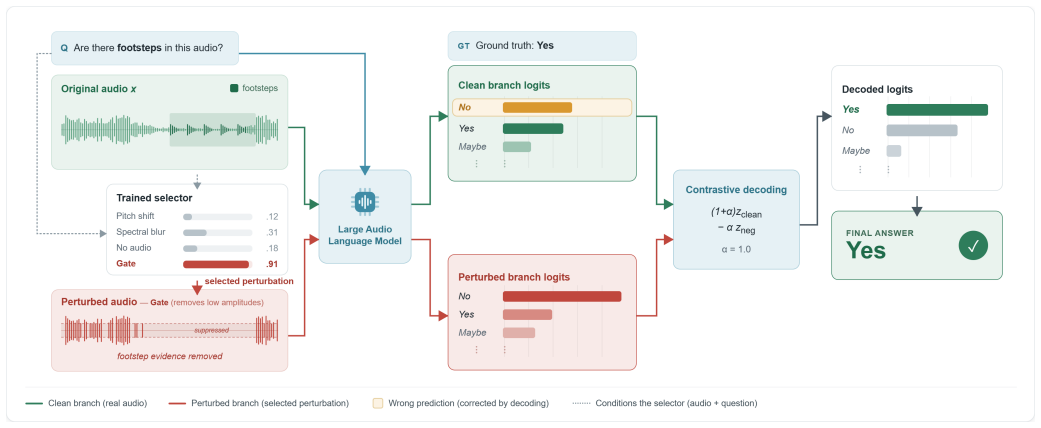
The central claim is that the negative branch used for contrastive decoding should be a structured, task-appropriate perturbation, selected per example, rather than a universal no-audio or noise baseline. Evidence: across four tasks and two models, the best fixed perturbation is task-dependent (e.g., full-waveform reversal is best for temporal order, pitch shift for existence on AF3), and a three-layer MLP trained on the last-token hidden states of the expert branch can predict which of four candidate perturbations will be correct, raising Qwen2 AH Existence accuracy from 72.4% (best fixed branch) to 76.7% and leaving a 9.5-point oracle gap. A yes/no-constrained prompt independently adds 11
What carries the argument
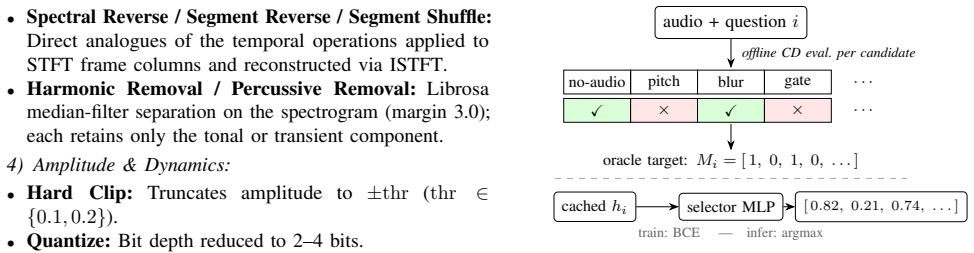
The central object is the contrastive-decoding logits processor: corrected logits = (1+α) expert logits − α negative-branch logits. The paper's additions are (i) a library of 105 audio perturbations in six families (temporal, frequency, spectral, amplitude, environmental, noise), each giving a negative branch; (ii) per-example oracle labels M_{i,s} computed by running each candidate branch once and checking correctness against the ground truth; and (iii) a lightweight three-layer MLP selector trained with binary cross-entropy on last-token, last-layer (plus early/mid-layer) hidden states to predict utility scores, routing each input to the branch with the highest predicted score. The key wor
Load-bearing premise
The router's training labels are single-pass correctness booleans for each candidate branch, computed from one forward pass and one ground-truth answer; the paper itself notes these finite-sample labels reflect random variance as much as true utility ordering, so if they are mostly noise the learned routing signal and the +4.3% gain will not transfer to new data.
What would settle it
Train the same selector architecture on a version of the AH Existence training set in which the per-example correctness labels M_{i,s} are randomly permuted across perturbations, preserving the same marginal distribution; if the resulting 'selector' still reaches roughly 76% accuracy, the gain comes from task-agnostic branch priors rather than routing. Alternatively, recompute oracle targets for a held-out split using a different random seed or a different expert model; if the selector's advantage over the fixed best branch is not reproducible out-of-distribution, the routing signal is sample
If this is right
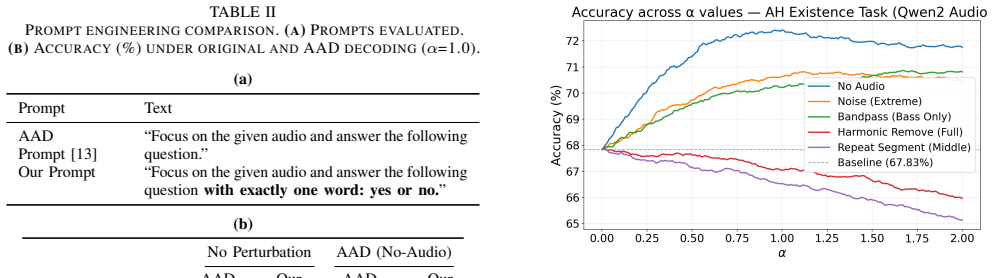
- The constrained yes/no prompt alone removes 40.4% of the affirmative bias and raises Qwen2 AH Existence by 11 points, more than four times the prior prompt-engineering gain; combining it with contrastive decoding shrinks residual bias to +1.8%.
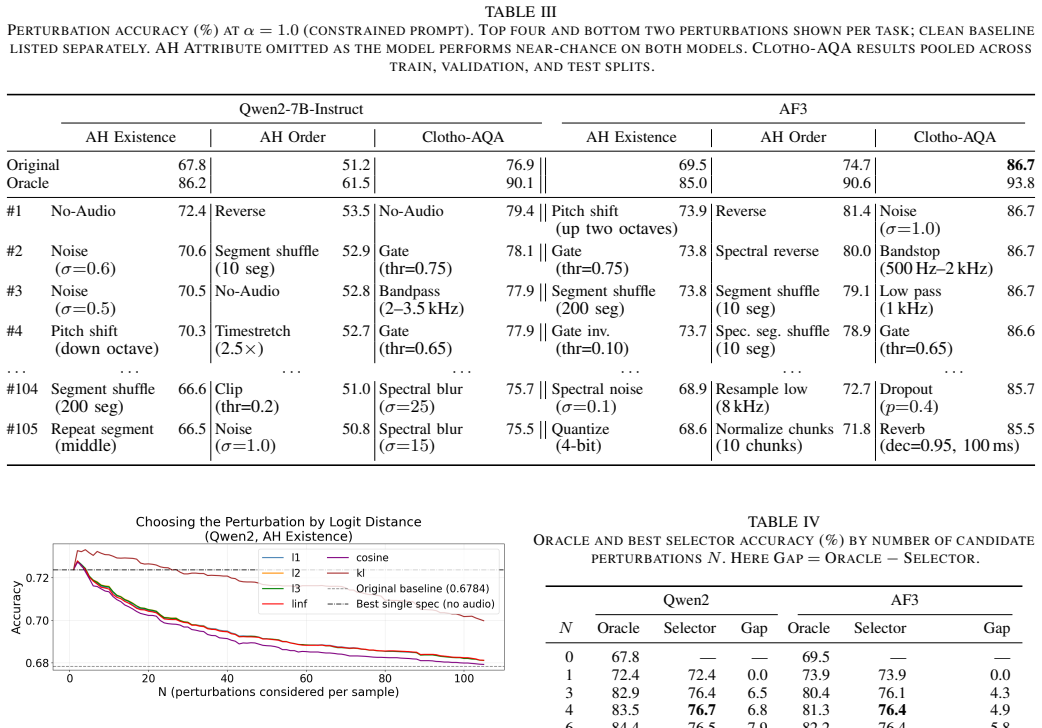
- Reverse audio is the best negative branch for temporal-order questions (AF3: 74.7% to 81.4%), establishing that structured perturbations targeting the task's acoustic dimension beat generic no-audio.
- A per-example selector trained on hidden states outperforms the best fixed branch by 4.3% on AH Existence, and does so without extra LALM forward passes at inference.
- The gap between the selector (76.7%) and the oracle (86.2%) shows the paradigm is data-limited, not method-limited: adding training data that isolates unique perturbation usefulness should close the gap.
- On near-chance tasks (AH Attribute) and near-ceiling tasks (AF3 Clotho-AQA), contrastive decoding offers little or no traction; the method helps precisely where the model is capable but biased.
Where Pith is reading between the lines
- The success of the selector suggests a general 'self-routing' principle: a model's own hidden activations contain enough information to pick the transformation that maximally exposes its confusions, which could transfer to vision-language hallucination benchmarks and to multi-choice or open-ended generation without token-wise labels.
- Since selector accuracy peaks at N=4 while oracle keeps rising with N, an editor would infer that a curriculum—greedily selecting a small diverse perturbation subset per task (the paper's greedy search suggests 10 suffice) and then training the router only over that subset—could preserve routing signal while enlarging the coverage.
- The paper's label-noise admission implies a follow-up: use soft targets derived from multiple forward passes or a teacher ensemble, or rank-based targets, before concluding that the learned routing generalizes beyond the ~7,500-example training set.
- The finding that distance-based selection (KL divergence) is unstable in audio, unlike in visual VCoDe, suggests that generic logit divergence is a poor proxy for contrastive utility; an editor might hypothesize that task-specific structural features (e.g., temporal coherence for order tasks) should drive future branch-selection criteria.
Editorial analysis
A structured set of objections, weighed in public.
Referee Report
Summary. This paper studies contrastive decoding (CD) for large audio-language models (LALMs) as a training-free hallucination mitigation strategy. The authors introduce a constrained yes/no prompt, a library of 105 audio perturbations across 38 types, and a lightweight MLP selector that routes each example to a perturbation based on cached hidden states. The main reported result is +4.3% accuracy over the best fixed branch on the AH Existence task with Qwen2 (72.4→76.7, with oracle 86.2), and task-dependent optimal perturbations (e.g., reverse audio improves AF3 AH Order from 74.7 to 81.4). The paper also reports ablations on candidate pool size, head architecture, input features, and regularization. The manuscript is transparent about several limitations, including near-chance performance on AH Attribute, selector underperformance on Clotho-AQA, and the structural impossibility of strict audio-file separation on AH Existence.
Significance. If the central claims hold, the paper makes a useful contribution: it systematically expands the perturbation design space for audio CD, demonstrates task-specific optimality, and shows that a lightweight selector can exploit internal representations for per-example routing. Strengths include a public code release, explicit oracle upper bounds, and unusually candid reporting of limitations. These features increase trust. However, the headline numbers rest on evaluation choices that need hardening before the results can be taken at face value. The composition leakage on AH Existence and the selection of perturbations, α, and N on the test benchmark are load-bearing concerns that could materially affect the reported gains.
major comments (3)
- [Section IV and Table V] Composition leakage on AH Existence: the paper states that strict audio-file separation is 'structurally impossible' and that overlap is only 'minimised.' Because AH Existence mixes three foreground events over a shared background track, the same background can appear in both training and held-out sets. A selector trained on hidden states could memorize background-specific cues that correlate with answer correctness, inflating the +4.3% gain without learning generalizable routing. Please quantify the actual clip/background overlap rate and provide a split that groups by background track, or show that the reported gain persists when backgrounds are held out.
- [Section V-C, V-E1, and Table III/IV] Test-set selection of perturbations and α: the perturbation rankings in Table III appear to be computed on the full data (the Table III footnote even says Clotho-AQA results are 'pooled across train, validation, and test splits'), and the N=4 candidate sets in Table IV are selected from the same benchmark on which the selector is evaluated. The 'best fixed branch' baseline (72.4%) and the oracle/selector comparisons are therefore optimistic. Use a nested split: select α, candidate perturbations, and selector hyperparameters on training/validation folds only, and report held-out test results. This applies to all tasks, not only Clotho-AQA.
- [Section III-C and V-E4] Noisy oracle labels and significance: the selector targets M_{i,s}=1[ŷ_{i,s}=y_i] from a single forward pass. The paper acknowledges that these single-sample labels reflect 'random variance as much as a true utility ordering.' Since the oracle upper bound in Eq. (4) is a maximum over s, it is inflated by chance agreement among binary balanced labels. Please report the expected chance oracle level (e.g., under label permutation), confidence intervals for the selector gains, and a significance test against the best fixed branch. This is necessary to establish that the +4.3% gain is not within sampling noise.
minor comments (5)
- [Section V-C] Typo: 'neither respond meanginfully to constrastive decoding' should be 'meaningfully' and 'contrastive.'
- [Table III caption] The caption footnote 'Clotho-AQA results pooled across train, validation, and test splits' is important methodological information; it should appear in the main text or experimental setup, not only in a table caption.
- [Section V-B / Fig. 3] The α sweep in Fig. 3 does not state which dataset split or fold it uses. Specify whether α was tuned on validation data or on the full test set, as this affects the validity of fixing α=1.0.
- [Table III] The note 'AH Attribute omitted as the model performs near-chance on both models' is slightly imprecise: AF3 reaches 56.0%, which is above chance. Clarify the threshold used for 'near-chance.'
- [References / notation] Reference [20] is rendered as 'V ACoDe' with a space; the original work uses 'VACoDe.' Also, 'A VCD' in Section II has a similar spacing artifact. These should be corrected for searchability.
Circularity Check
No circularity: adaptive selector is supervised on oracle correctness labels and tested held-out; empirical benchmarking, not a derivation from its own inputs.
full rationale
The paper's claims are empirical evaluations rather than a derivation chain that reduces to its inputs. The adaptive selector is trained on per-example oracle correctness vectors M_{i,s} = 1[ŷ_{i,s} = y_i] (Section III-C), which are defined from ground-truth labels and the model's own outputs under each fixed perturbation. The selector then predicts these targets from cached hidden states and is evaluated on held-out examples in five balanced splits (Section IV). That is a standard supervised learning setup, not a fitted parameter renamed as a prediction. The reported +4.3% gain over the best fixed branch on AH Existence is a held-out accuracy comparison, so it is not forced by construction. Choices of α, N, and the perturbation pool are model-selection decisions made on validation/benchmark results, which may inflate results but do not constitute circularity. The paper's explicit admission that single-sample branch utility labels 'reflect random variance as much as a true utility ordering' (Section V-E4) identifies label noise that makes the learning task harder rather than trivially soluble; it is a limitation, not a circular step. The pooling of Clotho-AQA results across train, validation, and test splits is a reporting/benchmark-integrity issue, not an input-output equivalence. There are no load-bearing self-citations and no uniqueness theorem imported from the authors' own prior work. The AH Existence clip-overlap caveat is a data-contamination risk that could affect generalization, but contamination is not circularity: the derivation itself is self-contained and the claims stand or fall on empirical validity, not on definitional equivalence.
Axiom & Free-Parameter Ledger
free parameters (5)
- alpha (contrastive strength) =
1.0
- candidate pool size N =
4
- selector regularization hyperparameters =
label smoothing 0.25; feature noise 0.10; input dropout 0.05; 3-layer MLP 512-256-128
- prompt constraint wording =
'with exactly one word: yes or no'
- perturbation library composition =
105 perturbations / 38 types
axioms (5)
- domain assumption Eq. (3) logit subtraction with α=1.0 is a valid way to suppress language priors across all tasks and perturbations.
- domain assumption Ground-truth yes/no labels and accuracy on the constructed splits are the correct measure of hallucination.
- domain assumption The final non-padding token hidden state in a causal decoder attends to the full input and is a sufficient routing feature.
- domain assumption The five 70/15/15 splits are independent; for AH Existence, minimized clip overlap is sufficient to avoid leakage.
- standard math SciPy and librosa implementations faithfully realize the intended acoustic transformations.
Cite this review
Pith. "Pith review of Adaptive Perturbation Selection for Contrastive Audio Decoding." pith.science (2026). https://pith.science/paper/73CFWKDI
@misc{pith2026260700247,
  author       = {Pith},
  title        = {Pith review of: Adaptive Perturbation Selection for Contrastive Audio Decoding},
  year         = {2026},
  howpublished = {\url{https://pith.science/paper/73CFWKDI}},
  note         = {Machine review of arXiv:2607.00247}
}
read the original abstract
Large audio-language models (LALMs) frequently hallucinate by overriding acoustic evidence with language priors. While contrastive decoding (CD) offers training-free mitigation, existing methods rely on blunt perturbations like masking or noise, leaving structured audio transformations unexplored. We explore this design space by evaluating a diverse library of targeted audio perturbations and adaptively selecting the optimal negative branch for each task and example. First, we improve upon earlier prompt engineering by showing that a simple binary yes/no constraint reduces the model's tendency to falsely confirm absent audio features. Second, evaluating our library across temporal, spectral, frequency, and amplitude domains reveals that optimal transformations are highly task-dependent; for instance, reversing the audio array disrupts temporal coherence, raising accuracy on the temporal order task from 74.7% to 81.4%. Finally, we trained a light-weight perturbation selector on model hidden states to dynamically route negative branches, yielding an additional +4.3% gain on the existence task.
Figures
Forward citations
Cited by 1 Pith paper
-
Encoder-Side Neuron Identification and Amplification for Acoustic Perception in Large Audio-Language Models
Label-free real-vs-noise scoring of audio-encoder neurons, followed by sparse amplification, substantially improves LALM perception of non-semantic speech attributes without retraining.
Reference graph
Works this paper leans on
-
[1]
SALMONN: Towards generic hearing abilities for large language models,
C. Tang, W. Yu, G. Sun, X. Chen, T. Tan, W. Li, L. Lu, Z. Ma, and C. Zhang, “SALMONN: Towards generic hearing abilities for large language models,” inProc. Int. Conf. Learn. Represent. (ICLR), 2024. [Online]. Available: https://arxiv.org/abs/2310.13289
Pith/arXiv arXiv 2024
-
[2]
Pengi: An audio language model for audio tasks,
S. Deshmukh, B. Elizalde, R. Singh, and H. Wang, “Pengi: An audio language model for audio tasks,” inAdv. Neural Inf. Process. Syst. (NeurIPS), 2023. [Online]. Available: https://arxiv.org/abs/2305.11834
Pith/arXiv arXiv 2023
-
[3]
Listen, think, and understand,
Y . Gong, H. Luo, A. H. Liu, L. Karlinsky, and J. Glass, “Listen, think, and understand,” inProc. Int. Conf. Learn. Represent. (ICLR), 2024. [Online]. Available: https://arxiv.org/abs/2305.10790
Pith/arXiv arXiv 2024
-
[4]
SALMONN-omni: A standalone speech LLM without codec injection for full-duplex conversation,
W. Yu, S. Wang, X. Yang, X. Chen, X. Tian, J. Zhang, G. Sun, L. Lu, Y . Wang, and C. Zhang, “SALMONN-omni: A standalone speech LLM without codec injection for full-duplex conversation,” in Adv. Neural Inf. Process. Syst. (NeurIPS), 2025. [Online]. Available: https://arxiv.org/abs/2505.17060
Pith/arXiv arXiv 2025
-
[5]
K.-H. Luet al.(2026) DeSTA2.5-Audio: Toward general-purpose large audio language model with self-generated cross-modal alignment. [Online]. Available: https://arxiv.org/abs/2507.02768
arXiv 2026
-
[6]
WavLLM: Towards robust and adaptive speech large language model,
S. Hu, L. Zhou, S. Liu, S. Chen, L. Meng, H. Hao, J. Pan, X. Liu, J. Li, S. Sivasankaran, L. Liu, and F. Wei, “WavLLM: Towards robust and adaptive speech large language model,” in Findings Assoc. Comput. Linguist. (EMNLP), 2024. [Online]. Available: https://arxiv.org/abs/2404.00656
Pith/arXiv arXiv 2024
-
[7]
C.-Y . Kuan and H.-y. Lee, “Can large audio-language models truly hear? tackling hallucinations with multi-task assessment and stepwise audio reasoning,” inProc. IEEE Int. Conf. Acoust., Speech, Signal Process. (ICASSP), 2025. [Online]. Available: https://arxiv.org/abs/2410.16130
Pith/arXiv arXiv 2025
-
[8]
C.-Y . Kuan, W.-P. Huang, and H.-y. Lee, “Understanding sounds, missing the questions: The challenge of object hallucination in large audio-language models,” inProc. Interspeech, 2024. [Online]. Available: https://arxiv.org/abs/2406.08402
Pith/arXiv arXiv 2024
-
[9]
HalluAudio: A comprehensive benchmark for hallucination detection in large audio-language models,
F. Zhao, Y . Chen, W. Lu, D. Zhang, X. Yue, and J. Wei, “HalluAudio: A comprehensive benchmark for hallucination detection in large audio-language models,” inProc. Annu. Meet. Assoc. Comput. Linguist. (ACL), 2026. [Online]. Available: https://arxiv.org/abs/2604.19300
Pith/arXiv arXiv 2026
-
[10]
AHa-Bench: Benchmarking audio hallucinations in large audio-language models,
X. Cheng, D. Fu, C. Wen, S. Yu, Z. Wang, S. Ji, S. Arora, T. Jin, S. Watanabe, and Z. Zhao, “AHa-Bench: Benchmarking audio hallucinations in large audio-language models,” inAdv. Neural Inf. Process. Syst. (NeurIPS), 2025. [Online]. Available: https://openreview.net/forum?id=vCej5sO61x
2025
-
[11]
Avhbench: A cross-modal hallucination benchmark for audio-visual large language models,
K. Sung-Bin, O. Hyun-Bin, J. Lee, A. Senocak, J. S. Chung, and T.-H. Oh, “Avhbench: A cross-modal hallucination benchmark for audio-visual large language models,” 2025. [Online]. Available: https://arxiv.org/abs/2410.18325
Pith/arXiv arXiv 2025
-
[12]
Contrastive decoding: Open-ended text generation as optimization,
X. L. Li, A. Holtzman, D. Fried, P. Liang, J. Eisner, T. Hashimoto, L. Zettlemoyer, and M. Lewis, “Contrastive decoding: Open-ended text generation as optimization,” inProc. Annu. Meet. Assoc. Comput. Linguist. (ACL), 2023. [Online]. Available: https://arxiv.org/abs/2210.15097
Pith/arXiv arXiv 2023
-
[13]
Reducing object hallucination in large audio-language models via audio-aware decoding,
T.-w. Hsu, K.-H. Lu, C.-H. Chiang, and H.-y. Lee, “Reducing object hallucination in large audio-language models via audio-aware decoding,” inProc. IEEE Autom. Speech Recognit. Underst. Workshop (ASRU),
-
[14]
Y . Chu, J. Xu, Q. Yang, H. Wei, X. Wei, Z. Guo, Y . Leng, Y . Lv, J. He, J. Lin, C. Zhou, and J. Zhou, “Qwen2-Audio technical report,” Qwen Team, Alibaba Group, Tech. Rep., 2024. [Online]. Available: https://arxiv.org/abs/2407.10759
Pith/arXiv arXiv 2024
-
[15]
Audio Flamingo 3: Advancing audio intelligence with fully open large audio language models,
A. Goel, S. Ghosh, J. Kim, S. Kumar, Z. Kong, S.-g. Lee, C.-H. H. Yang, R. Duraiswami, D. Manocha, R. Valle, and B. Catanzaro, “Audio Flamingo 3: Advancing audio intelligence with fully open large audio language models,” inAdv. Neural Inf. Process. Syst. (NeurIPS), 2025. [Online]. Available: https://arxiv.org/abs/2507.08128
Pith/arXiv arXiv 2025
-
[16]
Clotho-AQA: A crowdsourced dataset for audio question answering,
S. Lipping, P. Sudarsanam, K. Drossos, and T. Virtanen, “Clotho-AQA: A crowdsourced dataset for audio question answering,” inProc. Eur. Signal Process. Conf. (EUSIPCO), 2022. [Online]. Available: https://arxiv.org/abs/2204.09634
Pith/arXiv arXiv 2022
-
[17]
S. Leng, H. Zhang, G. Chen, X. Li, S. Lu, C. Miao, and L. Bing, “Mitigating object hallucinations in large vision-language models through visual contrastive decoding,” inProc. IEEE/CVF Conf. Comput. Vis. Pattern Recognit. (CVPR), 2024. [Online]. Available: https://arxiv.org/abs/2311.16922
Pith/arXiv arXiv 2024
-
[18]
DoLa: Decoding by contrasting layers improves factuality in large language models,
Y .-S. Chuang, Y . Xie, H. Luo, Y . Kim, J. Glass, and P. He, “DoLa: Decoding by contrasting layers improves factuality in large language models,” inProc. Int. Conf. Learn. Represent. (ICLR), 2024. [Online]. Available: https://arxiv.org/abs/2309.03883
Pith/arXiv arXiv 2024
-
[19]
A VCD: Mitigating hallucinations in audio-visual large language models through contrastive decoding,
C. Jung, Y . Jang, and J. S. Chung, “A VCD: Mitigating hallucinations in audio-visual large language models through contrastive decoding,” in Adv. Neural Inf. Process. Syst. (NeurIPS), 2025. [Online]. Available: https://arxiv.org/abs/2505.20862
arXiv 2025
-
[20]
S. Kim, B. Cho, S. Bae, S. Ahn, and S.-Y . Yun. (2024) V ACoDe: Visual augmented contrastive decoding. arXiv preprint arXiv:2408.05337. [Online]. Available: https://arxiv.org/abs/2408.05337
Pith/arXiv arXiv 2024
-
[21]
Temporal contrastive decoding: A training-free method for large audio-language models,
Y . Li, Y . Liu, Z. Song, Y . Wei, M. Tak´aˇc, and S. Lahlou, “Temporal contrastive decoding: A training-free method for large audio-language models,” 2026. [Online]. Available: https://arxiv.org/abs/2604.15383
Pith/arXiv arXiv 2026
- [22]
-
[23]
Scipy 1.0: fundamental algorithms for scientific computing in python,
P. Virtanenet al., “Scipy 1.0: fundamental algorithms for scientific computing in python,”Nature Methods, vol. 17, no. 3, pp. 261–272, Feb
-
[24]
librosa: Audio and music signal analysis in python,
B. McFee, C. Raffel, D. Liang, D. P. Ellis, M. McVicar, E. Battenberg, and O. Nieto, “librosa: Audio and music signal analysis in python,”SciPy 2015, 2015. [Online]. Available: https: //doi.org/10.25080/Majora-7b98e3ed-003
-
[25]
CompA: Addressing the gap in compositional reasoning in audio-language models,
S. Ghosh, A. Seth, S. Kumar, U. Tyagi, C. K. Evuru, S. Ramaneswaran, S. Sakshi, O. Nieto, R. Duraiswami, and D. Manocha, “CompA: Addressing the gap in compositional reasoning in audio-language models,” inProc. Int. Conf. Learn. Represent. (ICLR), 2024. [Online]. Available: https://arxiv.org/abs/2310.08753
Pith/arXiv arXiv 2024
-
[26]
Freesound technical demo,
F. Font, G. Roma, and X. Serra, “Freesound technical demo,” in Proceedings of the 21st ACM International Conference on Multimedia, ser. MM ’13. Barcelona, Spain: ACM, 2013, pp. 411–412
2013
-
[27]
Robust speech recognition via large-scale weak supervision,
A. Radford, J. W. Kim, T. Xu, G. Brockman, C. McLeavey, and I. Sutskever, “Robust speech recognition via large-scale weak supervision,” inProc. Int. Conf. Mach. Learn. (ICML), 2023. [Online]. Available: https://arxiv.org/abs/2212.04356
Pith/arXiv arXiv 2023
-
[28]
mdpo: Conditional preference optimization for multimodal large language models,
F. Wang, W. Zhou, J. Y . Huang, N. Xu, S. Zhang, H. Poon, and M. Chen, “mdpo: Conditional preference optimization for multimodal large language models,” 2024. [Online]. Available: https://arxiv.org/abs/2406.11839
Pith/arXiv arXiv 2024
-
[2020]
Available: http://dx.doi.org/10.1038/s41592-019-0686-2
[Online]. Available: http://dx.doi.org/10.1038/s41592-019-0686-2
-
[2025]
Available: https://arxiv.org/abs/2506.07233
[Online]. Available: https://arxiv.org/abs/2506.07233
discussion (0)
Sign in with ORCID, Apple, or X to comment. Anyone can read and Pith papers without signing in.