REVIEW 3 major objections 4 cited by
A robot policy keeps VLM semantics and inherits video-model dynamics via short latent foresight tokens, without pixel generation at test time.
Reviewed by Pith at T0; open to challenge. T0 means a machine referee read the full paper against a public rubric. the ladder, T0–T4 →
T0 review · grok-4.5
2026-07-11 10:27 UTC pith:LNVKGK4N
load-bearing objection Solid engineering VLA paper: latent foresight tokens + frozen WAN supervision + kept VQA/subtask co-training is a clean practical pattern with strong multi-benchmark numbers; causal isolation of foresight is incomplete but not fatal. the 3 major comments →
InternVLA-A1.5: Unifying Understanding, Latent Foresight, and Action for Compositional Generalization
The pith
A machine-rendered reading of the paper's core claim, the machinery that carries it, and where it could break.
Core claim
The paper claims that preserving ongoing VQA and subtask training on a native VLM backbone, while supervising a small set of learnable foresight tokens through a frozen video generator, unifies understanding, dynamics priors, and continuous action without eroding semantics or paying pixel-generation cost at inference, and that this yields the strongest overall results on six simulation benchmarks plus the best real-world compositional generalization and long-horizon success among the compared methods.
What carries the argument
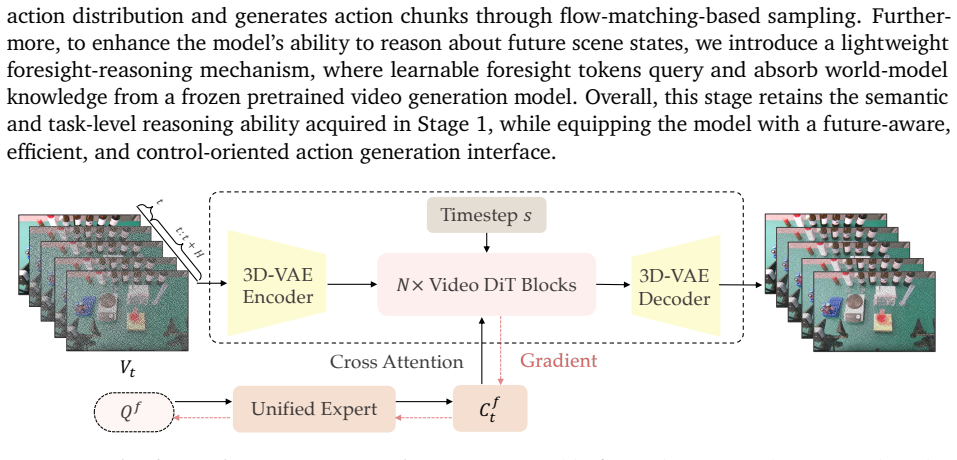
Latent foresight tokens: a fixed set of learnable queries that attend to the shared multimodal context, produce a compact conditioning code for a frozen video generator over a short future horizon, and feed that future-aware signal into flow-matching action prediction; the video branch exists only in training.
Load-bearing premise
That short-horizon supervision through a frozen, generic video generator is what mainly supplies the dynamics needed for the reported zero-shot dynamic and long-horizon gains, rather than data scale, co-training, or continuous-action training alone.
What would settle it
An ablation that matches data, co-training, and the continuous expert but removes video supervision and foresight tokens (or replaces the frozen generator with a weak random conditioner) and still matches InternVLA-A1.5 on DOMINO zero-shot, LIBERO-Plus, and real long-horizon MOF success.
Editorial analysis
A structured set of objections, weighed in public.
Referee Report
Summary. InternVLA-A1.5 proposes a unified VLA that keeps a native VLM backbone under continued VQA/subtask/discrete-action training and attaches a lightweight Mixture-of-Transformers expert for continuous flow-matching actions. Future prediction is cast as latent querying: learnable foresight tokens produce a compact condition for a frozen pretrained video generator (WAN2.2), so the policy inherits dynamics priors without pixel-level generation; the video branch is discarded at inference. Pretrained on 1.2M robot episodes and 3M multimodal samples, the model reports best overall scores on six simulation benchmarks (LIBERO, LIBERO-Plus, RoboTwin, DOMINO, EBench, SimplerEnv) and, in real-world held-out instruction-binding and long-horizon MOF tasks, stronger compositional generalization and sequential execution than π0.5 and Motus.
Significance. If the results hold under tighter causal controls, the work is a useful systems contribution to unified robot policies: it shows a practical way to keep VLM semantics while injecting world-model dynamics without paying generation cost at deployment, and it demonstrates strong multi-benchmark and real-world compositional performance. Strengths include broad evaluation (six simulators plus real held-out bindings and MOF), explicit ablations of video loss and foresight tokens (Table 8), qualitative foresight rollouts (Fig. 11), and a clear training/inference split that preserves real-time control. The latent-query design is a concrete alternative to learning pixel futures from scratch and is of interest to the VLA and world-model communities even if some gains partly come from scale and the continuous expert.
major comments (3)
- §5.3 Table 8 and §3.2: The central attribution of zero-shot DOMINO (27.7%) and long-horizon MOF gains to dynamics priors from foresight is under-isolated. Table 8 only removes L_video or the foresight tokens from the full two-stage model; it does not compare against an otherwise identical Stage-2 continuous flow-matching expert with no foresight pathway, nor against a matched continuous expert trained without the 0.15:0.85 multimodal co-training mixture (§4.3). Without those controls, the reported lifts could be driven mainly by the continuous expert, data scale, or co-training rather than WAN-distilled dynamics. Please add at least the no-foresight continuous-expert baseline (same architecture, data, and Stage-1 init) on LIBERO-Plus, RoboTwin, DOMINO, and one real task, and discuss effect sizes relative to removing video loss alone.
- §3.2 Eqs. (3)–(4), N=4, and Limitations: Foresight supervision spans only one action-chunk horizon (N=4 frames) through a frozen generic WAN2.2. The narrative links this short-horizon signal to long-horizon MOF success (76.4% vs π0.5 29.3%, Fig. 8) and dynamic DOMINO. That causal chain is not yet demonstrated: either provide intermediate analyses (e.g., foresight-token ablation on MOF subtask stages, or correlation between foresight quality and failure modes) or soften claims that latent foresight is what “sustains long-horizon execution,” and state more clearly that long-horizon gains may also come from explicit subtask prediction retained from Stage 1.
- §5.1 real-world protocol: Trial counts are modest (e.g., 15 trials per binding for Sort/Insert, 16 for Move, 20 for MOF) with no confidence intervals or statistical tests. Given that Sort Tubes overall is slightly behind π0.5 (75.9 vs 77.8) while OOD bindings favor InternVLA-A1.5, please report per-condition n, success counts or CIs, and whether differences on held-out bindings remain significant under a simple binomial or bootstrap test. This is load-bearing for the “strongest compositional generalization” claim.
Circularity Check
No load-bearing circularity: main claims are external success rates on simulators and real robots; only a minor self-referential qualitative check of foresight via the same frozen WAN used for supervision.
specific steps
-
self definitional
[§3.2 Eqs. 3–4 and §5.3 World Model Exploitation / Figure 11]
"the foresight queries are trained to retrieve video-model-readable information from the current visual-language context... To study how foresight reasoning leverages pretrained world model priors, we visualize future rollouts generated by the frozen WAN model conditioned on the learned foresight embeddings. As shown in Figure 11, the model produces plausible multi-step predictions over t to t+4"
L_video trains the foresight tokens so the frozen WAN denoiser matches target future latents under those conditionings. Showing that the same frozen WAN then produces plausible futures when conditioned on the learned foresight embeddings is, on training-like data, the training objective restated as qualitative evidence. Zero-shot rollouts add some content, but the qualitative claim that foresight 'successfully distill[s] spatiotemporal priors' is partly by construction of the supervision pathway. This does not force the external task success rates.
full rationale
InternVLA-A1.5 is an empirical systems paper. Its load-bearing claims are measured success rates on six external simulation benchmarks (LIBERO, LIBERO-Plus, RoboTwin, DOMINO, EBench, SimplerEnv) and four real-world tasks with held-out instruction bindings and a long-horizon MOF procedure. Those metrics are independent of the training losses and are not algebraic restatements of fitted parameters. Architecture choices (native VLM co-trained on VQA/subtask/FAST, MoT unified expert, flow-matching actions, latent foresight tokens supervised by frozen WAN2.2) are design decisions evaluated by those external outcomes, not derivations that reduce to their inputs by construction. Self-citations to InternVLA-A1/M1 and related lab work supply data recipes and baselines; they do not force the reported numbers. The only mild circularity is qualitative: foresight tokens are optimized so the frozen WAN reconstructs future frames (Eqs. 3–4, L_video), then §5.3/Figure 11 presents WAN rollouts conditioned on those tokens as evidence that foresight encodes dynamics—partly tautological on in-distribution data. That visualization is not load-bearing for the benchmark or real-world claims. Causal gaps in ablations (whether gains come from foresight vs continuous expert vs co-training) are correctness/attribution issues, not circularity. Score 1 reflects that single minor self-referential qualitative step only.
Axiom & Free-Parameter Ledger
free parameters (5)
- video loss weight α and action loss weight β
- number of foresight tokens M
- future frame count N and action chunk length
- robot vs multimodal sampling ratio and inter-source weights
- learning rates, steps, batch sizes (Stage 1/2/post-train)
axioms (5)
- domain assumption Continued next-token training on VQA, subtask, and FAST discrete actions preserves (and does not erode) pretrained VLM semantic priors under joint action/foresight training.
- domain assumption A frozen large video generator (WAN2.2) encodes transferable spatiotemporal dynamics priors for embodied manipulation that can be read out via cross-attention conditioning.
- domain assumption Flow-matching continuous action prediction plus MoT shared full-attention is a valid and efficient interface for closed-loop robot control.
- domain assumption Unified action-space padding across heterogeneous embodiments allows a single action head without destructive interference.
- standard math Cross-entropy next-token loss and flow-matching L2 velocity losses are appropriate and combinable under the stated attention masks.
invented entities (2)
-
Learnable foresight tokens (latent queries Q_f)
no independent evidence
-
Unified expert (lightweight MoT expert with hybrid attention)
no independent evidence
read the original abstract
Unified models for robot manipulation aim to equip one policy with both the semantic priors of pretrained VLMs and the physical dynamics learned through future prediction. In practice, existing designs tend to erode the semantics of the pretrained backbone, suffer interference among heterogeneous objectives, and learn future prediction from scratch in pixel space, leaving the dynamics priors of pretrained video generators unexploited. We present InternVLA-A1.5, which builds the policy on a native VLM backbone that keeps training on VQA and subtask prediction, and attaches a lightweight unified expert for continuous action generation. Future prediction is recast as a latent-querying problem, where a small set of learnable foresight tokens condenses the task-relevant future into a compact latent code under the supervision of a frozen pretrained video generation model, so the policy inherits world-model dynamics priors without ever learning pixel-level generation. The video branch is discarded at inference, keeping real-time control. Pretrained on 1.2M robot episodes and 3M multimodal samples, InternVLA-A1.5 achieves the best overall results on all six simulation benchmarks. In the real world, the preserved semantics deliver the strongest compositional generalization on held-out instruction bindings, and the two designs together sustain long-horizon execution.
Figures




Forward citations
Cited by 4 Pith papers
-
$N_0$-TWAM: Scaling Tactile-Native World-Action Model for Contact-Rich Manipulation
A scaled tactile-native world-action model jointly predicts vision, touch, and action and outperforms vision-only baselines on contact-rich sim and real robot tasks.
-
$N_0$-VTLA: Scaling Vision-Tactile-Language-Action Model with Latent Tactile Tokens
A VLA with predictive latent tactile tokens pretrained on large-scale visuo-tactile data, plus ALTER offline advantage labeling, leads contact-rich real and sim benchmarks.
-
RoboInter1.5: A Holistic Intermediate Representation Suite for Embodied World Modeling and Robotic Manipulation
Dense per-frame intermediate representations (traces, masks, grasp poses, subtasks) improve embodied VQA, VLA action generation, and world-model video prediction in the new 230k-episode RoboInter-Data suite.
-
Data Pyramid for Embodied Manipulation
Embodied training data form a five-layer pyramid—real-robot, UMI, ego/exo, simulation, general V–L—ordered by the trade-off between scale and robot alignment, and model capabilities track how those layers are mixed.
Reference graph
Works this paper leans on
-
[1]
Inserttheheldfunnelintotheroundbottomflaskontheplatform
-
[2]
Pickupthegraduatedcylinderontherightsideofthetablewithyourrighthand
-
[3]
Pourtheliquidfromtheheld graduatedcylinderintotheround bottomflaskthroughthefunnel
-
[4]
Placethegraduatedcylinderbackontherightsideofthetablewithyourrighthand
-
[5]
Pickupthefunnelonthetopoftheround-bottomflask
-
[6]
Placethefunnelbackonthetube rack
-
[7]
Pickuptheroundbottomflaskonthetablewithyourlefthandandplaceitontheblackstirrer
-
[8]
Placetheheldroundbottomflaskontheblackstirrerwiththelefthand
-
[9]
Pickupthestopperfromthetuberackwithyourlefthand
-
[10]
Insertthestopperintotheroundbottomflask
-
[11]
Pressthewhiteswitchontherightbottomoftheblackstirrerwithyourrighthand
-
[12]
Returntotheinitialposition
-
[13]
Taskcompleted. Figure 13.The long-horizon MOF task.The first panel gives the full instruction, and the remaining panels show the 13 sequential subtasks together with the final completed state, from inserting the funnel and pouring the liquid to stoppering the flask and switching on the stirrer. White outlines mark the object or target involved in each ste...
2023
discussion (0)
Sign in with ORCID, Apple, or X to comment. Anyone can read and Pith papers without signing in.