REVIEW 7 minor 1 cited by
QSCOUT documents a working qubit-boson gate set for hybrid continuous-discrete quantum computing, callable in Jaqal on its trapped-ion chain.
Reviewed by Pith at T0; open to challenge. T0 means a machine referee read the full paper against a public rubric. the ladder, T0–T4 →
T0 review · grok-4.5
2026-07-10 05:19 UTC pith:Y4RDZIF7
load-bearing objection Solid user-facing documentation of QSCOUT's hybrid spin-motion gates; useful for the platform, not a discovery paper.
QSCOUT's Qubit-Boson Gate Set
The pith
A machine-rendered reading of the paper's core claim, the machinery that carries it, and where it could break.
Core claim
QSCOUT has implemented and exposed a qubit-boson gate set—Jaynes-Cummings, anti-Jaynes-Cummings, three-axis conditional displacement, and conditional rotation, with conditional beamsplitter and squeeze gates in progress—so that hybrid continuous-discrete circuits can be written and run on its Yb-171 ion chain via ordinary Jaqal commands.
What carries the argument
The qubit-boson gate set itself: resonant red- and blue-sideband drives (JC/AJC), simultaneous red-blue sidebands that produce spin-dependent forces (conditional displacements), detuned light-shift sequences (conditional rotation), and planned four-tone second-order interactions (conditional beamsplitter and squeeze).
Load-bearing premise
That the four-tone beamsplitter and squeeze gates can be realized with usable fidelity by channel-duplication tricks, even though the control hardware is limited to two tones per channel and only certain qubits can host them.
What would settle it
Attempt to run the planned four-tone conditional-beamsplitter or squeeze gate on a supported qubit and measure whether the observed spin-dependent mode swap or squeezing matches the target unitary within the fidelity needed for a simple hybrid circuit.
If this is right
- Users can write hybrid CV-DV circuits in Jaqal that treat radial motional modes as bosonic registers.
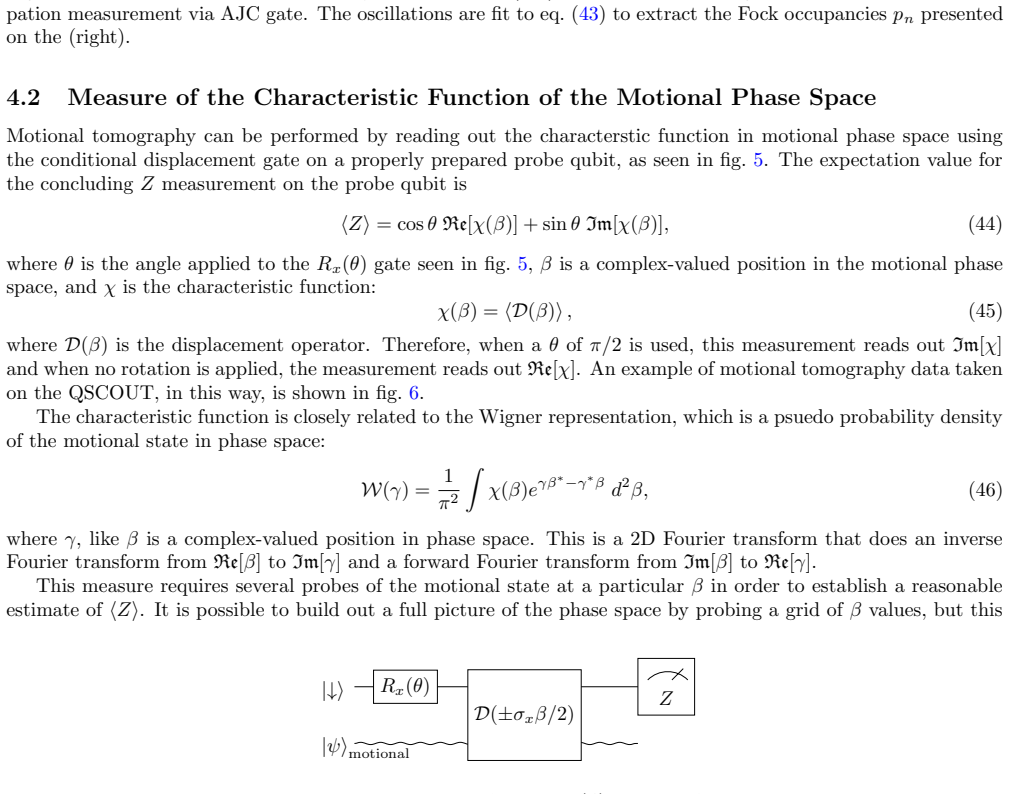
- Fock-state preparation and characteristic-function tomography become standard library routines rather than custom pulse sequences.
- Conditional-rotation and displacement gates enable parity readout and phase-space mapping without leaving the QSCOUT platform.
- Once the four-tone gates finish calibration, spin-dependent beamsplitters and squeezers become available for continuous-variable linear optics conditioned on qubits.
Where Pith is reading between the lines
- The same interface could later support multi-mode continuous-variable error-correction codes that use the ion chain as both discrete and continuous memory.
- Truncation around n≈10 implies that near-term hybrid algorithms will stay in low-photon subspaces unless readout is improved.
- Channel-mapping constraints may force circuit compilers to treat only a subset of qubits as valid control ions for the advanced gates.
Editorial analysis
A structured set of objections, weighed in public.
Referee Report
Summary. This manuscript documents the hybrid qubit-boson gate set available on the QSCOUT trapped-ion open user testbed for continuous-variable/discrete-variable (CV-DV) computing. It specifies the currently supported gates (Jaynes-Cummings, anti-Jaynes-Cummings, conditional displacements along x/y/z, and conditional rotation) together with their Jaqal syntax, explicit unitary/Hamiltonian definitions (Eqs. 4, 9, 12, 16), laser-tone configurations that realize them on the radial motional modes of a linear Yb-171 chain, and practical notes on coupling strengths and Lamb-Dicke factors. Conditional beamsplitter and squeeze gates are described as under development (Sec. 2.5). Complementary sections cover vacuum/Fock/squeezed-vacuum preparation and two readout methods (Fock-occupancy spectroscopy via AJC Rabi flops and characteristic-function tomography via conditional displacement), each illustrated with experimental data (Figs. 4 and 6).
Significance. The work supplies a concrete, machine-callable interface to hybrid CV-DV operations on an openly accessible testbed, thereby enabling external users to program and execute boson-qubit circuits without reverse-engineering the underlying Raman sideband drives. Gate definitions match textbook and cited theory (including the four-tone constructions of Sutherland & Srinivas), hardware limitations (CR decay profile, four-tone channel-duplication constraints, Fock truncation) are stated candidly, and the inclusion of ready-to-use Jaqal commands plus example tomography data constitutes a reproducible community resource. These strengths make the note a useful methods contribution even though it does not claim new physics results.
minor comments (7)
- [2.3] Typographical error: 'counter-propogating' should read 'counter-propagating'.
- [2.5] Typographical error: 'reb-blue' should read 'red-blue'.
- [4.1] The sentence 'An example dataset to illustrate the method is provided in section 4.1' is a self-reference; the data appear in Fig. 4.
- [Fig. 4] Left-panel vertical axis label is truncated ('P (probe qubit)'); expand to the full quantity (e.g., P_\uparrow).
- [1 / Fig. 1] Qubit indexing that begins at the center ion (Fig. 1) is non-standard; a one-sentence rationale would help new users avoid off-by-one errors when writing Jaqal.
- [Table 1] BS and CSq appear in Table 1 with full Jaqal signatures even though they are marked 'in progress'; consider relocating them to a separate 'forthcoming' table to prevent accidental use by external users.
- [2] Several multi-line exponential expressions (e.g., Eqs. 4, 9, 23, 29) render with broken line breaks in the source; ensure clean typesetting in the final version.
Circularity Check
No circularity: descriptive hardware/gate documentation with no fitted predictions or self-definitional derivations.
full rationale
The manuscript is a methods/user-guide note that enumerates QSCOUT's qubit-boson gates (JC, AJC, x/y/zCD, CR; BS and CSq marked in progress), their Jaqal syntax, explicit Hamiltonians (eqs. 4, 9, 12, 16, 23, 29), tone configurations, state-preparation sequences, and two readout protocols, supported by illustrative data (figs. 4, 6). It does not claim to derive a target observable from a fitted parameter and then present that fit as an independent prediction, nor does it import a uniqueness theorem or ansatz via self-citation to force a central result. Self-citations ([1], [3], [5], [6]) supply independent experimental/system context (trap architecture, control hardware, prior observations) and are not load-bearing for any claimed first-principles derivation. The four-tone gates are explicitly flagged as developmental; their description does not reduce any reported quantity to its own inputs by construction. Consequently the document is self-contained against its own documentation purpose and exhibits no circular steps.
Axiom & Free-Parameter Ledger
free parameters (4)
- average phonon occupation after sideband cooling =
~0.1 quanta
- Fock-basis truncation cutoff =
n ≈ 10
- sideband detuning δ (CR and four-tone gates)
- Lamb-Dicke parameter η (per mode)
axioms (5)
- domain assumption Resonant red/blue sideband Raman drives realize the Jaynes-Cummings and anti-Jaynes-Cummings Hamiltonians of eqs. (4) and (9).
- domain assumption Simultaneous red and blue sidebands generate a spin-dependent force that implements conditional displacement D(β σ_i).
- domain assumption Four-tone detuned sideband pairs produce the second-order σ_Z beamsplitter and squeeze interactions of Sutherland & Srinivas (2021).
- domain assumption Radial confinement is elliptical with all upper-manifold frequencies above all lower-manifold frequencies, and lasers address only radial modes.
- standard math Standard quantum harmonic-oscillator algebra and displacement/squeeze operators apply to the collective motional modes.
read the original abstract
The Quantum Scientific Computing Open User Testbed (QSCOUT) has developed a qubit-boson gate set for hybrid continuous-discrete variable (CV-DV) quantum computing. This document outlines how to utilize these gates on QSCOUT using Just Another Quantum Assembly Language, Jaqal\textsuperscript{TM}.
Figures



Forward citations
Cited by 1 Pith paper
-
Benchmarking trigonometric continuous-variable gate primitives with trapped ions
Cosine gates exp(-iθ cos(c x̂)) in one- and two-mode versions were implemented on trapped-ion motional modes and benchmarked against noise-inclusive simulations via Fock-space transition probabilities.
Reference graph
Works this paper leans on
-
[1]
S. M. Clark, D. Lobser, M. C. Revelle, C. G. Yale, D. Bossert, A. D. Burch, M. N. Chow, C. W. Hogle, M. Ivory, J. Pehr, B. Salzbrenner, D. Stick, W. Sweatt, J. M. Wilson, E. Winrow, and P. Maunz. Engineering the Quantum Scientific Computing Open User Testbed.IEEE Transactions on Quantum Engineering, 2:1–32, 2021. ISSN 2689-1808. doi: 10.1109/TQE.2021.3096...
-
[2]
Andrew J. Landahl, Daniel S. Lobser, Benjamin C. A. Morrison, Kenneth M. Rudinger, Antonio E. Russo, Jay W. Van Der Wall, and Peter Maunz. Jaqal, the quantum assembly language for QSCOUT, March 01, 2020
work page 2020
-
[3]
Jaqal, the Quantum Assembly Language for QSCOUT
URLhttps://arxiv.org/abs/2003.09382. 14 pages, 0 figures
work page internal anchor Pith review Pith/arXiv arXiv 2003
-
[4]
JaqalPaw: A Guide to Defining Pulses and Waveforms for Jaqal
Daniel Lobser, Joshua Goldberg, Andrew J. Landahl, Peter Maunz, Benjamin C. A. Morrison, Kenneth Rudinger, Antonio Russo, Brandon Ruzic, Daniel Stick, Jay Van Der Wall, and Susan M. Clark. JaqalPaw: A guide to defining pulses and waveforms for Jaqal, 2023. URLhttps://arxiv.org/abs/2305.02311
work page internal anchor Pith review Pith/arXiv arXiv 2023
-
[5]
R. T. Sutherland and R. Srinivas. Universal hybrid quantum computing in trapped ions.Phys. Rev. A, 104: 032609, Sep 2021. doi: 10.1103/PhysRevA.104.032609. URLhttps://link.aps.org/doi/10.1103/PhysRevA. 104.032609. 9
-
[6]
Daniel S. Lobser, Jay W. Van Der Wall, and Joshua D. Goldberg. Performant coherent control: bridging the gap between high- and low-level operations on hardware. In2022 IEEE International Conference on Quantum Computing and Engineering (QCE), pages 320–330, 2022. doi: 10.1109/QCE53715.2022.00053
-
[7]
Sungjoo Lim, Chanyang Im, Christopher G. Yale, Brian K. McFarland, Edward C. Tortorici, Daniel S. Lobser, Melissa C. Revelle, Susan M. Clark, Mahn-Soo Choi, and Junki Kim. Observation of the topological edge state of the generalized resonant Rabi model in a trapped-ion quantum simulator.in preparation, 2026. 10
work page 2026
discussion (0)
Sign in with ORCID, Apple, or X to comment. Anyone can read and Pith papers without signing in.