REVIEW 2 major objections 6 minor 1 cited by
A multi-conditioned diffusion pipeline turns a few dozen real sand-boil photos into hundreds of label-reliable synthetic inspection images without the seams of older cloning methods.
Reviewed by Pith at T0; open to challenge. T0 means a machine referee read the full paper against a public rubric. the ladder, T0–T4 →
T0 review · grok-4.5
2026-07-13 06:47 UTC pith:2UQQVGK6
load-bearing objection Careful, reproducible generative-augmentation engineering for a scarce civil-infrastructure defect class, honestly scoped to image quality and label provenance with no downstream claim. the 2 major comments →
Multi-Conditioned Diffusion Synthesis of Sand Boils for Low-Resource Earthen-Levee Inspection
The pith
A machine-rendered reading of the paper's core claim, the machinery that carries it, and where it could break.
Core claim
From a small curated reference set, a DreamBooth-fine-tuned SDXL generator conditioned by multi-branch ControlNets and soft-mask inpainting can produce hundreds of synthetic sand-boil inspection images that preserve real defect pixels, carry a single-policy automated mask, and pass distributional and memorisation audits against the real set and a Poisson baseline. The soft-mask path is the released default because its labels rest on preserved real structure rather than on an unverified synthetic render.
What carries the argument
Defect-preserving soft-mask latent blending: at every diffusion step the inverted, size-adaptively eroded and Gaussian-blurred ground-truth mask freezes the real dome pixels while the denoiser renegotiates only the boundary ring and background, removing both hard seams and post-hoc colour bleed.
Load-bearing premise
The automatic CLIP similarity band and the real-trained segmenter used to clean synthetic masks are assumed good enough to keep out-of-distribution junk and bad labels out of the released set, even though the same segmenter fails to certify the complementary mask-conditioned path.
What would settle it
Train an identical segmentation network once on real data only and once on real plus the released 815-image soft-mask set, then measure pixel IoU on a held-out real test set that never entered the generation pipeline; a null or negative delta would falsify the claim that the synthetic set is usable supervision.
Editorial analysis
A structured set of objections, weighed in public.
Referee Report
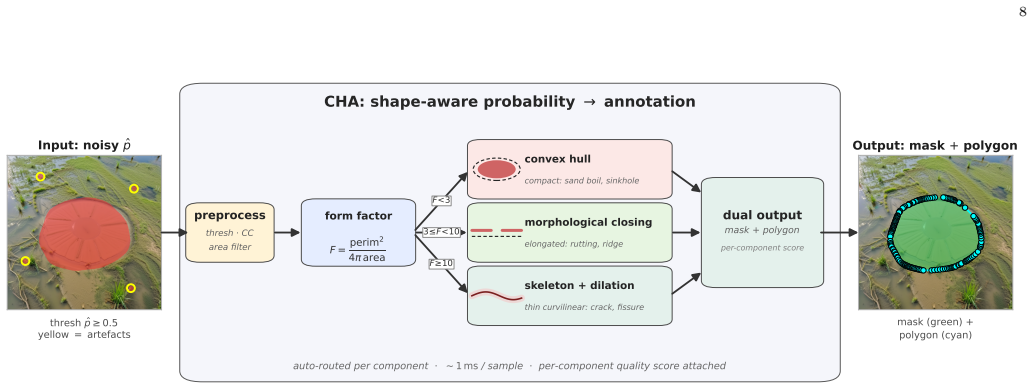
Summary. The paper presents a multi-conditioned diffusion pipeline for synthesizing sand-boil inspection imagery under severe annotation scarcity. An SDXL backbone is adapted with DreamBooth-LoRA, steered by a multi-branch ControlNet stack (Canny, depth, HED, normals) plus IP-Adapter, and driven by a taxonomy-based Prompt Atlas. The default production path (V4) uses soft-mask latent blending (Eqs. 3–4) to preserve real defect pixels while re-rendering the scene, avoiding Poisson seamless-cloning seams and colour casts. A complementary mask-conditioned ControlNet (MaskCN) can generate a boil into a chosen silhouette so the mask is the label by construction, but is not released as default because a real-trained CHA/SandBoilNet gate cannot certify those labels at scale (median IoU drift 0.15). From the real training pool the pipeline yields 1,020 candidates of which 815 pass a leave-one-out CLIP admissibility filter. Evaluation covers FID (two implementations), KID±SD, CLIP image–text, LPIPS diversity, precision/recall/density/coverage, a Poisson baseline, and memorisation audits. Claims are explicitly limited to image quality, single-policy label provenance, and diversity; downstream segmentation is deferred. Code and an artefact manifest are released.
Significance. If the reported image-quality, provenance, and diversity results hold, the work is a solid, carefully scoped engineering contribution to low-resource generative augmentation for civil-infrastructure inspection. Strengths include: (i) an explicit soft-mask compositor with size-adaptive geometry that addresses documented failure modes of prior Poisson compositing; (ii) dual generation engines with complementary diversity axes; (iii) a reproducible Prompt Atlas that ports via a single JSON specification; (iv) multi-metric evaluation (two FID implementations, KID with SD, fidelity–diversity decomposition, Poisson baseline, memorisation audit) rather than a single FID number; and (v) released code, checkpoint, and seed/manifest discipline. The deliberate scoping away from untested downstream segmentation claims is appropriate and increases credibility. The paper is more applied generative-augmentation engineering than a foundational graphics result, but it is useful and reproducible within its stated bounds.
major comments (2)
- [Section V-B, Fig. 12 caption, Abstract] Section V-B and the abstract select V4 as the “label-reliable” default on the basis of soft-mask pixel preservation plus uniform CHA post-processing, yet the manuscript never reports quantitative agreement between CHA masks and either the source masks or human corrections on V4 synthetics. Figure 12’s caption states that the displayed synthetic masks are “human-verified corrections,” with CHA only the default for uncorrected samples. Because “label-reliable” is the explicit selection criterion over lower-FID presets (V1) and higher-diversity MaskCN, a load-bearing claim is under-supported. Please report CHA–source (or CHA–human) IoU / boundary-error statistics on the admitted V4 set, or rephrase the selection language to “single-policy provenance with preserved dome core” if quantitative reliability is not yet measured.
- [Section IV-F, Tables IV–VI] Section IV-F correctly notes that soft-mask V4 shares real dome pixels with the 199-image reference, which biases FID/KID downward and makes absolute distances “not directly comparable across families” to MaskCN or Poisson. Tables IV–VI nonetheless present FID/KID/precision side-by-side without a within-family-only reading guide or a non-shared-pixel metric (e.g., background-only FID, or FID after masking the preserved core). Given that the paper already rejects minimum-FID as the selection criterion, this is fixable by restructuring the tables or adding a short “comparability” paragraph that marks which cells are confounded. As written, a reader can still misread V4’s higher FID as a pure quality deficit rather than a mixture of genuine scene novelty and metric bias.
minor comments (6)
- [Section III-G, VI-F] Section III-G notes that the v1 Prompt Atlas template omits the season axis from rendered text (40/44 taxonomy values appear). Flag this more visibly in the main results discussion so readers do not over-interpret seasonal coverage.
- [Section VI-F, Table IV] Section VI-F acknowledges mild CLIP circularity (Prompt Atlas filtered by CLIP; V3/V4 style-conditioned with a CLIP-aligned adapter). A one-sentence note near Table IV that CLIP image–text scores are partly in-family would help interpretation.
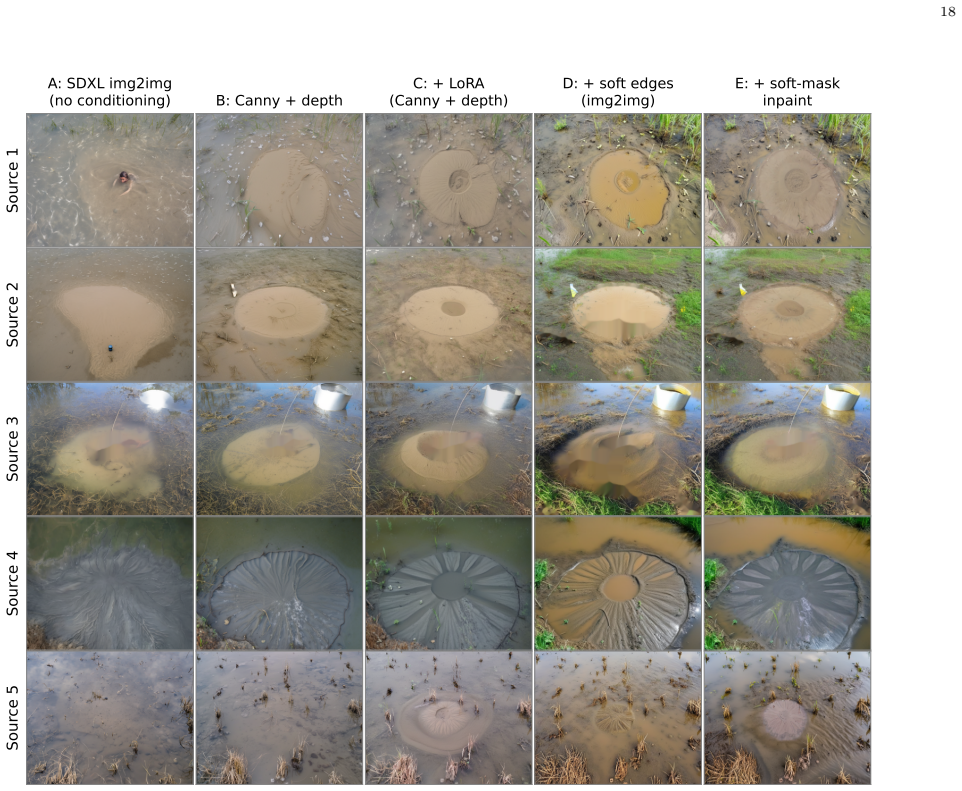
- [Section V-A, Table I] The generator ablation (Table I, Fig. 9) is qualitative only. Even a small automated metric panel on the five shared sources would make the A→E progression easier to cite.
- [Section III-D, III-E, VI-F] ControlNet scales (λc,λd,λh,λn)=(0.40,0.25,0.40,0.40) and soft-mask coefficients 0.04d/0.12d are fixed without a sensitivity sweep (acknowledged in VI-F). Listing them as “fixed, reproducible settings” in the main hyperparameter table is fine; consider moving the “not swept” caveat earlier so it is not buried in Discussion.
- [Figures 8, 11] Figure 8 and Figure 11 are dense multi-panel galleries; slightly larger captions or a legend for which preset produced each tile would improve readability in print.
- [Figure 1 caption] Minor wording: “landsideseepage” / missing spaces in a few compound terms in the Figure 1 caption; check for similar OCR-style joins in the compiled PDF.
Circularity Check
No load-bearing circular derivation; only mild self-flagged CLIP encoder reuse for prompt validation plus generation conditioning, plus ordinary self-citation of the authors' prior CHA/thesis tooling that is not used to force uniqueness or predictions.
specific steps
-
other
[Section VI-F (CLIP circularity in prompt validation)]
"The Prompt Atlas filters candidate prompts by their CLIP image–text similarity to the reference set, and the V3/V4 presets are in turn conditioned with a CLIP-aligned style. Validating prompts with the same family of encoder that guides generation is mildly circular and could bias the atlas toward CLIP-favoured phrasings."
Authors themselves note that the same CLIP family both validates the Prompt Atlas (Stage 5) and later supplies style conditioning (IP-Adapter) for the selected V4 preset; this creates a mild self-referential bias risk for the prompt bank that feeds generation. It is not a definitional reduction of a claimed prediction to its inputs, is disclosed as a limitation, and does not underwrite the FID/KID/LPIPS or label-provenance results.
full rationale
This is an engineering methods paper whose claims are explicitly scoped to image quality (FID/KID under two implementations, CLIP image-text, LPIPS, precision/recall/density/coverage), single-policy label provenance, and diversity of 815 CLIP-admissible synthetics versus a Poisson baseline; downstream segmentation is deferred. Soft-mask blending (Eq. 4 with size-adaptive radii Eq. 3) preserves real defect pixels by construction and then re-predicts labels via CHA; MaskCN makes the conditioning mask the label by construction but is not released as default precisely because the real-trained SandBoilNet gate fails (median IoU 0.15). Neither is presented as an independent scientific prediction that reduces to its inputs. The leave-one-out CLIP admissibility band is auto-tuned from the reference set and applied as a filter, a standard practice rather than a fitted-parameter-as-prediction. The sole mild circularity is the authors' own limitation note that Prompt Atlas CLIP image-text filtering uses the same encoder family later used for IP-Adapter style conditioning; this is disclosed, non-central, and does not force the quality or provenance claims. Self-citations to the thesis and CHA library supply inherited tooling and a baseline, not a uniqueness theorem or ansatz that underwrites the new soft-mask/Prompt-Atlas results. Metrics are external and standard. Score 2 reflects only that minor self-referential CLIP reuse; the derivation chain is otherwise self-contained against the stated scope.
Axiom & Free-Parameter Ledger
free parameters (5)
- soft-mask erosion/blur coefficients (0.04 d / 0.12 d)
- ControlNet conditioning scales (λc,λd,λh,λn)=(0.40,0.25,0.40,0.40)
- DreamBooth-LoRA rank 16, 1500 steps, LR 1e-4
- CLIP admissibility band (median−2.5 MAD, max+ε)
- IP-Adapter scale 0.55, CFG 8.5 (jittered [7.5,9.5] for V4)
axioms (4)
- domain assumption A stock SDXL backbone plus a small DreamBooth-LoRA adapter can be steered by multi-ControlNet residuals to produce photorealistic civil-infrastructure defects from ~39–199 reference images.
- domain assumption Soft-mask latent blending (Eq. 4) eliminates hard seams and Poisson colour bleed while preserving defect pixels verbatim up to a small rim drift that CHA can absorb.
- ad hoc to paper Leave-one-out CLIP centroid similarity defines a reliable in-distribution band that simultaneously rejects OOD drift and memorisation.
- domain assumption Standard generative metrics (FID/KID on Inception-v3, improved precision/recall, density/coverage, LPIPS) are informative for selecting augmentation presets even at N≈200 reference images.
invented entities (3)
-
Prompt Atlas
independent evidence
-
Convex Hull Annotator (CHA)
independent evidence
-
Defect-size-adaptive soft-mask geometry
no independent evidence
read the original abstract
Sand boils on earthen levees are safety-critical defects, but pixel-level detection is limited by scarce annotations. We present a diffusion-based synthesis pipeline for low-resource sand-boil imagery. Using Stable Diffusion XL fine-tuned with DreamBooth and conditioned by a multi-branch ControlNet stack, the pipeline generates synthetic inspection images from a small curated reference set. A soft-mask inpainting protocol preserves the real defect pixels while re-rendering the surrounding scene, avoiding seams and color shifts from prior seamless-cloning compositing. A mask-conditioned ControlNet can also generate a new boil inside a chosen mask, making the mask the segmentation label by construction; however, because large-scale label certification remains unresolved with the available real-trained gate, we release the soft-mask preset as the default. Text conditioning is supplied by a taxonomy-driven Prompt Atlas that expands one domain specification into a stratified, CLIP-validated prompt bank and transfers to new defect classes without code changes. From the real training images, the pipeline produces 1,020 synthetic candidates, of which 815 pass a CLIP admissibility filter. We evaluate image quality using distributional and fidelity-diversity measures against the real reference set and a Poisson baseline, and audit for out-of-distribution drift and memorization. No single preset dominates; each trades off fidelity, diversity, and label reliability. We therefore release the label-reliable preset as the default and treat a curated mixture as the natural augmentation set. Our claims are limited to image quality, label provenance, and diversity; downstream segmentation is left for future work. Code and an artifact manifest are released for reproducibility.
Figures






Forward citations
Cited by 1 Pith paper
-
Leak-Free Cross-Validated Stacking with Per-Architecture Calibration for Sand-Boil Segmentation in Earthen Levees
A leak-free stacking protocol and mask-conditioned synthetic generation improve sand-boil segmentation to 0.707 IoU, but stacking underperforms the best single model and synthetic gains come only from label-fidelity f...
Reference graph
Works this paper leans on
-
[1]
Investigation of the performance of the new orleans flood protection systems in hurricane katrina on august 29, 2005,
R.Seed,R.Bea,A.Athanasopoulos-Zekkosetal.,“Investigation of the performance of the new orleans flood protection systems in hurricane katrina on august 29, 2005,” Independent Levee Investigation Team, University of California Berkeley, Tech. Rep., 2006
2005
-
[2]
High-resolution image synthesis with latent diffusion models,
R.Rombach,A.Blattmann,D.Lorenz,P.Esser,andB.Ommer, “High-resolution image synthesis with latent diffusion models,” inProceedings of the IEEE/CVF Conference on Computer Vision and Pattern Recognition (CVPR), 2022
2022
-
[3]
Effective data augmentation with diffusion models,
B. Trabucco, K. Doherty, M. Gurinas, and R. Salakhutdinov, “Effective data augmentation with diffusion models,” inInter- nationalConferenceonLearningRepresentations(ICLR),2024
2024
-
[4]
SDXL: Improving latent diffusion models for high-resolution image synthesis,
D. Podell, Z. English, K. Lacey, A. Blattmann, T. Dockhorn, J. Müller, J. Penna, and R. Rombach, “SDXL: Improving latent diffusion models for high-resolution image synthesis,”arXiv preprint arXiv:2307.01952, 2023
Pith/arXiv arXiv 2023
-
[5]
Dreambooth: Fine tuning text-to-image diffu- sion models for subject-driven generation,
N. Ruiz, Y. Li, V. Jampani, Y. Pritch, M. Rubinstein, and K. Aberman, “Dreambooth: Fine tuning text-to-image diffu- sion models for subject-driven generation,” inProceedings of the IEEE/CVF Conference on Computer Vision and Pattern Recognition (CVPR), 2023
2023
-
[6]
LoRA: Low-rank adaptation of large language models,
E. J. Hu, Y. Shen, P. Wallis, Z. Allen-Zhu, Y. Li, S. Wang, L. Wang, and W. Chen, “LoRA: Low-rank adaptation of large language models,” inInternational Conference on Learning Representations (ICLR), 2022
2022
-
[7]
Flow straight and fast: Learning to generate and transfer data with rectified flow,
X. Liu, C. Gong, and Q. Liu, “Flow straight and fast: Learning to generate and transfer data with rectified flow,” inInterna- tional Conference on Learning Representations (ICLR), 2023
2023
-
[8]
Scaling recti- fied flow transformers for high-resolution image synthesis,
P. Esser, S. Kulal, A. Blattmann, R. Entezari, J. Müller, H. Saini, Y. Levi, D. Lorenz, A. Sauer, F. Boesel, D. Podell, T. Dockhorn, Z. English, and R. Rombach, “Scaling recti- fied flow transformers for high-resolution image synthesis,” in Proceedings of the 41st International Conference on Machine Learning (ICML), 2024
2024
-
[9]
Adding conditional control to text-to-image diffusion models,
L. Zhang, A. Rao, and M. Agrawala, “Adding conditional control to text-to-image diffusion models,” inProceedings of the IEEE/CVF International Conference on Computer Vision (ICCV), 2023
2023
-
[10]
Vision transformers for dense prediction,
R. Ranftl, A. Bochkovskiy, and V. Koltun, “Vision transformers for dense prediction,” inProceedings of the IEEE/CVF Inter- national Conference on Computer Vision (ICCV), 2021
2021
-
[11]
Holistically-nested edge detection,
S. Xie and Z. Tu, “Holistically-nested edge detection,” inPro- ceedings of the IEEE International Conference on Computer Vision (ICCV), 2015
2015
-
[12]
Toward robust semantic segmentation in levee in- frastructure monitoring: Enhancing accuracy with high-fidelity synthetic data and ensemble learning,
P. J. Thapa, “Toward robust semantic segmentation in levee in- frastructure monitoring: Enhancing accuracy with high-fidelity synthetic data and ensemble learning,” Master’s Thesis, Uni- versity of New Orleans, New Orleans, LA, USA, 2025, uni- versity of New Orleans Theses and Dissertations No. 3231. https://scholarworks.uno.edu/td/3231/
2025
-
[13]
Poisson image editing,
P. Pérez, M. Gangnet, and A. Blake, “Poisson image editing,” ACM Transactions on Graphics (SIGGRAPH), vol. 22, no. 3, pp. 313–318, 2003
2003
-
[14]
Learning transferable visual models from natural language supervision,
A. Radford, J. W. Kim, C. Hallacy, A. Ramesh, G. Gohet al., “Learning transferable visual models from natural language supervision,” inInternational Conference on Machine Learning (ICML), 2021
2021
-
[15]
Improved precision and recall metric for assessing generative models,
T. Kynkäänniemi, T. Karras, S. Laine, J. Lehtinen, and T. Aila, “Improved precision and recall metric for assessing generative models,” inAdvancesinNeuralInformationProcessingSystems (NeurIPS), 2019
2019
-
[16]
Deeplearning approaches in pavement distress identification: A review,
S.Guan,H.Liu,H.R.Pourreza,andH.Mahyar,“Deeplearning approaches in pavement distress identification: A review,”arXiv preprint arXiv:2308.00828, 2023
Pith/arXiv arXiv 2023
-
[17]
Deep learning approach for accurate segmen- tation of sand boils in levee systems,
M. Panta, M. T. Hoque, K. N. Niles, J. Tom, M. Abdelguerfi, and M. Flanagin, “Deep learning approach for accurate segmen- tation of sand boils in levee systems,”IEEE Access, vol. 11, pp. 126263–126282, 2023
2023
-
[18]
Machine learning applications in detecting sand boils from images,
A. Kuchi, M. T. Hoque, M. Abdelguerfi, and M. C. Flanagin, “Machine learning applications in detecting sand boils from images,”Array, vol. 3, p. 100012, 2019
2019
-
[19]
Imbalance-aware culvert-sewer defect segmen- tation using an enhanced feature pyramid network,
R.Alshawi,M.M.Ferdaus,M.Abdelguerfi,K.Niles,K.Pathak, and S. Sloan, “Imbalance-aware culvert-sewer defect segmen- tation using an enhanced feature pyramid network,”arXiv preprint arXiv:2408.10181, 2024
Pith/arXiv arXiv 2024
-
[20]
A depth-wise separable U-Net architecture with multiscale filters to detect sinkholes,
R. Alshawi, M. T. Hoque, and M. C. Flanagin, “A depth-wise separable U-Net architecture with multiscale filters to detect sinkholes,”Remote Sensing, vol. 15, no. 5, p. 1384, 2023
2023
-
[21]
Application of deeplearningforsegmentingseepagesinleveesystems,
M. Panta, P. J. Thapa, M. T. Hoque, K. N. Niles, S. Sloan, M. Flanagin, K. Pathak, and M. Abdelguerfi, “Application of deeplearningforsegmentingseepagesinleveesystems,”Remote Sensing, vol. 16, no. 13, p. 2441, 2024
2024
-
[22]
Earthen levee monitoring with synthetic aperture radar,
J. V. Aanstoos, K. Hasan, C. G. O’Hara, S. Prasad, L. Dab- biru, M. Mahrooghy, B. Gokaraju, and R. Nobrega, “Earthen levee monitoring with synthetic aperture radar,” in2011 IEEE Applied Imagery Pattern Recognition Workshop (AIPR), 2011
2011
-
[23]
Auto-encoding variational bayes,
D. P. Kingma and M. Welling, “Auto-encoding variational bayes,” inInternational Conference on Learning Representa- tions (ICLR), 2014
2014
-
[24]
Generative adversarial nets,
I. Goodfellow, J. Pouget-Abadie, M. Mirza, B. Xu, D. Warde- Farley, S. Ozair, A. Courville, and Y. Bengio, “Generative adversarial nets,” inAdvances in Neural Information Processing Systems (NeurIPS), 2014
2014
-
[25]
Analyzing and improving the image quality of StyleGAN,
T. Karras, S. Laine, M. Aittala, J. Hellsten, J. Lehtinen, and T. Aila, “Analyzing and improving the image quality of StyleGAN,” inProceedings of the IEEE/CVF Conference on Computer Vision and Pattern Recognition (CVPR), 2020
2020
-
[26]
Training generative adversarial networks with limited data,
T. Karras, M. Aittala, J. Hellsten, S. Laine, J. Lehtinen, and T. Aila, “Training generative adversarial networks with limited data,” inAdvances in Neural Information Processing Systems (NeurIPS), 2020
2020
-
[27]
Denoising diffusion probabilistic models,
J. Ho, A. Jain, and P. Abbeel, “Denoising diffusion probabilistic models,” inAdvancesinNeuralInformationProcessingSystems (NeurIPS), 2020
2020
-
[28]
Denoising diffusion implicit models,
J. Song, C. Meng, and S. Ermon, “Denoising diffusion implicit models,” inInternational Conference on Learning Representa- tions (ICLR), 2021
2021
-
[29]
IP-Adapter: Text compatible image prompt adapter for text-to-image diffu- sion models,
H. Ye, J. Zhang, S. Liu, X. Han, and W. Yang, “IP-Adapter: Text compatible image prompt adapter for text-to-image diffu- sion models,”arXiv preprint arXiv:2308.06721, 2023
Pith/arXiv arXiv 2023
-
[30]
Synthetic data from diffusion models improves ImageNet clas- sification,
S. Azizi, S. Kornblith, C. Saharia, M. Norouzi, and D. J. Fleet, “Synthetic data from diffusion models improves ImageNet clas- sification,”Transactions on Machine Learning Research, 2023
2023
-
[31]
Dif- fusion models meet remote sensing: Principles, methods, and perspectives,
Y. Liu, J. Yue, S. Xia, P. Ghamisi, W. Xie, and L. Fang, “Dif- fusion models meet remote sensing: Principles, methods, and perspectives,”IEEE Transactions on Geoscience and Remote Sensing, vol. 62, pp. 1–22, 2024, arXiv:2404.08926
Pith/arXiv arXiv 2024
-
[32]
Diffusion models in medical imaging: A comprehensive survey,
A. Kazerouni, E. K. Aghdam, M. Heidari, R. Azad, M. Fayyaz, I. Hacihaliloglu, and D. Merhof, “Diffusion models in medical imaging: A comprehensive survey,”Medical Image Analysis, vol. 88, p. 102846, 2023
2023
-
[33]
Few-shot defect image generation via defect-aware feature manipulation,
Y. Duan, Y. Hong, L. Niu, and L. Zhang, “Few-shot defect image generation via defect-aware feature manipulation,” in Proceedings of the AAAI Conference on Artificial Intelligence, 2023
2023
-
[34]
AnomalyDiffusion: Few-shot anomaly image generation with diffusion model,
T. Hu, J. Zhang, R. Yi, Y. Du, X. Chen, L. Liu, Y. Wang, and C. Wang, “AnomalyDiffusion: Few-shot anomaly image generation with diffusion model,” inProceedings of the AAAI Conference on Artificial Intelligence, 2024
2024
-
[35]
RePaint: Inpainting using denoising diffusion probabilistic models,
A. Lugmayr, M. Danelljan, A. Romero, F. Yu, R. Timofte, and L. Van Gool, “RePaint: Inpainting using denoising diffusion probabilistic models,” inProceedings of the IEEE/CVF Con- ference on Computer Vision and Pattern Recognition (CVPR), 2022
2022
-
[36]
Blended diffusion for text-driven editing of natural images,
O. Avrahami, D. Lischinski, and O. Fried, “Blended diffusion for text-driven editing of natural images,” inProceedings of the IEEE/CVF Conference on Computer Vision and Pattern Recognition (CVPR), 2022
2022
-
[37]
Semantic image synthesis with spatially-adaptive normalization,
T. Park, M.-Y. Liu, T.-C. Wang, and J.-Y. Zhu, “Semantic image synthesis with spatially-adaptive normalization,” inPro- ceedings of the IEEE/CVF Conference on Computer Vision and Pattern Recognition (CVPR), 2019
2019
-
[38]
DatasetGAN: Efficient labeled data factory with minimal human effort,
Y. Zhang, H. Ling, J. Gao, K. Yin, J.-F. Lafleche, A. Barriuso, A. Torralba, and S. Fidler, “DatasetGAN: Efficient labeled data factory with minimal human effort,” inProceedings of the IEEE/CVF Conference on Computer Vision and Pattern Recognition (CVPR), 2021
2021
-
[39]
CLIPScore: A reference-free evaluation metric for image cap- tioning,
J. Hessel, A. Holtzman, M. Forbes, R. Le Bras, and Y. Choi, “CLIPScore: A reference-free evaluation metric for image cap- tioning,” inConference on Empirical Methods in Natural Lan- guage Processing (EMNLP), 2021. 29
2021
-
[40]
Levee owner’s manual for non- federal flood control works,
U. A. C. of Engineers, “Levee owner’s manual for non- federal flood control works,” https://www.mvr.usace.army.mil/ Portals/48/docs/EC/LSP/LeveeOwnersManual.pdf, accessed 2025-02-17
2025
-
[41]
Segment anything,
A. Kirillov, E. Mintun, N. Ravi, H. Mao, C. Rolland, L. Gustafsonet al., “Segment anything,” inProceedings of the IEEE/CVF International Conference on Computer Vision (ICCV), 2023
2023
-
[42]
Convex_Hull_Annotator: Automated convex- hull mask annotation from a SandBoilNet probability map,
P. J. Thapa, “Convex_Hull_Annotator: Automated convex- hull mask annotation from a SandBoilNet probability map,” https://github.com/padam56/Convex_Hull_Annotator, 2024, companion tool to [12]; applies thresholding, connected- component analysis, and per-component convex hulls to a CNN- predicted sandboil probability map
2024
-
[43]
The VIA annotation software for images, audio and video,
A. Dutta and A. Zisserman, “The VIA annotation software for images, audio and video,” inProceedings of the 27th ACM International Conference on Multimedia, ser. MM ’19. ACM, 2019, pp. 2276–2279
2019
-
[44]
Albumentations: Fast and flexible image augmentations,
A. Buslaev, V. I. Iglovikov, E. Khvedchenya, A. Parinov, M. Druzhinin, and A. A. Kalinin, “Albumentations: Fast and flexible image augmentations,”Information, vol. 11, no. 2, p. 125, 2020
2020
-
[45]
8- bit optimizers via block-wise quantization,
T. Dettmers, M. Lewis, S. Shleifer, and L. Zettlemoyer, “8- bit optimizers via block-wise quantization,” inInternational Conference on Learning Representations (ICLR), 2022
2022
-
[46]
A computational approach to edge detection,
J. Canny, “A computational approach to edge detection,”IEEE TransactionsonPatternAnalysisandMachineIntelligence,vol. PAMI-8, no. 6, pp. 679–698, 1986
1986
-
[47]
Exploring CLIP for assessing the look and feel of images,
J. Wang, K. C. Chan, and C. C. Loy, “Exploring CLIP for assessing the look and feel of images,” inProceedings of the AAAI Conference on Artificial Intelligence, 2023
2023
-
[48]
A. Yanget al., “Qwen2.5 technical report,”arXiv preprint arXiv:2412.15115, 2024
Pith/arXiv arXiv 2024
-
[49]
SDXL-VAE-FP16-Fix: a numerically stable fp16 variational autoencoder for SDXL,
O. Boer Bohan, “SDXL-VAE-FP16-Fix: a numerically stable fp16 variational autoencoder for SDXL,” https://huggingface. co/madebyollin/sdxl-vae-fp16-fix, 2023, hugging Face model repository
2023
-
[50]
DPM- Solver: A fast ODE solver for diffusion probabilistic model sam- pling in around 10 steps,
C. Lu, Y. Zhou, F. Bao, J. Chen, C. Li, and J. Zhu, “DPM- Solver: A fast ODE solver for diffusion probabilistic model sam- pling in around 10 steps,” inAdvances in Neural Information Processing Systems (NeurIPS), 2022
2022
-
[51]
DPM-Solver++: Fast solver for guided sampling of dif- fusion probabilistic models,
——, “DPM-Solver++: Fast solver for guided sampling of dif- fusion probabilistic models,”arXiv preprint arXiv:2211.01095, 2022
Pith/arXiv arXiv 2022
-
[52]
Effectively unbiased FID and inception score and where to find them,
M. J. Chong and D. Forsyth, “Effectively unbiased FID and inception score and where to find them,” inProceedings of the IEEE/CVF Conference on Computer Vision and Pattern Recognition (CVPR), 2020
2020
-
[53]
GANs trained by a two time-scale update rule converge to a local nash equilibrium,
M. Heusel, H. Ramsauer, T. Unterthiner, B. Nessler, and S. Hochreiter, “GANs trained by a two time-scale update rule converge to a local nash equilibrium,” inAdvances in Neural Information Processing Systems (NeurIPS), 2017
2017
-
[54]
Demystifying MMD GANs,
M. Bińkowski, D. J. Sutherland, M. Arbel, and A. Gretton, “Demystifying MMD GANs,” inInternational Conference on Learning Representations (ICLR), 2018
2018
-
[55]
Rethinking the inception architecture for computer vision,
C. Szegedy, V. Vanhoucke, S. Ioffe, J. Shlens, and Z. Wojna, “Rethinking the inception architecture for computer vision,” in Proceedings of the IEEE Conference on Computer Vision and Pattern Recognition (CVPR), 2016
2016
-
[56]
On aliased resizing and surprising subtleties in GAN evaluation,
G. Parmar, R. Zhang, and J.-Y. Zhu, “On aliased resizing and surprising subtleties in GAN evaluation,” inProceedings of the IEEE/CVF Conference on Computer Vision and Pattern Recognition (CVPR), 2022
2022
-
[57]
The unreasonable effectiveness of deep features as a perceptual metric,
R. Zhang, P. Isola, A. A. Efros, E. Shechtman, and O. Wang, “The unreasonable effectiveness of deep features as a perceptual metric,” inProceedings of the IEEE Conference on Computer Vision and Pattern Recognition (CVPR), 2018
2018
-
[58]
Reliable fidelity and diversity metrics for generative models,
M. F. Naeem, S. J. Oh, Y. Uh, Y. Choi, and J. Yoo, “Reliable fidelity and diversity metrics for generative models,” inProceed- ings of the 37th International Conference on Machine Learning (ICML), 2020
2020
discussion (0)
Sign in with ORCID, Apple, or X to comment. Anyone can read and Pith papers without signing in.