REVIEW 2 major objections 5 minor 1 cited by
A new scan tool finds the highest allowed rates for extra Higgs scalars under all constraints so LHC limits can be mapped onto models.
Reviewed by Pith at T0; open to challenge. T0 means a machine referee read the full paper against a public rubric. the ladder, T0–T4 →
T0 review · grok-4.5
2026-07-14 04:41 UTC pith:ILD356XA
load-bearing objection Solid methods paper shipping a public tool that automates near-maximal rate maps for multi-parameter scalar models; useful for LHC reinterpretation, not a theoretical breakthrough. the 2 major comments →
TRSMScans
The pith
A machine-rendered reading of the paper's core claim, the machinery that carries it, and where it could break.
Core claim
TRSMScans, by an iterative volume-shrinking “zoom” optimization after a kernel-density-guided pre-scan, efficiently locates near-maximal values of production cross-section times branching ratio for fixed-mass points in the TRSM (and by construction any ScannerS model) while respecting all implemented theoretical and experimental constraints, enabling direct comparison with LHC exclusion limits.
What carries the argument
The zoom optimizer: after a global pre-scan, kernel density estimation isolates distinct high-rate “bumps”; each bump is then sampled with progressively higher density inside a shrinking volume until local or adaptive global stopping conditions are met, returning the highest surviving rate.
Load-bearing premise
That the combination of finite sampling density, user-chosen precision levels, adaptive early-stopping thresholds, and a relative-width filter is enough to guarantee that the reported maximum is close enough to the true global maximum for every mass point and decay mode of interest.
What would settle it
For a representative mass point and decay mode, a far denser independent sampling campaign (or a different global optimizer) finds a surviving point whose rate is substantially higher than the value returned by TRSMScans under its default high-precision settings.
If this is right
- Published LHC exclusion contours can be re-interpreted as model-parameter constraints for the TRSM without ad-hoc fixing of free parameters.
- Any extended-scalar model already available inside ScannerS can inherit the same automated maximal-rate machinery with modest interface work.
- Adaptive precision automatically spends less CPU on mass points far below or far above experimental sensitivity, making large mass grids practical.
- The public code and mass-list JSON format let experimental groups generate model-specific sensitivity maps for future searches.
Where Pith is reading between the lines
- The same zoom strategy could be applied to multi-Higgs final states or to production modes other than resonant pair production once those channels are coded.
- If the reported maxima systematically under-estimate true global maxima, published “sensitive” regions would be overly optimistic; an independent global check on a few benchmarks would quantify the bias.
- Once other models are interfaced, the tool becomes a generic bridge between experimental limit plots and multi-parameter BSM scalar phenomenology.
Editorial analysis
A structured set of objections, weighed in public.
Referee Report
Summary. The manuscript introduces TRSMScans, a publicly available Python tool that wraps ScannerS and HiggsTools to locate near-maximal values of production cross-section times branching ratio for fixed-mass points in extended scalar models. It is currently optimized for asymmetric processes of the form pp o h3 o h1 h2 (with hi CP-even neutrals) and is demonstrated on the Two-Real-Singlet Model (TRSM). After a full-volume pre-scan, kernel-density estimation partitions the free-parameter space into local “bumps”; independent zoom optimizers then iteratively densify sampling inside shrinking volumes until local and global stopping criteria are met. Filters enforce theoretical and experimental constraints (including a configurable relative-width cut). The paper documents installation, CLI usage, configuration, parallelization, and output formats, and applies the tool to CMS and ATLAS Run-2 searches (SH o bb au au and SH o bbγγ), overlaying maximal TRSM rates on experimental limits to identify sensitive mass regions.
Significance. Finding reliable maximal rates in multi-dimensional scalar potentials is a recurring practical bottleneck when experimental collaborations or theorists wish to interpret model-independent limits in concrete BSM scenarios. By automating the combination of ScannerS sampling, HiggsTools constraints, and an adaptive zoom strategy, TRSMScans lowers that barrier and makes the comparison reproducible. The public repository, explicit algorithm description (Section 3), and concrete TRSM applications (Figures 4–5) constitute a useful community resource. The absence of a rigorous global-maximum guarantee is acknowledged by the authors and is acceptable for a methods paper whose claims are algorithmic efficiency and practical utility rather than absolute optimality.
major comments (2)
- Section 3.2 and the adaptive early-stopping rules (1 % of target or >20 imes target) are load-bearing for the claim that reported maxima are “near-maximal.” The manuscript should quantify, at least for a representative mass point and decay mode, how much the final xb changes when the precision level is raised from coarse to high (or when the adaptive thresholds are disabled). Without such a convergence check, the reader cannot judge whether residual sampling error is negligible relative to the experimental limits shown in Figures 4–5.
- Section 3.1 states that a 15 % relative-width filter is applied by default. Because this cut can exclude otherwise allowed high-rate points, the paper should either (i) demonstrate that the reported maxima for the CMS/ATLAS mass planes remain stable when the cut is relaxed to 20–25 %, or (ii) clearly mark the filter as a user-configurable analysis choice whose effect must be re-checked for each new decay mode.
minor comments (5)
- The abstract and introduction emphasize “asymmetric production and decay,” yet Appendix B lists many inclusive and symmetric modes (Xbbbb, Xbbtautau, etc.). A short clarifying sentence would avoid confusion about the tool’s actual scope.
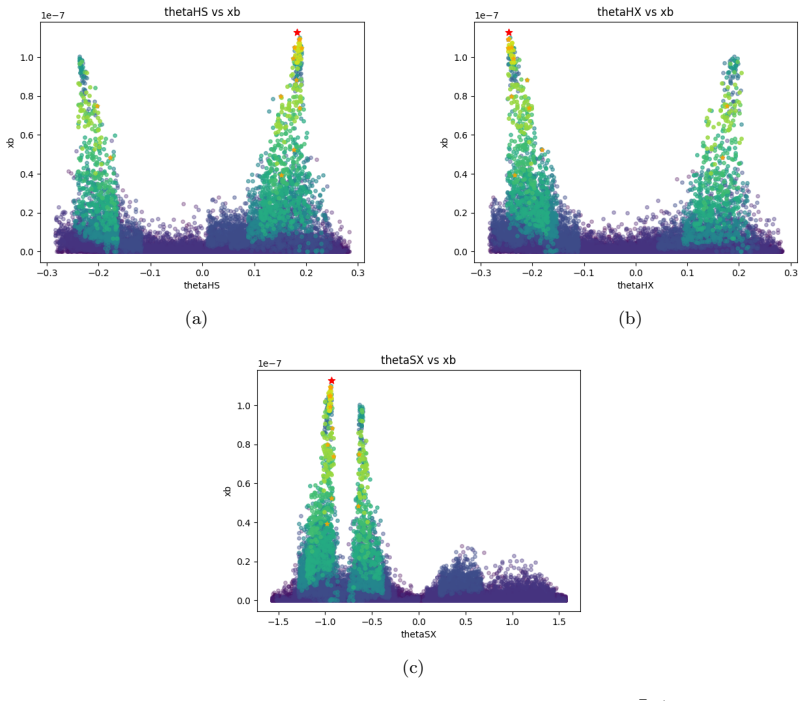
- Figures 1–3 use a purple-to-yellow color scale for iteration number; a discrete legend or explicit iteration labels would improve readability when printed in grayscale.
- The footnote on p. 2 notes that the latest ScannerS lacks a viable HiggsTools interface and that a standalone interface is used. The repository README or Section 4.1 should state the exact ScannerS and HiggsTools versions (or commit hashes) employed, to guarantee long-term reproducibility.
- Table 1 lists “-p, --precision” as required for single-mass-point runs, while Table 3 notes that precision can be left adaptive for mass-list runs. A brief remark on the recommended default for new users would be helpful.
- Minor typographical issues: “maxmimum” (p. 4), “thevs and heta s” (p. 3), and inconsistent hyphenation of “pre-scan/prescan.”
Circularity Check
No significant circularity: maximal rates are independently sampled from ScannerS/HiggsTools under external constraints and only later compared to LHC limits.
full rationale
The paper’s central claim is a numerical optimization procedure (prescan + KDE volume split + iterative zoom densification under documented stopping rules and filters) that returns near-maximal values of production cross-section times branching ratio for fixed-mass points in the TRSM (or any ScannerS model). Those rates are computed from free parameters via ScannerS (cross-sections, BRs, theoretical constraints) and filtered by HiggsTools (experimental exclusions and signal strengths); they are not fitted to the LHC limits against which they are subsequently plotted. Self-citations to the authors’ earlier TRSM papers supply only the model Lagrangian, free-parameter count, and sum rules—standard model-definition material that does not force the numerical maxima by construction. No equation equates a claimed prediction to a fitted input, no uniqueness theorem is imported to forbid alternatives, and no ansatz is smuggled in. The finite-sampling and adaptive-stopping caveats are methodological limitations, not circular reductions. Score 1 reflects only the ordinary presence of author self-citations for the model definition, which are not load-bearing for the tool’s results.
Axiom & Free-Parameter Ledger
free parameters (3)
- relative width upper limit (default 15 %)
- precision-level stopping thresholds (coarse/low/medium/high and adaptive 1 %/20 imes rules)
- TRSM free parameters (v_S, v_X, θ_hS, θ_hX, θ_SX) for each fixed-mass point
axioms (4)
- domain assumption ScannerS correctly implements all theoretical constraints (bounded-from-below, perturbativity, electroweak precision) and computes production cross-sections and branching ratios for the TRSM.
- domain assumption HiggsTools (HiggsBounds + HiggsSignals) correctly applies the latest experimental exclusion and signal-strength constraints.
- domain assumption The TRSM potential with two soft Z2 symmetries and the resulting 3×3 mixing matrix and sum rule Σ κ_i² = 1 correctly describe the scalar sector.
- ad hoc to paper Kernel-density estimation of the pre-scan reliably identifies distinct local “bumps” that each contain a relevant local maximum.
invented entities (1)
-
TRSMScans software tool (zoom optimizer + Python wrapper)
independent evidence
read the original abstract
In this work, we propose a new scan tool that automatically calculates maximal cross section predictions for a new physics scenario with additional scalar states. While the tool is currently optimized for asymmetric production and decay processes in the form of p p -> h3 -> h1 h2, where hi denote CP even neutral scalars, in principle it can be extended to include any production and decay mode. As the code builds largely on the structure of the publicly available code ScannerS, it can in principle be extended to any other model contained within this tool. We here show first applications for a specific model, the Two-Real-Singlet Model (TRSM), and compare to publicly available results from the LHC collaborations from the previous runs. We also in detail discuss the structure of the code, including code installation, usage, as well as underlying algorithms.
Figures


Forward citations
Cited by 1 Pith paper
-
Search for new scalars via $X \rightarrow SH \rightarrow b\bar{b}b\bar{b}$ in proton-proton collisions at $\sqrt{s} = 13$ TeV with the ATLAS detector
No excess over background is found in ATLAS's first search for X→SH→4b, which sets 95% CL upper limits of 0.7 fb–2.6 pb on the production cross-section times branching ratio.
Reference graph
Works this paper leans on
-
[1]
Rita Coimbra, Marco O. P. Sampaio, and Rui Santos. ScannerS: Constraining the phase diagram of a complex scalar singlet at the LHC.Eur. Phys. J. C, 73(9):2428, 2013, 1301.2599
Pith/arXiv arXiv 2013
-
[2]
P. M. Ferreira, R. Guedes, M. O. P. Sampaio, and R. Santos. Wrong sign and symmetric limits and non-decoupling in 2HDMs.JHEP, 12:067, 2014, 1409.6723
Pith/arXiv arXiv 2014
-
[3]
Raul Costa, Margarete M¨ uhlleitner, Marco O. P. Sampaio, and Rui Santos. Singlet Extensions of the Standard Model at LHC Run 2: Benchmarks and Comparison with the NMSSM.JHEP, 06:034, 2016, 1512.05355
Pith/arXiv arXiv 2016
-
[4]
Margarete M¨ uhlleitner, Marco O. P. Sampaio, Rui Santos, and Jonas Wittbrodt. The N2HDM under Theoretical and Experimental Scrutiny.JHEP, 03:094, 2017, 1612.01309
Pith/arXiv arXiv 2017
-
[5]
Margarete M¨ uhlleitner, Marco O. P. Sampaio, Rui Santos, and Jonas Wittbrodt. ScannerS: Parameter Scans in Extended Scalar Sectors.CoRR, abs/2007.02985, 2020, 2007.02985
Pith/arXiv arXiv 2007
-
[6]
HiggsTools: BSM scalar phenomenology with new versions of HiggsBounds and HiggsSignals.Comput
Henning Bahl, Thomas Biek¨ otter, Sven Heinemeyer, Cheng Li, Steven Paasch, Georg Wei- glein, and Jonas Wittbrodt. HiggsTools: BSM scalar phenomenology with new versions of HiggsBounds and HiggsSignals.Comput. Phys. Commun., 291:108803, 2023, 2210.09332
Pith/arXiv arXiv 2023
-
[7]
Philip Bechtle, Oliver Brein, Sven Heinemeyer, Georg Weiglein, and Karina E. Williams. HiggsBounds: Confronting Arbitrary Higgs Sectors with Exclusion Bounds from LEP and the Tevatron.Comput. Phys. Commun., 181(1):138–167, 2010, 0811.4169
Pith/arXiv arXiv 2010
-
[8]
Philip Bechtle, Oliver Brein, Sven Heinemeyer, Georg Weiglein, and Karina E. Williams. HiggsBounds 2.0.0: Confronting Neutral and Charged Higgs Sector Predictions with Exclu- sion Bounds from LEP and the Tevatron.Comput. Phys. Commun., 182:2605–2631, 2011, 1102.1898
Pith/arXiv arXiv 2011
-
[9]
Recent Developments in HiggsBounds and a Preview of HiggsSignals
Philip Bechtle, Oliver Brein, Sven Heinemeyer, Oscar St˚ a l, Tim Stefaniak, Georg Weiglein, and Karina Williams. Recent Developments in HiggsBounds and a Preview of HiggsSignals. InPoS CHARGED2012, page 024, 2012, 1301.2345
Pith/arXiv arXiv 2012
-
[10]
Philip Bechtle, Oliver Brein, Sven Heinemeyer, Oscar St˚ a l, Tim Stefaniak, Georg Weiglein, and Karina Williams. HiggsBounds-4: Improved Tests of Extended Higgs Sectors against Exclusion Bounds from LEP, the Tevatron and the LHC.Eur. Phys. J. C, 74:2693, 2014, 1311.0055
Pith/arXiv arXiv 2014
-
[11]
Applying Exclusion Likelihoods from LHC Searches to Extended Higgs Sectors.Eur
Philip Bechtle, Sven Heinemeyer, Oscar St˚ a l, Tim Stefaniak, and Georg Weiglein. Applying Exclusion Likelihoods from LHC Searches to Extended Higgs Sectors.Eur. Phys. J. C, 75(9), 2015, 1507.06706
Pith/arXiv arXiv 2015
-
[12]
HiggsBounds-5: Testing Higgs Sectors in the LHC 13 TeV Era
Philip Bechtle, Daniel Dercks, Sven Heinemeyer, Tobias Klingl, Tim Stefaniak, Georg Wei- glein, and Jonas Wittbrodt. HiggsBounds-5: Testing Higgs Sectors in the LHC 13 TeV Era. Eur. Phys. J. C, 80(12), 2020, 2006.06007
Pith/arXiv arXiv 2020
-
[13]
Testing Exotic Scalars with HiggsBounds.Eur
Henning Bahl, Victor Martin Lozano, Tim Stefaniak, and Jonas Wittbrodt. Testing Exotic Scalars with HiggsBounds.Eur. Phys. J. C, 82(7), 2022, 2109.10366. 21
Pith/arXiv arXiv 2022
-
[14]
HiggsSig- nals: Confronting arbitrary Higgs sectors with measurements at the Tevatron and the LHC
Philip Bechtle, Sven Heinemeyer, Oscar St˚ al, Tim Stefaniak, and Georg Weiglein. HiggsSig- nals: Confronting arbitrary Higgs sectors with measurements at the Tevatron and the LHC. Eur. Phys. J. C, 74(2):2711, 2014, 1305.1933
Pith/arXiv arXiv 2014
-
[15]
Constraining extended Higgs sectors with HiggsSignals
Oscar St˚ al and Tim Stefaniak. Constraining extended Higgs sectors with HiggsSignals. In PoS EPS-HEP2013, volume EPS-HEP2013, page 314, 2013, 1310.4039
Pith/arXiv arXiv 2013
-
[16]
Probing the Standard Model with Higgs signal rates from the Tevatron, the LHC and a future ILC
Philip Bechtle, Sven Heinemeyer, Oscar St˚ al, Tim Stefaniak, and Georg Weiglein. Probing the Standard Model with Higgs signal rates from the Tevatron, the LHC and a future ILC. JHEP, 11:039, 2014, 1403.1582
Pith/arXiv arXiv 2014
-
[17]
HiggsSignals-2: Probing new physics with precision Higgs measurements in the LHC 13 TeV era.Eur
Philip Bechtle, Sven Heinemeyer, Tobias Klingl, Tim Stefaniak, Georg Weiglein, and Jonas Wittbrodt. HiggsSignals-2: Probing new physics with precision Higgs measurements in the LHC 13 TeV era.Eur. Phys. J. C, 81(3):227, 2021, 2012.09197
Pith/arXiv arXiv 2021
-
[18]
Two-real-scalar-singlet extension of the SM: LHC phenomenology and benchmark scenarios.Eur
Tania Robens, Tim Stefaniak, and Jonas Wittbrodt. Two-real-scalar-singlet extension of the SM: LHC phenomenology and benchmark scenarios.Eur. Phys. J. C, 80(2):151, 2020, 1908.08554
Pith/arXiv arXiv 2020
-
[19]
Two-Real-Singlet-Model Benchmark Planes.Symmetry, 15:27, 2023, 2209.10996
Tania Robens. Two-Real-Singlet-Model Benchmark Planes.Symmetry, 15:27, 2023, 2209.10996
Pith/arXiv arXiv 2023
-
[20]
Preparing a python installation, 2023
Giovanni Iadarola. Preparing a python installation, 2023. 2026-06-19
2023
-
[21]
Extended scalar sectors from all angles (in 15 minutes)
Tania Robens. Extended scalar sectors from all angles (in 15 minutes). In59th Rencontres de Moriond on Electroweak Interactions and Unified Theories, 4 2025, 2504.13014
Pith/arXiv arXiv 2025
-
[22]
J. F. Gunion, H. E. Haber, and J. Wudka. Sum rules for Higgs bosons.Phys. Rev. D, 43:904–912, 1991
1991
-
[23]
CMS Collaboration. Search for a heavy Higgs boson decaying into two lighter Higgs bosons in theτ τ bbfinal state at 13 TeV.JHEP, 11:057, 2021, 2106.10361
Pith/arXiv arXiv 2021
-
[24]
ATLAS Collaboration. Search for a resonance decaying into a scalar particle and a Higgs boson in the final state with two bottom quarks and two photons in proton–proton collisions at a center of mass energy of 13 TeV with the ATLAS detector.JHEP, 11:047, 2024, 2404.12915
Pith/arXiv arXiv 2024
-
[25]
CMS Collaboration. Search for a massive scalar resonance decaying to a light scalar and a Higgs boson in the four b quarks final state with boosted topology.Phys. Lett. B, 842:137392, 2023, 2204.12413. 22
Pith/arXiv arXiv 2023
discussion (0)
Sign in with ORCID, Apple, or X to comment. Anyone can read and Pith papers without signing in.