REVIEW 3 major objections 6 minor 1 cited by
Nexus claims mesh generation can be done entirely with diffusion, replacing serialized token sequences with octree vertex growth and Spacetime-Interval topology embeddings, and reports lower error than autoregressive baselines.
Reviewed by Pith at T0; open to challenge. T0 means a machine referee read the full paper against a public rubric. the ladder, T0–T4 →
T0 review · deepseek-v4-flash
2026-08-02 04:48 UTC pith:OOCBRN2O
load-bearing objection Solid mesh-generation systems paper with a real gap: topology quality on generated meshes is never measured. the 3 major comments →
Nexus: Native Mesh Generation with Diffusion
The pith
A machine-rendered reading of the paper's core claim, the machinery that carries it, and where it could break.
Core claim
Nexus claims a sort-free, fully diffusion-based pipeline can outperform serialized autoregressive mesh generation. Vertices are generated as octree occupancy level by level via flow matching; topology is distilled into per-vertex embeddings by a KL-regularized autoencoder supervised by Spacetime Intervals — an edge exists when spatial squared distance exceeds temporal squared distance, a face when the analogous squared-area difference is positive. A second flow-matching model generates these embeddings; edges are recovered first, closed 3-cycles verified as faces. Reported results: lower Chamfer/Hausdorff error than baselines on standard benchmarks, stability over a 32-fold density range, an
What carries the argument
The Spacetime Interval: each vertex carries an embedding split into spatial and temporal halves (s,t); the first-order interval ‖s_u−s_v‖²−‖t_u−t_v‖² signals an edge when positive, and a second-order interval compares squared triangle areas in the spatial half against the temporal half to signal a face. The indefinite (Minkowski-like) signature is the load-bearing mechanism: the subtractive temporal term acts as a learned slack variable, letting the representation encode non-metric connectivity (including non-manifold faces) that positive-definite distances cannot. This indicator trains a topology autoencoder whose latents are generated by flow-matching diffusion; the octree stage uses the s
Load-bearing premise
The topology autoencoder's latent space is smooth enough that flow-matching samples decode into valid mesh topology; the paper shows reconstruction F1 ≈ 1.0 but never measures edge/face correctness on diffusion-generated vertices, so if sampled latents fall outside the training manifold the recovered topology could silently degrade.
What would settle it
Run the full pipeline on point clouds whose vertex distributions land outside the autoencoder's training manifold (very sparse, very dense, or non-uniformly sampled) and compute face-recovery F1 and the fraction of non-manifold edges on the generated meshes. If face F1 drops much below 0.9 while Chamfer distance stays low, the holistic topology claim is not supported by the reported metrics. A simpler check: compare the topology autoencoder's reconstruction F1 on latents drawn from the prior N(0,I) versus latents from its own posterior; if prior samples decode poorly, the diffusion stage will
If this is right
- If correct, mesh generation no longer degrades with sequence length: inference cost scales with octree occupancy and face count rather than with the number of serialized tokens, making larger scenes more tractable.
- Because topology is recovered edges-first and faces only from confirmed edge triples, generated meshes are structurally consistent by construction, which should make them easier to texture, edit, and animate downstream.
- The density and noise robustness results suggest a single trained model can serve inputs from different sensor resolutions without re-tuning, a practical property for real-world scan-to-mesh pipelines.
- The practitioner preference of 93% indicates the geometric gains are perceptually meaningful, strengthening the case for diffusion-native meshes in film and game asset workflows.
Where Pith is reading between the lines
- The strongest untested link is the autoencoder's latent-space smoothness: the reported near-perfect edge/face F1 scores are reconstruction-only, computed on the autoencoder's own encodings. If a sampled topology latent falls off the training manifold, the edge-first recovery could silently drop faces or create non-manifold edges while Chamfer/Hausdorff remain low; measuring face-recovery F1 on gen
- The Minkowski-signature argument — that positive-definite metrics impose transitivity that distorts connectivity — is general. A natural extension is to test the same spacetime-interval trick on other high-order relational structures such as hypergraph links or multi-body joints, where pairwise distances are known to be insufficient.
- Because the paper attributes part of the gain to separating the spatial and temporal determinants in the second-order interval, varying the split ratio between spatial and temporal channels might expose a trade-off between edge and face expressivity that the fixed half/half split hides.
Editorial analysis
A structured set of objections, weighed in public.
Referee Report
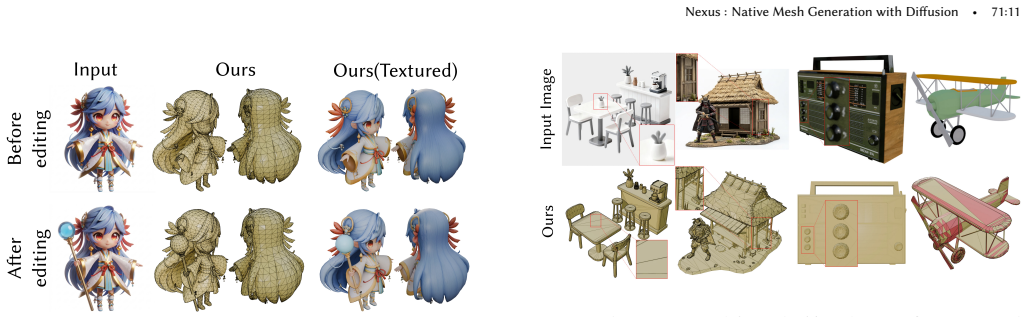
Summary. The paper presents Nexus, a two-stage diffusion framework for generating triangle meshes from point clouds or images. In the first stage, vertices are modeled as occupancy in an octree and generated coarse-to-fine with a flow-matching diffusion transformer. In the second stage, a KL-regularized graph-transformer autoencoder maps vertex sets plus edge/face topology into per-vertex 'Spacetime Interval' embeddings; a second diffusion model generates these embeddings conditioned on the vertices, and edges/faces are recovered by thresholding first- and second-order spacetime intervals followed by closed-3-cycle search. The authors claim state-of-the-art geometric quality on Objaverse and Toys4K, robust behavior across input density and noise, strong user-study preference, and the ability to generate non-manifold artist-style topology without serialization.
Significance. If the claims are fully supported, Nexus would be a meaningful step forward: it avoids autoregressive token ordering, scales geometry generation through octrees, and extends spacetime-distance ideas to a topology latent space that can in principle handle arbitrary connectivity. The paper has real strengths: large-scale training on roughly one million meshes, a broad baseline comparison, informative ablations of the topology autoencoder, robustness experiments, a practitioner user study, and an uncurated generation gallery. However, the central empirical claim about generated topology is not actually measured, and several quantitative comparisons lack statistical grounding. The significance of the contribution therefore depends on whether the revision can supply direct evidence that diffusion-sampled topology latents decode into valid, coherent meshes.
major comments (3)
- [§4.2–§4.3, especially Eq. (1) and Tab. 9] The paper's central claim is that Nexus generates coherent mesh topology, yet every generation-quality table (Tabs. 3–8) reports only geometric or semantic metrics (CD, HD, ECD, NC, ULIP/UNI3D). Tab. 9, the only topology table, measures the topology autoencoder's ability to reconstruct edge/face labels when encoding and decoding the same ground-truth mesh; it does not measure the ability of the 2B-parameter topology diffusion model, conditioned on generated vertices, to sample latents that decode into valid topology. This gap is load-bearing: the paper's own failure gallery (Fig. 12b) shows missing faces, and CD/HD cannot detect triangulation failures because different triangulations of the same surface can have nearly identical point-cloud distances. I request an end-to-end evaluation on generated meshes — edge/face precision, recall, F1, watertightness/manifoldness, non-manifold-edge r
- [§4.4, Tab. 9] The ablation table compares all variants at 8k iterations but reports the final model at 50k iterations. For example, 'Ours' at 8k has face F1 0.99985, while 'Ours (50k)' has 1.00000. The ablations for 'Minkowski loss', 'Euclidean', 'Spherical', and the component removals are not rerun to 50k, so the reported gaps may be partly due to training length rather than the design choice. Also, the exact 1.00000 values for edge F1 at 50k are suspicious without reported raw counts or error bars; the binary cross-entropy loss and thresholding can saturate. Please rerun ablations to the same iteration count and report standard deviations or at least the raw true/false positive/negative counts.
- [§4.2.1–§4.2.4, Tabs. 3–7] No variance or statistical significance is reported for the main quantitative comparisons. Tables 3, 5, and 6 give single numbers; the differences between Nexus and the best baseline are small at the margin (e.g., CD 0.031 vs. 0.040 on Objaverse, Table 3). Without multiple seeds or confidence intervals, it is impossible to tell whether the improvement is reliable. The user study in Table 7 reports Elo and preference percentages but no confidence intervals; with 1,221 comparisons, the 93% preference should have a small CI, but it needs to be stated. Please add standard deviations across at least 3 training/evaluation seeds or bootstrapped CIs, and clarify how many test objects per condition.
minor comments (6)
- [§4.2.1, Tab. 4 and text] The text says 'Our NC value (1.5441) is higher than baselines due to the absence of face normal prediction...', but Table 4 shows FastMesh with NC 1.9162, which is higher than 1.5441. The definition of Normal Consistency as an average dot product in [0,2] is also unusual; typical normal consistency is in [-1,1]. Please correct the definition and the comparison statement.
- [§3.2, Eq. (5)] The second-order spacetime interval is introduced as a heuristic extension of Eq. (3). It would help to state explicitly what geometric property the sign of A_s^2 - A_t^2 is intended to capture, and why the determinant-based Minkowski alternative in §4.4 is less stable. The current motivation is mostly intuitive.
- [§3.2.2] The closed-3-cycle recovery step can create non-manifold configurations or duplicate faces if the edge set is noisy. This is exactly the failure mode that needs quantitative monitoring; at minimum, define what 'topologically coherent' means in terms of the recovery algorithm and report the incidence of such cases on generated meshes.
- [§4.4, Tab. 9] The row 'w/o enc GCN' is described in the text as causing edge F1 to fall to 0.88448, but the table shows 0.80327. Please align the text and table.
- [Abstract and §1] Typo: 'stuggles' should be 'struggles'. Also, the phrase 'artist-friendly mesh topology' is used as a claim; the paper should clarify which topology properties (manifoldness, edge flow, face budget, etc.) are actually evaluated.
- [§4.3, Tab. 8] The comparison with TRELLIS is limited to one table and qualitative images. Since TRELLIS uses marching cubes, the topological comparison is implicit; consider adding an explicit topological statistics comparison for this setting as well.
Circularity Check
No circularity found: the method is a trained generative pipeline, and the topology-evaluation gap is a missing metric, not a reduction.
full rationale
No circular step of the specified kinds is present. The paper's central derivation is p(M|C)=p(V|C)p(F|V,C) (Eq. 1), implemented as separate flow-matching networks for vertices and topology. Vertex generation is supervised by ground-truth octree occupancy and evaluated on held-out data with CD/HD. Topology generation trains a KL-regularized autoencoder whose loss is a BCE on the spacetime-interval indicators (Eqs. 3, 5, 7), then trains a latent diffusion on those embeddings. Using the same indicator for supervision and decoding is a standard representation-learning design, not a prediction forced by construction: the embeddings are free parameters fit to ground-truth edge/face labels, and Tab. 9 compares against Euclidean, spherical, and Minkowski alternatives, making the spacetime-signature claim an internally controlled empirical comparison rather than an assumed premise. The main weakness is an evaluation gap, not circularity: Tab. 9 reports autoencoder reconstruction, not the topology quality of diffusion-sampled latents, and the Limitations admit missing-face failure cases ('Missing faces: large missing surfaces on building walls' in Fig. 12b). Self-citations (e.g., OctFusion [Xiong et al. 2025], TripoSG [Li et al. 2025], 3DShape2VecSet [Zhang et al. 2023]) appear as background or as architectural choices, not as load-bearing justification of the reported results. The derivation chain is therefore self-contained as an empirical system; any concerns about topology metrics belong to correctness/evaluation risk, not circularity.
Axiom & Free-Parameter Ledger
free parameters (5)
- Octree depth D =
9 (512^3 grid)
- Spacetime embedding dimension c =
not reported (decoder hidden dim 1024, latent bottleneck 64)
- Topology VAE latent bottleneck =
64
- KL weight on topology VAE =
not reported
- Negative triplet sampling ratio for face loss =
not reported
axioms (6)
- standard math Flow matching on binary child-occupancy tokens can learn conditional octree geometry.
- domain assumption All target meshes are triangular and can be described by edge and face indicator sets.
- domain assumption Octree depth 9 (512^3) is a sufficient vertex representation for the claimed quality.
- domain assumption Per-vertex embeddings with the Minkowski-type signed interval can express arbitrary edge/face topology.
- domain assumption The KL-VAE latent space is smooth enough for flow-matching diffusion to generate valid latents.
- domain assumption All faces can be recovered as closed 3-cycles on the recovered edge set.
invented entities (1)
-
2nd-order Spacetime Interval (spacetime embeddings [s_v, t_v])
no independent evidence
read the original abstract
Generating high-quality triangle meshes is essential for film, gaming, and interactive 3D applications. Mainstream methods rely on mesh serialization and autoregressive processes, which stuggles in effective inference and is sensitive to error accumulation. In this paper, we present Nexus, a diffusion method that achieves holistic mesh generation via decoupled vertex and topology generation. First, we view mesh vertices as sparse voxels organized as an octree and adopt a diffusion model to generate the vertices in a coarse-to-fine manner. Second, for topology modeling, we propose Spacetime Interval, as an extension of Spacetime Distance to encode arbitrary edge and face topology into continuous per-vertex embeddings. It allows for a global and efficient recovery of complex topology. We then employ a diffusion model to generate the continuous embeddings on the generated vertices. Extensive experiments on the Objaverse and Toys4K datasets and in-the-wild images demonstrate that our method outperforms state-of-the-art autoregressive and two-stage baselines, effectively circumventing the inherent limitations of sequential mesh modeling. A blind user study from 3D practitioners confirms strong perceptual preference for our results.
Figures




Forward citations
Cited by 1 Pith paper
-
Meshy T2: Fast Native Mesh Generation with Flow Matching
Single-image native mesh generation runs at interactive speed in Meshy T2 by flow-matching one continuous latent per vertex, then decoding vertices, edge connectivity, and face winding in one pass.
Reference graph
Works this paper leans on
-
[1]
Advances in Neural Information Processing Systems , volume=
Denoising diffusion probabilistic models , author=. Advances in Neural Information Processing Systems , volume=
-
[2]
Proceedings of the IEEE/CVF conference on computer vision and pattern recognition , pages=
Occupancy networks: Learning 3d reconstruction in function space , author=. Proceedings of the IEEE/CVF conference on computer vision and pattern recognition , pages=
-
[3]
Proceedings of the 28th annual conference on Computer graphics and interactive techniques , pages=
Reconstruction and representation of 3D objects with radial basis functions , author=. Proceedings of the 28th annual conference on Computer graphics and interactive techniques , pages=
-
[4]
Biao Zhang and Matthias Nie. 3. Advances in Neural Information Processing Systems , year=
-
[5]
Advances in neural information processing systems , volume=
Attention is all you need , author=. Advances in neural information processing systems , volume=
-
[6]
Proceedings of the IEEE/CVF Conference on Computer Vision and Pattern Recognition , pages=
High-resolution image synthesis with latent diffusion models , author=. Proceedings of the IEEE/CVF Conference on Computer Vision and Pattern Recognition , pages=
-
[7]
European conference on computer vision , pages=
End-to-end object detection with transformers , author=. European conference on computer vision , pages=. 2020 , organization=
2020
-
[8]
Proceedings of the IEEE/CVF conference on computer vision and pattern recognition , pages=
Deepsdf: Learning continuous signed distance functions for shape representation , author=. Proceedings of the IEEE/CVF conference on computer vision and pattern recognition , pages=
-
[9]
Proceedings of the IEEE/CVF Conference on Computer Vision and Pattern Recognition , pages=
Learning implicit fields for generative shape modeling , author=. Proceedings of the IEEE/CVF Conference on Computer Vision and Pattern Recognition , pages=
-
[10]
arXiv preprint arXiv:1901.06802 , year=
Deep level sets: Implicit surface representations for 3d shape inference , author=. arXiv preprint arXiv:1901.06802 , year=
Pith/arXiv arXiv 1901
-
[11]
2020 , booktitle=
NeRF: Representing Scenes as Neural Radiance Fields for View Synthesis , author=. 2020 , booktitle=
2020
-
[12]
Advances in Neural Information Processing Systems , volume=
Generative adversarial nets , author=. Advances in Neural Information Processing Systems , volume=
-
[13]
Kingma and Max Welling , editor =
Diederik P. Kingma and Max Welling , editor =. Auto-Encoding Variational Bayes , booktitle =
-
[14]
International Conference on Machine Learning , pages=
Variational Inference with Normalizing Flows , author=. International Conference on Machine Learning , pages=
-
[15]
Advances in Neural Information Processing Systems , volume=
Conditional image generation with pixelcnn decoders , author=. Advances in Neural Information Processing Systems , volume=
-
[16]
Proceedings of the IEEE/CVF Conference on Computer Vision and Pattern Recognition , pages=
Taming transformers for high-resolution image synthesis , author=. Proceedings of the IEEE/CVF Conference on Computer Vision and Pattern Recognition , pages=
-
[17]
Advances in neural information processing systems , volume=
Neural discrete representation learning , author=. Advances in neural information processing systems , volume=
-
[18]
International Conference on Machine Learning , pages=
A theory of generative convnet , author=. International Conference on Machine Learning , pages=. 2016 , organization=
2016
-
[19]
Predicting structured data , volume=
A tutorial on energy-based learning , author=. Predicting structured data , volume=
-
[20]
Proceedings of the IEEE conference on computer vision and pattern recognition , pages=
Pointnet: Deep learning on point sets for 3d classification and segmentation , author=. Proceedings of the IEEE conference on computer vision and pattern recognition , pages=
-
[21]
Advances in neural information processing systems , volume=
Pointnet++: Deep hierarchical feature learning on point sets in a metric space , author=. Advances in neural information processing systems , volume=
-
[22]
Acm Transactions On Graphics (tog) , volume=
Dynamic graph cnn for learning on point clouds , author=. Acm Transactions On Graphics (tog) , volume=. 2019 , publisher=
2019
-
[23]
Computational Visual Media , volume=
Pct: Point cloud transformer , author=. Computational Visual Media , volume=. 2021 , publisher=
2021
-
[24]
Proceedings of the IEEE/CVF International Conference on Computer Vision , pages=
Point transformer , author=. Proceedings of the IEEE/CVF International Conference on Computer Vision , pages=
-
[25]
Proceedings of the IEEE/CVF International Conference on Computer Vision , pages=
Sa-convonet: Sign-agnostic optimization of convolutional occupancy networks , author=. Proceedings of the IEEE/CVF International Conference on Computer Vision , pages=
-
[26]
Proceedings of the IEEE/CVF Conference on Computer Vision and Pattern Recognition , pages=
Learning deep implicit functions for 3D shapes with dynamic code clouds , author=. Proceedings of the IEEE/CVF Conference on Computer Vision and Pattern Recognition , pages=
-
[27]
European Conference on Computer Vision , pages=
Convolutional occupancy networks , author=. European Conference on Computer Vision , pages=. 2020 , organization=
2020
-
[28]
Proceedings of the IEEE/CVF Conference on Computer Vision and Pattern Recognition , pages=
Local deep implicit functions for 3d shape , author=. Proceedings of the IEEE/CVF Conference on Computer Vision and Pattern Recognition , pages=
-
[29]
ICLR , year=
An Image is Worth 16x16 Words: Transformers for Image Recognition at Scale , author=. ICLR , year=
-
[30]
Advances in Neural Information Processing Systems , volume=
Diffusion models beat gans on image synthesis , author=. Advances in Neural Information Processing Systems , volume=
-
[31]
International Conference on Machine Learning , pages=
Deep unsupervised learning using nonequilibrium thermodynamics , author=. International Conference on Machine Learning , pages=. 2015 , organization=
2015
-
[32]
IEEE Transactions on Pattern Analysis and Machine Intelligence , year=
Image super-resolution via iterative refinement , author=. IEEE Transactions on Pattern Analysis and Machine Intelligence , year=
-
[33]
Proceedings of the IEEE/CVF Conference on Computer Vision and Pattern Recognition , pages=
Diffusion probabilistic models for 3d point cloud generation , author=. Proceedings of the IEEE/CVF Conference on Computer Vision and Pattern Recognition , pages=
-
[34]
Proceedings of the IEEE/CVF International Conference on Computer Vision , pages=
3d shape generation and completion through point-voxel diffusion , author=. Proceedings of the IEEE/CVF International Conference on Computer Vision , pages=
-
[35]
arXiv preprint arXiv:2210.06978 , year=
LION: Latent Point Diffusion Models for 3D Shape Generation , author=. arXiv preprint arXiv:2210.06978 , year=
-
[36]
arXiv preprint arXiv:1512.03012 , year=
Shapenet: An information-rich 3d model repository , author=. arXiv preprint arXiv:1512.03012 , year=
-
[37]
Proceedings of the fourth Eurographics symposium on Geometry processing , volume=
Poisson surface reconstruction , author=. Proceedings of the fourth Eurographics symposium on Geometry processing , volume=
-
[38]
Proceedings of the IEEE/CVF Conference on Computer Vision and Pattern Recognition , pages=
Implicit functions in feature space for 3d shape reconstruction and completion , author=. Proceedings of the IEEE/CVF Conference on Computer Vision and Pattern Recognition , pages=
-
[39]
Proceedings of the IEEE/CVF Conference on Computer Vision and Pattern Recognition , pages=
Poco: Point convolution for surface reconstruction , author=. Proceedings of the IEEE/CVF Conference on Computer Vision and Pattern Recognition , pages=
-
[40]
Proceedings of the IEEE/CVF Conference on Computer Vision and Pattern Recognition , pages=
Autosdf: Shape priors for 3d completion, reconstruction and generation , author=. Proceedings of the IEEE/CVF Conference on Computer Vision and Pattern Recognition , pages=
-
[41]
International conference on machine learning , pages=
Polygen: An autoregressive generative model of 3d meshes , author=. International conference on machine learning , pages=. 2020 , organization=
2020
-
[42]
IEEE Transactions on Pattern Analysis and Machine Intelligence , year=
Generative VoxelNet: learning energy-based models for 3D shape synthesis and analysis , author=. IEEE Transactions on Pattern Analysis and Machine Intelligence , year=
-
[43]
Proceedings of the IEEE/CVF Winter Conference on Applications of Computer Vision , pages=
Pointgrow: Autoregressively learned point cloud generation with self-attention , author=. Proceedings of the IEEE/CVF Winter Conference on Applications of Computer Vision , pages=
-
[44]
Proceedings of the IEEE/CVF International Conference on Computer Vision , pages=
Pointflow: 3d point cloud generation with continuous normalizing flows , author=. Proceedings of the IEEE/CVF International Conference on Computer Vision , pages=
-
[45]
Proceedings of the IEEE/CVF Conference on Computer Vision and Pattern Recognition , pages=
3d shape generation with grid-based implicit functions , author=. Proceedings of the IEEE/CVF Conference on Computer Vision and Pattern Recognition , pages=
-
[46]
Proceedings of the IEEE/CVF Conference on Computer Vision and Pattern Recognition , pages=
Shapeformer: Transformer-based shape completion via sparse representation , author=. Proceedings of the IEEE/CVF Conference on Computer Vision and Pattern Recognition , pages=
-
[47]
arXiv preprint arXiv:2204.01955 , year=
Autoregressive 3d shape generation via canonical mapping , author=. arXiv preprint arXiv:2204.01955 , year=
-
[48]
Proceedings of the IEEE/CVF Conference on Computer Vision and Pattern Recognition , pages=
Generative pointnet: Deep energy-based learning on unordered point sets for 3d generation, reconstruction and classification , author=. Proceedings of the IEEE/CVF Conference on Computer Vision and Pattern Recognition , pages=
-
[49]
Proceedings of the IEEE/CVF Conference on Computer Vision and Pattern Recognition , pages=
Vector quantized diffusion model for text-to-image synthesis , author=. Proceedings of the IEEE/CVF Conference on Computer Vision and Pattern Recognition , pages=
-
[50]
International conference on machine learning , pages=
Perceiver: General perception with iterative attention , author=. International conference on machine learning , pages=. 2021 , organization=
2021
-
[51]
Tero Karras and Miika Aittala and Timo Aila and Samuli Laine , title =. Proc. NeurIPS , year =
-
[52]
, author=
Estimation of non-normalized statistical models by score matching. , author=. Journal of Machine Learning Research , volume=
-
[53]
arXiv preprint arXiv:2205.11487 , year=
Photorealistic Text-to-Image Diffusion Models with Deep Language Understanding , author=. arXiv preprint arXiv:2205.11487 , year=
-
[54]
International conference on machine learning , pages=
Learning representations and generative models for 3d point clouds , author=. International conference on machine learning , pages=. 2018 , organization=
2018
-
[55]
SDF-StyleGAN: Implicit SDF-Based StyleGAN for 3D Shape Generation , author =. Comput. Graph. Forum (SGP) , year =
-
[56]
SIGGRAPH Asia 2022 Conference Papers , pages=
Neural wavelet-domain diffusion for 3d shape generation , author=. SIGGRAPH Asia 2022 Conference Papers , pages=
2022
-
[57]
arXiv preprint arXiv:2211.16677 , year=
3D Neural Field Generation using Triplane Diffusion , author=. arXiv preprint arXiv:2211.16677 , year=
-
[58]
arXiv preprint arXiv:2211.13757 , year=
DiffusionSDF: Conditional Generative Modeling of Signed Distance Functions , author=. arXiv preprint arXiv:2211.13757 , year=
-
[59]
ACM Transactions on Graphics (TOG), Siggraph Asia 2019 , volume=
StructureNet: Hierarchical Graph Networks for 3D Shape Generation , author=. ACM Transactions on Graphics (TOG), Siggraph Asia 2019 , volume=. 2019 , publisher=
2019
-
[60]
3D-R2N2: A Unified Approach for Single and Multi-view 3D Object Reconstruction
Christopher Bongsoo Choy and Danfei Xu and JunYoung Gwak and Kevin Chen and Silvio Savarese. 3D-R2N2: A Unified Approach for Single and Multi-view 3D Object Reconstruction. european conference on computer vision. 2016
2016
-
[61]
arXiv preprint arXiv:1608.04236 , year=
Generative and discriminative voxel modeling with convolutional neural networks , author=. arXiv preprint arXiv:1608.04236 , year=
-
[62]
Proceedings of the IEEE conference on computer vision and pattern recognition , pages=
3d shapenets: A deep representation for volumetric shapes , author=. Proceedings of the IEEE conference on computer vision and pattern recognition , pages=
-
[63]
European Conference on Computer Vision , pages=
Learning a predictable and generative vector representation for objects , author=. European Conference on Computer Vision , pages=. 2016 , organization=
2016
-
[64]
Advances in Neural Information Processing Systems , pages=
Learning a probabilistic latent space of object shapes via 3d generative-adversarial modeling , author=. Advances in Neural Information Processing Systems , pages=
-
[65]
ACM Transactions on Graphics (TOG) , volume=
O-cnn: Octree-based convolutional neural networks for 3d shape analysis , author=. ACM Transactions on Graphics (TOG) , volume=. 2017 , publisher=
2017
-
[66]
Proceedings of the IEEE Conference on Computer Vision and Pattern Recognition , volume=
Octnet: Learning deep 3d representations at high resolutions , author=. Proceedings of the IEEE Conference on Computer Vision and Pattern Recognition , volume=
-
[67]
Octree Generating Networks: Efficient Convolutional Architectures for High-resolution 3D Outputs
Maxim Tatarchenko and Alexey Dosovitskiy and Thomas Brox. Octree Generating Networks: Efficient Convolutional Architectures for High-resolution 3D Outputs. 2017 IEEE International Conference on Computer Vision (ICCV). 2017
2017
-
[68]
SIGGRAPH Asia 2018 Technical Papers , pages=
Adaptive O-CNN: a patch-based deep representation of 3D shapes , author=. SIGGRAPH Asia 2018 Technical Papers , pages=. 2018 , organization=
2018
-
[69]
2017 International Conference on 3D Vision (3DV) , pages=
Octnetfusion: Learning depth fusion from data , author=. 2017 International Conference on 3D Vision (3DV) , pages=. 2017 , organization=
2017
-
[70]
2017 International Conference on 3D Vision (3DV) , pages=
Hierarchical surface prediction for 3d object reconstruction , author=. 2017 International Conference on 3D Vision (3DV) , pages=. 2017 , organization=
2017
-
[71]
1980 , publisher=
Octree encoding: A new technique for the representation, manipulation and display of arbitrary 3-d objects by computer , author=. 1980 , publisher=
1980
-
[72]
Haoqiang Fan and Hao Su and Leonidas J. Guibas. A Point Set Generation Network for 3D Object Reconstruction from a Single Image. 2017 IEEE Conference on Computer Vision and Pattern Recognition (CVPR). 2017
2017
-
[73]
Proceedings of the IEEE conference on computer vision and pattern recognition , pages=
Shape completion using 3d-encoder-predictor cnns and shape synthesis , author=. Proceedings of the IEEE conference on computer vision and pattern recognition , pages=
-
[74]
Proceedings of the IEEE/CVF Conference on Computer Vision and Pattern Recognition , pages=
Sg-nn: Sparse generative neural networks for self-supervised scene completion of rgb-d scans , author=. Proceedings of the IEEE/CVF Conference on Computer Vision and Pattern Recognition , pages=
-
[75]
FoldingNet: Point Cloud Auto-Encoder via Deep Grid Deformation
Yaoqing Yang and Chen Feng and Yiru Shen and Dong Tian. FoldingNet: Point Cloud Auto-Encoder via Deep Grid Deformation. 2018 IEEE/CVF Conference on Computer Vision and Pattern Recognition. 2018
2018
-
[76]
Neural 3D Mesh Renderer
Hiroharu Kato and Yoshitaka Ushiku and Tatsuya Harada. Neural 3D Mesh Renderer. computer vision and pattern recognition. 2018
2018
-
[77]
Kim and Bryan C
Thibault Groueix and Matthew Fisher and Vladimir G. Kim and Bryan C. Russell and Mathieu Aubry. AtlasNet: A Papier-Mâché Approach to Learning 3D Surface Generation. computer vision and pattern recognition. 2018
2018
-
[78]
Proceedings of the IEEE International Conference on Computer Vision , pages=
Deep Mesh Reconstruction from Single RGB Images via Topology Modification Networks , author=. Proceedings of the IEEE International Conference on Computer Vision , pages=
-
[79]
Proceedings of the IEEE Conference on Computer Vision and Pattern Recognition , pages=
A skeleton-bridged deep learning approach for generating meshes of complex topologies from single rgb images , author=. Proceedings of the IEEE Conference on Computer Vision and Pattern Recognition , pages=
-
[80]
IEEE transactions on pattern analysis and machine intelligence , year=
Skeletonnet: A topology-preserving solution for learning mesh reconstruction of object surfaces from rgb images , author=. IEEE transactions on pattern analysis and machine intelligence , year=
discussion (0)
Sign in with ORCID, Apple, or X to comment. Anyone can read and Pith papers without signing in.