REVIEW 3 major objections 5 minor 1 cited by
In Fock boson sampling under loss, transition probabilities are finite Fourier series in each phase, enabling exact gradients via n-th order parameter-shift rules; general GBS admits no such rule.
Reviewed by Pith at T0; open to challenge. T0 means a machine referee read the full paper against a public rubric. the ladder, T0–T4 →
T0 review · deepseek-v4-flash
2026-08-02 00:01 UTC pith:6A6BIHVW
load-bearing objection The Fock PSR result is real and the GBS boundary is new, but the paper overclaims on hardware exactness and the GBS no-go; worth refereeing with revision requests on scope and claims. the 3 major comments →
Parameter-Shift Rules for Gradients in Boson Sampling Experiments
The pith
A machine-rendered reading of the paper's core claim, the machinery that carries it, and where it could break.
Core claim
For a lossy interferometer with transmission matrix T, when each tunable phase θ enters entries as T_mn = a e^{iθ}+b with a,b independent of θ, the Fock-state transition probability from input i to output j equals (1/(i! j!)) Perm[B^{i⊕j}], where B is constructed from T and E = I − T†T. Because a permanent of size n is a polynomial in its entries, the probability is a finite Fourier series Σ_{m=−n}^{n} k_m e^{imθ}, and its derivative can be reconstructed exactly from shifted circuit evaluations via an n-th order parameter-shift rule. The analogous Gaussian boson sampling probability is a hafnian expression divided by the square root of a determinant (Eqs. 90–94); under general loss these fac
What carries the argument
The load-bearing identity is the permanent representation of the lossy Fock transition probability, (1/(i! j!)) Perm[B^{i⊕j}], together with the fact that each entry of the transmission matrix is a single-harmonic function of any given phase, T_mn = a e^{iθ}+b. From this, the entries of the permanent matrix B take the form a' e^{iθ}+b' e^{−iθ}+c', and because the permanent is a polynomial of degree equal to the total photon number n, the whole probability becomes a finite Fourier series with frequencies confined to [−n,n]. The parameter-shift rule exploits this structure by differentiating the series and solving a small linear system (Eqs. 38–43) to get exact derivative coefficients from shi
Load-bearing premise
The rule is exact only if each tunable phase appears exactly once in the circuit and its amplitude transmission is independent of the phase value, so that T entries are a e^{iθ}+b; if real phase-shifters couple amplitude to phase, the finite Fourier bound and the n-th order rule break down.
What would settle it
Measure the complex transmission matrix T(θ) of a real interferometer as a function of one phase (coherent-state input and heterodyne detection). If any entry deviates from a e^{iθ}+b — for example, amplitude varies with θ — the n-th order shift rule will show a systematic bias that scales with that coupling. Alternatively, for the GBS claim, measure a squeezed-state output probability versus θ under general loss and fit a finite Fourier series; if a finite order fits exactly, the claimed impossibility is wrong.
If this is right
- On any device where the phase-shifter model holds, the gradient of a Fock-state transition probability is computable exactly from 2n+1 (or n with symmetric shifts) circuit evaluations, independent of the number of modes or the loss level.
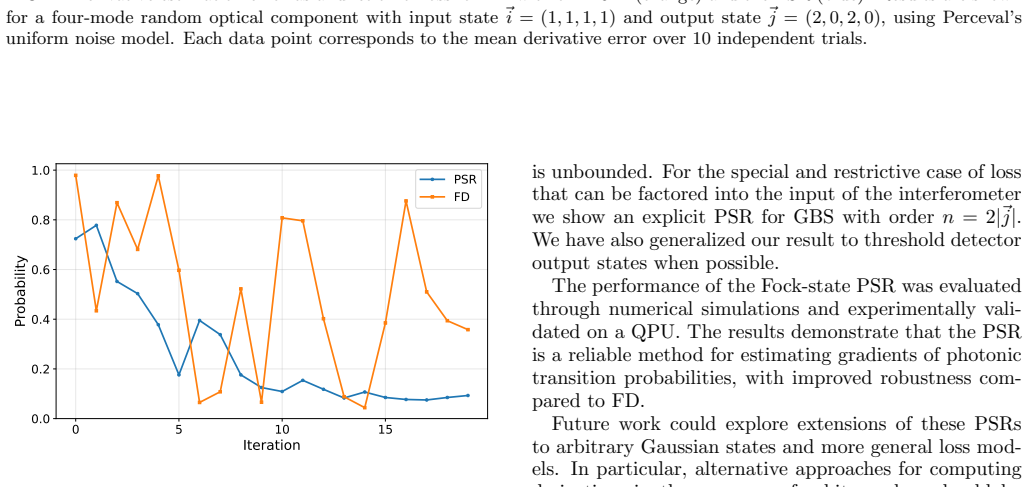
- Variational photonic algorithms can replace finite differences with this shift rule, removing the step-size trade-off and gaining robustness to phase noise, as demonstrated numerically and on Quandela's QPU.
- For Gaussian boson sampling, the result is a no-go: under general loss no exact finite-order rule exists; users must either engineer loss before the interferometer (where a rule of order 2|j| applies) or accept approximate alternative gradient estimators.
- Threshold-detector probabilities inherit the same finite Fourier structure in the Fock case, since they are finite sums of Fock probabilities, so the rule extends to click patterns.
- The order bound n = number of input photons gives a direct cost estimate: gradient evaluation scales linearly with input photon number, not with Hilbert-space dimension.
Where Pith is reading between the lines
- A testable extension suggested by the argument: the same finite-Fourier logic should apply to any photonic observable that is a degree-n polynomial in single-harmonic matrix entries, such as photon-number moments, multi-mode correlation functions, or averages of observables under Fock inputs.
- The GBS no-go points to a practical truncation strategy: an approximate finite-order rule could be built by truncating the infinite Fock support of squeezed states, with an error that decays as the tail of the squeezed-state distribution; the paper does not explore this.
- Because exactness rests on amplitude–phase decoupling, a hardware-level characterization of T(θ) along the lines of coherent-state tomography would provide a direct engineering criterion for when the method is applicable; the paper itself offers only an order-of-magnitude argument.
- The permanent formula is derived without the Choi–Jamiołkowski trick, so the same derivation route might generalize to partial distinguishability or mixed input states, though the paper does not address those cases.
Editorial analysis
A structured set of objections, weighed in public.
Referee Report
Summary. The paper derives parameter-shift rules (PSRs) for gradient estimation in photonic boson sampling circuits with loss. For Fock-state inputs, it claims that each transition probability is a finite Fourier series in any tunable phase with frequencies bounded by the number of input photons n, so an n-th order PSR gives the exact derivative even under arbitrary loss. For Gaussian boson sampling (GBS), it claims that no finite-order PSR exists under general loss; a finite-order rule of order 2|j| exists only when the loss commutes through the interferometer (T = UΔ). The paper also presents numerical simulations and a hardware demonstration on Quandela's Belenos QPU comparing PSR with finite differences.
Significance. If the Fock-state result is correct, it is a useful and nontrivial generalization of PSRs: it removes the need for post-selection or unitary-only models when computing gradients on lossy photonic hardware. The derivation is largely self-contained, and the permanent/hafnian formulas are cross-checked against known results. The GBS no-go result, if made rigorous, would be an important limitation for variational methods with squeezed states. The hardware demonstration is a valuable practical check, although it does not by itself validate the exactness of the Fock PSR under the most general loss model.
major comments (3)
- [Sec. III.B, Eqs. (94)–(97)] The claim that no finite-order PSR exists for GBS under general loss is not rigorously established. The two supporting arguments — that det(Λ'_uu)^(-1/2) is not polynomial in the entries of T, and that Eq. (97) contains an infinite sum over photon numbers — are suggestive but not proofs. A non-polynomial dependence on T does not logically exclude cancellation that leaves a finite Fourier series in θ, and Eq. (97) is only an example (loss after the unitary), not a general impossibility. Since the abstract advertises this as a main result, please either supply a concrete counterexample (e.g., a simple two-mode circuit with generic loss where the probability has infinite Fourier support) or soften the claim to 'the standard PSR construction does not apply in general.'
- [Sec. II.B, Eq. (31)] The exactness of the Fock PSR rests on the assumption Φ_i^(j) = √η_{i,j} e^{iθ_{i,j}}, i.e., that each phase shifter's amplitude transmission is independent of the applied phase and that each θ appears exactly once. If η depends on θ (thermo-optic or electro-optic phase shifters can exhibit loss-phase coupling), then T entries no longer have the form a e^{iθ} + b, and the frequency bound in Eq. (66) can fail. The paper's physical justification is an order-of-magnitude statement about optical path length, not a device-level guarantee. Please either provide phase-shifter characterization data from Belenos/Perceval showing θ-independent transmission over the relevant range, or explicitly scope the headline claim to the model in Eq. (31).
- [Sec. III.A, Eq. (66)] The derivation of the frequency support [-n, n] is only sketched as 'three observations.' For a reader, the bound is not immediate because the permanent in Eq. (61) has size |i|+|j|, not |i|. I recommend explicitly stating the block-counting argument: in B^{i⊕j}, with m=|j|, every permutation must contain exactly m T-factors and m T†-factors and (|i|-m) E-factors; since T-factors and E-factors contribute at most +1 frequency and T†-factors contribute at most 0, the maximum positive frequency is m + (|i|-m) = |i|. This would make the main result easier to verify.
minor comments (5)
- [Eq. (94)] The prefactor is written as '1/⃗j!' but the state is |⃗k⟩; it should be '1/⃗k!'.
- [Fig. 3 and Fig. 4 captions] The vertical-axis labels are garbled ('| Pr( )|'); please fix the mathematical notation in the captions.
- [Sec. II.B] The phrase 'without loss of generality' before the assumption that phase shifters do not affect transmission is too strong; it is an assumption of the model, not a consequence of generality.
- [Sec. II.C after Eq. (38)] The ordering of indices in the linear system is unusual but acceptable; please add a sentence clarifying that the DFT choice μ_m = 2πm/(2n+1) yields an invertible system for all n, not just for the displayed ordering.
- [Sec. IV] The hardware experiment uses a two-mode HOM setup with uniform loss; this is a valid proof-of-principle but does not exercise the 'arbitrary loss' scenario of the main theorem. A sentence acknowledging this limitation would be appropriate.
Circularity Check
No significant circularity: Fock and GBS gradient results are derived in-paper from explicit loss-model assumptions.
full rationale
The central derivation chain is self-contained. Equation (61) is obtained in-paper from the coherent-state generating function and hafnian formalism (Eqs. (46)-(60)), with the paper explicitly noting agreement with Ref. [19] only after deriving it. Equation (66) is a direct algebraic consequence of Eq. (64), which follows from the phase-shifter model Eq. (31) and the decomposition in Fig. 1. The PSR construction (Eqs. (32)-(43)) is re-derived rather than imported; the DFT shift-angle choice is attributed to Ref. [42], but exactness holds for any invertible shift matrix, so this author-overlapping citation is not load-bearing for the exactness claim. The GBS negative result is derived from the explicit expression Eq. (94) and illustrated by the infinite-support argument in Eq. (97), not taken from prior work. No parameters are fitted to data and then reported as predictions; the experimental section compares a deterministic PSR estimator with finite differences on hardware. The only load-bearing premise, Eq. (31)'s assumption of theta-independent transmission, is a stated modeling assumption supported by a physical plausibility argument; whether real thermo-optic or electro-optic phase shifters satisfy it is a correctness/robustness question, not a circularity. Therefore no circular step is present.
Axiom & Free-Parameter Ledger
axioms (7)
- standard math Canonical bosonic formalism: commutation relations, Fock/coherent/squeezed states, unitary mode transformations (Eqs. 1-25)
- domain assumption Loss model: arbitrary lossy interferometer = sub-unitary T embedded in a 2M-mode unitary W; environment in vacuum, traced out (Eqs. 26-29)
- domain assumption Phase-shifter transmission is θ-independent: Φ = √η e^{iθ} (Eq. 31), with each θ entering T exactly once
- domain assumption Universal interferometer decompositions factor into fixed sub-unitary blocks S_i and diagonal phase matrices (Fig. 1; Clements/Bell/DFT decompositions)
- standard math Squeezed states have unbounded Fock support; per-photon Bernoulli loss after the unitary gives binomial mixtures (Eq. 97)
- standard math Generating-function identities: coherent-state overlaps, hafnian/permanent replication (Eqs. 49-62)
- standard math Woodbury matrix identity (Eq. 89)
read the original abstract
Using a robust photon loss model for photonic quantum experiments, we derive $n-$th order parameter-shift rules for computing gradients of Fock boson sampling transition probabilities where $n$ photons are sent into a lossy interferometer. We also show that in general it is not possible to generalize this gradient recipe to the case of Gaussian boson sampling. Only in the specific case where the transmission matrix of the interferometer can be factorized as a diagonal loss matrix premultiplied by a pure unitary it is possible to obtain parameter-shift rules with a finite order given by twice the total number of photons detected. We demonstrate the efficacy of the proposed method by comparing its performance against finite differences on real hardware.
Figures


Forward citations
Cited by 1 Pith paper
-
The trainability of photonic quantum circuits
Fixed-order photon-number polynomial observables make passive linear-optical variational circuits trainable with polynomially many samples, while output-probability and high-order observables are exponentially hard to train.
Reference graph
Works this paper leans on
-
[1]
Why i am optimistic about the silicon- photonic route to quantum computing,
T. Rudolph, “Why i am optimistic about the silicon- photonic route to quantum computing,”APL Photonics, vol. 2, no. 3, p. 030901, Mar. 2017. [Online]. Available: https://doi.org/10.1063/1.4976737
-
[2]
Scalability of large-scale photonic integrated circuits,
Y. Su, Y. He, X. Guo, W. Xie, X. Ji, H. Wang, X. Cai, L. Tong, and S. Yu, “Scalability of large-scale photonic integrated circuits,”ACS Photonics, vol. 10, no. 6, pp. 2020–2030, 2023
2020
-
[3]
The potential and global outlook of integrated photonics for quantum technologies,
E. Pelucchi, G. Fagas, I. Aharonovich, D. Englund, E. Figueroa, Q. Gong, H. H¨ ubel, J. Liu, C.-Y. Lu, N. Matsuda, J.-W. Pan, F. Schreck, F. Sciarrino, C. Silberhorn, J. Wang, and K. D. J¨ ons, “The potential and global outlook of integrated photonics for quantum technologies,”Nature Reviews Physics, vol. 4, pp. 194–208, 2022. [Online]. Available: https: ...
-
[4]
Integrated photonic neural network with on-chip backpropagation training,
F. Ashtiani, M. H. Idjadi, and K. Kim, “Integrated photonic neural network with on-chip backpropagation training,”Nature, 2026, published online: 18 March
2026
-
[5]
A manufacturable platform for pho- tonic quantum computing,
PsiQuantum Team, “A manufacturable platform for pho- tonic quantum computing,”Nature, vol. 641, pp. 876– 883, 2025, published online 26 February 2025
2025
-
[6]
Scal- ing and networking a modular photonic quantum com- puter,
H. Aghaee Rad, T. Ainsworth, R. N. Alexander, B. Al- tieri, M. F. Askarani, R. Baby, L. Banchi, B. Q. Bara- giola, J. E. Bourassa, R. S. Chadwick, I. Charania, H. Chen, M. J. Collins, P. Contu, N. D’Arcy, G. Dauphi- nais, R. De Prins, D. Deschenes, I. Di Luch, S. Duque, P. Edke, S. E. Fayer, S. Ferracin, H. Ferrettiet al., “Scal- ing and networking a modu...
2025
-
[7]
A versatile single-photon-based quantum computing platform,
N. Maring, A. Fyrillas, M. Pont, E. Ivanov, P. Stepanov, N. Margaria, W. Hease, A. Pishchagin, A. Lema ˆ ıtre, I. Sagnes, T. H. Au, S. Boissier, E. Bertasi, A. Baert, M. Valdivia, M. Billard, O. Acar, A. Brieussel, R. Mezher, S. C. Wein, A. Salavrakos, P. Sinnott, D. A. Fioretto, P.-E. Emeriau, N. Belabas, S. Mansfield, P. Senellart, J. Senellart, and N. ...
2024
-
[8]
Quantum circuits with many photons on a programmable nanophotonic chip,
J. M. Arrazola, V. Bergholm, K. Br¨ adler, T. R. Bromley, M. J. Collins, I. Dhand, A. Fumagalli, T. Gerrits, A. Goussev, L. G. Helt, J. Hundal, T. Isacsson, R. B. Israel, J. Izaac, S. Jahangiri, R. Janik, N. Killoran, S. P. Kumar, J. Lavoie, A. E. Lita, D. H. Mahler, M. Menotti, B. Morrison, S. W. Nam, H. Y. Neuhaus, H. Y. Qi, N. Quesada, A. Repingon, K. ...
2021
-
[9]
Integrated photonic quantum technologies,
J. Wang, F. Sciarrino, A. Laing, and M. G. Thompson, “Integrated photonic quantum technologies,”Nature Photonics, vol. 14, pp. 273–284, 2020. [Online]. Available: https://doi.org/10.1038/s41566-019-0535-7
-
[10]
Recent progress towards large-scale integrated photonic quantum computation,
H. Zhu, T. Chen, H. Ma, Z. Zhao, J. Guo, Q. Liang, Y. Tu, T. He, W. Luo, B. Wang, Q. Song, C. Jin, F. Liu, Y. Yang, Y. Wang, K. C. Leong, D. Wang, and J. Yang, “Recent progress towards large-scale integrated photonic quantum computation,”npj Nanophotonics, vol. 3, no. 1, pp. 1–22, 2026. [Online]. Available: https://doi.org/10.1038/s44310-026-00114-8
-
[11]
Advances in photonic quantum sensing,
S. Pirandola, B. Bardhan, T. Gehring, C. Weedbrook, and S. Lloyd, “Advances in photonic quantum sensing,” Nature Photonics, vol. 12, no. 12, pp. 724–733, 2018
2018
-
[12]
Secure quantum key distribution,
H.-K. Lo, M. Curty, and K. Tamaki, “Secure quantum key distribution,”Nature Photonics, vol. 8, no. 8, pp. 595–604, 2014
2014
-
[13]
Optimal design for universal multiport interferometers,
W. R. Clements, P. C. Humphreys, B. J. Metcalf, W. S. Kolthammer, and I. A. Walmsley, “Optimal design for universal multiport interferometers,”Optica, vol. 3, no. 12, pp. 1460–1465, 2016. [Online]. Available: https://doi.org/10.1364/OPTICA.3.001460
-
[14]
Etching properties of pin-pmn-pt and its integration in electro-optic phase modulators,
S. Poveda-Hospital, N. Quesada, and Y.-A. Peter, “Etching properties of pin-pmn-pt and its integration in electro-optic phase modulators,”Optical Materials Express, vol. 15, no. 3, pp. 522–530, 2025. [Online]. Available: https://doi.org/10.1364/OME.542571
-
[15]
Foundations of photonic quantum compu- tation,
M. Bombardelli, G. Fleury, P. Lacomme, and B. Vulpescu, “Foundations of photonic quantum compu- tation,”arXiv preprint arXiv:2509.04266, 2025. [Online]. Available: https://doi.org/10.48550/arXiv.2509.04266
-
[16]
Programmable photonic integrated meshes for modular generation of optical entanglement links,
M. Dong, K. J. Palm, M. Zimmermann, A. Witte, D. Heim, H. Choi, D. Dominguez, G. Gilbert, G. Clark, A. J. Leenheer, M. Eichenfield, and D. Englund, “Programmable photonic integrated meshes for modular generation of optical entanglement links,”npj Quantum Information, vol. 9, no. 42, 2023. [Online]. Available: https://doi.org/10.1038/s41534-023-00708-6
-
[17]
Wideband two-port beam splitter of a binary fused- silica phase grating,
B. Wang, C. Zhou, J. Feng, H. Ru, and J. Zheng, “Wideband two-port beam splitter of a binary fused- silica phase grating,”Appl. Optics, vol. 47, no. 22, pp. 4004–4008, 2008. [Online]. Available: https: //doi.org/10.1364/AO.47.004004
-
[18]
G. T. Reed, G. Mashanovich, F. Y. Gardes, and D. J. Thomson, “Silicon optical modulators,”Nature Photonics, vol. 4, pp. 518–526, 2010. [Online]. Available: https://doi.org/10.1038/nphoton.2010.179
-
[19]
Riemannian optimization of photonic quantum circuits in phase and fock space,
Y. Yao, F. Miatto, and N. Quesada, “Riemannian optimization of photonic quantum circuits in phase and fock space,”SciPost Physics, vol. 17, no. 3, p. 082, 2024. [Online]. Available: https://doi.org/10. 21468/SciPostPhys.17.3.082
2024
-
[20]
Threshold detection statistics of bosonic states,
J. F. F. Bulmer, S. Paesani, R. S. Chadwick, and N. Que- sada, “Threshold detection statistics of bosonic states,” Phys. Rev. A, vol. 106, no. 4, p. 043712, 2022
2022
-
[21]
Simulating lossy and partially distinguish- able quantum optical circuits: Theory, algorithms, and applications to experiment validation and state prepara- tion,
J. F. Bulmer, J. Mart ´ ınez-Cifuentes, B. A. Bell, and N. Quesada, “Simulating lossy and partially distinguish- able quantum optical circuits: Theory, algorithms, and applications to experiment validation and state prepara- tion,”Advanced Photonics, vol. 8, no. 1, p. 016010, 2026
2026
-
[22]
Quan- tum sampling problems, bosonsampling and quantum supremacy,
A. P. Lund, M. J. Bremner, and T. C. Ralph, “Quan- tum sampling problems, bosonsampling and quantum supremacy,”npj Quantum Information, vol. 3, p. 15, 2017
2017
-
[23]
Toward scalable 13 boson sampling with photon loss,
H. Wang, W. Li, X. Jiang, Y.-M. He, Y.-H. Li, X. Ding, M.-C. Chen, J. Qin, C.-Z. Peng, C. Schneider, M. Kamp, W.-J. Zhang, H. Li, L.-X. You, Z. Wang, J. P. Dowling, S. H¨ ofling, C.-Y. Lu, and J.-W. Pan, “Toward scalable 13 boson sampling with photon loss,”Physical Review Let- ters, vol. 120, no. 23, p. 230502, 2018
2018
-
[24]
Variational quantum algo- rithms,
M. Cerezo, A. Arrasmith, R. Babbush, S. C. Benjamin, S. Endo, K. Fujii, J. R. McClean, K. Mitarai, X. Yuan, L. Cincio, and P. J. Coles, “Variational quantum algo- rithms,”Nature Reviews Physics, vol. 3, no. 9, pp. 625– 644, 2021
2021
-
[25]
Varia- tional quantum algorithms: Fundamental concepts, ap- plications and challenges,
H. Qi, S. Xiao, Z. Liu, C. Gong, and A. Gani, “Varia- tional quantum algorithms: Fundamental concepts, ap- plications and challenges,”Quantum Information Pro- cessing, vol. 23, no. 7, p. 250, 2024
2024
-
[26]
A variational eigenvalue solver on a photonic quantum pro- cessor,
A. Peruzzo, J. McClean, P. Shadbolt, M.-H. Yung, X.-Q. Zhou, P. J. Love, A. Aspuru-Guzik, and J. L. O’Brien, “A variational eigenvalue solver on a photonic quantum pro- cessor,”Nature Communications, vol. 5, p. 4213, 2014
2014
-
[27]
The variational quantum eigensolver: A review of methods and best practices,
J. Tilly, H. Chen, S. Cao, D. Picozzi, K. Setia, Y. Li, E. Grant, L. Wossnig, I. Rungger, G. H. Booth, and J. Tennyson, “The variational quantum eigensolver: A review of methods and best practices,”Physics Reports, vol. 986, pp. 1–128, 2022
2022
-
[28]
A quantum approximate optimization algorithm,
E. Farhi, J. Goldstone, and S. Gutmann, “A quantum approximate optimization algorithm,”arXiv preprint arXiv:1411.4028, 2014
Pith/arXiv arXiv 2014
-
[29]
A review on quantum approximate optimization algorithm and its variants,
K. Blekos, D. Brand, A. Ceschini, C.-H. Chou, R.-H. Li, K. Pandya, and A. Summer, “A review on quantum approximate optimization algorithm and its variants,” Physics Reports, vol. 1068, pp. 1–66, 2024
2024
-
[30]
Circuit-centric quantum classifiers,
M. Schuld, A. Bocharov, K. M. Svore, and N. Wiebe, “Circuit-centric quantum classifiers,”Phys. Rev. A, vol. 101, no. 3, p. 032308, 2020
2020
-
[31]
Supervised learning with quantum-enhanced fea- ture spaces,
V. Havl ´ ıˇ cek, A. D. C´ orcoles, K. Temme, A. W. Har- row, A. W. Kandala, J. M. Chow, and J. M. Gam- betta, “Supervised learning with quantum-enhanced fea- ture spaces,”Nature, vol. 567, pp. 209–212, 2019
2019
-
[32]
Continuous-variable quan- tum neural networks,
N. Killoran, T. R. Bromley, J. M. Arrazola, M. Schuld, N. Quesada, and S. Lloyd, “Continuous-variable quan- tum neural networks,”Phys. Rev. Research, vol. 1, no. 3, p. 033063, 2019
2019
-
[33]
The quest for a quantum neural network,
M. Schuld, I. Sinayskiy, and F. Petruccione, “The quest for a quantum neural network,”Quantum Information Processing, vol. 13, pp. 2567–2586, 2014
2014
-
[34]
Machine learning with quantum computers,
M. Schuld and F. Petruccione, “Machine learning with quantum computers,”Springer Nature, 2021
2021
-
[35]
Quantum neural network for quantum neu- ral computing,
M.-G. Zhou, Z.-P. Liu, H.-L. Yin, C.-L. Li, T.-K. Xu, and Z.-B. Chen, “Quantum neural network for quantum neu- ral computing,”Research, vol. 6, p. Article 0134, 2023
2023
-
[36]
Recent developments and applications in quantum neural network: A re- view,
S. K. Jeswal and S. Chakraverty, “Recent developments and applications in quantum neural network: A re- view,”Archives of Computational Methods in Engineer- ing, vol. 26, pp. 793–807, 2019
2019
-
[37]
M. V. Altaisky, “Quantum neural network,”arXiv preprint arXiv:quant-ph/0107012, 2001
Pith/arXiv arXiv 2001
-
[38]
Efficient variational quan- tum simulator incorporating active error minimization,
Y. Li and S. C. Benjamin, “Efficient variational quan- tum simulator incorporating active error minimization,” Phys. Rev. X, vol. 7, no. 2, p. 021050, 2017
2017
-
[39]
Theory of variational quantum simulation,
X. Yuan, S. Endo, Q. Zhao, Y. Li, and S. C. Benjamin, “Theory of variational quantum simulation,”Quantum, vol. 3, p. 191, 2019
2019
-
[40]
Optimized numerical gradient and hessian estimation for variational quantum algorithms,
Y. S. Teo, “Optimized numerical gradient and hessian estimation for variational quantum algorithms,”Phys. Rev. A, vol. 107, no. 4, p. 042421, 2023
2023
-
[41]
Qugstep: Refining step size selection in gradient estimation for variational quantum algorithms,
S. Liang, L. Zhu, X. Li, and C. Yang, “Qugstep: Refining step size selection in gradient estimation for variational quantum algorithms,”arXiv preprint arXiv:2503.14366, 2025
Pith/arXiv arXiv 2025
-
[42]
Pho- tonic parameter-shift rule: Enabling gradient computa- tion for photonic quantum computers,
A. Pappalardo, P.-E. Emeriau, G. de Felice, B. Ventura, H. Jaunin, R. Yeung, B. Coecke, and S. Mansfield, “Pho- tonic parameter-shift rule: Enabling gradient computa- tion for photonic quantum computers,”Phys. Rev. A, vol. 111, no. 3, p. 032429, 2025
2025
-
[43]
Exact gradients for linear optics with single photons,
G. Facelli, D. D. Roberts, H. Wallner, A. Makarovskiy, Z. Holmes, and W. R. Clements, “Exact gradients for linear optics with single photons,”arXiv preprint arXiv:2409.16369, 2024. [Online]. Available: https: //arxiv.org/abs/2409.16369
Pith/arXiv arXiv 2024
-
[44]
General parameter-shift rules for quantum gradients,
D. Wierichs, J. Izaac, C. Wang, and C. Y.-Y. Lin, “General parameter-shift rules for quantum gradients,” Quantum, vol. 6, p. 677, 2022. [Online]. Available: https://doi.org/10.22331/q-2022-03-30-677
-
[45]
S. M. Barnett and P. M. Radmore,Methods in Theoreti- cal Quantum Optics. Oxford: Oxford University Press, 2002
2002
-
[46]
Ma- trix decompositions in quantum optics: Takagi/autonne, bloch–messiah/euler, iwasawa, and williamson,
M. Houde, W. McCutcheon, and N. Quesada, “Ma- trix decompositions in quantum optics: Takagi/autonne, bloch–messiah/euler, iwasawa, and williamson,”Cana- dian Journal of Physics, vol. 102, no. 10, pp. 497–507, 2024
2024
-
[47]
Further compactifying linear optical unitaries,
B. A. Bell and I. A. Walmsley, “Further compactifying linear optical unitaries,”APL Photonics, vol. 6, no. 7, 2021
2021
-
[48]
Arbi- trary optical wave evolution with fourier transforms and phase masks,
V. L´ opez-Pastor, J. Lundeen, and F. Marquardt, “Arbi- trary optical wave evolution with fourier transforms and phase masks,”Optics Express, vol. 29, pp. 38 441–38 450, 2021
2021
-
[49]
Near-optimal decomposi- tion of unitary matrices using phase masks and the dis- crete fourier transform,
V. Girouard and N. Quesada, “Near-optimal decomposi- tion of unitary matrices using phase masks and the dis- crete fourier transform,”Journal of the Optical Society of America B, vol. 43, no. 3, pp. A66–A73, 2026
2026
-
[50]
Single-photon detectors for optical quantum information applications,
R. H. Hadfield, “Single-photon detectors for optical quantum information applications,”Nature Photonics, vol. 3, no. 12, pp. 696–705, 2009. [Online]. Available: https://doi.org/10.1038/nphoton.2009.230
-
[51]
Invited review article: Single-photon sources and detectors,
M. D. Eisaman, J. Fan, A. Migdall, and S. V. Polyakov, “Invited review article: Single-photon sources and detectors,”Review of Scientific Instruments, vol. 82, no. 7, p. 071101, 2011. [Online]. Available: https://doi.org/10.1063/1.3610677
-
[52]
Accurate un- supervised photon counting from transition-edge-sensor signals,
N. Dalbec-Constant, G. Thekkadath, D. England, B. Sussman, T. Gerrits, and N. Quesada, “Accurate un- supervised photon counting from transition-edge-sensor signals,”Phys. Rev. Appl., vol. 24, no. 3, p. 034018, 2025
2025
-
[53]
Training gaussian boson sampling distributions,
L. Banchi, N. Quesada, and J. M. Arrazola, “Training gaussian boson sampling distributions,”Phys. Rev. A, vol. 102, no. 1, p. 012417, 2020
2020
-
[54]
Inverting modified matrices,
M. A. Woodbury, “Inverting modified matrices,” Statis- tical Research Group, Princeton University, Princeton, NJ, Memorandum Report 42, 1950
1950
-
[55]
Gaussian boson sampling using threshold detectors,
N. Quesada, J. M. Arrazola, and N. Killoran, “Gaussian boson sampling using threshold detectors,”Phys. Rev. A, vol. 98, no. 6, p. 062322, 2018
2018
-
[56]
Photon-number moments and cumulants of gaussian states,
Y. Cardin and N. Quesada, “Photon-number moments and cumulants of gaussian states,”Quantum, vol. 8, p. 1521, 2024
2024
-
[57]
Strong simulation of linear optical processes,
N. Heurtel, S. Mansfield, J. Senellart, and B. Valiron, “Strong simulation of linear optical processes,”Computer Physics Communications, vol. 291, p. 108848, 2023
2023
-
[58]
Asymptotically fault-tolerant programmable photon- 14 ics,
R. Hamerly, S. Bandyopadhyay, and D. Englund, “Asymptotically fault-tolerant programmable photon- 14 ics,”Nature Communications, vol. 13, 2022. [Online]. Available: https://doi.org/10.1038/s41467-022-34308-3
-
[59]
Fast Prediction of Phase shifters Phase Error Distributions Using Gaussian Processes
Z. Zhang, “Fast prediction of phase shifters phase error distributions using gaussian processes,”arXiv preprint arXiv:2504.05685, 2025. [Online]. Available: https://doi.org/10.48550/arXiv.2504.05685
work page internal anchor Pith review Pith/arXiv arXiv doi:10.48550/arxiv.2504.05685 2025
-
[60]
Perceval: A Software Platform for Discrete Variable Photonic Quantum Computing,
N. Heurtel, A. Fyrillas, G. d. Gliniasty, R. Le Bihan, S. Malherbe, M. Pailhas, E. Bertasi, B. Bourdoncle, P.-E. Emeriau, R. Mezher, L. Music, N. Belabas, B. Valiron, P. Senellart, S. Mansfield, and J. Senellart, “Perceval: A Software Platform for Discrete Variable Photonic Quantum Computing,”Quantum, vol. 7, p. 931, 2023. [Online]. Available: https://doi...
2023
-
[61]
Measurement of subpicosecond time intervals between two photons by interference,
C. K. Hong, Z. Y. Ou, and L. Mandel, “Measurement of subpicosecond time intervals between two photons by interference,”Phys. Rev. Lett., vol. 59, no. 18, pp. 2044– 2046, 1987
2044
-
[62]
Exponentially- improved effective descriptions of physical bosonic sys- tems,
V. Upreti, N. Quesada, and U. Chabaud, “Exponentially- improved effective descriptions of physical bosonic sys- tems,”arXiv preprint arXiv:2604.18720, 2026
Pith/arXiv arXiv 2026
-
[2026]
Available: https://doi.org/10.1038/ s41586-026-10262-8
[Online]. Available: https://doi.org/10.1038/ s41586-026-10262-8
discussion (0)
Sign in with ORCID, Apple, or X to comment. Anyone can read and Pith papers without signing in.